A Practical Marine Wireless Sensor Network Monitoring System Based on LoRa and MQTT
Pith reviewed 2026-05-25 17:49 UTC · model grok-4.3
The pith
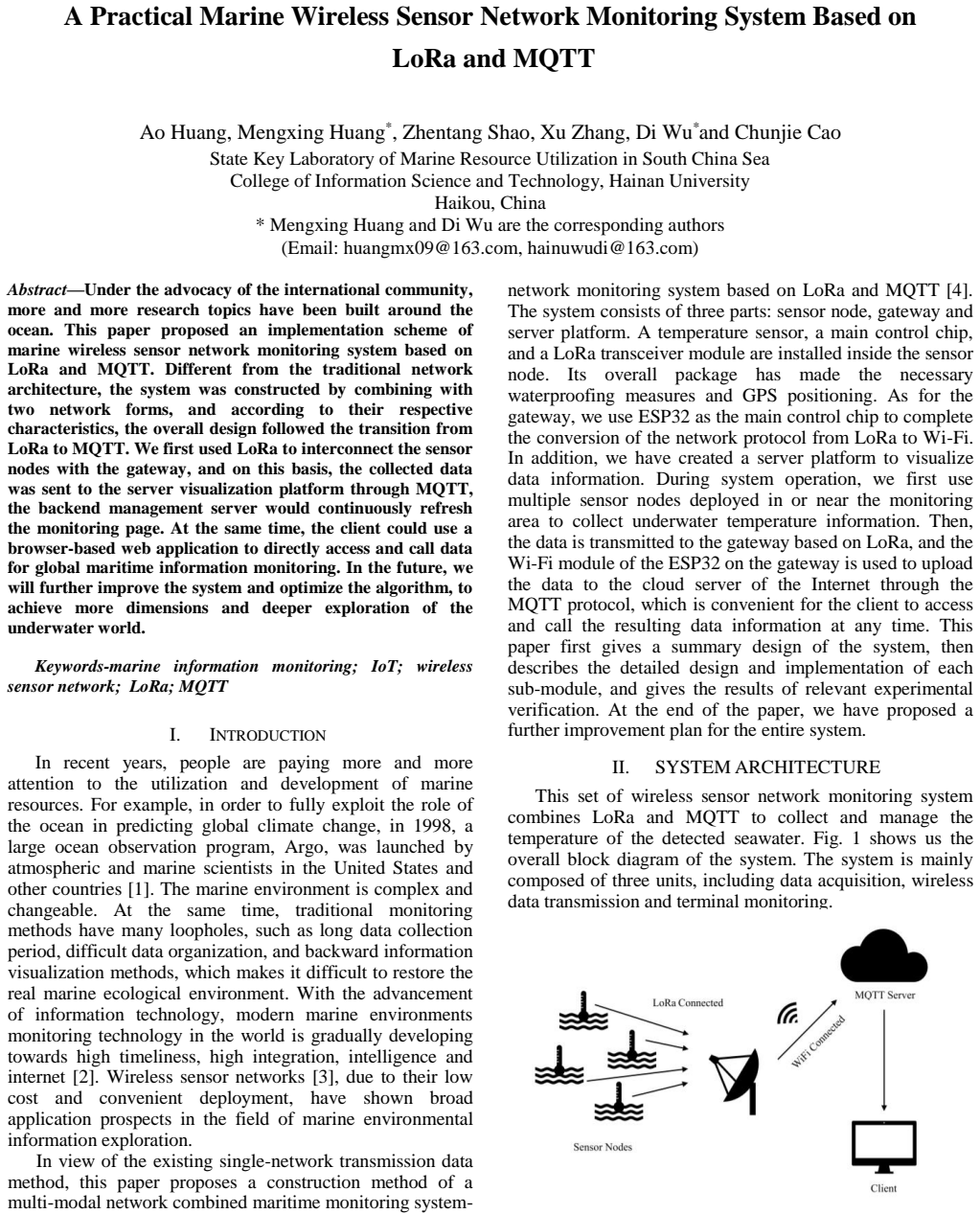
A hybrid system uses LoRa to link marine sensors to a gateway then MQTT to forward data to a web visualization server.
A machine-rendered reading of the paper's core claim, the machinery that carries it, and where it could break.
Core claim
The paper claims that a practical marine wireless sensor network monitoring system can be constructed by combining LoRa for sensor node to gateway interconnection with MQTT for sending the data to the server visualization platform, where the backend continuously refreshes the monitoring page and clients use a browser-based web application to directly access and call data for global maritime information monitoring.
What carries the argument
The LoRa-to-MQTT transition architecture that routes sensor data from long-range wireless links into lightweight messaging for server-side visualization and web access.
If this is right
- The backend server continuously refreshes the monitoring page with incoming data.
- Clients can access and call the data directly through a browser-based web application.
- The overall design supports global maritime information monitoring.
- Future improvements and algorithm optimizations can enable more dimensions and deeper exploration of the underwater world.
Where Pith is reading between the lines
- The same two-stage routing might apply to other remote environments where direct internet connectivity at the sensor is impractical.
- Adding explicit error handling or redundancy at the gateway could address marine-specific interference not discussed in the design.
- Integration with additional sensor types could expand the system beyond the initial monitoring scope described.
Load-bearing premise
That LoRa links from sensor nodes to the gateway plus MQTT forwarding to the server will function adequately in a marine environment.
What would settle it
Measurements from an actual marine deployment showing packet delivery rates, power consumption, or uptime under sea conditions would confirm or refute whether the hybrid links operate reliably.
Figures
read the original abstract
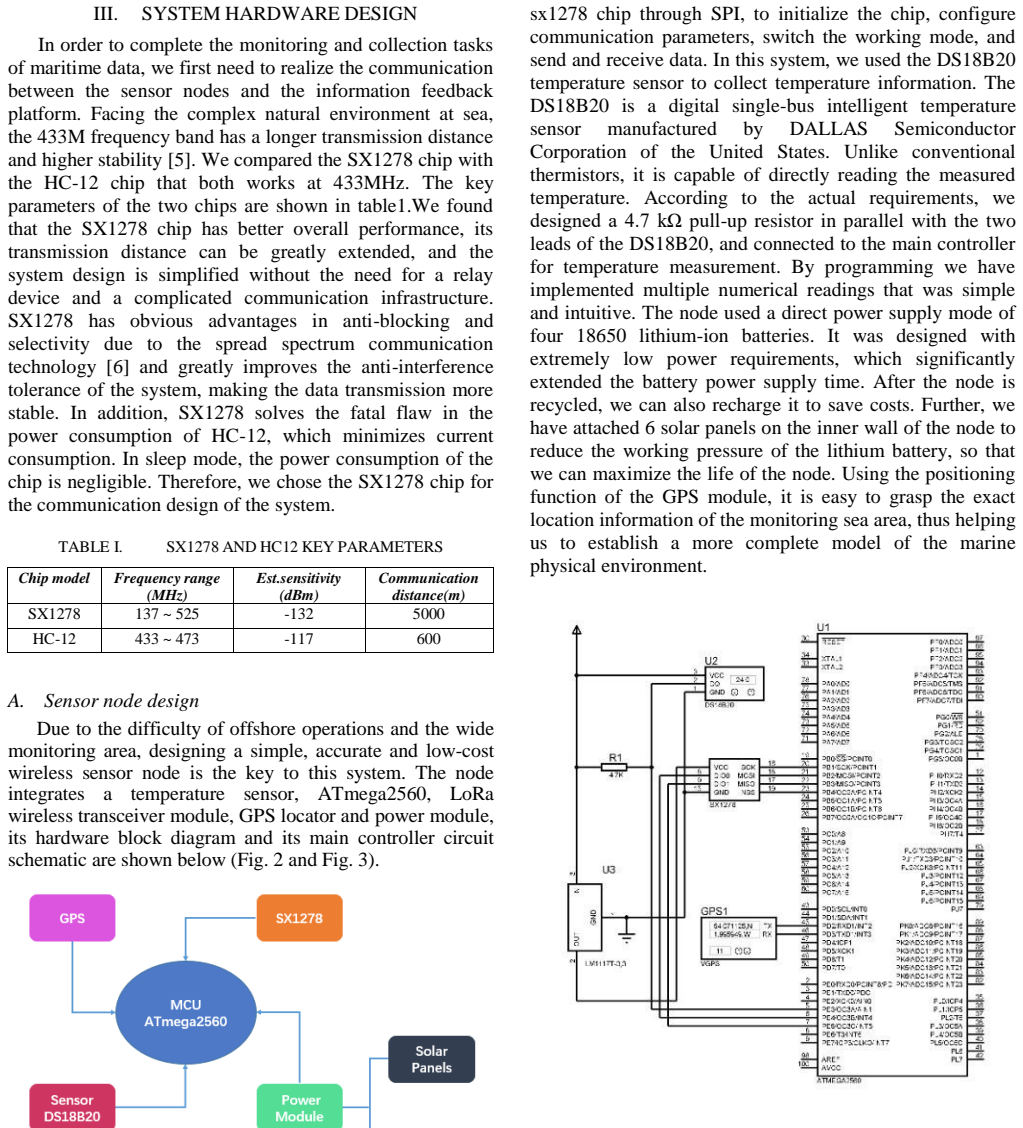
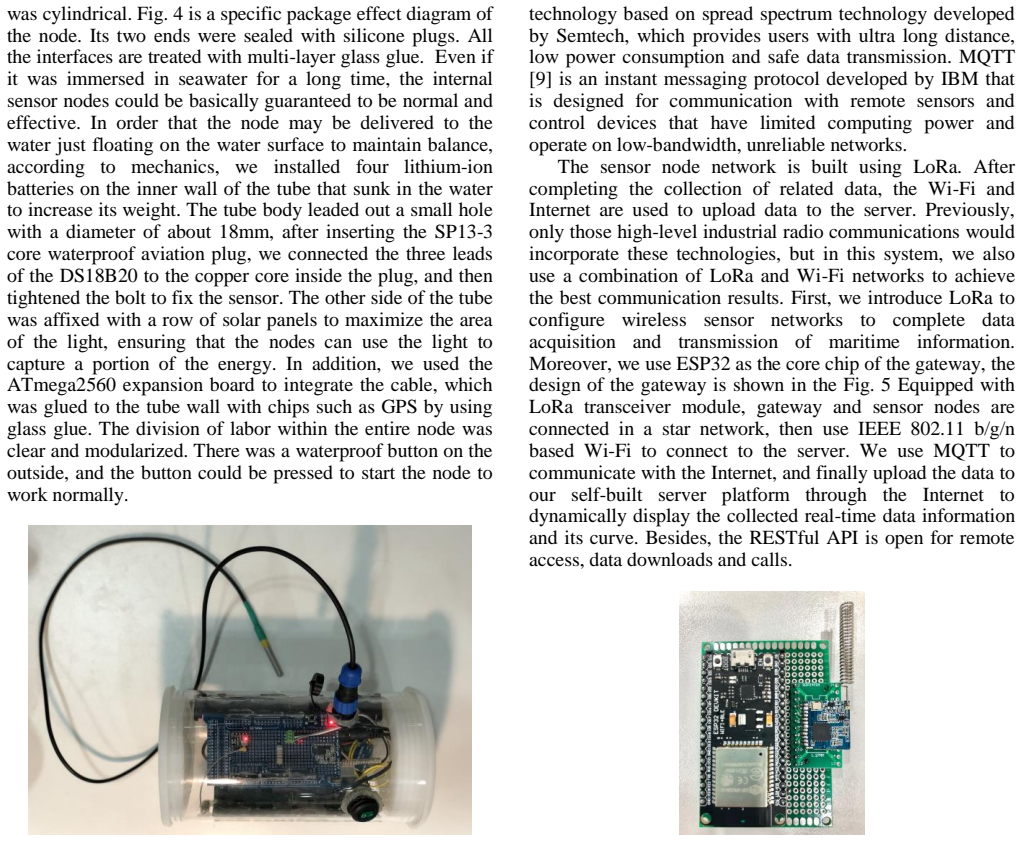
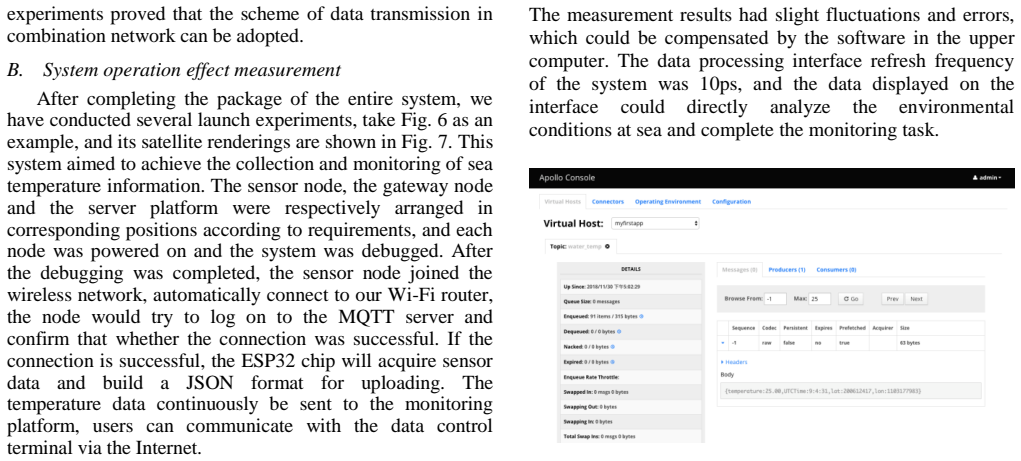
Under the advocacy of the international community, more and more research topics have been built around the ocean. This paper proposed an implementation scheme of marine wireless sensor network monitoring system based on LoRa and MQTT. Different from the traditional network architecture, the system was constructed by combining with two network forms, and according to their respective characteristics, the overall design followed the transition from LoRa to MQTT. We first used LoRa to interconnect the sensor nodes with the gateway, and on this basis, the collected data was sent to the server visualization platform through MQTT, the backend management server would continuously refresh the monitoring page. At the same time, the client could use a browser-based web application to directly access and call data for global maritime information monitoring. In the future, we will further improve the system and optimize the algorithm, to achieve more dimensions and deeper exploration of the underwater world.
Editorial analysis
A structured set of objections, weighed in public.
Referee Report
Summary. The paper describes an architecture for a marine wireless sensor network (WSN) monitoring system that interconnects sensor nodes to a gateway via LoRa and forwards collected data to a visualization server via MQTT, enabling browser-based global access; the design is presented as following the transition from LoRa to MQTT based on their respective characteristics, with future improvements noted.
Significance. If the described LoRa-to-MQTT bridging were shown to operate reliably in marine conditions, the approach could provide a low-cost, long-range monitoring platform for ocean data collection. However, the manuscript supplies only a high-level block-diagram description with no supporting measurements, so its potential contribution to the field cannot be assessed from the current text.
major comments (1)
- [Abstract] Abstract: the title asserts a 'Practical' system and the abstract states that 'the system was constructed' and data 'was sent', yet the text contains no range measurements, packet-error rates, power budgets, antenna specifications, or any marine-environment test results to substantiate link viability or end-to-end reliability.
minor comments (1)
- [Abstract] Abstract: tense inconsistency ('This paper proposed') should be revised to present tense ('This paper proposes') for standard technical writing.
Simulated Author's Rebuttal
We thank the referee for the constructive feedback. The primary concern about the lack of quantitative validation is addressed in the response below. We will revise the manuscript accordingly to better align claims with the presented content.
read point-by-point responses
-
Referee: [Abstract] Abstract: the title asserts a 'Practical' system and the abstract states that 'the system was constructed' and data 'was sent', yet the text contains no range measurements, packet-error rates, power budgets, antenna specifications, or any marine-environment test results to substantiate link viability or end-to-end reliability.
Authors: We agree that the manuscript provides only a high-level architectural description of the LoRa-to-MQTT integration and does not contain empirical measurements or marine test results. The work is framed as an implementation scheme rather than a fully evaluated deployment. In the revised version we will update the abstract to state that the system design combines LoRa for sensor-to-gateway links with MQTT for server access, without claiming completed marine construction or data transmission. We will add a specifications section listing component parameters (LoRa frequency, spreading factor, MQTT broker configuration) and a discussion of expected performance drawn from device datasheets and related literature. The title will be revised to 'Design of a Marine Wireless Sensor Network Monitoring System Based on LoRa and MQTT' to remove any implication of completed field validation. These changes will be made in the next version. revision: yes
Circularity Check
No circularity: high-level system description with no derivations or fitted results
full rationale
The paper is a descriptive account of a LoRa-to-MQTT architecture for marine sensor networks. The abstract and provided text contain only block-level design statements ('the system was constructed by combining with two network forms', 'overall design followed the transition from LoRa to MQTT') with no equations, parameters, predictions, uniqueness theorems, or self-citations. No load-bearing step reduces by construction to its own inputs; the text supplies no mathematical derivation chain at all.
Axiom & Free-Parameter Ledger
Reference graph
Works this paper leans on
-
[1]
Quality control of oceanographic in situ data from Argo floats using climatological convex hulls,
T.V.S.Udaya Bhaskara, R.Venkat Shesua, Timothy P.Boyerb, E.Pattabhi Rama Raoa, “Quality control of oceanographic in situ data from Argo floats using climatological convex hulls,” Met hodsX, vol. 4, pp.469–479, 2017
work page 2017
-
[2]
Zong Liang, Du Wencai, Bai, Yong, “An enhanced transmission control protocol scheme on the marine ecological environment sensor monitoring,” Sensor Letters, vol.13, pp.152-155, February 1, 2015
work page 2015
-
[3]
Wireless sensor networks: A survey on monitoring water quality,
Mompoloki Pule, Abid Yahya, Joseph Chuma, “Wireless sensor networks: A survey on monitoring water quality,” Journal of Applied Research and Technology, vol.15, Iss.6, pp.562-570, December, 2017
work page 2017
-
[4]
Network performance of a wireless sensor network for temperature monitoring in vineyards,
Liscano Ramiro, Jacoub John Khalil, Dersingh Anand, Zheng Jinfu, Helmer Martin, Elliott, Charles , Najafizadeh, Ali, “Network performance of a wireless sensor network for temperature monitoring in vineyards,” PE -WASUN'11 - Proceedings of the 8th ACM Symposium on Performance Evaluation of Wireless Ad Hoc, Sensor, and Ubiquitous Networks, pp.125-129, 2011
work page 2011
-
[5]
A study on the system of radio frequency identification and localization works in UHF,
Pan Yong, Liu Kaihua, Gao Yi, Zhao Rui, “A study on the system of radio frequency identification and localization works in UHF,” Advanced Materials Research, vol.588-589, pp.932-935, 2012
work page 2012
-
[6]
Research on Ship Wireless Communication Technology Based on LoRa,
Gui Fan, Yin, Yang, Lu, Aijie, “Research on Ship Wireless Communication Technology Based on LoRa,” Pr oceedings of 2018 2nd IEEE Advanced Information Management, Communicates, Electronic and Automation Control Conference, IMCEC 2018, pp.976-979, September 20, 2018
work page 2018
-
[7]
Sensor network algorithms and applications,
Trigoni Niki, Krishnamachari Bhaskar, “Sensor network algorithms and applications,” Philosophical Transactions of the Royal Society A: Mathematical, Physical and Engineering Sciences, vol.370, pp.5 -10, January 13, 2012
work page 2012
-
[8]
Experimental study of LoRa transmission over seawater,
Jovalekic Nikola, Drndarevic Vujo, Pietrosemoli Ermanno, Darby Iain, Zennaro Marco, “Experimental study of LoRa transmission over seawater,” Sensors (Switzerland), vol.18, September, 2018
work page 2018
-
[9]
Internet of Things: Survey and open issues of MQTT protocol,
Yassein Muneer Bani, Shatnawi Mohammed Q, Aljwarneh Shadi, Al-Hatmi Razan, “Internet of Things: Survey and open issues of MQTT protocol,” Proceedings - 2017 International Conference on Engineering and MIS, ICEMIS 2017, vol.2018 -January, pp.1 -6, January 29, 2018
work page 2017
- [10]
-
[11]
Liu, B, Cheng, J, Cai, K, Shi, P, &Tang, X. . (2017). Singular Point Probability Improve LSTM Network Performance for Long -term Traffic Flow Prediction. National Conference of Theoretical Computer Science, 328-340
work page 2017
discussion (0)
Sign in with ORCID, Apple, or X to comment. Anyone can read and Pith papers without signing in.