Spin effects in the particle current of Bose-Einstein condensates in synthetic gauge fields
Pith reviewed 2026-06-27 01:43 UTC · model grok-4.3
The pith
The spin term in the particle current of pseudospin-1/2 BECs in synthetic gauge fields is essential for matching classical drift velocity in the non-interacting ground state.
A machine-rendered reading of the paper's core claim, the machinery that carries it, and where it could break.
Core claim
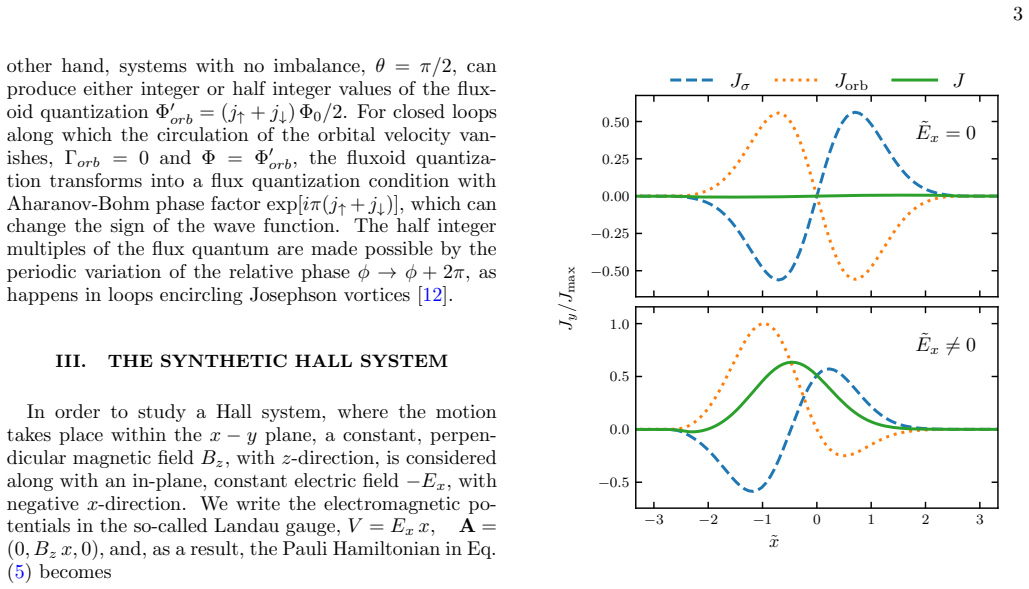
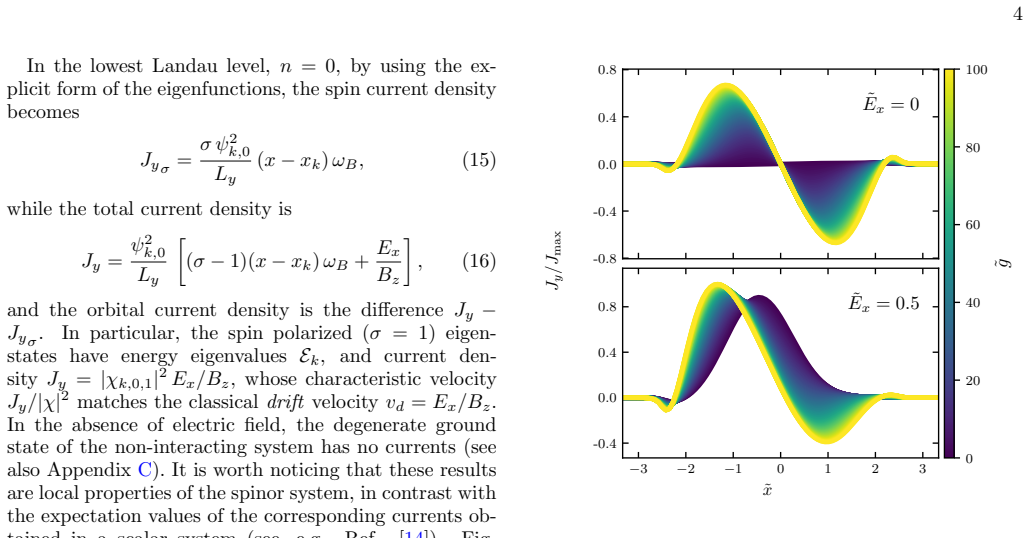
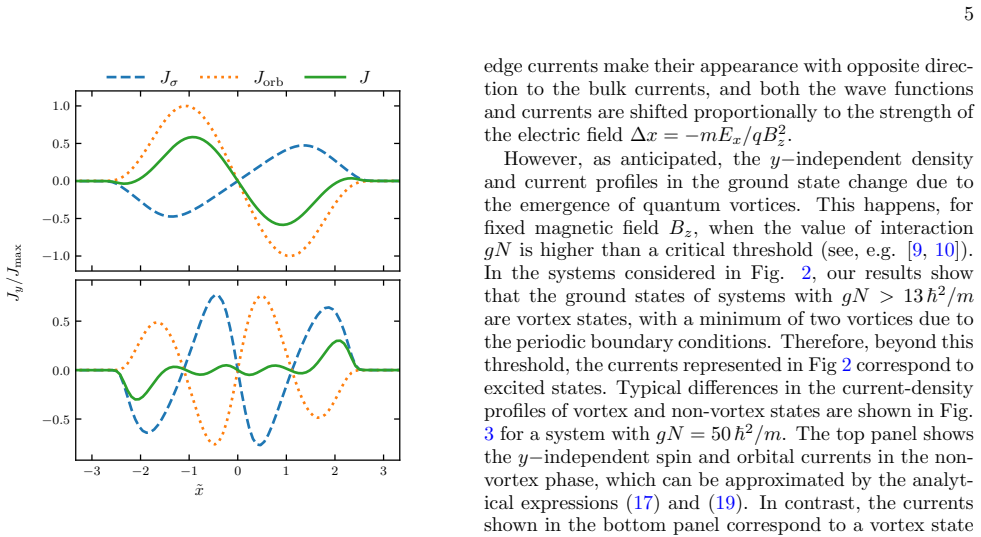
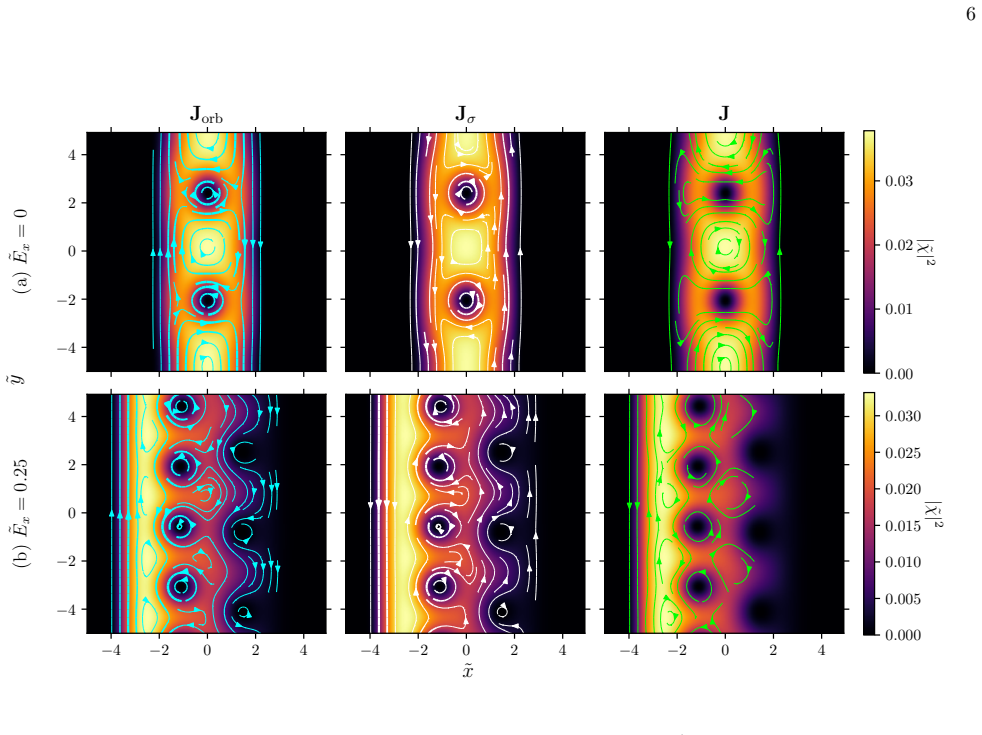
In the ground state of the non-interacting system the spin term in the particle current density is required for local matching of the classical drift velocity, while increasing interactions reduce the spin-to-orbital current ratio; in both regimes the spin contribution changes the overall particle velocity and its loop circulation, affecting the connection to the Aharonov-Bohm phase shift.
What carries the argument
The spin term in the particle current density of pseudospin-1/2 bosonic particles in synthetic gauge fields.
If this is right
- The local particle velocity matches classical drift only when the spin term is included in the non-interacting limit.
- The ratio of spin current to orbital current decreases as interaction strength increases.
- The circulation of the particle current around a loop changes due to the spin term, altering its relation to the Aharonov-Bohm phase.
Where Pith is reading between the lines
- Observing this effect could provide a way to measure spin contributions in synthetic Hall systems without relativistic effects.
- Similar spin terms might appear in other non-relativistic systems with artificial gauge fields.
- Adjusting interaction strength offers a control knob for the relative spin current contribution.
Load-bearing premise
The theoretical description of these pseudospin-1/2 bosons in synthetic gauge fields requires a separate spin term in the particle current density whose effects cannot be obtained from other parts of the framework.
What would settle it
An experiment measuring the local velocity field in the non-interacting ground state of the condensate and finding it does not match the classical drift velocity when the spin term is omitted from the current calculation.
Figures
read the original abstract
Although spin is not a relativistic quantity, its effects are not always manifestly captured within non-relativistic theoretical frameworks. We report on one of these effects: the spin term in the particle current density, which could be observed in the setup of a synthetic Hall system made with non-relativistic Bose-Einstein condensates of pseudospin-1/2 bosonic particles. By tuning the interaction strength, the system can show how the spin term in the particle current is needed for the local matching of classical drift velocity in the ground state of the non-interacting system, whereas for increasing interactions the spin-to-orbital current ratio decreases. In either case, since the overall particle velocity changes with the spin term contribution, so does its circulation in a loop, which in turn has physical consequences for its relationship with the Aharonov-Bohm phase shift.
Editorial analysis
A structured set of objections, weighed in public.
Referee Report
Summary. The paper analyzes the particle current density in a pseudospin-1/2 Bose-Einstein condensate subject to synthetic gauge fields. It identifies a distinct spin contribution to the current that arises from the minimal-coupling form of the two-component Hamiltonian. Explicit computation in the non-interacting limit shows this term is required for local matching to the classical drift velocity in the ground state; mean-field Gross-Pitaevskii calculations then demonstrate that the spin-to-orbital current ratio decreases with increasing interaction strength. The resulting change in circulation is linked to consequences for the Aharonov-Bohm phase shift.
Significance. The result supplies a concrete, verifiable example of a spin-dependent correction that is not manifestly absorbed into the orbital current within a non-relativistic framework. Because the matching condition is checked by direct evaluation of the velocity field and the interaction trend follows from standard mean-field ground states, the work offers a falsifiable prediction for synthetic Hall geometries that could be tested with existing BEC techniques. It also clarifies how circulation around closed loops acquires an interaction-tunable spin correction.
minor comments (2)
- The abstract refers to a 'synthetic Hall system' without specifying the gauge-field geometry (e.g., Landau-level or lattice-based); a brief sentence in the introduction would help readers map the model onto common experimental realizations.
- Notation for the spin and orbital pieces of the current operator is introduced in §2; a single equation that explicitly separates J_spin and J_orbital would improve readability when the ratio is later plotted.
Simulated Author's Rebuttal
We thank the referee for their positive assessment of the manuscript, accurate summary of the results, and recommendation to accept. No major comments were raised.
Circularity Check
No significant circularity
full rationale
The paper derives the spin term in the particle current directly from the minimal-coupling form of the two-component Hamiltonian for pseudospin-1/2 bosons. The local velocity matching condition is verified by explicit computation of the current operator in the non-interacting ground state, and the decrease in spin-to-orbital ratio with interactions follows from the mean-field Gross-Pitaevskii ground state. No parameters are fitted to the target observables, no self-citations are load-bearing for the central claims, and no step reduces by construction to its own inputs. The derivation is self-contained against the stated Hamiltonian and standard mean-field equations.
Axiom & Free-Parameter Ledger
Reference graph
Works this paper leans on
-
[1]
Hans C. Ohanian. What is spin?American Journal of Physics, 54(6):500–505, 1986
1986
-
[2]
The quantum mechanical current of the pauli equation.American Journal of Physics, 67(10):916–919, 1999
Marek Nowakowski. The quantum mechanical current of the pauli equation.American Journal of Physics, 67(10):916–919, 1999
1999
-
[3]
Quantum-torque-induced breaking of magnetic in- terfaces in ultracold gases.Nature Physics, 17(12):1359– 1363, 2021
Arturo Farolfi, Alessandro Zenesini, Dimitris Trypoge- orgos, Carmelo Mordini, Albert Gallem´ ı, Arko Roy, Alessio Recati, Giacomo Lamporesi, and Gabriele Fer- rari. Quantum-torque-induced breaking of magnetic in- terfaces in ultracold gases.Nature Physics, 17(12):1359– 1363, 2021
2021
-
[4]
Fer- romagnetism in an extended coherently coupled atomic superfluid.Physical Review X, 13(2):021037, 2023
Riccardo Cominotti, Anna Berti, Clement Dulin, Chiara Rogora, Giacomo Lamporesi, Iacopo Carusotto, Alessio Recati, Alessandro Zenesini, and Gabriele Ferrari. Fer- romagnetism in an extended coherently coupled atomic superfluid.Physical Review X, 13(2):021037, 2023. 7
2023
-
[5]
Kinetic theory of a spin-1/2 bose-condensed gas.Journal of low tempera- ture physics, 133(5):323–375, 2003
Tetsuro Nikuni and James E Williams. Kinetic theory of a spin-1/2 bose-condensed gas.Journal of low tempera- ture physics, 133(5):323–375, 2003
2003
-
[6]
Manchon, J
A. Manchon, J. ˇZelezn´ y, I. M. Miron, T. Jungwirth, J. Sinova, A. Thiaville, K. Garello, and P. Gambardella. Current-induced spin-orbit torques in ferromagnetic and antiferromagnetic systems.Rev. Mod. Phys., 91:035004, Sep 2019
2019
-
[7]
Coherently coupled mixtures of ultracold atomic gases.Annual Review of Condensed Matter Physics, 13(1):407–432, 2022
Alessio Recati and Sandro Stringari. Coherently coupled mixtures of ultracold atomic gases.Annual Review of Condensed Matter Physics, 13(1):407–432, 2022
2022
-
[8]
The universal defi- nition of spin current.Scientific reports, 2(1):388, 2012
Zhe An, FQ Liu, Y Lin, and C Liu. The universal defi- nition of spin current.Scientific reports, 2(1):388, 2012
2012
-
[9]
Lin, Rob L
Y.-J. Lin, Rob L. Compton, Karina Jim´ enez-Garc´ ıa, James V. Porto, and Ian B. Spielman. Synthetic magnetic fields for ultracold neutral atoms.Nature, 462(7273):628–632, 2009
2009
-
[10]
En- rico Fermi
Giacomo Lamporesi. Two-component spin mixtures. In Proceedings of the International School of Physics “En- rico Fermi”, Course 211 – Quantum Mixtures with Ultra- cold Atoms, volume 211, pages 1–28, 2025
2025
-
[11]
Elsevier, 2013
Lev Davidovich Landau and Evgenii Mikhailovich Lif- shitz.Quantum mechanics: non-relativistic theory, vol- ume 3. Elsevier, 2013
2013
-
[12]
Wiley, 1982
Antonio Barone and Gianfranco Paterno.Physics and applications of the Josephson effect. Wiley, 1982
1982
-
[13]
Stegun.Handbook of mathematical functions with formulas, graphs, and math- ematical tables, volume 55
Milton Abramowitz and Irene A. Stegun.Handbook of mathematical functions with formulas, graphs, and math- ematical tables, volume 55. US Government printing of- fice, 1948
1948
-
[14]
Lectures on the Quantum Hall Effect
David Tong. Lectures on the quantum hall effect.arXiv preprint arXiv:1606.06687, 2016
work page internal anchor Pith review Pith/arXiv arXiv 2016
-
[15]
Princeton University Press, 2017
Kip S Thorne and Roger D Blandford.Modern classical physics: optics, fluids, plasmas, elasticity, relativity, and statistical physics. Princeton University Press, 2017
2017
-
[16]
CRC press, 2018
Richard P Feynman.Statistical mechanics: a set of lec- tures. CRC press, 2018
2018
-
[17]
Emergence of coherence via transverse condensation in a uniform quasi-two-dimensional bose gas.Nature communications, 6(1):6162, 2015
Lauriane Chomaz, Laura Corman, Tom Bienaim´ e, R´ emi Desbuquois, Christof Weitenberg, Sylvain Nascimbene, J´ erˆ ome Beugnon, and Jean Dalibard. Emergence of coherence via transverse condensation in a uniform quasi-two-dimensional bose gas.Nature communications, 6(1):6162, 2015
2015
-
[18]
Quantum gases in optical boxes.Nature Physics, 17(12):1334–1341, 2021
Nir Navon, Robert P Smith, and Zoran Hadzibabic. Quantum gases in optical boxes.Nature Physics, 17(12):1334–1341, 2021
2021
-
[19]
Cambridge University Press, 1995
Steven Weinberg.The quantum theory of fields, volume 2. Cambridge University Press, 1995
1995
-
[20]
Pethick and Henrik Smith.Bose–Einstein Condensation in Dilute Gases
Christopher J. Pethick and Henrik Smith.Bose–Einstein Condensation in Dilute Gases. Cambridge University Press, Cambridge, 2 edition, 2008
2008
-
[21]
Oxford Univer- sity Press, 2016
Lev Pitaevskii and Sandro Stringari.Bose-Einstein con- densation and superfluidity, volume 164. Oxford Univer- sity Press, 2016. Appendix A: From Dirac to Pauli equation The Dirac Hamiltonian takes the compact form [19] ˆHDirac =cα·ˆ p+β mc 2,(A1) in the representation where α= 0σ σ0 . β= ˆ12×2 0 0− ˆ12×2 ,(A2) From Eq. (A1), and by writing the Dirac fiel...
2016
discussion (0)
Sign in with ORCID, Apple, or X to comment. Anyone can read and Pith papers without signing in.