η-pairing in metallic and particle-hole asymmetric systems
Pith reviewed 2026-06-28 04:03 UTC · model grok-4.3
The pith
η-pairing remains stable under particle-hole asymmetry in large-gap Mott insulators and appears in photo-excited metallic states with quasiparticle population inversion.
A machine-rendered reading of the paper's core claim, the machinery that carries it, and where it could break.
Core claim
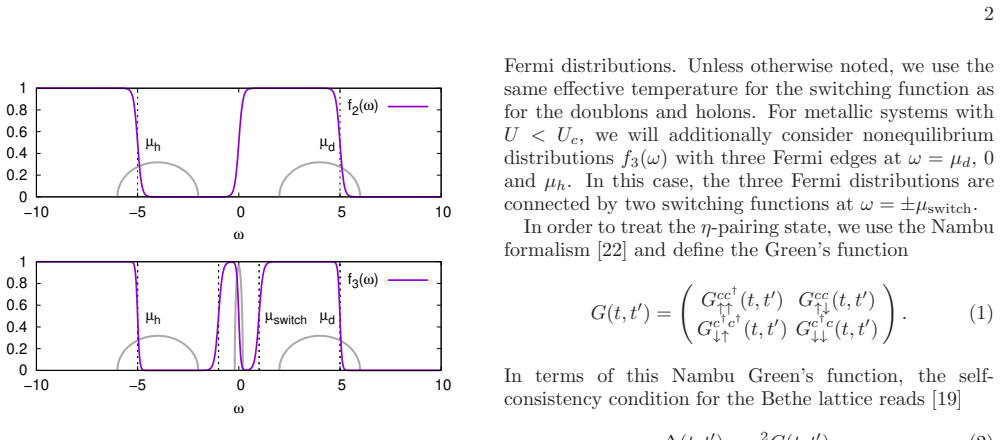
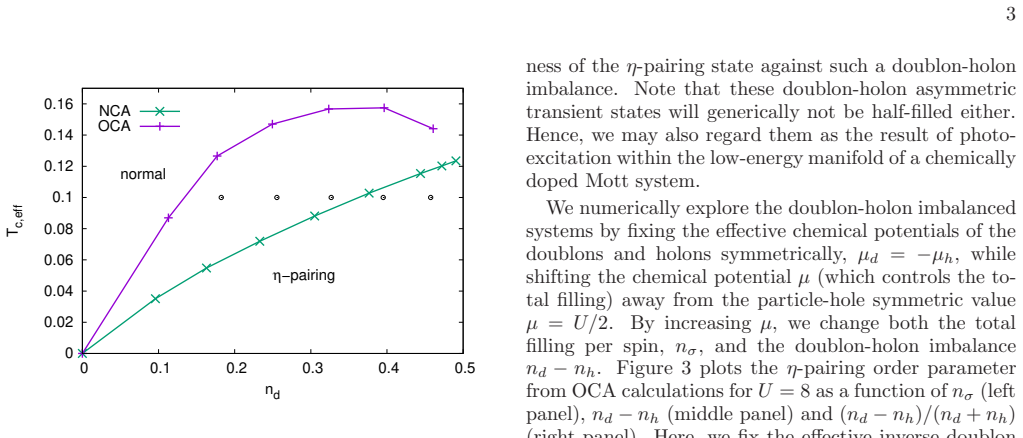
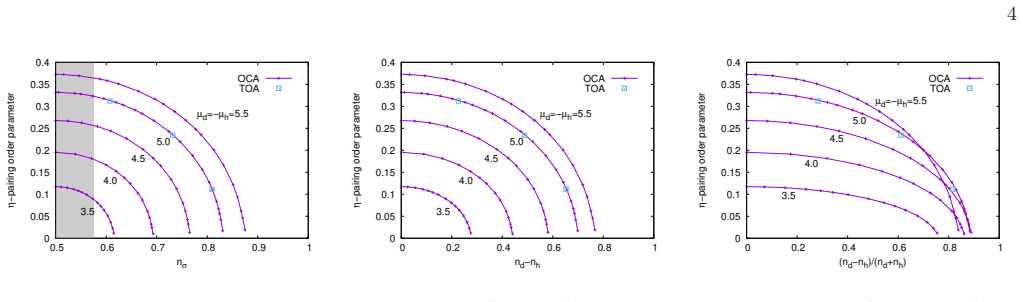
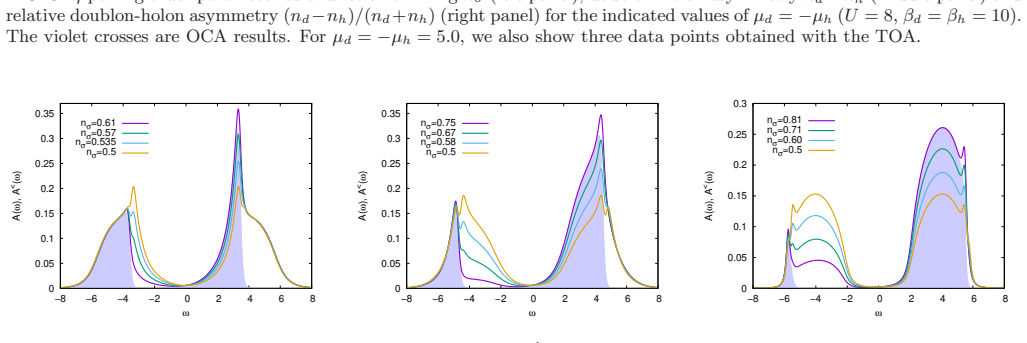
In the strongly correlated regime with large Mott gap and low effective doublon and holon temperatures, η-pairing is robust against changes in total filling and an imbalance in the doublon and holon density. An asymmetry in the effective doublon and holon temperatures can however strongly suppress the order parameter. In photo-doped metallic systems with a three-peak structure in the local density of states, η-pairing can be realized in set-ups with positive doublon and holon temperatures and a population inversion in the low-energy quasi-particle band.
What carries the argument
Steady-state nonequilibrium dynamical mean-field theory with a strong-coupling impurity solver truncated at third order, used to track the η-pairing order parameter under photo-doping.
If this is right
- η-pairing order survives deviations from half-filling when doublon and holon effective temperatures remain low.
- Densities of doublons and holons can be imbalanced without destroying the order under the same low-temperature condition.
- Asymmetry between doublon and holon temperatures strongly reduces the order parameter.
- In metallic systems that develop three-peak local spectra, population inversion in the quasiparticle band allows η-pairing at positive temperatures.
Where Pith is reading between the lines
- The results indicate that experiments on real, imperfectly symmetric materials could still observe η-pairing if effective temperatures are controlled.
- Similar order may appear under other nonequilibrium driving protocols that produce population inversion without requiring particle-hole symmetry.
- The findings tie the stability of the order to the separation of energy scales between the Mott gap and the low-energy band.
Load-bearing premise
The third-order truncation of the strong-coupling impurity solver is accurate enough to capture the emergence and stability of η-pairing.
What would settle it
If η-pairing vanishes at moderate deviations from half-filling or fails to appear in three-peak metallic systems even with quasiparticle inversion, the reported robustness would not hold.
Figures
read the original abstract
Light-induced superconducting-like states have been reported in several classes of correlated materials. From a theoretical point of view, the induction of $\eta$-pairing is a promising route to nonthermal superconductivity. Numerical studies of photo-doped Mott systems revealed $\eta$-pairing states with very high effective critical temperatures. These investigations were however restricted to particle-hole symmetric states in large-gap Mott insulators, while the experiments were performed on strongly correlated metallic systems. It is thus relevant to explore if $\eta$-pairing also exists in non-particle-hole symmetric setups and in photo-excited metallic states. Here we use steady-state nonequilibrium dynamical mean field theory combined with a strong-coupling impurity solver up to third order to investigate this issue. We find that in the strongly correlated regime with large Mott gap, and for low effective doublon and holon temperatures, $\eta$-pairing is robust against changes in the total filling and an imbalance in the doublon and holon density. An asymmetry in the effective doublon and holon temperatures can however strongly suppress the order parameter. In photo-doped metallic systems with a three-peak structure in the local density of states, $\eta$-pairing can be realized in set-ups with positive doublon and holon temperatures and a population inversion in the low-energy quasi-particle band.
Editorial analysis
A structured set of objections, weighed in public.
Referee Report
Summary. The manuscript uses steady-state nonequilibrium DMFT with a strong-coupling impurity solver truncated at third order to study η-pairing. It reports that, in the large-gap Mott regime at low effective doublon/holon temperatures, the order is robust to changes in total filling and doublon-holon imbalance (though suppressed by temperature asymmetry), and that η-pairing can be realized in photo-doped metals possessing a three-peak local DOS together with population inversion in the quasiparticle band.
Significance. If the truncation is shown to be controlled, the results would usefully extend prior particle-hole-symmetric insulator studies to the asymmetric and metallic regimes that are closer to experiment. The work employs an established nonequilibrium DMFT framework and directly solves the steady-state equations rather than relying on fitted parameters.
major comments (2)
- [Methods] Methods section (description of the impurity solver): the central claims on the stability of η-pairing and the emergence of population-inversion-driven order rest on the third-order truncation; the manuscript provides no convergence checks with fourth-order terms, comparisons to alternative solvers, system-size dependence, or error estimates on the order parameter and effective temperatures in the relevant regimes.
- [Results (metallic regime)] Results on metallic systems: the claim that η-pairing appears with positive doublon/holon temperatures and three-peak DOS requires explicit demonstration that the truncation does not artifactually stabilize the order parameter; without such validation the metallic-regime finding remains provisional.
minor comments (1)
- [Abstract] Abstract and figure captions: statements of numerical findings would be strengthened by brief mention of the truncation order and any available convergence indicators.
Simulated Author's Rebuttal
We thank the referee for the detailed report and constructive suggestions. We address the two major comments below. We agree that the absence of explicit convergence tests for the third-order truncation is a limitation that should be discussed more explicitly, and we will revise the manuscript accordingly by adding caveats and references to prior benchmarks. However, performing new fourth-order calculations or solver comparisons is not feasible within the current study.
read point-by-point responses
-
Referee: [Methods] Methods section (description of the impurity solver): the central claims on the stability of η-pairing and the emergence of population-inversion-driven order rest on the third-order truncation; the manuscript provides no convergence checks with fourth-order terms, comparisons to alternative solvers, system-size dependence, or error estimates on the order parameter and effective temperatures in the relevant regimes.
Authors: We acknowledge that the manuscript lacks explicit convergence checks with fourth-order terms or alternative solvers. The third-order strong-coupling expansion is a controlled approximation in the large-U limit and has been benchmarked in prior equilibrium and nonequilibrium DMFT studies for similar Mott regimes (e.g., Refs. on iterated perturbation theory extensions). In the large-gap insulator regime studied here, the effective temperatures are low and the gap is large, where higher-order corrections are expected to be small. We will add a dedicated paragraph in the Methods section discussing the expected accuracy, citing relevant benchmarks, and noting that quantitative error bars on the order parameter are not provided. System-size dependence is not applicable as this is a DMFT calculation (infinite dimensions). revision: partial
-
Referee: [Results (metallic regime)] Results on metallic systems: the claim that η-pairing appears with positive doublon/holon temperatures and three-peak DOS requires explicit demonstration that the truncation does not artifactually stabilize the order parameter; without such validation the metallic-regime finding remains provisional.
Authors: We agree that the metallic-regime results are more sensitive to the truncation and that additional validation would be desirable. The emergence of η-pairing in this regime is tied to the population inversion in the quasiparticle band and the three-peak DOS structure, which is absent in the equilibrium metallic state. We will revise the discussion to emphasize that the order vanishes when the inversion is suppressed (e.g., by increasing the effective temperature), providing indirect evidence against a pure truncation artifact. However, we cannot perform fourth-order calculations or direct comparisons here, so the metallic finding should indeed be viewed as suggestive rather than fully validated. revision: partial
- Explicit convergence checks with fourth-order truncation, alternative impurity solvers, or quantitative error estimates on the order parameter would require substantial new computational work and code modifications that are beyond the scope of the present study.
Circularity Check
No circularity: results from direct numerical solution of nonequilibrium DMFT equations
full rationale
The paper reports numerical findings on η-pairing obtained via steady-state nonequilibrium DMFT combined with a strong-coupling impurity solver truncated at third order. The central claims concern robustness of the order parameter against filling and asymmetry in the large-gap regime and its realization in metallic three-peak DOS setups; these emerge from solving the DMFT equations rather than from any analytical derivation, fitted parameter renamed as prediction, or self-referential definition. No load-bearing self-citations, uniqueness theorems imported from prior author work, or ansatzes smuggled via citation are present in the provided text. The method is a standard computational approach whose outputs are independent of the target observables by construction.
Axiom & Free-Parameter Ledger
axioms (1)
- domain assumption Steady-state nonequilibrium DMFT combined with a strong-coupling impurity solver truncated at third order is sufficient to determine the stability of η-pairing order.
Reference graph
Works this paper leans on
-
[1]
In the ab- sence of a gap between the Hubbard bands, long-lived and effectively cold photo-doped doublon and holon pop- ulations are unlikely to exist
and κ-(BEDT-TTF)2Cu[N(CN)2]Br [44]. In the ab- sence of a gap between the Hubbard bands, long-lived and effectively cold photo-doped doublon and holon pop- ulations are unlikely to exist. One can however imagine transient states with a partial doublon/holon population of the upper/lower Hubbard bands during laser driving, or on sub-picosecond timescales af...
-
[2]
75, in which the spectral function exhibits a low-energy quasi-particle peak
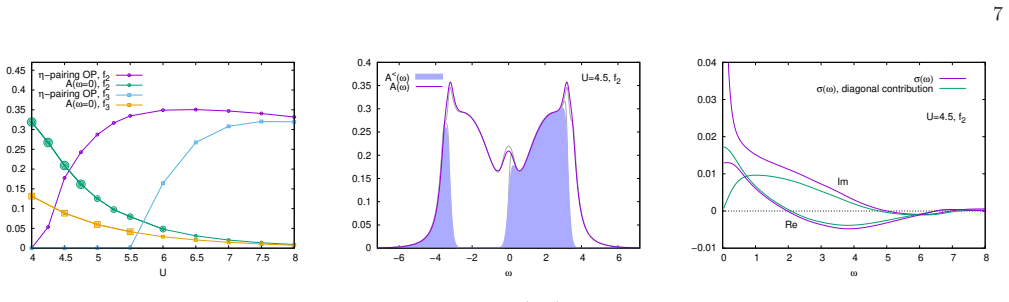
25 ≲ U ≲ 4. 75, in which the spectral function exhibits a low-energy quasi-particle peak. The spectral function and occupation for ( U, µ d) = (4 . 5, 3. 75), βeff = 10 and the f2 distribution are shown in the middle panel of Fig. 7 (vi- olet curves and shading). As the effective temperature is 7 0 0.05 0.1 0.15 0.2 0.25 0.3 0.35 0.4 0.45 4 4.5 5 5.5 6 6.5 ...
2000
-
[3]
Vaskivskyi, I
I. Vaskivskyi, I. A. Mihailovic, S. Brazovskii, J. Gospo - daric, T. Mertelj, D. Svetin, P. Sutar, and D. Mi- hailovic, Fast electronic resistance switching involving hidden charge density wave states, Nature Comm. 7, 11442 (2016)
2016
-
[4]
Mihailovic, D
D. Mihailovic, D. Svetin, I. Vaskivskyi, R. Venturini, B . Lipovsek, and A. Mraz, Ultrafast non-thermal and ther- mal switching in charge configuration memory devices based on 1T-TaS 2, Appl. Phys. Lett. 119, 013106 (2021)
2021
-
[5]
Cavalleri, Photo-induced superconductivity, Con- temp
A. Cavalleri, Photo-induced superconductivity, Con- temp. Phys. 59, 31 (2018)
2018
-
[6]
Fausti, R
D. Fausti, R. I. Tobey, N. Dean, S. Kaiser, A. Dienst, M. C. Hoffmann, S. Pyon, T. Takayama, H. Takagi, and A. Cavalleri, Light-Induced Superconductivity in a Stripe- Ordered Cuprate, Science 331, 189 (2011)
2011
-
[7]
Kaiser, C
S. Kaiser, C. R. Hunt, D. Nicoletti, W. Hu, I. Gierz, H. Y. Liu, M. Le Tacon, T. Loew, D. Haug, B. Keimer, and A. Cavalleri, Optically induced coherent transport far above Tc in underdoped YBa 2Cu3O6+δ , Phys. Rev. B 89, 184516 (2014)
2014
-
[8]
Mitrano, A
M. Mitrano, A. Cantaluppi, D. Nicoletti, S. Kaiser, A. Perucchi, S. Lupi, P. Di Pietro, D. Pontiroli, M. Ricco, A. Subedi, S. R. Clark, D. Jaksch, A. Cavalleri, Possible light-induced superconductivity in K 3C60 at high tem- perature, Nature 530, 461 (2016)
2016
-
[9]
Buzzi, D
M. Buzzi, D. Nicoletti, M. Fechner, N. Tancogne-Dejean, M. A. Sentef, A. Georges, M. Dressel, A. Henderson, T. Siegrist, J. A. Schlueter, K. Miyagawa, K. Kanoda, M.-S. Nam, A. Ardavan, J. Coulthard, J. Tindall, F. Schlawin, D. Jaksch, A. Cavalleri, Photomolecular High- Temperature Superconductivity, Phys. Rev. X 10, 031028 (2020)
2020
-
[10]
Budden, T
M. Budden, T. Gebert, M. Buzzi, G. Jotzu, E. Wang, T. Matsuyama, G. Meier, Y. Laplace, D. Pontiroli, M. Ricco, F. Schlawin, D. Jaksch, A. Cavalleri, Evidence for metastable photo-induced superconductivity in K 3C60, Nature Phys. 17, 611 (2021)
2021
-
[11]
S. Fava, G. De Vecchi, G. Jotzu, M. Buzzi, T. Gebert, Y. Liu, B. Keimer, and A. Cavalleri, Magnetic field expul- sion in optically driven YBa 2Cu3O6. 48, Nature 632, 75 (2024)
2024
-
[12]
J. S. Dodge, L. Lopez and D. G. Sahota, Optical Satura- tion Produces Spurious Evidence for Photoinduced Su- perconductivity in K 3C60, Phys. Rev. Lett. 130, 146002 (2023)
2023
-
[13]
Babadi, M
M. Babadi, M. Knap, I. Martin, G. Refael, and E. Demler, The theory of parametrically amplified electron- phonon superconductivity, Phys. Rev. B 96, 014512 10 (2017)
2017
-
[14]
Murakami, N
Y. Murakami, N. Tsuji, M. Eckstein, and P. Werner, Nonequilibrium steady states and transient dynamics of conventional superconductors under phonon driving, Phys. Rev. B 96, 045125 (2017)
2017
-
[15]
Tindall, B
J. Tindall, B. Buca, J. R. Coulthard, and D. Jaksch, Heating-Induced Long-Range η-Pairing in the Hubbard Model, Phys. Rev. Lett. 123, 030603 (2019)
2019
-
[16]
A. Nava, G. Giannetti, A. Georges, E. Tosatti, and M. Fabrizio, Cooling quasiparticles in A 3C60 fullerides by excitonic mid-infrared absorption, Nature Phys. 14, 154 (2018)
2018
-
[17]
Werner, M
P. Werner, M. Eckstein, and G. Refael, Light-induced evaporative cooling of holes in the Hubbard model, Na- ture Comm. 10, 5556 (2019)
2019
-
[18]
Yang, η-pairing and off-diagonal long-range order in a Hubbard model, Phys
C.-N. Yang, η-pairing and off-diagonal long-range order in a Hubbard model, Phys. Rev. Lett. 63, 2144 (1989)
1989
-
[19]
Rosch, D
A. Rosch, D. Rasch, B. Binz, and M. Vojta, Metastable Superfluidity of Repulsive Fermionic Atoms in Optical Lattices, Phys. Rev. Lett. 101, 265301 (2008)
2008
-
[20]
Kaneko, T
T. Kaneko, T. Shirakawa, S. Sorella, and S. Yunoki, Pho- toinduced Pairing in the Hubbard Model, Phys. Rev. Lett. 122, 077002 (2019)
2019
-
[21]
Werner, D
P. Werner, D. Golez, J. Li and M. Eckstein, Entropy- cooled nonequilibrium states of the Hubbard model, Phys. Rev. B 100, 155130 (2019)
2019
-
[22]
J. Li, D. Golez, P. Werner, and M. Eckstein, η-paired superconducting hidden phase in photodoped Mott insu- lators, Phys. Rev. B 102, 165136 (2020)
2020
- [23]
-
[24]
Georges, G
A. Georges, G. Kotliar, W. Krauth, and M. J. Rozen- berg, Dynamical mean-field theory of strongly correlated fermion systems and the limit of infinite dimensions, Rev. Mod. Phys. 68, 13 (1996)
1996
-
[25]
H. Aoki, N. Tsuji, M. Eckstein, M. Kollar, T. Oka, and P. Werner, Nonequilibrium dynamical mean field theory and its applications, Rev. Mod. Phys. 86, 779 (2014)
2014
-
[26]
Murakami, S
Y. Murakami, S. Takayoshi, T. Kaneko, Z. Sun, D. Golez, A. J. Millis, and P. Werner, Exploring nonequilibrium phases of photo-doped Mott insulators with generalized Gibbs ensembles, Commun. Phys. 5, 23 (2022)
2022
-
[27]
S. Ray, Y. Murakami, and P. Werner, Non-thermal super- conductivity in photo-doped multi-orbital Hubbard sys- tems, Phys. Rev. B 108, 174515 (2023)
2023
-
[28]
Ray and P
S. Ray and P. Werner, Photoinduced ferromagnetic and superconducting orders in multiorbital Hubbard models, Phys. Rev. B 110, L041109 (2024)
2024
-
[29]
J. Li, M. Mueller, A. Kim, A. Laeuchli, and P. Werner, Twisted chiral superconductivity in photodoped frus- trated Mott insulators, Phys. Rev. B 107, 205115 (2023)
2023
-
[30]
Li and M
J. Li and M. Eckstein, Nonequilibrium steady-state the - ory of photodoped Mott insulators, Phys. Rev. B 103, 045133 (2021)
2021
-
[31]
A. J. Kim and P. Werner, Strong coupling impurity solver based on quantics tensor cross interpolation, Phys. Rev. B 111, 125120 (2025)
2025
-
[32]
K¨ unzel, A
F. K¨ unzel, A. Erpenbeck, D. Werner, E. Arrigoni, E. Gull, G. Cohen and M. Eckstein, Numerically Exact Sim- ulation of Photodoped Mott Insulators, Phys. Rev. Lett. 132, 176501 (2024)
2024
-
[33]
L. Geng, A. J. Kim and P. Werner, Third-order strong- coupling impurity solver for real-frequency dynamical mean field theory: Accurate spectral functions for anti- ferromagnetic and photodoped states, Phys. Rev. B 112, 245119 (2025)
2025
-
[34]
Keiter and J
H. Keiter and J. C. Kimball, Diagrammatic Approach to the Anderson Model for Dilute Alloys, J. Appl. Phys. 42, 1460 (1971)
1971
-
[35]
Pruschke and N
T. Pruschke and N. Grewe, The Anderson model with fi- nite Coulomb repulsion, Z. Physik B - Condensed Matter 74, 439 (1989)
1989
-
[36]
Metzner and D
W. Metzner and D. Vollhardt, Correlated Lattice Fermions in d = ∞ Dimensions, Phys. Rev. Lett. 62, 324 (1989)
1989
-
[37]
Comanac, L de Medici, M
A. Comanac, L de Medici, M. Capone, and A. J. Mil- lis, Optical conductivity and the correlation strength of high temperature copper-oxide superconductors, Nature Phys. 4, 287 (2008)
2008
-
[38]
Werner and A
P. Werner and A. J. Millis, Doping-driven Mott transi- tion in the one-band Hubbard model, Phys. Rev. B 75, 085108 (2007)
2007
-
[39]
Sensarma et al
R. Sensarma et al. , Lifetime of double occupancies in the Fermi-Hubbard model, Phys. Rev. B 82, 224302 (2010)
2010
-
[40]
Eckstein and P
M. Eckstein and P. Werner, Thermalization of a pump- excited Mott insulator, Phys. Rev. B 84, 035122 (2011)
2011
-
[41]
Murakami, D
Y. Murakami, D. Golez, M. Eckstein, and P. Werner, Photo-induced nonequilibrium states in Mott insulators, Rev. Mod. Phys. 97, 035001 (2025)
2025
-
[42]
J. E. Hirsch, Dynamic Hubbard model, Phys. Rev. Lett. 87, 206402 (2001)
2001
-
[43]
Werner and M
P. Werner and M. Eckstein, Effective doublon and hole temperatures in the photo-doped dynamic Hubbard model, Struct. Dyn. 3, 023603 (2016)
2016
-
[44]
S. Ray, M. Eckstein and P. Werner, Role of the phonon coupling in driving photoexcited Mott insulators towards a transient superconducting state, Phys. Rev. B 111, 174309 (2025)
2025
-
[45]
R. H. Zadik, Y. Takabayashi, G. Klupp, R. H. Colman, A. Y. Ganin, A. Potocnik, P. Jeglic, D. Arcon, P. Matus, K. Kamaras, Y. Kasahara, Y. Iwasa, A. N. Fitch, Y. Ohishi, G. Garbarino, K. Kato, M. J. Rosseinsky, and K. Prassides, Optimized unconventional superconductivity in a molecular Jahn-Teller metal, Sci. Adv. 1, e1500059 (2015)
2015
-
[46]
Jerome, The Physics of Organic Superconductors, Sci - ence 252, 1509 (1991)
D. Jerome, The Physics of Organic Superconductors, Sci - ence 252, 1509 (1991)
1991
-
[47]
Golez, L
D. Golez, L. Boehnke, H. Strand, M. Eckstein and P. Werner, Nonequilibrium GW+EDMFT: Antiscreen- ing and inverted populations from nonlocal correlations, Phys. Rev. Lett. 118, 246402 (2017)
2017
-
[48]
Mott-Hubbard Metal-Insulator Transition and Optical Conductivity in High Dimen- sions
N. Bluemer, PhD thesis “Mott-Hubbard Metal-Insulator Transition and Optical Conductivity in High Dimen- sions”, University of Augsburg (2002)
2002
-
[49]
Tsuji, T
N. Tsuji, T. Oka, P. Werner and H. Aoki, Dynamical band flipping in fermionic lattice systems: An ac-field- driven change of the interaction from repulsive to attrac- tive, Phys. Rev. Lett. 106, 236401 (2011)
2011
discussion (0)
Sign in with ORCID, Apple, or X to comment. Anyone can read and Pith papers without signing in.