REVIEW 1 major objections 1 minor 1 cited by
3D Magnetic Field Vectors in Space: Bubbles, Clouds, and Filaments
T0 review · 1 major / 1 minor · reviewed 2026-06-26 · grok-4.3
Pith's one-line read SKA observations can reconstruct three-dimensional magnetic field vectors in interstellar structures like bubbles, clouds and filaments.
desk verdict This is a review recapping established radio techniques for 3D ISM magnetic field mapping and SKA prospects, with no new results or methods. read the letter →
The pith
A machine-rendered reading of the paper's core claim, the machinery that carries it, and where it could break.
The reading
What carries the argument
Synchrotron emission combined with Faraday rotation measurements of compact sources and diffuse emission, used to recover full three-dimensional field vectors.
What would settle it
Independent measurements of field direction and strength in the same volumes, for example from Zeeman splitting in dense gas or from dust polarization combined with velocity information, that show systematic mismatches with the vectors reconstructed from SKA synchrotron and rotation data would falsify the claim that the techniques yield reliable 3D vectors.
Extended reading notes
Core claim
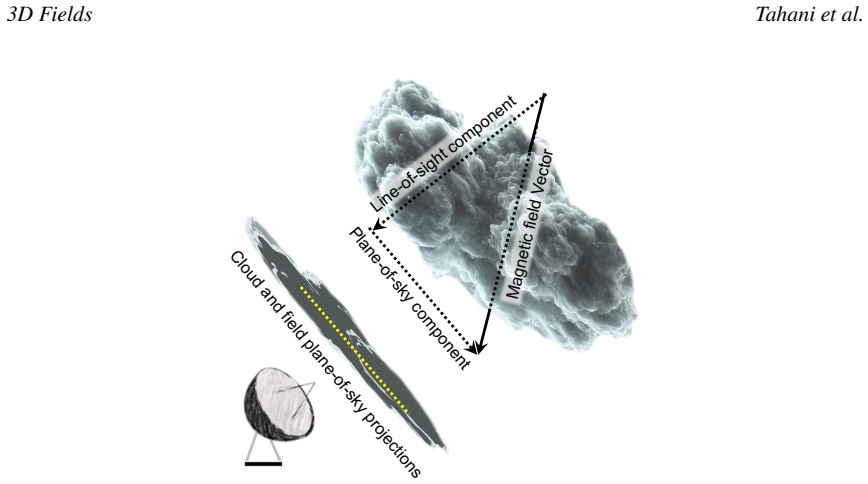
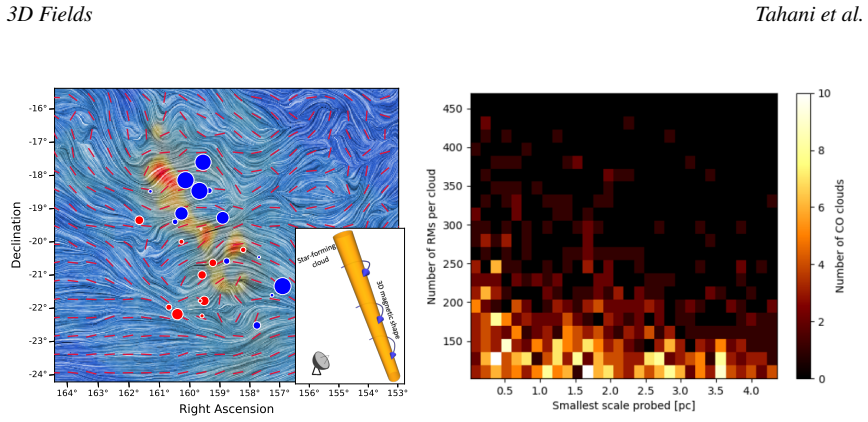
Mapping three-dimensional magnetic field vectors in space is required to understand the interplay between field strength, orientation and density structures that governs star formation. Although projection effects and the complex relationship between observable tracers and field geometry create challenges, synchrotron emission and Faraday rotation of both compact sources and diffuse emission provide the necessary probes for objects such as supernova remnants, superbubbles, HII regions, HI filaments, molecular clouds, filaments and cores. SKA AA4 will implement these techniques with vastly improved sensitivity, resolution and uv-coverage compared to existing datasets, thereby enhancing the ab
Load-bearing premise
The complex relationship between observable tracers such as synchrotron emission and Faraday rotation and the underlying field geometry can be disentangled sufficiently to obtain reliable full vector information despite projection effects.
Editorial extensions
If this is right
- Reconstruction of 3D magnetic field vectors becomes feasible for supernova remnants, superbubbles, HII regions and HI filaments in the diffuse ISM.
- The same techniques extend to dense ISM structures including molecular clouds, filaments and cores.
- Improved data quality from SKA AA4 will allow direct comparison of field orientation with density structures across multiple spatial scales.
- Magnetic field contributions to the interstellar energy budget can be quantified in three dimensions rather than line-of-sight projections.
Reading between the lines
- Combining the radio techniques with existing dust polarization maps could provide cross-checks on field geometry in overlapping regions.
- Successful 3D reconstructions would allow direct tests of whether magnetic fields align with or perpendicular to filamentary structures at different evolutionary stages.
- The methods could be applied to extragalactic targets once SKA sensitivity reaches nearby galaxies, linking Galactic and extragalactic field evolution.
Editorial analysis
A structured set of objections, weighed in public.
Referee Report
Summary. The manuscript is a review outlining established observational techniques based on synchrotron emission and Faraday rotation (of both compact sources and diffuse emission) to probe 3D magnetic field vectors in ISM structures including supernova remnants, superbubbles, HII regions, HI filaments, molecular clouds, filaments, and cores. It argues that SKA AA4's improved sensitivity, resolution, and uv-coverage will enable implementation of these techniques to reconstruct full 3D vectors, advancing understanding of magnetic fields in Galactic evolution and star formation, despite noted challenges from projection effects and tracer-geometry relationships.
Significance. If the outlined techniques prove implementable with SKA data as claimed, the review would be significant for guiding future observations and potentially providing 3D magnetic field maps essential for models of star formation and ISM evolution. The paper correctly identifies the scientific motivation and established methods but does not introduce new data, derivations, or validations.
major comments (1)
- [Abstract] Abstract: The central claim that SKA AA4 improvements will suffice to reconstruct reliable 3D vectors rests on the assumption that enhanced sensitivity/resolution/uv-coverage will disentangle projection effects and the complex tracer-geometry relationship. The manuscript flags these as persistent challenges but provides no specific mitigation strategies, inversion tests, or simulations showing how the degeneracies become resolvable, leaving the load-bearing step unsupported.
minor comments (1)
- The manuscript would benefit from explicit citations to foundational papers on synchrotron and Faraday techniques applied to the listed object classes (e.g., SNR, molecular clouds) to strengthen the review character.
Simulated Author's Rebuttal
We thank the referee for their constructive comments and for recognizing the scientific motivation and established methods in our review. We address the single major comment below.
read point-by-point responses
-
Referee: [Abstract] Abstract: The central claim that SKA AA4 improvements will suffice to reconstruct reliable 3D vectors rests on the assumption that enhanced sensitivity/resolution/uv-coverage will disentangle projection effects and the complex tracer-geometry relationship. The manuscript flags these as persistent challenges but provides no specific mitigation strategies, inversion tests, or simulations showing how the degeneracies become resolvable, leaving the load-bearing step unsupported.
Authors: As this manuscript is a review of established observational techniques rather than a methods or simulation paper, it summarizes techniques from the literature (synchrotron emission and Faraday rotation of compact and diffuse sources) that have been shown to yield 3D vector information when applied to ISM structures. The text explicitly identifies projection effects and tracer-geometry degeneracies as ongoing challenges. The claim regarding SKA AA4 is that its improved sensitivity, resolution, and uv-coverage will enable wider and higher-fidelity application of these same techniques, thereby reducing the practical impact of the degeneracies through better sampling of the relevant scales and structures. We agree that the abstract could state this basis more explicitly and will revise it to clarify that the anticipated improvements rest on the application of literature-established methods with higher-quality data, while the challenges themselves are not claimed to be eliminated. revision: yes
Circularity Check
Review paper with no derivations, predictions, or load-bearing self-references.
full rationale
The manuscript is an observational review outlining established techniques (synchrotron emission, Faraday rotation) for probing 3D magnetic fields in various ISM structures. It contains no equations, no fitted parameters, no claimed first-principles derivations, and no predictions that reduce to inputs by construction. The forward-looking statement about SKA AA4 is an expectation based on improved instrumental capabilities rather than a mathematical result. No self-citation chains, uniqueness theorems, or ansatzes are invoked to support any derivation. The text is therefore self-contained against external benchmarks with no circularity.
Assumptions & free parameters
Cite this review
Pith. "Pith review of 3D Magnetic Field Vectors in Space: Bubbles, Clouds, and Filaments." pith.science (2026). https://pith.science/paper/3WRGMNBP
@misc{pith2026260627346,
  author       = {Pith},
  title        = {Pith review of: 3D Magnetic Field Vectors in Space: Bubbles, Clouds, and Filaments},
  year         = {2026},
  howpublished = {\url{https://pith.science/paper/3WRGMNBP}},
  note         = {Machine review of arXiv:2606.27346}
}
read the original abstract
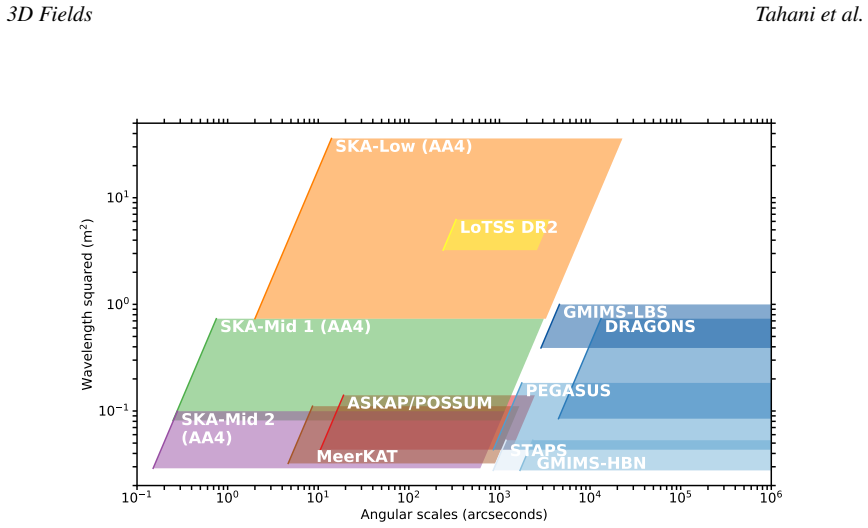
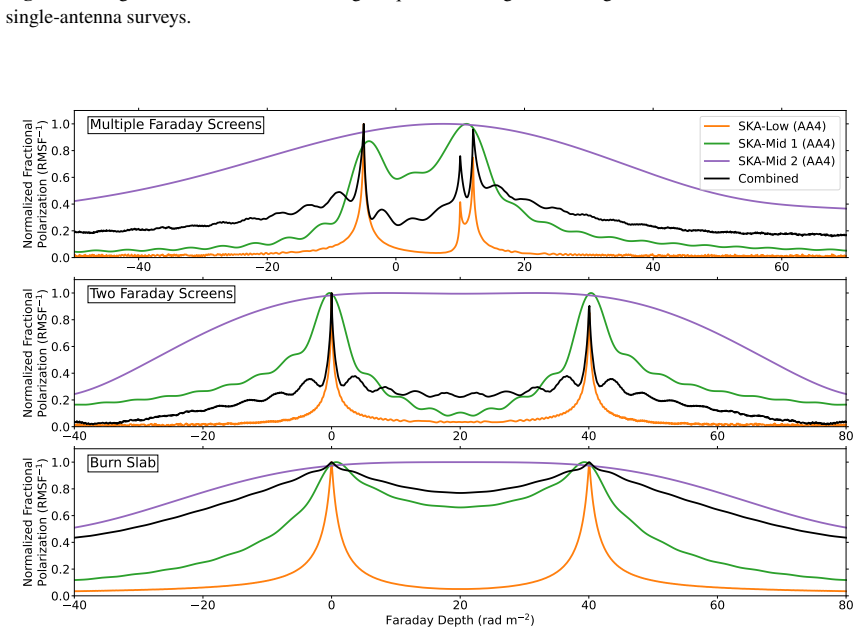
Magnetic fields play important roles in the star-formation process across different spatial scales. The interplay between magnetic field strength (a key component of the interstellar medium's energy budget) and field orientation relative to density structures impacts how interstellar material evolves toward star formation. To understand galactic evolution toward stars, planets, and ultimately life, we need to map three-dimensional (3D) magnetic field vectors in 3D space. However, determining full vector information remains challenging due to projection effects and the complex relationship between observable tracers and field geometry. We outline the observational techniques that can be used to probe the 3D magnetic field structures of objects such as supernova remnants (SNR), superbubbles, HII regions, and HI filaments in the diffuse interstellar medium (ISM), and objects in the dense ISM such as molecular clouds, filaments, and cores. The main SKA-specific observational techniques include synchrotron emission and Faraday rotation of both compact sources and the diffuse emission. We discuss how SKA AA4 will allow implementation of the techniques we describe, leveraging the vastly improved sensitivity, resolution and uv-coverage compared to existing datasets. This will enhance our ability to reconstruct 3D magnetic field vectors, advancing our understanding of magnetic fields in Galactic evolution and star formation.
Figures
Figures from the paper (2 more)
Forward citations
Cited by 1 Pith paper
-
DragonflyPol: Wide-Field Optical Linear Polarimetry with the Dragonfly Telephoto Array (Instrument Description and Commissioning)
By installing fixed polarizers in 44 lenses of the Dragonfly Telephoto Array, DragonflyPol enables simultaneous four-angle optical linear polarimetry over a ~5 deg² field, with commissioning checks confirming the expe...
Reference graph
Works this paper leans on
-
[1]
doi: 10.3847/1538-3881/addecc. B. D. Ball et al.ApJ, 988(1):75,
-
[2]
doi: 10.3847/1538-4357/addc63. J. Bally. Overview of the Orion Complex. In B. Reipurth, editor,Handbook of Star Forming Regions,VolumeI, volume 4, page
-
[3]
doi: 10.48550/arXiv.0812.0046. R. Beck and M. Krause.Astronomical Notes, 326:414–427,
-
[4]
doi: 10.1002/asna.200510366. A. S. Borlaff et al.ApJ, 952(1):4,
-
[5]
doi: 10.3847/1538-4357/acd934. F. Boulanger et al.A&A, 687:A102,
-
[6]
doi: 10.1051/0004-6361/202348953. T. L. Bourke et al. InAdvancingAstrophysicswiththeSKA–II(AASKAII)
-
[7]
arXiv search: Report number AASKAII/Bourke01. A. Bracco et al.A&A, 644:A5, 2020a. doi: 10.1051/0004-6361/202039282. A. Bracco et al.A&A, 644:L3, 2020b. doi: 10.1051/0004-6361/202039283. A. Bracco et al.A&A, 694:A148,
-
[8]
doi: 10.1051/0004-6361/202452010. A. Bracco et al. InAdvancingAstrophysicswith the SKA –II (AASKAII)
Show all 121 references
-
[9]
doi: 10.1051/0004-6361: 20052990. B. J. Burn.MNRAS, 133:67,
-
[10]
CCAT-Prime Collaboration et al.ApJSS, 264(1):7,
doi: 10.1093/mnras/133.1.67. CCAT-Prime Collaboration et al.ApJSS, 264(1):7,
-
[11]
doi: 10.3847/1538-4365/ac9838. S. Chandrasekhar and E. Fermi.ApJ, 118:113,
-
[12]
doi: 10.1086/145731. C.-Y. Chen et al.MNRAS, 485(3):3499–3513,
-
[13]
doi: 10.1093/mnras/stz618. C.-Y. Chen et al.MNRAS, 494(2):1971–1987,
1971 doi
-
[14]
25 3D Fields Tahani et al
doi: 10.1093/mnras/staa835. 25 3D Fields Tahani et al. Z. Chen et al.ApJ, 838(2):80,
-
[15]
doi: 10.3847/1538-4357/aa65d3. T.-C. Ching et al.Nature, 601(7891):49–52, 2022a. doi: 10.1038/s41586-021-04159-x. T.-C. Ching et al.Nature, 601(7891):49–52, 2022b. doi: 10.1038/s41586-021-04159-x. S.E.Clark,J.E.G.Peek,andM.E.Putman. ApJ,789(1):82,2014. doi: 10.1088/0004-637X/7...
2014 doi
-
[16]
doi: 10.3847/1538-4357/ 833/2/176. D. P. Clemens et al.ApJSS, 249(2):23,
-
[17]
doi: 10.3847/1538-4365/ab9f30. C. Collischon et al.A&A, 653:A16,
-
[18]
doi: 10.1051/0004-6361/202040153. R. M. Crutcher.ARA&A, 50:29–63,
-
[19]
doi: 10.1146/annurev-astro-081811-125514. R. M. Crutcher and A. J. Kemball.Frontiers in Astronomyand Space Sciences, 6:66,
-
[20]
doi: 10.3389/fspas.2019.00066. R. M. Crutcher et al.ApJL, 514:L121–L124,
2019 doi
-
[21]
doi: 10.1086/311952. T. Dacunha, S. Martin-Alvarez, S. E. Clark, and E. Lopez-Rodriguez.ApJ, 980(2):197,
-
[22]
doi: 10.3847/1538-4357/adab72. I. M. Daly et al.Nature Communications, 7(1):12140,
-
[23]
doi: 10.1038/ ncomms12140
ISSN 2041-1723. doi: 10.1038/ ncomms12140. URLhttps://doi.org/10.1038/ncomms12140. T. M. Dame, D. Hartmann, and P. Thaddeus.ApJ, 547(2):792–813,
-
[24]
doi: 10.1086/318388. L. Davis.PhysicalReview, 81(5):890–891,
-
[25]
L.Deharveng,A.Zavagno,andJ.Caplan
doi: 10.1103/PhysRev.81.890.2. L.Deharveng,A.Zavagno,andJ.Caplan. A&A,433(2):565–577,2005. doi: 10.1051/0004-6361: 20041946. Y. Doi et al.ApJ, 914(2):122, 2021a. doi: 10.3847/1538-4357/abfcc5. Y. Doi et al.ApJL, 923(1):L9, 2021b. doi: 10.3847/2041-8213/ac3cc1. A. Erceg et al.A...
2005 doi
-
[26]
doi: 10.1051/0004-6361/202142244. A. Erceg et al.A&A, 688:A200,
-
[27]
doi: 10.1051/0004-6361/202450082. L. Fanciullo et al.MNRAS, 512(2):1985–2002,
1985 doi
-
[28]
J.D.FiegeandR.E.Pudritz
doi: 10.1093/mnras/stac528. J.D.FiegeandR.E.Pudritz. MNRAS,311:85–104,2000a. doi: 10.1046/j.1365-8711.2000.03066. x. J. D. Fiege and R. E. Pudritz.MNRAS, 311:105–119, 2000b. doi: 10.1046/j.1365-8711.2000. 03067.x. L. M. Fissel et al.ApJ, 878(2):110,
2000 doi
-
[29]
doi: 10.3847/1538-4357/ab1eb0. B. M. Gaensler et al.PASA, 42:e091,
-
[30]
doi: 10.1017/pasa.2025.10031. P. F. Goldsmith and D. Li.ApJ, 622(2):938–958,
2025 doi
-
[31]
doi: 10.1086/428032. A. A. Goodman and C. Heiles.ApJ, 424:208,
-
[32]
doi: 10.1086/173884. A. Gupta et al.ApJ, 930(1):67,
-
[33]
A.Hacaretal
doi: 10.3847/1538-4357/ac63bc. A.Hacaretal. InS.Inutsukaetal.,editors, ProtostarsandPlanetsVII,volume534of Astronomical Society ofthe PacificConferenceSeries, page 153,
-
[34]
doi: 10.48550/arXiv.2203.09562. G. Halal, S. E. Clark, and M. Tahani.ApJ, 973(1):54,
-
[35]
doi: 10.3847/1538-4357/ad61e0. J. L. Han.ARA&A, 55(1):111–157,
-
[36]
doi: 10.1146/annurev-astro-091916-055221. M. Haverkorn, P. Katgert, and A. G. de Bruyn.A&A, 403:1031–1044,
-
[37]
doi: 10.3390/galaxies8030053. C. Heiles.ApJ, 229:533–537,
- [38]
-
[39]
doi: 10.1086/430814. R. H. Hildebrand et al.ApJ, 696:567–573,
-
[40]
doi: 10.1088/0004-637X/696/1/567. A. S. Hill.Galaxies, 6(4):129,
-
[41]
doi: 10.3390/galaxies6040129. T. Hoang and A. Lazarian.ApJ, 831(2):159,
-
[42]
doi: 10.3847/0004-637X/831/2/159. T. Hoang and B. Truong.ApJ, 965(2):183,
-
[43]
doi: 10.3847/1538-4357/ad2a56. M. Houde et al.ApJ, 706(2):1504–1516,
-
[44]
doi: 10.1088/0004-637X/706/2/1504. Y. Hu and A. Lazarian.MNRAS, 524(2):2379–2394, 2023a. doi: 10.1093/mnras/stad1996. Y. Hu and A. Lazarian.MNRAS, 519(3):3736–3748, 2023b. doi: 10.1093/mnras/stac3744. S. Hutschenreuter et al.A&A, 657:A43,
-
[45]
doi: 10.1051/0004-6361/202140486. J. Hwang et al.ApJ, 985(2):222,
-
[46]
doi: 10.3847/1538-4357/adce80. S. Ideguchi, T. Inoue, T. Akahori, and K. Takahashi.MNRAS, 513(3):3289–3301,
-
[47]
doi: 10.1093/mnras/stac1086. T. Inoue et al.PASJ, 70:S53,
-
[48]
doi: 10.1093/pasj/psx089. S.-i. Inutsuka, T. Inoue, K. Iwasaki, and T. Hosokawa.A&A, 580:A49,
-
[49]
doi: 10.3390/galaxies7020052. T. R. Jaffe et al.MNRAS, 401(2):1013–1028,
-
[50]
doi: 10.1111/j.1365-2966.2009.15745.x. R. Jansson and G. R. Farrar.ApJ, 757(1):14,
2009 doi
-
[51]
doi: 10.1088/0004-637X/757/1/14. V. Jelić et al.A&A, 615:L3,
-
[52]
M.Johnston-Hollittetal.In AdvancingAstrophysicswiththeSquareKilometreArray(AASKA14), page 92,
doi: 10.1051/0004-6361/201833291. M.Johnston-Hollittetal.In AdvancingAstrophysicswiththeSquareKilometreArray(AASKA14), page 92,
-
[53]
doi: 10.22323/1.215.0092. S. L. Jung et al.MNRAS, 534(3):2938–2952,
-
[54]
doi: 10.1093/mnras/stae2245. P. M. W. Kalberla.A&A, 694:L11,
-
[55]
doi: 10.1051/0004-6361/202452771. P. M. W. Kalberla and J. Kerp.A&A, 595:A37,
-
[56]
doi: 10.1051/0004-6361/201629113. P. M. W. Kalberla et al.ApJ, 821(2):117,
-
[57]
doi: 10.3847/0004-637X/821/2/117. R. Kandori et al.ApJ, 848(2):110,
-
[58]
doi: 10.3847/1538-4357/aa8d18. R. Kandori et al.ApJ, 888(2):120,
-
[59]
C.-G.KimandE.C.Ostriker
doi: 10.3847/1538-4357/ab6081. C.-G.KimandE.C.Ostriker. TheAstrophysicalJournal,802(2):99,2015.doi: 10.1088/0004-637x/ 802/2/99. URLhttps://doi.org/10.1088/0004-637x/802/2/99. P. K. King, L. M. Fissel, C.-Y. Chen, and Z.-Y. Li.MNRAS, 474(4):5122–5142,
2015 doi
-
[60]
doi: 10.1093/mnras/stx3096. P. K. King, C.-Y. Chen, L. M. Fissel, and Z.-Y. Li.MNRAS, 490(2):2760–2778,
-
[61]
doi: 10.1093/mnras/stz2628. R. Kothes and J.-A. Brown. In K. G. Strassmeier, A. G. Kosovichev, and J. E. Beckman, editors, Cosmic Magnetic Fields: From Planets, to Starsand Galaxies, volume 259 ofIAUSymposium, pages 75–80,
-
[62]
doi: 10.1017/S1743921309030087. M. Kounkel, T. Deng, and K. G. Stassun.AJ, 164(2):57,
-
[63]
doi: 10.3847/1538-3881/ac7951. M. R. Krumholz and C. Federrath.Frontiers in Astronomy and Space Sciences, 6:7,
-
[64]
doi: 10.3389/fspas.2019.00007. D. Li and P. F. Goldsmith.ApJ, 585(2):823–839,
2019 doi
-
[65]
27 3D Fields Tahani et al
doi: 10.1086/346227. 27 3D Fields Tahani et al. N. B. Linzer, L. Armillotta, E. C. Ostriker, and E. Quataert.arXive-prints, art. arXiv:2511.13834,
-
[66]
doi: 10.48550/arXiv.2511.13834. E. Lopez-Rodriguez et al.ApJL, 942(1):L13,
-
[67]
doi: 10.3847/2041-8213/acaaa2. X. Luri et al.A&A, 616:A9,
-
[68]
doi: 10.1051/0004-6361/201832964. Y. K. Ma et al. InAdvancing Astrophysicswith the SKA –II (AASKAII)
-
[69]
doi: 10.3847/1538-4357/ad2e9e. C. F. McKee and E. C. Ostriker.ARA&A, 45(1):565–687,
- [70]
-
[71]
doi: 10.3847/1538-4357/ad5099. M. Nowotka et al.arXiv e-prints, art. arXiv:2508.20065,
-
[72]
doi: 10.48550/arXiv.2508.20065. A. Ordog, J. C. Brown, R. Kothes, and T. L. Landecker.A&A, 603:A15,
-
[73]
doi: 10.3390/galaxies7020043. A. Ordog et al.AJ, 169(6):312,
-
[74]
doi: 10.3847/1538-3881/adc929. A. Ordog et al.ApJSS, 282(2):53,
-
[75]
doi: 10.3847/1538-4365/ae2471. M. Padovani and D. Galli.A&A, 620:L4,
-
[76]
doi: 10.1051/0004-6361/201834222. G. V. Panopoulou et al.ApJ, 872(1):56,
-
[77]
K.Pattleetal
doi: 10.3847/1538-4357/aafdb2. K.Pattleetal. InS.Inutsukaetal.,editors, ProtostarsandPlanetsVII,volume534of Astronomical Society ofthe PacificConferenceSeries, page 193,
-
[78]
doi: 10.48550/arXiv.2203.11179. V. Pelgrims et al.A&A, 670:A164,
-
[79]
doi: 10.1051/0004-6361/202244625. S. Pezzuto et al.A&A, 645:A55,
-
[80]
doi: 10.1051/0004-6361/201936534. T. G. S. Pillai et al.NatureAstronomy, 4:1195–1201,
-
[81]
Planck Collaboration et al.A&A, 596:A103, 2016a
doi: 10.1038/s41550-020-1172-6. Planck Collaboration et al.A&A, 596:A103, 2016a. doi: 10.1051/0004-6361/201528033. Planck Collaboration et al.A&A, 586:A138, 2016b. doi: 10.1051/0004-6361/201525896. S. B. Ponnada et al.MNRAS, 516(3):4417–4431,
-
[82]
doi: 10.1093/mnras/stac2448. C. R. Purcell et al.ApJ, 804(1):22,
-
[83]
doi: 10.1088/0004-637X/804/1/22. E. M. Purcell. Interstellar grains as pinwheels. In G. B. Field and A. G. W. Cameron, editors,The DustyUniverse, pages 155–167
-
[84]
doi: 10.1093/mnras/sty2415. T. Robishaw et al. InAdvancingAstrophysicswith the SKA –II (AASKAII)
-
[85]
URLhttps://doi.org/10.1086/308667
doi: 10.1086/308667. URLhttps://doi.org/10.1086/308667. D. Seifried and S. Walch.MNRAS, 452:2410–2422,
-
[86]
doi: 10.1093/mnras/stv1458. D. Seifried et al.MNRAS, 497(4):4196–4212,
-
[87]
doi: 10.1093/mnras/staa2231. A. Seta and N. M. McClure-Griffiths.MNRAS, 539(2):1024–1039,
-
[88]
doi: 10.1093/mnras/ staf520. E. Sharma et al.arXiv e-prints, art. arXiv:2503.20721,
-
[89]
28 3D Fields Tahani et al
doi: 10.48550/arXiv.2503.20721. 28 3D Fields Tahani et al. T. W. Shimwell et al.A&A, 659:A1,
-
[90]
doi: 10.1051/0004-6361/202142484. H. Shinnaga and S. Yamamoto.ApJ, 544(1):330–335,
-
[91]
doi: 10.1086/317212. R. Skalidis and V. Pelgrims.A&A, 631:L11,
-
[92]
doi: 10.1051/0004-6361/201936547. R. Skalidis and K. Tassis.A&A, 647:A186,
-
[93]
doi: 10.1051/0004-6361/202039779. J. D. Soler and P. Hennebelle.A&A, 607:A2,
-
[94]
doi: 10.1051/0004-6361/201731049. J. D. Soler et al.A&A, 622:A166,
-
[95]
doi: 10.1051/0004-6361/201834300. C. H. Sullivan et al.MNRAS, 503(4):5006–5024,
-
[96]
doi: 10.1093/mnras/stab596. X. Sun et al.A&A, 694:A169,
-
[97]
X.Sunetal
doi: 10.1051/0004-6361/202453326. X.Sunetal. In AdvancingAstrophysicswiththeSKA–II(AASKAII).2026. arXivsearch: Report number AASKAII/Sun01. H. Suzuki et al.ApJ, 392:551,
2026 doi
-
[98]
doi: 10.1086/171456. J. Syed et al.A&A, 657:A1,
-
[99]
M.Tahani
doi: 10.1051/0004-6361/202141265. M.Tahani. FrontiersinAstronomyandSpaceSciences,9:940027,2022. doi: 10.3389/fspas.2022. 940027. M. Tahani, R. Plume, J. C. Brown, and J. Kainulainen.A&A, 614:A100,
2022 doi
-
[100]
doi: 10.1051/0004-6361/201936280. M. Tahani et al.A&A, 660:L7, 2022a. doi: 10.1051/0004-6361/202243322. M. Tahani et al.A&A, 660:A97, 2022b. doi: 10.1051/0004-6361/202141170. M. Tahani et al.ApJ, 944(2):139,
-
[101]
doi: 10.3847/1538-4357/acac81. M. Tahani, L. Fissel, E. Lopez Rodriguez, and K. Pattle. Tracing Cloud Formation and Evolution Through 3D Magnetic Field Mapping. In A. Moullet et al., editors,PRIMA General Observer Science BookVolume2, volume 2, pages 513–518. 2025a. M. Tahani ...
- [102]
-
[103]
doi: 10.1088/0004-637X/ 702/2/1230. A. J. M. Thomson et al.PASA, 40:e040,
-
[104]
doi: 10.1017/pasa.2023.38. A. Tritsis et al.MNRAS, 451(4):4384–4396,
2023 doi
-
[105]
doi: 10.1093/mnras/stv1133. T. H. Troland, R. M. Crutcher, and I. Kazes.ApJL, 304:L57–L60,
-
[106]
doi: 10.1086/184670. B. Truong and T. Hoang.ApJ, 981(1):83,
-
[107]
doi: 10.3847/1538-4357/adb423. A. Tsouros et al.A&A, 690:A102,
-
[108]
doi: 10.1051/0004-6361/202449933. L. Turić et al.A&A, 654:A5,
-
[109]
doi: 10.1051/0004-6361/202141071. M. Unger and G. R. Farrar.ApJ, 970(1):95,
-
[110]
doi: 10.3847/1538-4357/ad4a54. B. Uyaniker, T. L. Landecker, A. D. Gray, and R. Kothes.ApJ, 585(2):785–800,
-
[111]
doi: 10.1086/346234. C. L. Van Eck et al.A&A, 597:A98,
-
[112]
doi: 10.1051/0004-6361/201629707. C. L. Van Eck et al.ApJSS, 267(2):28,
-
[113]
doi: 10.3847/1538-4365/acda24. S. L. Vanderwoude.Radio spectropolarimetry of Galactic and extragalactic magnetic fields. Phd thesis, University of Toronto, Toronto,
-
[114]
29 3D Fields Tahani et al
doi: 10.1051/0004-6361:200810564. 29 3D Fields Tahani et al. J. L. West et al.A&A, 587:A148,
-
[115]
doi: 10.1051/0004-6361/201527001. M. Wolleben et al.AJ, 158(1):44,
-
[116]
doi: 10.3847/1538-3881/ab22b0. M. Wolleben et al.AJ, 162(1):35,
-
[117]
doi: 10.3847/1538-3881/abf7c1. J. Wurster and Z.-Y. Li.Frontiers in Astronomy and Space Sciences, 5:39,
-
[118]
doi: 10.3389/ fspas.2018.00039. J. Xu and J. L. Han.MNRAS, 486(3):4275–4289,
2018
-
[119]
doi: 10.1093/mnras/stz1060. M. Xue et al.PASA, 34:e070,
-
[120]
doi: 10.1017/pasa.2017.66. S. Zaroubi et al.MNRAS, 454:L46–L50,
2017 doi
-
[121]
doi: 10.1093/mnrasl/slv123. 30
Reviewed June 26, 2026 · model on record in the stance chip above.
Discussion (0). Continue with ORCID to comment.