Testing the reliability of magnetic field strength measurements for M dwarfs
Reviewed by Pith T0 review T1 audit T2 compute T3 formal T4 kernel 2026-05-20 00:40 UTCgrok-4.3pith:3X26KW6Jrecord.jsonopen to challenge →
The pith
Zeeman broadening recovers magnetic fields in M dwarfs but its accuracy hinges on choices of statistical criteria and line strength treatment.
A machine-rendered reading of the paper's core claim, the machinery that carries it, and where it could break.
Core claim
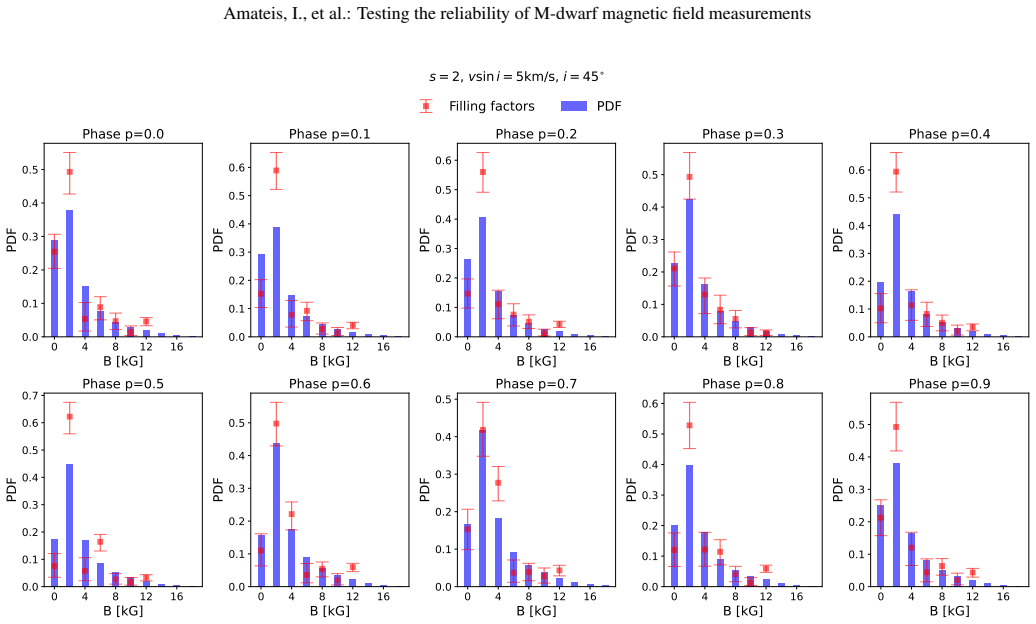
Synthetic tests demonstrate that Zeeman broadening diagnostics can recover the input magnetic field strengths in M dwarfs when the number of filling factors is chosen with WAIC or when line strengths are handled through a joint element abundance and continuum scaling; BIC and AIC sometimes select too few components in active rapid rotators and thereby underestimate the field, while free line strengths produce systematic underestimates of 30-50 percent.
What carries the argument
Synthetic Stokes I spectra of Ti I lines generated from 3D magnetohydrodynamic simulations combined with MARCS atmospheres, analysed with polarised radiative transfer and MCMC inference to compare model-selection criteria and line-strength treatments.
If this is right
- WAIC yields field estimates closer to the true values than BIC or AIC for active, rapidly rotating M dwarfs.
- Fitting a joint element abundance together with continuum scaling recovers the input field strength reliably, whereas treating individual line strengths as free parameters underestimates it by 30-50 percent.
- In most cases BIC, AIC and WAIC select the same number of magnetic components, but the choice matters for rapidly rotating active stars.
- The overall reliability of Zeeman broadening holds across a range of field strengths, rotational velocities and inclination angles when the better-performing methodological options are used.
Where Pith is reading between the lines
- Earlier measurements that treated line strengths independently may have systematically underestimated magnetic fields in active M dwarfs.
- Observers could improve consistency by reporting results from both WAIC and BIC/AIC and by adopting joint-abundance fitting as a default.
- The same synthetic-test framework can be extended to other spectral lines or to time-series data to check whether the same methodological sensitivities appear.
Load-bearing premise
The three-dimensional magnetohydrodynamic simulations combined with MARCS atmospheres produce sufficiently realistic temperature structures and Ti I line formation to stand in for real M dwarf photospheres.
What would settle it
Apply the same analysis pipeline to real high-resolution optical spectra of well-studied M dwarfs whose fields have been measured independently with infrared lines or Zeeman Doppler imaging and check whether the recovered values match within the stated uncertainties.
Figures



read the original abstract
M dwarfs host strong magnetic fields that can be measured using several complementary techniques. However, the impact of key methodological choices on Zeeman broadening diagnostics has not been systematically quantified. We assess the reliability of different approaches for inferring magnetic fields in M dwarfs using synthetic Stokes $I$ spectra of Ti I lines generated from three-dimensional magnetohydrodynamic simulations combined with MARCS model atmospheres. Synthetic observations were produced for different surface magnetic field strengths, projected rotational velocities, and inclination angles. Zeeman broadening and intensification were analysed using polarised radiative transfer calculations coupled with Markov chain Monte Carlo inference. We evaluated several statistical criteria (BIC, AIC, and WAIC) for selecting the number of magnetic filling factors and compared alternative strategies for treating line strengths. In most cases, BIC, AIC, and WAIC favoured the same number of components. For some active and rapidly rotating models, BIC and AIC selected fewer components and yielded lower field estimates, while WAIC generally produced closer agreement with the input field strengths. Treating individual line strengths as free parameters underestimated the field strength by 30--50%, whereas fitting a joint element abundance together with continuum scaling recovered the input field more reliably. Our results show that Zeeman broadening diagnostics can robustly recover magnetic fields in M dwarfs, but their accuracy depends strongly on methodological choices.
Editorial analysis
A structured set of objections, weighed in public.
Referee Report
Summary. The manuscript tests the reliability of Zeeman broadening diagnostics for inferring magnetic field strengths in M dwarfs. It generates synthetic Stokes I spectra of Ti I lines from 3D magnetohydrodynamic simulations combined with MARCS model atmospheres for varying field strengths, v sin i, and inclinations, then recovers the input fields via polarised radiative transfer and MCMC inference. The study compares model-selection criteria (BIC, AIC, WAIC) for choosing the number of magnetic filling factors and evaluates two line-strength treatments (individual free parameters versus joint element abundance plus continuum scaling).
Significance. If the results hold, the work provides a controlled, quantitative assessment of how methodological choices affect field recovery accuracy on synthetic data with known inputs. Strengths include direct recovery tests against prescribed field strengths and the demonstration that WAIC tends to yield closer agreement with inputs than BIC/AIC while joint-abundance fitting avoids the 30-50% underestimation seen with per-line strengths. This supplies practical guidance for observers even if the absolute applicability to real M dwarfs requires further checks.
major comments (2)
- [Abstract and §4] Abstract and §4 (results on model selection): the central claim that 'Zeeman broadening diagnostics can robustly recover magnetic fields in M dwarfs' is load-bearing for the paper's title and conclusions, yet it rests on the untested assumption that the 3D MHD + MARCS forward model reproduces real Ti I line formation and field distributions; no section compares synthetic profiles or recovered quantities to observed high-resolution M dwarf spectra or alternative forward models (e.g., non-LTE or different MHD codes).
- [Methods] Methods section describing synthetic spectrum generation: the choice of MARCS atmospheres plus the specific 3D MHD snapshots is invoked to generate the test data, but the manuscript provides no sensitivity tests to variations in temperature structure, magnetic topology, or line-formation physics that would quantify how robust the reported methodological differences are to those modeling assumptions.
minor comments (2)
- Figure captions and axis labels should explicitly state which statistical criterion and line-strength treatment each panel or curve corresponds to, to facilitate direct comparison of the recovery biases reported in the text.
- [Abstract] The abstract states 'in most cases' BIC/AIC/WAIC agree; adding the exact fraction of models or the specific conditions (e.g., active vs. quiet, slow vs. rapid rotators) would improve precision.
Simulated Author's Rebuttal
We thank the referee for the constructive report. Our study is a controlled test of methodological choices on synthetic spectra with known inputs; we address the comments by clarifying scope and adding caveats rather than expanding the computational scope of the present work.
read point-by-point responses
-
Referee: [Abstract and §4] Abstract and §4 (results on model selection): the central claim that 'Zeeman broadening diagnostics can robustly recover magnetic fields in M dwarfs' is load-bearing for the paper's title and conclusions, yet it rests on the untested assumption that the 3D MHD + MARCS forward model reproduces real Ti I line formation and field distributions; no section compares synthetic profiles or recovered quantities to observed high-resolution M dwarf spectra or alternative forward models (e.g., non-LTE or different MHD codes).
Authors: We agree that the phrasing in the abstract and §4 could be read as implying direct applicability to real data. The manuscript tests recovery accuracy under the specific assumptions of the 3D MHD snapshots and MARCS atmospheres; it does not claim the forward model exactly reproduces nature. We will revise the abstract and the final paragraph of §4 to state explicitly that the diagnostics recover the prescribed fields reliably within these modeling assumptions, and we will add a short discussion of the need for future validation against observed spectra and alternative forward models. revision: yes
-
Referee: [Methods] Methods section describing synthetic spectrum generation: the choice of MARCS atmospheres plus the specific 3D MHD snapshots is invoked to generate the test data, but the manuscript provides no sensitivity tests to variations in temperature structure, magnetic topology, or line-formation physics that would quantify how robust the reported methodological differences are to those modeling assumptions.
Authors: We accept that explicit sensitivity tests would be desirable. Generating additional MHD snapshots with varied temperature structures or topologies and repeating the full radiative-transfer and MCMC analysis is computationally prohibitive within the scope of this study. We will instead expand the methods and discussion sections to justify the adopted model choices, provide a qualitative assessment of how plausible variations could affect the relative performance of the tested methods, and flag full sensitivity experiments as future work. revision: partial
Circularity Check
No significant circularity; validation uses independent synthetic benchmarks
full rationale
The paper generates synthetic Stokes I spectra from 3D MHD simulations with independently prescribed magnetic field strengths, rotational velocities, and inclinations, then tests recovery via MCMC fitting of Zeeman broadening under varying statistical criteria and line-strength treatments. This is a standard forward-model validation against external truth values set by the simulation inputs rather than any fitted quantity or self-referential loop. No equation or claim reduces the recovered field strengths to the fitting procedure by construction, and no load-bearing step relies on self-citation chains or ansatzes imported from prior author work. The derivation chain remains self-contained against the stated synthetic benchmarks.
Axiom & Free-Parameter Ledger
free parameters (2)
- number of magnetic filling factors
- line strength treatment
axioms (2)
- domain assumption MARCS model atmospheres combined with 3D MHD simulations accurately capture M dwarf photospheric conditions and Ti I line formation
- standard math Polarized radiative transfer correctly models Zeeman broadening and intensification in the chosen lines
Reference graph
Works this paper leans on
-
[1]
Comparative study of small-scale magnetic fields on Boo A using optical and near-infrared spectroscopy. , keywords =. doi:10.1051/0004-6361/202453016 , archivePrefix =. 2503.04519 , primaryClass =
-
[2]
Multi-scale magnetic field investigation of the M-dwarf eclipsing binary CU Cancri. , keywords =. doi:10.1051/0004-6361/202348750 , archivePrefix =. 2402.00721 , primaryClass =
-
[3]
Physics of Magnetic Stars , date-added =
-
[4]
, keywords =. doi:10.1086/519017 , eprint =
-
[5]
arXiv , author =:1401.5250 , journal =
work page internal anchor Pith review Pith/arXiv arXiv
-
[6]
Magnetic Field of the Eclipsing M Dwarf Binary YY Gem
doi:10.3847/1538-4357/ab06c5 , eid =. arXiv , author =:1902.04157 , journal =
work page internal anchor Pith review Pith/arXiv arXiv doi:10.3847/1538-4357/ab06c5 1902
-
[7]
doi:10.1093/mnras/stad3144 , eprint =
, keywords =. doi:10.1093/mnras/stad3144 , eprint =
-
[8]
doi:10.1088/0004-637X/789/1/53 , eid =. arXiv , author =:1405.1767 , journal =
work page internal anchor Pith review Pith/arXiv arXiv doi:10.1088/0004-637x/789/1/53
-
[9]
doi:10.1038/s41550-017-0284-0 , eprint =
Nature Astronomy , keywords =. doi:10.1038/s41550-017-0284-0 , eprint =
-
[10]
Why Observations at Mid-infrared Wavelengths Partially Mitigate M Dwarf Star Host Stellar Activity Contamination in Exoplanet Transmission Spectroscopy. , keywords =. doi:10.3847/1538-4357/ad509a , adsurl =
-
[11]
doi:10.3847/1538-4357/ac54b8 , eid =. arXiv , author =:2202.07949 , journal =
-
[12]
Effects of M dwarf magnetic fields on potentially habitable planets
doi:10.1051/0004-6361/201321504 , eid =. arXiv , author =:1306.4789 , journal =
work page internal anchor Pith review Pith/arXiv arXiv doi:10.1051/0004-6361/201321504
-
[13]
A., Jardine , M., Morin , J., et al
, keywords =. doi:10.1093/mnras/stt2265 , eprint =
-
[14]
The CARMENES search for exoplanets around M dwarfs: The impact of rotation and magnetic fields on the radial velocity jitter in cool stars. , keywords =. doi:10.1051/0004-6361/202450836 , archivePrefix =. 2412.07691 , primaryClass =
-
[15]
Long-term magnetic activity of a sample of M-dwarf stars from the HARPS program . II. Activity and radial velocity. , keywords =. doi:10.1051/0004-6361/201118598 , archivePrefix =. 1202.1564 , primaryClass =
work page internal anchor Pith review Pith/arXiv arXiv doi:10.1051/0004-6361/201118598
-
[16]
The chemical make-up of the Sun: A 2020 vision
doi:10.1051/0004-6361/202140445 , eid =. arXiv , author =:2105.01661 , journal =
work page internal anchor Pith review Pith/arXiv arXiv doi:10.1051/0004-6361/202140445
-
[17]
Intrinsic Colors, Temperatures, and Bolometric Corrections of Pre-Main Sequence Stars
doi:10.1088/0067-0049/208/1/9 , eid =. arXiv , author =:1307.2657 , journal =
work page internal anchor Pith review Pith/arXiv arXiv doi:10.1088/0067-0049/208/1/9
-
[18]
Magnetic fields in M dwarfs from the CARMENES survey
2019 , bdsk-url-1 =. doi:10.1051/0004-6361/201935315 , eid =. arXiv , author =:1904.12762 , journal =
work page internal anchor Pith review Pith/arXiv arXiv doi:10.1051/0004-6361/201935315 2019
-
[19]
, keywords =. doi:10.1111/j.1365-2966.2010.17101.x , eprint =
-
[20]
2009, MNRAS, 392, 1591, doi: 10.1111/j.1365-2966.2008.14200.x
, keywords =. doi:10.1111/j.1365-2966.2008.13809.x , eprint =
-
[21]
2009, MNRAS, 392, 1591, doi: 10.1111/j.1365-2966.2008.14200.x
, keywords =. doi:10.1111/j.1365-2966.2008.13799.x , eprint =
-
[22]
doi:10.1051/0004-6361/200913149 , eprint =
, keywords =. doi:10.1051/0004-6361/200913149 , eprint =
-
[23]
, year = 2015, month = may, volume =
, month = may, number = 5, pages =. doi:10.1088/0031-8949/90/5/054005 , eid =
-
[24]
Living Reviews in Solar Physics , keywords =. doi:10.12942/lrsp-2005-8 , eid =
-
[25]
doi:10.1051/0004-6361/201525788 , eid =. arXiv , author =:1505.04739 , journal =
work page internal anchor Pith review Pith/arXiv arXiv doi:10.1051/0004-6361/201525788
-
[26]
, keywords =. doi:10.1086/498634 , eprint =
-
[27]
, keywords =. doi:10.1086/527432 , eprint =
-
[28]
arXiv , author =:2012.01259 , journal =
doi:10.1051/0004-6361/202040049 , eid =. arXiv , author =:2012.01259 , journal =
-
[29]
arXiv , author =:2305.16447 , journal =
doi:10.1051/0004-6361/202244666 , eid =. arXiv , author =:2305.16447 , journal =
-
[30]
Average magnetic field measurements in 292 M dwarfs
doi:10.1051/0004-6361/202243251 , eid =. arXiv , author =:2204.00342 , journal =
-
[31]
Explaining the coexistence of large-scale and small-scale magnetic fields in fully convective stars
doi:10.1088/2041-8205/813/2/L31 , eid =. arXiv , author =:1510.05541 , journal =
work page internal anchor Pith review Pith/arXiv arXiv doi:10.1088/2041-8205/813/2/l31 2041
-
[32]
Magnetic fields of M dwarfs. , keywords =. doi:10.1007/s00159-020-00130-3 , archivePrefix =. 2011.01781 , primaryClass =
-
[33]
The Global and Small-scale Magnetic Fields of Fully Convective, Rapidly Spinning M Dwarf Pair GJ65 A and B. , keywords =. doi:10.3847/2041-8213/835/1/L4 , archivePrefix =. 1702.02946 , primaryClass =
work page internal anchor Pith review Pith/arXiv arXiv doi:10.3847/2041-8213/835/1/l4 2041
-
[34]
Strong dipole magnetic fields in fast rotating fully convective stars
Strong dipole magnetic fields in fast rotating fully convective stars. Nature Astronomy , keywords =. doi:10.1038/s41550-017-0184 , archivePrefix =. 1801.08571 , primaryClass =
work page internal anchor Pith review Pith/arXiv arXiv doi:10.1038/s41550-017-0184
-
[35]
A grid of MARCS model atmospheres for late-type stars. I. Methods and general properties. , keywords =. doi:10.1051/0004-6361:200809724 , archivePrefix =. 0805.0554 , primaryClass =
work page internal anchor Pith review Pith/arXiv arXiv doi:10.1051/0004-6361:200809724
-
[36]
Least squares deconvolution of the stellar intensity and polarization spectra
Least-squares deconvolution of the stellar intensity and polarization spectra. , keywords =. doi:10.1051/0004-6361/201015429 , archivePrefix =. 1008.5115 , primaryClass =
work page internal anchor Pith review Pith/arXiv arXiv doi:10.1051/0004-6361/201015429
-
[37]
Small-scale magnetic fields of the spectroscopic binary T Tauri stars V1878 Ori and V4046 Sgr. , keywords =. doi:10.1051/0004-6361/202142425 , archivePrefix =. 2201.04978 , primaryClass =
-
[38]
Solar Bayesian Analysis Toolkit A New Markov Chain Monte Carlo IDL Code for Bayesian Parameter Inference. , keywords =. doi:10.3847/1538-4365/abc5c1 , archivePrefix =. 2005.05365 , primaryClass =
-
[39]
Markov Chain Monte Carlo Methods for Bayesian Data Analysis in Astronomy
Markov Chain Monte Carlo Methods for Bayesian Data Analysis in Astronomy. , keywords =. doi:10.1146/annurev-astro-082214-122339 , archivePrefix =. 1706.01629 , primaryClass =
work page internal anchor Pith review Pith/arXiv arXiv doi:10.1146/annurev-astro-082214-122339
-
[40]
Magnetic fields of non-degenerate stars
Magnetic Fields of Nondegenerate Stars. , keywords =. doi:10.1146/annurev-astro-082708-101833 , archivePrefix =. 0904.1938 , primaryClass =
work page internal anchor Pith review Pith/arXiv arXiv doi:10.1146/annurev-astro-082708-101833 1938
-
[41]
Structure and evolution of low-mass stars
Structure and evolution of low-mass stars. , keywords =. doi:10.48550/arXiv.astro-ph/9704118 , archivePrefix =. astro-ph/9704118 , primaryClass =
work page internal anchor Pith review Pith/arXiv arXiv doi:10.48550/arxiv.astro-ph/9704118
-
[42]
, year = 2014, month = aug, volume =
Solar Dynamo Theory. , year = 2014, month = aug, volume =. doi:10.1146/annurev-astro-081913-040012 , adsurl =
-
[43]
On the Generation of the Largescale and Turbulent Magnetic Fields in the Solar Type Stars. , keywords =. doi:10.1007/BF00690652 , adsurl =
-
[44]
Masses and Radii of Low-Mass Stars: Theory versus Observations
Masses and Radii of Low-Mass Stars: Theory Versus Observations. , keywords =. doi:10.1007/s10509-006-9081-4 , archivePrefix =. astro-ph/0511431 , primaryClass =
work page internal anchor Pith review Pith/arXiv arXiv doi:10.1007/s10509-006-9081-4
-
[45]
On the Correlation between the Magnetic Activity Levels, Metallicities, and Radii of Low-Mass Stars. , keywords =. doi:10.1086/513142 , archivePrefix =. astro-ph/0701702 , primaryClass =
work page internal anchor Pith review Pith/arXiv arXiv doi:10.1086/513142
-
[46]
Observations of Cool-Star Magnetic Fields
Observations of Cool-Star Magnetic Fields. Living Reviews in Solar Physics , keywords =. doi:10.12942/lrsp-2012-1 , archivePrefix =. 1203.0241 , primaryClass =
work page internal anchor Pith review Pith/arXiv arXiv doi:10.12942/lrsp-2012-1 2012
-
[47]
Estimating magnetic filling factors from Zeeman-Doppler magnetograms
Estimating Magnetic Filling Factors from Zeeman-Doppler Magnetograms. , keywords =. doi:10.3847/1538-4357/ab1096 , archivePrefix =. 1903.05595 , primaryClass =
work page internal anchor Pith review Pith/arXiv arXiv doi:10.3847/1538-4357/ab1096 1903
-
[48]
Characterising the surface magnetic fields of T Tauri stars with high-resolution near-infrared spectroscopy. , keywords =. doi:10.1051/0004-6361/201935695 , archivePrefix =. 1909.04965 , primaryClass =
-
[49]
Hidden magnetic fields of young suns. , keywords =. doi:10.1051/0004-6361/201937185 , archivePrefix =. 2002.10469 , primaryClass =
-
[50]
Determination of small-scale magnetic fields on Sun-like stars in the near-infrared using CRIRES ^ +. , keywords =. doi:10.1051/0004-6361/202346314 , archivePrefix =. 2305.06873 , primaryClass =
-
[51]
The magnetic field and multiple planets of the young dwarf AU Mic. , keywords =. doi:10.1093/mnras/stad1193 , archivePrefix =. 2304.09642 , primaryClass =
-
[52]
I., Donati, J.-F., Bellotti, S., et al
Rotational modulation and long-term evolution of the small-scale magnetic fields of M dwarfs observed with SPIRou. , keywords =. doi:10.1051/0004-6361/202554902 , archivePrefix =. 2508.04569 , primaryClass =
-
[53]
Alvarado-G \'o mez , J. D., Cohen , O., Drake , J. J., et al. 2022, , 928, 147
work page 2022
-
[54]
Anfinogentov , S. A., Nakariakov , V. M., Pascoe , D. J., & Goddard , C. R. 2021, , 252, 11
work page 2021
- [55]
-
[56]
Beeck , B., Sch \"u ssler , M., Cameron , R. H., & Reiners , A. 2015, , 581, A42
work page 2015
-
[57]
Berdyugina , S. V. 2005, Living Reviews in Solar Physics, 2, 8
work page 2005
-
[58]
Browning , M. K. 2008, , 676, 1262
work page 2008
- [59]
- [60]
-
[61]
Cristofari , P. I., Donati , J. F., Moutou , C., et al. 2023, , 526, 5648
work page 2023
- [62]
-
[63]
Donati , J. F. & Landstreet , J. D. 2009, , 47, 333
work page 2009
-
[64]
F., Morin , J., Petit , P., et al
Donati , J. F., Morin , J., Petit , P., et al. 2008, , 390, 545
work page 2008
-
[65]
Durney , B. R., De Young , D. S., & Roxburgh , I. W. 1993, , 145, 207
work page 1993
-
[66]
Feiden , G. A. & Chaboyer , B. 2014, , 789, 53
work page 2014
-
[67]
Gomes da Silva , J., Santos , N. C., Bonfils , X., et al. 2012, , 541, A9
work page 2012
-
[68]
Gustafsson , B., Edvardsson , B., Eriksson , K., et al. 2008, , 486, 951
work page 2008
- [69]
- [70]
-
[71]
Johns-Krull , C. M. 2007, , 664, 975
work page 2007
-
[72]
K \"a pyl \"a , P. J. 2021, , 651, A66
work page 2021
-
[73]
Kislyakova , K. G., Noack , L., Johnstone , C. P., et al. 2017, Nature Astronomy, 1, 878
work page 2017
-
[74]
2007, in Physics of Magnetic Stars, ed
Kochukhov , O. 2007, in Physics of Magnetic Stars, ed. I. I. Romanyuk & D. O. Kudryavtsev , 109--118
work page 2007
- [75]
-
[76]
Kochukhov , O., Hackman , T., Lehtinen , J. J., & Wehrhahn , A. 2020, , 635, A142
work page 2020
- [77]
- [78]
- [79]
-
[80]
Lavail , A., Kochukhov , O., & Hussain , G. A. J. 2019, , 630, A99
work page 2019
discussion (0)
Sign in with ORCID, Apple, or X to comment. Anyone can read and Pith papers without signing in.