REVIEW 1 major objections 6 minor 2 cited by
Introduction to the Cohomology of the Flag Variety
T0 review · 1 major / 6 minor · reviewed 2026-08-06 · deepseek-v4-flash
Pith's one-line read Every Schubert counting problem reduces to multiplying Schubert polynomials and reading off one coefficient.
desk verdict A solid, well-crafted survey chapter with no new theorem; the revisionist Monk-style route is a real pedagogical contribution, and the chapter deserves a serious referee. read the letter →
The pith
A machine-rendered reading of the paper's core claim, the machinery that carries it, and where it could break.
The reading
What carries the argument
The central objects are the Schubert varieties $X_w$, their classes $[X_w]$ in the Chow ring $A^*(\mathrm{Fl}(n)) \cong H^*(\mathrm{Fl}(n))$, and the Schubert polynomials $S_w$ defined by the transition equation via the lex-largest inversion recurrence, which the chapter derives from Monk's formula. The mechanism doing the work is the basis property: the Schubert polynomials form a basis of the coinvariant algebra with leading monomial given by the Lehmer code, and the induced ring isomorphism sends the product of Schubert classes to the ordinary product of the corresponding polynomials, so that structure constants are read off as expansion coefficients.
What would settle it
Compute a Schubert structure constant $c^w_{uv}$ in a small case such as $\mathrm{Fl}(4)$ or $\mathrm{Fl}(5)$ by two independent routes: expand the product of the corresponding Schubert polynomials in the Schubert basis, and directly solve the generic polynomial system of rank conditions that defines the triple intersection; any mismatch between the expansion coefficient and the number of solutions would refute the claimed reduction.
Extended reading notes
Core claim
The chapter establishes that for the complete flag variety $\mathrm{Fl}(n)$, the Chow ring $A^*(\mathrm{Fl}(n))$ is isomorphic to the cohomology ring and to the coinvariant algebra $\mathbb{Z}[x_1,\dots,x_n]/I_n^+$, with the Schubert classes $[X_w]$ forming a basis. Multiplication of these classes corresponds to generic intersection of the corresponding Schubert varieties, so the structure constants $c^w_{uv}$ in $[X_u][X_v] = \sum c^w_{uv}[X_w]$ are nonnegative integers counting points in 0-dimensional triple intersections. The chapter proves that the Schubert polynomials $S_w$ represent the Schubert classes $[X_{w_0 w}]$ and form a basis of the coinvariant algebra, so that products of Schubert classes become ordinary products of polynomials expanded in the Schubert basis. Thus the answer to any Schubert problem is a specific coefficient in a product of Schubert polynomials, and the authors state in Section 3.10 that "the generic solutions can be found by polynomial arithmetic and some linear algebra. The theory is completely rigorous."
Load-bearing premise
The reduction rests on the unproved theory of rational equivalence and the moving lemma, taken as given: that multiplying Chow classes of Schubert varieties genuinely counts their points of intersection when the varieties are moved into generic position.
Editorial extensions
If this is right
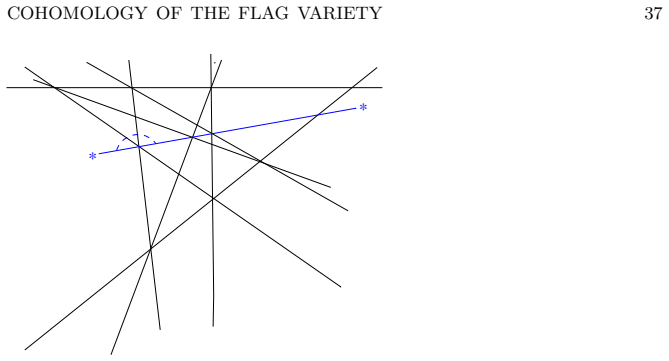
- Any 0-dimensional Schubert problem in the complete flag variety can be solved by expanding a product of Schubert polynomials in the Schubert basis and extracting one coefficient, which the chapter demonstrates on the classic problem of counting lines meeting four given lines.
- The Schubert structure constants are always nonnegative integers, because by the Geometry Implies Positivity theorem each one counts the flags in a generic triple intersection of Schubert varieties.
- The ring structure of the flag variety is generated by the special classes $[X_{w_0 s_i}]$, so Monk's formula for multiplication by these classes determines all structure constants recursively.
- The cohomology rings of all partial flag varieties and Grassmannians are governed by the same structure constants, extending the polynomial-arithmetic reduction beyond complete flags.
- The remaining barrier is computational: Narayanan's result that Schubert problems are at least as hard as $\#P$ bounds the feasibility of carrying out the polynomial expansions for large $n$.
Reading between the lines
- This reduction implies that progress on computing Schubert structure constants directly translates into progress on enumerative geometry, while the $\#P$-hardness result suggests that no universal polynomial-time combinatorial rule for these constants can exist unless the polynomial hierarchy collapses.
- The same polynomial-arithmetic framework should extend, with positivity lost, to equivariant and quantum cohomology and to double Schubert polynomials, where the chapter's degeneracy-locus discussion already points toward how the moving-flag language adapts.
- The realizability question for permutation arrays -- which higher-dimensional tables of intersection dimensions actually arise from configurations of flags -- is the natural combinatorial testbed for generalizing the reduction from pairs of flags to arbitrary numbers of reference flags.
- Because the chapter deliberately bypasses the divided-difference route, its transition-equation definition of Schubert polynomials is itself a testable claim: if the transition recurrence ever produced a polynomial not representing the corresponding Schubert class, the entire computational pipeline would need repair.
Editorial analysis
A structured set of objections, weighed in public.
Referee Report
Summary. This paper is a survey chapter intended for the 'Handbook of Combinatorial Algebraic Geometry: Subvarieties of the Flag Variety.' Its central claim is that Schubert problems on complete flag varieties can be reduced, rigorously and algorithmically, to expanding products of Schubert polynomials in the Schubert basis and extracting coefficients. The chapter develops the necessary background: flag varieties and Schubert varieties, Bruhat order, the Chow/cohomology ring, Monk's formula, the transition equation definition of Schubert polynomials, and their combinatorial models (pipe dreams, bumpless pipe dreams, etc.). It also surveys related geometry (matrix Schubert varieties, singular loci, degeneracy loci) and lists open problems. The exposition is constructive and intentionally follows a 'revisionist' path, starting from Monk's approach rather than the BGG/Demazure divided-difference formalism.
Significance. If the chapter's central assertion is accepted, it provides a clear and useful survey of a foundational area at the interface of algebraic geometry and combinatorics. The text is careful to credit original sources and gives a large number of exercises with citations, making it a valuable pedagogical resource. The explicit worked computation in §3.10, showing that (S_{1324})^4 expands with coefficient 2 on S_{3412} and thereby recovers the answer to the classical 'lines meeting four lines' problem, convincingly demonstrates the reduction. The chapter also serves as a broad introduction to modern tools (pipe dreams, puzzles, Stanley symmetric functions, etc.) and openly discusses computational complexity and open problems. For a handbook survey, the delegation of the deepest intersection-theoretic foundations to Fulton's books is appropriate rather than a flaw.
major comments (1)
- [§3.7 and §3.10] The chapter's main claim that 'the theory is completely rigorous' depends on Theorem 3.82 and Theorem 3.115(e), but the exposition does not state the precise transversality hypothesis (e.g., Kleiman's transversality theorem) underlying the equality between Chow ring multiplication and generic intersection numbers. I recommend adding a remark in §3.7 that explicitly names the external results on which Theorem 3.82 rests and notes their validity for the complete flag variety, with a specific citation to [133] or [134]. This would make the rigor claim in §3.10 fully supportable within the chapter's own text rather than leaving the reader to infer the missing hypothesis.
minor comments (6)
- [§3.9, Eq. (3.50)] The monomial for the longest permutation is typeset incompletely; it should read x_1^{n-1} x_2^{n-2} ... x_{n-1}^1 x_n^0, with the final exponent 0 explicitly written.
- [§3.6] After stating that the Realizability Conjecture is true for d = 1, 2, 3, the text says 'Nonetheless, the conjecture is false' without specifying the dimension; the counterexamples in [40] occur for higher d, and the sentence would be clearer if it said so explicitly.
- [§3.10, Eq. (3.56)] The expansion (x1+x2)^4 = 2 S_3412 + 3 S_25134 + S_162345 is asserted without indicating that S_25134 and S_162345 are permutations in S5 and S6, respectively; adding the one-line notation or a citation would help the reader verify the computation.
- [§3.5, Example 3.51] The statement 'z42 is not a flag minor' may confuse readers because z42 is a matrix entry; consider rephrasing to 'the entry z42 is not a flag minor' to emphasize the distinction.
- [§3.2, after Eq. (3.6)] The phrase 'tij are called transpositions' uses an untypeset t_{ij}; fix the indexing to t_{ij} throughout for consistency.
- [Note to Readers] The note states 'We hope to have it polished up soon for publication in 2025'; the final published version should remove this preliminary-status language or update it.
Circularity Check
No significant circularity: the chapter's reduction of Schubert problems to Schubert-polynomial arithmetic is grounded in standard intersection theory and proved from Monk's formula; self-citations are historical or auxiliary, not load-bearing.
full rationale
The chapter is an expository survey whose central reduction is: Schubert problems → products of Schubert classes → cohomology/coinvariant algebra → Schubert polynomials. The bridge is Theorem 3.82, which is not derived from Schubert polynomials; it is the standard Chow-ring statement that intersection numbers are coefficients in products of Chow classes, and the paper explicitly delegates the foundational moving-lemma/rational-equivalence machinery to Fulton's books, saying in §3.7: "Defining rational equivalence explicitly is beyond the scope of this chapter." Theorem 3.115, relating Schubert polynomials to Schubert classes, is proved in the text: Schubert polynomials are first defined by the transition equation (3.42), and the proof of Theorem 3.115 uses Lemma 3.114, whose proof is geometric (pullback under Fl(n) → Fl(n+1)), together with the independently known fact that Schubert classes form a basis of A*(Fl(n)). The structure-constant equality (e) is a consequence of the ring isomorphism f, not an input to it. Monk's formula is proved geometrically via triple intersections, and the polynomial results are then derived from it; no step fits a parameter and calls the result a prediction, and no object is defined in terms of its own conclusion. Self-citations such as Billey–Vakil in §3.6 and Billey–Jockusch–Stanley in §4.1 concern auxiliary algorithms and historical attributions; the main combinatorial identities used later are either proved or sketched in the chapter, and the load-bearing geometry is cited to standard references. The paper also hedges the Hilbert-15 claim in §2.1. I find no circular step.
Assumptions & free parameters
assumptions (4)
- standard math The Chow ring A*(Fl(n)) is free with basis the Schubert classes [X_w] for w in S_n.
- standard math A*(Z) is isomorphic to singular cohomology H*(Z;Z) when Z is smooth and has a cellular decomposition.
- standard math Schubert polynomials S_w represent the Schubert class [X_{w0 w}] in the coinvariant algebra R_n.
- domain assumption The moving lemma and rational equivalence for flag varieties: generic translates of Schubert varieties intersect as their Chow classes predict.
Cite this review
Pith. "Pith review of Introduction to the Cohomology of the Flag Variety." pith.science (2026). https://pith.science/paper/3X2L7S47
@misc{pith2026250621064,
  author       = {Pith},
  title        = {Pith review of: Introduction to the Cohomology of the Flag Variety},
  year         = {2026},
  howpublished = {\url{https://pith.science/paper/3X2L7S47}},
  note         = {Machine review of arXiv:2506.21064}
}
read the original abstract
One hundred years ago, Hilbert gave a list of important open problems in mathematics. His 15th problem asked for the development of a rigorous calculus explaining Schubert's enumerative results for intersecting varieties defined by rank conditions on vector spaces. Today by way of many contributions in algebraic topology, geometry, and combinatorics, we consider this solved. Yet, deep questions remain about the subtleties of actually carrying out the process. In this chapter, we hope to summarize the rigorous development of what has become known as Schubert calculus, with an eye toward computation. We discuss Grassmannians and flag varieties and their cohomology rings, following Monk's constructive algebraic approach. We derive formulas for Schur and Schubert polynomials, which represent cohomology classes of Schubert varieties. We hint at the vast literature in this area and point to the other references in the Handbook for more information. Finally, we identify open problems that remain a challenge even with modern tools at our fingertips in hopes of inspiring further contributions in this fascinating field. This is intended as the first chapter of a book entitled "Handbook of Combinatorial Algebraic Geometry: Subvarieties of the Flag Variety", a compendium of topics in the area. The book is being edited by Erik Insko, Martha Precup, and Ed Richmond. In addition to this introductory chapter, others will cover more advanced topics such as Kazhdan-Lusztig varieties, generalized smooth Schubert varieties, Richardson varieties and positroid varieties, spherical and torus orbit closures, spanning line configurations, different types of Hessenberg varieties, and generalizations to Kac-Moody flag varieties, each written by experts in those areas. We hope you enjoy this chapter enough to seek out the others, and that you send us any comments or corrections you find as you read this article!
Figures


Figures from the paper (58 more)















Forward citations
Cited by 2 Pith papers
-
Richardson tableaux and Schubert positivity
The Schubert cycle expansion of a Springer fiber component equal to a Richardson variety, indexed by a Richardson tableau, is computed combinatorially using translation-equivalent Bruhat intervals and Sottile's Pieri rule.
-
Quantum Schubert calculus for smooth Schubert divisors of $F\ell_n$
The quantum cohomology of the smooth Schubert divisor X_{w0 s_{n-1}} in Fl_n is presented, with a quantum Chevalley formula and quantum Schubert polynomials identical to those of Fl_n.
Reference graph
Works this paper leans on
-
[133]
Fulton, Intersection Theory, Springer-Verlag, New York, 1984
W. Fulton, Intersection Theory, Springer-Verlag, New York, 1984
1984
-
[134]
54 in CBMS Regional Conference Series in Mathematics, Amer.Math
, Introduction to Intersection Theory in Algebraic Geometry , no. 54 in CBMS Regional Conference Series in Mathematics, Amer.Math. Soc., 1984
1984
-
[1]
Abe and S
H. Abe and S. Billey, Consequences of the Lakshmibai-Sandhya Theorem: the ubiquity of permutation patterns in Schubert calculus and related geometry , in Schubert Calculus — Osaka 2012, Mathematical Society of Japan, 2016, pp. 1–52
2012
-
[2]
A. Adve, C. Robichaux, and A. Yong , An efficient algorithm for deciding vanishing of Schubert polynomial coefficients, Adv. Math., 383 (2021)
2021
-
[3]
Agnihotri and C
S. Agnihotri and C. Woodward, Eigenvalues of products of unitary matrices and quantum Schubert calculus, Math. Res. Lett., 5 (1998), pp. 817–836
1998
-
[4]
Akyıldız, A
E. Akyıldız, A. Lascoux, and P. Pragacz , Cohomology of Schubert subvarieties of GLn/P , J. Differential Geom., 35 (1992), pp. 511–519
1992
-
[5]
Almousa, D
A. Almousa, D. Huang, P. Klein, A. LaClair, Y. Luo, and J. McDonough , MatrixSchubert – matrix Schubert varieties and ASM varieties, Macaulay 2 Development Team, 2023.https://macaulay2. com/doc/Macaulay2/share/doc/Macaulay2/MatrixSchubert/html/index.html
2023
-
[6]
Anderson, Filtrations and recursions for schubert modules , arXiv, (2024)
D. Anderson, Filtrations and recursions for schubert modules , arXiv, (2024)
2024
Show all 299 references
-
[7]
Anderson and L
D. Anderson and L. Chen , Positivity of equivariant Gromov-Witten invariants , Math. Res. Lett., 22 (2015), pp. 1–9
2015
-
[8]
Anderson and W
D. Anderson and W. Fulton , Chern class formulas for classical-type degeneracy loci , Compos. Math., 154 (2018), pp. 1746–1774
2018
-
[9]
Anderson and W
D. Anderson and W. Fulton, Equivariant Cohomology in Algebraic Geometry, Cambridge University Press, Cambridge, UK, 2023
2023
-
[10]
G. E. Andrews , Plane partitions. V. The TSSCPP conjecture , J. Combin. Theory Ser. A, 66 (1994), pp. 28–39
1994
-
[11]
Angel, A
O. Angel, A. E. Holroyd, D. Romik, and B. Vir ´ag, Random sorting networks , Advances in Mathematics, 215 (2007), pp. 839–868
2007
-
[12]
D. L. Applegate, R. E. Bixby, V. Chv ´atal, and W. J. Cook , The Traveling Salesman Problem, Princeton Series in Applied Mathematics, Princeton University Press, Princeton, NJ, 2006. A computational study
2006
-
[13]
Ardila-Mantilla, The geometry of geometries: matroid theory, old and new , in ICM—International Congress of Mathematicians
F. Ardila-Mantilla, The geometry of geometries: matroid theory, old and new , in ICM—International Congress of Mathematicians. Vol. 6. Sections 12–14, EMS Press, Berlin, 2023, pp. 4510–4541
2023
-
[14]
Ardila-Mantilla, Intersection theory of matroids: variations on a theme , arXiv, (2024)
F. Ardila-Mantilla, Intersection theory of matroids: variations on a theme , arXiv, (2024)
2024
-
[15]
Arkani-Hamed, J
N. Arkani-Hamed, J. Bourjaily, F. Cachazo, A. Goncharov, A. Postnikov, and J. Trnka , Grassmannian geometry of scattering amplitudes , Cambridge University Press, Cambridge, 2016
2016
-
[16]
Arthur, E
J. Arthur, E. Bombieri, K. Chandrasekharan, F. Hirzebruch, G. Prasad, J.-P. Serre, T. A. Springer, and J. Tits , Armand Borel (1923–2003) , Notices Amer. Math. Soc., 51 (2004), pp. 498–524
2004
-
[17]
Assaf and D
S. Assaf and D. Searles , Schubert polynomials, slide polynomials, Stanley symmetric functions and quasi-Yamanouchi pipe dreams, Adv. Math., 306 (2017), pp. 89–122
2017
-
[18]
Beilinson and J
A. Beilinson and J. Bernstein , Localization of g-modules, C. R. Acad.Sci. Paris Ser. I Math, 292 (1981), pp. 15–18
1981
-
[19]
Belkale, Local systems on P1 − s for s a finite set , Comp
P. Belkale, Local systems on P1 − s for s a finite set , Comp. Math., 129 (2001), p. 67–86
2001
-
[20]
Algebraic Geom., 15 (2006), pp
, Geometric proofs of Horn and saturation conjectures , J. Algebraic Geom., 15 (2006), pp. 133–173
2006
-
[21]
Belkale, Quantum generalization of the Horn conjecture , J
P. Belkale, Quantum generalization of the Horn conjecture , J. Amer. Math. Soc., 21 (2008), pp. 365– 408
2008
-
[22]
Belkale and S
P. Belkale and S. Kumar , Eigenvalue problem and a new product in cohomology of flag varieties , Invent. Math., 166 (2006), pp. 185–228
2006
-
[23]
Bergeron, A combinatorial construction of the Schubert polynomials , J
N. Bergeron, A combinatorial construction of the Schubert polynomials , J. Combin. Theory Ser. A, 60 (1992), pp. 168–182
1992
-
[24]
Bergeron and S
N. Bergeron and S. Billey , RC-graphs and Schubert polynomials , Experimental Mathematics, 2 (1993), pp. 257–269
1993
-
[25]
Bergeron, C
N. Bergeron, C. Ceballos, and V. Pilaud , Hopf dreams and diagonal harmonics , J. Lond. Math. Soc. (2), 105 (2022), pp. 1546–1600
2022
-
[26]
Bergeron, S
N. Bergeron, S. Mykytiuk, F. Sottile, and S. van Willigenburg , Shifted quasi-symmetric functions and the Hopf algebra of peak functions , Discrete Math., 246 (2002), pp. 57–66. 180 SARA C. BILLEY, YIBO GAO, AND BRENDAN PA WLOWSKI
2002
-
[27]
Bergeron and F
N. Bergeron and F. Sottile , Schubert polynomials, the Bruhat order, and the geometry of flag manifolds, Duke Math. J., 95(2) (1998), pp. 373–423
1998
-
[28]
Bernstein, I
I. Bernstein, I. Gelfand, and S. Gelfand , Schubert cells and cohomology of the spaces G/P , Russian Math. Surveys, 28 (1973), pp. 1–26
1973
-
[29]
Billey, Pattern avoidance and rational smoothness of Schubert varieties , Adv
S. Billey, Pattern avoidance and rational smoothness of Schubert varieties , Adv. in Math., 139 (1998), pp. 141–156
1998
-
[30]
, Transition Equations for Isotropic Flag Manifolds , Discrete Math., 193 (1998), pp. 93–116
1998
-
[31]
J., 96 (1999), pp
, Kostant polynomials and the cohomology ring for G/B, Duke Math. J., 96 (1999), pp. 205–224
1999
-
[32]
Billey, K
S. Billey, K. Burdzy, and B. E. Sagan , Permutations with given peak set , J. Integer Seq., 16 (2013), pp. Article 13.6.1, 18
2013
-
[33]
Billey and I
S. Billey and I. Coskun , Singularities of generalized Richardson varieties , Comm. Algebra, 40 (2012), pp. 1466–1495
2012
-
[34]
Billey and M
S. Billey and M. Haiman , Schubert polynomials for the classical groups , J. Amer. Math. Soc., 8 (1995), pp. 443–482
1995
-
[35]
Billey, Z
S. Billey, Z. Hamaker, A. Roberts, and B. Young , Coxeter-Knuth graphs and a signed Little map for type B reduced words , Electron. J. Combin., 21 (2014), pp. Paper 4.6, 39
2014
-
[36]
Billey, W
S. Billey, W. Jockusch, and R. P. Stanley, Some combinatorial properties of Schubert polynomials, J. Algebraic Combin., 2 (1993), pp. 345–374
1993
-
[37]
Billey and V
S. Billey and V. Lakshmibai, Singular Loci of Schubert Varieties, no. 182 in Progress in Mathematics, Birkh¨ auser, 2000
2000
-
[38]
Billey and B
S. Billey and B. Pawlowski, Permutation patterns, Stanley symmetric functions, and generalized Specht modules, J. Combin. Theory Ser. A, 127 (2014), pp. 85–120
2014
-
[39]
Billey and A
S. Billey and A. Postnikov , Smoothness of Schubert varieties via patterns in root subsystems , Adv. in Appl. Math., 34 (2005), pp. 447–466
2005
-
[40]
Billey and R
S. Billey and R. V akil, Intersections of Schubert varieties and other permutation array schemes , IMA Volumes in Mathematics and its Applications, 146 (2007), pp. 21–54
2007
-
[41]
Billey and G
S. Billey and G. S. W arrington, Kazhdan-Lusztig polynomials for 321-hexagon-avoiding permuta- tions, J. Algebraic Combin., 13 (2001), pp. 111–136
2001
-
[42]
S. C. Billey and T. Braden, Lower bounds for Kazhdan-Lusztig polynomials from patterns, Transform. Groups, 8 (2003), pp. 321–332
2003
-
[43]
S. C. Billey, A. E. Holroyd, and B. J. Young , A bijective proof of Macdonald’s reduced word formula, Algebr. Comb., 2 (2019), pp. 217–248
2019
-
[44]
S. C. Billey and B. C. Jones , Embedded factor patterns for Deodhar elements in Kazhdan-Lusztig theory, Ann. Comb., 11 (2007), pp. 285–333
2007
-
[45]
S. C. Billey and P. R. W. McNamara , The contributions of Stanley to the fabric of symmetric and quasisymmetric functions , in The mathematical legacy of Richard P. Stanley, Amer. Math. Soc., Providence, RI, 2016, pp. 83–104
2016
-
[46]
S. C. Billey and B. E. Tenner , Fingerprint databases for theorems , Notices of the AMS, 60 (2013)
2013
-
[47]
S. C. Billey and G. S. W arrington, Maximal singular loci of Schubert varieties in SL(n)/B, Trans. Amer. Math. Soc., 355 (2003), pp. 3915–3945
2003
-
[48]
S. C. Billey and J. E. Weaver , Criteria for smoothness of positroid varieties via pattern avoidance, Johnson graphs, and spirographs , Trans. Am. Math. Soc., Ser. B, 12 (2025), pp. 112–164
2025
-
[49]
, Basic Schubert calculus , 2021
Billey, Sara C. , Basic Schubert calculus , 2021. Online. Part 1: https://icerm.brown.edu/video_ archive/?play=459, and Part 2: https://icerm.brown.edu/video_archive/?play=2427
2021
-
[50]
Bj¨orner, Posets, regular CW complexes and Bruhat order , European J
A. Bj¨orner, Posets, regular CW complexes and Bruhat order , European J. Combin., 5 (1984), pp. 7–16
1984
-
[51]
Bj ¨orner and F
A. Bj ¨orner and F. Brenti , An improved tableau criterion for Bruhat order , Electron. J. Combin., 3 (1996)
1996
-
[52]
Bj ¨orner and F
A. Bj ¨orner and F. Brenti , Combinatorics of Coxeter Groups , vol. 231 of Graduate Texts in Mathematics, Springer, New York, 2005
2005
-
[53]
Bj ¨orner and M
A. Bj ¨orner and M. W achs, Bruhat order of Coxeter groups and shellability , Adv. in Math., 43 (1982), pp. 87–100
1982
-
[54]
Blundell, L
C. Blundell, L. Buesing, A. Davies, P. Veliˇckovi´c, and G. Williamson, Towards combinatorial invariance for Kazhdan-Lusztig polynomials , Represent. Theory, 26 (2022), pp. 1145–1191. COHOMOLOGY OF THE FLAG V ARIETY 181
2022
-
[55]
Borel, Sur la cohomologie des espaces fibr´ es principaux et des espaces homog` enes de groupes de Lie compacts, Ann
A. Borel, Sur la cohomologie des espaces fibr´ es principaux et des espaces homog` enes de groupes de Lie compacts, Ann. of Math. (2), 57 (1953), pp. 115–207
1953
-
[56]
Bott and H
R. Bott and H. Samelson , Applications of the theory of Morse to symmetric spaces , American Journal of Mathematics, 80 (1958), pp. 964–1029
1958
-
[57]
Bourbaki, Groupes et Algebr` es de Lie, Masson, 1957
N. Bourbaki, Groupes et Algebr` es de Lie, Masson, 1957
1957
-
[58]
Bourjaily and H
J. Bourjaily and H. Thomas , What is... the amplituhedron , Not. Amer. Math. Soc., 65 (2018), pp. 167–169
2018
-
[59]
Bousquet-M´elou and S
M. Bousquet-M´elou and S. Butler , Forest-like permutations, Ann. Comb., 11 (2007), pp. 335–354
2007
-
[60]
Braden and R
T. Braden and R. MacPherson , From moment graphs to intersection cohomology , Mathematische Annalen, 321 (2001), pp. 533–551
2001
-
[61]
Brenti, The intersection cohomology of Schubert varieties is a combinatorial invariant , European J
F. Brenti, The intersection cohomology of Schubert varieties is a combinatorial invariant , European J. Combin., 25 (2004), pp. 1151–1167
2004
-
[62]
Brenti, F
F. Brenti, F. Caselli, and M. Marietti , Special matchings and Kazhdan-Lusztig polynomials , Adv. Math., 202 (2006), pp. 555–601
2006
-
[63]
Brion, Equivariant cohomology and equivariant intersection theory , in Representation theories and algebraic geometry
M. Brion, Equivariant cohomology and equivariant intersection theory , in Representation theories and algebraic geometry. Proceedings of the NATO Advanced Study Institute, Montreal, Canada, July 28–August 8, 1997, Dordrecht: Kluwer Academic Publishers, 1998, pp. 1–37. (Notes b...
1997
-
[64]
, Positivity in the Grothendieck group of complex flag varieties. , J. Algebra, 258 (2002), pp. 137–159
2002
-
[65]
, Lectures on the geometry of flag varieties , in Topics in cohomological studies of algebraic varieties, Trends Math., Birkh¨ auser, Basel, 2005, pp. 33–85
2005
-
[66]
Brion and S
M. Brion and S. Kumar , Frobenius Splitting Methods in Geometry and Representation Theory , vol. 231 of Progress in Mathematics, Birkh¨ auser Boston, 2005
2005
-
[67]
Brubaker, G
B. Brubaker, G. Frieden, P. Pylyavskyy, and T. Scrimshaw , Crystal invariant theory. I: Geometric RSK, Math. Z., 310 (2025), p. 43. Id/No 5
2025
-
[68]
Bruhat, Sur les repr´ esentations induites des groupes de Lie, Bull
F. Bruhat, Sur les repr´ esentations induites des groupes de Lie, Bull. Soc. Math. France, 84 (1956), pp. 97–205
1956
-
[69]
Brylinski and M
J.-L. Brylinski and M. Kashiwara, Kazhdan-Lusztig conjectures and holonomic systems , Invent. Math., 64 (1981), pp. 387–410
1981
-
[70]
A. S. Buch , A Littlewood-Richardson rule for the K-theory of Grassmannians , Acta mathematica, 189 (2002), pp. 37–78
2002
-
[71]
, Mutations of puzzles and equivariant cohomology of two-step flag varieties , Ann. Math. (2), 182 (2015), pp. 173–220
2015
-
[72]
https://sites.math.rutgers.edu/~asbuch/ talks/guangzhou2017.pdf, Nov 2017
, Puzzles for projections from 3-step flag varieties . https://sites.math.rutgers.edu/~asbuch/ talks/guangzhou2017.pdf, Nov 2017
2017
-
[73]
A. S. Buch and W. Fulton , Chern class formulas for quiver varieties , Invent. Math., 135 (1999), pp. 665–687
1999
-
[74]
A. S. Buch, A. Kresch, K. Purbhoo, and H. Tamvakis , The puzzle conjecture for the cohomology of two-step flag manifolds , J. Algebraic Combin., 44 (2016), pp. 973–1007
2016
-
[75]
A. S. Buch, A. Kresch, and H. Tamvakis , Gromov-Witten invariants on Grassmannians , J. Amer. Math. Soc., 16 (2003), pp. 901–915
2003
-
[76]
, Gromov-Witten invariants on Grassmannians , J. Am. Math. Soc., 16 (2003), pp. 901–915
2003
-
[77]
Reine Angew
, A Giambelli formula for even orthogonal Grassmannians , J. Reine Angew. Math., 708 (2015), pp. 17–48
2015
-
[78]
(N.S.), 23 (2017), pp
, A Giambelli formula for isotropic Grassmannians , Selecta Math. (N.S.), 23 (2017), pp. 869–914
2017
-
[79]
Burks and B
B. Burks and B. Pawlowski, Reduced words for clans, arXiv, (2018)
2018
-
[80]
Cameron, R
A. Cameron, R. Dinu, M. Micha lek, and T. Seynnaeve , Flag matroids: algebra and geometry , in Interactions with lattice polytopes. Selected papers based on the presentations at the workshop, Magdeburg, Germany, September 14–16, 2017, Cham: Springer, 2022, pp. 73–114
2017
-
[81]
M. B. Can, M. Joyce, and B. Wyser , Chains in weak order posets associated to involutions , Journal of Combinatorial Theory, Series A, 137 (2016), pp. 207–225
2016
-
[82]
J. B. Carrell , Some remarks on regular weyl group orbits and the cohomology of Schubert varieties , Contemporary Mathematics, 139 (1992). 182 SARA C. BILLEY, YIBO GAO, AND BRENDAN PA WLOWSKI
1992
-
[83]
, The Bruhat graph of a Coxeter group, a conjecture of Deodhar, and rational smoothness of Schubert varieties, Proceedings of Symposia in Pure Math., 56 (1994), pp. 53–61
1994
-
[84]
Castillo, Y
F. Castillo, Y. Cid-Ruiz, F. Mohammadi, and J. Monta ˜no, Double schubert polynomials do have saturated newton polytopes , Forum of Mathematics, Sigma, 11 (2023)
2023
-
[85]
Castro-Velez, A
F. Castro-Velez, A. Diaz-Lopez, R. Orellana, J. Pastrana, and R. Zevallos , Number of permutations with same peak set for signed permutations , J.Comb, 8 (2013), pp. 631–652
2013
-
[86]
Chen, Quantum cohomology of flag manifolds
L. Chen, Quantum cohomology of flag manifolds. , Adv. Math., 174 (2003), pp. 1–34
2003
-
[87]
Chevalley, Invariants of finite groups generated by reflections , Am
C. Chevalley, Invariants of finite groups generated by reflections , Am. J. Math., 77 (1955), pp. 778– 782
1955
-
[88]
Chevalley, Classification de groupes de lie alg´ ebriques, s´ eminaire, Secr´ etariat math´ ematique, II
C. Chevalley, Classification de groupes de lie alg´ ebriques, s´ eminaire, Secr´ etariat math´ ematique, II. (1958), pp. 1956–58. rue Pierre–Curie, Paris
1958
-
[89]
Chevalley, Sur les d´ ecompositions cellulaires des espacesG/B, in Algebraic Groups and their generalizations: Classical methods, vol
C. Chevalley, Sur les d´ ecompositions cellulaires des espacesG/B, in Algebraic Groups and their generalizations: Classical methods, vol. 56, Part 1 of Proceedings of Symposia in Pure Mathematics (University Park, PA, 1991), American Mathematical Society, 1994, pp. 1–23
1991
-
[90]
S. Cho, J. Huh, and S. Park, Towards combinatorial characterization of the smoothness of Hessenberg Schubert varieties. Preprint, arXiv:2307.13334 [math.CO] (2023), 2023
2023
-
[91]
Chriss and V
N. Chriss and V. Ginzburg , Representation Theory and Complex Geometry , Birkh¨ auser Boston, MA, 2009
2009
-
[93]
Ciocan-Fontanine, On quantum cohomology rings of partial flag varieties , Duke Math
I. Ciocan-Fontanine, On quantum cohomology rings of partial flag varieties , Duke Math. J., 98 (1999), pp. 485–524
1999
-
[94]
P. E. Conner and E. E. Floyd , Differentiable periodic maps, vol. 33 of Ergeb. Math. Grenzgeb., Springer-Verlag, Berlin, 1964
1964
-
[95]
contributors, Kazhdan-Lusztig polynomial — Wikipedia, the free encyclopedia , 2025
W. contributors, Kazhdan-Lusztig polynomial — Wikipedia, the free encyclopedia , 2025. [Online; accessed 1-March-2025]
2025
-
[96]
Cortez, Singularit´ es g´ en´ eriques et quasi-r´ esolutions des vari´ et´ es de Schubert pour le groupe lin´ eaire, Adv
A. Cortez, Singularit´ es g´ en´ eriques et quasi-r´ esolutions des vari´ et´ es de Schubert pour le groupe lin´ eaire, Adv. Math., 178 (2003)
2003
-
[97]
Coskun, A Littlewood-Richardson rule for two-step flag varieties , Invent
I. Coskun, A Littlewood-Richardson rule for two-step flag varieties , Invent. Math., 176 (2009), pp. 325– 395
2009
-
[98]
D. A. Cox, J. Little, and D. O’Shea , Ideals, varieties, and algorithms , Undergraduate Texts in Mathematics, Springer, Cham, fourth ed., 2015. An introduction to computational algebraic geometry and commutative algebra
2015
-
[99]
Dauvergne, The Archimedean limit of random sorting networks , J
D. Dauvergne, The Archimedean limit of random sorting networks , J. Amer. Math. Soc., 35 (2022), pp. 1215–1267
2022
-
[100]
Demazure, D´ esingularization des Vari´ et´ es de Schubert G´ en´ eralis´ ees, Ann
M. Demazure, D´ esingularization des Vari´ et´ es de Schubert G´ en´ eralis´ ees, Ann. Sc. E.N.S., 4 (1974), pp. 53–58
1974
-
[101]
Deodhar, On some geometric aspects of Bruhat orderings
V. Deodhar, On some geometric aspects of Bruhat orderings. I: A finer decomposition of Bruhat cells , Invent. Math., (1985), pp. 499–511
1985
-
[102]
Deodhar, A combinatorial setting for questions in Kazhdan-Lusztig theory , Geom
V. Deodhar, A combinatorial setting for questions in Kazhdan-Lusztig theory , Geom. Dedicata, 36 (1990), pp. 95–119
1990
-
[103]
Diaconis, Patterns in eigenvalues: the 70th Josiah Willard Gibbs lecture , Bull
P. Diaconis, Patterns in eigenvalues: the 70th Josiah Willard Gibbs lecture , Bull. Am. Math. Soc., New Ser., 40 (2003), pp. 155–178
2003
-
[104]
Diaz-Lopez, P
A. Diaz-Lopez, P. E. Harris, E. Insko, and M. Omar , A proof of the peak polynomial positivity conjecture, J. Combin. Theory Ser. A, 149 (2017), pp. 21–29
2017
-
[105]
Diaz-Lopez, P
A. Diaz-Lopez, P. E. Harris, E. Insko, and D. Perez-Lavin , Peak sets of classical Coxeter groups, Involve, 10 (2017), pp. 263–290
2017
-
[106]
Draisma, E
J. Draisma, E. Horobe t, G. Ottaviani, B. Sturmfels, and R. Thomas , The Euclidean distance degree of an algebraic variety , Found. Comput. Math, 16 (2016), pp. 99–149
2016
-
[107]
du Cloux , Rigidity of Schubert closures and invariance of Kazhdan-Lusztig polynomials , Adv
F. du Cloux , Rigidity of Schubert closures and invariance of Kazhdan-Lusztig polynomials , Adv. Math., 180 (2003), pp. 146–175
2003
-
[108]
Duan, The degree of a Schubert variety , Adv
H. Duan, The degree of a Schubert variety , Adv. Math., 180 (2003), pp. 112–133
2003
-
[109]
Math., 159 (2005), pp
, Multiplicative rule of Schubert classes , Invent. Math., 159 (2005), pp. 407–436
2005
-
[110]
Dyer, Hecke algebras and reflections in Coxeter groups , PhD thesis, University of Sydney, 1987
M. Dyer, Hecke algebras and reflections in Coxeter groups , PhD thesis, University of Sydney, 1987. COHOMOLOGY OF THE FLAG V ARIETY 183
1987
-
[111]
Bruhat graph
, On the “Bruhat graph” of a Coxeter system , Compositio Math., 78 (1991), pp. 185–191
1991
-
[112]
Edelman and C
P. Edelman and C. Greene , Balanced Tableaux, Adv. Math., 63 (1987), pp. 42–99
1987
-
[113]
Ehresmann, Sur la topologie de certains espaces homog` enes, Ann
C. Ehresmann, Sur la topologie de certains espaces homog` enes, Ann. of Math. (2), 35 (1934), pp. 396– 443
1934
-
[114]
Eisenbud and J
D. Eisenbud and J. Harris , 3264 and All That: A Second Course in Algebraic Geometry , Cambridge University Press, 2016
2016
-
[115]
Elias and G
B. Elias and G. Williamson , The Hodge theory of Soergel bimodules , Ann. of Math. (2), 180 (2014), pp. 1089–1136
2014
-
[116]
Eriksson and S
K. Eriksson and S. Linusson , Combinatorics of Fulton ’s essential set, Duke Math. J., 85 (1996), pp. 61–76
1996
-
[117]
, A combinatorial theory of higher-dimensional permutation arrays , Adv. in Appl. Math., 25 (2000), pp. 194–211
2000
-
[118]
, A decomposition of Fl(n)d indexed by permutation arrays , Adv. in Appl. Math., 25 (2000), pp. 212–227
2000
-
[119]
Escobar, O
L. Escobar, O. Pechenik, B. E. Tenner, and A. Yong , Rhombic tilings and Bott-Samelson varieties, Proc. Am. Math. Soc., 146 (2018), pp. 1921–1935
2018
-
[120]
Feh´er and R
L. Feh´er and R. Rim ´anyi, Classes of degeneracy loci for quivers: The Thom polynomial point of view, Duke Math. J., 114 (2002), pp. 193–213
2002
-
[121]
L. M. Feh ´er and R. Rim ´anyi, Schur and Schubert polynomials as Thom polynomials—cohomology of moduli spaces, Cent. Eur. J. Math., 1 (2003)
2003
-
[122]
A. Fink, K. M ´esz´aros, and A. St. Dizier , Schubert polynomials as integer point transforms of generalized permutahedra, Adv. Math., 332 (2018), pp. 465–475
2018
-
[123]
Z., 297 (2021), pp
, Zero-one Schubert polynomials, Math. Z., 297 (2021), pp. 1023–1042
2021
-
[124]
Fischer, A new proof of the refined alternating sign matrix theorem , J
I. Fischer, A new proof of the refined alternating sign matrix theorem , J. Combin. Theory Ser. A, 114 (2007), pp. 253–264
2007
-
[125]
Fomin, S
S. Fomin, S. Gelfand, and A. Postnikov , Quantum Schubert polynomials , J. Am. Math. Soc., 10 (1997), pp. 565–596
1997
-
[126]
Fomin, C
S. Fomin, C. Greene, V. Reiner, and M. Shimozono, Balanced labellings and Schubert polynomials, European Journal of Combinatorics, 18 (1997), pp. 373–389
1997
-
[127]
Fomin and A
S. Fomin and A. N. Kirillov , Grothendieck polynomials and the Yang-Baxter equation , in Proc. Formal Power Series and Alg. Comb, 1994, pp. 183–190
1994
-
[128]
Fomin and A
S. Fomin and A. N. Kirillov , Combinatorial Bn analogues of Schubert polynomials , Trans. of AMS, 348 (1996), pp. 3591–3620
1996
-
[129]
, Yang-Baxter equation, symmetric functions, and Schubert polynomials , Discrete Mathematics, 153 (1996), pp. 123–143
1996
-
[130]
Fomin and R
S. Fomin and R. P. Stanley , Schubert polynomials and the nil-Coxeter algebra , Adv. Math., 103 (1994), pp. 196–207
1994
-
[131]
Fomin, L
S. Fomin, L. Williams, and A. Zelevinsky , Introduction to Cluster Algebras , arXiv preprint arXiv:2106.02160, (2025)
2025 arXiv
-
[132]
A. S. Fraenkel and D. Lichtenstein , Computing a perfect strategy for n × n chess requires time exponential in n, J. Combin. Theory Ser. A, 31 (1981), pp. 199–214
1981
-
[135]
J., 65 (1992), pp
, Flags, Schubert polynomials, degeneracy loci, and determinantal formulas , Duke Math. J., 65 (1992), pp. 381–420
1992
-
[136]
Fulton, Young Tableaux; With Applications To Representation Theory And Geometry , vol
W. Fulton, Young Tableaux; With Applications To Representation Theory And Geometry , vol. 35 of London Mathematical Society Student Texts, Cambridge University Press, New York, 1997
1997
-
[137]
Fulton, Eigenvalues, invariant factors, highest weights, and Schubert calculus , Bull
W. Fulton, Eigenvalues, invariant factors, highest weights, and Schubert calculus , Bull. Amer. Math. Soc., 37 (2000), pp. 209–249
2000
-
[138]
Fulton and J
W. Fulton and J. Harris , Representation Theory, vol. 129 of Graduate Texts in Mathematics, Springer-Verlag, New York, 1991. A first course, Readings in Mathematics
1991
-
[139]
Fulton and A
W. Fulton and A. Lascoux , A Pieri formula in the Grothendieck ring of a flag bundle , Duke Math. J., 76 (1994), pp. 711–729. 184 SARA C. BILLEY, YIBO GAO, AND BRENDAN PA WLOWSKI
1994
-
[140]
Gaetz, Spherical Schubert varieties and pattern avoidance , Sel
C. Gaetz, Spherical Schubert varieties and pattern avoidance , Sel. Math., New Ser., 28 (2022), p. 9. Id/No 44
2022
-
[141]
Gaetz and Y
C. Gaetz and Y. Gao, A combinatorial duality between the weak and strong Bruhat orders , J. Combin. Theory Ser. A, 171 (2020), pp. 105178, 14
2020
-
[142]
, A combinatorial sl2-action and the Sperner property for the weak order , Proc. Amer. Math. Soc., 148 (2020), pp. 1–7
2020
-
[143]
Gale, Optimal assignments in an ordered set: An application of matroid theory , J
D. Gale, Optimal assignments in an ordered set: An application of matroid theory , J. Combinatorial Theory, 4 (1968), pp. 176–180
1968
-
[144]
Gao and A
S. Gao and A. Yong , Minimal equations for matrix Schubert varieties , J. Commut. Algebra, 16 (2024), pp. 267–273
2024
-
[145]
Y. Gao, R. Hodges, and A. Yong , Levi-spherical Schubert varieties , Adv. Math., 439 (2024), p. 109486
2024
-
[146]
Gao and D
Y. Gao and D. Huang , The canonical bijection between pipe dreams and bumpless pipe dreams , Int. Math. Res. Not. IMRN, (2023), pp. 18629–18663
2023
-
[147]
Gasharov, Factoring the Poincar´ e polynomials for the Bruhat order on Sn, Combinatorial Theory, Series A, 83 (1998), pp
V. Gasharov, Factoring the Poincar´ e polynomials for the Bruhat order on Sn, Combinatorial Theory, Series A, 83 (1998), pp. 159–164
1998
-
[148]
Gasharov, Sufficiency of Lakshmibai-Sandhya singularity conditions for Schubert varieties , Com- positio Math., 126 (2001), pp
V. Gasharov, Sufficiency of Lakshmibai-Sandhya singularity conditions for Schubert varieties , Com- positio Math., 126 (2001), pp. 47–56
2001
-
[149]
Gasharov and V
V. Gasharov and V. Reiner , Cohomology of smooth Schubert varieties in partial flag manifolds , Journal of the London Mathematical Society (2), 66 (2002), pp. 550–562
2002
-
[150]
I. M. Gessel , Multipartite P -partitions and inner products of skew Schur functions , in Combinatorics and algebra (Boulder, Colo., 1983), vol. 34 of Contemp. Math., Amer. Math. Soc., Providence, RI, 1984, pp. 289–317
1983
-
[151]
Gillespie, Variations on a theme of Schubert calculus , in Recent trends in algebraic combinatorics, vol
M. Gillespie, Variations on a theme of Schubert calculus , in Recent trends in algebraic combinatorics, vol. 16 of Assoc. Women Math. Ser., Springer, Cham, 2019, pp. 115–158
2019
-
[152]
Givental and B
A. Givental and B. Kim , Quantum cohomology of flag manifolds and Toda lattices , Commun. Math. Phys., 168 (1995), pp. 609–641
1995
-
[153]
Goresky, R
M. Goresky, R. Kottwitz, and R. MacPherson , Equivariant cohomology, Koszul duality, and the localization theorem, Invent. Math., 131 (1998), pp. 25–83
1998
-
[154]
Goresky and R
M. Goresky and R. MacPherson , Intersection homology. II , Invent. Math., 72 (1983), pp. 77–129
1983
-
[155]
Graham, Positivity in equivariant Schubert calculus , Duke Math
W. Graham, Positivity in equivariant Schubert calculus , Duke Math. J., 109 (2001), pp. 599–614
2001
-
[156]
Greene, A
C. Greene, A. Nijenhuis, and H. S. Wilf , A probabilistic proof of a formula for the number of Young tableaux of a given shape , Adv. in Math., 31 (1979), pp. 104–109
1979
-
[157]
Guillemot and D
S. Guillemot and D. Marx , Finding small patterns in permutations in linear time , SIAM, 2013, pp. 82–101
2013
-
[158]
P. L. Guo, Z. Lin, and S. C. Peng , Zero-one dual characters of flagged Weyl modules , arXiv preprint arXiv:2411.10933, (2024)
2024 arXiv
-
[159]
M. D. Haiman , Dual equivalence with applications, including a conjecture of Proctor , Discrete Mathe- matics, 99 (1992), pp. 79–113
1992
-
[160]
Hamaker, E
Z. Hamaker, E. Marberg, and B. Pawlowski , Involution words: Counting problems and connec- tions to Schubert calculus for symmetric orbit closures , Journal of Combinatorial Theory, Series A, 160 (2018), pp. 217–260
2018
-
[161]
Hamaker, E
Z. Hamaker, E. Marberg, and B. Pawlowski , Transition formulas for involution Schubert polynomials, Selecta Math. (N.S.), 24 (2018), pp. 2991–3025
2018
-
[162]
Hamaker, E
Z. Hamaker, E. Marberg, and B. Pawlowski , Transition formulas for involution Schubert polynomials, Selecta Math., 24 (2018), pp. 2991–3025
2018
-
[163]
, Schur P-positivity and involution Stanley symmetric functions , Int. Math. Res. Not., 2019 (2019), pp. 5389–5440
2019
-
[164]
, Involution pipe dreams, Canad. J. Math., 74 (2022), pp. 1310–1346
2022
-
[165]
Hamaker, O
Z. Hamaker, O. Pechenik, D. E. Speyer, and A. Weigandt , Derivatives of Schubert polynomials and proof of a determinant conjecture of Stanley , Algebr. Comb., 3 (2020), pp. 301–307
2020
-
[166]
Hamaker and B
Z. Hamaker and B. Young , Relating Edelman-Greene insertion to the Little map , J. Algebraic Combin., 40 (2014), pp. 693–710. COHOMOLOGY OF THE FLAG V ARIETY 185
2014
-
[167]
Hammett and B
A. Hammett and B. Pittel , On the likelihood of comparability in Bruhat order , arXiv preprint math/0605490, (2006)
2006 arXiv
-
[168]
Hansson and A
M. Hansson and A. Hultman , A word property for twisted involutions in Coxeter groups , Journal of Combinatorial Theory, Series A, 161 (2019), pp. 220–235
2019
-
[169]
Hersch and B
J. Hersch and B. Zwahlen , ´Evaluations par d´ efaut pour une summe quelconque de valeurs propres γk d’un op´ erateurC = A + B, ` a l’aide de valeurs propresαi de A et βj de B, C. R. Acad. Sci. Paris, 254 (1962), pp. 1559–1561
1962
-
[170]
Hilbert, Mathematical problems, Bull
D. Hilbert, Mathematical problems, Bull. Amer. Math. Soc., 8 (1902), pp. 437–479
1902
-
[171]
Hodges and A
R. Hodges and A. Yong , Coxeter combinatorics and spherical Schubert geometry , J. Lie Theory, 32 (2022), pp. 447–474
2022
-
[172]
M. E. Hohmeyer and S. J. Teller , Computing the lines piercing four lines , Journal of Graphics Tools, 4 (1999), pp. 11–22
1999
-
[173]
Horn, Eigenvalues of sums of Hermitian matrices , Pacific J
A. Horn, Eigenvalues of sums of Hermitian matrices , Pacific J. Math., 12 (1962), pp. 225–241
1962
-
[174]
Huang, Bijective proofs of Monk’s rule for Schubert and double Schubert polynomials with bumpless pipe dreams, Electron
D. Huang, Bijective proofs of Monk’s rule for Schubert and double Schubert polynomials with bumpless pipe dreams, Electron. J. Combin., 30 (2023), pp. Paper No. 3.4, 14
2023
-
[175]
Huang and S
D. Huang and S. Nguyen , Growth diagrams for Schubert RSK , 2023
2023
-
[176]
Huang and P
D. Huang and P. Pylyavskyy, Bumpless pipe dream RSK, growth diagrams, and Schubert structure constants, 2022
2022
-
[177]
Huang, M
D. Huang, M. Shimozono, and T. Yu , Marked bumpless pipedreams and compatible pairs, arXiv preprint arXiv:2407.18160, (2024)
2024 arXiv
-
[178]
Huang and J
D. Huang and J. Striker , A pipe dream perspective on totally symmetric self-complementary plane partitions, Forum Math. Sigma, 12 (2024), pp. Paper No. e17, 19
2024
-
[179]
Huh , Rota’s conjecture and positivity of algebraic cycles in permutohedral varieties , PhD thesis, University of Michigan, 2014
J. Huh , Rota’s conjecture and positivity of algebraic cycles in permutohedral varieties , PhD thesis, University of Michigan, 2014
2014
-
[180]
Huh, Tropical geometry of matroids, in Current developments in mathematics 2016
J. Huh, Tropical geometry of matroids, in Current developments in mathematics 2016. Papers based on selected lectures given at the conference, Harvard University, Cambridge, MA, USA, November 2016, Somerville, MA: International Press, 2018, pp. 1–46
2016
-
[181]
Hultman, Bruhat intervals of length 4 in Weyl groups , J
A. Hultman, Bruhat intervals of length 4 in Weyl groups , J. Combin. Theory Ser. A, 102 (2003), pp. 163–178
2003
-
[182]
J. E. Humphreys , Introduction to Lie Algebras and Representation Theory , no. 9 in GTM, Springer- Verlag, New York, 1972
1972
-
[183]
21 of Graduate texts in mathematics, Springer-Verlag, New York, 1975
, Linear Algebraic Groups, vol. 21 of Graduate texts in mathematics, Springer-Verlag, New York, 1975
1975
-
[184]
J. E. Humphreys , Reflection groups and Coxeter groups , vol. 29 of Cambridge Studies in Advanced Mathematics, Cambridge University Press, Cambridge, 1990
1990
-
[185]
Ikeda, L
T. Ikeda, L. C. Mihalcea, and H. Naruse , Double Schubert polynomials for the classical groups , Advances in Mathematics, 226 (2011), pp. 840–886
2011
-
[186]
Ikeda and H
T. Ikeda and H. Naruse , K-theoretic analogues of factorial schur P - and Q-functions, Adv. Math., 243 (2013), pp. 22–66
2013
-
[187]
Ikenmeyer, I
C. Ikenmeyer, I. Pak, and G. Panova, Positivity of the symmetric group characters is as hard as the polynomial time hierarchy , Int. Math. Res. Not., 2024 (2024), pp. 8442–8458
2024
-
[188]
Incitti, Bruhat order on the involutions of classical Weyl groups , Adv
F. Incitti, Bruhat order on the involutions of classical Weyl groups , Adv. in Appl. Math., 37 (2006), pp. 68–111
2006
-
[189]
R. S. Irving , The socle filtration of a Verma module , Ann. Sci. ´Ecole Norm. Sup. (4), 21 (1988), pp. 47–65
1988
-
[190]
J. C. Jantzen , Moduln mit einem h¨ ochsten Gewicht, vol. 750 of Lecture Notes in Mathematics, Springer, Berlin, 1979
1979
-
[191]
Johnson, The Schubert calculus and eigenvalue inequalities for sums of Hermitian matrices , PhD thesis, University of California, Santa Barbara, 1979
S. Johnson, The Schubert calculus and eigenvalue inequalities for sums of Hermitian matrices , PhD thesis, University of California, Santa Barbara, 1979
1979
-
[192]
B. C. Jones , Leading coefficients of Kazhdan-Lusztig polynomials for Deodhar elements. , J. Algebr. Comb., 29 (2009), pp. 229–260
2009
-
[193]
Karp and K
S. Karp and K. Purbhoo , Universal Pl¨ ucker coordinates for the Wronski map and positivity in real Schubert calculus, arXiv preprint arXiv:2309.04645, (2023). 186 SARA C. BILLEY, YIBO GAO, AND BRENDAN PA WLOWSKI
2023 arXiv
-
[194]
Kassel, A
C. Kassel, A. Lascoux, and C. Reutenauer , The singular locus of a Schubert variety , J. Algebra, 269 (2003), pp. 74–108
2003
-
[195]
Kazhdan and G
D. Kazhdan and G. Lusztig , Representations of Coxeter groups and Hecke algebras , Invent. Math., 53 (1979), pp. 165–184
1979
-
[196]
Kazhdan and G
D. Kazhdan and G. Lusztig , Schubert varieties and Poincar´ e duality, Proc. Symp. Pure. Math., A.M.S., 36 (1980), pp. 185–203
1980
-
[197]
L. G. Khachiyan, A polynomial algorithm in linear programming , Dokl. Akad. Nauk SSSR, 244 (1979), pp. 1093–1096
1979
-
[198]
Kim, Homology class of a Deligne-Lusztig variety and its analogs , Int
D. Kim, Homology class of a Deligne-Lusztig variety and its analogs , Int. Math. Res. Not., 2020 (2020), pp. 1246–1280
2020
-
[199]
Kinser and J
R. Kinser and J. Rajchgot , Type A quiver loci and Schubert varieties , J. Comm. Alg., 7 (2015), pp. 265–301
2015
-
[200]
S. L. Kleiman and D. Laksov , Schubert calculus, Amer. Math. Monthly, 79 (1972), pp. 1061–1082
1972
-
[201]
Klein and A
P. Klein and A. Weigandt, Bumpless pipe dreams encode Gr¨ obner geometry of Schubert polynomials, S´ em. Lothar. Combin., 86B (2022), pp. Art. 84, 12
2022
-
[202]
Klein, The multiplication of Schur-functions and extensions of p-modules, J
T. Klein, The multiplication of Schur-functions and extensions of p-modules, J. Lond. Math. Soc., 43 (1968), pp. 1–43
1968
-
[203]
A. A. Klyachko, Orbits of a maximal torus on a flag space , Funct. Anal. Appl., 19 (1985), pp. 65–66
1985
-
[204]
A. A. Klyachko, Stable bundles, representation theory and Hermitian operators , Selecta Math. (N.S.), 4 (1998), pp. 419–445
1998
-
[205]
D. E. Knuth , The Art of Computer Programming , Addison-Wesley Publishing Co., Reading, Mass.- London-Amsterdam, second ed., 1975. Volume 1: Fundamental algorithms, Addison-Wesley Series in Computer Science and Information Processing
1975
-
[206]
Knutson, Schubert calculus and shifting of interval positroid varieties
A. Knutson, Schubert calculus and shifting of interval positroid varieties . arXiv:1408.1261 [math.AG], 2014
2014 arXiv
-
[207]
4582–4605
, Schubert calculus and quiver varieties , in Proceedings of the International Congress of Mathe- maticians 2022: Volume 6, EMS Press., 2022, pp. 4582–4605
2022
-
[208]
https://www.youtube.com/ watch?v=vsnL0SWDNsI, Aug 2022
, Schubert calculus and quiver varieties - ICM 2022 Allen Knutson . https://www.youtube.com/ watch?v=vsnL0SWDNsI, Aug 2022
2022
-
[209]
Knutson, Schubert polynomials, pipe dreams, equivariant classes, and a co-transition formula , in Facets of algebraic geometry
A. Knutson, Schubert polynomials, pipe dreams, equivariant classes, and a co-transition formula , in Facets of algebraic geometry. Vol. II, vol. 473 of London Math. Soc. Lecture Note Ser., Cambridge Univ. Press, Cambridge, 2022, pp. 63–83
2022
-
[210]
Knutson, Schubert polynomials and symmetric functions; notes for the Lisbon combinatorics summer school 2012, unpublished, (July 28, 2012)
A. Knutson, Schubert polynomials and symmetric functions; notes for the Lisbon combinatorics summer school 2012, unpublished, (July 28, 2012). http://www.math.cornell.edu/~allenk/schubnotes.pdf
2012
-
[211]
Knutson, T
A. Knutson, T. Lam, and D. E. Speyer , Positroid varieties: juggling and geometry , Compos. Math., 149 (2013), pp. 1710–1752
2013
-
[212]
Knutson and E
A. Knutson and E. Miller , Gr¨ obner geometry of Schubert polynomials, Ann. of Math. (2), 161 (2005), pp. 1245–1318
2005
-
[213]
Knutson, E
A. Knutson, E. Miller, and M. Shimozono , Four positive formulae for type A quiver polynomials , Invent. Math., 166 (2006), pp. 229–325
2006
-
[214]
Knutson and T
A. Knutson and T. Tao, The honeycomb model of GLn(C) tensor products. I. Proof of the Saturation Conjecture, J. Amer. Math. Soc., 12 (1999), pp. 1055–1090
1999
-
[215]
Knutson and T
A. Knutson and T. Tao , Puzzles and (equivariant) cohomology of Grassmannians , Duke Math. J., 119 (2003), pp. 221–260
2003
-
[216]
Knutson, T
A. Knutson, T. Tao, and C. Woodward, The honeycomb model of GLn(C) tensor products. II. Puzzles determine facets of the Littlewood-Richardson cone , J. Amer. Math. Soc., 17 (2004), pp. 19–48
2004
-
[217]
Knutson and G
A. Knutson and G. Udell , Interpolating between classic and bumpless pipe dreams , S´ em. Lothar. Combin., 89B (2023), pp. Art. 89, 12
2023
-
[218]
Knutson and P
A. Knutson and P. Zinn-Justin , Schubert puzzles and integrability I: invariant trilinear forms , arXiv preprint arXiv:1706.10019, (2017)
2017 arXiv
-
[219]
Kogan, Schubert Geometry of Flag Varieties and Gelfand-Cetlin Theory , PhD thesis, Massachusetts Institute of Technology, 2000
M. Kogan, Schubert Geometry of Flag Varieties and Gelfand-Cetlin Theory , PhD thesis, Massachusetts Institute of Technology, 2000
2000
-
[220]
Kohnert, Weintrauben, Polynome, Tableaux, Bayreuther Math, 38 (1990), pp
A. Kohnert, Weintrauben, Polynome, Tableaux, Bayreuther Math, 38 (1990), pp. 1–97. COHOMOLOGY OF THE FLAG V ARIETY 187
1990
-
[221]
Kostant and S
B. Kostant and S. Kumar , The Nil Hecke Ring and Cohomology of G/P for a Kac-Moody Group G∗, Advances in Math., 62 (1986), pp. 187–237
1986
-
[222]
Kostant and S
B. Kostant and S. Kumar , T -equivariant K-theory of generalized flag varieties , J. Differ. Geom., 32 (1990), pp. 549–603
1990
-
[223]
Kra´skiewicz, Reduced decompositions in hyperoctahedral groups, CR Acad
W. Kra´skiewicz, Reduced decompositions in hyperoctahedral groups, CR Acad. Sci. Paris S´ er. I Math, 309 (1989), pp. 903–904
1989
-
[224]
Kra´skiewicz and P
W. Kra´skiewicz and P. Pragacz , Schubert polynomials and Schubert functors , Preprint., (1986)
1986
-
[225]
Kra´skiewicz and P
W. Kra´skiewicz and P. Pragacz , Foncteurs de Schubert, C. R. Acad. Sci. Paris S´ er. I Math., 304 (1987), pp. 209–211
1987
-
[226]
Kra´skiewicz and P
W. Kra´skiewicz and P. Pragacz , Schubert functors and Schubert polynomials , European Journal of Combinatorics, 25 (2004), pp. 1327–1344
2004
-
[227]
Kumar, The nil Hecke ring and singularity of Schubert varieties , Inventiones Math., 123 (1996), pp
S. Kumar, The nil Hecke ring and singularity of Schubert varieties , Inventiones Math., 123 (1996), pp. 471–506
1996
-
[228]
204 of Progress in Mathematics, Birkhauser, 2002
, Kac-Moody Groups, Their Flag Varieties and Representation Theory , vol. 204 of Progress in Mathematics, Birkhauser, 2002
2002
-
[229]
Kuperberg, Another proof of the alternating-sign matrix conjecture , Internat
G. Kuperberg, Another proof of the alternating-sign matrix conjecture , Internat. Math. Res. Notices, (1996), pp. 139–150
1996
-
[230]
Lakshmibai and J
V. Lakshmibai and J. Brown , Flag Varieties , vol. 53 of Texts and Readings in Mathematics, Hindustan Book Agency, New Delhi, 2009. An interplay of geometry, combinatorics, and representation theory
2009
-
[231]
42 of Developments in Mathematics, Springer, New York, 2015
, The Grassmannian variety , vol. 42 of Developments in Mathematics, Springer, New York, 2015. Geometric and representation-theoretic aspects
2015
-
[232]
Lakshmibai and B
V. Lakshmibai and B. Sandhya , Criterion for smoothness of Schubert varieties in SL(n)/B, Proc. Indian Acad. Sci. (Math Sci.), 100 (1990), pp. 45–52
1990
-
[233]
Lakshmibai and C
V. Lakshmibai and C. S. Seshadri , Singular locus of a Schubert variety , Bull. Amer. Math. Soc. (N.S.), 11 (1984), pp. 363–366
1984
-
[234]
Lam, Schubert polynomials for the affine Grassmannian , J
T. Lam, Schubert polynomials for the affine Grassmannian , J. Amer. Math. Soc., 21 (2008), pp. 259–281
2008
-
[235]
T. Lam, L. Lapointe, J. Morse, A. Schilling, M. Shimozono, and M. Zabrocki , k-Schur functions and affine Schubert calculus , vol. 33 of Fields Institute Monographs, Springer, New York; Fields Institute for Research in Mathematical Sciences, Toronto, ON, 2014
2014
-
[236]
T. Lam, L. Lapointe, J. Morse, and M. Shimozono , Affine insertion and Pieri rules for the affine Grassmannian, Mem. Amer. Math. Soc., 208 (2010), pp. xii+82
2010
-
[237]
T. Lam, S. J. Lee, and M. Shimozono , Back stable Schubert calculus , Compos. Math., 157 (2021), pp. 883–962
2021
-
[238]
Lam and M
T. Lam and M. Shimozono , A Little bijection for affine Stanley symmetric functions , S´ em. Lothar. Combin., 54A (2005)
2005
-
[239]
, Quantum cohomology of G/P and homology of affine Grassmannian , Acta Math., 204 (2010), pp. 49–90
2010
-
[240]
, From quantum Schubert polynomials to k-Schur functions via the Toda lattice , Math. Res. Lett., 19 (2012), pp. 81–93
2012
-
[241]
T. K. Lam, B and D Analogues of Stable Schubert Polynomials and Related Insertion Algorithms , PhD thesis, MIT, 1995
1995
-
[242]
, Bn Stanley Symmetric Functions , Discrete Math, 157 (1996), pp. 241–270
1996
-
[243]
Lapointe, A
L. Lapointe, A. Lascoux, and J. Morse , Tableau atoms and a new Macdonald positivity conjecture , Duke Math. J., 116 (2003), pp. 103–146
2003
-
[244]
Lapointe and J
L. Lapointe and J. Morse , Quantum cohomology and the k-Schur basis, Trans. Am. Math. Soc., 360 (2008), pp. 2021–2040
2008
-
[245]
Lascoux, Polynˆ omes de Kazhdan–Lusztig pour les vari´ et´ es de Schubert vexillaires., C
A. Lascoux, Polynˆ omes de Kazhdan–Lusztig pour les vari´ et´ es de Schubert vexillaires., C. R. Acad. Sci. Paris S´ er. I Math., 321 (1995), pp. 667–670
1995
-
[246]
Lascoux, Chern and Yang through ice , Selecta Mathematica, (2008), p
A. Lascoux, Chern and Yang through ice , Selecta Mathematica, (2008), p. 10pp
2008
-
[247]
Lascoux and M.-P
A. Lascoux and M.-P. Sch ¨utzenberger. Personal communication
-
[248]
Ricerca Sci
A. Lascoux and M.-P. Sch ¨utzenberger, Le mono ¨ ıde plaxique, in Noncommutative structures in algebra and geometric combinatorics (Naples, 1978), vol. 109 of Quad. “Ricerca Sci.”, CNR, Rome, 1981, pp. 129–156. 188 SARA C. BILLEY, YIBO GAO, AND BRENDAN PA WLOWSKI
1978
-
[249]
Lascoux and M.-P
A. Lascoux and M.-P. Sch ¨utzenberger, Polynˆ omes de Kazhdan & Lusztig pour les grassman- niennes, in Young tableaux and Schur functors in algebra and geometry (Toru´ n, 1980), vol. 87 of Ast´ erisque, Soc. Math. France, Paris, 1981, pp. 249–266
1980
-
[250]
Lascoux and M.-P
A. Lascoux and M.-P. Sch ¨utzenberger, Polynomes de Schubert , C.R. Acad. Sci. Paris, 294 (1982), pp. 447–450
1982
-
[251]
, Structure de Hopf de l’anneau de cohomologie et de l’anneau de Grothendieck d’une variete de drapeaux, Comptes Rendus Acad. Sci. Paris Ser. I Math., 295 (1982), pp. 629–633
1982
-
[252]
Physics, 10 (1985), pp
, Schubert Polynomials and the Littlewood-Richardson Rule , Letters in Math. Physics, 10 (1985), pp. 111–124
1985
-
[253]
, Tableaux and non-commutative Schubert Polynomials , Funk. Anal. and Appl., 23 (1989), pp. 63– 64
1989
-
[254]
Lascoux and M.-P
A. Lascoux and M.-P. Sch ¨utzenberger, Treillis et bases des groupes de Coxeter , Electron. J. Combin., 3 (1996), pp. Research paper 27, approx. 35
1996
-
[255]
Lenart, A K-theory version of Monk’s formula and some related multiplication formulas , J
C. Lenart, A K-theory version of Monk’s formula and some related multiplication formulas , J. Pure Appl. Algebra, 179 (2003), pp. 137–158
2003
-
[256]
Algebraic Combin., 20 (2004), pp
, A unified approach to combinatorial formulas for Schubert polynomials , J. Algebraic Combin., 20 (2004), pp. 263–299
2004
-
[257]
Lenart, Growth diagrams for the Schubert multiplication , Journal of Combinatorial Theory, Series A, 117 (2010), pp
C. Lenart, Growth diagrams for the Schubert multiplication , Journal of Combinatorial Theory, Series A, 117 (2010), pp. 842–856
2010
-
[258]
Lenart and F
C. Lenart and F. Sottile , A Pieri-type formula for the K-theory of a flag manifold , Trans. Amer. Math. Soc., 359 (2007), pp. 2317–2342
2007
-
[259]
C. Li, V. Ravikumar, F. Sottile, and M. Yang , A geometric proof of an equivariant Pieri rule for flag manifolds , Forum Math., 31 (2019), pp. 779–783
2019
-
[260]
D. P. Little , Combinatorial aspects of the Lascoux-Sch¨ utzenberger tree, Advances in Mathematics, 174 (2003), pp. 236–253
2003
-
[261]
, Factorization of the Robinson–Schensted–Knuth correspondence, Journal of Combinatorial Theory, Series A, 110 (2005), pp. 147–168
2005
-
[262]
R. I. Liu , Twisted Schubert polynomials, Selecta Math. (N.S.), 28 (2022), pp. Paper No. 87, 23
2022
-
[263]
Lusztig, Cells in affine Weyl groups , in Algebraic groups and related topics (Kyoto/Nagoya, 1983), vol
G. Lusztig, Cells in affine Weyl groups , in Algebraic groups and related topics (Kyoto/Nagoya, 1983), vol. 6 of Adv. Stud. Pure Math., North-Holland, Amsterdam, 1985, pp. 255–287
1983
-
[264]
Lusztig, Bruhat decomposition and applications , arXiv, math/1006.5004 (2010)
G. Lusztig, Bruhat decomposition and applications , arXiv, math/1006.5004 (2010)
2010 arXiv
-
[265]
Macdonald, Notes on Schubert Polynomials , vol
I. Macdonald, Notes on Schubert Polynomials , vol. 6, Publications du LACIM, Universit´ e du Qu´ ebec ` a Montr´ eal, 1991.https://lacim.uqam.ca/les-parutions/LACIM-Publications-Volume-06.pdf
1991
-
[266]
P. A. MacMahon , Combinatory analysis. Vol. I, II (bound in one volume) , Dover Publications, Inc., Mineola, NY, 1915,1916
1915
-
[267]
Magyar, Borel–weil theorem for configuration varieties and schur modules, Advances in Mathematics, 134 (1998), pp
P. Magyar, Borel–weil theorem for configuration varieties and schur modules, Advances in Mathematics, 134 (1998), pp. 328–366
1998
-
[268]
, Schubert polynomials and Bott-Samelson varieties, Comment. Math. Helv., 73 (1998), pp. 603–636
1998
-
[269]
Manivel, Le lieu singulier des vari´ et´ es de Schubert, Internat
L. Manivel, Le lieu singulier des vari´ et´ es de Schubert, Internat. Math. Res. Notices, (2001), pp. 849– 871
2001
-
[270]
Manivel, Symmetric Functions, Schubert Polynomials and Degeneracy Loci , vol
L. Manivel, Symmetric Functions, Schubert Polynomials and Degeneracy Loci , vol. 6 of SMF/AMS Texts and Monographs, American Mathematical Society, 2001
2001
-
[271]
Marberg and B
E. Marberg and B. Pawlowski , Stanley symmetric functions for signed involutions , Journal of Combinatorial Theory, Series A, 168 (2019), pp. 288–317
2019
-
[272]
Math., 372 (2020), p
, K-theory formulas for orthogonal and symplectic orbit closures , Adv. Math., 372 (2020), p. 107299
2020
-
[273]
Math., 405 (2022), p
, Gr¨ obner geometry for skew-symmetric matrix Schubert varieties , Adv. Math., 405 (2022), p. 108488
2022
-
[274]
W. M. McGovern , Pattern avoidance and K-orbit closures, 2022
2022
-
[275]
W. M. McGovern , Representation theory and geometry of the flag variety , vol. 90 of De Gruyter Stud. Math., Berlin: De Gruyter, 2023
2023
-
[276]
T. J. McLarnan and G. S. W arrington, Counterexamples to the 0-1 conjecture, Represent. Theory, 7 (2003), pp. 181–195
2003
-
[277]
V. B. Mehta and A. Ramanathan , Frobenius splitting and cohomology vanishing for Schubert varieties, Ann. of Math., 122 (1985), pp. 27–40. COHOMOLOGY OF THE FLAG V ARIETY 189
1985
-
[278]
M´esz´aros, A
K. M´esz´aros, A. St. Dizier, and A. Tanjaya , Principal specialization of dual characters of flagged Weyl modules, Electron. J. Combin., 28 (2021), pp. Paper No. 4.17, 12
2021
-
[279]
Micha lek and B
M. Micha lek and B. Sturmfels, Invitation to nonlinear algebra , vol. 211 of Graduate Studies in Mathematics, American Mathematical Society, Providence, RI, [2021] ©2021
2021
-
[280]
Miller, Mitosis recursion for coefficients of Schubert polynomials , J
E. Miller, Mitosis recursion for coefficients of Schubert polynomials , J. Combin. Theory Ser. A, 103 (2003), pp. 223–235
2003
-
[281]
Miller and B
E. Miller and B. Sturmfels , Combinatorial Commutative Algebra , Springer, New York, 2004
2004
-
[282]
W. H. Mills, D. P. Robbins, and H. Rumsey, Jr. , Alternating sign matrices and descending plane partitions, J. Combin. Theory Ser. A, 34 (1983), pp. 340–359
1983
-
[283]
Milnor, Topology from the differentiable viewpoint, The University Press of Virginia, 1965
J. Milnor, Topology from the differentiable viewpoint, The University Press of Virginia, 1965
1965
-
[284]
Milnor and J
J. Milnor and J. Stasheff , Characteristic Classes, Princeton University Press and Tokyo University Press, 1974
1974
-
[285]
N. E. Mn ¨ev, The universality theorems on the classification problem of configuration varieties and convex polytopes varieties, in Topology and Geometry: Rohlin Seminar, O. Y. Viro, ed., vol. 1346 of Lecture Notes in Mathematics, Springer, 1988, pp. 527–543
1988
-
[286]
Monica V azirani, Math 280 spring 2005, 2005. Online. https://www.math.ucdavis.edu/~vazirani/ S05/KL.details.html
2005
-
[287]
Monical, N
C. Monical, N. Tokcan, and A. Yong , Newton polytopes in algebraic combinatorics , Selecta Math. (N.S.), 25 (2019)
2019
-
[288]
Monk, The geometry of flag manifolds , Proc
D. Monk, The geometry of flag manifolds , Proc. London Math. Soc., 3 (1959), pp. 253–286
1959
-
[289]
Mukhin, V
E. Mukhin, V. Tarasov, and A. V archenko, The B. and M. Shapiro conjecture in real algebraic geometry and the Bethe ansatz , Ann. Math. (2), 170 (2009), pp. 863–881
2009
-
[290]
, Schubert calculus and representations of the general linear group , J. Amer. Math. Soc., 22 (2009), pp. 909–940
2009
-
[291]
Nadeau, H
P. Nadeau, H. Spink, and V. Tewari , Schubert polynomial expansions revisited, arXiv, (2024)
2024
-
[292]
Nadeau and V
P. Nadeau and V. Tewari, A q-deformation of an algebra of klyachko and macdonald’s reduced word formula, to appear in TAMS, (2021)
2021
-
[293]
Narayanan, On the complexity of computing Kostka numbers and Littlewood-Richardson coefficients, J
H. Narayanan, On the complexity of computing Kostka numbers and Littlewood-Richardson coefficients, J. Algebraic Combin., 24 (2006), pp. 347–354
2006
-
[294]
K. L. Nyman , The peak algebra of the symmetric group , J. Algebr. Comb., 17 (2003), pp. 309–322
2003
-
[295]
OEIS Foundation Inc., The On-Line Encyclopedia of Integer Sequences , 2025. Online. http://oeis. org
2025
-
[296]
S. Oh, A. Postnikov, and H. Yoo , Bruhat order, smooth Schubert varieties, and hyperplane arrangements, J. Comb. Theory, Series A, 115 (2008), pp. 1156–166
2008
-
[297]
Oh and E
S. Oh and E. Richmond , Coxeter groups and Billey-Postnikov decompositions , arXiv, 2409.03096 (2024)
2024 arXiv
-
[298]
, Coxeter groups and Billey-Postnikov decompositions , 2024
2024
-
[299]
Oxley, Matroid Theory, vol
J. Oxley, Matroid Theory, vol. 21 of Oxford Graduate Texts in Mathematics, Oxford University Press, Oxford, second ed., 2011
2011
-
[300]
Pak, What is a combinatorial interpretation? , arXiv preprint arXiv:2209.06142, (2022)
I. Pak, What is a combinatorial interpretation? , arXiv preprint arXiv:2209.06142, (2022)
2022 arXiv
Reviewed August 6, 2026 · model on record in the stance chip above.
Discussion (0). Continue with ORCID to comment.