REVIEW 3 major objections 4 minor 37 references
Generalized Gaussian beams in terms of Jones vectors
T0 review · 3 major / 4 minor · reviewed 2026-08-14 · deepseek-v4-flash
Pith's one-line read Every generalized Hermite-Laguerre-Gauss mode can be written as a compact sum over a Jones vector and its antipode, cutting the standard Wigner-d expansion to at most half its terms and tying the mode's shape to its ray ellipse and…
desk verdict The paper's central formula fails because the antipodal Jones vector is misdefined; the derivation also lacks proof for Eq. (15), so this version is not publishable as is. read the letter →
The pith
A machine-rendered reading of the paper's core claim, the machinery that carries it, and where it could break.
The reading
What carries the argument
The load-bearing object is the SU(2) ladder operator $\hat T_-(\mathbf u)=\hat T_1(\mathbf u)-i\hat T_2(\mathbf u)$, built from rotated versions of the three operators that generate the modal algebra. The paper introduces the identity (Eq. 15) for how this operator acts on a product $U_m(v;r)U_n(\bar v;r)$, producing two shifted terms with coefficients $-i\sqrt{m(n+1)}$ and $-\cot\theta\sqrt{m(m-1)}$. Starting from the extremal HLG mode, already known as the single product term $U_N(v;r)U_0(\bar v;r)$, repeated application of this identity generates the binomial sum in Eq. (16). The function $U_j$ is a complex Hermite-Gauss function defined through $H_j(\sqrt{2}\,v\cdot r/(w\sqrt{v\cdot v}))$, so the entire beam is encoded by $v$ and $\bar v$.
What would settle it
Substitute the explicit definitions of $U_j$ into the two sides of Eq. (15) for a small pair such as $m=2,n=0$; the $\cot\theta$ term is then nontrivial, and any mismatch at a generic $\theta$ refutes the derivation. Independently, compare Eq. (16) with the Wigner-$d$ expansion in Eq. (3) numerically, for instance for $N=4,\ell=2$ at $\theta=\pi/6,\phi=\pi/2$ over the transverse plane: agreement supports the central identity, a clear discrepancy falsifies it.
Extended reading notes
Core claim
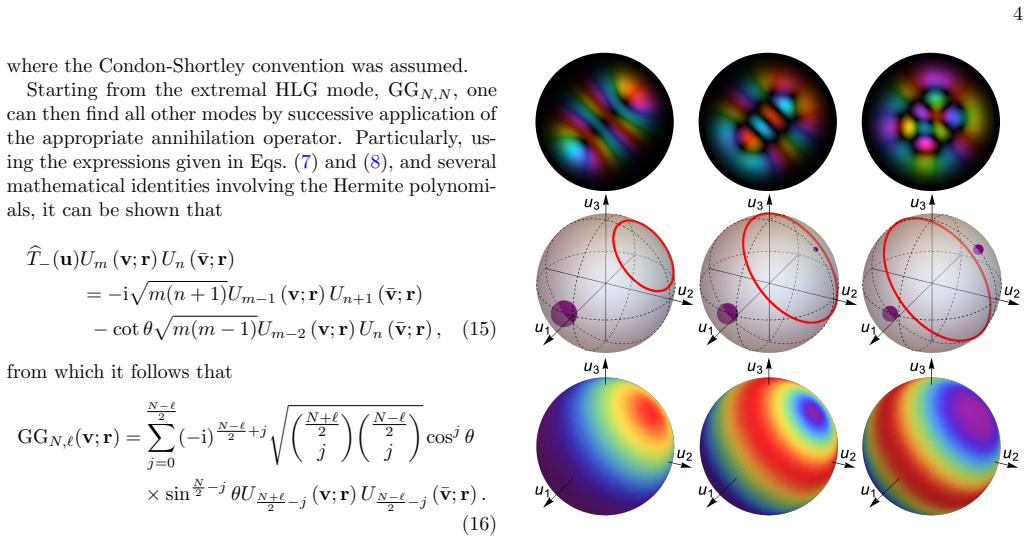
The paper's central claim is Eq. (16): $$ \mathrm{GG}_{N,\ell}(v;r)=\sum_{j=0}^{(N-\ell)/2}(-i)^{(N-\ell)/2+j}\sqrt{\binom{(N+\ell)/2}{j}\binom{(N-\ell)/2}{j}}\cos^j\$\theta$\,\$sin^{{N/2-j}}$\$\theta$\, U_{(N+\ell)/2-j}(v;r)\,U_{(N-\ell)/2-j}(\bar v;r). $$ Here $v=v(\theta,\phi)$ is the Jones vector of the modal spot on the modal Poincaré sphere, $\bar v=v(\pi-\theta,-\phi)$ is its antipode, and $U_j(v;r)$ is a complex-valued Hermite-Gauss function whose argument contains $v\cdot r$. The formula holds for all HLG modes, with $\ell$ changing in steps of two, and reduces to the previously known one-term extremal case when $\ell=N$. Because the summation runs only over $j=0,\dots,(N-\ell)/2$, it has far fewer terms than the Wigner-$d$ expansion and makes the underlying SU(2) structure explicit.
Load-bearing premise
The load-bearing premise is the unproved algebraic identity (Eq. 15) for the action of the lowering operator on the product of two Hermite-Gauss functions; the paper introduces it with 'it can be shown that' and gives no proof, so if that identity fails the main sum formula does not follow.
Editorial extensions
If this is right
- Any HLG mode can be computed from a Jones vector and its antipode with $(N-\ell)/2+1$ terms; even in the worst case this is $\lfloor N/2\rfloor+1$ terms instead of $N+1$, which halves the work for the most structured beams and improves scaling from linear to half-linear in $N$.
- The formula supplies a direct dictionary between wave functions and ray families: the same $v$ that appears in the mode shape also enters $q+ip=\sqrt{N+1}\,v\,e^{-i\tau}$, so each term in the sum corresponds to a point on the elliptic ray family's Poincaré path.
- The Majorana constellation of an HLG mode—the $N$ points on a sphere that represent the beam through the zeros of its Husimi $Q$ function—is read directly from the exponents in the sum: $(N-\ell)/2$ stars at the modal spot and $(N+\ell)/2$ at the antipode, matching how the maximum polynomial order in each factor shifts as $\ell$ changes.
- The recursion formulas for moving between HLG modes of different total order $N$ can be rewritten in Jones-vector form (Eqs. 18), so neighboring modes are reached by simple algebraic operations on $v$.
- The expression also provides a computational advantage over the standard Wigner-$d$ formula, since the number of terms drops from $N+1$ to at most about half that value.
Reading between the lines
- The paper does not pursue it, but the same SU(2) ladder construction should apply to any system with a coherent-state seed and a known Wigner-$d$ expansion, so analogous Jones-vector formulas may exist for spin coherent states or two-mode oscillator states.
- The paper does not benchmark speeds, but the term count falling from $N+1$ to about $N/2$ suggests Eq. (16) could make real-time generation of HLG masks cheaper in beam shaping or communications.
- Because the formula is written purely in $v$ and $\bar v$, derived quantities such as the Husimi $Q$ function or the orbital-angular-momentum spectrum may also be computable directly from the Jones vector; working this out is left for future work.
Signed reviews
Editorial analysis
A structured set of objections, weighed in public.
Referee Report
Summary. The manuscript derives a compact representation of generalized Hermite-Laguerre-Gauss (HLG) modes in terms of a two-component Jones vector v and its purported antipodal vector v-bar. The derivation proceeds from the SU(2) operator formalism of the two-dimensional isotropic oscillator, using the extremal-mode expression of Ref. [6] as a starting point. The central result is Eq. (16), which expresses GG_{N,l}(v;r) as a short sum of products U_j(v;r)U_k(v-bar;r). The authors further connect this representation to ray families, Majorana constellations, and recursion relations, and claim a computational advantage over the standard Wigner d-function expansion. The paper is a research letter aimed at an optics audience.
Significance. If correct, Eq. (16) would be a valuable and elegant result: it reduces the standard N+1-term Wigner d-function expansion to roughly N/2+1 terms, makes the modal-sphere geometry explicit via a Jones vector, and extends the independently proven extremal case Eq. (7) to all HLG modes. The connections to ray families and Majorana constellations are conceptually appealing and likely to spur further work. The manuscript also builds on known operator algebra and the extremal result has independent support. However, as printed, the main formula contains a definitional error in the antipodal vector, and the key operator identity is asserted without proof; therefore the central claim is not established as written.
major comments (3)
- [Text before Eq. (3); Eq. (16)] The antipodal Jones vector is misdefined. The paper states that if the unit vector u corresponds to v, then -u corresponds to v-bar(theta,phi)=v(pi-theta,-phi). With v(theta,phi)=cos(theta/2)e^{-i phi/2} epsilon_+ + sin(theta/2)e^{i phi/2} epsilon_- and u=(cos phi sin theta, sin phi sin theta, cos theta), the spinor corresponding to -u is v(pi-theta, phi+pi), not v(pi-theta, -phi). For a concrete failure, take N=2, l=0, theta=pi/2, phi=0; then v=e_x and v-bar=v(pi/2,0)=e_x, so Eq. (16) gives a contribution proportional to H_1(sqrt(2)x/w)^2 e^{-r^2/w^2}, whereas the standard HLG mode at this point is proportional to H_1(sqrt(2)x/w)H_1(sqrt(2)y/w)e^{-r^2/w^2}. Thus Eq. (16) is false as stated. The fix appears to be v-bar(theta,phi)=v(pi-theta, phi+pi), but all subsequent uses of v-bar must then be rechecked.
- [Eq. (15)] The identity for T_-(u) acting on U_m(v)U_n(v-bar) is introduced with the phrase 'it can be shown that' and is not proved. This identity is the load-bearing step from which the main result Eq. (16) follows; no derivation, reference, or numerical verification is provided. Since Eq. (17) is also stated without proof, the central derivation is incomplete. The authors should supply a proof (or a detailed supplementary derivation) and verify Eq. (15) and Eq. (16) by numerical or symbolic substitution for representative values of N, l, theta, and phi.
- [Eq. (16)] The combinatorial step from Eq. (15) to Eq. (16) is not shown. Even if Eq. (15) is granted, it is not immediate how repeated application of T_- produces the binomial coefficients, the powers of cos theta and sin theta, and the summation range appearing in Eq. (16). The authors should display the induction, generating-function, or cluster-expansion argument that connects these two equations.
minor comments (4)
- [Paragraph after Eq. (18)] There is a typo: 'emerges form' should read 'emerges from'.
- [Eq. (3)] The summation limits in Eq. (3) are written in a confusing way; please state the index range explicitly, for example sum over l' in {-N, -N+2, ..., N}.
- [Eq. (8)] The normalization factor 1/(w sqrt(pi) 2^{j-1/2} j!) should be checked for consistency with the standard Hermite-Gauss normalization; a brief derivation or reference would remove ambiguity.
- [Throughout] The term 'antipode' should be reserved for the point -u on the Poincare sphere; the current text conflates the spinor representative with the point itself, and this is the source of the incorrect v-bar definition.
Circularity Check
No significant circularity: the main result is a genuine derivation from prior, externally supported premises.
full rationale
The derivation chain runs from the extremal-mode expression in Eq. (7), through the operator identity in Eq. (15), to the main expansion in Eq. (16). Each of these is presented as a mathematical consequence of stated premises, not as a restatement of the target result. Eq. (7) is cited to the authors' earlier work [6,25], but the letter also notes that the same expression was independently derived in [26] and formally proven in [25]; the self-citation therefore carries independent support and is not load-bearing circularity. Eq. (15) is introduced with the phrase "it can be shown that" and is not proved in the letter, which is a completeness or correctness risk, but it is not circularity: no fitted parameter, normalization condition, or definitional identification makes Eq. (16) equal to its input. The antipode convention v_bar(theta,phi) = v(pi-theta,-phi) is asserted before the main result rather than derived from it, so even if that convention is inconsistent with Eq. (1) as a skeptic argues, the issue is an error in the stated formula, not a circular argument. The claimed computational advantage and the Majorana-constellation interpretation follow from the form of Eq. (16) rather than being presupposed by it. No step in the paper reduces, by construction, to its own inputs, and no load-bearing uniqueness theorem is imported from the authors' prior work. The paper is therefore not circular.
Assumptions & free parameters
assumptions (4)
- domain assumption HLG modes are defined by the Wigner d-function expansion (3), and this is equivalent to the SU(2) eigenfunction definition in (12).
- standard math The operators in Eqs. (9a)-(9c) realize the angular-momentum algebra and the ladder relations (14) for LG/HLG modes.
- domain assumption The extremal HLG mode GG_{N,N} is given by the coherent-state expression in Eqs. (7)-(8).
- standard math The Hermite polynomial identities used in Eq. (15) and the recurrence (17) are valid.
Cite this review
Pith. "Pith review of Generalized Gaussian beams in terms of Jones vectors." pith.science (2026). https://pith.science/paper/3YSXRBDD
@misc{pith2026190801363,
  author       = {Pith},
  title        = {Pith review of: Generalized Gaussian beams in terms of Jones vectors},
  year         = {2026},
  howpublished = {\url{https://pith.science/paper/3YSXRBDD}},
  note         = {Machine review of arXiv:1908.01363}
}
abstract
Based on the operator formalism that arises from the underlying SU(2) group structure, a formula is derived that provides a description of the generalized Hermite-Laguerre Gauss modes in terms of a Jones vector, traditionally used to describe polarization. This identity highlights the relation between these generalized Gaussian beams, the elliptical ray families, and the Majorana constellations used to represent structured-Gaussian beams. Moreover, it provides a computational advantage over the standard formula in terms of Wigner $d$ functions.
Figures


Figures from the paper (1 more)
Reference graph
Works this paper leans on
-
[6]
M. A. Alonso and M. R. Dennis, Optica 4, 476 (2017)
work page 2017
-
[1]
A. E. Siegman, Lasers (University Science Books, Sausal- ito, CA, 1986)
work page 1986
-
[2]
D. L. Andrews, Structured Light and Its Applications: An Introduction to Phase-Structured Beams and Nanoscale Optical Forces (ACADEMIC PR INC, 2008)
work page 2008
-
[3]
A. M. Yao and M. J. Padgett, Adv. Opt. Photonics 3, 161 (2011)
2011
-
[4]
H. Rubinsztein-Dunlop, A. Forbes, M. V. Berry, M. R. Dennis, D. L. Andrews, M. Mansuripur, C. Denz, C. Alp- mann, P. Banzer, T. Bauer, E. Karimi, L. Marrucci, M. Padgett, M. Ritsch-Marte, N. M. Litchinitser, N. P. Bigelow, C. Rosales-Guzm´ an, A. Belmonte, J. P. Tor- res, T. W. Neely, M. Baker, R. Gordon, A. B. Stil- goe, J. Romero, A. G. White, R. Fickle...
work page 2017
-
[5]
D. L. Andrews and M. Babiker, The angular momentum of light (Cambridge University Press, 2012)
work page 2012
-
[7]
the proper way to extend the MPS to higher-order modes is through the Majorana representation, originally proposed for spin systems, where a general SG beam is represented by N points (or stars) on the surface of the modal Majorana sphere. For the particular case of the HLG modes, the Majorana constellation is composed of (N−𝓁)/2 stars at the modal spot a...
-
[8]
Modal Majorana sphere and hidden symmetries of structured-Gaussian beams
R. Gutirrez-Cuevas and M. A. Alonso, arXiv:1901.06987 [physics.optics] (2019), http://arxiv.org/abs/1901.06987v1
work page Pith review arXiv 2019
Show all 37 references
-
[9]
E. G. Abramochkin and V. G. Volostnikov, J. Opt. A: Pure Appl. Opt. 6, S157 (2004)
2004
-
[10]
D. Deng, Q. Guo, and W. Hu, J. Phys. B: At., Mol. Opt. Phys. 41, 225402 (2008)
2008
-
[11]
Deng and Q
D. Deng and Q. Guo, Opt. Lett. 33, 1225 (2008)
2008
-
[12]
Alieva and M
T. Alieva and M. J. Bastiaans, Opt. Lett. 32, 1226 (2007)
2007
-
[13]
van Enk, Opt
S. van Enk, Opt. Commun. 102, 59 (1993)
1993
-
[14]
M. J. Padgett and J. Courtial, Opt. Lett. 24, 430 (1999)
1999
-
[15]
G. F. Calvo, Opt. Lett. 30, 1207 (2005)
2005
-
[16]
S. J. M. Habraken and G. Nienhuis, Opt. Lett. 35, 3535 (2010)
2010
-
[17]
Milione, H
G. Milione, H. I. Sztul, D. A. Nolan, and R. R. Alfano, Phys. Rev. Lett. 107, 053601 (2011)
2011
-
[18]
M. R. Dennis and M. A. Alonso, Phil. Trans. R. Soc. A 375, 20150441 (2017)
2017
-
[19]
Pancharatnam, in Proc
S. Pancharatnam, in Proc. Ind. Acad. Sci. , Vol. 44 (Springer, 1956) pp. 247–262
1956
-
[20]
M. V. Berry, Proc. R. Soc. Lond. A 392, 45 (1984)
1984
-
[21]
Malhotra, R
T. Malhotra, R. Guti´ errez-Cuevas, J. Hassett, M. Dennis, A. Vamivakas, and M. Alonso, Phys. Rev. Lett. 120, 233602 (2018)
2018
-
[22]
Danakas and P
S. Danakas and P. K. Aravind, Phys. Rev. A 45, 1973 (1992)
1992
-
[23]
Allen, M
L. Allen, M. W. Beijersbergen, R. J. C. Spreeuw, and J. P. Woerdman, Phys. Rev. A 45, 8185 (1992)
1992
-
[24]
Kimel and L
I. Kimel and L. Elias, IEEE J. Quantum Electron. 29, 2562 (1993)
1993
-
[25]
J. J. Sakurai and J. J. Napolitano, Modern Quantum Me- chanics (2nd Edition) (Pearson, 2010)
2010
-
[26]
M. R. Dennis and M. A. Alonso, J. Phys. Photonics 1, 025003 (2019)
2019
-
[27]
V. V. Kotlyar, A. A. Kovalev, and A. P. Porfirev, Opt. Lett. 40, 701 (2015)
2015
-
[28]
van Enk and G
S. van Enk and G. Nienhuis, Opt. Commun. 94, 147 (1992)
1992
-
[29]
Nienhuis and L
G. Nienhuis and L. Allen, Phys. Rev. A 48, 656 (1993)
1993
-
[30]
Pollett, O
J. Pollett, O. Meplan, and C. Gignoux, J. Phys. A: Math. Gen. 28, 7287 (1995)
1995
-
[31]
Wnsche, J
A. Wnsche, J. Comput. Appl. Math. 133, 665 (2001)
2001
-
[32]
Alieva and M
T. Alieva and M. J. Bastiaans, Opt. Lett. 30, 1461 (2005)
2005
-
[33]
Majorana, Il Nuovo Cimento 9, 43 (1932)
E. Majorana, Il Nuovo Cimento 9, 43 (1932)
1932
-
[34]
Penrose, Shadows of the Mind: A Search for the Missing Science of Consciousness (OXFORD UNIV PR, 1996)
R. Penrose, Shadows of the Mind: A Search for the Missing Science of Consciousness (OXFORD UNIV PR, 1996)
1996
-
[35]
Bacry, J
H. Bacry, J. Math. Phys. 15, 1686 (1974)
1974
-
[36]
M. R. Dennis, J. Phys. A: Math. Gen. 37, 9487 (2004)
2004
-
[37]
Bengtsson and K
I. Bengtsson and K. Zyczkowski, Geometry of Quantum States (Cambridge University Pr., 2017)
2017
Reviewed August 14, 2026 · model on record in the stance chip above.
Discussion (0). Continue with ORCID to comment.