REVIEW 4 major objections 5 minor 41 references
Subgroups of right-angled Coxeter groups via Stallings-like techniques
T0 review · 4 major / 5 minor · reviewed 2026-08-14 · deepseek-v4-flash
Pith's one-line read The paper proves that a subgroup of a right-angled Coxeter group is quasiconvex exactly when its standard completion—an edge-labeled cube complex built from the subgroup's generators—is finite, and uses this equivalence to detect…
desk verdict A genuinely useful Stallings-style completion framework for RACGs; the quasiconvexity characterization is solid, but the finite-index embeddability algorithm leans on a long hand-audited word-length bound. read the letter →
The pith
A machine-rendered reading of the paper's core claim, the machinery that carries it, and where it could break.
The reading
What carries the argument
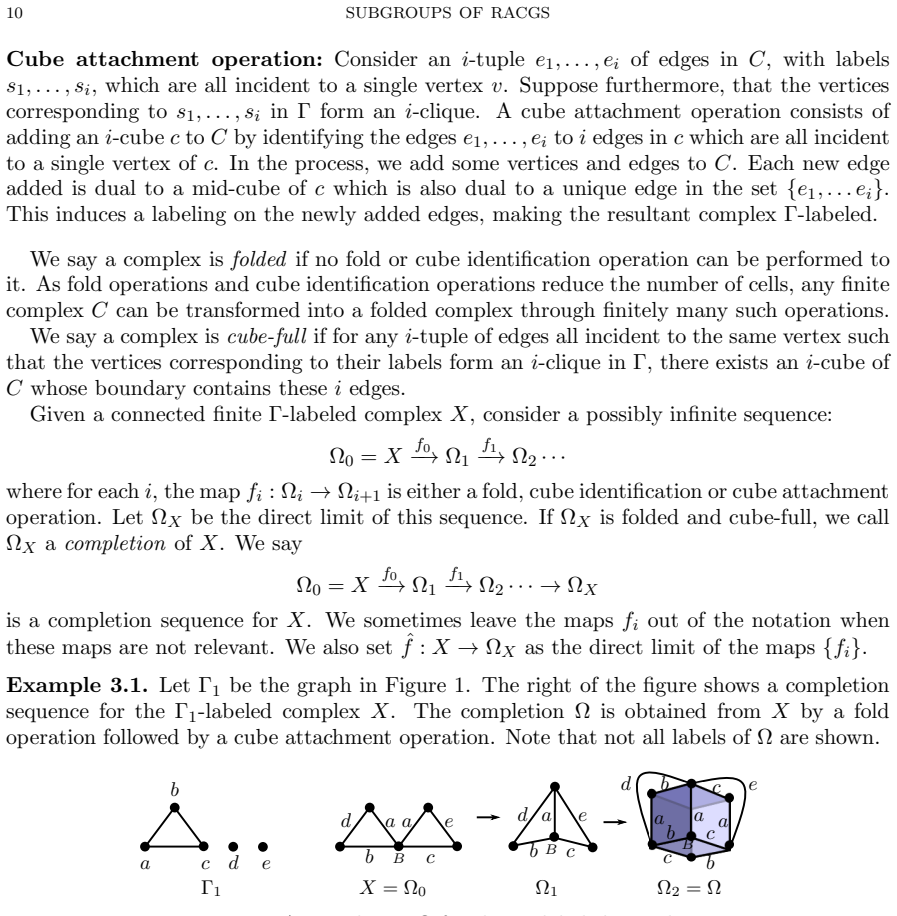
The completion is the central object. Starting from a 'rose' graph whose petals are labeled by the chosen generator words, one repeatedly folds pairs of edges with the same label, attaches cubes whenever a tuple of incident edges has labels forming a clique in the defining graph, and identifies cubes with identical boundaries; the process stops when the complex is folded and cube-full. Being cube-full guarantees that no commuting relations are missing, so reduced words behave like geodesics in the complex; this is what lets finiteness of the completion control quasiconvexity and lets non-positively curved completions support the geometric arguments.
What would settle it
Find a triangle-free, non-almost-star graph Γ and a finite set of reflections R generating a finite-index subgroup of WΓ such that every trimmed generating set contains a word longer than the constant M(|V(Γ)|,|R|) supplied by Proposition 12.1; equivalently, exhibit a pair (Γ,Γ′) for which the algorithm of Theorem 12.8 says 'no' although WΓ′ embeds as a finite-index subgroup of WΓ.
Extended reading notes
Core claim
For any finitely generated subgroup G of a RACG WΓ, the paper constructs a completion Ω: a folded, cube-full, edge-labeled cube complex whose loops based at the basepoint carry exactly the reduced words representing elements of G, and in which every reduced word for a group element labels a loop. Theorem 8.4 states that G is quasiconvex in WΓ if and only if G is finitely generated and some (equivalently every) standard completion is finite. A completion is finite exactly when it can be built in finite time, so quasiconvexity becomes decidable. The paper further shows that a completion determines whether G is finite-index (the complex is finite and every vertex is incident to an edge of every label), torsion-free (no loop reduces into a finite special subgroup), and normal (conditions on the core graph, with a computable reformulation).
Load-bearing premise
The finite-index embeddability algorithm rests on the bound in Proposition 12.1: for a triangle-free defining graph that is not almost star, every trimmed reflection generating set of a finite-index subgroup has word lengths bounded by a constant depending only on the graph and the number of reflections, so a subgroup needing a longer generator would escape the algorithm's enumeration.
Editorial extensions
If this is right
- Quasiconvexity of a subgroup of a RACG is algorithmically detectable: build a standard completion and check whether it is finite.
- For a quasiconvex subgroup given by finitely many words, there are algorithms to test torsion-freeness, compute its index, test whether a power of a given element lies in the subgroup, and test normality.
- Every finitely generated reflection subgroup of a RACG is quasiconvex, because it admits a finite completion.
- Every one-ended Coxeter subgroup of a 2-dimensional RACG is a reflection subgroup and hence quasiconvex.
- There is an explicit algorithm that decides, given a 2-dimensional RACG WΓ and any RACG WΓ′, whether WΓ′ is isomorphic to a finite-index subgroup of WΓ, and outputs the embedding words when it is.
Reading between the lines
- A natural next step, not taken in the paper, is to implement the standard completion algorithm on small defining graphs and compare the finite-completion criterion with known commensurability classifications; this would give empirical data on how sharp the length bound in Proposition 12.1 is.
- Because the completion construction does not assume hyperbolicity, the same cube-full finiteness criterion may be adaptable to other graph products of groups whose defining graphs carry a similar commutativity structure, though the paper does not claim this.
- The algorithm in Theorem 12.8 effectively reduces finite-index embeddability to a bounded search over trimmed reflection sets; if the bound in Proposition 12.1 can be made explicit and small, the theorem becomes a practical computational tool for commensurability questions.
Signed reviews
Editorial analysis
A structured set of objections, weighed in public.
Referee Report
Summary. The paper develops a Stallings-style completion theory for subgroups of right-angled Coxeter groups (RACGs). For a finitely generated subgroup G < W_Γ, the authors construct a Γ-labeled cube complex, called a completion, via fold, cube-attachment, and cube-identification operations. They prove that properties of G are reflected in completions: quasiconvexity is equivalent to finiteness of a standard completion (Theorem A(1) / Theorem 8.4), finite index is characterized by finite full-valence resolved completions (Theorem 6.6), torsion is detected by loops with reduced labels in finite special subgroups (Proposition 4.6), and normality has a core-graph characterization (Theorem 5.3). The paper then applies this machinery to show that finitely generated reflection subgroups are quasiconvex (Theorem 10.5), that one-ended Coxeter subgroups of 2-dimensional RACGs are reflection subgroups and hence quasiconvex (Theorem 11.4 and Corollary 11.5), and to give an algorithm deciding finite-index embeddability between certain RACGs (Theorem 12.8). It also provides algorithms for several properties of quasiconvex subgroups (Theorem E) and gives new proofs of residual finiteness and of Haglund's separability theorem for quasiconvex subgroups.
Significance. If the results are correct, this is a substantial contribution to the geometric and algorithmic study of subgroups of RACGs. The completion construction is a genuinely new tool in this setting, and the characterization of quasiconvexity by finiteness of a completion is both conceptually clean and algorithmically useful. The paper contains many explicit, detailed arguments, and the main theorems are not obtained by circular reasoning: the completion is defined independently, and the axioms ledger is empty. The algorithmic applications, especially Theorems D and E, are strong and well-motivated. However, the paper's central algorithmic theorem depends on a long and only hand-audited combinatorial bound, and several statements rely on omitted proof details. These points need to be addressed before the paper can be accepted in its present form.
major comments (4)
- [Section 12, Proposition 12.1 and Lemmas 12.2–12.5] The completeness of the algorithm in Theorem 12.8 rests entirely on Proposition 12.1, because the algorithm enumerates M-admissible trimmed reflection sets and would silently miss a finite-index subgroup if the uniform length bound failed. The proof of Proposition 12.1 is a long chain of auxiliary lemmas, and I could not fully verify the crucial uniqueness claim in Lemma 12.4, namely that ``e_1 is the only edge of ``f(FT) dual to H_1``. In particular, the step where the maximal-prefix choice of the expressions w_i is used to rule out all other edges dual to H_1 deserves a more explicit and self-contained justification. Since a gap here would invalidate the main algorithmic theorem, I request that the proof of Proposition 12.1 be expanded, with special attention to Lemma 12.4 and to the maximal-prefix argument.
- [Section 5, Proposition 5.2] Proposition 5.2 is stated with the proof omitted, with the explanation that it follows closely from [KM02, Theorem 5.2]. This is not satisfactory, because in the present setting completions are not unique and need not even have the same homotopy type (Example 3.7), so uniqueness of the core graph is a nontrivial claim. The proposition is used in the proof of Theorem 5.3, which is one of the advertised characterizations in Theorem A(2). Please provide a complete proof, or at minimum a precise reduction to [KM02, Theorem 5.2] that accounts for the distinction between completions and Stallings graphs.
- [Section 3, Lemma 3.9] In the fold operation case, the proof says that path types 3 and 4 are handled similarly and omits them. These cases are not merely cosmetic: they cover loops based at the basepoint B that traverse the folded edge near the beginning or end of the loop, and they are needed for the iteration in Lemma 3.10, which in turn underpins Theorem 3.11. Please supply the missing arguments for types 3 and 4.
- [Introduction, Theorem D; Section 12, Theorem 12.8] The introduction states Theorem D as providing an algorithm that, given a one-ended 2-dimensional RACG W_Γ and any RACG W_Γ', decides whether W_Γ' embeds as a finite-index subgroup of W_Γ. However, the theorem actually proved in Section 12 assumes that Γ' has no isolated vertex. If the isolated-vertex case is genuinely excluded, the introductory and abstract statements need to be revised; if it is covered by a separate argument, that argument must be included. This mismatch concerns one of the paper's central advertised claims.
minor comments (5)
- [Section 5, Proposition 5.2] The statement contains a typo: the right-hand side reads ``C_2(Ω_1, B_2)``, but it should presumably be ``C_2(Ω_2, B_2)``.
- [Section 3, Example 3.7] The two completions are described as a torus and a Klein bottle obtained by attaching a square to the rose graph, but the attaching maps are not written out. Since the labels and the attaching words determine whether the complexes are Γ-labeled completions, the example would be much easier to check if the boundary words of the attached squares were specified explicitly.
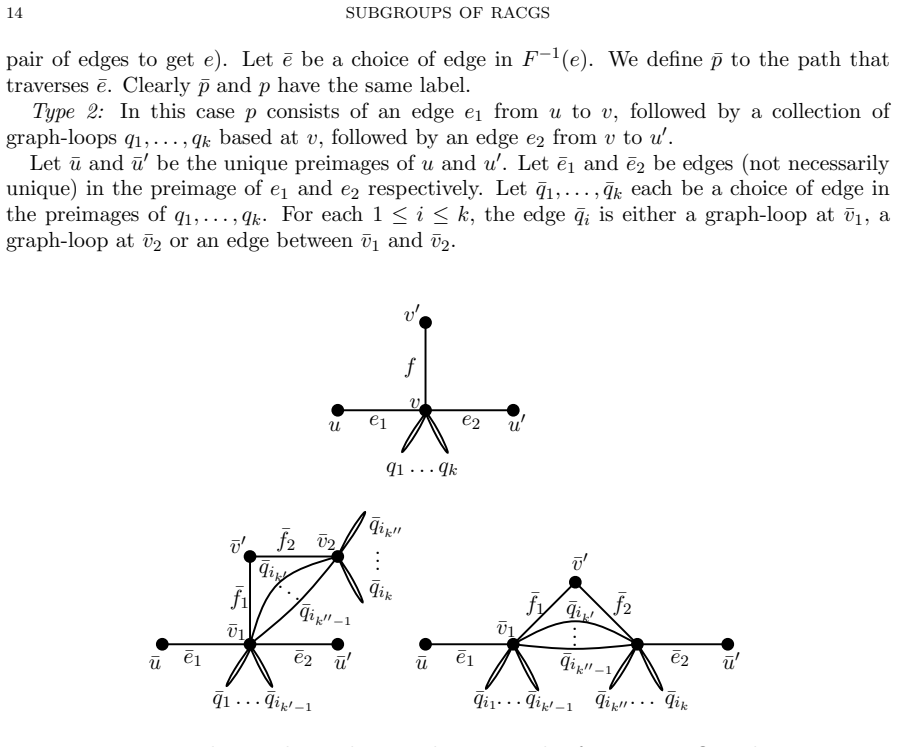
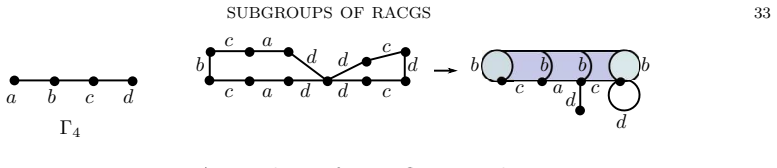
- [Figures 2 and 7] Several figures omit edge labels or use very small labels, which makes the examples difficult to verify independently. Please add labels or explain the omitted labels in the captions.
- [Section 12, Theorem 12.8] In case (iv) of the proof, the reduction to the non-almost-star case via the kernel K' is clear in principle, but the sentence ``The theorem now follows`` hides the induction on the number of vertices. Since the algorithm is central, a short explicit statement of the induction and of why termination is guaranteed would improve readability.
- [Section 13, Lemma 13.1] The notation ``k^{(n mod 2)}`` is used without a prior definition. For clarity, state explicitly that this means the word k if n is odd and the empty word if n is even.
Circularity Check
No significant circularity; main derivations are self-contained and do not reduce to their own inputs.
full rationale
The paper's central constructions are defined independently of the properties they characterize. A completion of a subgroup G is defined by abstract conditions (Definition 3.6), but existence is proved constructively: standard completions are built from a finite generating set via fold, cube-attachment, and cube-identification operations (Propositions 3.3 and 3.5, Theorem 3.11), with Lemmas 3.8-3.10 verifying that the resulting complex satisfies the defining properties. The quasiconvexity characterization (Theorem 8.4) is not a renaming: Lemma 8.1 compares distances in the completion with distances in the Cayley graph to G, Lemma 8.2 derives quasiconvexity from finiteness of any completion, and Lemma 8.3 derives finiteness of every standard completion from quasiconvexity using bounds on core-graph vertices and hyperplane finiteness. These are independent geometric arguments. The index characterization (Theorem 6.6), torsion characterization (Proposition 4.6), and normality characterization (Theorems 5.3 and Proposition 13.2) likewise each have proofs that do not assume the conclusion. The reflection-subgroup results use the Dyer-Deodhar theorem and standard Coxeter-group facts as external inputs, and the Coxeter-subgroup theorem (Theorem 11.4) is proved through Lemmas 11.1-11.3 without invoking quasiconvexity. In Section 12, Theorem 12.8 enumerates M-admissible trimmed reflection sets; Proposition 12.1 supplies the required bound under the hypothesis that the set generates a finite-index subgroup. This is a genuine correctness-sensitive step and its proof is hand-audited rather than machine-verified, but it is not circular: the enumeration is not defined as 'all finite-index subgroups' and the theorem would be incomplete, not tautological, if the bound failed. The self-reference to [DL20] is a forward pointer to a companion paper and is not load-bearing for any theorem proved here; the omitted proof of Proposition 5.2 follows an external argument of Kapovich-Miasnikov and is not used in the headline quasiconvexity theorem. The new proof of Haglund's separability result uses the independently built full-valence extension and external residual-finiteness facts, so it does not smuggle in the conclusion. Overall, no predicted quantity is fitted into the input and no load-bearing step reduces by construction to an earlier claim of the paper.
Assumptions & free parameters
assumptions (6)
- standard math Tits' solution to the word problem and deletion property for right-angled Coxeter groups
- standard math Every finite subgroup of a RACG is conjugate into a special finite subgroup (clique subgraph)
- standard math Reflection subgroups of Coxeter groups are Coxeter groups, and trimmed reflection sets are standard Coxeter generating sets
- standard math A RACG is one-ended iff its defining graph is connected and has no separating clique
- standard math Graph products, and in particular RACGs, have unique defining graphs up to isomorphism
- standard math Virtual retracts of residually finite groups are separable
Cite this review
Pith. "Pith review of Subgroups of right-angled Coxeter groups via Stallings-like techniques." pith.science (2026). https://pith.science/paper/3Z7NOU27
@misc{pith2026190809046,
  author       = {Pith},
  title        = {Pith review of: Subgroups of right-angled Coxeter groups via Stallings-like techniques},
  year         = {2026},
  howpublished = {\url{https://pith.science/paper/3Z7NOU27}},
  note         = {Machine review of arXiv:1908.09046}
}
read the original abstract
We associate cube complexes called completions to each subgroup of a right-angled Coxeter group (RACG). A completion characterizes many properties of the subgroup such as whether it is quasiconvex, normal, finite-index or torsion-free. We use completions to show that reflection subgroups are quasiconvex, as are one-ended Coxeter subgroups of a 2-dimensional RACG. We provide an algorithm that determines whether a given one-ended, 2-dimensional RACG is isomorphic to some finite-index subgroup of another given RACG. In addition, we answer several algorithmic questions regarding quasiconvex subgroups. Finally, we give a new proof of Haglund's result that quasiconvex subgroups of RACGs are separable.
Figures

Figures from the paper (4 more)


Reference graph
Works this paper leans on
-
[1]
G. N. Arzhantseva and P.-A. Cherix, On the C ayley graph of a generic finitely presented group , Bull. Belg. Math. Soc. Simon Stevin 11 (2004), no. 4, 589--601. 2115727
work page 2004
-
[2]
Ian Agol, The virtual H aken conjecture , Doc. Math. 18 (2013), 1045--1087, With an appendix by Agol, Daniel Groves, and Jason Manning
work page 2013
-
[3]
G. N. Arzhantseva and A. Yu. Ol'shanskii, Generality of the class of groups in which subgroups with a lesser number of generators are free, Mat. Zametki 59 (1996), no. 4, 489--496, 638. 1445193
work page 1996
-
[4]
G. N. Arzhantseva, Generic properties of finitely presented groups, PhD thesis, Moscow Lomonosov State University, 1998
work page 1998
-
[5]
, On groups in which subgroups with a fixed number of generators are free, Fundam. Prikl. Mat. 3 (1997), no. 3, 675--683. 1794135
work page 1997
-
[6]
, Generic properties of finitely presented groups and H owson's theorem , Comm. Algebra 26 (1998), no. 11, 3783--3792. 1647075
work page 1998
-
[7]
, A property of subgroups of infinite index in a free group, Proc. Amer. Math. Soc. 128 (2000), no. 11, 3205--3210. 1694447
work page 2000
-
[8]
Patrick Bahls, The isomorphism problem in C oxeter groups , Imperial College Press, London, 2005
work page 2005
Show all 41 references
-
[9]
32, Springer, 2005
Anders Bjorner and Francesco Brenti, Combinatorics of C oxeter groups , Graduate Texts in Mathematics, vol. 32, Springer, 2005
2005
-
[10]
Howlett, A finiteness property and an automatic structure for C oxeter groups , Math
Brigitte Brink and Robert B. Howlett, A finiteness property and an automatic structure for C oxeter groups , Math. Ann. 296 (1993), no. 1, 179--190
1993
-
[11]
Bridson and Andr \'e Haefliger, Metric spaces of non-positive curvature, Grundlehren der Mathematischen Wissenschaften [Fundamental Principles of Mathematical Sciences], vol
Martin R. Bridson and Andr \'e Haefliger, Metric spaces of non-positive curvature, Grundlehren der Mathematischen Wissenschaften [Fundamental Principles of Mathematical Sciences], vol. 319, Springer-Verlag, Berlin, 1999
1999
-
[12]
Benjamin Beeker and Nir Lazarovich, Stallings' folds for cube complexes, Israel J. Math. 227 (2018), no. 1, 331--363
2018
-
[13]
Samuel Brown, Geometric structures on negatively curved groups and their subgroups, P h D thesis , University College London, 2016
2016
-
[14]
John Crisp and Luisa Paoluzzi, Commensurability classification of a family of right-angled C oxeter groups , Proc. Amer. Math. Soc. 136 (2008), no. 7, 2343--2349
2008
-
[15]
Montserrat Casals-Ruiz, Embeddability and universal theory of partially commutative groups, Int. Math. Res. Not. IMRN (2015), no. 24, 13575--13622
2015
-
[16]
Pierre-Emmanuel Caprace and Michah Sageev, Rank rigidity for CAT (0) cube complexes , Geom. Funct. Anal. 21 (2011), no. 4, 851--891
2011
-
[17]
V, International Press and Higher Education Press, 2018
Pallavi Dani, The large-scale geometry of right-angled C oxeter groups , Handbook of Group Actions, vol. V, International Press and Higher Education Press, 2018
2018
-
[18]
Davis, The geometry and topology of C oxeter groups , London Mathematical Society Monographs Series, vol
Michael W. Davis, The geometry and topology of C oxeter groups , London Mathematical Society Monographs Series, vol. 32, Princeton University Press, Princeton, NJ, 2008
2008
-
[19]
Deodhar, A note on subgroups generated by reflections in C oxeter groups , Arch
Vinay V. Deodhar, A note on subgroups generated by reflections in C oxeter groups , Arch. Math. (Basel) 53 (1989), no. 6, 543--546
1989
-
[20]
Davis and Tadeusz Januszkiewicz, Right-angled A rtin groups are commensurable with right-angled C oxeter groups , J
Michael W. Davis and Tadeusz Januszkiewicz, Right-angled A rtin groups are commensurable with right-angled C oxeter groups , J. Pure Appl. Algebra 153 (2000), no. 3, 229--235
2000
-
[21]
Pallavi Dani and Ivan Levcovitz, Right-angled A rtin subgroups of right-angled C oxeter and A rtin groups , arXiv:2003.05531, 2020
2003 arXiv
-
[22]
Pallavi Dani, Emily Stark, and Anne Thomas, Commensurability for certain right-angled C oxeter groups and geometric amalgams of free groups , Groups Geom. Dyn. 12 (2018), no. 4, 1273--1341
2018
-
[23]
Algebra 135 (1990), no
Matthew Dyer, Reflection subgroups of C oxeter systems , J. Algebra 135 (1990), no. 1, 57--73
1990
-
[24]
Gruber, Infinitely presented graphical small cancellation groups, PhD thesis, University of Vienna, 2015, http://othes.univie.ac.at/38520/
Dominik. Gruber, Infinitely presented graphical small cancellation groups, PhD thesis, University of Vienna, 2015, http://othes.univie.ac.at/38520/
2015
-
[25]
Dedicata 135 (2008), 167--209
Fr\' e d\' e ric Haglund, Finite index subgroups of graph products, Geom. Dedicata 135 (2008), 167--209
2008
-
[26]
Christopher Hruska, Emily Stark, and Hung Cong Tran, Surface group amalgams that (don't) act on 3-manifolds, arXiv:1705.01361, to appear in American Journal of Mathematics, 2017
G. Christopher Hruska, Emily Stark, and Hung Cong Tran, Surface group amalgams that (don't) act on 3-manifolds, arXiv:1705.01361, to appear in American Journal of Mathematics, 2017
2017 arXiv
-
[27]
Wise, Special cube complexes, Geom
Fr\' e d\' e ric Haglund and Daniel T. Wise, Special cube complexes, Geom. Funct. Anal. 17 (2008), no. 5, 1551--1620
2008
-
[28]
, Coxeter groups are virtually special, Adv. Math. 224 (2010), no. 5, 1890--1903
2010
-
[29]
Sang-hyun Kim and Thomas Koberda, Embedability between right-angled A rtin groups , Geom. Topol. 17 (2013), no. 1, 493--530
2013
-
[30]
Algebra 248 (2002), no
Ilya Kapovich and Alexei Myasnikov, Stallings foldings and subgroups of free groups, J. Algebra 248 (2002), no. 2, 608--668
2002
-
[31]
Algebra 488 (2017), 442--483
Olga Kharlampovich, Alexei Miasnikov, and Pascal Weil, Stallings graphs for quasi-convex subgroups, J. Algebra 488 (2017), 442--483
2017
-
[32]
Michael Mihalik and Steven Tschantz, Visual decompositions of C oxeter groups , Groups Geom. Dyn. 3 (2009), no. 1, 173--198
2009
-
[33]
J. P. McCammond and D. T. Wise, Coherence, local quasiconvexity, and the perimeter of 2-complexes, Geom. Funct. Anal. 15 (2005), no. 4, 859--927
2005
-
[34]
Radcliffe, Rigidity of graph products of groups, Algebr
David G. Radcliffe, Rigidity of graph products of groups, Algebr. Geom. Topol. 3 (2003), 1079--1088
2003
-
[35]
Schupp, Coxeter groups, 2-completion, perimeter reduction and subgroup separability, Geom
Paul E. Schupp, Coxeter groups, 2-completion, perimeter reduction and subgroup separability, Geom. Dedicata 96 (2003), 179--198
2003
-
[36]
Stallings, Topology of finite graphs, Invent
John R. Stallings, Topology of finite graphs, Invent. Math. 71 (1983), no. 3, 551--565
1983
-
[37]
Algebra 438 (2015), 337--378
Markus Steenbock, Rips- S egev torsion-free groups without the unique product property , J. Algebra 438 (2015), 337--378. 3353035
2015
-
[38]
Wise, Cores for quasiconvex actions, Proc
Michah Sageev and Daniel T. Wise, Cores for quasiconvex actions, Proc. Amer. Math. Soc. 143 (2015), no. 7, 2731--2741
2015
-
[39]
B. A. F. Wehrfritz, Infinite linear groups, Queen Mary College Mathematical Notes, Queen Mary College, Department of Pure Mathematics, London, 1969
1969
-
[40]
Wise, The structure of groups with a quasiconvex hierarchy, available at https://www.math.mcgill.ca/wise/papers.html, 2011
Daniel T. Wise, The structure of groups with a quasiconvex hierarchy, available at https://www.math.mcgill.ca/wise/papers.html, 2011
2011
-
[41]
117, Published for the Conference Board of the Mathematical Sciences, Washington, DC; by the American Mathematical Society, Providence, RI, 2012
, From riches to raags: 3-manifolds, right-angled A rtin groups, and cubical geometry , CBMS Regional Conference Series in Mathematics, vol. 117, Published for the Conference Board of the Mathematical Sciences, Washington, DC; by the American Mathematical Society, Providence, RI, 2012
2012
Reviewed August 14, 2026 · model on record in the stance chip above.
Discussion (0). Continue with ORCID to comment.