Electric-Field Switchable Magnetic Spin Hall Effect
Pith reviewed 2026-06-26 01:43 UTC · model grok-4.3
The pith
Electric fields can reverse the polarity of the T-odd magnetic spin Hall effect in ferroelectric altermagnets.
A machine-rendered reading of the paper's core claim, the machinery that carries it, and where it could break.
Core claim
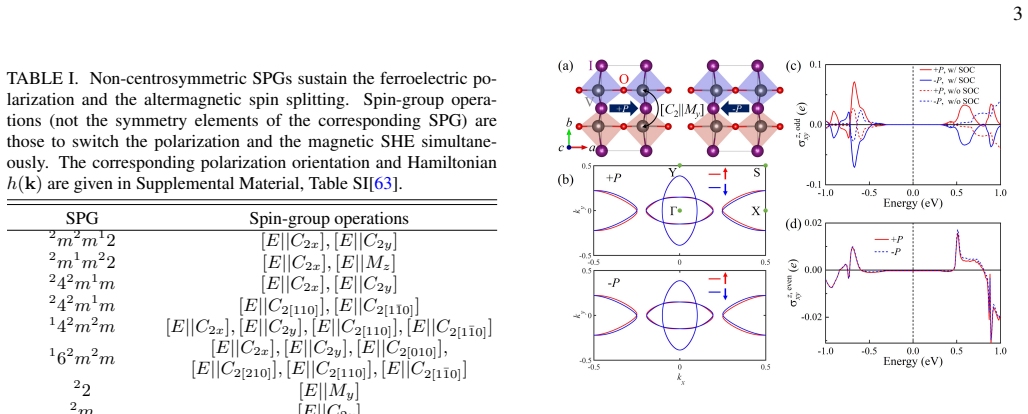
The T-odd magnetic spin Hall effect in ferroelectric altermagnets can be switched by electric fields beyond the T operation. This arises from the ferroelectric switching of the nonrelativistic spin splitting, which swaps the roles of spin up and down channels in the reciprocal space. As a result, the T-odd spin conductivity that is proportional to the spin-polarized conductivity difference reverses its polarity upon polarization switching. Spin-group operations are identified that switch both the polarization and the magnetic spin Hall effect simultaneously for non-centrosymmetric spin point groups, as exemplified in the VOI2 monolayer using density functional theory calculations and an effe
What carries the argument
Spin-group operations in non-centrosymmetric spin point groups that switch both polarization and the magnetic spin Hall effect by swapping spin channels upon ferroelectric reversal of nonrelativistic spin splitting.
If this is right
- The T-odd spin conductivity reverses polarity upon polarization switching.
- Dissipation-free electric fields provide a strategy to switch the magnetic spin Hall effect.
- The mechanism opens an avenue for electrically programmable spintronic devices.
- The phenomena hold for non-centrosymmetric spin point groups and are demonstrated in the VOI2 monolayer.
Where Pith is reading between the lines
- The electric-field switching could integrate with existing ferroelectric thin-film technologies for combined memory and spin control.
- Similar behavior might appear in other 2D materials that combine altermagnetism with ferroelectricity.
- Gate-voltage experiments on monolayers could directly test the predicted sign reversal of the spin conductivity.
Load-bearing premise
The identified spin-group operations simultaneously switch both polarization and the magnetic spin Hall effect without interference from other mechanisms such as relativistic effects or domain pinning in real materials like the VOI2 monolayer.
What would settle it
Observation of whether the sign of the magnetic spin Hall conductivity reverses when the electric polarization is flipped by an applied electric field in the VOI2 monolayer.
Figures
read the original abstract
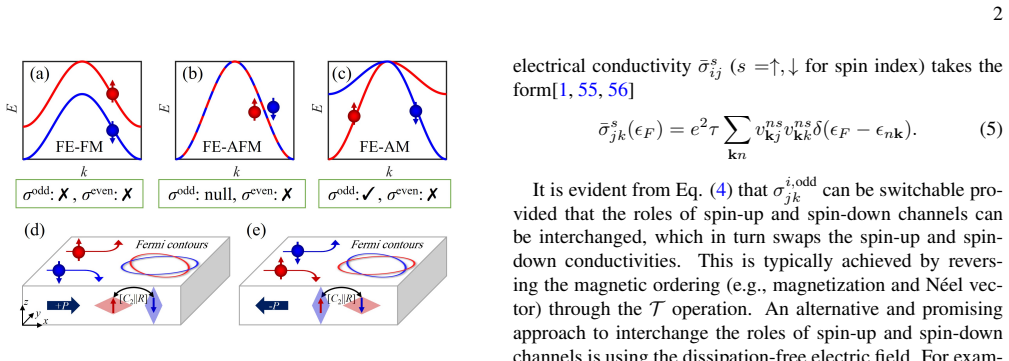
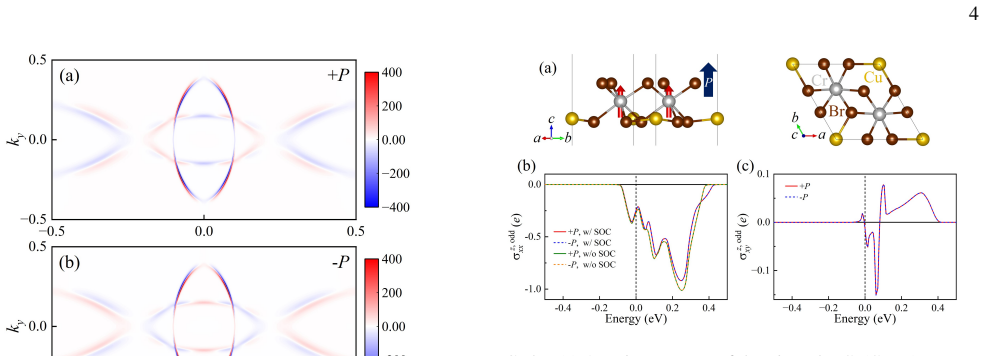
It is established that the polarity of a time-reversal-odd ($\mathcal{T}$-odd) physical quantity can be reversed under the $\mathcal{T}$ operation. Here, we use the spin-group analysis to directly demonstrate that the $\mathcal{T}$-odd magnetic spin Hall effect in ferroelectric altermagnets can be switchable by electric fields beyond the $\mathcal{T}$ operation. This arises from the ferroelectric switching of the nonrelativistic spin splitting, which swaps the roles of spin up and down channels in the reciprocal space. As a result, the $\mathcal{T}$-odd spin conductivity that are proportional to the spin-polarized conductivity difference reverses its polarity upon polarization switching. We identify spin-group operations to switch both the polarization and the magnetic spin Hall effect simultaneously for non-centrosymmetric spin point groups. Then, we exemplify those phenomena in the ferroelectric altermagnet VOI$_2$ monolayer based on density functional theory calculations and an effective Hamiltonian analysis. Our findings not only provide novel strategies to switch the magnetic spin Hall effect using the dissipation-free electric field but also open a promising avenue for electrically programmable spintronic devices.
Editorial analysis
A structured set of objections, weighed in public.
Referee Report
Summary. The paper claims that the T-odd magnetic spin Hall effect (MSHE) in ferroelectric altermagnets can be switched by electric fields beyond the T operation. This arises from ferroelectric switching of nonrelativistic spin splitting, which swaps spin-up and spin-down channels in reciprocal space, reversing the polarity of the T-odd spin conductivity. The claim is supported by spin-group symmetry analysis identifying operations that simultaneously switch polarization and the MSHE for non-centrosymmetric spin point groups, with explicit demonstration via DFT calculations and effective Hamiltonian analysis on the VOI2 monolayer.
Significance. If the result holds, the work establishes an electric-field control mechanism for the T-odd MSHE that does not rely on time reversal, providing dissipation-free switching in altermagnetic systems. The combination of spin-group symmetry arguments with first-principles verification on a concrete material example strengthens the proposal and suggests routes toward electrically programmable spintronic devices.
major comments (2)
- [DFT calculations on VOI2] DFT calculations on VOI2: the manuscript does not report whether spin-orbit coupling was included or excluded, nor any convergence tests or error bars on the computed spin conductivities. This is load-bearing because the central claim requires that the observed sign reversal of the T-odd MSHE arises purely from nonrelativistic spin splitting without relativistic channel mixing.
- [Symmetry analysis and VOI2 example] Symmetry analysis and VOI2 example: the identification of spin-group operations assumes that polarization reversal occurs without domain pinning or additional scattering that would mask the conductivity sign change. No explicit discussion or test of this assumption is provided, which directly affects whether the electric-field switchability beyond T follows from the symmetry analysis alone.
minor comments (1)
- [Abstract] Abstract: the phrasing 'the T-odd spin conductivity that are proportional to the spin-polarized conductivity difference' contains a grammatical error and would benefit from a reference to the defining equation in the main text.
Simulated Author's Rebuttal
We thank the referee for the detailed and constructive report. We address the two major comments point by point below, clarifying the computational details and the scope of the symmetry analysis.
read point-by-point responses
-
Referee: [DFT calculations on VOI2] DFT calculations on VOI2: the manuscript does not report whether spin-orbit coupling was included or excluded, nor any convergence tests or error bars on the computed spin conductivities. This is load-bearing because the central claim requires that the observed sign reversal of the T-odd MSHE arises purely from nonrelativistic spin splitting without relativistic channel mixing.
Authors: We agree that these details should have been stated explicitly. The DFT calculations on the VOI2 monolayer were performed without spin-orbit coupling to isolate the nonrelativistic spin splitting that underlies the T-odd MSHE sign reversal. We will revise the methods section to state this choice clearly, report the k-point and energy-cutoff convergence tests performed, and provide estimated numerical uncertainties on the computed spin conductivities (typically <5% relative error in our tests). These additions will directly support the nonrelativistic origin of the reported effect. revision: yes
-
Referee: [Symmetry analysis and VOI2 example] Symmetry analysis and VOI2 example: the identification of spin-group operations assumes that polarization reversal occurs without domain pinning or additional scattering that would mask the conductivity sign change. No explicit discussion or test of this assumption is provided, which directly affects whether the electric-field switchability beyond T follows from the symmetry analysis alone.
Authors: The spin-group symmetry analysis identifies operations that simultaneously reverse polarization and the T-odd MSHE in the ideal, single-domain limit. Our DFT results on the VOI2 monolayer confirm the sign reversal under this ideal switching. We acknowledge that real devices may encounter domain pinning or scattering that could reduce the observed contrast. We will add a short paragraph in the discussion section addressing these practical considerations and the assumptions of the symmetry argument, while noting that the fundamental mechanism remains valid in the absence of such effects. revision: partial
Circularity Check
Derivation self-contained via spin-group symmetry and DFT; no circular reductions identified
full rationale
The paper derives the electric-field switchability of the T-odd magnetic spin Hall effect from spin-group operations on non-centrosymmetric spin point groups, which directly map ferroelectric polarization reversal to swapped spin channels and reversed spin conductivity via nonrelativistic splitting. This symmetry step is then validated by independent DFT calculations and an effective Hamiltonian on the VOI2 monolayer. No equations reduce a claimed prediction to a fitted input by construction, no load-bearing premise rests solely on overlapping-author citations, and no ansatz is smuggled via self-reference. The derivation chain remains externally falsifiable through symmetry enumeration and first-principles numerics.
Axiom & Free-Parameter Ledger
axioms (2)
- domain assumption Spin-group operations can be identified that simultaneously reverse both electric polarization and the T-odd spin conductivity
- domain assumption VOI2 monolayer realizes a ferroelectric altermagnet with nonrelativistic spin splitting that dominates the effect
Reference graph
Works this paper leans on
-
[1]
1(a), the po- larity of spin splitting is locked to the magnetization orienta- tion and bothσ odd andσ even remains invariant upon polariza- tion switching
In a ferroelectric ferromagnet shown in Fig. 1(a), the po- larity of spin splitting is locked to the magnetization orienta- tion and bothσ odd andσ even remains invariant upon polariza- tion switching. In a ferroelectric (collinear) antiferromagnet shown in Fig. 1(b),σ odd is null due to doubly spin-degenerate bands whileσ even is the same for both polari...
-
[2]
Callaway,Quantum Theory of the Solid State, (Academic Press, 1991)
J. Callaway,Quantum Theory of the Solid State, (Academic Press, 1991)
1991
-
[3]
S. S. P. Parkin, C. Kaiser, A. Panchula, P. M. Rice, B. Hughes, M. Samant, and S.-H. Yang, Giant tunnelling magnetoresis- tance at room temperature with MgO(100) tunnel barriers, Nat. Mater.3, 862 (2004)
2004
-
[4]
Yuasa, T
S. Yuasa, T. Nagahama, A. Fukushima, Y . Suzuki, and K. Ando, Giant room-temperature magnetoresistance in single- crystal Fe/MgO/Fe magnetic tunnel junctions, Nat. Mater.3, 868 (2004)
2004
-
[5]
D.-F. Shao, S. H. Zhang, M. Li, C. B. Eom, and E. Y . Tsymbal, Spin-neutral currents for spintronics, Nat. Commun.12, 7061 (2021)
2021
-
[6]
ˇSmejkal, A
L. ˇSmejkal, A. Birk Hellenes, R. Gonz ´alez-Hern´andez, J. Sinova, and T. Jungwirth, Giant and Tunneling Magnetore- sistance in Unconventional Collinear Antiferromagnets with Nonrelativistic Spin-Momentum Coupling, Phys. Rev. X12, 011028 (2022)
2022
-
[7]
J. Dong, X. Li, G. Gurung, M. Zhu, P. Zhang, F. Zheng, Evgeny Y . Tsymbal, and J. Zhang, Tunneling Magnetoresistance in Noncollinear Antiferromagnetic Tunnel Junctions, Phys. Rev. Lett.128, 197201 (2022)
2022
-
[8]
P. Qin, H. Yan, X. Wang, H. Chen, Z. Meng, J. Dong, M. Zhu, J. Cai, Z. Feng, X. Zhou, L. Liu, T. Zhang, Z. Zeng, J. Zhang, C. Jiang, and Z. Liu, Room-temperature magnetoresistance in an all-antiferromagnetic tunnel junction, Nature613, 485 (2023)
2023
-
[9]
X. Chen, T. Higo, K. Tanaka, T. Nomoto, H. Tsai, H. Idzuchi, M. Shiga, S. Sakamoto, R. Ando, H. Kosaki, T. Matsuo, D. Nishio-Hamane, R. Arita, S. Miwa, and S. Nakatsuji, Octupole- driven magnetoresistance in an antiferromagnetic tunnel junc- tion, Nature613, 490 (2023)
2023
-
[10]
Brataas, A
A. Brataas, A. D. Kent, and H. Ohno, Current-induced torques in magnetic materials, Nat. Mater.11, 372 (2012)
2012
-
[11]
Manchon, J
A. Manchon, J. ˇZelezn´y, I. M. Miron, T. Jungwirth, J. Sinova, A. Thiaville, K. Garello, and P. Gambardella, Current-induced spin-orbit torques in ferromagnetic and antiferromagnetic sys- tems, Rev. Mod. Phys.91, 035004 (2019)
2019
-
[12]
X. Han, X. Wang, C. Wang, G. Yu, X. Lv, Spin-orbit torques: Materials, physics, and devices, Appl. Phys. Lett.118, 120502 (2021)
2021
-
[13]
C. Song, R. Zhang, L. Liao, Y . Zhou, X. Zhou, R. Chen, Y . You, X. Chen, and F. Pan, Spin-orbit torques: Materials, mech- anisms, performances, and potential applications, Prog. Mater. Sci.118, 100761 (2021)
2021
-
[14]
M.-G. Kang, S. Lee, and B.-G. Park, Field-free spin-orbit torques switching and its applications, npj Spintronics3, 8 (2025)
2025
-
[15]
Z. Han, Y . Huo, Y . Yu, H. Wu, L. Gao, Z. Ma, G. Zhang, M. Jiang, Unveiling the potential of spin–orbit torque in a magnetic single layer for advancing spintronics application, Appl. Phys. Rev.13, 011305 (2026)
2026
-
[16]
N. A. Spaldin and R. Ramesh, Advances in magnetoelectric multiferroics, Nat. Mater.18, 203 (2019)
2019
-
[17]
Manipatruni, D
S. Manipatruni, D. E. Nikonov, C.-C. Lin, T. A. Gosavi, H. Liu, B. Prasad, Y .-L. Huang, E. Bonturim, R. Ramesh, and I. A. Young, Scalable energy-efficient magnetoelectric spin–orbit logic, Nature565, 35 (2019)
2019
-
[18]
S. F. Weber, A. Urru, S. Bhowal, C. Ederer, and N. A. Spaldin, Surface Magnetization in Antiferromagnets: Classification, Ex- ample Materials, and Relation to Magnetoelectric Responses, Phys. Rev. X14, 021033 (2024)
2024
-
[19]
L. L. Tao, Q. Zhang, H. Li, H. J. Zhao, X. Wang, B. Song, E. Y . Tsymbal, and L. Bellaiche, Layer Hall Detection of the N´eel Vector in Centrosymmetric Magnetoelectric Antiferromagnets, Phys. Rev. Lett.133, 096803 (2024)
2024
-
[20]
Soumyanarayanan, N
A. Soumyanarayanan, N. Reyren, A. Fert, and C. Panagopou- los, Emergent phenomena induced by spin-orbit coupling at surfaces and interfaces, Nature539, 509 (2016)
2016
-
[21]
W. Han, Y . Otani, and S. Maekawa, Quantum materials for spin and charge conversion, npj Quant. Mater.3, 27 (2018)
2018
-
[22]
Trier, P
F. Trier, P. No¨el, J. Kim, J. Attan´e, L. Vila, and M. Bibes, Oxide spin-orbitronics: spin–charge interconversion and topological spin textures, Nat. Rev. Mater.7, 258 (2022)
2022
-
[23]
Freimuth, S
F. Freimuth, S. Bl¨ugel, and Y . Mokrousov, Spin-orbit torques in Co/Pt(111) and Mn/W(001) magnetic bilayers from first princi- ples, Phys. Rev. B90, 174423 (2014)
2014
-
[24]
ˇZelezn´y, Y
J. ˇZelezn´y, Y . Zhang, C. Felser, and B. Yan, Spin-Polarized Cur- rent in Noncollinear Antiferromagnets, Phys. Rev. Lett.119, 187204 (2017)
2017
-
[25]
Kimata, H
M. Kimata, H. Chen, K. Kondou, S. Sugimoto, P. K. Muduli, M. Ikhlas, Y . Omori, T. Tomita, Allan. H. MacDonald, S. Nakat- suji, and Y . Otani, Magnetic and magnetic inverse spin Hall effects in a non-collinear antiferromagnet, Nature565, 627 (2019)
2019
-
[26]
Zheng, M
F. Zheng, M. Zhu, J. Dong, X. Li, Y . Zhou, K. Wu, and J. Zhang, Anatomy of the spin Hall effect in ferromagnetic metals, Phys. 6 Rev. B109, 224401 (2024)
2024
-
[27]
Tenzin, B
K. Tenzin, B. Kilic, R. M. Sattigeri, Z. He, C. C. Ye, M. Costa, M. B. Nardelli, C. Autieri, and J. Sławi´nska, Persistent spin tex- tures, altermagnetism and charge-to-spin conversion in metallic chiral crystals TM3X6, npj Spintronics3, 46 (2025)
2025
-
[28]
Hu, D.-F
S. Hu, D.-F. Shao, H. Yang, C. Pan, Z. Fu, M. Tang, Y . Yang, W. Fan, S. Zhou, E. Y . Tsymbal, and X. Qiu, Efficient perpendicu- lar magnetization switching by a magnetic spin Hall effect in a noncollinear antiferromagnet, Nat. Commun.13, 4447 (2022)
2022
-
[29]
Sinova, S
J. Sinova, S. O. Valenzuela, J. Wunderlich, C. H. Back, and T. Jungwirth, Spin Hall effects, Rev. Mod. Phys.87, 1213 (2015)
2015
-
[30]
Freimuth, S
F. Freimuth, S. Bl ¨ugel, and Y . Mokrousov, Anisotropic Spin Hall Effect from First Principles, Phys. Rev. Lett.105, 246602 (2010)
2010
-
[31]
ˇSmejkal, J
L. ˇSmejkal, J. Sinova, and T. Jungwirth, Beyond Conventional Ferromagnetism and Antiferromagnetism: A Phase with Non- relativistic Spin and Crystal Rotation Symmetry, Phys. Rev. X 12, 031042 (2022)
2022
-
[32]
ˇSmejkal, J
L. ˇSmejkal, J. Sinova, and T. Jungwirth, Emerging Research Landscape of Altermagnetism, Phys. Rev. X12, 040501 (2022)
2022
-
[33]
L. Bai, W. Feng, S. Liu, L. ˇSmejkal, Y . Mokrousov, Y . Yao, Altermagnetism: Exploring New Frontiers in Magnetism and Spintronics, Adv. Funct. Mater.34, 2409327 (2024)
2024
-
[34]
S. S. Fender, O. Gonzalez, and D. K. Bediako, Altermagnetism: A Chemical Perspective, J. Am. Chem. Soc.147, 2257 (2025)
2025
-
[35]
C. Song, H. Bai, Z. Zhou, L. Han, H. Reichlova, J. Hugo Dil, J. Liu, X. Chen, and F. Pan, Altermagnets as a new class of functional materials, Nat. Rev. Mater.10, 473 (2025)
2025
-
[36]
Jungwirth, J
T. Jungwirth, J. Sinova, R. M. Fernandes, Q. Liu, H. Watanabe, S. Murakami, S. Nakatsuji, and L. ˇSmejkal, Symmetry, mi- croscopy and spectroscopy signatures of altermagnetism, Na- ture649, 837 (2026)
2026
-
[37]
Hayami, Y
S. Hayami, Y . Yanagi, and H. Kusunose, Momentum- Dependent Spin Splitting by Collinear Antiferromagnetic Or- dering, J. Phys. Soc. Jpn.88, 123702 (2019)
2019
-
[38]
L.-D. Yuan, Z. Wang, J.-W. Luo, E. I. Rashba, and A. Zunger, Giant momentum-dependent spin splitting in centrosymmetric low-Z antiferromagnets, Phys. Rev. B102, 014422 (2020)
2020
-
[39]
H.-Y . Ma, M. Hu, N. Li, J. Liu, W. Yao, J.-F. Jia, and J. Liu, Multifunctional antiferromagnetic materials with giant piezo- magnetism and noncollinear spin current, Nat. Commun.12, 2846 (2021)
2021
-
[40]
Gonz ´alez-Hern´andez, L
R. Gonz ´alez-Hern´andez, L. ˇSmejkal, K. V ´yborn´y, Y . Yahagi, J. Sinova, T. Jungwirth, and J. ˇZelezn´y, Efficient Electrical Spin Splitter Based on Nonrelativistic Collinear Antiferromag- netism, Phys. Rev. Lett.126, 127701 (2021)
2021
-
[41]
H. Bai, L. Han, X. Y . Feng, Y . J. Zhou, R. X. Su, Q. Wang, L. Y . Liao, W. X. Zhu, X. Z. Chen, F. Pan, X. L. Fan, and C. Song, Observation of Spin Splitting Torque in a Collinear Antiferro- magnetRuO 2, Phys. Rev. Lett.128, 197202 (2022)
2022
-
[42]
Karube, T
S. Karube, T. Tanaka, D. Sugawara, N. Kadoguchi, M. Kohda, and J. Nitta, Observation of Spin-Splitter Torque in Collinear AntiferromagneticRuO 2, Phys. Rev. Lett.129, 137201 (2022)
2022
-
[43]
Zhang, H
Y . Zhang, H. Bai, J. Dai, L. Han, C. Chen, S. Liang, Y . Cao, Y . Zhang, Q. Wang, W. Zhu, F. Pan, and C. Song, Electrical manipulation of spin splitting torque in altermagnetic RuO 2, Nat. Commun.16, 5646 (2025)
2025
-
[44]
Y . Guo, A. Chen, Z. Zeng, T. An, Q. Cui, Y . Ga, D. Zheng, X. Deng, X. Zhang, M. Tang, Z. Zhu, C. Wu, J. Zhang, Y . Fan, Z. Wang, W. Song, P. Yan, T. Zhu, S. Wang, X. Han, J. Zhao, Kang L. Wang, G. Yu, X. Zhang, and H. Wu, Magnetic mem- ory driven by spin splitting torque in nonrelativistic collinear antiferromagnet, Nat. Commun.17, 1309 (2026)
2026
-
[45]
ˇSmejkal, Altermagnetic multiferroics and altermagnetoelec- tric effect, arXiv:2411.19928
L. ˇSmejkal, Altermagnetic multiferroics and altermagnetoelec- tric effect, arXiv:2411.19928
-
[46]
M. Gu, Y . Liu, H. Zhu, K. Yananose, X. Chen, Y . Hu, A. Stroppa, and Q. Liu, Ferroelectric Switchable Altermagnetism, Phys. Rev. Lett.134, 106802 (2025)
2025
-
[47]
X. Duan, J. Zhang, Z. Zhu, Y . Liu, Z. Zhang, I. ˇZuti´c, and T. Zhou, Antiferroelectric Altermagnets: Antiferroelectricity Al- ters Magnets, Phys. Rev. Lett.134, 106801 (2025)
2025
-
[48]
Y . Zhu, M. Gu, Y . Liu, X. Chen, Y . Li, S. Du, and Q. Liu, Sliding Ferroelectric Control of Unconventional Magnetism in Stacked Bilayers, Phys. Rev. Lett.135, 056801 (2025)
2025
-
[49]
Z. Zhu, X. Duan, J. Zhang, B. Hao, I. ˇZuti´c, and T. Zhou, Two- Dimensional Ferroelectric Altermagnets: From Model to Mate- rial Realization, Nano Lett.25, 9456 (2025)
2025
-
[50]
Wang, W.-W
S. Wang, W.-W. Wang, J. Fan, X. Zhou, X.-P. Li, and L. Wang, Two-Dimensional Dual-Switchable Ferroelectric Alter- magnets: Altering Electrons and Magnons, Nano Lett.25, 14618 (2025)
2025
-
[51]
N. Ding, H. Ye, S.-S. Wang, and S. Dong, Ferroelastically tun- able altermagnets, Phys. Rev. B112, L220410 (2025)
2025
-
[52]
Zhang, C.-A
H.-M. Zhang, C.-A. Ji, T. Zhu, H. Xiang, H. Kageyama, S. Dong, J. M. Rondinelli, and X.-Z. Lu, Design and Theory of Switchable Linear Magnetoelectricity by Ferroelectricity in Type-I Multiferroics, Phys. Rev. Lett.135, 176701 (2025)
2025
-
[53]
Salemi and P
L. Salemi and P. M. Oppeneer, Theory of magnetic spin and orbital Hall and Nernst effects in bulk ferromagnets, Phys. Rev. B106, 024410 (2022)
2022
-
[54]
M. Dou, X. Wang, and L. L. Tao, Anisotropic spin-polarized conductivity in collinear altermagnets, Phys. Rev. B111, 224423 (2025)
2025
-
[55]
M. Dou, X. Wang, L. L. Tao, Anisotropic nonrelativistic charge-to-spin conversion in altermagnets, arXiv:2512.08156
-
[56]
X. Chen, Y . Fu, X. Wang, Yu Sui, H. J. Zhao, and L. L. Tao, Magnetic control of nonreciprocal charge transport, Phys. Rev. B111, 155411 (2025)
2025
-
[57]
Zhang, X
Q. Zhang, X. Chen, M. Dou, M. Ye. Zhuravlev, A. V . Nikolaev, X. Wang, and L. L. Tao, Anisotropic nonlinear transport in two- dimensional ferroelectrics, Phys. Rev. B112, 075422 (2025)
2025
-
[58]
L. L. Tao and E. Y . Tsymbal, Two-dimensional spin-valley locking spin valve, Phys. Rev. B100, 161110(R) (2019)
2019
-
[59]
L. L. Tao, A. Naeemi, and E. Y . Tsymbal, Valley-spin logic gates, Phys. Rev. Appl.13, 054043 (2020)
2020
-
[60]
Di Sante, P
D. Di Sante, P. Barone, R. Bertacco, and S. Picozzi, Electric control of the giant Rashba effect in bulk GeTe, Adv. Mater.25, 509 (2013)
2013
-
[61]
L. L. Tao and E. Y . Tsymbal, Perspectives of spin-textured fer- roelectrics, J. Phys. D54, 113001 (2021)
2021
-
[62]
Picozzi, Spin–orbit coupling in quantum materials: emer- gent phenomena, their modelling and examples from two- dimensional magnets, Riv
S. Picozzi, Spin–orbit coupling in quantum materials: emer- gent phenomena, their modelling and examples from two- dimensional magnets, Riv. Nuovo Cim.47, 609 (2024)
2024
-
[63]
L. L. Tao, M. Dou, X. Wang, and E. Y . Tsymbal, Ferroelectric Spin-Orbit Valve Effect, Phys. Rev. Lett.134, 076801 (2025)
2025
-
[64]
[64–72], for the computational method and details, band structures, switching path, spin textures andk·peffective Hamiltonian
See Supplemental Material at, which includes Refs. [64–72], for the computational method and details, band structures, switching path, spin textures andk·peffective Hamiltonian
-
[65]
Vanderbilt, Soft self-consistent pseudopotentials in a gener- alized eigenvalue formalism, Phys
D. Vanderbilt, Soft self-consistent pseudopotentials in a gener- alized eigenvalue formalism, Phys. Rev. B41, 7892(R) (1990)
1990
-
[66]
Giannozzi, S
P. Giannozzi, S. Baroni, N. Bonini, M. Calandra, R. Car, C. Cavazzoni, D. Ceresoli, G. L. Chiarotti, M. Cococcioni, I. Dabo et al., QUANTUM ESPRESSO: a modular and open-source software project for quantum simulations of materials, J. Phys.: Condens. Matter21, 395502 (2009)
2009
-
[67]
Giannozzi, O
P. Giannozzi, O. Andreussi, T. Brumme, O. Bunau, M. B. Nardelli, M. Calandra, R. Car, C. Cavazzoni, D. Ceresoli, M. Cococcioniet al., Advanced capabilities for materials mod- 7 elling with Quantum ESPRESSO, J. Phys.: Condens. Matter 29, 465901 (2017)
2017
-
[68]
Giannozzi, O
P. Giannozzi, O. Baseggio, P. Bonf `a, D. Brunato, R. Car, I. Carnimeo, C. Cavazzoni, S. de Gironcoli, P. Delugas, F. F. Ruffinoet al., Quantum ESPRESSO toward the exascale, J. Chem. Phys.152154105 (2020)
2020
-
[69]
J. P. Perdew, K. Burke, and M. Ernzerhof, Generalized Gradient Approximation Made Simple, Phys. Rev. Lett.77, 3865 (1996)
1996
-
[70]
Zelezny, https://bitbucket.org/zeleznyj/wannier- linearresponse/wiki/Home
J. Zelezny, https://bitbucket.org/zeleznyj/wannier- linearresponse/wiki/Home
-
[71]
Marzari and D
N. Marzari and D. Vanderbilt, Maximally localized generalized Wannier functions for composite energy bands, Phys. Rev. B 56, 12847 (1997)
1997
-
[72]
Marzari, A
N. Marzari, A. A. Mostofi, J. R. Yates, I. Souza and D. Vander- bilt, Maximally localized Wannier functions: Theory and appli- cations, Rev. Mod. Phys.84, 1419 (2012)
2012
-
[73]
Giovanni, V
P. Giovanni, V . Vitale, R. Arita,S. Bl ¨ugel, F. Freimuth, G. Granton, M. Gibertini, D. Gresch, C. Johnson, T. Koretsuneet al., Wannier90 as a community code: new features and applica- tions, J. Phys.: Condens. Matter32, 165902 (2020)
2020
-
[74]
H. Tan, M. Li, H. Liu, Z. Liu, Y . Li, and W. Duan, Two- dimensional ferromagnetic-ferroelectric multiferroics in viola- tion of thed 0 rule, Phys. Rev. B99, 195434 (2019)
2019
-
[75]
Zhang, L.-F
Y . Zhang, L.-F. Lin, A. Moreo, G. Alvarez, and E. Dagotto, Peierls transition, ferroelectricity, and spin-singlet formation in monolayerVOI 2, Phys. Rev. B103, L121114 (2021)
2021
-
[76]
C. Xu, P. Chen, H. Tan, Y . Yang, H. Xiang, and L. Bellaiche, Electric-Field Switching of Magnetic Topological Charge in Type-I Multiferroics, Phys. Rev. Lett.125, 037203 (2020)
2020
-
[77]
M. Liu, S. He, H. Ji, J. Guo, Z. Jiang, J.-T. Sun, and H.- J. Gao, Intrinsic single-layer multiferroics in transition-metal- decorated chromium trihalides, npj Comput. Mater.10, 180 (2024)
2024
-
[78]
Momma and F
K. Momma and F. Izumi, VESTA 3 for three-dimensional visu- alization of crystal, volumetric and morphology data, J. Appl. Crystallogr.44, 1272 (2011)
2011
discussion (0)
Sign in with ORCID, Apple, or X to comment. Anyone can read and Pith papers without signing in.