REVIEW 4 major objections 5 minor 29 references
On the three-dimensional stability of Poiseuille flow in a finite-length duct
T0 review · 4 major / 5 minor · reviewed 2026-08-14 · deepseek-v4-flash
Pith's one-line read Three-dimensional duct Poiseuille flow is linearly stable up to Re=2500, but the least-stable modes form wall boundary layers with unbounded gradients at high Re, making linear stability analysis a poor model for physical disturbances.
desk verdict Solid numerical stability study whose boundary-layer singularity claim needs a resolution study before it can be taken seriously. read the letter →
The pith
A machine-rendered reading of the paper's core claim, the machinery that carries it, and where it could break.
The reading
What carries the argument
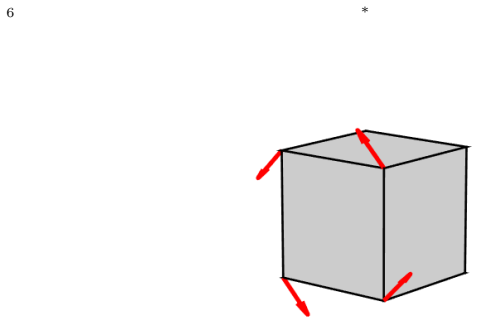
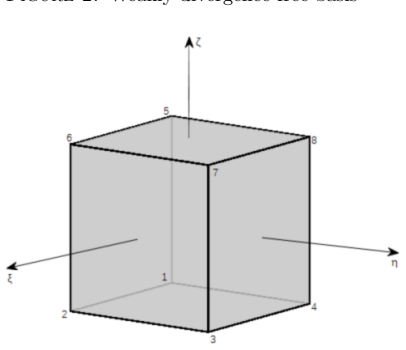
The central mechanism is a SUPG-stabilized finite-element eigenvalue formulation built on a weakly divergence-free basis. The basis is constructed from face vortices on cubic Q1 elements, with boundary 'half vortices' at the outflow, so the incompressibility constraint is built into the discrete velocity space and the pressure variable drops out of the weak form. A streamline-upwind Petrov-Galerkin (SUPG) term with parameter τ is added to stabilize the eigenvalue problem when the element Péclet number is large, reducing the linearized Navier-Stokes operator to a generalized matrix eigenvalue problem Hc=λMc. The paper proves O($h^{2}$) convergence for eigenvalues and O(h) for eigenmodes under smoothness assumptions. The argument then uses the energy identity d/dt(1/2⟨u,u⟩)=λ1ε²⟨u1,u1⟩-ε³⟨u1·∇u1,u1⟩ at t=0 to define a critical perturbation amplitude below which linearization stays a valid model.
What would settle it
Run the same eigenvalue problem at Re=2500 with boundary-layer-refined meshes or a spectral method and track the normalized mode gradient and leading eigenvalue: if the peak gradient stops growing and converges to a finite value as the mesh is refined, or if the eigenvalue shifts significantly with the mesh, the unbounded-gradient and pseudospectral claims lose their support. Experimentally, one could seed an eigenmode-like disturbance and measure whether its energy initially grows at amplitudes where the linear prediction says it should decay.
Extended reading notes
Core claim
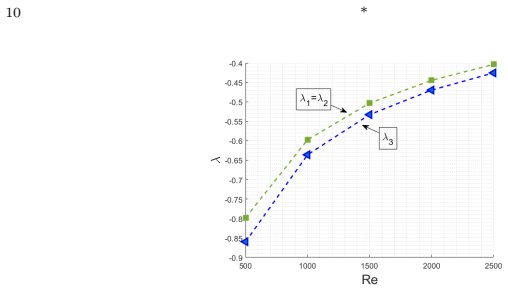
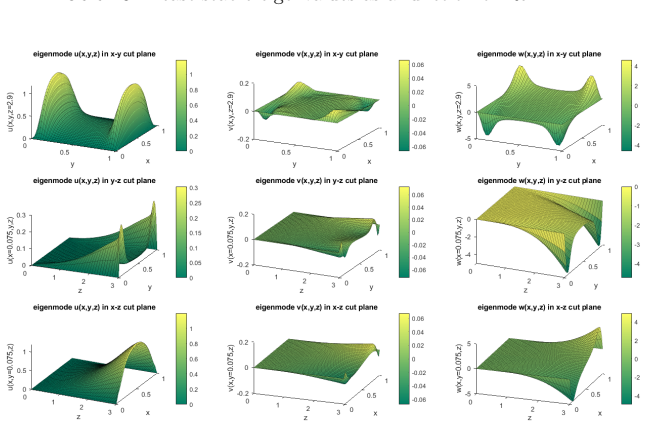
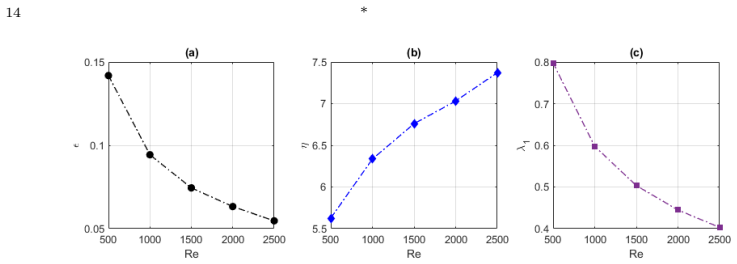
On its own terms, the paper's discovery is that the least-stable eigenmodes of the linearized Navier-Stokes operator for three-dimensional duct Poiseuille flow are not smooth global modes at high Re: they form a boundary layer near the duct wall, peak closer to the wall as Re rises, and have an unbounded normalized gradient in the inviscid limit, even though the Poiseuille base flow has no boundary-layer structure. The paper connects this singular mode shape to two consequences: the linear operator becomes pseudospectral, because small wall perturbations can greatly alter the steep modes and hence the eigenvalues, and the nonlinear mechanism acts at small disturbance amplitudes, so the linear decay rate alone does not bound the dynamics. The computed data show decay rates decreasing with Re and a critical amplitude for nonlinear energy production that falls roughly as $Re^{{-0.6}}$. The paper also notes that the leading modes do not have a simple normal-mode structure u=Ψ(x,y)$e^{{ikz}}$, so that common ansatz may be inadequate for finite-length duct stability.
Load-bearing premise
The proof of convergence assumes smooth duct walls and smooth eigenmodes, but the duct has sharp corners and the modes that carry the conclusion are thin boundary layers with steep gradients, so the reported singular structure could be a numerical artifact in exactly the regime where the argument depends on it.
Editorial extensions
If this is right
- The normal-mode ansatz u=Ψ(x,y)e^{ikz} is not a safe starting point for finite-length duct stability, since the leading disturbances are wall-focused, outlet-concentrated, and genuinely three-dimensional.
- Predictions of transition based only on the real part of the least-stable eigenvalue become unreliable as Re grows, because nonlinear energy production can overwhelm linear decay while perturbation energy is still small.
- Small manufacturing roughness or geometric imperfections of the duct wall can substantially alter the least-stable eigenmodes and eigenvalues at high Re, giving a physical interpretation of pseudospectral sensitivity.
- The stable region shrinks with Re for two compounding reasons: the decay rate of the leading mode falls and the nonlinear production rate rises, so any disturbance threshold below critical amplitude must also decrease.
- The computed critical amplitude for eigenmode-like disturbances scales roughly as ε∼Re^{-0.6}, giving a quantitative, initial-condition-dependent boundary beyond which linear stability analysis stops being a good model.
Reading between the lines
- If the wall-layer mechanism is generic, the same unbounded-gradient eigenmode behavior should appear in other finite-length shear flows, so the linear-stability breakdown would not be a quirk of square ducts; this could be tested by applying the same eigenvalue analysis to rectangular or circular cross-sections.
- The ε∼Re^{-0.6} exponent is tied to an eigenmode initial condition and a finite duct length, so real disturbances triggered by noise or localized forcing may follow a different scaling; the paper's durable contribution is the mechanism, not a universal threshold.
- The pseudospectral claim is qualitative; computing the resolvent norm of the discretized linearized operator at these eigenmodes would turn the 'tends to have pseudospectra' statement into a quantitative curve.
- The outlet condition and finite length may themselves concentrate the modes near the outflow; testing longer ducts or periodic streamwise boundary conditions would separate finite-length effects from intrinsic wall-layer mechanics.
Signed reviews
Editorial analysis
A structured set of objections, weighed in public.
Referee Report
Summary. The paper studies the linear stability of three-dimensional Poiseuille flow through a finite-length square duct. The authors formulate the linearized eigenvalue problem using a weakly divergence-free finite element basis and propose a SUPG-based stabilized eigenvalue scheme. They compute the least-stable eigenvalues and eigenmodes for Reynolds numbers from 500 to 2500 and report that the flow is linearly stable in this range. The central new assertion is that at high Reynolds numbers the least-stable eigenmodes develop a boundary-layer structure near the duct walls, with gradients that grow without bound as Re increases. The paper argues that this singular structure, combined with the decreasing decay rate, makes the linearized Navier-Stokes operator pseudospectral and permits nonlinear effects to become significant while perturbation energy is still small. A critical perturbation amplitude scaling of approximately Re^-0.6 is inferred from the computed modes.
Significance. If the central claim were established, the paper would make a notable contribution by suggesting that standard linear stability analysis may be an inadequate model for high-Reynolds-number duct flow, and by connecting eigenmode structure to pseudospectral sensitivity and early nonlinearity. The numerical method itself, a divergence-free-basis FEM with a SUPG eigenvalue formulation, is potentially useful and is described in enough detail to be assessed. The eigenvalue computations for Re up to 2500 appear plausible and consistent with the existing understanding that duct Poiseuille flow is linearly stable. However, the paper's most important and novel conclusion, namely the unbounded gradient of the eigenmodes and its physical consequences, rests on numerical evidence that is not supported by the paper's own convergence analysis and lacks resolution checks.
major comments (4)
- [Section 6, first paragraph and Theorem 6.4, Eqs. (87)-(88)] The convergence proof assumes a smooth domain boundary and smooth base flow, eigenmode, and pressure fields, with constants C_{u,p} that depend on the solution. The central high-Re claim is precisely that the eigenmodes are boundary-layer-like with unbounded gradients, a regime in which the smoothness assumptions fail and the constants are uncontrolled. The duct also has sharp corners, which the analysis does not cover. No mesh-refinement study of the eigenmode gradients is reported; Figure 9 uses a fixed Nx=40 for all Reynolds numbers, so the observed shift of the peak from x about 0.1375 at Re=500 to x about 0.1 at Re=2500 cannot be distinguished from a resolution artifact, and it does not directly demonstrate an unbounded gradient.
- [Section 4, Eq. (25) and Figure 10] The critical amplitude epsilon and the Re^-0.6 scaling are computed from the same eigenmode whose gradient convergence is not verified, so the scaling is not independent evidence for the singular-structure scenario. The formula itself is ambiguous: the ratio |lambda_1 u_i^1 u_i^1 dOmega| / |u_k^1 grad_k u_i^1 u_i^1 dOmega| is written with dOmega inside the absolute values, making it unclear whether the quantity is a pointwise local ratio or an integral over an infinitesimal volume. If it is a local quantity, the global energy threshold in Eq. (24) should be derived from integrated quantities, and the two definitions may yield different scalings.
- [Section 4, Eqs. (23)-(24)] The energy identity is derived from 'equation (1)' for the total velocity, but the forms A0 and C0 in Eq. (13) are the linearized operators acting on perturbation velocities. If u in Eq. (23) is the total velocity, pressure boundary terms at the inlet and outlet as well as the base-flow advection contribution are omitted. The derivation should be written explicitly for the perturbation velocity after subtracting the base flow; otherwise Eq. (24), which is the basis for the critical amplitude, is not justified.
- [Section 3 and boundary conditions (2)-(4), (8)-(10)] All computations are performed for a single finite duct length L=3 and a single outlet condition. Figures 7 and 8 show that the least-stable modes are concentrated near the outlet, so the claimed boundary-layer structure and its extrapolation to very high Re may be controlled by the artificial outflow boundary rather than by intrinsic duct-flow dynamics. A study of the dependence on L and on the outlet boundary condition is needed before the result can be interpreted as a property of high-Reynolds-number duct Poiseuille flow.
minor comments (5)
- [Abstract and throughout] The manuscript contains many typographical errors, including 'Navier-Stoker', 'pseudospectrua', 'condtions', 'soltuions', and 'satifised'. These should be corrected throughout.
- [Eq. (20)] In the definition of M(u_h, w_h), the second term uses u^i instead of u_h^i; the notation should be consistent.
- [Section 6, Remark 6.0.2] The remark states that m_supg(u,w) = -M(u,w) and that M is 'a bilinear form defined in equation', but the equation reference is missing.
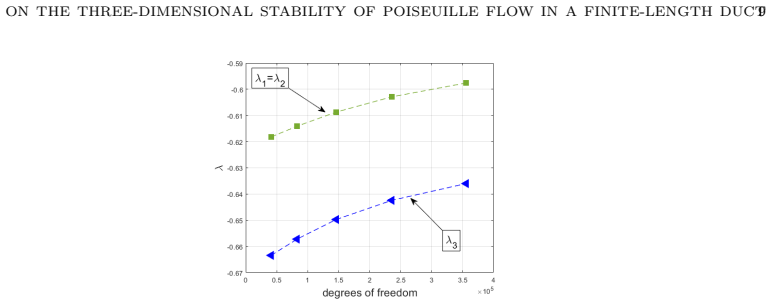
- [Figure 5] The convergence plot caption does not state the Reynolds number or the sequence of mesh sizes used. This information is needed to assess the claimed convergence.
- [Eq. (6)] The constant K0 is given to many significant figures without explanation of how it is determined from the total flux constraint; a brief derivation or reference would improve reproducibility.
Circularity Check
No circular derivation: the stability results are direct numerical eigenvalue computations; the Re^{-0.6} scaling is a post-hoc fit, not a fitted input, and there is no load-bearing self-citation.
full rationale
The paper's central results are obtained by discretizing the linearized Navier-Stokes eigenvalue problem (Eq. 12) with a weakly divergence-free SUPG finite-element scheme and solving a generalized matrix eigenvalue problem (Eq. 21). The least-stable eigenvalues and eigenmodes are outputs of this computation, not inputs. The only numerical fit reported is "A fit to the ε−Re curve gives approximately ε ∼ O(Re−0.6)" (Section 4, Fig. 10), and this scaling is a descriptive summary of the computed critical-amplitude curve, not a parameter fitted to data that then predicts the same curve. The critical amplitude itself is defined by an energy-balance ratio (Eq. 25) from the computed eigenmode; using that definition to evaluate nonlinear effects is a diagnostic criterion, not a circular derivation. The paper contains no self-citations by the authors, and its cited external results (e.g., Trefethen et al. [15]) are used as motivation, not as the proof of the boundary-layer claim. The boundary-layer-structure and unbounded-gradient claims are inferred from the computed modes (Figs. 7-9). Whether those claims survive a mesh-refinement study in the singular high-Re limit, given the smoothness assumptions in Section 6, is a correctness or convergence concern, not a circularity: the convergence theorem is independent of the numerical results it is used to justify, and the paper does not define the eigenmodes or eigenvalues in terms of the boundary-layer structure. Therefore no load-bearing step reduces to its inputs.
Assumptions & free parameters
free parameters (1)
- SUPG stabilization parameter tau =
tau = min(alpha/3, 1) h / (2 |u0|)
assumptions (3)
- domain assumption The Q1-P0 element yields correct eigenvalues for the velocity-only divergence-free formulation even without the Babuska-Brezzi condition.
- domain assumption The outlet condition -pn + nu d u/dn = 0 is a physically appropriate outflow boundary for the stability analysis.
- ad hoc to paper The smoothed-domain convergence analysis in Section 6 transfers to the cornered duct and to eigenmodes with boundary-layer structure.
Cite this review
Pith. "Pith review of On the three-dimensional stability of Poiseuille flow in a finite-length duct." pith.science (2026). https://pith.science/paper/42LHP3CF
@misc{pith2026190802191,
  author       = {Pith},
  title        = {Pith review of: On the three-dimensional stability of Poiseuille flow in a finite-length duct},
  year         = {2026},
  howpublished = {\url{https://pith.science/paper/42LHP3CF}},
  note         = {Machine review of arXiv:1908.02191}
}
abstract
The stability of a three-dimensional, incompressible, viscous flow through a finite-length duct is studied. A divergence-free basis technique is used to formulate the weak form of the problem. A SUPG (streamingline upwind Petrov-Galerkin) based scheme for eigenvalue problems is proposed to stabilize the solution. With proper boundary condtions, the least-stable eigenmodes and decay rates are computed. It is again found that the flows are asymptotically stable for all $Re$ up to $2500$. It is discovered that the least-stable eigenmodes have a boundary-layer-structure at high $Re$, although the Poiseuille base flow does not exhibits such structure. At these Reynolds numbers, the eigenmodes are dominant in the vicinity of the duct wall and are convected downstream. The boundary-layer-structure brings singularity to the modes at high $Re$ with unbounded perturbation gradient. It is shown that due to the singular structure of the least-stable eigenmodes, the linear Navier-Stoker operator tends to have pseudospectrua and the nonlinear mechanism kicks in when the perturbation energy is still small at high $Re$. The decreasing stable region as $Re$ increases is a result of both the decreasing decay rate and the singular structure of the least-stable modes. The result demonstrated that at very high $Re$, linearization of Navier-Stokes equation for duct flow may not be a good model problem with physical disturbances.
Figures

Figures from the paper (7 more)



Reference graph
Works this paper leans on
-
[1]
O. Reynolds, An experimental investigation of the circumastances which determine whether the motion of water shall be direct or sinuous and of the law of resistance in parallel channels , Phil. Trans. R. Soc. Lond. (1883)
- [2]
- [3]
-
[4]
P. L. O’Sullivan, K. S. Breuer, Transient growth in a circular pipe. I. Linear distrubances , Phys. Fluids (1994)
work page 1994
-
[5]
V. G. Priymak, T. Miyazaki, Accurate Navier-Stokes investigation of transitional and tur- bulent flows in a circular pipe , J. Comp. Phys. (1998)
work page 1998
-
[6]
O. Yu. Zikanov, On the instability of pipe Poiseuille flow , Phys. Fluids (1996)
work page 1996
-
[7]
Bergstr¨ om,Optimal growth of small disturbances in pipe Poiseuille flow , Phys
L. Bergstr¨ om,Optimal growth of small disturbances in pipe Poiseuille flow , Phys. Fluids A (1993)
work page 1993
-
[8]
P. J. Schmid, D. S. Henningson, Optimal energy growth in Hagen-Poiseuille flow , J. Fluid Mech (1994)
work page 1994
Show all 29 references
-
[9]
A. E. Trefethen, L. N. Trefethen, P. J. Schmid, Spectra and pseudospectra for pipe Poiseuille flow, Comp. Metho. Appl. Mech. Engr. (1999)
1999
-
[10]
Meseguer, L
´A. Meseguer, L. N. Trefethen, Linearized pipe flow to Reynolds number 107, J. Comp. Phys. (2003)
2003
-
[11]
Delplace, G
F. Delplace, G. Delaplace, S. Lefebvre, et al. Friction curves for the flow of Newtonian and non-Newtonian liquids in ducts of complex crosssectional shape. Proc. 7th International congress on engineering and food. (1997)
1997
-
[12]
A. G. Darbyshire, T. Mullin, Transition to turbulence in constant mass-flux pipe flow , J. Fluid Mech. (1995)
1995
-
[13]
I. J. Wygnanski, F. H. Champagne, On transition in a pipe. Part 1. The origin of puffs and slugs and the flow in a turbulent slug , J. Fluid Mech (1973)
1973
-
[14]
B. Hof, A. Juel, T. Mullin, Scaling of the turbulence transition threshold in a pipe , Phys. Rev. Lett. (2003)
2003
-
[15]
L. N. Trefethen, A. E. Trefethen, S. C. Reddy, T. A. Driscoll, Hydrodynamic stability without eigenvalues, Science (1993)
1993
-
[16]
Meseguer Streak breakdown instability in pipe Poiseuille flow , Phys
´A. Meseguer Streak breakdown instability in pipe Poiseuille flow , Phys. Fluids (2003)
2003
-
[17]
Eckhardt, A
B. Eckhardt, A. Mersmann, Transition to turbulence in a shear flow , Phys. Rev. E (1999)
1999
-
[18]
T. J. R. Hughes, A. N. Brooks, A multidimensional upwind scheme with no crosswind dif- fusion, in: T.J.R. Hughes, ed., Finite Element Methods for Convection Dominated Flows (ASME, New York, 1979)
1979
-
[19]
T. J. R. Hughes, A. N. Brooks, A theoretical framework for Petrov-Galerkin methods with discontinuous weighting functions: application to the streamline upwind procedure , in: R. H. Gallagher, D. H. Norrie, J. T. Oden and O. C. Zienkiewicz, Finite Elements in Fluids, Vol. IV (...
1982
-
[20]
Hughes, Recent progress in the development and understanding of SUPG methods with special reference to the compressible Euler and Navier-Stokes equations , Internat
T.J.R. Hughes, Recent progress in the development and understanding of SUPG methods with special reference to the compressible Euler and Navier-Stokes equations , Internat. J. Numer. Methods Fluids (1987). 24 *
1987
-
[21]
D. F. Griffiths, Finite element for incompressible flow , Math. Methods Appl. Sci. (1979)
1979
-
[22]
D. F. Griffiths, The construction of approximately divergence-free finite element , in: The Mathematics of Finite Element and its Applications, Vol. 3, ed. J.R. Whiteman (Academic Press, New York, 1979)
1979
-
[23]
D. F. Griffiths, An approximately divergence-free 9-node velocity element for incompressible flows, Internat. J. Numer. Methods Fluids (1981)
1981
-
[24]
Fortin, Old and new finite elements for incompressible flows, Internat
M. Fortin, Old and new finite elements for incompressible flows, Internat. J. Numer. Methods Fluids (1981)
1981
-
[25]
X. Ye, C. A. Hall, A discrete divergence-free basis for finite element methods , Numerical Algorithms (1997)
1997
-
[26]
D. Boffi, F. Brezzi and L. Gastaldi, On the convergence of eigenvalues for mixed formulations, Ann. Scuola Norm. Sup. Pisa Cl. Sci. (1997)
1997
-
[27]
Hughes, M
T.J.R. Hughes, M. Mallet and A. Mizukami, A new finite element formulation for computa- tional fluid dynamics: II. Beyond SUPG , Comput. Meths. Appl. Mech.(1986)
1986
-
[28]
Babˇ uska and J
I. Babˇ uska and J. Osborn,Eigenvalue problems, In Handbook of Numerical Analysis, Vol. II, North-Holland, Amsterdam (1991)
1991
-
[29]
Boffi, Finite element approximation of eigenvalue problems , Acta Numerica (2010)
D. Boffi, Finite element approximation of eigenvalue problems , Acta Numerica (2010)
2010
Reviewed August 14, 2026 · model on record in the stance chip above.
Discussion (0). Continue with ORCID to comment.