REVIEW 2 major objections 1 minor 34 references
Asymmetric induced saturation
T0 review · 2 major / 1 minor · reviewed 2026-06-25 · grok-4.3
Pith's one-line read H-deletion-saturated graphs exist for every non-complete graph on at most six vertices and for several infinite families of larger graphs.
desk verdict The paper proves existence of H-deletion-saturated graphs for several families and all H with at most 6 vertices using explicit constructions. read the letter →
The pith
A machine-rendered reading of the paper's core claim, the machinery that carries it, and where it could break.
The reading
What carries the argument
An H-deletion-saturated graph: an edge-containing graph free of induced H such that every single-edge deletion produces an induced copy of H.
What would settle it
A counterexample would be any non-complete graph H on six or fewer vertices together with a demonstration that no H-deletion-saturated graph exists for it.
Extended reading notes
Core claim
The authors establish that for every graph H on at most six vertices there exists a graph G with at least one edge containing no induced copy of H such that the deletion of any edge of G produces an induced copy of H. They further construct such graphs G for all complete bipartite graphs H with unequal part sizes, all triangle-free unicyclic graphs H, all graphs H with two leaves at distance at most three, and all line graphs of trees H, with the constructions extending to more general families within each category.
Load-bearing premise
The structural features of the considered families of H are sufficient to permit explicit construction of one graph G that avoids induced H while every edge deletion forces an induced H.
Editorial extensions
If this is right
- Such an H-deletion-saturated graph exists for any complete bipartite H with parts of different sizes.
- Such a graph exists for any triangle-free H that contains exactly one cycle.
- Such a graph exists for any H that has exactly two leaves at distance at most three.
- Such a graph exists for any H that is the line graph of a tree.
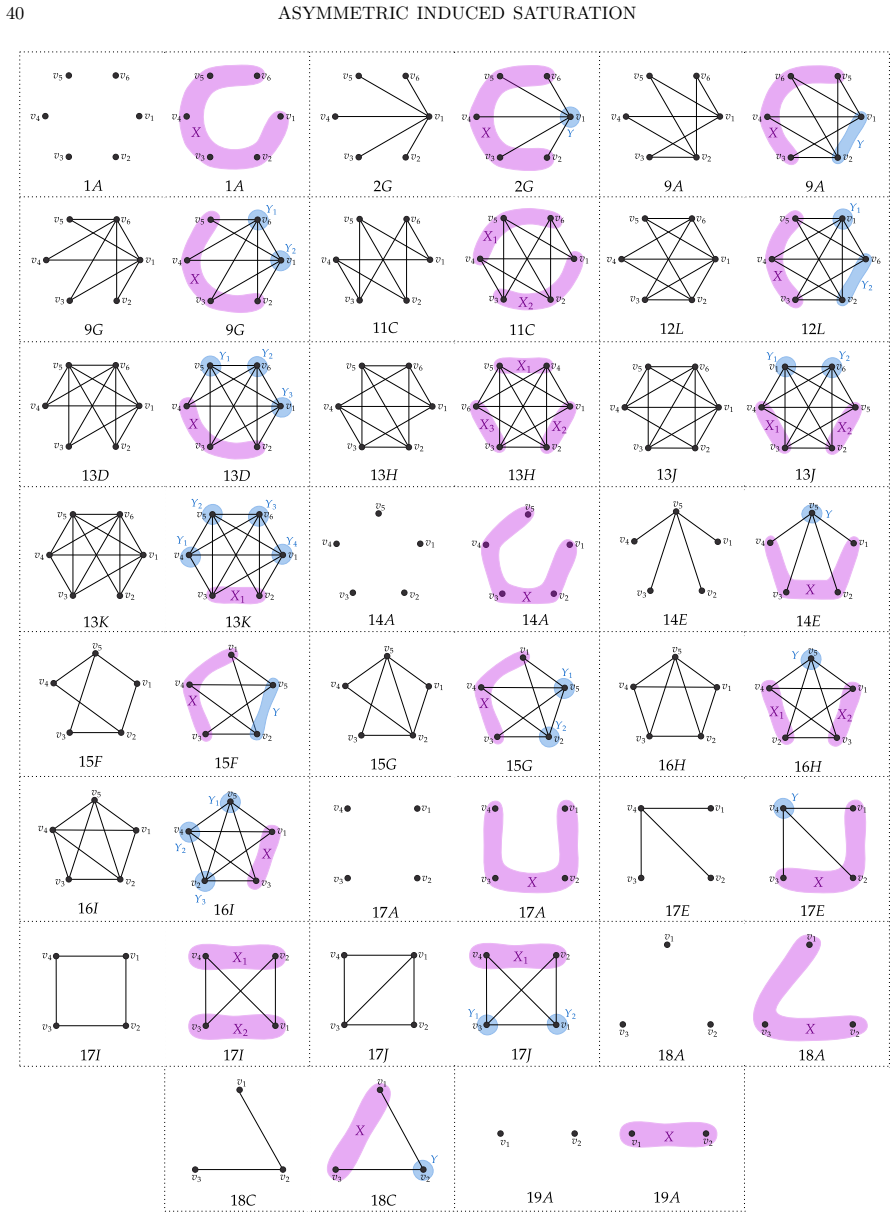
- The existence holds for every H with at most six vertices.
Reading between the lines
- The results indicate that completeness of H may be the only obstruction to existence of deletion-saturated graphs.
- Constructions for these families could be adapted to test the conjecture on other specific infinite families of graphs.
- If the conjecture holds in general it would separate the difficulty of the asymmetric deletion version from the symmetric add-and-delete version of induced saturation.
Editorial analysis
A structured set of objections, weighed in public.
Referee Report
Summary. The manuscript defines H-deletion-saturated graphs G (containing at least one edge, no induced copy of a fixed H, but every single edge deletion creates an induced H) and conjectures that such G exists for every non-complete H. It proves the conjecture for complete bipartite graphs with unequal part sizes, triangle-free unicyclic graphs, graphs with two leaves at distance at most three, line graphs of trees (and substantially more general families in each case), as well as all H on at most six vertices, via explicit constructions and exhaustive small-case verification.
Significance. If the constructions hold, the work supplies concrete supporting evidence for the conjecture by resolving it for multiple infinite families and all small-order H. The emphasis on explicit constructions (rather than non-constructive existence arguments) is a methodological strength, as it permits direct checking of the two required properties.
major comments (2)
- [Abstract] Abstract and introduction: the central existence claims for the four listed families rest on explicit constructions asserted to satisfy both the no-induced-H property and the every-edge-deletion property, yet the manuscript supplies neither proof sketches nor an outline of the case analysis used to verify these properties. Without these details the load-bearing step from construction to verified saturation cannot be inspected.
- [Introduction] The claim that the constructions extend to 'substantially more general families' is stated without a precise definition of the enlarged families or an indication of which additional structural hypotheses are relaxed while preserving the saturation property.
minor comments (1)
- Notation for the distance condition on leaves and for the line-graph case should be introduced with a short example to avoid ambiguity in the general-family statements.
Simulated Author's Rebuttal
We thank the referee for the careful review and constructive suggestions. We address each major comment below and will revise the manuscript accordingly to improve clarity on the verification of constructions and the definitions of generalized families.
read point-by-point responses
-
Referee: [Abstract] Abstract and introduction: the central existence claims for the four listed families rest on explicit constructions asserted to satisfy both the no-induced-H property and the every-edge-deletion property, yet the manuscript supplies neither proof sketches nor an outline of the case analysis used to verify these properties. Without these details the load-bearing step from construction to verified saturation cannot be inspected.
Authors: We agree that the abstract and introduction would benefit from additional guidance on the verification process. In the revised manuscript we will insert concise proof sketches and outlines of the case analyses (with pointers to the relevant sections) for each of the four families, making the transition from construction to verified saturation properties explicit and inspectable. revision: yes
-
Referee: [Introduction] The claim that the constructions extend to 'substantially more general families' is stated without a precise definition of the enlarged families or an indication of which additional structural hypotheses are relaxed while preserving the saturation property.
Authors: The body of the paper defines the enlarged families and the relaxed hypotheses in the respective sections. To address the concern, we will add a clarifying paragraph in the introduction that explicitly names each generalized family, states the additional structural hypotheses that are relaxed, and cross-references the precise definitions and theorems where the saturation property is proved for those families. revision: yes
Circularity Check
Minor self-citation to prior result on even cycles; all new existence claims rest on explicit constructions
full rationale
The paper's central results consist of explicit combinatorial constructions proving existence of H-deletion-saturated graphs for the listed families (unequal bipartite, unicyclic triangle-free, two leaves at distance ≤3, line graphs of trees, and all |V(H)|≤6). These constructions are presented as direct and independent of any fitted parameters or self-referential definitions. The only self-citation is the reference to the authors' recent proof for even cycles, which is not load-bearing for the new families or the conjecture verification on small H. No step reduces by construction to its inputs, no ansatz is smuggled, and no uniqueness theorem is invoked from self-work. The derivation chain is therefore self-contained against external combinatorial verification.
Assumptions & free parameters
assumptions (1)
- standard math Graphs are finite, simple, undirected, with no loops or multiple edges.
Cite this review
Pith. "Pith review of Asymmetric induced saturation." pith.science (2026). https://pith.science/paper/42PJNF3Y
@misc{pith2026260624763,
  author       = {Pith},
  title        = {Pith review of: Asymmetric induced saturation},
  year         = {2026},
  howpublished = {\url{https://pith.science/paper/42PJNF3Y}},
  note         = {Machine review of arXiv:2606.24763}
}
abstract
For which graphs $H$ does there exist a graph $G$ with at least one edge and no induced subgraph isomorphic to $H$, such that deleting any edge of $G$ creates an induced copy of $H$? We call such a graph "$H$-deletion-saturated". This version of the well-studied notion of "$H$-induced-saturated" graphs -- where both adding and deleting any edge creates an induced copy of $H$ -- appears more tractable. For example, while it remains wide open whether $H$-induced-saturated graphs exist for every even cycle $H$, we proved recently that deletion-saturated graphs exist for all even cycles. In fact, apart from complete graphs, no graph $H$ is known for which $H$-deletion-saturated graphs do not exist. We conjecture that $H$-deletion-saturated graphs exist for every non-complete graph $H$, and prove this conjecture for several types of graphs, including: complete bipartite graphs with parts of unequal size, triangle-free graphs with one cycle, graphs with two leaves at distance at most three, and line graphs of trees. In fact, in all cases, we prove the conjecture for substantially more general families. We also verify our conjecture for every graph $H$ on at most six vertices.
Figures


Figures from the paper (28 more)





Reference graph
Works this paper leans on
-
[1]
N. Alon, A. Kostochka, B. Reiniger, D. B. West, and X. Zhu. Coloring, sparseness and girth.Israel J. Math., 214(1):315–331, 2016
2016
-
[2]
Axenovich and M
M. Axenovich and M. Csikós. Induced saturation of graphs.Discrete Math., 342(4):1195–1212, 2019
2019
-
[3]
Behrens, C
S. Behrens, C. Erbes, M. Santana, D. Yager, and E. Yeager. Graphs with induced-saturation number zero.Electron. J. Combin., 23(1):Paper 1.54, 23, 2016
2016
-
[4]
L. W. Beineke. Characterizations of derived graphs.Journal of Combinatorial Theory, 9(2):129–135, 1970
1970
-
[5]
Bonamy, C
M. Bonamy, C. Groenland, T. Johnston, N. Morrison, and A. Scott. Induced saturation forP5. https://tomjohnston.co.uk/blog/2020-05-22-induced-saturation-for-paths.html
2020
-
[6]
Bonamy, C
M. Bonamy, C. Groenland, T. Johnston, N. Morrison, and A. Scott. Infinite induced-saturated graphs.Canadian Journal of Mathematics, page 1–31, 2026
2026
-
[7]
Briański, J
M. Briański, J. Davies, and B. Walczak. Separating polynomialχ-boundedness fromχ-boundedness. Combinatorica, 44(1):1–8, 2024
2024
-
[8]
P. J. Cameron. 6-transitive graphs.Journal of Combinatorial Theory, Series B, 28(2):168–179, 1980
1980
Show all 34 references
-
[9]
B. L. Currie, J. R. Faudree, R. J. Faudree, and J. R. Schmitt. A survey of minimum saturated graphs.The Electronic Journal of Combinatorics, pages DS19–Oct, 2012
2012
-
[10]
Devillers
A. Devillers. Classification of some homogeneous and ultrahomogeneous structures. Ph.D. thesis, Université Libre de Bruxelles, 2002
2002
-
[11]
Diestel.Graph theory, volume 173 ofGraduate Texts in Mathematics
R. Diestel.Graph theory, volume 173 ofGraduate Texts in Mathematics. Springer, Berlin, fifth edition, 2018
2018
-
[12]
Dvořák.Pn-induced-saturated graphs exist for alln⩾6.Electron
V. Dvořák.Pn-induced-saturated graphs exist for alln⩾6.Electron. J. Combin., 27(4):Paper No. 4.43, 6, 2020
2020
-
[13]
Erdős and A
P. Erdős and A. Hajnal. On chromatic number of graphs and set-systems.Acta Math. Acad. Sci. Hungar., 17:61–99, 1966
1966
-
[14]
Erdős, C
P. Erdős, C. Ko, and R. Rado. Intersection theorems for systems of finite sets.Quarterly Journal of Mathematics, 12:313–320, 1961
1961
-
[15]
X. Fan, S. Hajebi, S. Hajebi, and S. Spirkl. Halfway to induced saturation for even cycles. Manuscript available athttps://arxiv.org/abs/2505.24100, 2025
2025
-
[16]
P. Frankl. An Erdős–Ko–Rado theorem for direct products.European Journal of Combinatorics, 17(8):727–730, 1996
1996
-
[17]
Groenland
C. Groenland. Private communication
-
[18]
S. Hajebi. On Asymmetric Induced Saturation. University of Waterloo, 2025. Available athttps: //hdl.handle.net/10012/22753
2025
-
[19]
M. Kneser. Aufgabe 360.Jahresbericht der Deutschen Mathematiker-Vereinigung, 2(27):3–16, 1955
1955
-
[20]
L. Lovász. On chromatic number of finite set-systems.Acta Math. Acad. Sci. Hungar., 19:59–67, 1968
1968
-
[21]
R. R. Martin and J. J. Smith. Induced saturation number.Discrete Math., 312(21):3096–3106, 2012
2012
-
[22]
B. McKay. Database of graphs. Available athttps://users.cecs.anu.edu.au/~bdm/data/ graphs.html
-
[23]
Peterson
D. Peterson. Gridline graphs: a review in two dimensions and an extension to higher dimensions. Discrete Applied Mathematics, 126(2):223–239, 2003
2003
-
[24]
J. J. Smith. Induced saturation number.ProQuest Dissertations and Theses, page 75, 2012. Copyright - Database copyright ProQuest LLC; ProQuest does not claim copyright in the individual underlying works; Last updated - 2025-10-31
2012
-
[25]
C. M. Tennenhouse. Induced subgraph saturated graphs.Theory Appl. Graphs, 3(2):Art. 1, 14, 2016
2016
-
[26]
sporadic
H. Whitney. Congruent Graphs and the Connectivity of Graphs.Amer. J. Math., 54(1):150–168, 1932. 22 ASYMMETRIC INDUCED SATURATION AppendixA.Graphs on at most six vertices Here, we give a proof of Theorem 1.9. Up to isomorphism, there are202non-complete graphs on at most six ve...
1932
-
[27]
•P 1 =u 1 1-u2 1-u2
ThenI 1 ={u 1 4, u1 5, u2 6}, andG[I 1]is isomorphic to P3. •P 1 =u 1 1-u2 1-u2
-
[28]
•P 1 =u 1 1-u2 1-u2
ThenI 1 ={u 1 4, u1 5, u2 2}, andG[I 1]is isomorphic to P3. •P 1 =u 1 1-u2 1-u2
-
[29]
But in all three cases,G[I1]isP 3-free, a contradiction
ThenI 1 ={u 1 3, u1 5}is a stable set. But in all three cases,G[I1]isP 3-free, a contradiction. This proves (22). (23)For everye∈E( G), the graphG+ehas an induced subgraph isomorphic to2P 3. We need to prove that there are two anticomplete induced copiesP1 andP 2 ofP 3 in G+e....
-
[30]
•e=u 1 1u1
In this case,P1 =u 1 6-u1 1-u1 3 andP 2 =u 2 4-u2 2-u2 5 work. •e=u 1 1u1
-
[31]
Next, assume thate∈E( G2)
In this case,P1 =u 1 1-u1 4-u1 5 andP 2 =u 2 2-u2 6-u2 3 work. Next, assume thate∈E( G2). Then, by symmetry, we may assume thate=u 2 1u2 6, in which caseP 1 =u 1 2-u1 3-u1 4 andP 2 =u 2 5-u2 1-u2 6 work. Finally, assume thate=u 1 i u2 j for somei, j∈ {1, . . . ,6}withi̸=j. The...
-
[32]
•e=u 1 1u2
In this case,P1 =u 1 6-u1 1-u2 2 andP 2 =u 1 4-u1 3-u2 3 work. •e=u 1 1u2
-
[33]
•e=u 1 1u2
In this case,P1 =u 1 6-u1 1-u2 3 andP 2 =u 1 4-u2 4-u2 2 work. •e=u 1 1u2
-
[34]
This proves (23)
In this case,P1 =u 1 6-u1 1-u2 4 andP 2 =u 1 3-u2 3-u2 5 work. This proves (23). The result now follows from (22) and (23). This completes the proof of Theorem A.16. ■ Theorem A.17.Entry15Iin Figure 22 is deletion-normal. 38 ASYMMETRIC INDUCED SATURATION Figure 21.Proof of The...
Reviewed June 25, 2026 · model on record in the stance chip above.
Discussion (0). Continue with ORCID to comment.