REVIEW 2 major objections 4 minor 16 references
Population collapse in Elite-dominated societies: A differential equations model without differential equations
T0 review · 2 major / 4 minor · reviewed 2026-08-14 · deepseek-v4-flash
Pith's one-line read In an elite-dominated society — elites both outgrow and out-consume commoners while depending on their labor — both populations are proven to collapse to zero under five qualitative conditions, and the HANDY model under elite-dominated…
desk verdict Main theorem is sound and the H* framework is genuinely new, but the 'elite-dominated' framing overstates the role of H3; the load-bearing H*2 uniform-gap condition should be front and center. read the letter →
The pith
A machine-rendered reading of the paper's core claim, the machinery that carries it, and where it could break.
The reading
What carries the argument
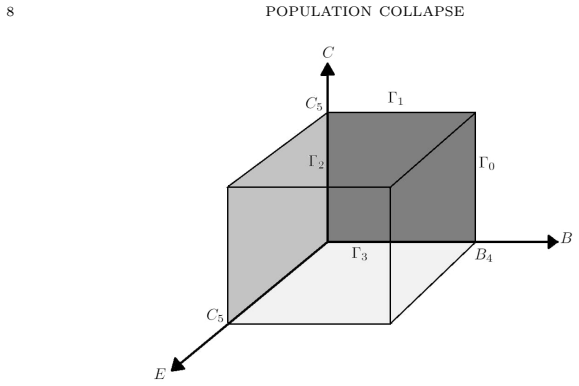
The argument is carried by the ratio $V(t)=C(t)/E(t)$ of Commoners to Elites. Hypothesis H3 makes $V$ non-increasing, because $\dot V/V = C'/C - E'/E \leq 0$. The critical quantitative input is H*2: there exist positive $\delta_2^*$ and $\varepsilon_2^*$ such that whenever $|C'/C|\le \delta_2^*$, the growth-rate gap $E'/E - C'/C$ exceeds $\varepsilon_2^*$. Uniform continuity from H*1 converts this instantaneous gap into a one-step decay estimate ($H^{**}_2$): whenever $C'$ is near zero at time $t$, $V(t+1) \le (1+\varepsilon_2)^{-1}V(t)$ (Lemma 10). Since $V$ decreases geometrically, $V(t)\to 0$, and because $E$ is bounded, $C(t)\to 0$; hypothesis HZ then forces $E(t)\to 0$. In the differential-equation version, $V$ acts as a Lyapunov function and a generalized Barbashin–Krasovskii–LaSalle theorem places all limit points in the set $E=0$.
What would settle it
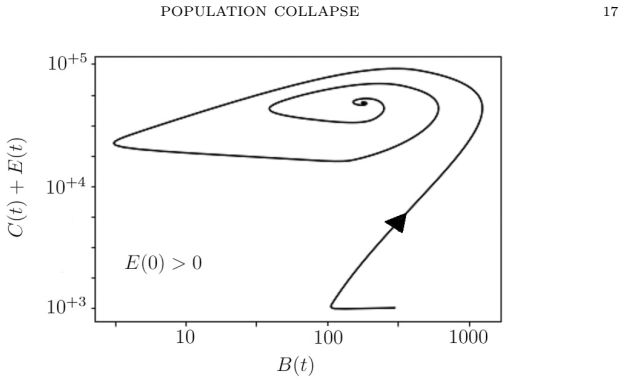
Simulate a HANDY* trajectory with strictly positive initial coordinates and parameters satisfying (5.8), e.g., the values in Table 1 with $E(0)=1$; Theorem 6 predicts both $C(t)$ and $E(t)$ converge to 0. A bounded trajectory that stays away from 0 (or one where $C(t)$ and $E(t)$ do not both vanish) would falsify the central claim. Alternatively, any bounded trajectory satisfying H*1, H*2, H3, HB, HZ in which $C(t)\not\to 0$ would refute Theorem 3 directly.
Extended reading notes
Core claim
The central claim is Theorem 3: any trajectory satisfying the qualitative hypotheses H*1 (smoothness and boundedness), H*2 (a uniform positive gap between elite and commoner per-capita growth rates whenever commoner growth is near zero), H3 (elite change rate always at least commoner change rate), HB (boundedness), and HZ (elites die out if commoners do) has $C(t)\to 0$ and $E(t)\to 0$ as $t\to\infty$. Theorem 6 shows every HANDY* trajectory with strictly positive initial coordinates satisfies these hypotheses, so the HANDY family inherits the collapse. The authors also prove a differential-equation-level version (Theorem 2) for the 'H model' of three generic equations, which becomes a corollary of the qualitative result. In their own framing, the theorems establish that elite-dominated social structure is sufficient for population collapse across a broad class of models, and they identify one modification — downward mobility of elites into the commoner population — that replaces collapse with a stable equilibrium.
Load-bearing premise
The theorem hinges on H*2 — that whenever the Commoner per-capita growth rate is within some fixed tolerance of zero, the Elite per-capita growth rate exceeds it by a margin bounded below by a fixed positive constant — because that uniform gap is what drives the geometric decay of the ratio $C/E$; if the gap can be arbitrarily small, collapse does not follow from the other conditions.
Editorial extensions
If this is right
- Any model in the qualitative class H* collapses regardless of the specific functional forms, so collapse is a structural feature of elite dominance rather than a quirk of HANDY's equations.
- The HANDY model, when restricted to elite-dominated parameters, always collapses for $E(0)>0$; the earlier numerical findings of collapse are now proven for all such parameter choices.
- The time-varying generalization HANDY* shows the result survives climate and seasonality-type fluctuations in parameters, as long as they are bounded and sufficiently smooth.
- The existence of a stable equilibrium in the downward-mobility version (Sec. 9) shows that moving elites into the commoner class is one effective structural remedy against collapse.
- Because the proofs rely only on qualitative hypotheses, verifying the hypotheses for a new model is a finite check; the collapse conclusion then follows immediately.
Reading between the lines
- We speculate the same ratio-decay mechanism may hold in any two-group system where one group has a uniformly higher per-capita growth rate and the other group's stagnation is a recurrent event — for example parasite–host or predator–prey systems with obligate dependence.
- An empirical counterpart would be: if a real stratified society exhibits periods where commoner population growth is near zero while elite per-capita growth retains a sustained gap, demographic data should show a secular decline of the commoner-to-elite ratio; the absence of such decline would suggest some unmodeled mobility or buffering mechanism.
- The paper leaves open whether weaker conditions suffice — for instance, whether the uniform gap H*2 can be replaced by an integrated (average) gap over time, which would enlarge the domain of the theorem at the cost of a different proof.
- The downward-mobility term $\mu E^2$ is one specific fix; a natural extension is to ask whether the equilibrium remains stable when mobility is a function of resource scarcity, not a constant.
Signed reviews
Editorial analysis
A structured set of objections, weighed in public.
Referee Report
Summary. The paper proposes two qualitative frameworks for population collapse in elite-commoner societies. The H model (Section 2) keeps abstract differential equations for B, C, E and imposes hypotheses H1-H3, HB, and HZ, with elite dominance represented by H3 (E'/E >= C'/C); Theorem 2 asserts C,E -> 0. The H* model (Section 3) removes differential equations entirely and replaces H1-H2 with trajectory-level conditions H*1 and H*2, where H*2 requires a uniform positive gap E'/E - C'/C whenever |C'/C| is small; Theorem 3 asserts collapse under H*1, H*2, H3, HB, and HZ. Section 5 defines the HANDY* model with time-dependent parameters and proves that every positive HANDY* trajectory is an H* trajectory, yielding collapse (Theorem 6). Section 9 adds a downward-mobility term to exhibit an equilibrium. The main mathematical contribution is the qualitative collapse theorem and its verification for a generalized HANDY model.
Significance. If the formal theorems are correct, this is a meaningful methodological contribution: it shows that population collapse can be deduced from structural inequalities rather than from detailed equations or numerical simulation, and the verification for HANDY* is explicit and does not fit free parameters. The paper is also careful to state boundedness (HB) and dependency (HZ) as separate hypotheses. However, the abstract and introduction overstate the result by attributing collapse to 'Elite-dominated' models defined through H3 alone. The uniform-gap condition H*2 is essential and is not implied by elite dominance. This gap between the advertised slogan and the formal theorem is the central issue to address.
major comments (2)
- [Abstract, Sec. 1, Sec. 3] The informal claim that 'Elite-dominated' societies collapse is not the content of Theorem 3. As defined in the introduction, elite dominance is H3 (E'/E >= C'/C), but Theorem 3 also requires H*2, a uniform positive lower bound on E'/E - C'/C whenever |C'/C| is small, and H*2 does not follow from H3. For example, B(t)=1 and C(t)=E(t)=2+e^{-t} satisfies H*1, H3 with equality, HB, and HZ vacuously, yet converges to (2,2) rather than to 0; it satisfies every listed hypothesis except H*2. Thus the theorem as stated is sound, but the abstract's statement that the HANDY model collapses for all parameter choices that are 'Elite-dominated' should be qualified to the full H* hypothesis set. Please revise the abstract and introduction accordingly and add a remark or example demonstrating that H3 alone is insufficient.
- [Sec. 8, Eq. (8.1) and Lemma 10] The statement of H**2 in Eq. (8.1) uses |C'(t)| < delta2, whereas the proof and the application in Theorem 3 require |C'/C(t)| < delta2; these are not equivalent because C can be small. In the proof of Lemma 10, the symbol delta is used both for the width of the interval in which |C'/C| remains small and for the lower bound of the gap E'/E - C'/C, but H*2 only guarantees the gap exceeds epsilon*2, not delta*2. The intended argument is easily repaired by choosing delta = min{delta*2, epsilon*2}/2 and writing the integral bound in terms of epsilon*2, but as written the proof of this load-bearing lemma is not correct.
minor comments (4)
- [Sec. 10] The discussion states that if one assumes only H*1, H*2, and H3, then for each bounded trajectory C(t) -> infinity; the preceding proof gives C(t) -> 0 for bounded trajectories, so the arrow appears to be a typo that should point to 0.
- [Sec. 5, H*2 verification] In the HANDY* verification of H*2, the display 'If |C'/C| < delta*2' uses delta*2 before any choice is specified; the argument should explicitly define a sufficiently small delta*2 before using it.
- [Sec. 6, Proposition 8] In the proof of the generalized Barbashin-Krasovskii-LaSalle theorem, the equality Y(t) = lim X(t_n + t) is asserted without justification; a brief argument using continuous dependence on initial conditions would make the proof self-contained.
- [Table 1 and references] Table 1 contains a duplicated header line 'Symbols: Symbols:', and the reference list has a malformed entry beginning 'Lotka. Lotka. Elements of Physical Biology'; please clean up these formatting issues.
Circularity Check
No significant circularity: the collapse theorem is a genuine derivation from explicit qualitative hypotheses, and the HANDY* verification is algebraically independent.
full rationale
The paper's central results are Theorem 3 and Theorem 6. Theorem 3 proves that any trajectory satisfying hypotheses H*1, H*2, H3, HB, and HZ has C(t), E(t) -> 0. The hypotheses are stated as assumptions about trajectories and do not include the conclusion: H*2 only requires a uniform positive gap between E'/E and C'/C when |C'/C| is small, which is a verifiable quantitative condition, not a collapse assumption. The proof derives collapse by showing that repeated near-stagnation of C forces geometric decay of C/E (Lemma 10), and then HZ converts C -> 0 into E -> 0. This is a genuine derivation, not a restatement of the input. Theorem 6 verifies that every HANDY* trajectory satisfies the H* hypotheses; the verification is algebraic, using the explicit equations (5.1)-(5.6) and parameter conditions (5.7)-(5.8). In particular, H*2 is proved from the model equations, not assumed. The informal framing that 'Elite-dominated HANDY collapses' is broader than the formal statement, because the proof relies on H*2 in addition to H3, but this is a framing overstatement, not circularity. There are no fitted parameters renamed as predictions, no load-bearing self-citations, and no uniqueness theorems imported from the authors' prior work. The cited HANDY model is external and used as the object of analysis, not as evidence for the theorem. Overall, the derivation is self-contained and no circular step was found.
Assumptions & free parameters
assumptions (5)
- standard math Barbashin-Krasovskii-LaSalle invariance principle as formulated in Prop. 8
- standard math Existence, uniqueness, and boundedness theory for the ODE systems, including the non-smooth min term handled by uniform continuity
- domain assumption The HANDY model (Motesharrei et al. 2014) is an accepted starting model; the paper's Elite-dominated version inherits its biological interpretation
- domain assumption H*2: uniform positive gap between E'/E and C'/C when |C'/C| is small
- domain assumption HZ: if C(t) -> 0 then E(t) -> 0 as t -> infinity
Cite this review
Pith. "Pith review of Population collapse in Elite-dominated societies: A differential equations model without differential equations." pith.science (2026). https://pith.science/paper/42PPKH7S
@misc{pith2026190802870,
  author       = {Pith},
  title        = {Pith review of: Population collapse in Elite-dominated societies: A differential equations model without differential equations},
  year         = {2026},
  howpublished = {\url{https://pith.science/paper/42PPKH7S}},
  note         = {Machine review of arXiv:1908.02870}
}
read the original abstract
The HANDY model of Motesharrei, Rivas, and Kalnay examines interactions with the environment by human populations, both between poor and rich people, i.e., "Commoners" and "Elites". The Elites control the society's wealth and consume it at a higher rate than Commoners, whose work produces the wealth. We say a model is "Elite-dominated" when the Elites' per capita population change rate is always at least as large as the Commoners'. We can show the HANDY model always exhibits population crashes for all choices of parameter values for which it is Elite-dominated. But any such model with explicit equations raises questions of how the resulting behaviors depend on the details of the models. How important are the particular design features codified in the differential equations? In this paper, we first replace the explicit equations of HANDY with differential equations that are only described conceptually or qualitatively - using only conditions that can be verified for explicit systems. Next, we discard the equations entirely, replacing them with qualitative conditions, and we prove these conditions imply population collapse must occur. In particular, one condition is that the model is Elite-dominated. We show that the HANDY model with Elite-dominated parameters satisfies our hypotheses and thus must undergo population collapse. Our approach of introducing qualitative mathematical hypotheses can better show the underlying features of the model that lead to collapse. We also ask how societies can avoid collapse.
Figures


Figures from the paper (2 more)

Reference graph
Works this paper leans on
-
[1]
Peter Turchin and Sergey A Nefedov. Secular cycles. Princeton University Press, 2009
work page 2009
-
[2]
Regional population collapse followed initial agriculture booms in mid-holocene europe
Stephen Shennan, Sean S Downey, Adrian Timpson, Kevan Edinborough, Sue Colledge, Tim Kerig, Katie Manning, and Mark G Thomas. Regional population collapse followed initial agriculture booms in mid-holocene europe. Nature communications, 4: 0 2486, 2013
work page 2013
-
[3]
Post-invasion demography of prehistoric humans in south america
Amy Goldberg, Alexis M Mychajliw, and Elizabeth A Hadly. Post-invasion demography of prehistoric humans in south america. Nature, 532 0 (7598): 0 232, 2016
work page 2016
-
[4]
Safa Motesharrei, Jorge Rivas, Eugenia Kalnay, Ghassem R Asrar, Antonio J Busalacchi, Robert F Cahalan, Mark A Cane, Rita R Colwell, Kuishuang Feng, Rachel S Franklin, et al. Modeling sustainability: population, inequality, consumption, and bidirectional coupling of the earth and human systems. National Science Review, 3 0 (4): 0 470--494, 2016
work page 2016
-
[5]
Historical dynamics: Why states rise and fall, volume 26
Peter Turchin. Historical dynamics: Why states rise and fall, volume 26. Princeton University Press, 2018
work page 2018
-
[6]
Collapse: How societies choose to fail or succeed
Jared Diamond. Collapse: How societies choose to fail or succeed. Penguin, 2005
work page 2005
-
[7]
Famine, revolt, and the dynastic cycle
CY Cyrus Chu and Ronald D Lee. Famine, revolt, and the dynastic cycle. Journal of Population Economics, 7 0 (4): 0 351--378, 1994
work page 1994
-
[8]
From F unan to A ngkor: Collapse and regeneration in ancient cambodia
Miriam T Stark. From F unan to A ngkor: Collapse and regeneration in ancient cambodia. After collapse: the regeneration of complex societies, pages 144--167, 2006
work page 2006
Show all 16 references
-
[9]
Resource use, institutions, and sustainability: a tale of two pacific island cultures
Jon D Erickson and John M Gowdy. Resource use, institutions, and sustainability: a tale of two pacific island cultures. Land Economics, pages 345--354, 2000
2000
-
[10]
Human and nature dynamics (handy): Modeling inequality and use of resources in the collapse or sustainability of societies
Safa Motesharrei, Jorge Rivas, and Eugenia Kalnay. Human and nature dynamics (handy): Modeling inequality and use of resources in the collapse or sustainability of societies. Ecological Economics, 101: 0 90--102, 2014
2014
-
[11]
Lotka. Lotka. Elements of Physical Biology. Williams and Wilkins, 1925
1925
-
[12]
Variazioni e fluttuazioni del numero d'individui in specie animali conviventi
Vito Volterra. Variazioni e fluttuazioni del numero d'individui in specie animali conviventi. C. Ferrari, 1927
1927
-
[13]
Economic principles in the emergence of humankind
Vernon L Smith. Economic principles in the emergence of humankind. Economic Inquiry, 30 0 (1): 0 1, 1992
1992
-
[14]
The simple economics of easter island: A ricardo-malthus model of renewable resource use
James A Brander and M Scott Taylor. The simple economics of easter island: A ricardo-malthus model of renewable resource use. American economic review, pages 119--138, 1998
1998
-
[15]
Differential dynamical systems, volume 14
James D Meiss. Differential dynamical systems, volume 14. Siam, 2007
2007
-
[16]
Nonlinear dynamical systems and control: a Lyapunov-based approach
Wassim M Haddad and VijaySekhar Chellaboina. Nonlinear dynamical systems and control: a Lyapunov-based approach. Princeton University Press, 2011
2011
Reviewed August 14, 2026 · model on record in the stance chip above.
Discussion (0). Continue with ORCID to comment.