REVIEW 2 major objections 4 minor 1 cited by
Overionized plasma in the supernova remnant Sagittarius A East anchored by XRISM observations
T0 review · 2 major / 4 minor · reviewed 2026-08-12 · deepseek-v4-flash
Pith's one-line read Sgr A East, the supernova remnant beside the Milky Way's supermassive black hole, is pinned down: its X-ray emission is overionized, with a forbidden-to-resonance Fe XXV ratio of 1.39 ± 0.12 and an initial ionization temperature above 4…
desk verdict First XRISM look at Sgr A East resolves the Fe XXV triplet and makes a solid case for overionized plasma, though the headline kTinit and tau numbers are softer than the quoted systematics imply. read the letter →
The pith
A machine-rendered reading of the paper's core claim, the machinery that carries it, and where it could break.
The reading
What carries the argument
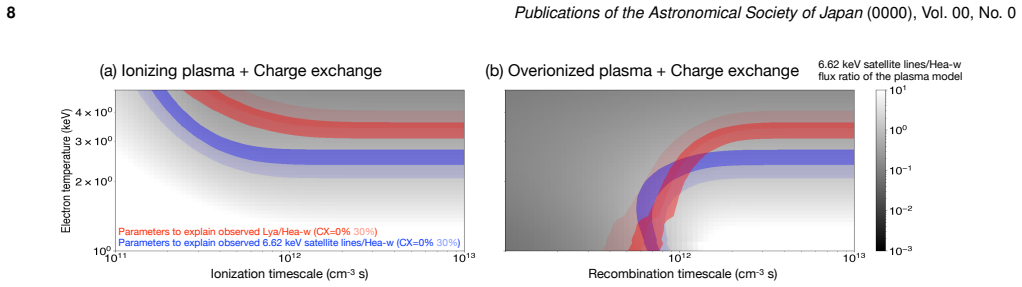
The central diagnostic is the Fe XXV Heα triplet, the forbidden (z), intercombination (x/y), and resonance (w) lines, whose relative intensities depend on how the plasma was ionized and how it is recombining. In a recombining plasma the forbidden line is enhanced relative to the resonance line; comparing the observed z/w and Lyα/Heα-w ratios against AtomDB collisional-radiative models, via the bvvrnei overionized model with Lorentzians for the six bright lines, directly maps out the allowed electron temperature, present ionization temperature, initial ionization temperature, and recombination timescale.
What would settle it
The overionized model predicts an He-like Fe radiative recombination continuum at ~8.83 keV; a deeper XRISM observation with better control of the power-law and transient contamination that found no such edge at the predicted strength, or an independent density-age estimate forcing τ > 8 × $10^{11}$ $cm^{-3}$ s, would refute the single-component overionized interpretation.
Extended reading notes
Core claim
On its own terms, the discovery is that the Fe K-shell emitting plasma in Sgr A East is overionized: the observed line ratios select a narrow corner of parameter space in which the electron temperature is 1.6 ± 0.2 keV while the ionization state corresponds to a present ionization temperature of 4.7 ± 0.4 keV, requiring kT_init > 4 keV and τ < 8 × $10^{11}$ $cm^{-3}$ s. The paper also reports a velocity dispersion of 109 ± 6 km $s^{-1}$, implying an Fe ion temperature < 8 keV and an expansion velocity < 200 km $s^{-1}$, and rules out resonance scattering (< 5% effect) and charge exchange (< 10%) as alternative explanations for the enhanced forbidden line.
Load-bearing premise
The line-ratio diagnostic assumes that all Fe K emission from the region can be attributed to a single overionized plasma component, with the foreground transient AX J1745.6-2901 and the Galactic center X-ray background correctly subtracted; if the emission is actually a spatial mixture of separate ionizing and recombining regions, or if the transient's variable Fe absorption distorts the forbidden and resonance lines differently, the inferred kT_init and τ would not be unique.
Editorial extensions
If this is right
- Sgr A East becomes a firmly established member of the small class of overionized supernova remnants, ending the dispute between earlier claims of overionization and counter-claims of an ionizing plasma.
- The measured kT_init > 4 keV and τ < 8 × 10^11 cm^-3 s narrow the plausible triggers to rapid cooling from a dense circumstellar medium or past photoionization by Sgr A*, and disfavor thermal conduction.
- The small velocity dispersion (< 200 km s^-1) and Fe ion temperature (< 8 keV) require a dense environment that suppresses expansion, consistent with a high-density CSM or strong reverse shock.
- The recombination timescale combined with the plasma density implies that the overionization started ≲ 2500 yr (n_e / 10 cm^-3)^-1 ago, linking the plasma state to a recent event at the Galactic center.
Reading between the lines
- If the photoionization scenario holds, Sgr A East acts as a fossil X-ray echo of a Sgr A* outburst within the past few thousand years; a separate test would look for overionization signatures in other elements (Si, S, Ar) in the swept-up interstellar medium, which the paper notes should also be overionized in that case.
- The absolute charge-exchange contribution is only bounded (< 10% at Heα-w); a direct measurement of CX lines in a longer exposure could tighten the overionized parameter constraints further.
- XRISM's resolving power makes the z/w plus Lyα/Heα-w pair a reusable diagnostic: the same two-ratio analysis could be applied to other mixed-morphology remnants to test whether Sgr A East's overionized state is typical or exceptional.
Editorial analysis
A structured set of objections, weighed in public.
Referee Report
Summary. The paper presents the first XRISM/Resolve observation of the supernova remnant Sgr A East. After modeling the Fe K band with six Lorentzian lines plus a two-temperature bvvrnei plasma, a power-law, the Galactic center X-ray emission, and the transient AX J1745.6-2901, the authors measure Fe Heα-z/Heα-w = 1.39 ± 0.12 and Lyα/Heα-w = 0.36 ± 0.07. Comparing these ratios with AtomDB grids, they find that CIE models cannot reproduce the large forbidden-to-resonance ratio, while an overionized NEI model with kTe = 1.6 ± 0.2 keV, present ionization temperature kTz = 4.7 ± 0.4 keV, initial ionization temperature kTinit > 4 keV, and recombination timescale tau < 8e11 cm^-3 s can. The high initial temperature and short recombination timescale are interpreted as evidence for rapid adiabatic cooling from dense CSM or for past photoionization by Sgr A*. Checks on resonance scattering, charge exchange, GCXE spatial variation, and AX J1745.6-2901 absorption are included.
Significance. If correct, this is an important result: it provides the first fine-structure-resolved Fe XXV diagnostics of Sgr A East, appears to settle the conflict between Ono et al. (2019) and Zhou et al. (2021), and yields quantitative constraints that bear on the past activity of Sgr A*. The paper's strengths are the clean spectral separation, the simultaneous source/background fit with C-stat/d.o.f. = 2975.1/2589, and the explicit treatment of resonance scattering, charge exchange, GCXE normalization, and AX J1745.6-2901 absorption. The overionized character of at least part of the Fe-K emitting plasma is well supported; the main uncertainty is whether the quantitative single-zone values are unique.
major comments (2)
- [Section 3.2 / Fig. 3] The derivation of kTinit > 4 keV and tau < 8e11 cm^-3 s assumes that the Fe Heα and Lyα fluxes originate in a single overionized NEI zone. The two-temperature model in Section 3.1 does not test this assumption because its low-temperature component is fixed to Ono et al. (2019) and contributes less than 5% at the Fe lines; it cannot represent an independent hotter CIE admixture. A two-component model with a recombining component plus a kTe ~ 3-5 keV CIE component can in principle reproduce both measured ratios: the CIE component adds resonance and Lyα flux without adding forbidden-line flux, which would change the kTinit and tau values required to match z/w = 1.39 and Lyα/w = 0.36. The systematic checks in Section 3.1 (GCXE +40% scaling and AX J1745.6-2901 absorption) rescale components within the same single-zone framework and therefore do not bound this model ambiguity. I request an explicit fit or upper limit for such an admixture, or a revision of the abstract and Section 4 so that kTinit > 4 keV and tau < 8e11 cm^-3 s are presented as single-zone NEI values rather than as robust constraints.
- [Abstract and Section 3.2] The phrase "reliable constraint on the ionization temperature just before the transition into the overionization state" is stronger than the model comparison supports. The constraint kTinit > 4 keV is read off a one-zone AtomDB grid in Fig. 3(d) and is only as secure as the one-zone assumption. Because the abstract and the Discussion use this number to argue against thermal conduction and in favor of adiabatic expansion or photoionization, the model-dependence should be stated wherever the number is used.
minor comments (4)
- [Section 1] In the last paragraph, "hearafter" should be "hereafter".
- [Table 1] The power-law flux row is labeled "Absorbed photon flux in 6.5-7.1 keV (erg s^-1 cm^-2)"; please clarify whether this is a photon flux or an energy flux and make the units consistent.
- [Figure 3(d)] The background color scale shows the Heα-z/Heα-w ratio while the red region marks the intersection of the two observed ratio constraints; drawing explicit 1σ contour lines would make the allowed region easier to read.
- [Section 3.1] The statement that kTinit is fixed to 10 keV because the model is insensitive to it could be cross-referenced to Section 3.2, where kTinit is treated as a diagnostic parameter, to avoid an apparent contradiction.
Circularity Check
No significant circularity: the overionized-plasma claim is anchored to measured Fe line ratios compared against AtomDB grids, not to assumed plasma parameters.
full rationale
The central diagnostic is self-contained: the Fe Heα and Lyα line fluxes are measured with semi-phenomenological Lorentzian models, and the forbidden-to-resonance ratio z/w = 1.39 ± 0.12 is then compared directly with AtomDB CIE and overionized NEI grids (Section 3.2, Figure 3). The inferred constraints kTinit > 4 keV and τ < 8×10^11 cm^-3 s are read off those grids, not imposed by the fit. The spectral model does include a two-temperature overionized bvvrnei component with parameters fixed from Ono et al. (2019), and Ono et al. shares authors with the present paper (Uchiyama, Nobukawa, et al.). However, the paper explicitly states that the low-temperature component contributes below 5% at Fe Heα and Lyα, that kTinit is insensitive without the six major lines, and that the absorption column is unimportant at 6.5–7 keV; these fixed inputs are therefore not load-bearing for the headline result. Self-citations to Suzuki et al. (2020) for the Lorentzian-replacement methodology and to XRISM Collaboration (2024) for instrument calibration are methodological, not evidential load-bearing. The single-zone NEI interpretation is a model-choice concern rather than a circularity: a two-component recombining-plus-hot-CIE mixture could in principle shift the quantitative constraints, but the paper’s own model comparison does not define the conclusion in terms of its inputs. Overall, no equation or fitted parameter is renamed as a prediction, and the central overionization evidence stands independently of the cited prior work.
Assumptions & free parameters
free parameters (9)
- kTinit (initial ionization temperature) =
10 keV (fixed, from Ono et al. 2019)
- kTe (electron temperature of high-temperature component) =
1.69 ± 0.09 keV
- tau (recombination timescale) =
(7.7 ± 1.1) × 10^11 s cm^-3
- Velocity dispersion (line broadening) =
109 ± 6 km/s
- Emission measure nenHV =
(5.0 ± 0.5) × 10^58 cm^-5
- Power-law flux =
(1.8 ± 0.7) × 10^-13 erg/s/cm^2 (6.5-7.1 keV, absorbed)
- GCXE surface brightness =
(3.0 ± 0.1) × 10^-14 erg/s/cm^2/arcmin^2 (6.5-7.1 keV)
- Fe abundance =
1.5 solar (fixed)
- NH (absorption column) =
1.5 × 10^23 cm^-2 (fixed)
assumptions (6)
- domain assumption Distance to Sgr A East is 8 kpc.
- domain assumption AtomDB v3.0.9, ACX2, and SPEX CX models provide accurate Fe line emissivities and recombination rates.
- domain assumption The Fe K-shell emission is from a single-zone overionized plasma modeled by bvvrnei plus a low-temperature component fixed from Ono et al. (2019).
- domain assumption The GCXE surface brightness is the same for source and background regions, and the AX J1745.6-2901 model is correct after allowing its normalization to vary within ±50%.
- domain assumption Plasma electrons have a Maxwellian distribution and the plasma follows the non-equilibrium collisional ionization description in bvvrnei.
- domain assumption Charge exchange emission is evaluated assuming a collision velocity of 1000 km/s and repeated electron capture until neutralization.
Cite this review
Pith. "Pith review of Overionized plasma in the supernova remnant Sagittarius A East anchored by XRISM observations." pith.science (2026). https://pith.science/paper/436RU4RZ
@misc{pith2026241200676,
  author       = {Pith},
  title        = {Pith review of: Overionized plasma in the supernova remnant Sagittarius A East anchored by XRISM observations},
  year         = {2026},
  howpublished = {\url{https://pith.science/paper/436RU4RZ}},
  note         = {Machine review of arXiv:2412.00676}
}
abstract
Sagittarius A East is a supernova remnant with a unique surrounding environment, as it is located in the immediate vicinity of the supermassive black hole at the Galactic center, Sagittarius A*. The X-ray emission of the remnant is suspected to show features of overionized plasma, which would require peculiar evolutionary paths. We report on the first observation of Sagittarius A East with X-Ray Imaging and Spectroscopy Mission (XRISM). Equipped with a combination of high-resolution microcalorimeter spectrometer and large field-of-view CCD imager, we for the first time resolved the Fe XXV K-shell lines into fine structure lines and measured the forbidden-to-resonance intensity ratio to be $1.39\pm0.12$, which strongly suggests the presence of overionized plasma. We obtained a reliable constraint on the ionization temperature just before the transition into the overionization state, to be > 4 keV. The recombination timescale was constrained to be < $8\times10^{11}$ cm$^{-3}$ s. The small velocity dispersion of $109\pm6$ km s$^{-1}$ indicates a low Fe ion temperature < 8 keV and a small expansion velocity < 200 km s$^{-1}$. The high initial ionization temperature and small recombination timescale suggest that either rapid cooling of the plasma via adiabatic expansion from dense circumstellar material or intense photoionization by Sagittarius A* in the past may have triggered the overionization.
Figures


Figures from the paper (1 more)
Forward citations
Cited by 1 Pith paper
-
Revisiting the Suzaku spectrum of the Galactic SNR W 49 B: non-detection of iron K-shell charge exchange emission and refined ejecta mass ratios of iron-group elements
A reanalysis of Suzaku data on W49B shows the reported Fe XXV charge exchange signal is explained by missing high-shell dielectronic recombination satellite lines, leaving no robust CX detection.
Reference graph
Works this paper leans on
-
[1]
\@bibitem \@bib@author\@prev@author \@set@biblabel \@lbibitem[#1] \@bib@parse#1()\@nil \@set@biblabel \@bib@parse#1(#2)#3\@nil \@bib@author #1 @edef\@bib@year @space#2 \@empty \@set@biblabel#1 \@bib@author\@empty \@latex@warning Author name should be given for reference entry ``#1'' \@bib@year\@empty \@latex@warning Publication year should be given for re...
- [2]
-
[3]
Cash , W., 1979, , 228, 939
work page 1979
-
[4]
Chandra, P., Chevalier, R.A., Maeda, K., Ray, A.K., & J., N.A., 2024, The Astrophysical Journal Letters, 963, 1, L4
work page 2024
-
[5]
Chatzopoulos , S., Fritz , T.K., Gerhard , O., Gillessen , S., Wegg , C., Genzel , R., & Pfuhl , O., 2015, , 447, 1, 948
work page 2015
-
[6]
Eckart, M.E., Brown, G.V., Chiao, M.P., et al., 2024, in Proc. SPIE, volume 13093, 130931P
work page 2024
-
[7]
Ekers , R.D., Goss , W.M., Schwarz , U.J., Downes , D., & Rogstad , D.H., 1975, , 43, 159
work page 1975
- [8]
Show all 57 references
-
[9]
Foster , A.R., Ji , L., Smith , R.K., & Brickhouse , N.S., 2012, , 756, 2, 128
2012
-
[10]
Frail , D.A., 2011, , 82, 703
2011
-
[11]
Fryer , C.L., Rockefeller , G., Hungerford , A., & Melia , F., 2006, , 638, 2, 786
2006
-
[12]
Gillessen , S., Eisenhauer , F., Trippe , S., Alexander , T., Genzel , R., Martins , F., & Ott , T., 2009, , 692, 2, 1075
2009
-
[13]
Gu , L., Kaastra , J., & Raassen , A.J.J., 2016, , 588, A52
2016
-
[14]
HEASARC , 2014, HEAsoft: Unified Release of FTOOLS and XANADU
2014
-
[15]
Hyodo , Y., Ueda , Y., Yuasa , T., Maeda , Y., Makishima , K., & Koyama , K., 2009, , 61, S99
2009
-
[16]
Ishisaki , Y., Ezoe , Y., Yamada , S., et al., 2018, Journal of Low Temperature Physics, 193, 5-6, 991
2018
-
[17]
& Masai , K., 1989, , 236, 885
Itoh , H. & Masai , K., 1989, , 236, 885
1989
-
[18]
& Mewe , R., 1995, , 302, L13
Kaastra , J.S. & Mewe , R., 1995, , 302, L13
1995
-
[19]
Kaastra , J.S., Mewe , R., & Nieuwenhuijzen , H., 1996, in UV and X-ray Spectroscopy of Astrophysical and Laboratory Plasmas, eds. K. Yamashita & T. Watanabe , 411--414
1996
-
[20]
& Kastner , R.E., 1990, , 44, 275
Kastner , S.O. & Kastner , R.E., 1990, , 44, 275
1990
-
[21]
Kawasaki , M.T., Ozaki , M., Nagase , F., Masai , K., Ishida , M., & Petre , R., 2002, , 572, 2, 897
2002
-
[22]
Koyama , K., 2018, , 70, 1, R1
2018
-
[23]
Koyama , K., Uchiyama , H., Hyodo , Y., Matsumoto , H., Tsuru , T.G., Ozaki , M., Maeda , Y., & Murakami , H., 2007, , 59, 237
2007
-
[24]
SPIE, volume 11444, 114445D
Loewenstein , M., Hill , R.S., Holland , M.P., et al., 2020, in Proc. SPIE, volume 11444, 114445D
2020
-
[25]
Lugten , J.B., Genzel , R., Crawford , M.K., & Townes , C.H., 1986, , 306, 691
1986
-
[26]
Maeda , Y., Baganoff , F.K., Feigelson , E.D., et al., 2002, , 570, 2, 671
2002
-
[27]
Masai , K., 1994, , 437, 770
1994
-
[28]
SPIE, volume 12181, 121811T
Mori , K., Tomida , H., Nakajima , H., et al., 2022, in Proc. SPIE, volume 12181, 121811T
2022
-
[29]
Muno , M.P., Baganoff , F.K., Bautz , M.W., et al., 2004, , 613, 1, 326
2004
-
[30]
Nakashima , S., Nobukawa , M., Uchida , H., Tanaka , T., Tsuru , T.G., Koyama , K., Murakami , H., & Uchiyama , H., 2013, , 773, 1, 20
2013
-
[31]
Ohshiro, Y., Suzuki, S., Okada, Y., Suzuki, H., & Yamaguchi, H., 2024, The Astrophysical Journal, 976, 2, 180
2024
-
[32]
Ono , A., Uchiyama , H., Yamauchi , S., Nobukawa , M., Nobukawa , K.K., & Koyama , K., 2019, , 71, 3, 52
2019
-
[33]
Ozawa , M., Koyama , K., Yamaguchi , H., Masai , K., & Tamagawa , T., 2009, , 706, 1, L71
2009
-
[34]
Park , S., Muno , M.P., Baganoff , F.K., et al., 2005, , 631, 2, 964
2005
-
[35]
SPIE, volume 13093, 130931K
Porter, F.S., Kilbourne, C.A., Chiao, M., et al., 2024, in Proc. SPIE, volume 13093, 130931K
2024
-
[36]
& Leahy , D., 2022, , 940, 1, 63
Ranasinghe , S. & Leahy , D., 2022, , 940, 1, 63
2022
-
[37]
Reid , M.J., 1993, , 31, 345
1993
-
[38]
& Petre , R., 1998, , 503, 2, L167
Rho , J. & Petre , R., 1998, , 503, 2, L167
1998
-
[39]
Ryu , S.G., Koyama , K., Nobukawa , M., Fukuoka , R., & Tsuru , T.G., 2009, , 61, 751
2009
-
[40]
Ryu , S.G., Nobukawa , M., Nakashima , S., Tsuru , T.G., Koyama , K., & Uchiyama , H., 2013, , 65, 33
2013
-
[41]
Sakano , M., Warwick , R.S., Decourchelle , A., & Predehl , P., 2004, , 350, 1, 129
2004
-
[42]
& Hughes , J.P., 2017, , 840, 2, 112
Sato , T. & Hughes , J.P., 2017, , 840, 2, 112
2017
-
[43]
Sawada , M., Gu , L., & Yamazaki , R., 2024, arXiv e-prints, arXiv:2405.14937
2024 arXiv
-
[44]
Su , M., Slatyer , T.R., & Finkbeiner , D.P., 2010, , 724, 2, 1044
2010
-
[45]
Suzuki , H., Yamaguchi , H., Ishida , M., Uchida , H., Plucinsky , P.P., Foster , A.R., & Miller , E.D., 2020, , 900, 1, 39
2020
-
[46]
SPIE, volume 10699 of Society of Photo-Optical Instrumentation Engineers (SPIE) Conference Series, 1069922
Tashiro , M., Maejima , H., Toda , K., et al., 2018, in Proc. SPIE, volume 10699 of Society of Photo-Optical Instrumentation Engineers (SPIE) Conference Series, 1069922
2018
-
[47]
SPIE, volume 11444, 1144422
Tashiro , M., Maejima , H., Toda , K., et al., 2020, in Proc. SPIE, volume 11444, 1144422
2020
-
[48]
Terada , Y., Holland , M., Loewenstein , M., et al., 2021, Journal of Astronomical Telescopes, Instruments, and Systems, 7, 037001
2021
-
[49]
Trueba , N., Miller , J.M., Fabian , A.C., et al., 2022, , 925, 2, 113
2022
-
[50]
Tsuboi , M., Handa , T., & Ukita , N., 1999, , 120, 1, 1
1999
-
[51]
Tsuboi , M., Tadaki , K.I., Miyazaki , A., & Handa , T., 2011, , 63, 763
2011
-
[52]
XRISM Collaboration , 2024, arXiv e-prints, arXiv:2408.14301
2024 arXiv
-
[53]
Yamaguchi, H., 2020, Astronomische Nachrichten, 341, 2, 150
2020
-
[54]
Yamaguchi , H., Tanaka , T., Wik , D.R., et al., 2018, , 868, 2, L35
2018
-
[55]
Zhou , P., Leung , S.C., Li , Z., Nomoto , K., Vink , J., & Chen , Y., 2021, , 908, 1, 31
2021
-
[56]
, " * write output.state after.block = add.period write newline
ENTRY address author booktitle chapter edition editor eid howpublished institution journal key month note number organization pages publisher school series title type volume year label extra.label sort.label short.list INTEGERS output.state before.all mid.sentence after.senten...
-
[57]
write newline
" write newline "" before.all 'output.state := FUNCTION n.dashify 't := "" t empty not t #1 #1 substring "-" = t #1 #2 substring "--" = not "--" * t #2 global.max substring 't := t #1 #1 substring "-" = "-" * t #2 global.max substring 't := while if t #1 #1 substring * t #2 gl...
Reviewed August 12, 2026 · model on record in the stance chip above.
Discussion (0). Continue with ORCID to comment.