REVIEW 1 major objections 6 minor 24 references
Highlights of Galactic Physics with VERITAS
T0 review · 1 major / 6 minor · reviewed 2026-08-14 · deepseek-v4-flash
Pith's one-line read Recent VERITAS results show the 50-year binary PSR J2032+4127 flared in very-high-energy gamma rays then dipped near periastron in a way current models do not reproduce, while deep pulsar searches found no new pulsed TeV emitters.
desk verdict A faithful conference summary of already-published VERITAS results; useful as a status report, not as a research contribution, and it has a couple of small traceability slips. read the letter →
The pith
A machine-rendered reading of the paper's core claim, the machinery that carries it, and where it could break.
The reading
What carries the argument
The central instrument is VERITAS, an array of four 12-meter imaging atmospheric Cherenkov telescopes that detect gamma rays above about 100 GeV by imaging the Cherenkov light from air showers, with an angular resolution of 0.1 degrees and a sensitivity of 1 percent of the Crab Nebula flux in about 25 hours. The paper also relies on the observability metric spin-down power divided by distance squared to rank pulsars for the search, on the 2HWC catalog from HAWC as the source list for follow-up, and on multiwavelength light curves combining Swift-XRT X-ray data, Fermi-LAT data, and very-high-energy data to characterize the J2032 binary. These components carry the argument because each highlighted result is a comparison of VERITAS measurements against a published catalog, model, or prior detection.
What would settle it
A quantitative comparison of the archived VERITAS and MAGIC light curves of J2032 with the model-predicted light curve, computing a correlation coefficient or chi-square with systematic errors, would settle whether the claimed poor correlation is real; a detection of pulsed very-high-energy emission in any of the 13 pulsars using updated ephemerides would refute the paper's negative pulsar result.
Extended reading notes
Core claim
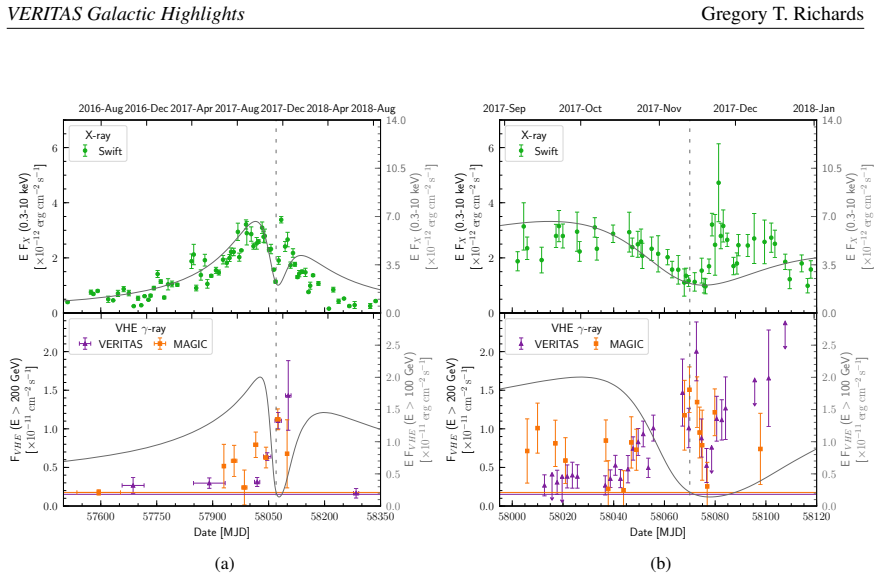
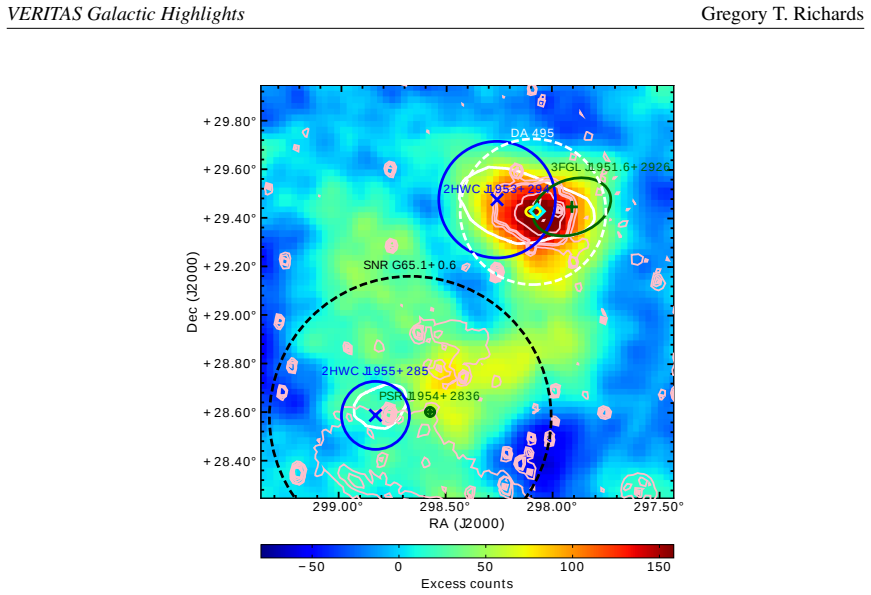
On its own terms, the paper's claim is that recent VERITAS observations have sharpened the empirical constraints on Galactic particle accelerators in four ways. First, very-high-energy emission from the binary PSR J2032+4127/MT91 213 brightened from September 2017 onward and then dipped around periastron, and this behavior is poorly reproduced by current model light curves, implying the system's geometry and emission mechanisms are not yet understood. Second, the combined Fermi-LAT and VERITAS spectrum of Cassiopeia A strongly favors a power law with an exponential cutoff at a few TeV, so Cas A is not operating as a PeVatron. Third, VERITAS detects a 5.2-sigma source, VER J1952+294, coincident with 2HWC J1953+294, most likely the pulsar wind nebula DA 495, while not detecting 2HWC J1955+285 in 64 hours. Fourth, none of 13 young pulsars ranked by spin-down luminosity over distance squared show pulsed very-high-energy emission, so pulsed TeV emission remains confined to the Crab and Vela among known pulsars.
Load-bearing premise
The paper's usefulness rests on the assumption that the cited collaboration papers are accurate summaries of the data, because this proceeding itself provides no raw data, analysis configuration, or software; for the J2032 result, the 'poorly correlated' statement is also qualitative, with no correlation coefficient or model uncertainties shown.
Editorial extensions
If this is right
- If the J2032 periastron very-high-energy dip is confirmed, modelers must substantially revise the assumed binary geometry and shock emission, not just tune parameters.
- If the Cassiopeia A spectrum truly cuts off at a few TeV, Cas A cannot be a major source of Galactic cosmic rays up to the knee, and the search for PeVatrons must focus elsewhere.
- If none of the 13 ranked pulsars emit pulsed TeV gamma rays at or above the Crab pulsar's level, pulsed very-high-energy emission is either extremely rare or requires a special geometry not captured by spin-down power ranking.
- If VER J1952+294 is DA 495, then IACT follow-up of wide-field HAWC surveys is a productive route to identifying new pulsar wind nebulae and measuring their spectra.
- The combination of Fermi-LAT, HAWC, and VERITAS data across nearly seven decades in energy demonstrates that multiwavelength coverage can tie individual sources to specific acceleration mechanisms.
Reading between the lines
- A natural reading is that the poor model correlation in J2032 hints that the very-high-energy and X-ray emission zones respond differently to changing orbital separation; comparing the X-ray and very-high-energy light-curve shapes around periastron could test this without waiting for the next passage in about 50 years.
- The pulsar null result suggests spin-down power over distance squared alone is a poor predictor of pulsed TeV emission, so future searches might also weight magnetic field strength, inclination, or outer-gap geometry; this is an inference, not something the paper concludes.
- The non-detection of 2HWC J1955+285 with 64 hours of VERITAS suggests that some HAWC sources may be extended or variable in a way that IACT follow-up can reveal; this is a testable extension.
- If the Cassiopeia A cutoff is generic for young supernova remnants, the PeVatron population may be dominated by other source classes; the paper does not draw this conclusion, but it follows from combining its Cas A statement with the earlier observation that supernova remnant spectra show sub-PeV cutoffs.
Signed reviews
Editorial analysis
A structured set of objections, weighed in public.
Referee Report
Summary. This proceedings paper (ICRC 2019) summarizes recent highlights of the VERITAS Galactic science program and explicitly claims no new measurements; all results are attributed to published or in-preparation collaboration papers. Section 3 reports that VERITAS and MAGIC observed a rising very-high-energy (VHE) flux from PSR J2032+4127 beginning in 2017 September, with a dip near the November 2017 periastron, and asserts that the VHE light curve is 'poorly correlated' with overlaid model predictions (Figure 1). Section 4 reviews Cassiopeia A, whose combined Fermi-LAT/VERITAS spectrum shows a cutoff at a few TeV, with current modeling favoring a hadronic origin. Section 5 reports the VERITAS detection of VER J1952+294 coincident with 2HWC J1953+294, likely DA 495, and a non-detection at the position of 2HWC J1955+285. Section 6 reports no pulsed VHE emission from 13 young pulsars searched in archival VERITAS data, with upper limits 'in many cases' below the Crab pulsar flux. The paper's correctness reduces to the fidelity of its restatements of [7], [14], and [21], which appears high for the claims checkable from the text; the main defect is the unquantified 'poorly correlated' claim in Section 3 and the blank citation on the model curve in Figure 1.
Significance. If the restatements are faithful, this is a useful, accessible summary of current VERITAS Galactic science, well suited to a proceedings venue. Strengths: results are clearly attributed to the primary literature (methodology per [2], pulsar parameters per [23], model parameters per [4] via [6]); the J2032 discussion honestly flags the model discrepancy as an open problem; and the pulsar section correctly frames the Crab/Vela context and the observability metric. The three headline results (the J2032 rise-and-dip light curve, the DA 495 association, and the null pulsar search) are previously published in [7], [14], and [21], and the text restates them accurately as far as can be checked from a proceedings, which reproduces no light-curve tables, upper-limit values, or significance contours. No circular reasoning or internal inconsistency is present; the one interpretive claim, 'poorly correlated' in Section 3, is a traceability defect discussed in the major comment, not an error in the underlying published result. I therefore view the paper as publishable after the local corrections below.
major comments (1)
- [Section 3 / Figure 1] The assertion that the J2032 VHE flux is 'poorly correlated' with the overlaid model prediction is the central interpretive claim of Section 3, and as printed it cannot be checked by the reader: no correlation coefficient, residual, or uncertainty band accompanies it, and the gray model curve for the X-rays is attributed to an empty citation ('predictions from []'). The paragraph ends with a citation to [7], and the wording is presumably a faithful restatement of the comparison made there, so the underlying published result is likely safe. However, the proceedings should restore the missing reference, attach a citation to the 'poorly correlated' sentence, and either give a quantitative comparison (for example, a chi-square or per-bin significance over the periastron interval) or explicitly attribute the qualitative judgment to [7]. This is a local traceability fix that does not require re-analysis, but it should be completed before publication because it concerns the paper's headline result.
minor comments (6)
- [Section 4 / Figure 2] The combined Fermi-LAT/VERITAS SED in Figure 2 is presented without a citation, and the statement that recent modeling favors hadronic scenarios rests on 'Abeysekara et al., in prep.' Please identify the source of the SED in the caption (for example, as that in-preparation work) and update the reference if a publication appears before the printed proceedings.
- [Section 6] The concluding sentence states that 'VHE pulsed emission from each pulsar, if present, must be more faint than that observed from the Crab pulsar,' which is stronger than the preceding hedge ('in many cases below the flux level of the Crab pulsar'); for pulsars whose upper limits are not below the Crab level, the conclusion does not follow. Please reword to match the per-pulsar limits in [21].
- [Section 6] The accounting of the northern-sky top-twelve list is incomplete: after the eight ranked pulsars in Table 1 plus Crab and Geminga, two positions in the top twelve are unaccounted for; please clarify which pulsars these are or rephrase the sentence.
- [Section 5] The sentence 'which resulted upper limits for both a point-source and extended-source search' is missing the preposition 'in'; it should read 'which resulted in upper limits.'
- [Section 3] The claim that TeV J2032+4130 has been observed for 'thirteen years of observations since its discovery' is not attributed; please cite the discovery paper (for example, Aharonian et al. 2005; HEGRA) and, if needed, the work identifying the source as a pulsar wind nebula.
- [References] Reference [20] contains typographical errors ('vela puslar', 'gev') and points to a conference presentation without a published record; please correct the typos and, if possible, update to the refereed H.E.S.S. publication on the Vela pulsar.
Circularity Check
No circularity: the paper is a conference summary that makes no new derivation, fit, or prediction; all load-bearing numbers are quoted from published external papers.
full rationale
This proceedings paper's claims are all restatements of published collaboration results: the J2032 periastron VHE rise and dip from [7] (Abeysekara et al. 2018, ApJL), the DA 495 association from [14], and the pulsar search upper limits from [21]. Each is externally published in refereed journals and does not depend on this paper, so there is no loop in which an output is defined by an input. The paper introduces no fit or model; Figure 1 overlays model predictions from Takata et al. [4]/[6], but this overlay is an illustration, not a fitted prediction of this paper, and the 'poorly correlated' statement is explicitly attributed to [7]. The in-preparation citation for Cas A hadronic modeling is non-load-bearing: it supports only a 'tends to favor' remark, not a central result, and it is a collaboration self-citation only in the loose sense, with no indication that it is the sole support for any claim. One completeness defect, not a circularity, is that the Figure 1 caption reads 'predictions from []' with an empty citation, and no correlation coefficient or residual is given for the 'poorly correlated' claim; this is a traceability and correctness risk, not a derivation loop. The paper's correctness therefore rests on citation fidelity of [7], [14], and [21], all of which are external and falsifiable, so the appropriate circularity score is 0.
Assumptions & free parameters
assumptions (3)
- domain assumption The VERITAS analysis methodology of [2] (background rejection, energy reconstruction, flux estimation) yields valid fluxes and significances.
- domain assumption The quoted results faithfully represent the cited publications ([7], [14], [21]).
- domain assumption The pulsar periods, spin-down rates, spin-down luminosities, and distances used in Table 1 (from the second Fermi-LAT pulsar catalog [23]) are accurate.
Cite this review
Pith. "Pith review of Highlights of Galactic Physics with VERITAS." pith.science (2026). https://pith.science/paper/43CKQZQ3
@misc{pith2026190805325,
  author       = {Pith},
  title        = {Pith review of: Highlights of Galactic Physics with VERITAS},
  year         = {2026},
  howpublished = {\url{https://pith.science/paper/43CKQZQ3}},
  note         = {Machine review of arXiv:1908.05325}
}
read the original abstract
VERITAS (Very Energetic Radiation Imaging Telescope Array System) is one of the most sensitive currently operating arrays of imaging atmospheric Cherenkov telescopes, which detect very high-energy (VHE; E > 100 GeV) gamma rays. VERITAS is currently in its 11th year of full-array operations with four 12m-diameter telescopes. Many Galactic sources of VHE gamma rays have been detected by VERITAS, such as pulsar wind nebulae, binary systems, and supernova remnants, and the study of VHE emission from these objects has enabled a deeper understanding of the underlying physical processes responsible for the observed gamma rays. Recent highlights from the VERITAS Galactic science program will be presented, including results on pulsar searches, follow-up of sources detected by HAWC, and the 50-year-period binary PSR J2032+4127.
Figures

Reference graph
Works this paper leans on
- [7]
-
[14]
A. U. Abeysekara, A. Archer, W. Benbow, R. Bird, R. Brose, M. Buchovecky et al., VERITAS and Fermi-LAT Observations of TeV Gamma-Ray Sources Discovered by HA WC in the 2HWC Catalog, ApJ 866 (Oct., 2018) 24, [1808.10423]
arXiv 2018
- [21]
-
[2]
V . A. Acciari, M. Beilicke, G. Blaylock, S. M. Bradbury, J. H. Buckley, V . Bugaev et al.,VERITAS Observations of the γ-Ray Binary LS I +61 303 , ApJ 679 (June, 2008) 1427–1432, [0802.2363]
work page Pith review arXiv 2008
-
[23]
A. A. Abdo, M. Ajello, A. Allafort, L. Baldini, J. Ballet, G. Barbiellini et al., The Second Fermi Large Area Telescope Catalog of Gamma-Ray Pulsars, ApJS 208 (Oct., 2013) 17, [1305.4385]. 7
arXiv 2013
-
[4]
High-Energy emissions from the Pulsar/Be binary system PSR J2032+4127/MT91 213
J. Takata, P. H. T. Tam, C. W. Ng, K. L. Li, A. K. H. Kong, C. Y . Hui et al.,High-energy Emissions from the Pulsar/Be Binary System PSR J2032+4127/MT91 213 , ApJ 836 (Feb., 2017) 241, [1702.04446]
work page Pith review arXiv 2017
-
[6]
K. L. Li, J. Takata, C. W. Ng, A. K. H. Kong, P. H. T. Tam, C. Y . Hui et al.,The X-Ray Modulation of PSR J2032+4127/MT91 213 during the Periastron Passage in 2017 , ApJ 857 (Apr., 2018) 123, [1803.06703]
work page Pith review arXiv 2017
-
[1]
J. Holder, V . A. Acciari, E. Aliu, T. Arlen, M. Beilicke, W. Benbow et al.,Status of the VERITAS Observatory, in American Institute of Physics Conference Series (F. A. Aharonian, W. Hofmann and F. Rieger, eds.), vol. 1085 of American Institute of Physics Conference Series , pp. 657–660, Dec., 2008, 0810.0474, DOI
arXiv 2008
Show all 24 references
-
[3]
A. G. Lyne, B. W. Stappers, M. J. Keith, P. S. Ray, M. Kerr, F. Camilo et al.,The binary nature of PSR J2032+4127, MNRAS 451 (July, 2015) 581–587, [1502.01465]
2015 arXiv
-
[5]
W. C. G. Ho, C.-Y . Ng, A. G. Lyne, B. W. Stappers, M. J. Coe, J. P. Halpern et al.,Multiwavelength monitoring and X-ray brightening of Be X-ray binary PSR J2032+4127/MT91 213 on its approach to periastron, MNRAS 464 (Jan., 2017) 1211–1219, [1609.06328]
2017 arXiv
-
[8]
Abramowski, F
HESS Collaboration, A. Abramowski, F. Aharonian, F. A. Benkhali, A. G. Akhperjanian, E. O. Angüner et al., Acceleration of petaelectronvolt protons in the Galactic Centre , Nature 531 (Mar.,
-
[9]
M. A. Malkov and L. O. Drury, Nonlinear theory of diffusive acceleration of particles by shock waves, Reports on Progress in Physics 64 (Apr., 2001) 429–481
2001
-
[10]
F. A. Aharonian, Gamma rays from supernova remnants, Astroparticle Physics 43 (Mar., 2013) 71–80
2013
-
[11]
E. V . Gotthelf, B. Koralesky, L. Rudnick, T. W. Jones, U. Hwang and R. Petre,Chandra Detection of the F orward and Reverse Shocks in Cassiopeia A, ApJL 552 (May, 2001) L39–L43, [astro-ph/0104161]
2001 arXiv
-
[12]
L. Saha, T. Ergin, P. Majumdar, M. Bozkurt and E. N. Ercan, Origin of gamma-ray emission in the shell of Cassiopeia A , A& A 563 (Mar., 2014) A88, [1401.5626]
2014 arXiv
-
[13]
A. U. Abeysekara, A. Albert, R. Alfaro, C. Alvarez, J. D. Álvarez, R. Arceo et al., The 2HWC HA WC Observatory Gamma-Ray Catalog, ApJ 843 (July, 2017) 40, [1702.02992]
2017 arXiv
-
[15]
A. R. Taylor, S. J. Gibson, M. Peracaula, P. G. Martin, T. L. Landecker, C. M. Brunt et al., The Canadian Galactic Plane Survey, AJ 125 (June, 2003) 3145–3164
2003
-
[16]
VERITAS Collaboration, E. Aliu, T. Arlen, T. Aune, M. Beilicke, W. Benbow et al., Detection of Pulsed Gamma Rays Above 100 GeV from the Crab Pulsar , Science 334 (Oct., 2011) 69–, [1108.3797]
2011 arXiv
-
[17]
E. Aliu, H. Anderhub, L. A. Antonelli, P. Antoranz, M. Backes, C. Baixeras et al., Observation of Pulsed γ-Rays Above 25 GeV from the Crab Pulsar with MAGIC , Science 322 (Nov., 2008) 1221, [0809.2998]
2008 arXiv
-
[18]
Ansoldi, L
S. Ansoldi, L. A. Antonelli, P. Antoranz, A. Babic, P. Bangale, U. Barres de Almeida et al., Teraelectronvolt pulsed emission from the Crab Pulsar detected by MAGIC , A& A 585 (Jan., 2016) A133, [1510.07048]
2016 arXiv
-
[19]
Abdalla, F
H. Abdalla, F. Aharonian, F. Ait Benkhali, E. O. Angüner, M. Arakawa, C. Arcaro et al., First ground-based measurement of sub-20 GeV to 100 GeV γ-Rays from the V ela pulsar with H.E.S.S. II, A& A 620 (Dec., 2018) A66, [1807.01302]
2018 arXiv
-
[20]
H.e.s.s. stereoscopic observations of the vela puslar above 100 gev
Djannati-Ataï A. for the H.E.S.S. Collaboration, “H.e.s.s. stereoscopic observations of the vela puslar above 100 gev.” 2017
2017
-
[22]
E. Aliu, S. Archambault, A. Archer, T. Aune, A. Barnacka, M. Beilicke et al., A Search for Pulsations from Geminga above 100 GeV with VERITAS , ApJ 800 (Feb., 2015) 61, [1412.4734]
2015 arXiv
-
[2016]
6 VERITAS Galactic Highlights Gregory T
476–479, [1603.07730]. 6 VERITAS Galactic Highlights Gregory T. Richards
Reviewed August 14, 2026 · model on record in the stance chip above.
Discussion (0). Continue with ORCID to comment.