Joint CFO-Channel Estimation under Strong Inter-Cell Interference for Low-Altitude Radio Mapping
Pith reviewed 2026-05-25 07:10 UTC · model grok-4.3
The pith
A successive waveform reconstruction and cancellation framework with joint CFO-channel estimation detects 5G synchronization signals at SINR levels down to -30 dB.
A machine-rendered reading of the paper's core claim, the machinery that carries it, and where it could break.
Core claim
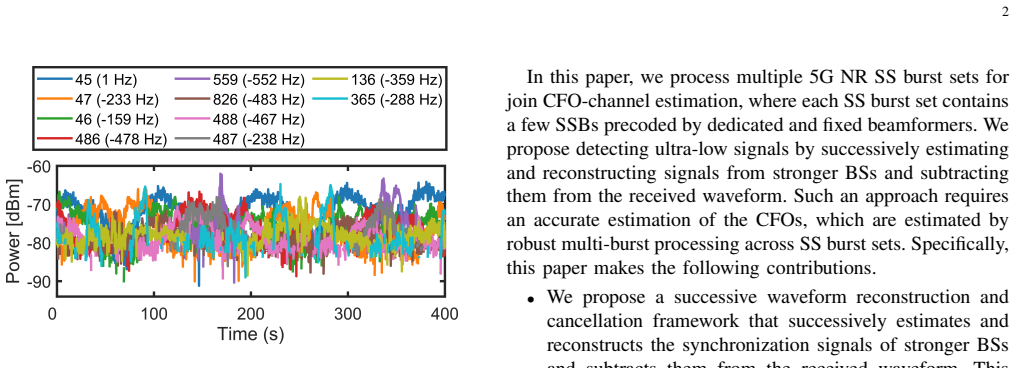
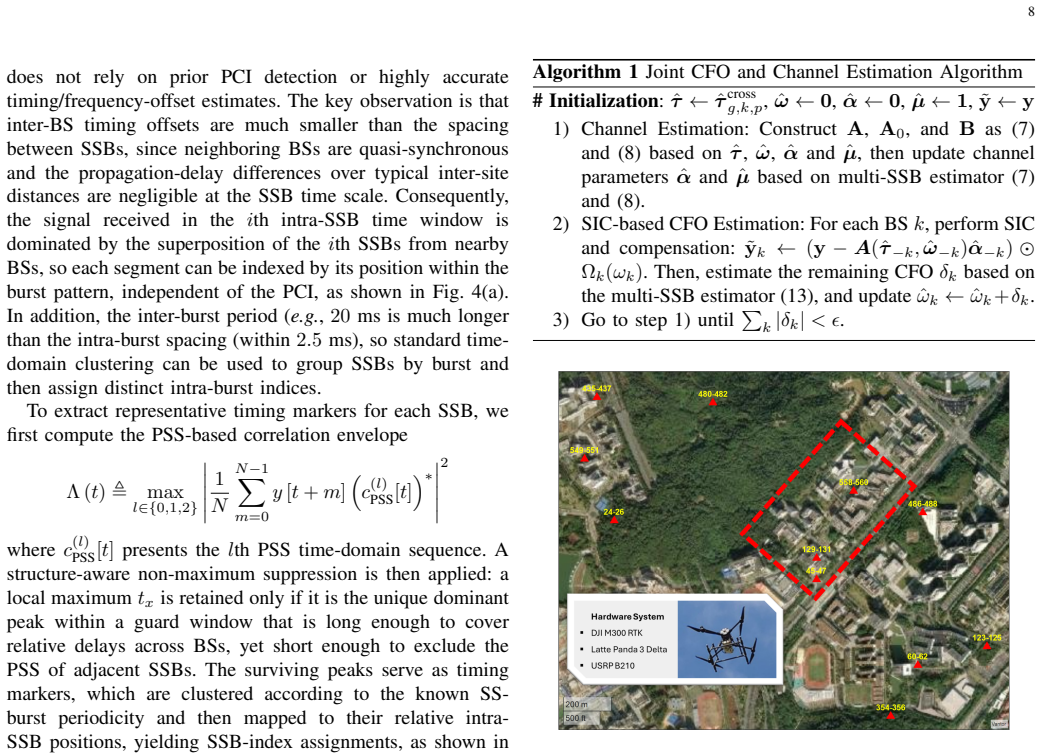
The paper claims that successive waveform reconstruction and cancellation, supported by a CFO-coherent block model and joint CFO-channel estimation, permits reliable detection and estimation of ultra-weak synchronization signals from multiple base stations at SINR levels down to -30 dB, with the approach validated through both simulation and 150 m altitude field tests that also reveal typical SINR below 10 dB despite strong received power.
What carries the argument
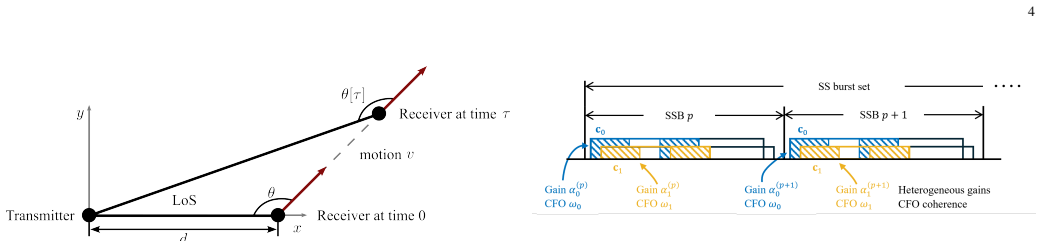
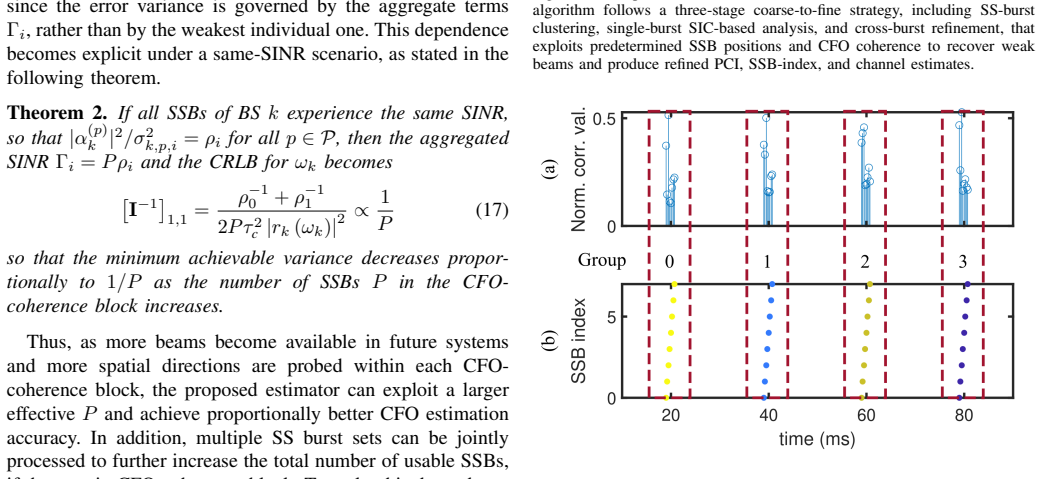
The successive waveform reconstruction and cancellation framework that iteratively estimates, reconstructs, and subtracts SSs of stronger BSs, enabled by the CFO-coherent block and joint CFO-channel estimator.
If this is right
- Per-beam coverage maps become feasible for more than ten overlapping base stations in dense low-altitude scenarios.
- Measured SINR rarely exceeds 10 dB, indicating that interference management is required for reliable aerial operation.
- Estimation accuracy follows explicit scaling laws with UAV speed, motion geometry, burst periodicity, and CFO-coherent block length.
Where Pith is reading between the lines
- The approach could be adapted to map other downlink signals or frequency bands where similar burst structures exist.
- The consistently low observed SINR implies that aerial receivers may need dedicated interference mitigation beyond what terrestrial users require.
- Relaxing or adapting the CFO-coherent block definition might extend applicability to higher UAV speeds or different mobility patterns.
Load-bearing premise
A CFO-coherent block must exist within which a common-CFO and per-SSB-channel model holds, enabling coherent aggregation of multiple SSBs.
What would settle it
A simulation or field experiment in which the method cannot detect or estimate synchronization signals at -30 dB SINR when multiple SSBs are present and the CFO-coherent block assumption is satisfied would falsify the central performance claim.
Figures



read the original abstract
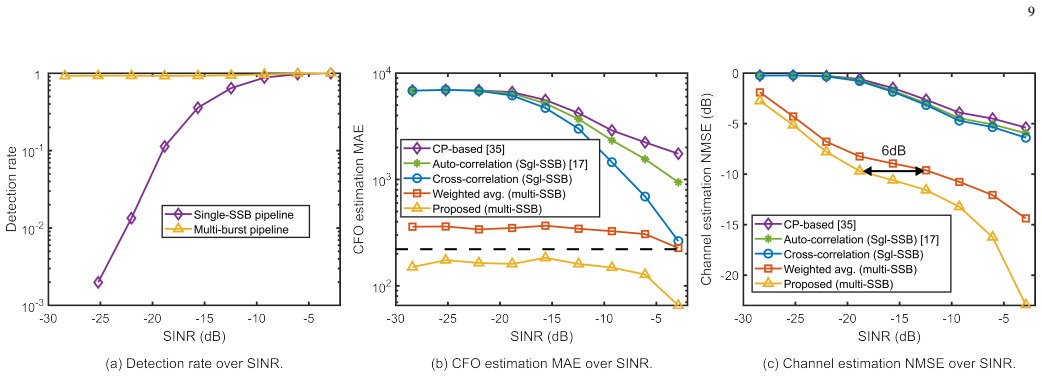
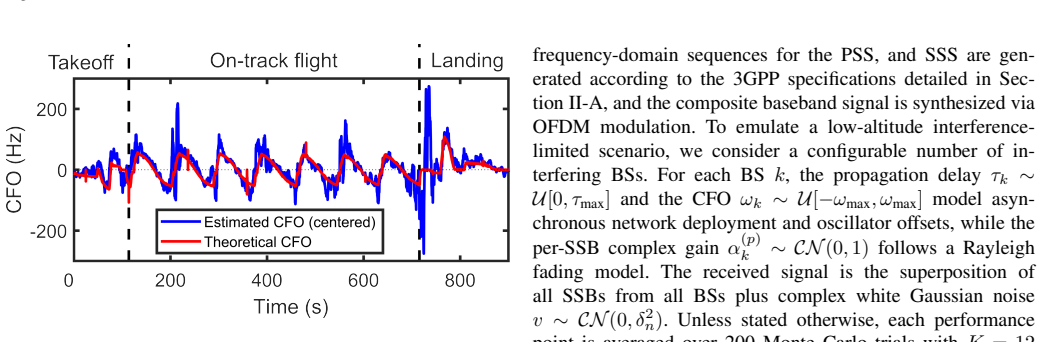
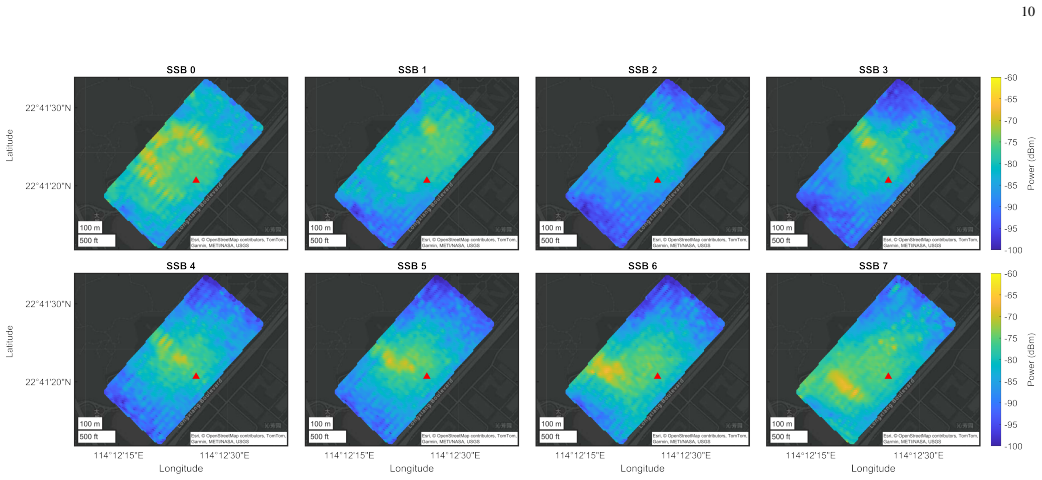
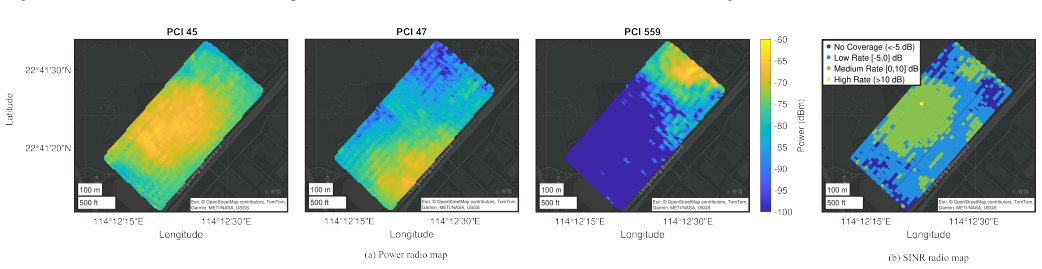
Extending terrestrial networks into low-altitude airspace is a practical way to support aerial services, and accurate low-altitude radio maps are essential for characterizing terrestrial base station (BS) coverage and guiding system design. This work targets per-cell per-beam radio mapping from 5G new radio (NR) synchronization signal (SS) burst sets. Conventional processing treats interference as noise and focuses on the strongest link, which is insufficient to comprehensive awareness of the radio environment and ineffective in dense multi-cell low-altitude scenarios. We propose a successive waveform reconstruction and cancellation framework that iteratively estimates, reconstructs, and subtracts the SSs of stronger BSs, thereby enabling reliable detection and estimation of ultra-weak signals. To support this, we introduce the notion of a carrier frequency offset (CFO)-coherent block within which a common-CFO/per-synchronization signal block (SSB)-channel model holds and design a joint CFO-channel estimator that coherently aggregates multiple SSBs within each CFO-coherent block. We further derive closed-form scaling laws that relate estimation accuracy to unmanned aerial vehicle (UAV) speed, motion geometry, burst periodicity, and the length of the CFO-coherent block. Simulations show that the proposed framework can detect and estimate SSs at signal-to-interference-and-noise ratio (SINR) levels down to -30 dB. Field tests at 150 m altitude demonstrate per-beam coverage maps for more than ten overlapping BSs and reveal that, despite strong received power, the measured SINR rarely exceeds 10 dB, underscoring the need for careful interference management in low-altitude airspace.
Editorial analysis
A structured set of objections, weighed in public.
Referee Report
Summary. The manuscript proposes a successive waveform reconstruction and cancellation framework for joint CFO-channel estimation from 5G NR synchronization signal bursts in strong inter-cell interference. It introduces the concept of a CFO-coherent block in which a common-CFO and per-SSB channel model is assumed to hold, enabling coherent aggregation of multiple SSBs in a joint estimator. Closed-form scaling laws are derived relating estimation accuracy to UAV speed, motion geometry, burst periodicity, and block length. Simulations claim reliable detection and estimation down to -30 dB SINR, while field tests at 150 m altitude produce per-beam coverage maps for more than ten overlapping base stations and show that measured SINR rarely exceeds 10 dB.
Significance. If the CFO-coherent block model and associated scaling laws are valid, the work would provide a practical method for comprehensive low-altitude radio mapping under realistic interference conditions, with direct relevance to UAV network planning and interference management in 5G/6G aerial extensions. The combination of analytical scaling laws with both simulation and field-test results would represent a useful contribution to signal processing for wireless systems in high-mobility, multi-cell environments.
major comments (2)
- [Abstract and model definition section] The CFO-coherent block assumption (common-CFO/per-SSB-channel constancy enabling coherent aggregation) is load-bearing for the claimed -30 dB detection performance and the validity of the closed-form scaling laws. The manuscript provides no quantitative bound or sensitivity analysis showing that Doppler variation induced by 150 m UAV motion remains negligible over the chosen block length, nor does it demonstrate that residual interference after successive cancellation preserves the model.
- [Scaling laws derivation] The closed-form scaling laws relating estimation accuracy to UAV speed, geometry, burst periodicity, and block length are presented as derived quantities, yet no explicit equations or derivation steps are referenced that would allow verification they are independent of any fitted parameters within the paper.
minor comments (3)
- [Simulations and field tests] Simulations and field-test descriptions lack error bars, number of Monte Carlo trials, or explicit exclusion criteria for data points, which weakens assessment of statistical reliability for the -30 dB claim and coverage-map results.
- [Results] The abstract and results sections would benefit from a direct comparison table showing performance metrics (detection probability, estimation MSE) of the proposed joint estimator versus conventional per-SSB processing at the same low SINR levels.
- [Estimator derivation] Notation for the joint estimator (e.g., definitions of the aggregated observation model inside the CFO-coherent block) should be introduced with an equation reference for clarity.
Simulated Author's Rebuttal
We thank the referee for the constructive feedback on our manuscript. The comments highlight important aspects of the CFO-coherent block model and the presentation of the scaling laws. We address each major comment below and commit to revisions that strengthen the paper without altering its core contributions.
read point-by-point responses
-
Referee: [Abstract and model definition section] The CFO-coherent block assumption (common-CFO/per-SSB-channel constancy enabling coherent aggregation) is load-bearing for the claimed -30 dB detection performance and the validity of the closed-form scaling laws. The manuscript provides no quantitative bound or sensitivity analysis showing that Doppler variation induced by 150 m UAV motion remains negligible over the chosen block length, nor does it demonstrate that residual interference after successive cancellation preserves the model.
Authors: We agree that explicit validation of the CFO-coherent block assumption strengthens the claims. The model is justified in the manuscript by the short block duration relative to UAV motion at 150 m altitude, with performance confirmed via simulation at -30 dB SINR and field measurements. However, we acknowledge the absence of a dedicated quantitative sensitivity analysis. In the revision we will add a new subsection deriving an upper bound on residual phase drift over the block length, using the UAV velocity vector, geometry, and SSB periodicity. We will also include analysis and simulation results showing that, after successive cancellation reduces dominant interferers below the noise floor, the common-CFO/per-SSB-channel model continues to hold for the remaining signals. These additions will be placed in the model-definition section. revision: yes
-
Referee: [Scaling laws derivation] The closed-form scaling laws relating estimation accuracy to UAV speed, geometry, burst periodicity, and block length are presented as derived quantities, yet no explicit equations or derivation steps are referenced that would allow verification they are independent of any fitted parameters within the paper.
Authors: The scaling laws are obtained analytically from the Cramér-Rao bound of the joint CFO-channel estimator under the CFO-coherent block model; they contain no empirically fitted parameters. The manuscript states the final closed-form expressions but does not reproduce the intermediate algebraic steps. To address the concern we will expand the derivation section to include the key steps from the signal model through the Fisher information matrix to the final variance expressions, and we will add an appendix containing the complete derivation. This will make the independence from fitted parameters explicit and allow direct verification. revision: yes
Circularity Check
No circularity: scaling laws derived from geometry and periodicity; model assumptions do not reduce to fitted inputs or self-citations.
full rationale
The paper introduces a CFO-coherent block model and derives closed-form scaling laws relating estimation accuracy to UAV speed, motion geometry, burst periodicity, and block length. These derivations are presented as following from the motion and periodicity inputs rather than from fitted parameters or self-citation chains. No equations or claims in the provided text reduce a prediction or result to its own definition by construction, and the reader's assessment of score 2 aligns with minor or absent load-bearing self-citation. The framework is self-contained against external benchmarks such as field tests and simulations at -30 dB SINR.
Axiom & Free-Parameter Ledger
free parameters (1)
- length of CFO-coherent block
axioms (1)
- domain assumption Common-CFO/per-SSB-channel model holds within each CFO-coherent block
invented entities (1)
-
CFO-coherent block
no independent evidence
Forward citations
Cited by 2 Pith papers
-
Privacy-Preserving Federated Radio Map Learning for Wireless Digital Twins via Adaptive Noise Allocation
Proposes budget-constrained adaptive noise allocation for privacy-preserving federated radio map learning with RadioUNet, claiming better privacy and reconstruction quality than uniform or static baselines under match...
-
Model Predictive Communication for Timely Status Updates in Low-Altitude Networks
The MPComm framework decomposes a bi-objective optimization into outer timing selection via graph search and inner power/channel allocation with asymptotic optimality, yielding up to 6x less terrestrial interference a...
Reference graph
Works this paper leans on
-
[1]
Trustworthy intelligent networks for low-altitude economy,
M. Song, Y . Lin, J. Wang, G. Sun, C. Dong, N. Ma, D. Niyato, and P. Zhang, “Trustworthy intelligent networks for low-altitude economy,” IEEE Commun. Mag., vol. 63, no. 7, pp. 72–79, 2025
work page 2025
-
[2]
Integrated sensing and communication for low altitude economy: Opportunities and challenges,
Y . Jiang, X. Li, G. Zhu, H. Li, J. Deng, K. Han, C. Shen, Q. Shi, and R. Zhang, “Integrated sensing and communication for low altitude economy: Opportunities and challenges,”IEEE Commun. Mag., pp. 1–7, 2025
work page 2025
-
[3]
Optimal base station antenna downtilt in downlink cellular networks,
J. Yang, M. Ding, G. Mao, Z. Lin, D.-G. Zhang, and T. H. Luan, “Optimal base station antenna downtilt in downlink cellular networks,” IEEE Trans. on Wireless Commun., vol. 18, no. 3, pp. 1779–1791, 2019
work page 2019
-
[4]
M. U. C. Md, G. Ismail, S. Walid, and B. Arupjyoti, “Ensuring reliable connectivity to cellular-connected UA Vs with up-tilted antennas and interference coordination,”ITU Journal on Future and Evolving Technologies, vol. 2, no. 2, pp. 165–185, 2021
work page 2021
-
[5]
What will the future of UA V cellular communications be? a flight from 5G to 6G,
G. Geraci, A. Garcia-Rodriguez, M. M. Azari, A. Lozano, M. Mezzav- illa, S. Chatzinotas, Y . Chen, S. Rangan, and M. D. Renzo, “What will the future of UA V cellular communications be? a flight from 5G to 6G,” IEEE Commun. Surveys Tuts., vol. 24, no. 3, pp. 1304–1335, 2022
work page 2022
-
[6]
Predictive communications for low-altitude networks,
J. Chen, B. Li, H. Sun, S. Cui, and N. Pappas, “Predictive communications for low-altitude networks,” 2025. [Online]. Available: https://arxiv.org/abs/2509.01705
-
[7]
S. Chai and V . K. Lau, “Mixed-timescale request-driven user association, trajectory and radio resource control for cache-enabled multi-UA V networks,”IEEE Trans. Signal Process., vol. 70, pp. 4997–5011, 2022
work page 2022
-
[8]
Z. Zhou, Y . Zeng, C. Li, F. Yang, Y . Chen, and J. Joung, “Full-dimensional beamforming for multi-user MIMO-OFDM ISAC for low-altitude UA V with zero sensing resource allocation,” 2025. [Online]. Available: https://arxiv.org/abs/2508.06428
-
[9]
Radio map estimation: A data-driven approach to spectrum cartography,
D. Romero and S.-J. Kim, “Radio map estimation: A data-driven approach to spectrum cartography,”IEEE Signal Process. Mag., vol. 39, no. 6, pp. 53–72, 2022
work page 2022
-
[10]
Integrated interpolation and block-term tensor decomposition for spectrum map construction,
H. Sun and J. Chen, “Integrated interpolation and block-term tensor decomposition for spectrum map construction,”IEEE Trans. Signal Process., vol. 72, pp. 3896–3911, 2024
work page 2024
-
[11]
Deep spectrum cartography: Com- pleting radio map tensors using learned neural models,
S. Shrestha, X. Fu, and M. Hong, “Deep spectrum cartography: Com- pleting radio map tensors using learned neural models,”IEEE Trans. Signal Process., vol. 70, pp. 1170–1184, 2022
work page 2022
-
[12]
Digital twin channel for 6G: Concepts, architectures and potential applications,
H. Wang, J. Zhang, G. Nie, L. Yu, Z. Yuan, T. Li, J. Wang, and G. Liu, “Digital twin channel for 6G: Concepts, architectures and potential applications,”IEEE Commun. Mag., vol. 63, no. 3, pp. 24–30, 2025
work page 2025
-
[13]
D. He, B. Ai, K. Guan, L. Wang, Z. Zhong, and T. Kürner, “The design and applications of high-performance ray-tracing simulation platform for 5G and beyond wireless communications: A tutorial,”IEEE Commun. Surveys Tuts., vol. 21, no. 1, pp. 10–27, 2019
work page 2019
-
[14]
NR; Radio Resource Con- trol (RRC); Protocol specification,
3rd Generation Partnership Project (3GPP), “NR; Radio Resource Con- trol (RRC); Protocol specification,” 3GPP, Technical Specification (TS) 38.331, Jul 2025, release 18
work page 2025
-
[15]
NR; Physical layer procedures for control,
——, “NR; Physical layer procedures for control,” 3GPP, Technical Specification (TS) 38.213, Jul 2025, release 18
work page 2025
-
[16]
NR; Physical channels and modulation,
——, “NR; Physical channels and modulation,” 3GPP, Technical Spec- ification (TS) 38.211, Apr 2025, release 18
work page 2025
-
[17]
R. Tuninato, D. G. Riviello, R. Garello, B. Melis, and R. Fantini, “A comprehensive study on the synchronization procedure in 5G NR with 3GPP-compliant link-level simulator,”EURASIP J. Wireless Com. Network, vol. 2023, no. 1, p. 111
work page 2023
-
[18]
Indoor localization with multi-beam of 5G new radio signals,
X. Zhou, L. Chen, Y . Ruan, and R. Chen, “Indoor localization with multi-beam of 5G new radio signals,”IEEE Trans. on Wireless Commun., vol. 23, no. 9, pp. 11 260–11 275, 2024
work page 2024
-
[19]
S. Yoneda, M. Sawahashi, S. Nagata, and S. Suyama, “Prach trans- mission employing carrier frequency offset pre-compensation based on measurement at UE for NR uplink,”IEICE Trans. on Commun., vol. E108-B, no. 3, pp. 330–338, 2025
work page 2025
-
[20]
Beam- switching-based time-of-arrival ranging on commercial 5G NR signals for outdoor positioning,
W. Dong, L. Chen, Z. Ju, T. Zhou, Z. Liu, and R. Chen, “Beam- switching-based time-of-arrival ranging on commercial 5G NR signals for outdoor positioning,”IEEE Trans. on Wireless Commun., pp. 1–1, 2025
work page 2025
-
[21]
NR cell search and MIB and SIB1 recovery,
MathWorks, “NR cell search and MIB and SIB1 recovery,” https://se.mathworks.com/help/5g/ug/nr-cell-search-and-mib-and- sib1-recovery.html, 2025, accessed: 2025-11-03
work page 2025
-
[22]
M. Morelli, C.-C. J. Kuo, and M.-O. Pun, “Synchronization techniques for orthogonal frequency division multiple access (OFDMA): A tutorial review,”Proc. IEEE, vol. 95, no. 7, pp. 1394–1427, 2007
work page 2007
-
[23]
J. Park and J. Chun, “Improved lattice reduction-aided MIMO successive interference cancellation under imperfect channel estimation,”IEEE Trans. Signal Process., vol. 60, no. 6, pp. 3346–3351, 2012
work page 2012
-
[24]
ML estimation of time and frequency offset in OFDM systems,
J. van de Beek, M. Sandell, and P. Borjesson, “ML estimation of time and frequency offset in OFDM systems,”IEEE Trans. Signal Process., vol. 45, no. 7, pp. 1800–1805, 1997
work page 1997
-
[25]
T. Lv, H. Li, and J. Chen, “Joint estimation of symbol timing and carrier frequency offset of ofdm signals over fast time-varying multipath channels,”IEEE Trans. Signal Process., vol. 53, no. 12, pp. 4526–4535, 2005
work page 2005
-
[26]
Timing and carrier synchronization with channel estimation in multi-relay cooperative networks,
A. A. Nasir, H. Mehrpouyan, S. D. Blostein, S. Durrani, and R. A. Kennedy, “Timing and carrier synchronization with channel estimation in multi-relay cooperative networks,”IEEE Trans. Signal Process., vol. 60, no. 2, pp. 793–811, 2012
work page 2012
-
[27]
Multi-cell MIMO cooperative networks: A new look at inter- ference,
D. Gesbert, S. Hanly, H. Huang, S. Shamai Shitz, O. Simeone, and W. Yu, “Multi-cell MIMO cooperative networks: A new look at inter- ference,”IEEE J. Sel. Areas Commun., vol. 28, no. 9, pp. 1380–1408, 2010
work page 2010
-
[28]
Y . Xu, E. G. Larsson, E. A. Jorswieck, X. Li, S. Jin, and T.-H. Chang, “Distributed signal processing for extremely large-scale antenna array systems: State-of-the-art and future directions,”IEEE Trans. Signal Process., vol. 19, no. 2, pp. 304–330, 2025
work page 2025
-
[29]
Multiple frequency offset estimation for the downlink of coordinated MIMO systems,
B. W. Zarikoff and J. K. Cavers, “Multiple frequency offset estimation for the downlink of coordinated MIMO systems,”IEEE J. Sel. Areas Commun., vol. 26, no. 6, pp. 901–912, 2008
work page 2008
-
[30]
H. Wang, X.-G. Xia, and Q. Yin, “Computationally efficient equalization for asynchronous cooperative communications with multiple frequency offsets,”IEEE Trans. on Wireless Commun., vol. 8, no. 2, pp. 648–655, 2009
work page 2009
-
[31]
Y .-R. Tsai, H.-Y . Huang, Y .-C. Chen, and K.-J. Yang, “Simultaneous multiple carrier frequency offsets estimation for coordinated multi-point transmission in OFDM systems,”IEEE Trans. on Wireless Commun., vol. 12, no. 9, pp. 4558–4568, 2013
work page 2013
-
[32]
Multi-relay communications in the presence of phase noise and carrier frequency offsets,
O. H. Salim, A. A. Nasir, H. Mehrpouyan, and W. Xiang, “Multi-relay communications in the presence of phase noise and carrier frequency offsets,”IEEE Trans. on Commun., vol. 65, no. 1, pp. 79–94, 2017
work page 2017
-
[33]
Frequency synchronization for uplink massive mimo systems,
W. Zhang, F. Gao, S. Jin, and H. Lin, “Frequency synchronization for uplink massive mimo systems,”IEEE Trans. on Wireless Commun., vol. 17, no. 1, pp. 235–249, 2018
work page 2018
-
[34]
BeamSync: Over-the-air synchronization for distributed massive MIMO systems,
U. Kunnath Ganesan, R. Sarvendranath, and E. G. Larsson, “BeamSync: Over-the-air synchronization for distributed massive MIMO systems,” IEEE Trans. on Wireless Commun., vol. 23, no. 7, pp. 6824–6837, 2024
work page 2024
-
[35]
S. Singh, S. Kumar, S. Majhi, U. Satija, and C. Yuen, “Blind carrier frequency offset estimation techniques for next-generation multicarrier communication systems: Challenges, comparative analysis, and future prospects,”IEEE Commun. Surveys Tuts., vol. 27, no. 1, pp. 1–36, 2025
work page 2025
-
[36]
Analysis of the frequency offset effect on Zadoff-Chu sequence timing performance,
M. Hua, M. Wang, K. W. Yang, and K. J. Zou, “Analysis of the frequency offset effect on Zadoff-Chu sequence timing performance,”IEEE Trans. on Commun., vol. 62, no. 11, pp. 4024–4039, 2014
work page 2014
-
[37]
3rd Generation Partnership Project (3GPP), “5G; NR; User Equipment (UE) conformance specification; Radio transmission and reception; Part 1: Range 1 standalone,” 3GPP, Technical Specification (TS) 38.521-1, Feb 2025, 3GPP TS 38.521-1 version 18.5.0 Release 18
work page 2025
-
[38]
S. M. Kay,Fundamentals of statistical signal processing, Volume I: estimation theory. Prentice-Hall, Inc., 1993
work page 1993
discussion (0)
Sign in with ORCID, Apple, or X to comment. Anyone can read and Pith papers without signing in.