REVIEW 4 major objections 4 minor 50 references
A multi-factor polynomial framework for long-term electricity forwards with delivery period
T0 review · 4 major / 4 minor · reviewed 2026-08-14 · deepseek-v4-flash
Pith's one-line read Electricity forwards with multi-year delivery periods can be priced, correlated, and hedged through a polynomial diffusion framework with fully explicit formulas.
desk verdict A clean, genuinely useful polynomial-diffusion toolkit for long-dated electricity forwards with an explicit locally risk-minimizing rolling hedge; the theory is tight, but the headline hedge improvements are in-sample and rest on unvalidated model-implied correlations. read the letter →
The pith
A machine-rendered reading of the paper's core claim, the machinery that carries it, and where it could break.
The reading
What carries the argument
The central object is the polynomial diffusion $X_t$ in $\mathbb{R}^d$: a diffusion whose generator maps polynomials to polynomials, so the moment formula $\mathbb{E}^{\mathbb{Q}}[q(X_T)\mid\mathcal{F}_t] = H(X_t)^\top e^{(T-t)G}\vec q$ holds for every polynomial $q$. Since the spot price is the quadratic polynomial $p_S(x)=c+x^\top Qx$, every forward price is a linear combination of entries of $H(X_t)$ with coefficients obtained from exponentials of the generator matrix $G$; a delivery-period forward averages those exponentials over the delivery window. The same machinery produces the risk premium by comparing $G$ under the pricing measure with $G_\lambda$ under the real-world measure, and the hedge ratio by taking the quotient of covariations $d\langle P^k,\tilde F\rangle_t / d\langle P^k,P^k\rangle_t$, which is the projection in the Galtchouk–Kunita–Watanabe decomposition of the long-term claim onto the traded forward.
What would settle it
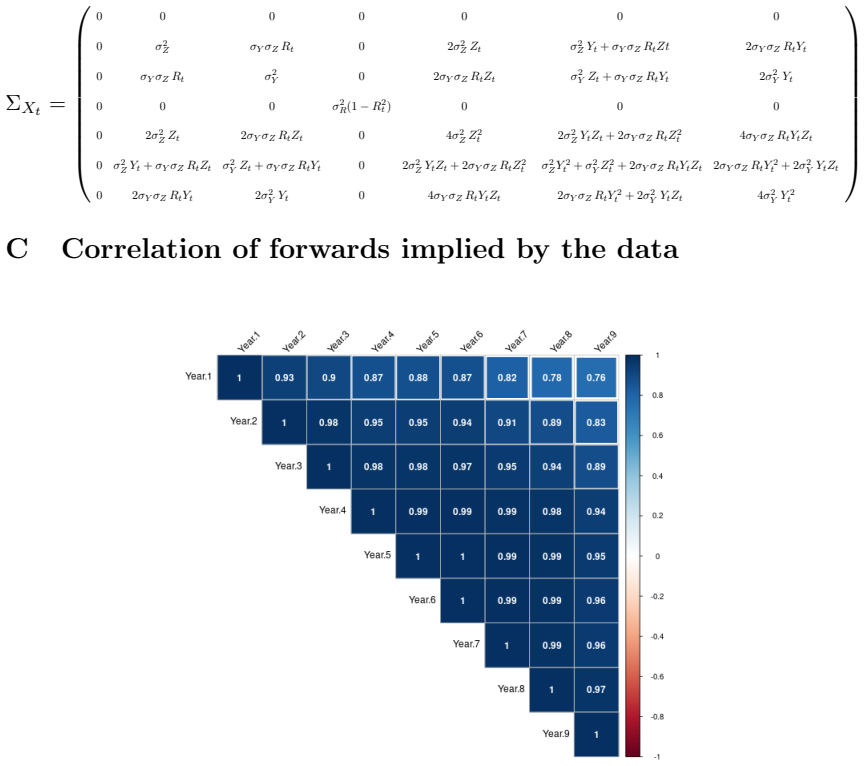
Compare the model-implied instantaneous correlations between, say, the first- and tenth-nearby German calendar-year forwards, computed from equations (25)–(27) with the estimated parameters, against the sample correlations of the monthly quoted changes in the observed forward curves; a large systematic discrepancy would falsify the correlation structure that the rolling hedge relies on. A second check: re-estimate on 2010–2014 data, simulate the rolling hedge for 2015–2018, and compare realized hedged exposures with those predicted by the model.
Extended reading notes
Core claim
The central claim is that a polynomial diffusion $X_t$ with spot price $S_t = c + X_t^\top Q X_t$ gives a complete, closed-form model for long-term electricity forwards with delivery period. Proposition 4.2 prices a forward delivering over $[T_1,T_2)$ as $$F(t,T_1,T_2,X_t)=\frac{1}{T_2-T_1}H(X_t)^\top $e^{{(T_1-t)G}}$\$int_0^{{T_2-T_1}}$$e^{{uG}}$du\,\vec p_S,$$ and equations (23)–(27) give the instantaneous covariances and correlations between any two such forwards in terms of the same generator matrix $G$ and the covariation matrix $\Sigma(X_t)$. Under an affine market price of risk, forward risk premia are also explicit, stochastic, and can change sign. Section 6.3 shows that the locally risk-minimizing rolling hedge—which at each time holds only the currently first-nearby liquid yearly contract—has hedge ratio $\xi^k_t = d\langle P^k,\tilde F\rangle_t / d\langle P^k,P^k\rangle_t$, the projection coefficient of the long-term commitment onto the traded forward. The two-factor Specification 2.1, estimated with a quadratic Kalman filter to German calendar-year baseload forwards quoted monthly from January 2010 to April 2018, fits with 0.661% average relative error; simulated hedges over 2–10 year horizons reduce standard deviation and skew of exposures, with residual risk remaining because the restricted market is incomplete.
Load-bearing premise
The load-bearing premise is that the calibrated two-factor polynomial model, with its affine market price of risk, describes the actual dynamics of German calendar-year forward curves; if the real curves move differently—especially with a different correlation structure between nearby and far-dated contracts—the reported fit and hedge improvements need not persist.
Editorial extensions
If this is right
- Any contract whose payoff is polynomial in the state—including forwards with delivery period and options on them—can be priced by evaluating matrix exponentials, with no simulation or numerical PDE step.
- A hedger with a long-term delivery commitment can implement a locally risk-minimizing strategy using only the first-nearby liquid yearly forward; all hedge ratios are explicit and require only the current state and model parameters.
- Because only one contract is traded at a time while two Brownian shocks drive the two-factor model, the restricted market is incomplete; the paper's simulations quantify the irreducible residual exposure, which grows with hedging horizon.
- The two-factor model calibrated to eight years of German calendar-year baseload forwards attains 0.661% average relative error overall, with errors rising on the backend (seventh to tenth nearby contracts) where quotes are sparse.
- The same framework can extrapolate the forward curve beyond the liquid horizon, smooth observed forward surfaces, and interpolate between quotation dates once calibrated.
Reading between the lines
- The paper's hedge simulations draw forward curves from the calibrated model itself, so the reported variance and skew reductions are in-sample; a natural out-of-sample extension would re-estimate on an early subsample and evaluate the rolling hedge on later observed German forward curves, where the fit is likely to degrade.
- Because correlations between forwards are fully explicit, one can compare model-implied correlations of nearby and far-dated contracts with those inferred from observed quote changes; a systematic mismatch would indicate where the factor structure needs another state variable.
- The three-factor specification with a stochastic correlation factor is presented but not estimated; testing it on multi-market data or long-term hedges would show whether time-varying correlation materially improves hedging performance.
- Allowing $c<0$ extends the same formulas to markets with negative short-term prices, so the framework could be adapted to shorter-horizon trading without changing the pricing or hedging machinery, although seasonality and spikes would require time-dependent or jump-extended versions.
Signed reviews
Editorial analysis
A structured set of objections, weighed in public.
Referee Report
Summary. The paper proposes a polynomial diffusion framework in which the electricity spot price is a quadratic function of Gaussian factors, and derives fully explicit formulas for instantaneous-delivery and delivery-period forwards, their covariances and correlations, and forward risk premia under an affine market price of risk. It then constructs a rolling hedge that uses only the first-nearby liquid yearly forward contract and proves that the proposed hedge ratio is locally risk-minimizing in the Föllmer–Schweizer sense relative to the risk-neutral measure Q. The two-factor Specification 2.1 is calibrated to more than eight years of German calendar-year forward curves using a quadratic Kalman filter, achieving an average relative pricing error of 0.661%. A simulation study based on the calibrated P-dynamics reports that the rolling hedge substantially reduces, but does not eliminate, the variance and skewness of long-term exposures over horizons from two to ten years.
Significance. The theoretical contribution is substantial and, to my knowledge, new in the electricity forward literature: the paper combines polynomial diffusion moment formulas with explicit delivery-period averaging and an explicit GKW hedge ratio under liquidity constraints, all in closed form. The derivations of the pricing formulas, the correlation formulas, and the hedge ratio are clearly laid out, and the calibration exercise uses a real eight-year OTC dataset rather than simulated data for the level fit. These strengths make the paper a useful reference for long-term power forward modeling and risk management. The main limitations are empirical: the headline hedging figures come from an in-sample simulation in which the calibrated model is also the data-generating process, so the variance reductions are partly guaranteed by construction, and the model-implied correlation surface that drives the hedge is not validated against the empirical correlations displayed in Figure 7.
major comments (4)
- [Sections 6.2–6.3 and 7.3] The Föllmer–Schweizer criterion is defined in Eq. (36) using the Q-conditional variance, and the hedge ratio (38)–(39) is the GKW projection under Q. The simulation study in Section 7.3, however, generates forward curves under the calibrated real-world P-dynamics with the affine market price of risk from Section 5 and evaluates variance and skew reductions under P. Since P and Q differ by the market price of risk, the Q-GKW projection does not in general minimize the P-conditional variance of the cost process. The paper should either derive and implement the locally risk-minimizing strategy under P, using the P-generator G_λ and the P-drift of the forward price processes, or clearly label the empirical analysis as evaluating the Q-GKW hedge as a heuristic and adjust the abstract's wording accordingly.
- [Section 7.3, Figure 6 and table; Eq. (27) vs. Figure 7] The hedge evaluation is in-sample: the data-generating process for the simulated forward curves is the same calibrated Specification 2.1, and the hedge ratio is the model-implied projection. A GKW projection reduces Q-variance by construction, so the reported reductions (for example std 0.1532 vs. 1.1278 at the two-year horizon) do not by themselves demonstrate robustness to model misspecification. The calibration target is the level of forward curves, reported as 0.661% average relative error, and the paper does not compare the model-implied cross-maturity correlation surface from Eq. (27) with the empirical correlations shown in Figure 7. I recommend adding such a comparison or an out-of-sample hedge evaluation, and stating the in-sample caveat explicitly in the abstract and conclusions.
- [Section 6.3, derivation preceding Eq. (38)] The proof states that ⟨P^k,~F⟩_{k-1}=0 because ~F_{k-1} is constant and known at t≥k−1. This is not correct: F_{k-1}-measurability does not make the quadratic covariation process vanish at time k−1, since the covariation accumulates over the whole history before k−1. The final hedge ratio formula (38) is nevertheless correct if the argument is rewritten using the GKW decomposition restricted to the interval [k−1,k) conditional on F_{k−1}, but the proof as written needs to be corrected.
- [Section 7.2, Algorithm 1] The data description in Section 7.1 states that not every contract is quoted on every date and that the tenth nearby contract is available on only four quotation dates, but the quadratic Kalman filter in Algorithm 1 is written for a full 10-dimensional observation vector F_k with no missing-data handling. The paper should specify how missing observations are treated, for example by updating only the available subvector of observations, since the estimated parameters and the reported fit depend on this choice.
minor comments (4)
- [Section 4, Eq. (26)] The instantaneous covariation formula for general delivery periods [T1,T2) and [T3,T4) is missing the normalization factors 1/(T2−T1)(T4−T3). For one-year delivery periods these factors equal one, so the empirical results are unaffected, but the displayed formula should be corrected or a convention stated.
- [Table 1] The calibration table reports point estimates only, without standard errors, confidence intervals, or a sensitivity analysis. Given the nonlinear filter and the global optimizer used, the reader cannot assess parameter uncertainty or the robustness of the reported hedge ratios; at least a bootstrap or perturbation analysis would be helpful.
- [Section 7.3] The Monte Carlo hedging results report sample standard deviations and skewnesses but no Monte Carlo standard errors or confidence intervals; with M=5000 simulations these are easy to add and would strengthen the comparison across horizons.
- [Throughout] There are several typographical issues, including "calender-year" in Section 7.1 and inconsistent rendering of "Föllmer" and "Hölder" in the text; these should be cleaned up in the final version.
Circularity Check
No circularity: pricing and hedging formulas are derived from an explicit polynomial assumption, and the calibration/simulation exercise is in-sample rather than a disguised prediction.
full rationale
The paper's central mathematical claims are derived from an explicitly stated modeling assumption (spot price is a quadratic polynomial of a polynomial diffusion) and the polynomial moment formula, with the ODE system in Theorem 3.2 proved in the text. The pricing formulas in Proposition 4.2 and the covariance/correlation formulas in Equations (23)–(27) are direct consequences of the moment formula, not restatements of fitted inputs or renamed empirical patterns. The hedging ratio in Equations (38)–(39) is obtained from the Galtchouk–Kunita–Watanabe decomposition in Equation (37), and the local risk-minimization property is a theorem about that decomposition, not a fitted assertion. The calibration section does fit parameters to German forward curves and reports an average relative error of 0.661%, and the subsequent hedging simulation uses those same fitted parameters as the data-generating process. This makes the simulated variance and skew reductions conditional on the model being correct, and they should not be read as out-of-sample empirical validation. However, the paper presents the hedging study as a simulation under the estimated model, not as an external prediction, so this is a limitation rather than a circular step. The citations to Filipovic and Larsson (2016, 2019) are mathematical foundations for polynomial moment formulas and are not used as unverified uniqueness theorems or as load-bearing substitutes for the paper's own derivations. No circularity step can be exhibited from the text.
Assumptions & free parameters
free parameters (15)
- c =
0.239614
- alpha =
10.250035
- beta =
0.176807
- kappa_Z =
0.010022
- kappa_Y =
0.400207
- sigma_Z =
0.406479
- sigma_Y =
0.889130
- rho =
0.112439
- lambda_Z =
0.089990
- lambda_Y =
0.111842
- gamma_Z =
0.086791
- gamma_Y =
0.127365
- z0 =
2.358048
- y0 =
2.007557
- noise scaling N_j^k =
chosen from spreads via (N_j^k)^2 = delta_j^k/3 + delta_j/3 + delta/3
assumptions (8)
- standard math Moment formula for polynomial diffusions (Filipović and Larsson 2016, Theorem 3.1)
- standard math The generator of X preserves the space of polynomials of degree at most n when diffusion matrix entries are polynomials of degree at most two
- standard math Strong solution existence and pathwise uniqueness for the Jacobi-type process under conditions (7)-(8)
- standard math Girsanov theorem and true martingale property of the Radon-Nikodym density under the linear market price of risk
- standard math GKW decomposition and Föllmer-Schweizer local risk-minimization theory in incomplete markets
- ad hoc to paper The market price of risk is of the affine form lambda(x) = sigma(x)^{-1}(gamma + Lambda x)
- domain assumption Liquidity constraint: only the first-nearby yearly forward can be traded and contracts stop trading at delivery start (condition (34))
- domain assumption Spot price is a quadratic function of the factors and the factors follow Spec 2.1 under P with estimated parameters
Cite this review
Pith. "Pith review of A multi-factor polynomial framework for long-term electricity forwards with delivery period." pith.science (2026). https://pith.science/paper/44DW3ZI7
@misc{pith2026190808954,
  author       = {Pith},
  title        = {Pith review of: A multi-factor polynomial framework for long-term electricity forwards with delivery period},
  year         = {2026},
  howpublished = {\url{https://pith.science/paper/44DW3ZI7}},
  note         = {Machine review of arXiv:1908.08954}
}
read the original abstract
We propose a multi-factor polynomial framework to model and hedge long-term electricity contracts with delivery period. This framework has several advantages: the computation of forwards, risk premium and correlation between different forwards are fully explicit, and the model can be calibrated to observed electricity forward curves easily and well. Electricity markets suffer from non-storability and poor medium- to long-term liquidity. Therefore, we suggest a rolling hedge which only uses liquid forward contracts and is risk-minimizing in the sense of F\"ollmer and Schweizer. We calibrate the model to over eight years of German power calendar year forward curves and investigate the quality of the risk-minimizing hedge over various time horizons.
Figures


Figures from the paper (4 more)


Reference graph
Works this paper leans on
-
[1]
Damien Ackerer and Damir Filipovi \'c . Linear credit risk models. arXiv preprint arXiv:1605.07419, 2016
work page Pith review arXiv 2016
-
[2]
Option Pricing with Orthogonal Polynomial Expansions
Damien Ackerer and Damir Filipovic. Option pricing with orthogonal polynomial expansions. arXiv preprint arXiv:1711.09193, 2017
work page Pith review arXiv 2017
-
[3]
The jacobi stochastic volatility model
Damien Ackerer, Damir Filipovi \'c , and Sergio Pulido. The jacobi stochastic volatility model. Finance and Stochastics, 22 0 (3): 0 667--700, 2018
work page 2018
-
[4]
J ump-diffusion calibration using D ifferential E volution
David Ardia, Juan Ospina Arango, and Norman Giraldo Gomez. J ump-diffusion calibration using D ifferential E volution. Wilmott Magazine, 55: 0 76--79, 2011 a . URL http://www.wilmott.com/
work page 2011
-
[5]
David Ardia, Kris Boudt, Peter Carl, Katharine M. Mullen, and Brian G. Peterson. D ifferential E volution with DEoptim : An application to non-convex portfolio optimization. The R Journal, 3 0 (1): 0 27--34, 2011 b . URL https://journal.r-project.org/archive/2011-1/RJournal_2011-1_Ardia et al.pdf
work page 2011
-
[6]
David Ardia, Katharine M. Mullen, Brian G. Peterson, and Joshua Ulrich. DEoptim : Differential Evolution in R , 2016. URL https://CRAN.R-project.org/package=DEoptim. version 2.2-4
work page 2016
-
[7]
The information premium for non-storable commodities
Fred Espen Benth and Thilo Meyer-Brandis. The information premium for non-storable commodities. Journal of Energy Markets, 2 0 (3): 0 111--140, 2009
work page 2009
-
[8]
A pricing measure to explain the risk premium in power markets
Fred Espen Benth and Salvador Ortiz-Latorre. A pricing measure to explain the risk premium in power markets. SIAM Journal on Financial Mathematics, 5 0 (1): 0 685--728, 2014
work page 2014
Show all 50 references
-
[9]
A non-gaussian ornstein--uhlenbeck process for electricity spot price modeling and derivatives pricing
Fred Espen Benth, Jan Kallsen, and Thilo Meyer-Brandis. A non-gaussian ornstein--uhlenbeck process for electricity spot price modeling and derivatives pricing. Applied Mathematical Finance, 14 0 (2): 0 153--169, 2007 a
2007
-
[10]
Extracting and applying smooth forward curves from average-based commodity contracts with seasonal variation
Fred Espen Benth, Steen Koekebakker, and Fridthjof Ollmar. Extracting and applying smooth forward curves from average-based commodity contracts with seasonal variation. Journal of Derivatives, 15 0 (1): 0 52, 2007 b
2007
-
[11]
Stochastic modelling of electricity and related markets, volume 11
Fred Espen Benth, Jurate Saltyte Benth, and Steen Koekebakker. Stochastic modelling of electricity and related markets, volume 11. World Scientific, 2008 a
2008
-
[12]
Pricing forward contracts in power markets by the certainty equivalence principle: explaining the sign of the market risk premium
Fred Espen Benth, \'A lvaro Cartea, and R \"u diger Kiesel. Pricing forward contracts in power markets by the certainty equivalence principle: explaining the sign of the market risk premium. Journal of Banking & Finance, 32 0 (10): 0 2006--2021, 2008 b
2006
-
[13]
A critical empirical study of three electricity spot price models
Fred Espen Benth, R \"u diger Kiesel, and Anna Nazarova. A critical empirical study of three electricity spot price models. Energy Economics, 34 0 (5): 0 1589--1616, 2012
2012
-
[14]
Mean-reverting additive energy forward curves in a heath--jarrow--morton framework
Fred Espen Benth, Marco Piccirilli, and Tiziano Vargiolu. Mean-reverting additive energy forward curves in a heath--jarrow--morton framework. Mathematics and Financial Economics, 13 0 (4): 0 543--577, 2019
2019
-
[15]
Polynomial diffusion models for life insurance liabilities
Francesca Biagini and Yinglin Zhang. Polynomial diffusion models for life insurance liabilities. Insurance: Mathematics and Economics, 71: 0 114--129, 2016
2016
-
[16]
The forward premium in electricity futures
Derek W Bunn and Dipeng Chen. The forward premium in electricity futures. Journal of Empirical Finance, 23: 0 173--186, 2013
2013
-
[17]
A survey of commodity markets and structural models for electricity prices
Ren \'e Carmona and Michael Coulon. A survey of commodity markets and structural models for electricity prices. In Quantitative Energy Finance, pages 41--83. Springer, 2014
2014
-
[18]
Local risk-minimization with multiple assets under illiquidity with applications in energy markets
Panagiotis Christodoulou, Nils Detering, and Thilo Meyer-Brandis. Local risk-minimization with multiple assets under illiquidity with applications in energy markets. International Journal of Theoretical and Applied Finance, 2018
2018
-
[19]
Polynomial processes in stochastic portfolio theory
Christa Cuchiero. Polynomial processes in stochastic portfolio theory. Stochastic Processes and their Applications, 2018
2018
-
[20]
Polynomial processes and their applications to mathematical finance
Christa Cuchiero, Martin Keller-Ressel, and Josef Teichmann. Polynomial processes and their applications to mathematical finance. Finance and Stochastics, 16 0 (4): 0 711--740, 2012
2012
-
[21]
An interest rate model with upper and lower bounds
Freddy Delbaen and Hiroshi Shirakawa. An interest rate model with upper and lower bounds. Asia-Pacific Financial Markets, 9 0 (3-4): 0 191--209, 2002
2002
-
[22]
Modelling electricity prices: International evidence
Alvaro Escribano, J Ignacio Pena, and Pablo Villaplana. Modelling electricity prices: International evidence. Oxford bulletin of economics and statistics, 73 0 (5): 0 622--650, 2011
2011
-
[23]
Polynomial diffusions and applications in finance
Damir Filipovi \' c and Martin Larsson. Polynomial diffusions and applications in finance. Finance and Stochastics, 20 0 (4): 0 931--972, Oct 2016. ISSN 1432-1122. doi:10.1007/s00780-016-0304-4
2016 doi
-
[24]
Polynomial jump-diffusion models
Damir Filipovi \'c and Martin Larsson. Polynomial jump-diffusion models. Swiss Finance Institute Research Paper, 0 (17-60), 2019
2019
-
[25]
A term structure model for dividends and interest rates
Damir Filipovi \'c and Sander Willems. A term structure model for dividends and interest rates. 2018
2018
-
[26]
Quadratic variance swap models
Damir Filipovi \'c , Elise Gourier, and Loriano Mancini. Quadratic variance swap models. Journal of Financial Economics, 119 0 (1): 0 44--68, 2016
2016
-
[27]
Linear-rational term structure models
Damir Filipovi \'c , Martin Larsson, and Anders B Trolle. Linear-rational term structure models. The Journal of Finance, 72 0 (2): 0 655--704, 2017
2017
-
[28]
Polynomial processes for power prices
Damir Filipovi \'c , Martin Larsson, and Tony Ware. Polynomial processes for power prices. 2018
2018
-
[29]
Hedging of contingent claims
H F \"o llmer and Martin Schweizer. Hedging of contingent claims. Applied stochastic analysis, 5: 0 389, 1991
1991
-
[30]
Contributions to mathematical economics
Hans Follmer and Dieter Sondermann. Contributions to mathematical economics. North Holland, 1986
1986
-
[31]
Occurrence of negative prices on the german spot market for electricity and their influence on balancing power markets
Fabio Genoese, Massimo Genoese, and Martin Wietschel. Occurrence of negative prices on the german spot market for electricity and their influence on balancing power markets. In 2010 7th International Conference on the European Energy Market, pages 1--6. IEEE, 2010
2010
-
[32]
Shortfall risk in long-term hedging with short-term futures contracts
Paul Glasserman. Shortfall risk in long-term hedging with short-term futures contracts. Option Pricing, Interest Rates and Risk management, pages 477--508, 2001
2001
-
[33]
The relationship between spot and futures prices: An empirical analysis of australian electricity markets
Rangga Handika, Stefan Tr \"u ck, et al. The relationship between spot and futures prices: An empirical analysis of australian electricity markets. In 3rd IAEE Asian Conference, 2012
2012
-
[34]
Numerical comparison of local risk-minimisation and mean-variance hedging
David Heath, Eckhard Platen, and Martin Schweizer. Numerical comparison of local risk-minimisation and mean-variance hedging. Australian National University, Centre for Mathematics and its Applications, School of Mathematical Sciences, 1999
1999
-
[35]
A comparison of two quadratic approaches to hedging in incomplete markets
David Heath, Eckhard Platen, and Martin Schweizer. A comparison of two quadratic approaches to hedging in incomplete markets. Mathematical Finance, 11 0 (4): 0 385--413, 2001
2001
-
[36]
Exponentially affine martingales, affine measure changes and exponential moments of affine processes
Jan Kallsen and Johannes Muhle-Karbe. Exponentially affine martingales, affine measure changes and exponential moments of affine processes. Stochastic Processes and their Applications, 120 0 (2): 0 163--181, 2010
2010
-
[37]
Brownian Motion and Stochastic Calculus
Ioannis Karatzas and Steven E Shreve. Brownian Motion and Stochastic Calculus. Springer, 1998
1998
-
[38]
Forward curve dynamics in the nordic electricity market
Steen Koekebakker and Fridthjof Ollmar. Forward curve dynamics in the nordic electricity market. Managerial Finance, 31 0 (6): 0 73--94, 2005
2005
-
[39]
Towards definition of the risk premium function
Nikola Kre c ar, Fred E Benth, and Andrej F Gubina. Towards definition of the risk premium function. IEEE Transactions on Power Systems, 2019
2019
-
[40]
A quadratic kalman filter
Alain Monfort, Jean-Paul Renne, and Guillaume Roussellet. A quadratic kalman filter. Journal of Econometrics, 187 0 (1): 0 43--56, 2015
2015
-
[41]
DEoptim : An R package for global optimization by differential evolution
Katharine Mullen, David Ardia, David Gil, Donald Windover, and James Cline. DEoptim : An R package for global optimization by differential evolution. Journal of Statistical Software, 40 0 (6): 0 1--26, 2011. URL http://www.jstatsoft.org/v40/i06/
2011
-
[42]
Hedging long-term exposures with multiple short-term futures contracts
Anthony Neuberger. Hedging long-term exposures with multiple short-term futures contracts. The Review of Financial Studies, 12 0 (3): 0 429--459, 1999
1999
-
[43]
Price, Rainer M
Kenneth V. Price, Rainer M. Storn, and Jouni A. Lampinen. D ifferential E volution - A Practical Approach to Global Optimization . Natural Computing. Springer-Verlag, January 2006. ISBN 540209506
2006
-
[44]
Continuous martingales and Brownian motion, volume 293
Daniel Revuz and Marc Yor. Continuous martingales and Brownian motion, volume 293. Springer Science & Business Media, 2013
2013
-
[45]
Risk-minimality and orthogonality of martingales
Martin Schweizer. Risk-minimality and orthogonality of martingales. Stochastics: An International Journal of Probability and Stochastic Processes, 30 0 (2): 0 123--131, 1990
1990
-
[46]
A guided tour through quadratic hedging approaches
Martin Schweizer. A guided tour through quadratic hedging approaches. Technical report, Discussion Papers, Interdisciplinary Research Project 373: Quantification and Simulation of Economic Processes, 1999
1999
-
[47]
Differential evolution -- a simple and efficient heuristic for global optimization over continuous spaces
Rainer Storn and Kenneth Price. Differential evolution -- a simple and efficient heuristic for global optimization over continuous spaces. Journal of Global Optimization, 11 0 (4): 0 341--359, Dec 1997. ISSN 1573-2916. doi:10.1023/A:1008202821328. URL https://doi.org/10.1023/A...
1997 doi
-
[48]
Risk premia in the german day-ahead electricity market revisited: The impact of negative prices
Niyaz Valitov. Risk premia in the german day-ahead electricity market revisited: The impact of negative prices. Energy Economics, 82: 0 70--77, 2019
2019
-
[49]
Risk premiums in the german day-ahead electricity market
Johannes Viehmann. Risk premiums in the german day-ahead electricity market. Energy policy, 39 0 (1): 0 386--394, 2011
2011
-
[50]
Market price of risk implied by asian-style electricity options and futures
Rafa Weron. Market price of risk implied by asian-style electricity options and futures. Energy Economics, 30 0 (3): 0 1098--1115, 2008
2008
Reviewed August 14, 2026 · model on record in the stance chip above.
Discussion (0). Continue with ORCID to comment.