REVIEW 53 references
Deciphering the Formation and Dynamics of Double-decker Filament Through Component Magnetic Reconnection
T0 review · reviewed 2026-08-07 · deepseek-v4-flash
Pith's one-line read A braided solar filament was observed to split into a double-decker structure via internal component magnetic reconnection, triggered by footpoint rotation.
The pith
A machine-rendered reading of the paper's core claim, the machinery that carries it, and where it could break.
The reading
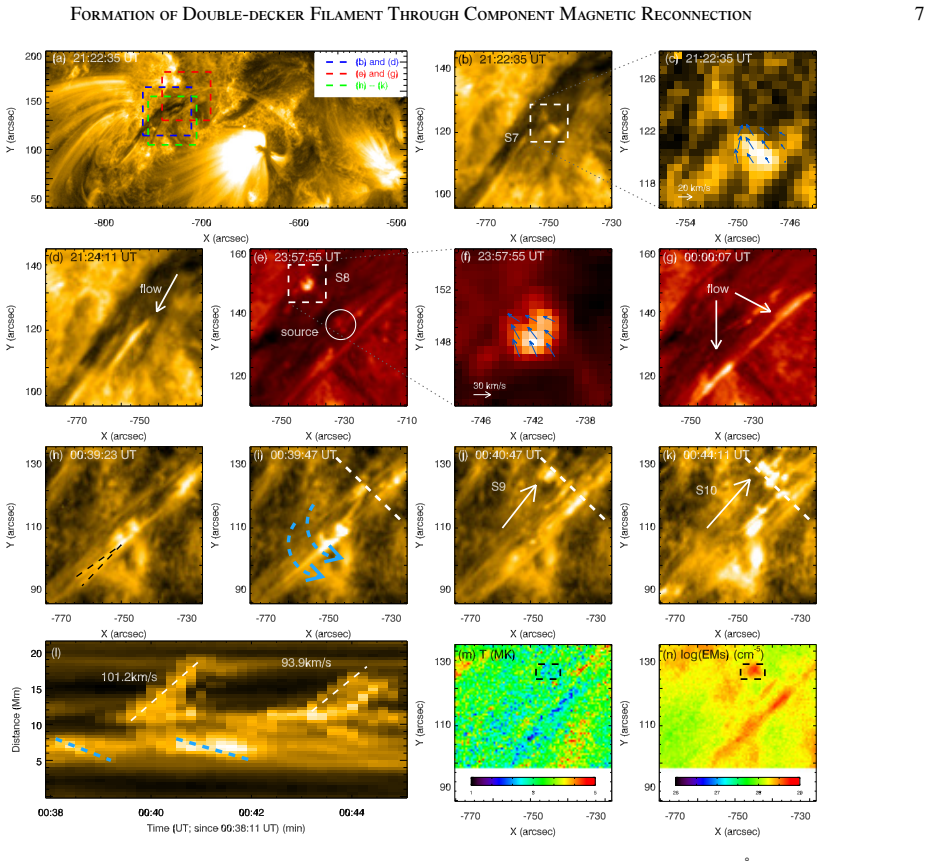
Using images from two spacecraft (SDO and STEREO), the authors saw small jets shooting out sideways from the filament, bright spots, and plasma flowing in both directions along the filament threads. These are classic signatures of magnetic reconnection, the breaking and reconnecting of magnetic field lines, happening inside the filament itself. They also saw that some threads appeared twisted and crossed each other, and that one footpoint of the filament was slowly rotating. Their interpretation: the rotation twisted the braided magnetic field, and when the threads crossed, they reconnected, releasing energy and splitting the filament into two stacked ropes.
After the split, the upper rope rose and erupted, producing a moderate solar flare and a fast coronal mass ejection. The authors calculate that the surrounding magnetic field had decayed enough at the height of the upper rope to be unstable, explaining the eruption. If this mechanism is real, it means double-decker filaments can form from the inside out, through component reconnection of a braided structure, rather than only from outside forces.
Extended reading notes
Core claim
The double-decker filament on 2013 August 30 formed by the splitting of a braided magnetic flux rope, driven by component magnetic reconnection between intertwined field lines, triggered by the rotational motion in a part of one filament footpoint. If true, this establishes a new formation mechanism for double-decker filaments distinct from reconnection between legs of confining field lines.
Load-bearing premise
The interpretation that the filament was a braided MFR relies on 2D projections of misaligned threads in AIA 171 Å (Figure 4h). If these threads are not actually intertwined in 3D and the jets and bidirectional flows arise from some other process, the geometric basis for component magnetic reconnection as the splitting mechanism collapses. This premise is load-bearing because the entire mechanism depends on identifying thread crossings as reconnection sites.
Editorial analysis
A structured set of objections, weighed in public.
Assumptions & free parameters
free parameters (2)
- Included angle between reconnecting threads =
11.02 deg (measured for S9, applied to all jets)
- Line-of-sight path length L =
Set equal to observed jet width (about 5.0e8 cm)
assumptions (6)
- domain assumption PFSS extrapolation provides a valid background field for the decay index
- domain assumption EUV emission is optically thin, so DEM analysis yields densities and temperatures
- domain assumption Jet energies are converted from magnetic free energy via reconnection
- domain assumption Misaligned threads are a braided MFR, not a projection effect
- domain assumption The observed footpoint vortex causes twist accumulation leading to reconnection
- domain assumption Critical decay index thresholds (1.1-1.3 or 1.5-2.0) apply to this event
Cite this review
Pith. "Pith review of Deciphering the Formation and Dynamics of Double-decker Filament Through Component Magnetic Reconnection." pith.science (2026). https://pith.science/paper/44ZFXCVR
@misc{pith2026250513981,
  author       = {Pith},
  title        = {Pith review of: Deciphering the Formation and Dynamics of Double-decker Filament Through Component Magnetic Reconnection},
  year         = {2026},
  howpublished = {\url{https://pith.science/paper/44ZFXCVR}},
  note         = {Machine review of arXiv:2505.13981}
}
read the original abstract
The formation of double-decker filaments has long been an enigma in the field of solar physics. Using stereoscopic observations from the Solar Dynamics Observatory and the Solar Terrestrial Relations Observatory, we show that the double-decker filament formed on 2013 August 30 resulted from the splitting of a braided magnetic flux rope. The splitting was driven by component magnetic reconnection between intertwined field lines, triggered by the rotational motion in a part of one filament footpoint. This mechanism, inferred from observed small jets, brightenings, and bidirectional mass flows, differs from the previous conclusion attributing filament splitting to magnetic reconnection between the legs of confining magnetic field lines within or above the filament. The splitting speed might be modulated by the reconnection speed, as evidenced by the correspondence between the filament's slow and fast rising phases and the intermittent and violent brightening stages. Following the splitting, the upper branch of the double-decker filament erupted as a coronal mass ejection (CME), giving rise to a GOES soft X-ray M1.2 flare. In conclusion, our observations present a new formation mechanism for double-decker filaments, and the subsequent partial eruption is likely attributable to the torus instability of the background coronal magnetic field. Moreover, the detection of small jets within the filament provides new insights into the role of component magnetic reconnection in localized coronal heating processes.
Figures


Figures from the paper (3 more)


Reference graph
Works this paper leans on
-
[1]
2021, Nature Astronomy, 5, 54, doi: 10.1038/s41550-020-1199-8
Antolin, P., Pagano, P., Testa, P., Petralia, A., & Reale, F. 2021, Nature Astronomy, 5, 54, doi: 10.1038/s41550-020-1199-8
-
[2]
Awasthi, A. K., Liu, R., & Wang, Y . 2019, ApJ, 872, 109, doi: 10.3847/1538-4357/aafdad
-
[3]
2015, ApJ, 805, 48, doi: 10.1088/0004-637X/805/1/48
Bi, Y ., Jiang, Y ., Yang, J., et al. 2015, ApJ, 805, 48, doi: 10.1088/0004-637X/805/1/48
-
[4]
2023, A&A, 679, A9, doi: 10.1051/0004-6361/202346944
Bi, Y ., Yang, J.-Y ., Qin, Y ., et al. 2023, A&A, 679, A9, doi: 10.1051/0004-6361/202346944
-
[5]
2020, ApJ, 899, 19, doi: 10.3847/1538-4357/ab9cad
Chen, H., Zhang, J., De Pontieu, B., et al. 2020, ApJ, 899, 19, doi: 10.3847/1538-4357/ab9cad
-
[6]
2017, ApJL, 841, L13, doi: 10.3847/2041-8213/aa71a2
Chen, H., Zhang, J., Ma, S., Yan, X., & Xue, J. 2017, ApJL, 841, L13, doi: 10.3847/2041-8213/aa71a2
-
[7]
2021, ApJ, 923, 142, doi: 10.3847/1538-4357/ac2ba1
Chen, J., Su, Y ., Liu, R., et al. 2021, ApJ, 923, 142, doi: 10.3847/1538-4357/ac2ba1
-
[8]
Chen, P. F. 2011, Living Reviews in Solar Physics, 8, 1, doi: 10.12942/lrsp-2011-1
Show all 53 references
-
[9]
D., Zhang, J., et al
Cheng, X., Ding, M. D., Zhang, J., et al. 2014, ApJ, 789, 93, doi: 10.1088/0004-637X/789/2/93
2014 doi
-
[10]
Cheng, X., Kliem, B., & Ding, M. D. 2018, ApJ, 856, 48, doi: 10.3847/1538-4357/aab08d
2018 doi
-
[11]
2020, ApJ, 894, 85, doi: 10.3847/1538-4357/ab886a
Cheng, X., Zhang, J., Kliem, B., et al. 2020, ApJ, 894, 85, doi: 10.3847/1538-4357/ab886a
2020 doi
-
[12]
P., Peter, H., Parenti, S., et al
Chitta, L. P., Peter, H., Parenti, S., et al. 2022, A&A, 667, A166, doi: 10.1051/0004-6361/202244170
2022 doi
-
[13]
2025, arXiv e-prints, arXiv:2502.01796, doi: 10.48550/arXiv.2502.01796 D´emoulin, P., & Aulanier, G
Cozzo, G., Pagano, P., Reale, F., et al. 2025, arXiv e-prints, arXiv:2502.01796, doi: 10.48550/arXiv.2502.01796 D´emoulin, P., & Aulanier, G. 2010, ApJ, 718, 1388, doi: 10.1088/0004-637X/718/2/1388
-
[14]
H., & Welsch, B
Fisher, G. H., & Welsch, B. T. 2008, in Astronomical Society of the Pacific Conference Series, V ol. 383, Subsurface and Atmospheric Influences on Solar Activity, ed. R. Howe, R. W
2008
- [15]
-
[16]
K., Tziotziou, K., & Raouafi, N.-E
Georgoulis, M. K., Tziotziou, K., & Raouafi, N.-E. 2012, ApJ, 759, 1, doi: 10.1088/0004-637X/759/1/1
2012 doi
- [17]
-
[18]
R., Holzer, T
Gilbert, H. R., Holzer, T. E., & Burkepile, J. T. 2001, ApJ, 549, 1221, doi: 10.1086/319444
2001 doi
-
[19]
2024, ApJ, 970, 110, doi: 10.3847/1538-4357/ad54b8
Guo, Y ., Hou, Y ., Li, T., et al. 2024, ApJ, 970, 110, doi: 10.3847/1538-4357/ad54b8
2024 doi
-
[20]
1994a, SoPh, 152, 321, doi: 10.1007/BF00680443
Hill, F., Fischer, G., Grier, J., et al. 1994a, SoPh, 152, 321, doi: 10.1007/BF00680443
-
[21]
1994b, SoPh, 152, 351, doi: 10.1007/BF00680444
Hill, F., Fischer, G., Forgach, S., et al. 1994b, SoPh, 152, 351, doi: 10.1007/BF00680444
-
[22]
T., Liu, Y ., Hayashi, K., et al
Hoeksema, J. T., Liu, Y ., Hayashi, K., et al. 2014, SoPh, 289, 3483, doi: 10.1007/s11207-014-0516-8
2014 doi
-
[23]
2023, 959, 69, doi: 10.3847/1538-4357/ad08bd
Hou, Y ., Li, C., Li, T., et al. 2023, 959, 69, doi: 10.3847/1538-4357/ad08bd
2023 doi
-
[24]
2007, ApJL, 667, L105, doi: 10.1086/521949
Jiang, Y ., Yang, L., Li, K., & Shen, Y . 2007, ApJL, 667, L105, doi: 10.1086/521949
2007 doi
-
[25]
L., Kucera, T
Kaiser, M. L., Kucera, T. A., Davila, J. M., et al. 2008, Space Science Reviews, 136, 5, doi: 10.1007/s11214-007-9277-0
2008 doi
-
[26]
2006, PhRvL, 96, 255002, doi: 10.1103/PhysRevLett.96.255002
Kliem, B., & T¨or¨ok, T. 2006, PhRvL, 96, 255002, doi: 10.1103/PhysRevLett.96.255002
2006 doi
-
[27]
S., et al
Kliem, B., T¨or¨ok, T., Titov, V . S., et al. 2014, ApJ, 792, 107, doi: 10.1088/0004-637X/792/2/107
2014 doi
-
[28]
R., Title, A
Lemen, J. R., Title, A. M., Akin, D. J., et al. 2012, Solar Physics, 275, 17, doi: 10.1007/s11207-011-9776-8
2012 doi
-
[29]
2024, Universe, 10, 42, doi: 10.3390/universe10010042
Liu, J., Zhang, Y ., Zheng, Y ., Liu, Y ., & Chen, J. 2024, Universe, 10, 42, doi: 10.3390/universe10010042
2024 doi
-
[30]
2012, ApJ, 756, 59, doi: 10.1088/0004-637X/756/1/59
Liu, R., Kliem, B., T¨or¨ok, T., et al. 2012, ApJ, 756, 59, doi: 10.1088/0004-637X/756/1/59
2012 doi
-
[31]
2014, SoPh, 289, 2945, doi: 10.1007/s11207-014-0523-9
Morgan, H., & Druckm¨uller, M. 2014, SoPh, 289, 2945, doi: 10.1007/s11207-014-0523-9
2014 doi
-
[32]
2021, ApJ, 909, 32, doi: 10.3847/1538-4357/abda4e
Pan, H., Liu, R., Gou, T., et al. 2021, ApJ, 909, 32, doi: 10.3847/1538-4357/abda4e
2021 doi
-
[33]
2014, Living Reviews in Solar Physics, 11, 1, doi: 10.12942/lrsp-2014-1
Parenti, S. 2014, Living Reviews in Solar Physics, 11, 1, doi: 10.12942/lrsp-2014-1
2014 doi
-
[34]
2022, ApJ, 938, 122, doi: 10.3847/1538-4357/ac92e5
Patel, R., & Pant, V . 2022, ApJ, 938, 122, doi: 10.3847/1538-4357/ac92e5
2022 doi
-
[35]
D., Thompson, B
Pesnell, W. D., Thompson, B. J., & Chamberlin, P. C. 2012, SoPh, 275, 3, doi: 10.1007/s11207-011-9841-3 Ramada C. Sukarmadji, A., Antolin, P., & McLaughlin, J. A. 2022, ApJ, 934, 190, doi: 10.3847/1538-4357/ac7870
2012 doi
-
[36]
D., et al
Shen, Y ., Liu, Y ., Liu, Y . D., et al. 2015, ApJL, 814, L17, doi: 10.1088/2041-8205/814/1/L17
2015 doi
-
[37]
2012, ApJ, 750, 12, doi: 10.1088/0004-637X/750/1/12
Shen, Y ., Liu, Y ., & Su, J. 2012, ApJ, 750, 12, doi: 10.1088/0004-637X/750/1/12
2012 doi
-
[38]
2024, ApJ, 964, 125, doi: 10.3847/1538-4357/ad2349
Shen, Y ., Liu, D., Yao, S., et al. 2024, ApJ, 964, 125, doi: 10.3847/1538-4357/ad2349
2024 doi
-
[39]
2011, Research in Astronomy and Astrophysics, 11, 594, doi: 10.1088/1674-4527/11/5/009
Shen, Y .-D., Liu, Y ., & Liu, R. 2011, Research in Astronomy and Astrophysics, 11, 594, doi: 10.1088/1674-4527/11/5/009
2011 doi
-
[40]
M., Hannah, I
Su, Y ., Veronig, A. M., Hannah, I. G., et al. 2018, ApJL, 856, L17, doi: 10.3847/2041-8213/aab436
2018 doi
-
[41]
2023, ApJ, 953, 148, doi: 10.3847/1538-4357/ace5b1
Sun, Z., Li, T., Tian, H., et al. 2023, ApJ, 953, 148, doi: 10.3847/1538-4357/ace5b1
2023 doi
-
[42]
T., Kliem, B., & T¨or¨ok, T
Thompson, W. T., Kliem, B., & T¨or¨ok, T. 2012, SoPh, 276, 241, doi: 10.1007/s11207-011-9868-5
2012 doi
-
[43]
T., Davila, J
Thompson, W. T., Davila, J. M., Fisher, R. R., et al. 2003, in Society of Photo-Optical Instrumentation Engineers (SPIE) Conference Series, V ol. 4853, Innovative Telescopes and Instrumentation for Solar Astrophysics, ed. S. L. Keil & S. V . Avakyan, 1–11, doi: 10.1117/12.460267
2003 doi
-
[44]
2018, NewA, 65, 7, doi: 10.1016/j.newast.2018.05.005
Tian, Z., Shen, Y ., & Liu, Y . 2018, NewA, 65, 7, doi: 10.1016/j.newast.2018.05.005
2018 doi
-
[45]
S., Priest, E
Titov, V . S., Priest, E. R., & Demoulin, P. 1993, Å, 276, 564 T¨or¨ok, T., & Kliem, B. 2005, ApJL, 630, L97, doi: 10.1086/462412 14 Liu et al
1993 doi
-
[46]
2025, ApJL, 982, L50, doi: 10.3847/2041-8213/adbf96
Wang, Q., Bi, Y ., Liang, H., Yang, J., & Gong, L. 2025, ApJL, 982, L50, doi: 10.3847/2041-8213/adbf96
2025 doi
-
[47]
2023, ApJ, 958, 116, doi: 10.3847/1538-4357/acf569
Wei, H., Huang, Z., Li, C., et al. 2023, ApJ, 958, 116, doi: 10.3847/1538-4357/acf569
2023 doi
-
[48]
2012, Living Reviews in Solar Physics, 9, 5, doi: 10.12942/lrsp-2012-5
Wiegelmann, T., & Sakurai, T. 2012, Living Reviews in Solar Physics, 9, 5, doi: 10.12942/lrsp-2012-5
2012 doi
-
[49]
R., Tarbell, T
Wuelser, J.-P., Lemen, J. R., Tarbell, T. D., et al. 2004, in Society of Photo-Optical Instrumentation Engineers (SPIE) Conference
2004
-
[50]
5171, Telescopes and Instrumentation for Solar Astrophysics, ed
Series, V ol. 5171, Telescopes and Instrumentation for Solar Astrophysics, ed. S. Fineschi & M. A. Gummin, 111–122, doi: 10.1117/12.506877
-
[51]
2014, ApJ, 789, 133, doi: 10.1088/0004-637X/789/2/133
Zhang, Q., Liu, R., Wang, Y ., et al. 2014, ApJ, 789, 133, doi: 10.1088/0004-637X/789/2/133
2014 doi
-
[52]
2020, ApJL, 898, 12, doi: 10.3847/2041-8213/aba1f3
Zhang, Q., Wang, Y ., Liu, R., et al. 2020, ApJL, 898, 12, doi: 10.3847/2041-8213/aba1f3
2020 doi
-
[53]
2014, Solar Physics, 289, 279, doi: 10.1007/s11207-013-0349-x
Zhu, C., & Alexander, D. 2014, Solar Physics, 289, 279, doi: 10.1007/s11207-013-0349-x
2014 doi
Reviewed August 7, 2026 · model on record in the stance chip above.
Discussion (0). Continue with ORCID to comment.