REVIEW 3 major objections 4 minor
Radicalization Kinetics under Algorithmic Exposure in a Stochastic Multiplex Model of Opinion Dynamics
T0 review · 3 major / 4 minor · reviewed 2026-08-12 · deepseek-v4-flash
Pith's one-line read The paper argues that under repulsive social influence, an uncurated platform is the most radicalizing design because the stationary cross-bloc attention fraction, not any threshold, sets the radicalization rate.
desk verdict Clean kinetic mechanism for the exposure-polarization inversion, but the headline no-threshold claim is under-tested because the sampled λ grid starts at 0.05, above the predicted crossover. read the letter →
The pith
A machine-rendered reading of the paper's core claim, the machinery that carries it, and where it could break.
The reading
What carries the argument
The load-bearing object is the cross-bloc attention fraction $p(y)=E(2y)/(E(0)+E(2y))$: under fast rewiring, the stationary probability that one of an agent's $k$ attention slots points into the opposite bloc when the blocs sit at $\pm y$. It maps any curation kernel $E$ to a state-dependent repulsive-exposure profile and enters the two-bloc rate equation $dy/dt=2\alpha_{\mathrm{tot}}\lambda\eta\,p(y)\,y$, valid once the bloc separation exceeds the repulsion threshold. Because that equation is separable, the radicalization time is an exact quadrature over $1/(y\,p(y))$, and the constant-exposure approximation gives the closed-form crossover $\lambda_c(T)$. This is the object that turns platform design into a number: the three kernels' profiles are pointwise ordered, and their cross-bloc fractions at the observed starting separation span two orders of magnitude.
What would settle it
Measure the influence function $F(x_i, x_j)$ directly in a controlled opinion-change experiment: if the response to strongly opposed views has no negative (repulsive) branch and merely flattens to indifference, then the outward drift in Eq. (9) is zero and the predicted inversion cannot occur; if the negative branch exists, the measured $\epsilon_2$ and $\eta$ make the finite-horizon crossover $\lambda_c(T)$ quantitatively testable.
Extended reading notes
Core claim
The paper's central claim is an inversion of the standard platform-ranking story. In a model with Brownian mobility, bounded-confidence physical interaction, and an algorithmically rewired digital layer under conserved attention, purely assimilative influence makes an opinion-blind platform heal fragmentation and homophilic curation build echo chambers. Once the influence function gains a repulsive branch for opinion distances beyond $\epsilon_2$, the order reverses: the neutral platform drives opinions to the boundary and pins them there, the controversy-seeking platform arrests just short of the boundary, and the similarity-driven platform only slowly creeps outward. The author reduces this to a two-bloc statement: when two blocs sit at $\pm y$, the stationary cross-bloc attention fraction is $p(y)=E(2y)/(E(0)+E(2y))$, and the bloc separation obeys $dy/dt = 2\alpha_{\mathrm{tot}}\lambda\eta\,p(y)\,y$. Radicalization is therefore rate-limited, not threshold-limited: any $\lambda>0$ with nonzero cross-bloc exposure produces outward drift, and the finite-horizon crossover $\lambda_c(T)=\ln(y_f/y_0)/(2\alpha_{\mathrm{tot}}\eta\,p_0\,T)$, with no parameters fitted to the onset data, places the neutral and controversy onsets near $\lambda\approx0.01$–$0.02$ and the similarity onset near $\lambda\approx1$, matching the simulations.
Load-bearing premise
The entire rate theory assumes that attention slots renew so quickly that the platform's exposure mix reaches its stationary value before the two opinion blocs drift noticeably, and that the two blocs are symmetric in strength—an assumption the paper itself flags as only marginally met for the neutral kernel at its reference parameters.
Editorial extensions
If this is right
- With repulsive influence active, the neutral platform pins mean extremism at about 1, the controversy platform arrests near 0.95, and the similarity platform reaches only about 0.79 on the simulation horizon—so the platform ordering is quantitative, not just qualitative.
- Radicalization has no positive critical attention share within the deterministic reduction; apparent thresholds in finite experiments are horizon effects captured by $\lambda_c(T)$.
- Uncurated exposure sets the saturation ceiling: the similarity platform approaches it as $\gamma\to1$, and the controversy platform reaches it once its engagement peak $\delta\geq\epsilon_2$, at which point it radicalizes twice as fast as the neutral platform.
- Once the platform owns most of an agent's attention, physical mobility becomes irrelevant to the outcome, so geography determines the social state only at low digital attention share.
- Under opinion-independent mobility there is no geographic opinion structure, and reinstating it requires homophilic drift above a Péclet threshold $\chi\ell/D\sim1$.
Reading between the lines
- If the rate-limited picture transfers to real platforms, an exposure-diversity intervention should change polarization continuously with dose and with the population's repulsion prevalence; the mixed field record could then reflect different populations sitting at different points on the $\lambda_c(T)$ curve rather than contradictory evidence.
- The $p(y)$ mapping suggests a practical diagnostic: from logged feed exposure and opinion estimates, one could measure the realized cross-bloc fraction and forecast whether an exposure policy will help or backfire without fitting a complete opinion-dynamics model.
- The same two-bloc machinery should extend to any curation objective whose exposure profile is pointwise ordered over the traversed opinion range—such as chronological, novelty-maximizing, or advertiser-optimized feeds—so the three kernels studied here are boundary examples of a broader design space.
Signed reviews
Editorial analysis
A structured set of objections, weighed in public.
Referee Report
Summary. The paper introduces a continuous-time multiplex model in which agents diffuse in physical space and interact through an adaptively rewired digital attention graph under a conserved attention budget. Influence is assimilative, indifferent, or repulsive depending on opinion distance, and three platform designs are compared: similarity-driven, neutral, and controversy-seeking engagement kernels. The central result is an inversion: when repulsion is active, the neutral platform is the most radicalizing, the controversy-driven platform is close behind, and strong algorithmic homophily is the least radicalizing. A two-bloc reduction yields a rate equation dy/dt = 2 alpha_tot lambda eta p(y) y with p(y) = E(2y)/(E(0)+E(2y)), leading to a finite-horizon crossover lambda_c(T) in the digital attention share. The well-mixed limit reproduces the neutral Var(x)-versus-lambda curve nearly quantitatively. Additional results include a mobility-attention phase diagram, a null result for geographic opinion structure under opinion-independent mobility, and a Peclet-number threshold for the onset of spatial opinion domains under homophilic mobility.
Significance. If the central claim holds, the paper makes a conceptual contribution by framing platform-induced radicalization as rate-limited rather than threshold-limited and by mapping any curation kernel to a state-dependent cross-bloc exposure profile whose quadrature sets the radicalization time. The paper is unusually transparent: simulation code and data are openly available, the analytic reduction is clearly stated, and the platform ordering is tested across the (eta, epsilon2) grid, system sizes up to N=1600, and five control variants. The robustness controls (homogeneous strengths, finite-variance strengths, reflecting boundaries, attention-window size, and rewiring rate) strengthen confidence in the ordering itself. However, the headline claim that 'any lambda > 0 with nonzero cross-bloc exposure produces outward drift' is not directly resolved by the presented simulations, because the predicted crossovers for the neutral and controversy platforms lie below the smallest sampled attention share. The empirical support for rate-limited, rather than threshold-limited, radicalization is therefore incomplete.
major comments (3)
- [Sec. III B / IV E, Eq. (12), Fig. 9] The central rate-limited claim is tested only in the saturated regime. Table I predicts lambda_c = 0.016 (neutral) and 0.008 (controversy) at T=80, while Fig. 9 samples lambda only at 0.05 and above. The simulations therefore rule out thresholds at or above 0.05 (including the uniform-state values 0.34 and 0.55), but they are fully consistent with any nonzero threshold below 0.05. Since the distinction between 'rate-limited' and 'threshold-limited' is the paper's headline, the comparison in Fig. 9 is not sufficient. I recommend adding simulations at lambda = 0.005, 0.01, 0.02, 0.03, and 0.04 for the neutral and controversy platforms, and/or measuring the early-time drift d<|x|>/dt to test the predicted linear scaling in lambda. Without such a test, the statement in the abstract that radicalization is rate-limited, not threshold-limited, goes beyond what the data establish.
- [Sec. III B, Table I] The claim that the crossover prediction involves 'no parameters fitted' is overstated because y0 = 0.6 is read off from simulation output (Figs. 1 and 3) rather than derived from the model parameters. The crossover scales as ln(1/y0); changing y0 to 0.5 raises lambda_c by about 35%, and y0 below 0.45 would postpone the onset until the repulsion threshold 2y >= epsilon2 is reached. The prediction is parameter-free with respect to the onset data, but not parameter-free in the strict sense stated in the abstract. I ask the authors to either derive y0 from the bounded-confidence fragmentation condition or report how y0 varies across initial conditions, noise levels, and box sizes, and to state explicitly that the tabulated lambda_c values inherit this measured input.
- [Sec. III A, Eq. (8)] The two-bloc reduction assumes symmetric, equal-strength blocs and fast rewiring relative to bloc drift. The authors note that the fast-rewiring condition is only marginally met for the neutral kernel at the reference parameters, and for heavy-tailed influence strengths the realized cross-bloc exposure fluctuates around Eq. (8) with convergence that is slow in N. While Table II shows the platform ordering is robust at lambda = 0.6, the quantitative values of lambda_c in Table I inherit these assumptions. A sensitivity analysis of Eq. (12) with respect to asymmetric bloc sizes and finite slot memory would clarify the regime of validity of the reported crossover values and would strengthen the rate-limited conclusion.
minor comments (4)
- [Eq. (13)] The appearance of s_j^2 in the well-mixed equation is explained in the text, but a one-line derivation showing that slot sampling proportional to E s_j combined with s_j-weighted averaging produces the squared strength would help the reader verify this step.
- [Fig. 9 caption] The dotted vertical lines marking lambda_c are described as part of the left panel, but the centre and right panel captions also mention lambda_c(T); please clarify which panels contain the crossover markers.
- [Sec. IV E] The phrase 'the finest nonzero attention share sampled' would be more informative if the exact lambda grid were stated in the text or caption, since the low-lambda resolution is central to the threshold question.
- [Sec. II E] The word 'polarization' is used both for Var(x) and for the two-cluster categorical state. The definitions in Sec. II E are clear, but the double use may confuse readers; a footnote or a different name for one of the two quantities would improve readability.
Circularity Check
No significant circularity: the rate theory is derived from the model's own definitions, and the simulation comparison is an internal consistency check rather than a fitted prediction.
full rationale
The central derivation chain is not circular. Equation (8), p(y) = E(2y)/(E(0)+E(2y)), is the stationary cross-bloc attention fraction obtained from the rewiring rule (6) for two symmetric blocs at ±y; Equation (9), dy/dt = 2 α_tot λ η p(y) y, follows by inserting the repulsive branch of the influence function (4) into the digital drift of (2). These are direct consequences of the model definitions, not ansaetze imported from prior work. The finite-horizon crossover (12) is obtained by quadrature of (9) and the definition t_rad = T, so it is an analytic consequence rather than a fit. The only empirical input to Table I is y0 = 0.6, which the paper states is 'the bounded-confidence cluster position at ϵ = 0.3, read off from Figs. 1 and 3, not fitted to the threshold data'; this is a measured initial condition from the assimilative levels, not a parameter fitted to the Level-4 onset data being compared, so the validation is not statistically forced. The paper contains no self-citations, so no load-bearing argument reduces to a self-citation chain, and no uniqueness theorem is imported from the author's prior work. The simulation comparison demonstrates that the agent-based model behaves as the reduction predicts; this is internal consistency, which is expected in a theory-and-simulation paper and is not circular. The skeptic's concern that the predicted λc values (0.008–0.016) lie below the smallest sampled λ = 0.05 is a resolution limitation of the numerical test, explicitly acknowledged by the paper, not a circular reduction of the prediction to the data. The paper's own heuristic caveats about symmetric blocs and fast rewiring further show that the reduction is not being presented as a tautology. Therefore no circular step meets the evidentiary standard required by the review rules.
Assumptions & free parameters
free parameters (11)
- eta (repulsion strength) =
0.4
- epsilon2 (repulsion threshold) =
0.9
- epsilon (bounded-confidence threshold) =
0.3
- gamma (algorithmic homophily strength) =
4
- delta (controversy-kernel engagement peak) =
0.8
- w (controversy-kernel width) =
0.2
- kappa (influence-strength tail exponent) =
2.5
- y0 (initial bloc position) =
0.6
- k (attention slots per agent) =
10
- rho (slot renewal rate) =
5
- sigma_x (opinion noise) =
0.02
assumptions (6)
- domain assumption The assimilation-indifference-repulsion influence function F(x_i,x_j) with eta greater than 0 describes human social influence.
- domain assumption Finite attention budget: digital exposure linearly displaces physical interaction with rates alpha_i = alpha_tot (1-lambda) and beta_i = alpha_tot lambda, and a hard slot constraint sum_j A_ij = k.
- ad hoc to paper Quasi-stationary cross-bloc attention fraction p(y) = E(2y)/(E(0)+E(2y)) with fast rewiring relative to bloc drift.
- domain assumption Fragmentation into two blocs near y0 occurs before repulsion acts, so the uniform-state linear stability analysis is irrelevant.
- domain assumption The physical layer exerts no restoring force between blocs separated beyond the confidence bound.
- domain assumption Translation invariance and zero opinion-position coupling at chi = 0.
invented entities (2)
-
Conserved attention budget with rates alpha_i = alpha_tot(1-lambda), beta_i = alpha_tot lambda, and k attention slots
-
Engagement kernel E(Delta) as the platform's content-selection rule
Cite this review
Pith. "Pith review of Radicalization Kinetics under Algorithmic Exposure in a Stochastic Multiplex Model of Opinion Dynamics." pith.science (2026). https://pith.science/paper/452YRE44
@misc{pith2026260810968,
  author       = {Pith},
  title        = {Pith review of: Radicalization Kinetics under Algorithmic Exposure in a Stochastic Multiplex Model of Opinion Dynamics},
  year         = {2026},
  howpublished = {\url{https://pith.science/paper/452YRE44}},
  note         = {Machine review of arXiv:2608.10968}
}
abstract
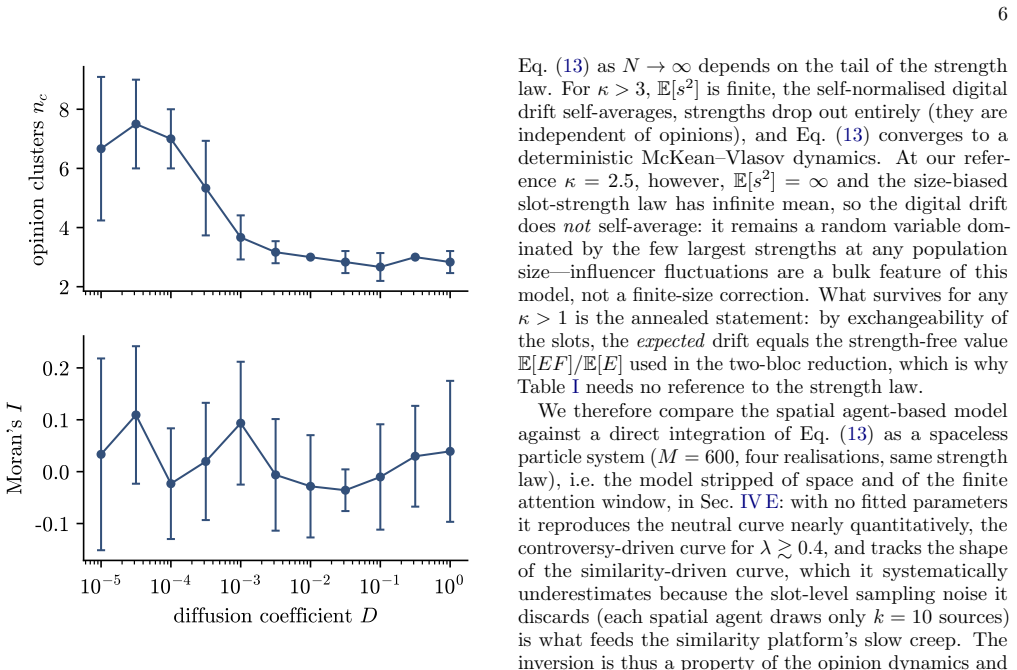
We study how physical mobility, algorithmic exposure, and repulsive social influence interact in a stochastic multiplex model of opinion dynamics. Agents diffuse in physical space while a directed digital network rewires under a conserved attention budget, so digital exposure displaces rather than supplements local interaction. With purely assimilative bounded-confidence influence, opinion-blind long-range exposure reduces locality-induced fragmentation whereas homophilic recommendation preserves echo chambers. When a contested repulsive response to sufficiently distant opinions is activated, this ordering reverses at the reference parameters: a neutral platform reaches the maximal polarization permitted by the bounded opinion space, controversy-seeking curation drives faster initial separation but slows sharply near the boundary, and homophilic curation delays radicalization by suppressing cross-bloc exposure. In a late-stage symmetric two-bloc reduction, any curation kernel maps to a state-dependent cross-bloc exposure profile $p(y)$ and an exact quadrature for the radicalization time. Pointwise-ordered profiles inherit a global kinetic ordering; crossing profiles yield target- and horizon-dependent rankings. For similarity-driven curation the quadrature has a closed form involving the exponential integral. Simulations, finite-size scans to $N=1600$, structural controls, and a well-mixed particle comparison support the mechanism. Heavy-tailed influence strengths are not required for the inversion; in the well-mixed heavy-tail regime they additionally produce a non-self-averaging stable-weighted asymptotic description. Finally, opinion-independent Brownian mobility produces no detectable geographic opinion structure in the explored regime, whereas opinion-dependent drift produces spatial domains through a P\'eclet-controlled crossover near $\chi\ell/D \sim 1$.
Figures


Figures from the paper (8 more)


Reviewed August 12, 2026 · model on record in the stance chip above.
Discussion (0). Continue with ORCID to comment.