REVIEW 3 major objections 6 minor 45 references
Signature-based identification of volatility models from path geometry
T0 review · 3 major / 6 minor · reviewed 2026-07-08 · glm-5.2
Pith's one-line read Signatures identify volatility models from path geometry alone
desk verdict Solid proof-of-concept: signatures + XGBoost classify volatility models well on simulated data; needs multi-seed CIs and code release before it's fully convincing. read the letter →
The pith
A machine-rendered reading of the paper's core claim, the machinery that carries it, and where it could break.
The reading
What carries the argument
The path signature, a formal series of iterated integrals over a time-augmented path, truncated at order 4 to produce 31 real-valued features per trajectory. These features are classified by XGBoost, a gradient-boosted tree ensemble. The pipeline is: simulate volatility paths from candidate models, compute truncated signatures, train the classifier on labelled signature vectors, and evaluate on out-of-sample paths.
What would settle it
If the same signature features and classifier were applied to realized volatility series from financial markets and failed to identify the correct model class at rates above chance, the central claim that path geometry alone suffices for model identification would be undermined.
Extended reading notes
Core claim
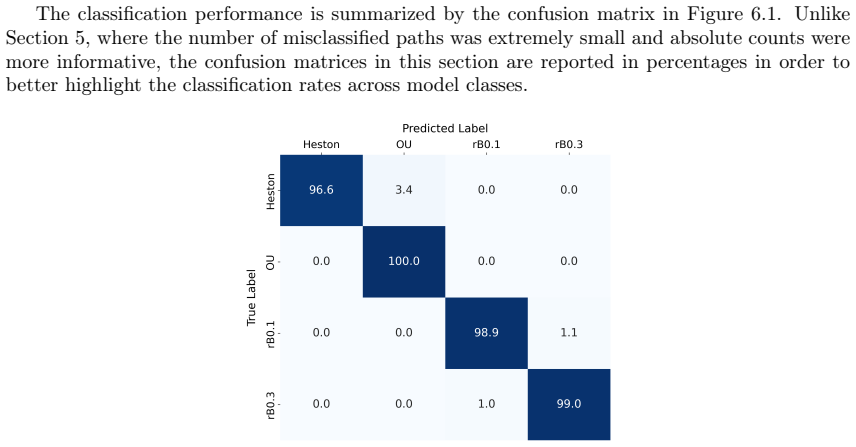
The central finding is that truncated path signatures of order 4 (31 features) encode sufficient geometric information to classify stochastic volatility model classes from simulated paths with high accuracy, including under parameter uncertainty. The discriminative information resides primarily in third- and fourth-order iterated integrals rather than in lower-order path statistics. Classification errors are not random but traceable to specific regimes where the underlying processes become genuinely similar, as when the Heston volatility-of-volatility parameter is small and the Heston diffusion term becomes negligible relative to its drift.
Load-bearing premise
The load-bearing premise is that simulated paths from the three model families with the specific parameter ranges chosen are representative enough to demonstrate that signatures capture model-class geometry. The classifier is trained and tested on paths from the same simulation pipeline; whether the signature features generalize to market data with microstructure noise, discrete observation, and structural breaks is untested.
Editorial extensions
If this is right
- Model identification could be performed as a pre-calibration step: before fitting parameters, one could determine which model family is appropriate for a given dataset based on path geometry alone.
- The signature-based approach generalizes beyond the three model families tested here to any setting where candidate dynamical systems produce paths with distinguishable geometric structure.
- The finding that order-4 truncation suffices suggests a practical ceiling on feature dimensionality for signature-based model identification, keeping the approach computationally tractable.
- Misclassification patterns could serve as a diagnostic tool: systematic confusion between two model classes in specific parameter regimes reveals where those models are genuinely indistinguishable, informing model selection under uncertainty.
Reading between the lines
- If signatures can identify model class from path geometry, they could also serve as a model misspecification detector: given a path from a fitted model, a signature-based classifier could flag whether the path's geometry is consistent with the assumed model family.
- The reuse of the same eta realizations across rough Bergomi classes (Section 6.1) means the rough Bergomi classification problem is constructed to differ only through H; with independent parameter draws, the classification task would be harder and the reported accuracy may overstate performance in a fully realistic setting.
- The concentration of discriminative power in signature terms S1100 and S0100 suggests these specific iterated integrals capture geometric features most sensitive to roughness and mean-reversion structure; understanding why these particular terms dominate could yield a reduced feature set for practical deployment.
- Extension to market data faces a fundamental challenge the paper acknowledges but does not resolve: real volatility series contain microstructure noise, jumps, and structural breaks absent from the simulation pipeline, and whether signature features trained on clean simulated paths transfer to noisy empirical data is untested.
Signed reviews
Editorial analysis
A structured set of objections, weighed in public.
Referee Report
Summary. The paper proposes using truncated path signatures (order 4, 31 features) combined with XGBoost to identify stochastic volatility model classes (Heston, OU, rough Bergomi) from simulated paths. The authors present experiments in two settings: fixed parameters (proof of concept) and randomly sampled parameters (parameter uncertainty). The method achieves near-perfect accuracy in controlled settings and 84-99% accuracy under parameter uncertainty. A detailed analysis of Heston/OU misclassification patterns via the volatility-of-volatility parameter nu is provided, along with robustness checks on truncation order, time horizon, sample size, and classifier choice (NN comparison).
Significance. The paper addresses a well-defined model identification problem using a mathematically grounded feature representation (path signatures) and an off-the-shelf classifier (XGBoost). The experimental design is careful: balanced datasets (250K paths/class), train-test splits, confusion matrices, and multiple robustness checks. The Heston/OU misclassification analysis (Section 6.8) with nu-binning is well-motivated and provides a genuine geometric explanation for classification errors. The feature importance analysis (Section 6.4) comparing built-in XGBoost scores with permutation importance is a useful robustness step. The framework is non-circular: signatures are computed from first principles, models are standard with cited parameterizations, and the classifier is an off-the-shelf tool. The computational feasibility (31 features, seconds of training time) is a practical strength.
major comments (3)
- Section 6.1: The paper states that reusing the same eta realizations across rough Bergomi classes 'makes the identification problem strictly harder for the classifier as, conditioned on H, the two rough Bergomi classes are statistically identical.' This claim is incorrect. The classifier observes individual paths, not paired paths across classes. Whether eta is shared or independently drawn across classes, the marginal distribution of signature features within each class is identical (eta ~ U(0.8, 2.0) in both cases, with the same driving noise distribution). The sharing only induces dependence between paths from different classes (a joint-distribution effect), which the classifier never observes. The sharing is irrelevant to the marginal classification problem; it affects interpretability (ensuring classification is attributable to H, not eta) but not difficulty. The authors should修正dly
- All reported accuracies are single-run point estimates. There are no multi-seed confidence intervals for the full pipeline (simulation + training). While the large sample sizes (250K train, 50K test) provide some stability, the variance across different random seeds is unknown. For the most challenging experiment (Section 6.3, 84% accuracy), the variance could be non-trivial. Adding multi-seed results (e.g., 5-10 seeds) with standard errors for the main experiments would substantially strengthen the claims.
- Section 6.8: The experiment with identical parameter distributions for Heston and OU reports 64.6% Heston accuracy. The paper attributes the asymmetry (OU at 100%, Heston at 64.6%) to the classifier learning 'a decision boundary biased toward the Ornstein-Uhlenbeck class.' This interpretation is incomplete. The asymmetry likely reflects a statistical identifiability issue: when nu is small, Heston paths are realizations of a process that is close to OU, so the Bayes-optimal classifier would also struggle. The paper should clarify whether this is a fundamental statistical limit (irreducible) or an artifact of the finite feature set / classifier, e.g., by checking whether a larger truncation order or a different classifier reduces the asymmetry.
minor comments (6)
- Section 3, Eq. (3.1): The Heston model is written with parameter xi for the volatility of volatility, but the text refers to it as nu in subsequent sections (e.g., Section 6.1). The notation should be consistent.
- Section 6.1: The Feller condition constraint uses nu_max = 0.95 * sqrt(2*kappa*theta), but the 5% safety margin is applied to the upper bound of the uniform distribution, not to the Feller condition itself. This should be clarified.
- Figure references (e.g., 'Figure 5.1') refer to figures that are not visible in the text. Ensure figures are properly labeled and referenced.
- Section 6.4: The feature sig_27 is identified as S1100, but the multi-index notation should be explicitly defined (e.g., whether 0 denotes time or path component) for readers unfamiliar with the convention.
- Table 6.2: The accuracy for Experiment 6.1 with 50K paths is 0.9846, but with 250K paths it is 0.9863. The difference is small, but the paper should note whether these are comparable given the absence of confidence intervals.
- The paper mentions 'the full code will be made available upon publication' (Section 4.1). For reproducibility, consider depositing the code in a public repository prior to publication.
Simulated Author's Rebuttal
We thank the referee for a careful and constructive report. The referee correctly identifies a factual error in our discussion of the shared-eta design (Major Comment 1), requests multi-seed confidence intervals (Major Comment 2), and asks for clarification of the Heston/OU asymmetry as a possible statistical identifiability limit (Major Comment 3). We address each point below and indicate the revisions we will make.
read point-by-point responses
-
Referee: Section 6.1: The claim that reusing the same eta realizations across rough Bergomi classes 'makes the identification problem strictly harder' is incorrect. The classifier observes individual paths, not paired paths. The marginal distribution of signature features within each class is identical whether eta is shared or independently drawn. The sharing only induces dependence between paths from different classes, which the classifier never observes.
Authors: The referee is correct on the substance. The classifier operates on marginal distributions of individual paths, and sharing eta across classes does not alter the marginal distribution within each class. The claim that the shared-eta design 'makes the identification problem strictly harder' is incorrect as stated. What the design does ensure is interpretability: by holding eta fixed across rough Bergomi classes, we guarantee that any successful classification is attributable to differences in H rather than to incidental variation in eta. This is a valid methodological motivation for the design, but it does not affect the difficulty of the marginal classification problem. We will revise Section 6.1 to remove the incorrect claim and reframe the shared-eta design solely as an interpretability safeguard. revision: yes
-
Referee: All reported accuracies are single-run point estimates. There are no multi-seed confidence intervals for the full pipeline. Adding multi-seed results (e.g., 5-10 seeds) with standard errors for the main experiments would substantially strengthen the claims.
Authors: We agree that multi-seed confidence intervals would strengthen the paper. We will rerun the main experiments (Sections 6.1, 6.2, and 6.3) with 10 independent seeds, varying both the simulation seed (path generation) and the XGBoost seed (training), and report mean accuracies with standard errors. For the most challenging experiment (Section 6.3, currently 83.9% accuracy), this will quantify the variance the referee is concerned about. Given the large sample sizes (250K train, 50K test per class), we expect the variance to be modest, but we will report it transparently. We will add a table of multi-seed results and update the main text accordingly. revision: yes
-
Referee: Section 6.8: The asymmetry (OU at 100%, Heston at 64.6%) is attributed to the classifier learning 'a decision boundary biased toward OU.' This interpretation is incomplete. The asymmetry likely reflects a statistical identifiability issue: when nu is small, Heston paths are close to OU, so the Bayes-optimal classifier would also struggle. The paper should clarify whether this is a fundamental statistical limit or an artifact of the finite feature set / classifier.
Authors: The referee's interpretation is more precise than ours. The asymmetry is better understood as a statistical identifiability issue: when nu is small, the Heston process is genuinely close to an OU process with matching drift parameters, and the Bayes-optimal classifier would face the same difficulty. Our current phrasing ('decision boundary biased toward OU') describes the symptom but not the cause. We will revise the interpretation in Section 6.8 to frame the asymmetry as a consequence of statistical identifiability rather than a classifier artifact. Regarding the referee's suggestion to check whether a larger truncation order or different classifier reduces the asymmetry: our existing results already provide partial evidence. The nu-binning analysis (Figure 6.11) shows that misclassification is concentrated in the low-nu regime (70.7% misclassification) and drops to 8.2% in the high-nu regime, indicating that the difficulty is driven by the genuine proximity of the processes rather than by the feature representation. Additionally, the experiment with high fixed nu (Figure 6.10, right) shows Heston accuracy recovering to 90.9%, further supporting the identifiability interpretation. We will add a brief experiment with truncation order 5 on the identical-parameter Heston/OU setting to explicitly confirm that higher-order signatures do not materially reduce the asymmetry, and we will revise the text to clarify that the limit is statistical rather than representational. revision: yes
Circularity Check
No significant circularity: the derivation chain is self-contained, with one minor self-citation for background that is not load-bearing.
full rationale
The paper's central claim—that truncated path signatures combined with XGBoost can identify stochastic volatility model classes from simulated paths—is supported by a straightforward experimental pipeline: simulate paths from standard models (Heston, OU, rough Bergomi), compute their truncated signatures (well-defined iterated integrals from rough path theory, with foundational results like Chen's identity and Lyons' Extension Theorem cited to standard sources: Chen 1957, Lyons 1998, Lyons et al. 2007, Friz and Victoir 2010, Coutin and Qian 2002), and train an off-the-shelf XGBoost classifier. No 'prediction' or 'first-principles result' reduces to a fitted input by construction. The classification accuracies are empirical outcomes of training and testing on independent simulated data, not quantities defined in terms of their own inputs. The one self-citation, Alòs et al. (2026), is used for background exposition on signature theory ('We follow Alòs et al. (2026), which provides a self-contained introduction to the necessary concepts and includes the proofs of most results') and for a minor footnote about interpolation choice. This citation is not load-bearing for the paper's claims: the mathematical foundations (Chen's identity, Extension Theorem, universal approximation theorems) are all attributed to their original sources (Chen 1957, Lyons 1998, Lyons et al. 2007), and the experimental results stand independently of the cited work. The Burés and Larrosa (2023) citation is for a different application domain (chemical reaction mechanisms) and provides methodological inspiration, not a load-bearing premise. No fitted parameter is renamed as a prediction, no ansatz is smuggled through self-citation, and no uniqueness theorem from the authors' own prior work is invoked to forbid alternatives. The paper is self-contained against its external benchmarks (simulated paths from standard models with cited parameterizations).
Assumptions & free parameters
free parameters (10)
- XGBoost learning rate =
0.05
- XGBoost max tree depth =
6
- XGBoost n_estimators =
500
- Signature truncation order N =
4
- Time horizon T =
0.1
- Number of time steps =
100
- Heston parameter ranges (κ, θ, ν) =
κ~U(1,3), θ~U(0.05,0.15), ν~U(0.15,min(0.35,ν_max))
- OU parameter ranges (κ, θ, σ) =
κ~U(1.5,3.5), θ~U(0.10,0.20), σ~U(0.05,0.30)
- Rough Bergomi η range =
η~U(0.8,2.0)
- Hurst parameter values H =
Various: 0.05, 0.1, 0.15, 0.2, 0.25, 0.3, 0.35, 0.4, 0.6
assumptions (4)
- standard math Fractional Brownian motion with H>1/4 admits a canonical geometric rough path lift (Coutin and Qian 2002).
- standard math Continuous semimartingales admit a canonical Stratonovich rough path lift (Friz and Victoir 2010, Ch. 14).
- standard math Time-augmented weakly geometric p-rough paths are uniquely determined by their signature (Theorem 2.11).
- domain assumption Simulated paths from the chosen models with the chosen parameter ranges are representative of the model classes.
Cite this review
Pith. "Pith review of Signature-based identification of volatility models from path geometry." pith.science (2026). https://pith.science/paper/45672F3W
@misc{pith2026260706340,
  author       = {Pith},
  title        = {Pith review of: Signature-based identification of volatility models from path geometry},
  year         = {2026},
  howpublished = {\url{https://pith.science/paper/45672F3W}},
  note         = {Machine review of arXiv:2607.06340}
}
read the original abstract
We propose a signature-based framework for the identification of stochastic volatility model classes from observed path data. By mapping volatility trajectories into a feature space via truncated path signatures and applying a gradient boosting classifier, we show that it is possible to distinguish between different classes of volatility dynamics without relying on parametric calibration. Through a series of numerical experiments, we demonstrate that the method achieves high classification accuracy across a range of settings, from structurally distinct models to cases involving rough volatility models with closely spaced Hurst parameters. We show that the method remains effective under parameter uncertainty, where each simulated path is drawn with randomly sampled model parameters, and provide a detailed analysis of the misclassification pattern between the Heston and Ornstein--Uhlenbeck models in terms of the volatility of volatility parameter. The results highlight that most of the relevant discriminative information is captured by the first four levels of the signature, while higher-order terms provide only marginal improvements. Overall, the findings support the view that stochastic volatility models can be effectively identified through the geometry of their sample paths.
Figures


Figures from the paper (11 more)


Reference graph
Works this paper leans on
-
[1]
Elisa Al. Estimating the Hurst parameter from short term volatility swaps: a Malliavin calculus approach , journal =. 2019 , doi =
work page 2019
-
[2]
Estimating the Hurst parameter from the zero vanna implied volatility and its dual , journal =
Elisa Al. Estimating the Hurst parameter from the zero vanna implied volatility and its dual , journal =. 2025 , eprint =
work page 2025
-
[3]
Volatility Modeling with Rough Paths: A Signature-Based Alternative to Classical Expansions
Elisa Al. Volatility Modeling in. arXiv preprint arXiv:2507.23392 , year =. 2507.23392 , url =
-
[4]
Organic reaction mechanism classification using machine learning , journal =
Jordi Bur. Organic reaction mechanism classification using machine learning , journal =. 2023 , volume =
work page 2023
-
[5]
Mathematical Finance , volume=
Long memory in continuous-time stochastic volatility models , author=. Mathematical Finance , volume=
-
[6]
Finance and Stochastics , volume=
On the short-time behavior of the implied volatility for jump-diffusion models with stochastic volatility , author=. Finance and Stochastics , volume=
-
[7]
Integration of paths, geometric invariants and a generalized
Chen, Kuo-Tsai , journal=. Integration of paths, geometric invariants and a generalized. 1957 , publisher=
work page 1957
-
[8]
Revista Matemática Iberoamericana , volume=
Differential equations driven by rough signals , author=. Revista Matemática Iberoamericana , volume=. 1998 , publisher=
work page 1998
Show all 45 references
-
[9]
Lyons and Michael Caruana and Thierry Lévy , title =
Terry J. Lyons and Michael Caruana and Thierry Lévy , title =. 2007 , publisher =
2007
-
[10]
2002 , publisher=
System control and rough paths , author=. 2002 , publisher=
2002
-
[11]
Quantitative Finance , volume=
Short-time at-the-money skew and rough fractional volatility , author=. Quantitative Finance , volume=
-
[12]
Quantitative Finance , volume=
Pricing under rough volatility , author=. Quantitative Finance , volume=
-
[13]
Friz and Archil Gulisashvili and Blanka Horvath and Benjamin Stemper , title =
Christian Bayer and Peter K. Friz and Archil Gulisashvili and Blanka Horvath and Benjamin Stemper , title =. Quantitative Finance , volume =. 2019 , doi =
2019
-
[14]
and Jaisson, T
Gatheral, J. and Jaisson, T. and Rosenbaum, M. , title =. Quantitative Finance , year =
-
[15]
Pakkanen , title =
Mikkel Bennedsen and Asger Lunde and Mikko S. Pakkanen , title =. Journal of Financial Econometrics , year =. doi:10.1093/jjfinec/nbaa027 , url =
-
[16]
IISE Transactions , volume =
Gabriele Livieri and Stefano Mouti and Andrea Pallavicini and Mathieu Rosenbaum , title =. IISE Transactions , volume =. 2018 , doi =
2018
-
[17]
The Journal of Business , year =
On the Estimation of Security Price Volatilities from Historical Data , author =. The Journal of Business , year =. doi:10.1086/296072 , url =
-
[18]
Physica A: Statistical Mechanics and its Applications , year =
From rough to multifractal volatility: The log S-fBM model , author =. Physica A: Statistical Mechanics and its Applications , year =
-
[19]
2022 , eprint =
From Rough to Multifractal volatility: the log S-fBM model , author =. 2022 , eprint =
2022
-
[20]
Mathematics and Financial Economics , year =
Asymptotics for volatility derivatives in multi-factor rough volatility models , author =. Mathematics and Financial Economics , year =. doi:10.1007/s11579-020-00288-5 , url =
-
[21]
Quantitative Finance , year =
Calibrating rough volatility models: a convolutional neural network approach , author =. Quantitative Finance , year =. doi:10.1080/14697688.2019.1654126 , url =
2019 doi
-
[22]
2021 , journal =
Blanka Horvath and Aitor Muguruza and Mehdi Tomas , title =. 2021 , journal =. doi:10.1080/14697688.2020.1817974 , url =
2021 doi
- [23]
-
[24]
arXiv preprint arXiv:1603.03788 , year=
A primer on the signature method in machine learning , author=. arXiv preprint arXiv:1603.03788 , year=
-
[25]
SIAM Journal on Financial Mathematics , volume=
Signature-based models: Theory and calibration , author=. SIAM Journal on Financial Mathematics , volume=. 2023 , publisher=
2023
-
[26]
Joint calibration to
Cuchiero, Christa and Gazzani, Guido and M. Joint calibration to. Mathematical Finance , volume=. 2025 , publisher=
2025
-
[27]
2021 , url =
Geng, Xi , title =. 2021 , url =
2021
-
[28]
SIAM Journal on Financial Mathematics , volume=
Optimal execution with rough path signatures , author=. SIAM Journal on Financial Mathematics , volume=. 2020 , publisher=
2020
-
[29]
The Annals of Applied Probability , volume=
Optimal stopping with signatures , author=. The Annals of Applied Probability , volume=. 2023 , month=
2023
-
[30]
2010 , publisher =
Multidimensional Stochastic Processes as Rough Paths: Theory and Applications , author =. 2010 , publisher =
2010
-
[31]
2024 , publisher=
A Course on Rough Paths: With an Introduction to Regularity Structures , author=. 2024 , publisher=
2024
-
[32]
Probability Theory and Related Fields , year =
Coutin, Laure and Qian, Zhongmin , title =. Probability Theory and Related Fields , year =
-
[33]
2016 , publisher =
Chen, Tianqi and Guestrin, Carlos , booktitle =. 2016 , publisher =. doi:10.1145/2939672.2939785 , note =
2016 doi
-
[34]
arXiv preprint arXiv:1908.08806 , year =
Christian Bayer and Blanka Horvath and Aitor Muguruza and Benjamin Stemper and Mehdi Tomas , title =. arXiv preprint arXiv:1908.08806 , year =. 1908.08806 , archiveprefix =
1908 arXiv
-
[35]
Risk , year =
Andres Hernandez , title =. Risk , year =
-
[36]
SSRN Electronic Journal , year =
Alexei Kondratyev , title =. SSRN Electronic Journal , year =
-
[37]
Proceedings of the 2021 International Conference on Future Trends in Intelligent Computing (ICFTIC) , year =
Jincenzi Wu and Yuanyuan Li and Yizhou Ma , title =. Proceedings of the 2021 International Conference on Future Trends in Intelligent Computing (ICFTIC) , year =. doi:10.1109/ICFTIC54370.2021.9647373 , url =
2021 doi
-
[38]
Intelligent Tutoring Systems: 17th International Conference,
Filippos Giannakas and Christos Troussas and Akrivi Krouska and Cleo Sgouropoulou and Ioannis Voyiatzis , title =. Intelligent Tutoring Systems: 17th International Conference,. 2021 , month =. doi:10.1007/978-3-030-80421-3_37 , url =
2021 doi
-
[39]
2025 , month =
Teslim Lekan and Joshua Cena and Alfie Harry and Husam Rajab , title =. 2025 , month =
2025
-
[40]
Advances in Neural Information Processing Systems , volume =
Why Tree-Based Models Still Outperform Deep Learning on Tabular Data , author =. Advances in Neural Information Processing Systems , volume =
-
[41]
Information Fusion , volume =
Tabular Data: Deep Learning Is Not All You Need , author =. Information Fusion , volume =. 2022 , publisher =
2022
-
[42]
Non‑Adversarial Training of
Issa, Zacharia and Horvath, Blanka and Lemercier, Maud and Salvi, Cristopher , booktitle =. Non‑Adversarial Training of. 2023 , articleNumber =
2023
-
[43]
Machine Learning , volume =
Random Forests , author =. Machine Learning , volume =. 2001 , publisher =
2001
-
[44]
, title =
Bennedsen, Mikkel and Lunde, Asger and Pakkanen, Mikko S. , title =. Finance and Stochastics , year =
-
[45]
, title =
McCrickerd, Ryan and Pakkanen, Mikko S. , title =. Quantitative Finance , year =
Reviewed July 8, 2026 · model on record in the stance chip above.
Discussion (0). Continue with ORCID to comment.