REVIEW 4 major objections 5 minor 15 references
AI-Empowered Channel Generation for IoV Semantic Communications in Dynamic Conditions
T0 review · 4 major / 5 minor · reviewed 2026-08-06 · deepseek-v4-flash
Pith's one-line read CTCD couples a diffusion-generated channel estimate with a large-model fine-tune to keep IoV image transmission clear when scenes change.
desk verdict A sensible integration of known semantic-communication pieces, but the one experiment that matters—GPT-2 refinement on a new scene—is reported without any protocol, so the central claim is currently unsupported. read the letter →
The pith
A machine-rendered reading of the paper's core claim, the machinery that carries it, and where it could break.
The reading
What carries the argument
The central machinery is the trio of a lightweight CNN-Transformer codec, a conditional denoising diffusion probabilistic model (DDPM) guided by the received pilot signal to generate channel state information (CSI), and a cloud-hosted GPT-2 large model that fine-tunes the diffusion model when route planning says the vehicle will soon enter a new scene. The conditional diffusion model is the load-bearing generator: it learns the channel distribution so the receiver can compensate for interference rather than relying on an offline-predicted channel, while the pilot condition keeps generated CSI from drifting to unreasonable samples. The GPT-2 refinement is meant to keep that generator accurate after a scene change, and route planning determines when the fine-tuning should start so the updated model is ready before the vehicle arrives.
What would settle it
Run CTCD on a DeepMIMO scene that was excluded from both GPT-2 and diffusion training, compare fine-tuned against no-fine-tune PSNR/SSIM at the SNRs used in Fig. 4, and require the fine-tuned variant to win; if it does not, the central adaptability claim fails. A weaker decisive check is reproducing Fig. 4's reported gains in a held-out scene, since the paper gives no training protocol or hyperparameters for the large-model refinement.
Extended reading notes
Core claim
CTCD claims that image transmission in IoV remains accurate even when the wireless environment changes, because the receiver does not just estimate the channel from pilots but generates the channel state with a conditional diffusion model that has learned the channel distribution. That generated CSI is used to compensate the received signal before the semantic decoder reconstructs the image. When route planning detects that the vehicle is about to enter a new propagation scene, a cloud-hosted GPT-2, pre-trained on a large corpus of channel data, fine-tunes the diffusion model so it stays accurate. The paper reports that this refinement raises both PSNR and SSIM, most visibly at low SNR.
Load-bearing premise
The load-bearing premise, asserted in Section II.B.3 rather than demonstrated, is that a cloud-hosted GPT-2 trained on DeepMIMO channel data can fine-tune the diffusion channel estimator for new propagation scenes not in its training set; if that transfer fails, the claimed adaptability of CTCD in dynamic conditions collapses.
Editorial extensions
If this is right
- If CTCD works as described, a lightweight CNN-Transformer semantic codec combined with diffusion-generated CSI will reconstruct transmitted images at higher PSNR than ResNet, RC, and ViT-based systems across SNR levels on both the Stanford Cars and Traffic-Net datasets.
- The conditional diffusion channel estimator, guided by pilot signals, will deliver lower NMSE than conditional VAE, conditional GAN, and SR/DnCNN baselines for channel estimation.
- When a vehicle changes scene, pre-emptive fine-tuning of the channel diffusion model with the cloud large model will raise PSNR and SSIM of reconstructed images, with the largest improvement at low SNR.
- Joint end-to-end training of the codec with the channel estimation module will yield better image quality than the semantic codec alone, showing that the generated channel state does useful compensation work.
- Because the codec is lightweight and the large model lives in the cloud, the framework is meant to fit resource-constrained vehicles while shifting heavy computation off-board.
Reading between the lines
- A decisive but untested extension would be to keep the fine-tuned channel model fixed and evaluate against a scenario truly absent from the large model's training corpus; the paper's Fig. 4 compares fine-tuning versus no fine-tuning but does not establish that GPT-2 generalizes to unseen propagation scenes.
- The authors themselves note that computational energy can offset transmission savings; an end-to-end latency-and-energy accounting of the fine-tuning pipeline would determine whether the 100 ms autonomous-driving deadline still holds in practice.
- If multiple vehicles on the same road fine-tune local channel models for different scenes, sender and receiver may end up with inconsistent channel priors; a shared or federated knowledge-update scheme would be needed to preserve semantic consistency, an open direction the paper flags.
Editorial analysis
A structured set of objections, weighed in public.
Referee Report
Summary. The paper proposes CTCD, a semantic communication framework for IoV image transmission that combines a CNN-Transformer semantic codec, a conditional diffusion model for channel estimation, and a cloud-hosted large model (GPT-2) to refine the channel model when vehicles enter new propagation scenes, with route planning used to schedule the refinement. The framework is evaluated on Stanford Cars, Traffic-Net, and DeepMIMO datasets, reporting PSNR, SSIM, and NMSE improvements over baselines such as ResNet, ViT, RC, VAE, GAN, and SRCNN/DnCNN.
Significance. If validated, the framework would address a real problem: maintaining semantic communication quality under changing channel conditions in vehicular networks. The paper's use of public datasets and comparisons with several baselines is a strength, as is the explicit design of route-planning to trigger model refinement. However, the current experimental evidence is insufficient to support the central claims, particularly the large-model refinement, and the lack of reproducibility details limits the paper's contribution.
major comments (4)
- [Section III, Figure 4] The headline claim that GPT-2 refinement improves PSNR/SSIM under scene change is not supported by a described protocol. The paper does not specify how DeepMIMO CSI is tokenized or encoded for GPT-2, the training objective or task formulation, how GPT-2's output is used to refine the CDiffusion model (e.g., gradient updates, prompts, or weight interpolation), or whether the 'new scene' in Fig. 4 is held out from both the diffusion model's and GPT-2's training sets. Without this information, the observed gains could be attributed to training-set overlap rather than generalization.
- [Section III, experimental setup] No train/test splits, hyperparameters, or architecture details are provided for the diffusion model or GPT-2 (e.g., number of diffusion steps, network depth, GPT-2 variant, optimizer settings, seeds). All quantitative results are presented as figures without error bars or numerical tables, making it impossible to assess statistical significance or reproduce the experiments.
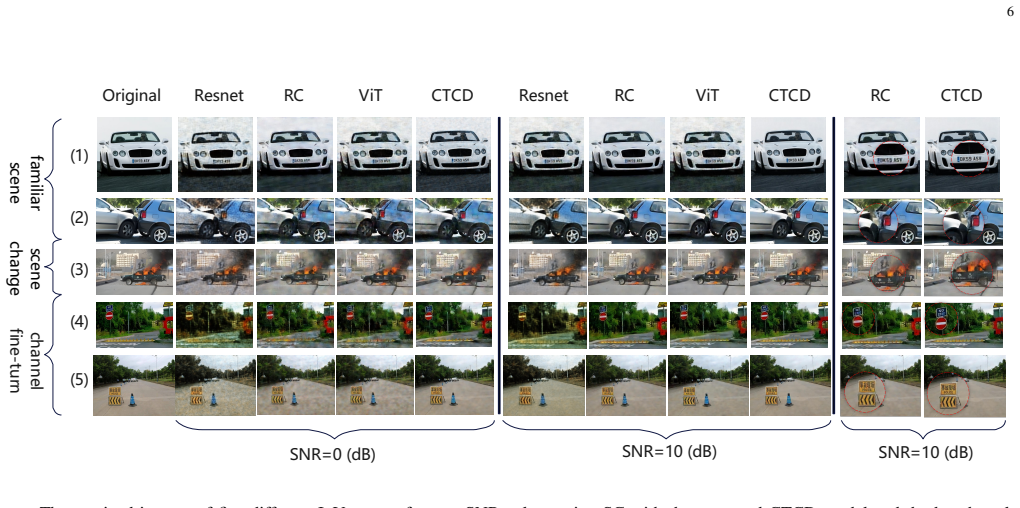
- [Section III, Figure 5] The qualitative visualization uses only selected image examples and does not provide aggregated quantitative results; the claim that CTCD is 'superior to all benchmarks' is not substantiated by the sparse examples. Additionally, the description of rows (1)-(5) is ambiguous about which conditions apply to which images.
- [Section II.B.3] The route planning module is described only conceptually (sampling coordinates every kilometer, determining new scene, calculating optimal start time), but no algorithm, threshold, or evaluation of this module is given. Since the refinement scheduling is essential for the low-latency claim, this is a material gap.
minor comments (5)
- [Section II.B.3] There is a typo 'necessarym' in the text: 'whether refinement is necessarym and when'.
- [Section III] The phrase 'the performance of the our framework' should be corrected to 'the performance of our framework'.
- [Figure 4 caption] The caption contains 'PSINR' instead of 'PSNR'.
- [Figure 3(c)] The legend references 'SRIR' while the text mentions 'SRCNN' and 'DnCNN'; these abbreviations should be clarified and made consistent.
- [Section III] The paper would benefit from stating the SNR ranges and the specific DeepMIMO scenarios (e.g., O1, I2) used for training and testing the channel estimation models.
Circularity Check
No significant circularity: the paper is an empirical system proposal whose claims rest on experiments, not on a derivation that reduces to its own inputs.
full rationale
The paper's nominal derivation chain is not a derivation: Sections II and III describe an architecture and an empirical evaluation. The semantic codec follows the Lite-mono CNN-Transformer design (ref [15]), the channel estimator is a conditional DDPM, and the refinement step uses GPT-2 trained on DeepMIMO. None of these components is claimed to follow from a theorem or from a prior result by the same authors in a way that would force the reported PSNR/SSIM numbers. The reported gains in Figs. 3 and 4 are measurements, not quantities obtained by substituting values into equations, so there is no self-definitional reduction. The only self-citations (e.g., ref [1] for edge intelligence in 6G) are background and are not load-bearing for the CTCD claim; no uniqueness theorem is invoked. The GPT-2/DeepMIMO refinement experiment in Section III and Fig. 4 is under-specified (no tokenization or fine-tuning objective, no explicit held-out-scene split), which is a data-hygiene and reproducibility concern, but an under-specified experiment is not a circular argument: the paper never defines the new-scene improvement as a fitted parameter renamed as a prediction. Under the hard rules, no circular step can be exhibited with quotation, so the appropriate verdict is no significant circularity.
Assumptions & free parameters
free parameters (4)
- CNN-Transformer semantic codec weights =
not reported
- Conditional diffusion channel estimator weights =
not reported
- GPT-2 fine-tuning weights =
not reported
- Route planning sampling interval and new-scene threshold =
not reported
assumptions (5)
- domain assumption Denoising diffusion probabilistic models produce accurate CSI when conditioned on pilot signals.
- domain assumption DeepMIMO channel data is representative of dynamic IoV propagation scenes, including scene changes.
- domain assumption PSNR and SSIM are adequate proxies for semantic communication quality in IoV image transmission.
- ad hoc to paper Route planning can predict scene changes early enough to schedule fine-tuning.
- ad hoc to paper GPT-2 is a suitable architecture for processing and generating CSI data.
Cite this review
Pith. "Pith review of AI-Empowered Channel Generation for IoV Semantic Communications in Dynamic Conditions." pith.science (2026). https://pith.science/paper/45WC7TY2
@misc{pith2026250702013,
  author       = {Pith},
  title        = {Pith review of: AI-Empowered Channel Generation for IoV Semantic Communications in Dynamic Conditions},
  year         = {2026},
  howpublished = {\url{https://pith.science/paper/45WC7TY2}},
  note         = {Machine review of arXiv:2507.02013}
}
read the original abstract
The Internet of Vehicles (IoV) transforms the transportation ecosystem promising pervasive connectivity and data-driven approaches. Deep learning and generative Artificial Intelligence (AI) have the potential to significantly enhance the operation of applications within IoV by facilitating efficient decision-making and predictive capabilities, including intelligent navigation, vehicle safety monitoring, accident prevention, and intelligent traffic management. Nevertheless, efficiently transmitting and processing the massive volumes of data generated by the IoV in real-time remains a significant challenge, particularly in dynamic and unpredictable wireless channel conditions. To address these challenges, this paper proposes a semantic communication framework based on channel perception to improve the accuracy and efficiency of data transmission. The semantic communication model extracts and compresses the information to be transmitted. In addition, the wireless channel is estimated by using a generative diffusion model, which is employed to predict the dynamic channel states, thereby improving the quality of IoV service. In dynamic scenarios, however, the channel estimation performance may be degraded when substantially new scenarios take place, which will adversely affect user experience. To mitigate this limitation, we employ a large model to fine-tune the channel generation model to enhance its adaptability for varying scenarios. The performance and reliability of the proposed framework are evaluated on the two public datasets.
Figures


Figures from the paper (3 more)


Reference graph
Works this paper leans on
-
[1]
Edge intelligence for autonomous driving in 6G wireless system: Design challenges and solutions,
B. Yang, X. Cao, K. Xiong, C. Yuen, Y . L. Guan, S. Leng, L. Qian, and Z. Han, “Edge intelligence for autonomous driving in 6G wireless system: Design challenges and solutions,” IEEE Wireless Commun. , vol. 28, no. 2, pp. 40–47, 2021
work page 2021
-
[2]
Semantic communications for future internet: Fundamentals, applications, and challenges,
W. Yang, H. Du, Z. Q. Liew, W. Y . B. Lim, Z. Xiong, D. Niyato, X. Chi, X. Shen, and C. Miao, “Semantic communications for future internet: Fundamentals, applications, and challenges,” IEEE Commun. Surveys & Tuts., vol. 25, no. 1, pp. 213–250, 2022
work page 2022
-
[3]
Deep joint source- channel coding for wireless image transmission,
E. Bourtsoulatze, D. B. Kurka, and D. G ¨und¨uz, “Deep joint source- channel coding for wireless image transmission,” IEEE Trans. Cogn. Commun. Netw., vol. 5, no. 3, pp. 567–579, 2019
2019
-
[4]
Deep joint source-channel coding for wireless image transmission with adaptive rate control,
M. Yang and H.-S. Kim, “Deep joint source-channel coding for wireless image transmission with adaptive rate control,” in Proc. IEEE ICASSP , Singapore, 2022, pp. 5193–5197
work page 2022
-
[5]
Transformer-aided wireless image transmission with channel feedback,
H. Wu, Y . Shao, E. Ozfatura, K. Mikolajczyk, and D. G ¨und¨uz, “Transformer-aided wireless image transmission with channel feedback,” IEEE Tran. Wireless Commun., vol. 23, no. 9, pp. 11 904–11 919, 2024. 7
work page 2024
-
[6]
Towards Intelligent Communications: Large Model Empowered Semantic Communications
H. Xie, Z. Qin, X. Tao, and Z. Han, “Towards intelligent commu- nications: Large model empowered semantic communications,” arXiv preprint arXiv:2402.13073, 2024
work page Pith review arXiv 2024
-
[7]
Large AI Model Empowered Multimodal Semantic Communications
F. Jiang, L. Dong, Y . Peng, K. Wang, K. Yang, C. Pan, and X. You, “Large AI model empowered multimodal semantic communications,” arXiv preprint arXiv:2309.01249 , 2023
work page Pith review arXiv 2023
-
[8]
Generative AI-aided joint training-free secure semantic communications via multi-modal prompts,
H. Du, G. Liu, D. Niyato, J. Zhang, J. Kang, Z. Xiong, B. Ai, and D. I. Kim, “Generative AI-aided joint training-free secure semantic communications via multi-modal prompts,” in Proc. IEEE ICASSP , Seoul, South Korea, 2024, pp. 12 896–12 900
work page 2024
Show all 15 references
-
[9]
Generative semantic communication: Diffusion models beyond bit recovery,
E. Grassucci, S. Barbarossa, and D. Comminiello, “Generative semantic communication: Diffusion models beyond bit recovery,” arXiv preprint arXiv:2306.04321, 2023
2023 arXiv
-
[10]
Unleashing the power of edge- cloud generative AI in mobile networks: A survey of AIGC services,
M. Xu, H. Du, D. Niyato, J. Kang, Z. Xiong, S. Mao, Z. Han, A. Jamalipour, D. I. Kim, X. Shen et al., “Unleashing the power of edge- cloud generative AI in mobile networks: A survey of AIGC services,” IEEE Commun. Surveys & Tuts. , vol. 26, no. 2, pp. 1127–1170, 2024
2024
-
[11]
Deep learning-based channel estimation,
M. Soltani, V . Pourahmadi, A. Mirzaei, and H. Sheikhzadeh, “Deep learning-based channel estimation,” IEEE Commun. Lett., vol. 23, no. 4, pp. 652–655, 2019
2019
-
[12]
LSTM-GRU model-based chan- nel prediction for one-bit massive MIMO system,
I. Helmy, P. Tarafder, and W. Choi, “LSTM-GRU model-based chan- nel prediction for one-bit massive MIMO system,” IEEE Trans. Veh. Technol., vol. 72, no. 8, pp. 11 053–11 057, 2023
2023
-
[13]
Transformer-based channel prediction for rate-splitting multiple access- enabled vehicle-to-everything communication,
S. Zhang, S. Zhang, Y . Mao, L. K. Yeung, B. Clerckx, and T. Q. S. Quek, “Transformer-based channel prediction for rate-splitting multiple access- enabled vehicle-to-everything communication,” IEEE Trans. Wireless Commun., vol. 23, no. 10, pp. 12 717–12 730, 2024
2024
-
[14]
Large generative model assisted 3D semantic communication,
F. Jiang, Y . Peng, L. Dong, K. Wang, K. Yang, C. Pan, and X. You, “Large generative model assisted 3D semantic communication,” arXiv preprint arXiv:2403.05783, 2024
2024 arXiv
-
[15]
Lite-mono: A lightweight cnn and transformer architecture for self-supervised monoc- ular depth estimation,
N. Zhang, F. Nex, G. V osselman, and N. Kerle, “Lite-mono: A lightweight cnn and transformer architecture for self-supervised monoc- ular depth estimation,” in Proc. IEEE/CVF Conf. Computer Vision Pattern Recogn., Vancouver, Canada, 2023, pp. 18 537–18 546. Hao Liu (IEEE Stude...
2023
Reviewed August 6, 2026 · model on record in the stance chip above.
Discussion (0). Continue with ORCID to comment.