DPD-KAN: Kolmogorov-Arnold Networks for Low Complexity Digital Predistortion in 5G Analog Radio-over-Fiber Systems
Pith reviewed 2026-06-26 13:43 UTC · model grok-4.3
The pith
Kolmogorov-Arnold Networks deliver lower error vector magnitude at reduced bit operations for digital predistortion in 5G radio-over-fiber systems.
A machine-rendered reading of the paper's core claim, the machinery that carries it, and where it could break.
Core claim
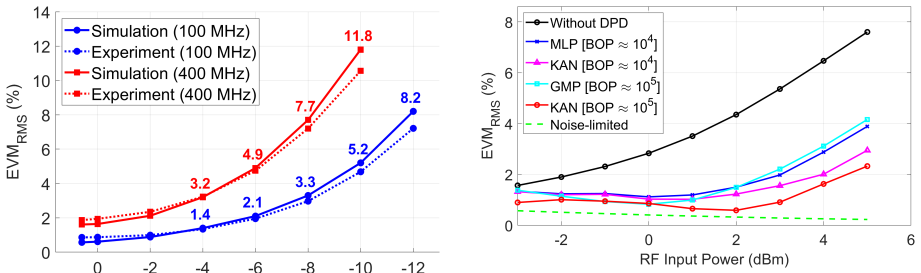
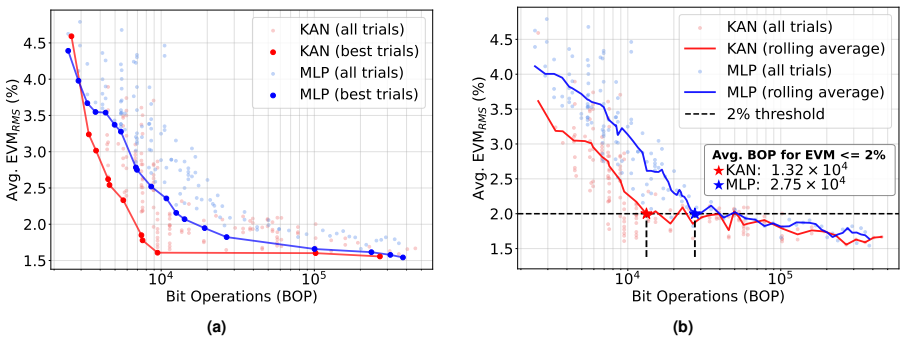
The central claim is that a Kolmogorov-Arnold Network-based digital predistortion model for 5G analog RoF fronthaul achieves better EVM performance at equivalent bit-operation complexity than both multi-layer perceptron and generalized memory polynomial models, and requires substantially fewer bit operations to meet the EVM threshold of 2 percent.
What carries the argument
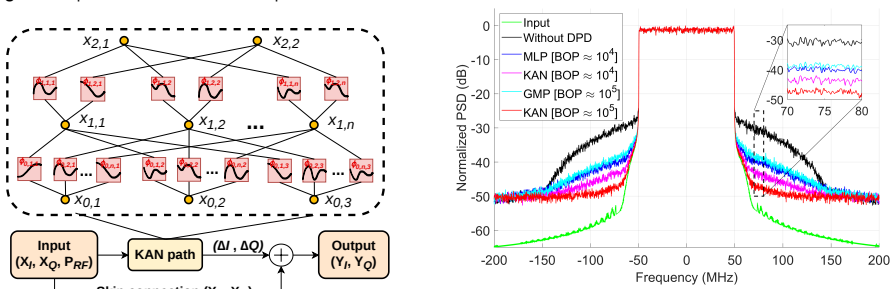
Kolmogorov-Arnold Network (KAN) applied to digital predistortion, where the network's edge functions are learned to compensate for nonlinear distortions in the analog RoF link.
If this is right
- KAN DPD reaches EVM below 2% using about 52% fewer bit operations than perceptron DPD.
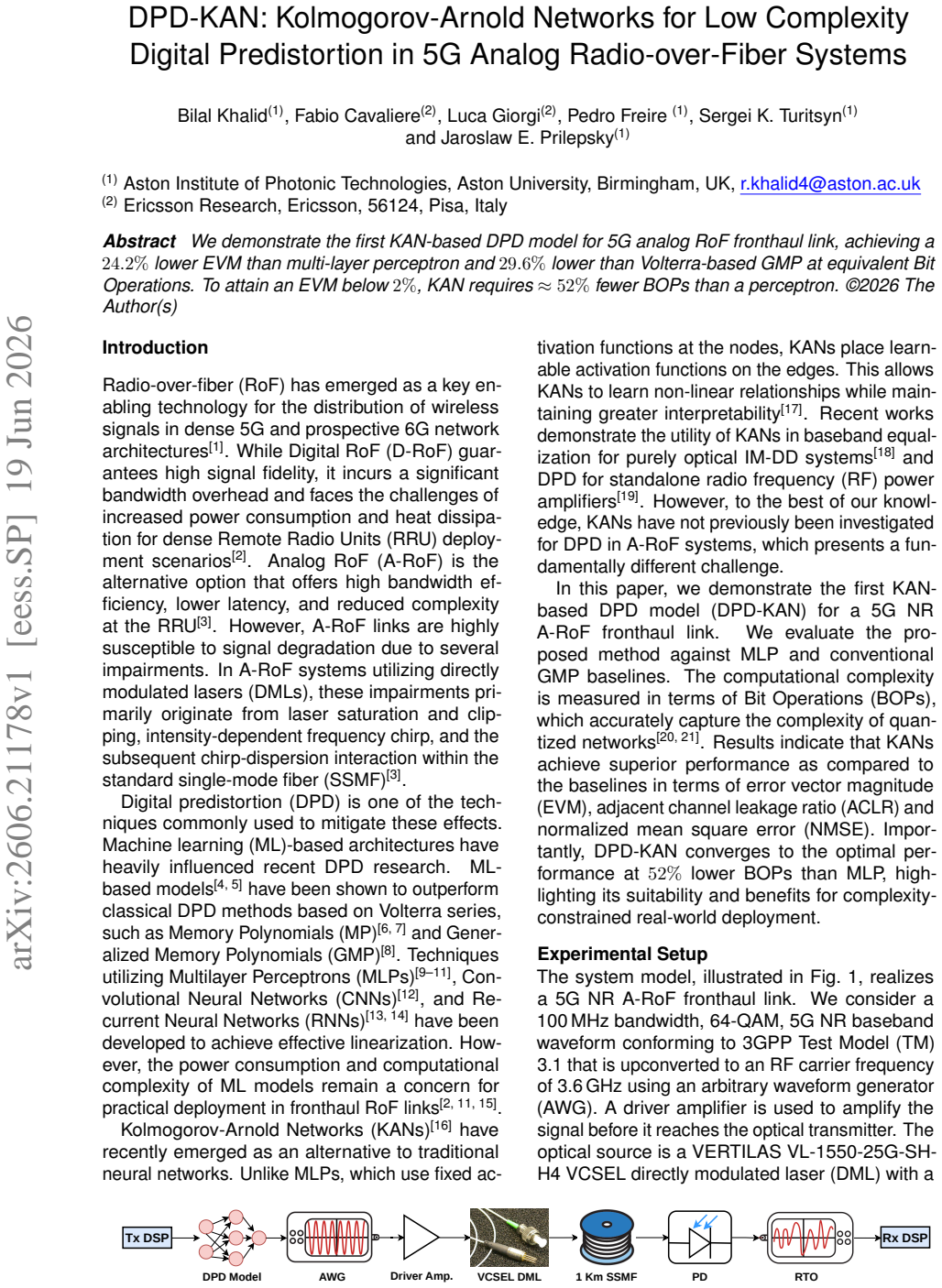
- At the same bit operations count, KAN yields 24.2% lower EVM than MLP and 29.6% lower than GMP.
- The first demonstration of KAN in this 5G RoF DPD context opens a path to lower-complexity predistorters.
- Performance gains hold when training and test conditions remain identical across compared models.
Where Pith is reading between the lines
- If bit operations correlate with actual FPGA or ASIC costs, KAN could reduce power draw in fronthaul equipment.
- KAN structures might apply to predistortion in other nonlinear channels such as satellite or optical wireless links.
- Further work could test whether the advantage persists when models are optimized independently for each architecture.
Load-bearing premise
The bit-operations count accurately represents end-to-end hardware cost on the target platform, and all models use identical training and test data.
What would settle it
Hardware implementation on the target FPGA showing that the measured power consumption or resource utilization for KAN does not reflect the predicted 52 percent reduction in operations when EVM is kept below 2 percent.
Figures
read the original abstract
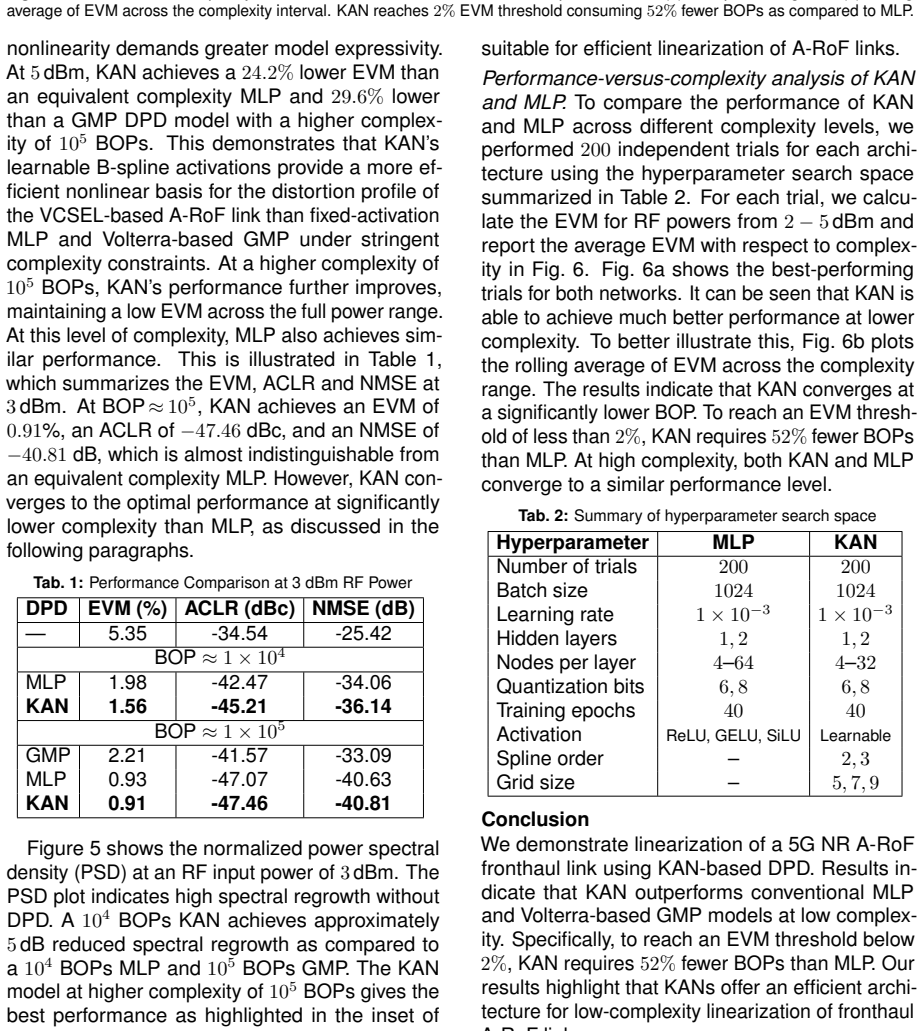
We demonstrate the first KAN-based DPD model for 5G analog RoF fronthaul link, achieving a 24.2% lower EVM than multi-layer perceptron and 29.6% lower than Volterra-based GMP at equivalent Bit Operations. To attain an EVM below 2%, KAN requires ~52% fewer BOPs than a perceptron.
Editorial analysis
A structured set of objections, weighed in public.
Referee Report
Summary. The manuscript introduces DPD-KAN, the first Kolmogorov-Arnold Network (KAN) based digital predistortion (DPD) model for 5G analog Radio-over-Fiber fronthaul links. It reports that, at equivalent Bit Operations (BOP), the KAN model achieves 24.2% lower EVM than a multi-layer perceptron (MLP) and 29.6% lower EVM than a Volterra-based generalized memory polynomial (GMP). It further claims that KAN requires ~52% fewer BOPs than an MLP to reach EVM below 2%.
Significance. If the BOP equivalence and performance deltas are shown to be robust, the work would demonstrate a practically relevant complexity-performance trade-off improvement for DPD in RoF systems. The application of KANs to this domain is novel and could motivate further exploration of spline-based models for hardware-constrained linearization tasks.
major comments (2)
- [§4 and abstract] §4 (Complexity Analysis) and abstract: the central ranking of KAN vs. MLP vs. GMP rests on 'equivalent Bit Operations.' The BOP definition counts spline coefficients or a fixed multiplier per activation but does not enumerate the per-sample arithmetic for knot lookup, B-spline basis evaluation (multiple multiplies/adds per grid point), and summation. Because this cost model is used to declare the 24.2%, 29.6%, and 52% advantages, an incomplete accounting directly undermines the headline claims.
- [§5 and abstract] §5 (Results) and abstract: no information is supplied on training-set size, validation/test splits, number of independent runs, or statistical error bars on the reported EVM values. Without these, the quantitative deltas cannot be assessed for reproducibility or significance.
minor comments (2)
- [§3] Notation for the KAN grid size and spline order should be defined once in §3 and used consistently in the complexity formulas.
- [Figures 4-6] Figure captions for the EVM-vs-BOP curves should explicitly state the exact BOP formula applied to each model.
Simulated Author's Rebuttal
We thank the referee for the constructive feedback on our manuscript. We address each major comment below and commit to revisions that strengthen the presentation of the complexity model and experimental reproducibility.
read point-by-point responses
-
Referee: [§4 and abstract] §4 (Complexity Analysis) and abstract: the central ranking of KAN vs. MLP vs. GMP rests on 'equivalent Bit Operations.' The BOP definition counts spline coefficients or a fixed multiplier per activation but does not enumerate the per-sample arithmetic for knot lookup, B-spline basis evaluation (multiple multiplies/adds per grid point), and summation. Because this cost model is used to declare the 24.2%, 29.6%, and 52% advantages, an incomplete accounting directly undermines the headline claims.
Authors: We agree that the BOP accounting in §4 is incomplete and does not fully capture the arithmetic operations required for B-spline basis evaluation, knot lookup, and summation. The current model was intended as a first-order approximation focused on coefficient multiplications, but this simplification affects the validity of the reported performance deltas. In the revised manuscript we will expand the complexity analysis to enumerate these per-sample costs explicitly, recompute the equivalent BOP figures for KAN, MLP, and GMP, and update the abstract and §4 accordingly. This may result in adjusted numerical claims but will provide a more defensible comparison. revision: yes
-
Referee: [§5 and abstract] §5 (Results) and abstract: no information is supplied on training-set size, validation/test splits, number of independent runs, or statistical error bars on the reported EVM values. Without these, the quantitative deltas cannot be assessed for reproducibility or significance.
Authors: We acknowledge that the experimental protocol details were omitted from §5. The revised manuscript will report the training-set size, the train/validation/test split ratios, the number of independent runs performed, and statistical error bars (standard deviation across runs) on all EVM values. These additions will be placed in §5 and referenced in the abstract where the quantitative claims appear. revision: yes
Circularity Check
No significant circularity in derivation chain
full rationale
The paper reports empirical performance comparisons (EVM and BOP counts) between a KAN-based DPD model and baselines (MLP, GMP) on 5G RoF data. No equations, fitted parameters, or self-citations are presented in the provided text that reduce the headline claims to inputs by construction. The BOP metric is an explicit complexity proxy chosen by the authors; its application to rank models does not match any enumerated circularity pattern (self-definitional, fitted-input-as-prediction, load-bearing self-citation, etc.). The central results remain externally falsifiable via independent implementation on the same dataset and hardware model. This is the expected non-finding for an applied ML comparison paper whose claims rest on measured outcomes rather than closed-form derivation.
Axiom & Free-Parameter Ledger
Reference graph
Works this paper leans on
-
[1]
Past and future development of radio- over-fiber
C. Lim et al., “Past and future development of radio- over-fiber”,Journal of Lightwave Technology, vol. 43, no. 4, pp. 1525–1541, 2025.DOI: 10.1109/JLT.2024. 3485129
-
[2]
Microwave and high-speed pho- tonics applications to 6g systems
R. Sabella, A. Bigongiari, F . Cavaliere, A. D’Errico, L. Giorgi, and S. Stracca, “Microwave and high-speed pho- tonics applications to 6g systems”,Journal of Lightwave Technology, vol. 43, no. 21, pp. 9775–9792, Nov. 2025. [Online]. Available: https : / / opg . optica . org / jlt / abstract.cfm?URI=jlt-43-21-9775
2025
-
[3]
Performance improvement and cost reduction techniques for radio over fiber communications
V. A. Thomas, M. El-Hajjar, and L. Hanzo, “Performance improvement and cost reduction techniques for radio over fiber communications”,IEEE Communications Sur- veys & Tutorials, vol. 17, no. 2, pp. 627–670, 2015.DOI: 10.1109/COMST.2015.2394911
-
[4]
Digital predistortion for lin- earity improvement of vcsel-ssmf-based radio-over-fiber links
M. U. Hadi, P . A. Traverso, G. Tartarini, O. Venard, G. Baudoin, and J.-L. Polleux, “Digital predistortion for lin- earity improvement of vcsel-ssmf-based radio-over-fiber links”,IEEE Microwave and Wireless Components Let- ters, vol. 29, no. 2, pp. 155–157, 2019.DOI: 10.1109/ LMWC.2018.2889004
arXiv 2019
-
[5]
Neural network dpd for aggrandizing sm-vcsel- ssmf-based radio over fiber link performance
M. U. Hadi, M. Awais, M. Raza, K. Khurshid, and H. Jung, “Neural network dpd for aggrandizing sm-vcsel- ssmf-based radio over fiber link performance”,Photon- ics, vol. 8, no. 1, 2021,ISSN: 2304-6732.DOI: 10.3390/ photonics8010019 [Online]. Available: https : / / www . mdpi.com/2304-6732/8/1/19
2021
-
[6]
A robust digital baseband predistorter constructed using memory polynomials
L. Ding et al., “A robust digital baseband predistorter constructed using memory polynomials”,IEEE Transac- tions on Communications, vol. 52, no. 1, pp. 159–165, 2004.DOI:10.1109/TCOMM.2003.822188
-
[7]
Real-Time Depth From Focus on a Programmable Focal Plane Processor
A. Hekkala et al., “Predistortion of radio over fiber links: Algorithms, implementation, and measurements”,IEEE Transactions on Circuits and Systems I: Regular Papers, vol. 59, no. 3, pp. 664–672, 2012.DOI: 10.1109/TCSI. 2011.2167267
-
[8]
A generalized memory polynomial model for digital pre- distortion of rf power amplifiers
D. Morgan, Z. Ma, J. Kim, M. Zierdt, and J. Pastalan, “A generalized memory polynomial model for digital pre- distortion of rf power amplifiers”,IEEE Transactions on Signal Processing, vol. 54, no. 10, pp. 3852–3860, 2006. DOI:10.1109/TSP.2006.879264
-
[9]
Machine learning-based linearization schemes for radio over fiber systems
L. A. M. Pereira, L. L. Mendes, C. J. A. Bastos-Filho, and A. C. S. Jr, “Machine learning-based linearization schemes for radio over fiber systems”,IEEE Photonics Journal, vol. 14, no. 6, pp. 1–10, 2022.DOI: 10.1109/ JPHOT.2022.3210454
arXiv 2022
-
[10]
Nonlinear compensation using artificial neural network in radio-over-fiber system
A. C. Najarro and S.-M. Kim, “Nonlinear compensation using artificial neural network in radio-over-fiber system”, Journal of Information & Communication Convergence Engineering, vol. 16, no. 1, pp. 1–5, 2018
2018
-
[11]
C. D. Fontes da Silva and E. Porto da Silva, “Perfor- mance vs complexity analysis of neural network and memory polynomial-based dpd for a-rof fronthaul”, in 2025 SBMO/IEEE MTT -S International Microwave and Optoelectronics Conference (IMOC), 2025, pp. 1–5.DOI: 10.1109/IMOC65414.2025.11365761
-
[12]
Practical demonstration of 5g nr transport over-fiber system with convolutional neural network
M. U. Hadi, “Practical demonstration of 5g nr transport over-fiber system with convolutional neural network”, Telecom, vol. 3, no. 1, pp. 103–117, 2022,ISSN: 2673- 4001.DOI: 10 . 3390 / telecom3010006[Online]. Avail- able:https://www.mdpi.com/2673-4001/3/1/6
2022
-
[13]
Amplified radio-over-fiber system lineariza- tion using recurrent neural networks
L. A. M. Pereira, L. L. Mendes, C. J. A. B. Filho, and A. C. Sodré, “Amplified radio-over-fiber system lineariza- tion using recurrent neural networks”,Journal of Optical Communications and Networking, vol. 15, no. 3, pp. 144– 154, Mar. 2023.DOI: 10.1364/JOCN.474290 [Online]. Available: https://opg.optica.org/jocn/abstract. cfm?URI=jocn-15-3-144
-
[14]
M. U. Hadi, K. U. Danyaro, A. AlQushaibi, R. Qureshi, and T. Alam, “Digital predistortion based experimen- tal evaluation of optimized recurrent neural network for 5g analog radio over fiber links”,IEEE Access, vol. 12, pp. 19 765–19 777, 2024.DOI: 10.1109/ACCESS.2024. 3360298
-
[15]
Machine learning techniques in radio-over-fiber systems and net- works
J. He, J. Lee, S. Kandeepan, and K. Wang, “Machine learning techniques in radio-over-fiber systems and net- works”,Photonics, vol. 7, no. 4, 2020,ISSN: 2304-6732. DOI: 10 . 3390 / photonics7040105[Online]. Available: https://www.mdpi.com/2304-6732/7/4/105
2020
-
[16]
KAN: Kolmogorov–arnold networks
Z. Liu et al., “KAN: Kolmogorov–arnold networks”, in The Thirteenth International Conference on Learning Representations, 2025. [Online]. Available: https:// openreview.net/forum?id=Ozo7qJ5vZi
2025
-
[17]
A survey on kolmogorov-arnold network
S. Somvanshi, S. A. Javed, M. M. Islam, D. Pandit, and S. Das, “A survey on kolmogorov-arnold network”,ACM Comput. Surv., vol. 58, no. 2, Sep. 2025,ISSN: 0360- 0300.DOI: 10.1145/3743128 [Online]. Available: https: //doi.org/10.1145/3743128
-
[18]
Kolmogorov-arnold network for efficient equalization in short-reach im/dd systems
C. Chen et al., “Kolmogorov-arnold network for efficient equalization in short-reach im/dd systems”,Opt. Ex- press, vol. 33, no. 16, pp. 33 139–33 152, Aug. 2025. DOI: 10 . 1364 / OE . 566194[Online]. Available: https : //opg.optica.org/oe/abstract.cfm?URI=oe- 33- 16-33139
2025
-
[19]
Real- valued time delay kolmogorov-arnold network for digital predistortion of rf power amplifiers
J. Chen, Y . Lv, W. Zhao, L. Xin, G. Xu, and T. Liu, “Real- valued time delay kolmogorov-arnold network for digital predistortion of rf power amplifiers”, in2025 Interna- tional Conference on Microwave and Millimeter Wave Technology (ICMMT), 2025, pp. 1–3.DOI: 10 . 1109 / ICMMT65948.2025.11188977
arXiv 2025
-
[20]
Computational complexity optimization of neural network-based equalizers in digital signal pro- cessing: A comprehensive approach
P . Freire et al., “Computational complexity optimization of neural network-based equalizers in digital signal pro- cessing: A comprehensive approach”,Journal of Light- wave Technology, vol. 42, no. 12, pp. 4177–4201, 2024
2024
-
[21]
B. Khalid, P . Freire, S. K. Turitsyn, and J. E. Prilepsky, Hardware-oriented inference complexity of kolmogorov- arnold networks, 2026. arXiv:2604.03345 [cs.LG]. [On- line]. Available:https://arxiv.org/abs/2604.03345
Pith/arXiv arXiv 2026
-
[22]
Mopa re- quirements and blueprints v26a
Mobile Optical Pluggables Alliance (MOPA), “Mopa re- quirements and blueprints v26a”, Tech. Rep., Mar. 2025, p. 22. [Online]. Available: https : / / mopa - alliance . org/wp- content/uploads/MOPA_Technical_Paper_ Requirements_and_Blueprints_26a_Final.pdf
2025
-
[23]
Cavaliere,Centralization vs
F . Cavaliere,Centralization vs. disaggregation in 5g and 6g radio access: The role of photonics, presented at the 51st European Conference on Optical Communication (ECOC), Copenhagen, Denmark, [Online]. Available: https : / / www . ecocexhibition . com / wp - content / uploads / Wed - 1120 - ECOC - 2025 - Fabio - Cavaliere - presentation.pdf, Oct. 2025
2025
-
[24]
A new volterra predistorter based on the indirect learning architecture
C. Eun and E. Powers, “A new volterra predistorter based on the indirect learning architecture”,IEEE Trans- actions on Signal Processing, vol. 45, no. 1, pp. 223– 227, 1997.DOI:10.1109/78.552219
discussion (0)
Sign in with ORCID, Apple, or X to comment. Anyone can read and Pith papers without signing in.