REVIEW 3 major objections 5 minor 112 references
Robustness in Sequential Decision Making under Evolving Uncertainty: Evidence from High-Frequency Market Making
T0 review · 3 major / 5 minor · reviewed 2026-07-10 · grok-4.5
Pith's one-line read In high-frequency market making, how you respond to uncertainty reshapes quoting more than how much uncertainty you admit.
desk verdict Clean two-knob robustness story for HFT market making with solid directional evidence that δ dominates ε̄ and liquidity modulates value; the shared exponential fill model is a real but disclosed soft spot, not a collapse of the claim. read the letter →
The pith
A machine-rendered reading of the paper's core claim, the machinery that carries it, and where it could break.
The reading
What carries the argument
Sinkhorn-based ambiguity sets around a reference transition law, dualized into a robust Bellman operator whose two parameters (shifted radius ¯ε and entropic regularisation δ) separately control uncertainty tolerance and action robustness; the resulting fitted actor–critic learns adaptive bid/ask spreads and quantities under that operator.
What would settle it
Re-estimate fill rates from the same order-book data under an adverse-selection or multi-agent model; if the liquidity ranking of robust versus non-robust Sharpe ratios reverses or disappears once fills deviate from the exponential form, the claim that action robustness is the dominant and liquidity-dependent lever is falsified.
Extended reading notes
Core claim
Robustness in sequential market making has two economically distinct dimensions—uncertainty tolerance (how much model deviation is admitted) and action robustness (how conservatively decisions respond inside the admitted set)—and action robustness exerts a substantially larger effect on quoting, inventory paths and risk-adjusted performance. Robustness therefore reshapes the state-to-action map itself rather than merely protecting terminal P&L, and its net value is positive mainly when execution opportunities remain plentiful.
Load-bearing premise
Fill probabilities are treated as known exponential functions of quoted distance that are identical in simulation and on real data and independent of adverse selection or competing market makers.
Editorial analysis
A structured set of objections, weighed in public.
Referee Report
Summary. The paper develops a distributionally robust RL framework for high-frequency market making that places Sinkhorn ambiguity sets on the stochastic innovation law of a finite-horizon MDP. It decomposes robustness into two parameters: a shifted radius ¯ε (uncertainty tolerance, size of the ambiguity set) and an entropic regularization δ (action robustness, how the worst-case measure is tilted). A dual Sinkhorn Bellman operator yields a fitted actor–critic algorithm. Simulation under six modular stress regimes and a 2×2 empirical design (AAPL/TSLA/MKC/TWLO × 2019 vs COVID-2020) are used to argue that (i) robustness reshapes state-dependent quoting and inventory paths rather than only terminal metrics, (ii) δ has a substantially larger behavioral and performance impact than ¯ε, and (iii) robustness improves risk-adjusted outcomes mainly in liquid markets and can reduce profitability when execution opportunities are scarce.
Significance. If the two-dimensional robustness interpretation and the liquidity-dependent value of robustness hold under more realistic execution, the paper would give practitioners separate, economically interpretable levers for model risk versus decision conservatism, and would push robust RL beyond one-parameter worst-case guarantees. Strengths include a clean deterministic/stochastic state split, an explicit dual Bellman form with value-iteration contraction, modular stress scenarios that isolate distinct misspecifications, a held-out COVID distribution-shift design, and extensive policy diagnostics (intraday paths, state-conditional maps, Pareto frontiers). The contribution is therefore potentially useful for both robust sequential decision theory and market-microstructure practice, provided the main comparative claims are more tightly quantified and stress-tested against the shared fill map.
major comments (3)
- [Appendix A.1.4; §4.2; Table 3; §5] Appendix A.1.4 and the empirical protocol: executed quantities in both simulation and real-data evaluation are generated from the same exponential fill map λ = A e^{−κδ} (and the same square-root terminal liquidation). Section 5 correctly lists adverse selection, competing makers, and depth-dependent fills as limitations, but the central claims—that δ dominates ¯ε and that excessive robustness “limits execution opportunities” in illiquid names (abstract, §4.2, Table 3)—are conditioned on this fixed fill map. Because the Sinkhorn adversary only perturbs innovations around that map, comparative rankings of (¯ε, δ) and the liquidity interaction may be artifacts of fill misspecification. At minimum the paper should re-evaluate greedy vs robust policies under alternative fill specifications (e.g., depth-dependent or adverse-selection-adjusted fills) or show that the δ-vs-¯ε ranking and the HL
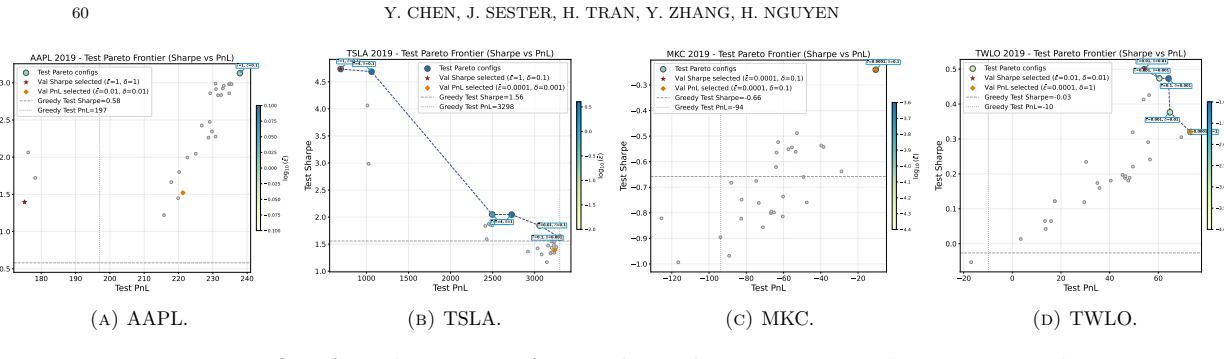
- [§4.1.1–4.1.2; Table 1; Figure 1; Appendix B heatmaps] The claim that “action robustness has a substantially larger impact than uncertainty tolerance” (abstract, finding (2), §4.1.2) rests mainly on visual comparison of four (¯ε, δ) corners in Figure 1 and qualitative reading of heatmaps (Figs. 5–6, 23–24). Table 1 further reports that the same two pairs—(0.0001, 0.1) for Val PnL and (4, 1) for Val Sharpe—are selected in all six simulation scenarios, which weakens the claim of state-dependent calibration and makes the δ-dominance story look like a corner-effect of the grid. A load-bearing revision should quantify the relative contribution of δ versus ¯ε (e.g., partial derivatives of policy/performance along each axis, ANOVA-style decomposition over the full grid, or hold-one-fixed sweeps with confidence bands) rather than relying on four labeled policies and identical selected pairs across environments.
- [§4.2.1; Table 3; Figures 4, 26–27] In the low-liquidity cells of Table 3 (MKC LL–LV, TWLO LL–HV), robust policies often improve P&L or MDD modestly but leave Sharpe near zero or negative (e.g., MKC 2020 Sharpe ≈ −0.7 to −0.8 across greedy and robust). The narrative that “excessive robustness may reduce profitability in illiquid markets by limiting execution opportunities” is therefore only partially supported: the paper shows weaker gains, not a clean demonstration that robustness itself rationed fills. Direct evidence—fill rates, participation rates, or opportunity counts by liquidity tier under high-δ policies—should be reported so that the mechanism is distinguished from simply “harder markets where no policy works well.”
minor comments (5)
- [§2.3.2; Table 1 notes] Notation for the shifted radius switches between ¯ε, ¯ε_{x,a}, and ϵ in tables/notes (e.g., Table 1 notes write (¯ϵ, δ)). Unify symbols and state once whether the reported grid is the shifted or original Sinkhorn radius.
- [Lemma 2.1; §2.2.2] Lemma 2.1 assumes martingale mid-price and fill–price independence; these are used to justify the additive reward but are not revisited when interpreting inventory risk under price stress. A short remark on when the decomposition fails would help.
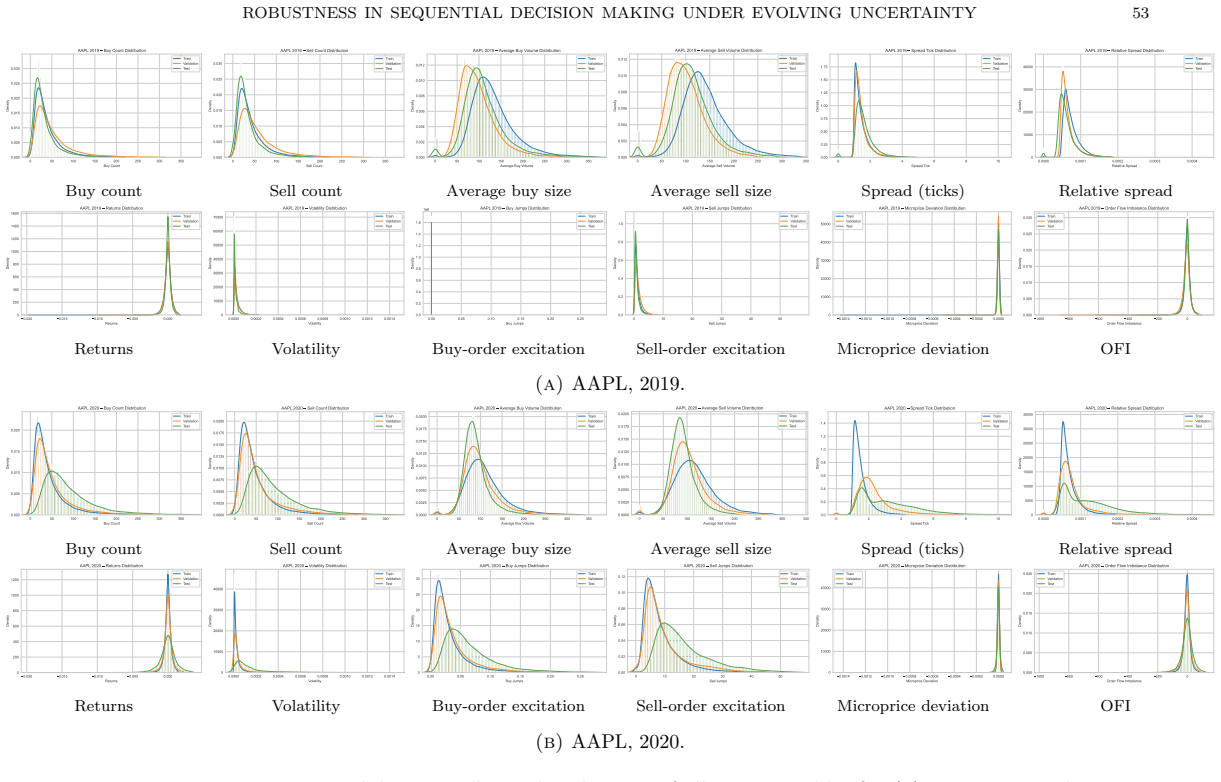
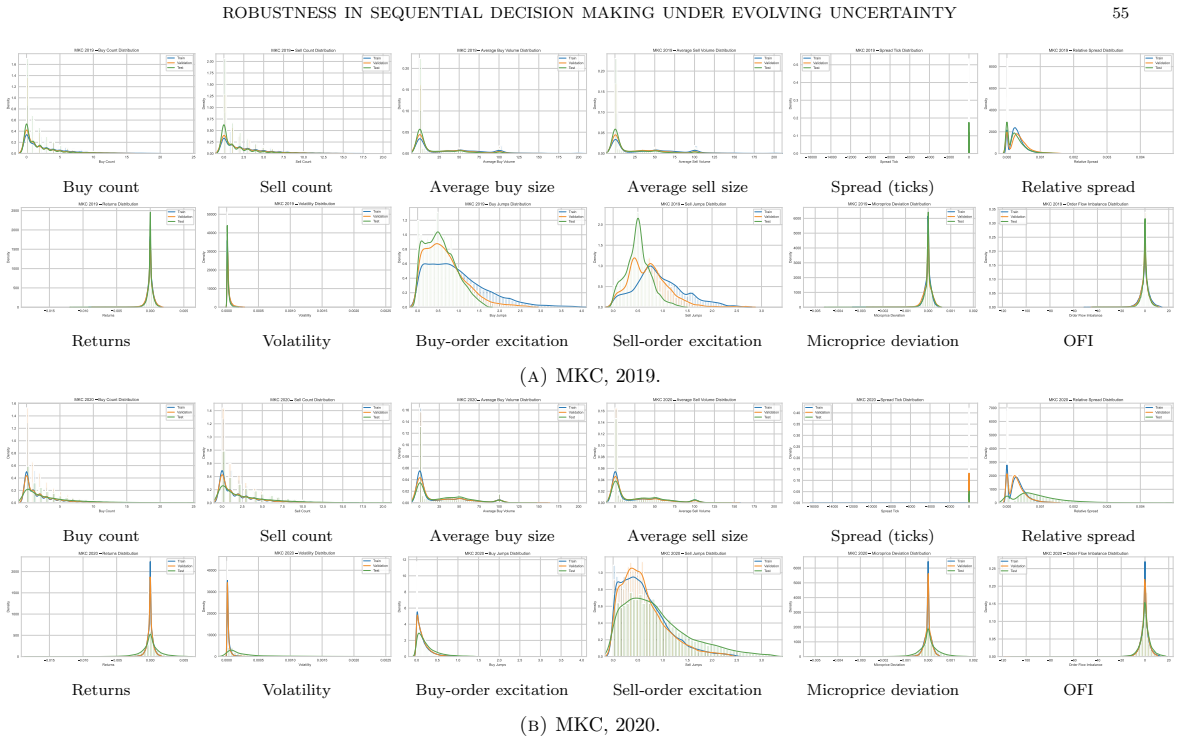
- [Appendices B–C] Several appendix figures (e.g., Shapley panels, distribution plots) are dense; consider moving a subset to an online supplement and keeping only the diagnostics that directly support δ-vs-¯ε and liquidity claims in the main text.
- [References; Appendix C.4] Typos and wording: “stategies” (Cartea–Jaimungal citation), “countvvgbherparts” in C.4, and occasional missing spaces around math. A careful copy-edit pass is needed.
- [§2.1.3; §3.2] Clarify early that order quantities are participation rates in [0,1] of contemporaneous volume (footnote in §2.1.3 / §3.2); some readers will otherwise misread absolute share sizes.
Circularity Check
No load-bearing circularity: ¯ε and δ are free Sinkhorn design parameters whose relative impact is measured out-of-sample, not forced by definition or self-citation.
full rationale
The paper’s central claims—that robustness has two economically distinct dimensions (uncertainty tolerance ¯ε vs action robustness δ), that δ has a substantially larger behavioral impact, and that excessive robustness can hurt in illiquid markets—are not derived by construction from their inputs. ¯ε and δ enter as free parameters of the Sinkhorn dual Bellman operator (Eqs. 2.26–2.29, Corollary 2.3); the paper then varies them on a grid and reports empirical/simulation differences in quoting, inventory, Sharpe, and P&L against held-out stress scenarios and real 2019/2020 LOB data (Tables 1–3, Figs. 1–4). Validation selection and out-of-sample test windows (including the COVID shift) are disclosed; the ranking “δ matters more than ¯ε” is a comparative static, not an identity. The shared exponential fill map (Appendix A.1.4) is a modeling assumption that can misspecify real LOBs, but that is a correctness risk, not circularity: fills are not fitted to the same performance metrics later reported as predictions. Self-citations (e.g., Lu–Sester–Zhang DRO RL) supply algorithmic background and are not used as uniqueness theorems that force the two-dimensional claim. The derivation chain is therefore self-contained against external benchmarks (greedy, AS, random, fixed); score 1 only for ordinary non-load-bearing self-reference in the methods lineage.
Assumptions & free parameters
free parameters (6)
- shifted Sinkhorn radius ¯ε (uncertainty tolerance)
- Sinkhorn regularization δ (action robustness)
- risk-aversion schedule γ_t and baseline γ
- fill intensity A and elasticity κ
- deep-ensemble size K, network widths, learning rates, discount α, look-back m
- liquidation impact factor η
assumptions (5)
- domain assumption One-step mid-price increments are martingale and fills are conditionally independent of price innovations (Lemma 2.1).
- standard math Strong duality for the Sinkhorn primal-dual pair holds under the stated cost and support conditions (Wang et al. 2025).
- domain assumption Reference transition is adequately captured by a deep ensemble of Gaussian/log-normal conditionals; ambiguity is only around the stochastic innovation.
- domain assumption Single representative market maker, no adverse selection, no competing liquidity providers.
- ad hoc to paper Exponential fill probability λ = A exp(−κδ) is the true execution mechanism for both simulation and real-data evaluation.
Cite this review
Pith. "Pith review of Robustness in Sequential Decision Making under Evolving Uncertainty: Evidence from High-Frequency Market Making." pith.science (2026). https://pith.science/paper/463REQGS
@misc{pith2026260708291,
  author       = {Pith},
  title        = {Pith review of: Robustness in Sequential Decision Making under Evolving Uncertainty: Evidence from High-Frequency Market Making},
  year         = {2026},
  howpublished = {\url{https://pith.science/paper/463REQGS}},
  note         = {Machine review of arXiv:2607.08291}
}
read the original abstract
We study sequential decision making under evolving uncertainty in high-frequency financial markets, where changing market dynamics continually challenge static decision policies. We show that robustness has two economically meaningful dimensions: uncertainty tolerance, which determines how much uncertainty the decision maker allows, and action robustness, which governs how conservatively decisions respond. Robustness is not merely protection against model misspecification, but a state-dependent mechanism that reshapes sequential decision behaviors. Simulation and empirical evidence show that action robustness has a substantially larger impact than uncertainty tolerance. Moreover, excessive robustness may reduce profitability in illiquid markets by limiting execution opportunities.
Figures


Figures from the paper (38 more)







Reference graph
Works this paper leans on
-
[1]
Mathematics and financial economics , volume=
Dealing with the inventory risk: a solution to the market making problem , author=. Mathematics and financial economics , volume=. 2013 , publisher=
work page 2013
- [2]
-
[3]
Applied Mathematical Finance , volume=
Deep reinforcement learning for market making in corporate bonds: beating the curse of dimensionality , author=. Applied Mathematical Finance , volume=. 2019 , publisher=
work page 2019
-
[4]
Mathematics of Operations Research , volume=
Distributionally robust stochastic optimization with Wasserstein distance , author=. Mathematics of Operations Research , volume=. 2023 , publisher=
work page 2023
-
[5]
Mathematical Programming , volume=
Data-driven distributionally robust optimization using the Wasserstein metric: Performance guarantees and tractable reformulations , author=. Mathematical Programming , volume=. 2018 , publisher=
work page 2018
-
[7]
Gašperov, Bruno and Kostanjčar, Zvonko , journal=. Deep Reinforcement Learning for Market Making Under a Hawkes Process-Based Limit Order Book Model , year=
-
[8]
The Review of Financial Studies , volume=
On the Sensitivity of Mean-Variance-Efficient Portfolios to Changes in Asset Means: Some Analytical and Computational Results , author=. The Review of Financial Studies , volume=
-
[9]
The Journal of Portfolio Management , volume=
The Effect of Errors in Means, Variances, and Covariances on Optimal Portfolio Choice , author=. The Journal of Portfolio Management , volume=
Show all 112 references
-
[10]
Journal of Financial Economics , volume=
Stock Return Predictability and Model Uncertainty , author=. Journal of Financial Economics , volume=
-
[11]
Applied Mathematical Finance , volume=
Pricing and Hedging Derivative Securities in Markets with Uncertain Volatilities , author=. Applied Mathematical Finance , volume=
-
[12]
Review of Economic Dynamics , volume=
Model Uncertainty and Liquidity , author=. Review of Economic Dynamics , volume=
-
[13]
Management Science , volume=
Robust Mean-Variance Portfolio Selection: A Distributionally Robust Optimization Approach , author=. Management Science , volume=
-
[14]
Acta Numerica , volume=
Distributionally robust optimization , author=. Acta Numerica , volume=. 2025 , publisher=
2025
-
[15]
Management Science , volume=
A Generalized Approach to Portfolio Optimization: Improving Performance by Constraining Portfolio Norms , author=. Management Science , volume=
-
[16]
Robust Control and Model Uncertainty , author=
-
[17]
Intraday market making with overnight inventory costs , journal =
Adrian,Tobias and Capponi, Agostino and Fleming, Michael and Vogt, Erik and Zhang, Hongzhong , keywords =. Intraday market making with overnight inventory costs , journal =. 2020 , issn =. doi:https://doi.org/10.1016/j.finmar.2020.100564 , url =
2020 doi
-
[18]
2013 , publisher=
Convergence of probability measures , author=. 2013 , publisher=
2013
-
[19]
2004 , publisher=
Probability essentials , author=. 2004 , publisher=
2004
-
[20]
Journal of the Operational Research Society , volume=
Dynamic programming and optimal control , author=. Journal of the Operational Research Society , volume=
-
[22]
2009 , publisher=
Optimal transport: old and new , author=. 2009 , publisher=
2009
-
[23]
Management Science , volume=
Distributionally robust mean-variance portfolio selection with Wasserstein distances , author=. Management Science , volume=. 2022 , publisher=
2022
-
[25]
Management Science , volume =
Chen, Ningyuan and Kou, Steven and Wang, Chun , title =. Management Science , volume =. 2018 , doi =. https://doi.org/10.1287/mnsc.2016.2639 , abstract =
2018 doi
-
[26]
Quantitative Finance , volume =
Avellaneda,Marco and Stoikov,Sasha , title =. Quantitative Finance , volume =. 2008 , publisher =
2008
-
[27]
2013 , issn =
Optimal trading strategy and supply/demand dynamics , journal =. 2013 , issn =. doi:https://doi.org/10.1016/j.finmar.2012.09.001 , author =
2013 doi
-
[28]
2013 , issn =
Dealing with the inventory risk: a solution to the market making problem , journal =. 2013 , issn =. doi:https://doi.org/10.1007/s11579-012-0087-0 , author =
2013 doi
-
[29]
Optimal Make-Take Fees in a Multi Market-Maker Environment , journal =
Baldacci, Bastien and Possama\". Optimal Make-Take Fees in a Multi Market-Maker Environment , journal =. 2021 , doi =
2021
-
[30]
Applied Mathematical Finance , volume =
Guéant,Olivier , title =. Applied Mathematical Finance , volume =. 2017 , publisher =
2017
-
[32]
Buy Low, Sell High: A High Frequency Trading Perspective , journal =
Cartea, \'. Buy Low, Sell High: A High Frequency Trading Perspective , journal =. 2014 , doi =
2014
-
[33]
Applied Mathematical Finance , volume =
Campi,Luciano and Zabaljauregui,Diego , title =. Applied Mathematical Finance , volume =. 2020 , publisher =
2020
-
[34]
Mathematical Finance , volume =
Guilbaud, Fabien and Pham, Huyên , title =. Mathematical Finance , volume =. doi:https://doi.org/10.1111/mafi.12042 , abstract =
-
[35]
Quantitative Finance , volume =
Guilbaud,Fabien and Pham,Huyên , title =. Quantitative Finance , volume =. 2013 , publisher =
2013
-
[36]
Proceedings of the 17th International Conference on Autonomous Agents and MultiAgent Systems , pages =
Spooner, Thomas and Fearnley, John and Savani, Rahul and Koukorinis, Andreas , title =. Proceedings of the 17th International Conference on Autonomous Agents and MultiAgent Systems , pages =. 2018 , publisher =
2018
-
[37]
Applied Mathematical Finance , volume =
Guéant,Olivier and Manziuk,Iuliia , title =. Applied Mathematical Finance , volume =. 2019 , publisher =
2019
-
[38]
Proceedings of the Twenty-Ninth International Joint Conference on Artificial Intelligence , articleno =
Spooner, Thomas and Savani, Rahul , title =. Proceedings of the Twenty-Ninth International Joint Conference on Artificial Intelligence , articleno =. 2021 , isbn =
2021
-
[39]
2019 , eprint=
Reinforcement Learning for Market Making in a Multi-agent Dealer Market , author=. 2019 , eprint=
2019
-
[40]
Online Robust Reinforcement Learning with Model Uncertainty , volume =
Wang, Yue and Zou, Shaofeng , booktitle =. Online Robust Reinforcement Learning with Model Uncertainty , volume =
-
[41]
Kernel-Based Reinforcement Learning in Robust
Lim, Shiau Hong and Autef, Arnaud , booktitle =. Kernel-Based Reinforcement Learning in Robust. 2019 , editor =
2019
-
[42]
Reinforcement Learning under Model Mismatch , url =
Roy, Aurko and Xu, Huan and Pokutta, Sebastian , booktitle =. Reinforcement Learning under Model Mismatch , url =
-
[43]
Proceedings of the 31st International Conference on Machine Learning , pages =
Scaling Up Robust MDPs using Function Approximation , author =. Proceedings of the 31st International Conference on Machine Learning , pages =. 2014 , editor =
2014
-
[44]
Robust Markov Decision Processes , journal =
Wiesemann, Wolfram and Kuhn, Daniel and Rustem, Ber. Robust Markov Decision Processes , journal =
-
[45]
Robust Markov Decision Processes: Beyond Rectangularity , journal =
Goyal, Vineet and Grand-Cl\'. Robust Markov Decision Processes: Beyond Rectangularity , journal =
-
[46]
and Singh, Sundeep and Moore, David , title =
Goh, Joel and Bayati, Mohsen and Zenios, Stefanos A. and Singh, Sundeep and Moore, David , title =. Operations Research , volume =
-
[47]
Mathematics of Operations Research , volume =
Xu, Huan and Mannor, Shie , title =. Mathematics of Operations Research , volume =
-
[48]
Strens, Malcolm J. A. , title =. Proceedings of the Seventeenth International Conference on Machine Learning , pages =. 2000 , isbn =
2000
-
[49]
, title =
Iyengar, Garud N. , title =. Mathematics of Operations Research , volume =
-
[50]
Operations Research , volume=
Robust control of Markov decision processes with uncertain transition matrices , author=. Operations Research , volume=. 2005 , publisher=
2005
-
[51]
Neural computation , volume=
Robust reinforcement learning , author=. Neural computation , volume=. 2005 , publisher=
2005
-
[52]
and Border, Kim C
Aliprantis, Charalambos D. and Border, Kim C. , TITLE =. 2006 , PAGES =
2006
-
[53]
High Frequency Traders and Asset Prices , journal =
Cvitanic, Jaksa and Kirilenko, Andrei , year =. High Frequency Traders and Asset Prices , journal =
-
[54]
Quantitative Finance , volume =
Marcello Rambaldi and Emmanuel Bacry and Fabrizio Lillo , title =. Quantitative Finance , volume =. 2017 , publisher =
2017
-
[55]
Market Making With Signals Through Deep Reinforcement Learning , year=
Gašperov, Bruno and Kostanjčar, Zvonko , journal=. Market Making With Signals Through Deep Reinforcement Learning , year=
-
[56]
Proceedings of the AAAI conference on artificial intelligence , volume=
Deep reinforcement learning with double q-learning , author=. Proceedings of the AAAI conference on artificial intelligence , volume=
-
[57]
1921 , publisher=
Risk, uncertainty and profit , author=. 1921 , publisher=
1921
-
[58]
Mathematics , VOLUME =
Gašperov, Bruno and Begušić, Stjepan and Posedel Šimović, Petra and Kostanjčar, Zvonko , TITLE =. Mathematics , VOLUME =. 2021 , NUMBER =
2021
-
[59]
Proceedings of the Second ACM International Conference on AI in Finance , articleno =
Zhao, Muchen and Linetsky, Vadim , title =. Proceedings of the Second ACM International Conference on AI in Finance , articleno =. 2022 , isbn =
2022
-
[60]
Advances in Neural Information Processing Systems , volume=
Adaptive market making via online learning , author=. Advances in Neural Information Processing Systems , volume=
-
[61]
2013 , publisher=
Probability theory: a comprehensive course , author=. 2013 , publisher=
2013
-
[62]
2007 , publisher=
Measure theory , author=. 2007 , publisher=
2007
-
[63]
1981 , author =
Optimal dealer pricing under transactions and return uncertainty , journal =. 1981 , author =
1981
-
[64]
Mathematical Finance , volume=
Markov decision processes under model uncertainty , author=. Mathematical Finance , volume=
-
[65]
The Review of Financial Studies , volume =
Korajczyk, Robert A and Murphy, Dermot , title = ". The Review of Financial Studies , volume =. 2018 , month =
2018
-
[68]
Advances in Neural Information Processing Systems , volume=
Simple and scalable predictive uncertainty estimation using deep ensembles , author=. Advances in Neural Information Processing Systems , volume=
-
[69]
Deep Reinforcement Learning in a Handful of Trials using Probabilistic Dynamics Models , booktitle =
Kurtland Chua and Roberto Calandra and Rowan McAllister and Sergey Levine , editor =. Deep Reinforcement Learning in a Handful of Trials using Probabilistic Dynamics Models , booktitle =. 2018 , url =
2018
-
[70]
Journal of Financial Econometrics , year =
Cont, Rama and Kukanov, Arseniy and Stoikov, Sasha , title =. Journal of Financial Econometrics , year =
-
[71]
Quantitative Finance , volume =
Sasha Stoikov , title =. Quantitative Finance , volume =. 2018 , publisher =. doi:10.1080/14697688.2018.1489139 , URL =
2018 doi
-
[72]
and Bollerslev, Tim , title =
Andersen, Torben G. and Bollerslev, Tim , title =. Journal of Finance , year =
-
[73]
2015 , publisher=
Algorithmic and High-Frequency Trading , author=. 2015 , publisher=
2015
-
[75]
International Conference on Learning Representations , year =
Loshchilov, Ilya and Hutter, Frank , title =. International Conference on Learning Representations , year =
-
[76]
Risk , volume =
Almgren, Robert and Thum, Chee and Hauptmann, Emmanuel and Li, Hong , title =. Risk , volume =
-
[77]
Anomalous Price Impact and the Critical Nature of Liquidity in Financial Markets , journal =
T. Anomalous Price Impact and the Critical Nature of Liquidity in Financial Markets , journal =
-
[78]
Direct estimation of equity market impact
Robert Almgren, Chee Thum, Emmanuel Hauptmann, and Hong Li. Direct estimation of equity market impact. Risk, 18 0 (7): 0 58--62, 2005
2005
-
[79]
Andersen and Tim Bollerslev
Torben G. Andersen and Tim Bollerslev. Deutsche mark--dollar volatility: Intraday activity patterns, macroeconomic announcements, and longer run dependencies. Journal of Finance, 53 0 (1): 0 219--265, 1998
1998
-
[80]
High-frequency trading in a limit order book
Marco Avellaneda and Sasha Stoikov. High-frequency trading in a limit order book. Quantitative Finance, 8 0 (3): 0 217--224, 2008. doi:https://doi.org/10.1080/14697680701381228
2008 doi
-
[81]
Pricing and hedging derivative securities in markets with uncertain volatilities
Marco Avellaneda, Arnon Levy, and Antonio Par \'a s. Pricing and hedging derivative securities in markets with uncertain volatilities. Applied Mathematical Finance, 2 0 (2): 0 73--88, 1995
1995
-
[82]
Stock return predictability and model uncertainty
Doron Avramov. Stock return predictability and model uncertainty. Journal of Financial Economics, 64 0 (3): 0 423--458, 2002
2002
-
[83]
Optimal make-take fees in a multi market-maker environment
Bastien Baldacci, Dylan Possama\" , and Mathieu Rosenbaum. Optimal make-take fees in a multi market-maker environment. SIAM Journal on Financial Mathematics, 12 0 (1): 0 446--486, 2021. doi:10.1137/19M1277412
2021 doi
-
[84]
Best and Robert R
Michael J. Best and Robert R. Grauer. On the sensitivity of mean-variance-efficient portfolios to changes in asset means: Some analytical and computational results. The Review of Financial Studies, 4 0 (2): 0 315--342, 1991
1991
-
[85]
Convergence of probability measures
Patrick Billingsley. Convergence of probability measures. John Wiley & Sons, 2013
2013
-
[86]
Algorithmic and High-Frequency Trading
\'A lvaro Cartea, Sebastian Jaimungal, and Jos \'e Penalva. Algorithmic and High-Frequency Trading. Cambridge University Press, 2015
2015
-
[87]
Risk metrics and fine tuning of high-frequency trading stategies
Álvaro Cartea and Sebastian Jaimungal. Risk metrics and fine tuning of high-frequency trading stategies. Mathematical Finance, 25 0 (3): 0 576--611, 2015. doi:https://doi.org/10.1111/mafi.12023
2015 doi
-
[88]
Chopra and William T
Vijay K. Chopra and William T. Ziemba. The effect of errors in means, variances, and covariances on optimal portfolio choice. The Journal of Portfolio Management, 19 0 (2): 0 6--11, 1993
1993
-
[89]
Deep reinforcement learning in a handful of trials using probabilistic dynamics models
Kurtland Chua, Roberto Calandra, Rowan McAllister, and Sergey Levine. Deep reinforcement learning in a handful of trials using probabilistic dynamics models. In Samy Bengio, Hanna M. Wallach, Hugo Larochelle, Kristen Grauman, Nicol \` o Cesa - Bianchi, and Roman Garnett, edito...
2018
-
[90]
The price impact of order book events
Rama Cont, Arseniy Kukanov, and Sasha Stoikov. The price impact of order book events. Journal of Financial Econometrics, 12 0 (1): 0 47--88, 2014
2014
-
[91]
Distributionally robust optimization under moment uncertainty with application to data-driven problems
Erick Delage and Yinyu Ye. Distributionally robust optimization under moment uncertainty with application to data-driven problems. Operations Research, 58 0 (3): 0 595--612, 2010. doi:10.1287/opre.1090.0741. URL https://doi.org/10.1287/opre.1090.0741
2010 doi
-
[92]
Distributionally robust stochastic optimization with wasserstein distance
Rui Gao and Anton Kleywegt. Distributionally robust stochastic optimization with wasserstein distance. Mathematics of Operations Research, 48 0 (2): 0 603--655, 2023
2023
-
[93]
Limit theorems for markovian hawkes processes with a large initial intensity
Xuefeng Gao and Lingjiong Zhu. Limit theorems for markovian hawkes processes with a large initial intensity. Stochastic Processes and their Applications, 128 0 (11): 0 3807--3839, 2018. ISSN 0304-4149. doi:https://doi.org/10.1016/j.spa.2017.12.001. URL https://www.sciencedirec...
2018 doi
-
[94]
Zenios, Sundeep Singh, and David Moore
Joel Goh, Mohsen Bayati, Stefanos A. Zenios, Sundeep Singh, and David Moore. Data uncertainty in markov chains: Application to cost-effectiveness analyses of medical innovations. Operations Research, 66 0 (3): 0 697--715, 2018
2018
-
[95]
Robust markov decision processes: Beyond rectangularity
Vineet Goyal and Julien Grand-Cl\' e ment. Robust markov decision processes: Beyond rectangularity. Mathematics of Operations Research, 48 0 (1): 0 203--226, 2023
2023
-
[96]
Deep reinforcement learning for market making in corporate bonds: beating the curse of dimensionality
Olivier Gu \'e ant and Iuliia Manziuk. Deep reinforcement learning for market making in corporate bonds: beating the curse of dimensionality. Applied Mathematical Finance, 26 0 (5): 0 387--452, 2019
2019
-
[97]
Dealing with the inventory risk: a solution to the market making problem
Olivier Gu \'e ant, Charles-Albert Lehalle, and Joaquin Fernandez-Tapia. Dealing with the inventory risk: a solution to the market making problem. Mathematics and financial economics, 7 0 (4): 0 477--507, 2013
2013
-
[98]
Optimal high-frequency trading with limit and market orders
Fabien Guilbaud and Huyên Pham. Optimal high-frequency trading with limit and market orders. Quantitative Finance, 13 0 (1): 0 79--94, 2013. doi:10.1080/14697688.2012.708779
2013 doi
-
[99]
Robustness
Lars Peter Hansen and Thomas J Sargent. Robustness. Princeton university press, 2011
2011
-
[100]
Garud N. Iyengar. Robust dynamic programming. Mathematics of Operations Research, 30 0 (2): 0 257--280, 2005
2005
-
[101]
Distributionally robust optimization
Daniel Kuhn, Soroosh Shafiee, and Wolfram Wiesemann. Distributionally robust optimization. Acta Numerica, 34: 0 579--804, 2025
2025
-
[102]
Simple and scalable predictive uncertainty estimation using deep ensembles
Balaji Lakshminarayanan, Alexander Pritzel, and Charles Blundell. Simple and scalable predictive uncertainty estimation using deep ensembles. In Advances in Neural Information Processing Systems, volume 30, pages 6405--6416, 2017
2017
-
[103]
Kernel-based reinforcement learning in robust M arkov decision processes
Shiau Hong Lim and Arnaud Autef. Kernel-based reinforcement learning in robust M arkov decision processes. In Kamalika Chaudhuri and Ruslan Salakhutdinov, editors, Proceedings of the 36th International Conference on Machine Learning, volume 97 of Proceedings of Machine Learnin...
2019
-
[104]
Decoupled weight decay regularization
Ilya Loshchilov and Frank Hutter. Decoupled weight decay regularization. International Conference on Learning Representations, 2019
2019
-
[105]
Distributionally robust deep q-learning
Chung I Lu, Julian Sester, and Aijia Zhang. Distributionally robust deep q-learning. arXiv preprint arXiv:2505.19058, 2025
2025 arXiv
-
[106]
Price fluctuations from the order book perspective—empirical facts and a simple model
Sergei Maslov and Mark Mills. Price fluctuations from the order book perspective—empirical facts and a simple model. Physica A: Statistical Mechanics and its Applications, 299 0 (1): 0 234--246, 2001. ISSN 0378-4371. doi:https://doi.org/10.1016/S0378-4371(01)00301-6. URL https...
2001 doi
-
[107]
Data-driven distributionally robust optimization using the wasserstein metric: Performance guarantees and tractable reformulations
Peyman Mohajerin Esfahani and Daniel Kuhn. Data-driven distributionally robust optimization using the wasserstein metric: Performance guarantees and tractable reformulations. Mathematical Programming, 171 0 (1): 0 115--166, 2018
2018
-
[108]
Markov decision processes under model uncertainty
Ariel Neufeld, Julian Sester, and Mario S iki \'c . Markov decision processes under model uncertainty. Mathematical Finance, 33 0 (3): 0 618--665, 2023
2023
-
[109]
Robust control of markov decision processes with uncertain transition matrices
Arnab Nilim and Laurent El Ghaoui. Robust control of markov decision processes with uncertain transition matrices. Operations Research, 53 0 (5): 0 780--798, 2005
2005
-
[110]
Prajit Ramachandran, Barret Zoph, and Quoc V. Le. Searching for activation functions. arXiv preprint arXiv:1710.05941, 2018
2018 arXiv
-
[111]
Market making via reinforcement learning
Thomas Spooner, John Fearnley, Rahul Savani, and Andreas Koukorinis. Market making via reinforcement learning. In Proceedings of the 17th International Conference on Autonomous Agents and MultiAgent Systems, AAMAS '18, page 434–442, Richland, SC, 2018. International Foundation...
2018
-
[112]
Malcolm J. A. Strens. A bayesian framework for reinforcement learning. In Proceedings of the Seventeenth International Conference on Machine Learning, ICML '00, page 943–950, San Francisco, CA, USA, 2000. Morgan Kaufmann Publishers Inc. ISBN 1558607072
2000
-
[113]
Scaling up robust mdps using function approximation
Aviv Tamar, Shie Mannor, and Huan Xu. Scaling up robust mdps using function approximation. In Eric P. Xing and Tony Jebara, editors, Proceedings of the 31st International Conference on Machine Learning, volume 32 of Proceedings of Machine Learning Research, pages 181--189, Bej...
2014
-
[114]
Anomalous price impact and the critical nature of liquidity in financial markets
Bence T \'o th, Yves Lemp \'e ri \`e re, Cyril Deremble, Joachim De Lataillade, Julien Kockelkoren, and Jean-Philippe Bouchaud. Anomalous price impact and the critical nature of liquidity in financial markets. Physical Review X, 1: 0 021006, 2011
2011
-
[115]
Optimal transport: old and new, volume 338
C \'e dric Villani et al. Optimal transport: old and new, volume 338. Springer, 2009
2009
-
[116]
Sinkhorn distributionally robust optimization
Jie Wang, Rui Gao, and Yao Xie. Sinkhorn distributionally robust optimization. Operations Research, 2025. doi:10.1287/opre.2023.0294. URL https://doi.org/10.1287/opre.2023.0294
2025 doi
-
[117]
Online robust reinforcement learning with model uncertainty
Yue Wang and Shaofeng Zou. Online robust reinforcement learning with model uncertainty. In M. Ranzato, A. Beygelzimer, Y. Dauphin, P.S. Liang, and J. Wortman Vaughan, editors, Advances in Neural Information Processing Systems, volume 34, pages 7193--7206. Curran Associates, Inc., 2021
2021
-
[118]
Robust markov decision processes
Wolfram Wiesemann, Daniel Kuhn, and Ber c Rustem. Robust markov decision processes. Mathematics of Operations Research, 38 0 (1): 0 153--183, 2013
2013
-
[119]
Distributionally robust markov decision processes
Huan Xu and Shie Mannor. Distributionally robust markov decision processes. Mathematics of Operations Research, 37 0 (2): 0 288--300, 2012
2012
Reviewed July 10, 2026 · model on record in the stance chip above.
Discussion (0). Sign in to comment.