A cross-epoch endpoint-consistency test of a single effective scaling from dark energy to inflation
Pith reviewed 2026-06-25 22:39 UTC · model grok-4.3
The pith
A single power-law scaling from H0 to H* matches dark energy to inflation with γ ≃ 0.491 and β ≃ 0.68.
A machine-rendered reading of the paper's core claim, the machinery that carries it, and where it could break.
Core claim
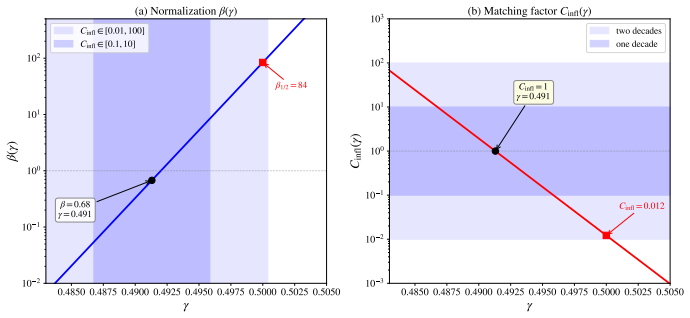
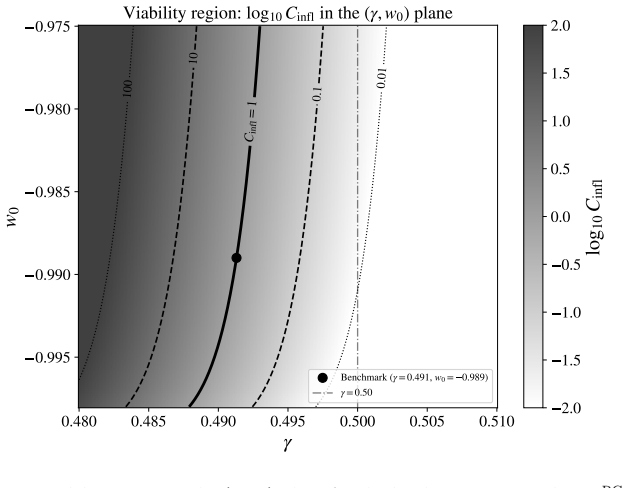
The central claim is that the power-law form M_U(μ) = β^{1/4} M_P (μ/M_P)^γ, normalized at μ = H0 via the DRG closure relations, when evaluated at the Starobinsky inflationary scale, produces a residual matching factor C_infl of order unity for γ ≃ 0.491 and β ≃ 0.68. Varying the exponent p in the potential shifts γ only mildly (0.45–0.52) and favors p ≃ 3–4. As a direct consequence the vacuum sector evolves as ρ_Φ ∝ a^{-6γ}, which exceeds the dilution rate of curvature for γ > 1/3 and therefore permits a turnaround at |Ω_K| ∼ O(10^{-4}).
What carries the argument
The effective scaling M_U(μ) = β^{1/4} M_P (μ/M_P)^γ that carries the extrapolation from the late-time anchor to the inflationary epoch and defines the residual C_infl.
If this is right
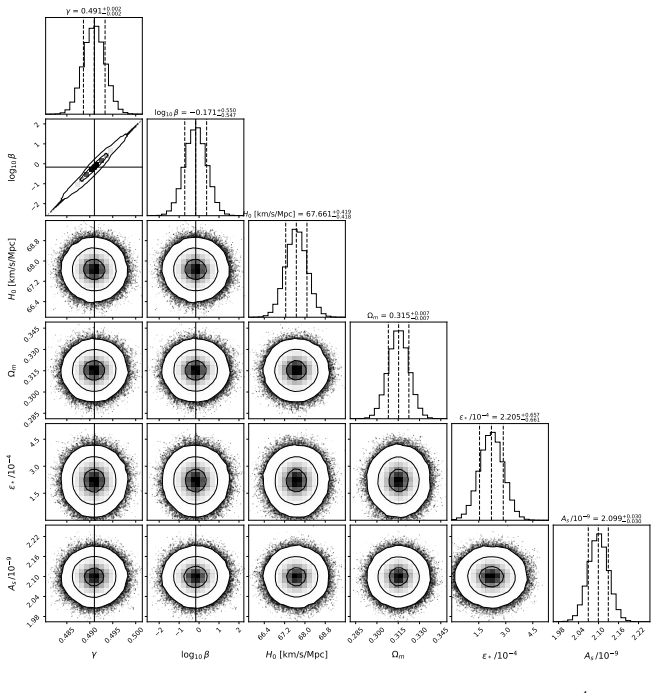
- Matching at the inflationary scale selects γ ≃ 0.491 and β ≃ 0.68 for the benchmark V0 ∝ M_U^4 with c4 = O(1).
- Changing the potential exponent p across [2,8] moves γ only mildly within 0.45–0.52 and favors natural values near p ≃ 3–4.
- The vacuum energy density scales as ρ_Φ ∝ a^{-6γ} at late times, diluting faster than spatial curvature whenever γ > 1/3.
- In a closed universe the faster dilution allows a cosmological turnaround at curvature densities |Ω_K| ∼ O(10^{-4}).
Where Pith is reading between the lines
- Tighter late-time measurements of w0 and A_s would shrink the allowed window on γ without requiring new high-energy data.
- The predicted dilution law ρ_Φ ∝ a^{-6γ} supplies a distinct late-time expansion history that can be contrasted with ΛCDM using distance-redshift surveys.
- The same scaling supplies a concrete target for model-building attempts that seek a single effective description across the two epochs.
Load-bearing premise
The normalization is fixed at μ = H0 by the late-time dark energy closure relations of the density-responsive gravity framework.
What would settle it
A measurement showing that C_infl lies many orders of magnitude away from unity after the full uncertainty budget (including w0, A_s, H*, and threshold effects) is applied, or the absence of a turnaround signature at |Ω_K| ∼ 10^{-4} in Stage-IV data.
Figures
read the original abstract
A cross-epoch endpoint-consistency test is formulated for a single power-law effective scaling, $M_U(\mu)=\beta^{1/4}\,M_P(\mu/M_P)^\gamma$, connecting late-time cosmic acceleration to the inflationary energy scale. The normalization is anchored at $\mu=H_0$ by the late-time dark energy closure relations of the density-responsive gravity (DRG) framework and extrapolated to the inflationary Hubble rate $\mu=H_*$. Comparison with the CMB-normalized Starobinsky plateau defines the residual matching factor $C_{\rm infl}\equiv V_0^{A_s}/V_0^{\rm RG}$. The novelty is the formulation of the inflation - dark-energy connection as a quantitative endpoint test between two empirically anchored energy scales. The lever arm $H_*/H_0\sim 10^{55}$ compresses endpoint uncertainties into $\delta\gamma\propto [p\ln(H_*/H_0)]^{-1}\delta\ln X$, so requiring $C_{\rm infl}=\mathcal{O}(1)$ selects a narrow consistency band. For the benchmark $V_0\propto M_U^4$ with $c_4=\mathcal{O}(1)$, matching requires $\gamma\simeq 0.491$ and $\beta\simeq 0.68$, both $\mathcal{O}(1)$. Varying $p\in[2,8]$ shifts $\gamma$ only mildly (approximately $0.45$--$0.52$), with natural matching favoring $p\simeq 3$--$4$. We present the full uncertainty budget, including cumulative threshold effects ($\Xi$) and observational errors on the late-time anchor ($w_0$, $A_s$, $H_*$). A secondary consequence is that the effective vacuum sector dilutes as $\rho_\Phi\propto a^{-6\gamma}$ at late times, faster than spatial curvature for $\gamma>1/3$. In a closed universe, this permits a cosmological turnaround at $|\Omega_K|\sim\mathcal{O}(10^{-4})$, testable with Stage-IV surveys and qualitatively distinct from $\Lambda$CDM.
Editorial analysis
A structured set of objections, weighed in public.
Referee Report
Summary. The paper formulates a cross-epoch endpoint-consistency test for the single power-law effective scaling M_U(μ)=β^{1/4} M_P (μ/M_P)^γ that connects the late-time dark-energy scale at μ=H_0 to the inflationary Hubble rate μ=H_*. The normalization is fixed at H_0 by the late-time closure relations of the density-responsive gravity (DRG) framework; extrapolation across the lever arm H_*/H_0∼10^{55} is then required to produce C_infl≡V_0^{A_s}/V_0^{RG}=O(1) when matched to the CMB-normalized Starobinsky plateau. For the benchmark V_0∝M_U^4 with c_4=O(1) this selects γ≃0.491 and β≃0.68; the values remain O(1) under variation of the exponent p∈[2,8]. A secondary consequence is that the effective vacuum energy dilutes as ρ_Φ∝a^{-6γ}, permitting a cosmological turnaround at |Ω_K|∼O(10^{-4}) in a closed universe.
Significance. If the DRG late-time closure relations hold and are independently validated, the large lever arm converts the endpoint-matching requirement into a narrow consistency band for the two free parameters γ and β, both of which emerge O(1). The same scaling supplies a concrete, falsifiable prediction (faster-than-curvature dilution allowing a turnaround at |Ω_K|∼10^{-4}) that is qualitatively distinct from ΛCDM and testable with Stage-IV surveys. The manuscript also supplies a full uncertainty budget that includes threshold effects Ξ and observational errors on w_0, A_s and H_*.
major comments (2)
- [Abstract, paragraph 2] Abstract, paragraph 2: the normalization M_U(H_0) is taken directly from the late-time dark-energy closure relations of the DRG framework. No independent derivation or external validation of those relations is supplied in the present manuscript; without them the power-law has no empirical anchor and the subsequent extrapolation to H_* reduces to an internal consistency condition on parameters already fitted inside DRG.
- [Abstract] Abstract: the claim that the procedure constitutes an 'independent cross-epoch test' is undermined by the fact that both the anchor and the requirement C_infl=O(1) are internal to the DRG framework. The derived values γ≃0.491, β≃0.68 are therefore best described as the parameter region in which the DRG scaling remains consistent with Starobinsky inflation rather than a prediction tested against an external datum.
Simulated Author's Rebuttal
We thank the referee for the thoughtful review and for highlighting the need to clarify the scope of our cross-epoch test. We respond to the major comments below, emphasizing that the work assumes the DRG late-time relations as input from prior work and tests their consistency with inflation as an external scale.
read point-by-point responses
-
Referee: [Abstract, paragraph 2] the normalization M_U(H_0) is taken directly from the late-time dark-energy closure relations of the DRG framework. No independent derivation or external validation of those relations is supplied in the present manuscript; without them the power-law has no empirical anchor and the subsequent extrapolation to H_* reduces to an internal consistency condition on parameters already fitted inside DRG.
Authors: We agree that this manuscript does not re-derive or independently validate the DRG closure relations; these are adopted from the established DRG framework. The present analysis focuses on extrapolating the resulting power-law scaling to the inflationary epoch and requiring consistency with the Starobinsky model normalized by CMB data. The empirical content comes from matching to the independently observed inflationary scale, providing a test of whether the DRG-derived form remains viable across epochs. We are prepared to revise the abstract to explicitly state that the late-time relations are taken as given from DRG. revision: partial
-
Referee: [Abstract] the claim that the procedure constitutes an 'independent cross-epoch test' is undermined by the fact that both the anchor and the requirement C_infl=O(1) are internal to the DRG framework. The derived values γ≃0.491, β≃0.68 are therefore best described as the parameter region in which the DRG scaling remains consistent with Starobinsky inflation rather than a prediction tested against an external datum.
Authors: The inflationary scale and the condition C_infl = O(1) are not internal to DRG. Starobinsky inflation and its CMB normalization (A_s) are standard results from inflationary cosmology, independent of the DRG framework. The test is whether the DRG scaling, anchored at late times, produces a value of V_0 that matches this external inflationary datum within O(1). The narrow selection of γ ≈ 0.49 and β ≈ 0.68 is thus a consequence of this cross-epoch requirement. We note that the abstract in the manuscript describes it as an 'endpoint-consistency test' rather than explicitly 'independent', but we can adjust wording to avoid any ambiguity. revision: partial
Circularity Check
Normalization at H0 relies on DRG closure relations; γ,β values are consistency conditions within that framework
specific steps
-
self citation load bearing
[Abstract]
"The normalization is anchored at μ=H0 by the late-time dark energy closure relations of the density-responsive gravity (DRG) framework and extrapolated to the inflationary Hubble rate μ=H*."
The load-bearing normalization and scaling premise is taken directly from the DRG framework (prior work by the same author). The subsequent extrapolation and requirement that C_infl≡V0^{A_s}/V0^{RG}=O(1) then selects γ and β, rendering the 'consistency test' and O(1) values dependent on the internal DRG closure relations rather than independent external data.
full rationale
The derivation anchors the power-law scaling at μ=H0 using late-time dark energy closure relations from the DRG framework, then extrapolates across H*/H0∼10^55 and requires C_infl=O(1) to obtain γ≃0.491, β≃0.68. This makes the endpoint test a consistency condition on the DRG anchor rather than an independent cross-epoch prediction against external benchmarks. The central claim therefore reduces to the self-cited DRG relations for its empirical starting point, with the lever-arm compression applying only after that anchor is granted. No other circular steps are exhibited in the provided text.
Axiom & Free-Parameter Ledger
free parameters (3)
- γ
- β
- p
axioms (2)
- domain assumption Late-time dark energy closure relations of the DRG framework hold at μ = H0.
- domain assumption The same functional form M_U(μ) = β^{1/4} M_P (μ/M_P)^γ remains valid from H0 to H*.
Reference graph
Works this paper leans on
-
[1]
Weinberg, The cosmological constant problem, Rev
S. Weinberg, The cosmological constant problem, Rev. Mod. Phys. 61 (1989) 1–23.doi:10.1103/RevModPhys.61.1
-
[2]
J. Martin, Everything you always wanted to know about the cosmological constant problem (but were afraid to ask), Comptes Rendus Physique 13 (2012) 566–665.doi:10.1016/j.crhy.2012.04.008
-
[3]
arXiv:2404.03002,doi:10.1088/1475-7516/2025/02/021
DESI Collaboration, DESI 2024 VI: Cosmological constraints from the measurements of baryon acoustic oscillations, JCAP 2025 (02) (2025) 021. arXiv:2404.03002,doi:10.1088/1475-7516/2025/02/021
-
[4]
DESI Collaboration, M. Abdul-Karim, et al., DESI DR2 results II: Mea- surements of baryon acoustic oscillations and cosmological constraints, Phys. Rev. D 112 (2025) 083515.arXiv:2503.14738,doi:10.1103/ PhysRevD.112.083515
Pith/arXiv arXiv 2025
-
[5]
DES Collaboration, Dark Energy Survey Year 6 Results: Cosmological Constraints from Galaxy Clustering and Weak Lensing, arXiv preprint (2026).arXiv:2601.14559. 29
arXiv 2026
-
[6]
P. J. E. Peebles, A. Vilenkin, Quintessential inflation, Phys. Rev. D 59 (1999) 063505.arXiv:astro-ph/9810509
Pith/arXiv arXiv 1999
-
[7]
K. Dimopoulos, C. Owen, Quintessential inflation withα-attractors, JCAP 06 (2017) 027.arXiv:1703.00305
Pith/arXiv arXiv 2017
-
[8]
I. L. Shapiro, J. Solà, On the possible running of the cosmological “con- stant”, Phys. Lett. B 682 (2009) 105–113.arXiv:0910.4925
Pith/arXiv arXiv 2009
-
[9]
J. Solà Peracaula, Running vacuum in quantum field theory in curved spacetime: renormalizingρ vac without∼m 4 terms, Phil. Trans. R. Soc. A 380 (2022) 20210182.arXiv:2203.13757
arXiv 2022
-
[10]
A. A. Starobinsky, Disappearing cosmological constant in f(R) gravity, JETP Lett. 86 (2007) 157–163.arXiv:0706.2041
Pith/arXiv arXiv 2007
-
[11]
S. Nojiri, S. D. Odintsov, Unified cosmic history in modified gravity: From F(R) theory to Lorentz non-invariant models, Phys. Rept. 505 (2011) 59– 144.arXiv:1011.0544
Pith/arXiv arXiv 2011
-
[12]
M. Drobczyk, A density-responsive scalar-field framework for singularity regularization and dynamical dark energy, Classical and Quantum Gravity 42 (22) (2025) 225016.doi:10.1088/1361-6382/ae1ac1. URLhttps://doi.org/10.1088/1361-6382/ae1ac1
-
[13]
T. Appelquist, D. Karabali, L. C. R. Wijewardhana, Chiral hierarchies and the flavor changing neutral current problem in technicolor, Phys. Rev. Lett. 57 (1986) 957–960.doi:10.1103/PhysRevLett.57.957
-
[14]
F. Sannino, K. Tuominen, Orientifold theory dynamics and symmetry breaking, Phys. Rev. D 71 (2005) 051901.arXiv:hep-ph/0405209
Pith/arXiv arXiv 2005
-
[15]
DeGrand, Lattice tests of beyond Standard Model dynamics, Rev
T. DeGrand, Lattice tests of beyond Standard Model dynamics, Rev. Mod. Phys. 88 (2016) 015001.arXiv:1510.05018
Pith/arXiv arXiv 2016
-
[16]
A. Hasenfratz, D. Schaich, Nonperturbativeβfunction of twelve-flavor SU(3) gauge theory, JHEP 02 (2018) 132.arXiv:1610.10004
Pith/arXiv arXiv 2018
-
[17]
Planck Collaboration, Planck 2018 results. VI. Cosmological parameters, Astron. Astrophys. 641 (2020) A6.arXiv:1807.06209
Pith/arXiv arXiv 2018
-
[18]
DES Collaboration, Dark Energy Survey Year 3 results: Cosmological con- straints from galaxy clustering and weak lensing, Phys. Rev. D 105 (2022) 023520.arXiv:2105.13549
Pith/arXiv arXiv 2022
-
[19]
M. Drobczyk, Naturally resonant two-mediator model of self-interacting dark matter with decoupled relic abundance, Classical and Quantum Grav- ity 42 (22) (2025) 225006.doi:10.1088/1361-6382/ae16f9. URLhttps://doi.org/10.1088/1361-6382/ae16f9 30
-
[20]
N. C. Tsamis, R. P. Woodard, The quantum gravitational back-reaction on inflation, Ann. Phys. 253 (1997) 1–54.arXiv:hep-ph/9602316
Pith/arXiv arXiv 1997
-
[21]
D. Boyanovsky, H. J. de Vega, N. G. Sanchez, Quantum corrections to slow roll inflation and new scaling of superhorizon fluctuations, Nucl. Phys. B 747 (2006) 25–54.arXiv:astro-ph/0503669
Pith/arXiv arXiv 2006
-
[22]
A. A. Starobinsky, A new type of isotropic cosmological models without singularity, Phys. Lett. B 91 (1980) 99–102.doi:10.1016/0370-2693(80) 90670-X
-
[23]
B 145 (1984) 176–178.doi:10.1016/0370-2693(84)90332-0
B.Whitt, Fourth-ordergravityasgeneralrelativityplusmatter, Phys.Lett. B 145 (1984) 176–178.doi:10.1016/0370-2693(84)90332-0
-
[24]
R. Kallosh, A. Linde, D. Roest, Superconformal inflationaryα-attractors, JHEP 11 (2013) 198.arXiv:1311.0472
Pith/arXiv arXiv 2013
-
[25]
M. Galante, R. Kallosh, A. Linde, D. Roest, Unity of cosmological inflation attractors, Phys. Rev. Lett. 114 (2015) 141302.arXiv:1412.3797
Pith/arXiv arXiv 2015
-
[26]
Planck Collaboration, Planck 2018 results. X. Constraints on inflation, As- tron. Astrophys. 641 (2020) A10.arXiv:1807.06211
Pith/arXiv arXiv 2018
-
[27]
BICEP/Keck Collaboration, Improved constraints on primordial gravita- tional waves using Planck, WMAP, and BICEP/Keck observations through the 2018 observing season, Phys. Rev. Lett. 127 (2021) 151301.arXiv: 2110.00483
arXiv 2018
-
[28]
LiteBIRD Collaboration, Probing cosmic inflation with the LiteBIRD cos- mic microwave background polarization survey, Prog. Theor. Exp. Phys. 2023 (2023) 042F01.arXiv:2202.02773
arXiv 2023
-
[29]
CMB-S4 Collaboration, CMB-S4 Science Book, First Edition, arXiv preprint (2016).arXiv:1610.02743
Pith/arXiv arXiv 2016
-
[30]
D. Foreman-Mackey, D. W. Hogg, D. Lang, J. Goodman, emcee: The mcmc hammer, Publ. Astron. Soc. Pac. 125 (2013) 306–312.arXiv:1202.3665
Pith/arXiv arXiv 2013
-
[31]
J. Torrado, A. Lewis, Cobaya: code for Bayesian analysis of hierarchical physical models, JCAP 05 (2021) 057.arXiv:2005.05290
Pith/arXiv arXiv 2021
-
[32]
A. Lewis, A. Challinor, A. Lasenby, Efficient computation of CMB anisotropies in closed FRW models, Astrophys. J. 538 (2000) 473–476. arXiv:astro-ph/9911177
Pith/arXiv arXiv 2000
-
[33]
F. Bezrukov, M. Shaposhnikov, Standard Model Higgs boson mass from inflation: Two loop analysis, JHEP 07 (2009) 089.arXiv:0904.1537
Pith/arXiv arXiv 2009
-
[34]
D. S. Gorbunov, A. G. Panin, Scalaron the mighty: producing dark matter and baryon asymmetry at reheating, Phys. Lett. B 700 (2011) 157–162. arXiv:1009.2448. 31
Pith/arXiv arXiv 2011
-
[35]
M. Kawasaki, K. Kohri, T. Moroi, A. Yotsuyanagi, Big-bang nucleosynthe- sis and gravitino, Phys. Rev. D 78 (2008) 065011.arXiv:0804.3745
Pith/arXiv arXiv 2008
-
[36]
C. Gordon, D. Wands, B. A. Bassett, R. Maartens, Adiabatic and en- tropy perturbations from inflation, Phys. Rev. D 63 (2001) 023506.arXiv: astro-ph/0009131
Pith/arXiv arXiv 2001
-
[37]
K.Yamawaki, M.Bando, K.-i.Matumoto, Scale-invarianthypercolormodel and a dilaton, Phys. Rev. Lett. 56 (1986) 1335–1338.doi:10.1103/ PhysRevLett.56.1335
1986
-
[38]
F.Sannino, ConformalwindowsofSP(2N)andSO(N)gaugetheories, Phys. Rev. D 79 (2009) 096007.arXiv:0902.3494
Pith/arXiv arXiv 2009
-
[39]
M. Drobczyk, Code for: A cross-epoch endpoint-consistency test of a single effective scaling from dark energy to inflation, concept DOI; resolves to latest version (2026).doi:10.5281/zenodo.18621282. URLhttps://doi.org/10.5281/zenodo.18621282
-
[40]
A. A. Starobinsky, J. Yokoyama, Equilibrium state of a self-interacting scalar field in the de Sitter background, Phys. Rev. D 50 (1994) 6357–6368. arXiv:astro-ph/9407016. 32
Pith/arXiv arXiv 1994
discussion (0)
Sign in with ORCID, Apple, or X to comment. Anyone can read and Pith papers without signing in.