REVIEW 2 major objections 5 minor 33 references
Multilingual and Multimode Phone Recognition System for Indian Languages
T0 review · 2 major / 5 minor · reviewed 2026-08-14 · deepseek-v4-flash
Pith's one-line read A phone recognizer that first classifies each utterance as read or conversational and then decodes it with a mode-specific recognizer outperforms fixed-mode recognizers on four Indian languages.
desk verdict A competent incremental ASR paper whose central claim is undercut by a missing pooled-mode baseline and an internal numerical inconsistency in the COMB result. read the letter →
The pith
A machine-rendered reading of the paper's core claim, the machinery that carries it, and where it could break.
The reading
What carries the argument
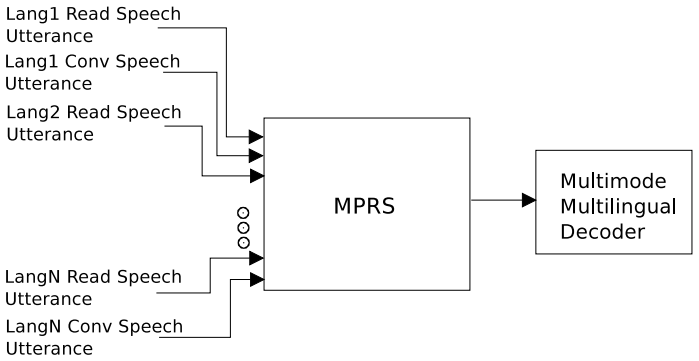
The load-bearing mechanism is a mode switch: a front-end speech-mode classifier produces a read/conversation label, and that label selects one of two DNN-based multilingual phone recognizers. The classifier is an MLP fed by two feature streams, vocal-tract (MFCC with deltas) and excitation-source (pitch contour and epoch strength contour), whose classifier scores are combined by an adaptive weighted fusion scheme using weights 0.35 and 0.65. Each recognizer is a DNN acoustic model trained with MFCCs, tandem features (phone posterior probabilities from a discriminative classifier), and the excitation-source features RMFCC and MPDSS; decoding uses a phone bigram language model.
What would settle it
Train one multilingual phone recognizer on the union of the read and conversation training sets using the same features and decoding setup, and evaluate it on the same mixed test set. If its average phone recognition accuracy is at least 60.19%, the claim that mode routing improves recognition is falsified; if it is clearly lower, the two-stage design is supported.
Extended reading notes
Core claim
The central claim is that routing an utterance through a speech-mode classifier before phone recognition is better than committing to one mode. The paper builds two mode-specific multilingual phone recognizers, one trained on read speech and one on conversation speech, each using MFCCs, tandem phone posteriors, and the excitation-source features RMFCC and MPDSS; the added source features improve read accuracy from 64.45% to 68.15% and conversation accuracy from 64.23% to 66.53% over the same-mode baselines. When the mode is unknown, the two-stage COMB-MPRS uses a 91.10%-accurate multilingual mode classifier and achieves 61.02% on read and 59.37% on conversation, for an average of 60.19%. The paper notes that a perfect mode classifier would give 67.34%, so 7.15 percentage points of the remaining gap are attributed to mode-classification errors.
Load-bearing premise
The load-bearing premise is that one phone recognizer trained on read and conversation data together would not match the accuracy of routing through a mode classifier; the paper reports no such mixed-training baseline, so the gain could come from having two recognizers rather than from the mode classification itself.
Editorial extensions
If this is right
- In mixed read-and-conversation streams, COMB-MPRS is the best of the compared systems: 60.19% average accuracy versus 48.97% for the read baseline and 47.26% for the conversation baseline.
- Adding excitation-source features to the mode-specific recognizers improves within-mode accuracy by about four and three percentage points over the matching baseline.
- The multilingual mode classifier performs about as well as per-language classifiers, so one front-end can serve several languages at once.
- If the mode classifier can be pushed closer to perfect, the phone recognizer's average accuracy would rise toward 67.34% on these data, since 7.15 points of the current gap are charged to mode-classification mistakes.
Reading between the lines
- The comparison leaves open whether the gain comes from the mode classifier or simply from having two acoustic models; a recognizer trained on the pooled read-plus-conversation data, with the same features, would isolate the routing effect, and the paper does not report such a baseline.
- If pooling the two modes trains a recognizer with accuracy near 60%, the two-stage architecture would be unnecessary; if pooling falls short, the mode switch is doing the work.
- The same two-stage idea could be applied to other speaking-style contrasts, such as spontaneous versus scripted or read versus shouted, as long as the front-end classifier is accurate enough that routing errors do not outweigh within-mode gains.
- The reported language-independent fusion weights suggest a test on an unseen Indian language: if the SMC still classifies accurately without retraining, the multilingual claim is stronger than the four-language evidence alone.
Signed reviews
Editorial analysis
A structured set of objections, weighed in public.
Referee Report
Summary. The paper proposes a two-stage multilingual phone recognition system for four Indian languages (Telugu, Kannada, Odia, Bengali) operating on both read and conversational speech. The first stage is an MLP-based speech mode classifier (SMC) that fuses vocal-tract (MFCC) and excitation-source (pitch contour and epoch strength contour) features through weighted score fusion; the second stage routes each utterance to a mode-specific DNN-based multilingual phone recognizer (MPRS) trained on MFCC, tandem, RMFCC, and MPDSS features. The authors report an average SMC accuracy of 91.10% and a combined two-stage system (COMB-MPRS) phone recognition accuracy of 60.19%, compared with 48.97% and 47.26% for read-only and conversation-only baseline MPRSs, and conclude that the proposed framework outperforms mode-dependent baselines.
Significance. If validated, the work addresses a practically relevant scenario for Indian-language broadcast and conversational audio, and the systematic comparison of vocal-tract and excitation-source features for speech-mode classification is a useful contribution. I credit the authors for reporting per-mode and per-language breakdowns, for using test speakers disjoint from training, and for the correlation analysis supporting mode-discriminative pitch and epoch-strength information. The phone-recognition comparison also provides some evidence that adding RMFCC and MPDSS features to an existing MPRS gives consistent gains over the corresponding mode-dependent baselines. However, the central claim that the SMC front-end improves phone recognition is not identified by the current evaluation, and the reported COMB-MPRS numbers are internally inconsistent with the separately reported SMC and mode-specific MPRS accuracies.
major comments (2)
- [Section 8, Table 6 / Figure 3] The evaluation lacks the decisive control that would isolate the SMC front-end's contribution. The COMB-MPRS uses two mode-specific acoustic models, and the reported gain over the mode-dependent baselines could come simply from training two specialized recognizers on mode-specific data rather than from routing through the mode classifier. The paper should add a pooled-mode MPRS trained on the combination of read and conversation data with the same feature set (MFCC+tandem+RMFCC+MPDSS), the same DNN topology, and the same bigram language model, and compare its average accuracy with the 60.19% COMB result. Without this baseline, the central claim that mode classification provides an improvement is unidentified.
- [Section 8, Table 6, versus Tables 4 and 5] The reported COMB-MPRS accuracy is not arithmetically consistent with the per-mode SMC accuracies and the mode-specific proposed MPRS accuracies. Using the multilingual SMC per-mode accuracies from Table 5 (read 92.28%, conversation 89.97%) and the proposed MPRS per-mode accuracies from Table 6 (read-proposed: 68.15% on read, 38.31% on conversation; conv-proposed: 34.85% on read, 66.53% on conversation), and noting that Table 1 implies a balanced read/conversation test set, the expected COMB accuracy is approximately 0.5*(0.9228*68.15 + 0.0772*34.85 + 0.8997*66.53 + 0.1003*38.31) = 64.6%, not the reported 60.19%. The reported COMB values for read (61.02%) and conversation (59.37%) are also both about 4 percentage points below the corresponding expected values (65.58% and 63.70%). The reported 60.19% implies an effective SMC accuracy near 77%, far below the 91.10% reported in Table 4. The authors must reconcile this discrepancy, for example by reporting the routing confusion matrix and the per-mode COMB accuracies after the SMC decisions, before the gain can be attributed to the proposed framework.
minor comments (5)
- [Section 5, Eq. (4)] The LM scaling factor alpha is introduced but its value and tuning procedure are never reported; please provide the value used for the reported results.
- [Section 6.5] The claim that the fusion weights w1=0.45, w2=0.55, w3=0.35, w4=0.65 are language-independent is stronger than the evidence presented, because no per-language optimal weights, development-set size, or the corresponding accuracy comparisons on the development set are tabulated; either provide this evidence or soften the claim.
- [Section 7.4, Figure 5] The text refers to a 'VT-MSC' model; this appears to be a typo for 'VT-SMC', and the figure caption should be self-contained by defining the red and black circles as in the text.
- [Section 8, Eq. (7)] The paper reports recognition accuracy but defines the phone error rate E; please state explicitly how accuracy is derived from E (e.g., accuracy = 1 - E) and whether insertion errors are handled in that conversion.
- [Tables 3, 4, and 6] No confidence intervals or significance tests are reported, even though the central comparisons are between systems; adding per-speaker standard deviations or a paired test would help assess whether the reported differences are reliable.
Circularity Check
No significant circularity: the reported phone-recognition accuracies are measured system outputs, the SMC and MPRS components are evaluated independently, and the fusion weights are development-set tuning choices rather than fitted predictions.
full rationale
The paper's central claim is an empirical comparison of a two-stage system (mode classifier followed by mode-specific multilingual phone recognizers) against mode-dependent baselines. The accuracies in Tables 3, 4, 5, and 6 are test-set measurements, not quantities derived from the system's own assumptions. The SMC is evaluated separately from the MPRS, so the mode-classification accuracy is not defined in terms of phone-recognition performance. The weighted score fusion in Section 6.5 selects weights on a development set; this is standard hyperparameter tuning, and the reported SMC accuracies are not a renamed version of those weights. The baseline MPRSs are reimplemented from prior work [5] by the same research group, but the baseline is an experimental comparison point rather than a load-bearing theorem or a source of the claimed conclusion. No equation in the paper reduces to its own inputs: the COMB-MPRS accuracy is measured by routing utterances through the predicted mode-specific recognizer, and the 'ideal case' 67.34% is only an arithmetic illustration from the per-mode accuracies. The absence of a pooled-mode baseline and the apparent numerical inconsistency between Tables 5 and 6 are experimental-design and consistency concerns, not circularity. Therefore, no circular step can be exhibited, and the appropriate finding is no significant circularity.
Assumptions & free parameters
free parameters (3)
- SMC score fusion weights =
w1=0.45, w2=0.55, w3=0.35, w4=0.65
- MLP hidden layer sizes =
q1=56 for pitch and ESC models, q2=21 for MFCC model
- Language model scaling factor alpha =
not reported
assumptions (4)
- domain assumption IPA transcription provides language-independent phone units that can be shared across the four languages.
- domain assumption Zero frequency filtering (ZFF) reliably estimates pitch and epoch strength contours.
- domain assumption The corpus transcriptions are phonetically accurate and prosodically rich.
- domain assumption Training and test speakers are disjoint and randomly selected.
Cite this review
Pith. "Pith review of Multilingual and Multimode Phone Recognition System for Indian Languages." pith.science (2026). https://pith.science/paper/46LSO5O5
@misc{pith2026190809634,
  author       = {Pith},
  title        = {Pith review of: Multilingual and Multimode Phone Recognition System for Indian Languages},
  year         = {2026},
  howpublished = {\url{https://pith.science/paper/46LSO5O5}},
  note         = {Machine review of arXiv:1908.09634}
}
read the original abstract
The aim of this paper is to develop a flexible framework capable of automatically recognizing phonetic units present in a speech utterance of any language spoken in any mode. In this study, we considered two modes of speech: conversation, and read modes in four Indian languages, namely, Telugu, Kannada, Odia, and Bengali. The proposed approach consists of two stages: (1) Automatic speech mode classification (SMC) and (2) Automatic phonetic recognition using mode-specific multilingual phone recognition system (MPRS). In this work, the vocal tract and excitation source features are considered for speech mode classification (SMC) task. SMC systems are developed using multilayer perceptron (MLP). Further, vocal tract, excitation source, and tandem features are used to build the deep neural network (DNN)-based MPRSs. The performance of the proposed approach is compared with mode-dependent MPRSs. Experimental results show that the proposed approach which combines both SMC and MPRS into a single system outperforms the baseline mode-dependent MPRSs.
Figures


Figures from the paper (3 more)


Reference graph
Works this paper leans on
-
[1]
K. Manjunath, K. S. Rao, Source and system features for ph one recog- nition, International Journal of Speech Technology 18 (2) ( 2015) 257–270. doi:10.1007/s10772-014-9266-0
-
[2]
R. Pradeep, K. S. Rao, Deep neural networks for Kannada ph oneme recognition, in: Proceedings of Ninth International Conference on Conte mporary Computing (IC3), JIIT, Noida, 2016, pp. 1–6. doi:10.1109/IC3.2016.7880202
-
[3]
S. Scanzio, P . Laface, L. Fissore, R. Gemello, F. Mana, On the use of a multilin- gual neural network front-end, in: Proceedings of Ninth Ann ual Conference of the International Speech Communication Association, Bris bane, Australia, 2008, pp. 2711–2714
work page 2008
-
[4]
L. Burget, P . Schwarz, M. Agarwal, P . Akyazi, K. Feng, A. G hoshal, O. Glembek, N. Goel, M. Karafi´ at, D. Povey, et al., Multiling ual acous- tic modeling for speech recognition based on subspace Gauss ian mixture models, in: Proceedings of International Conference on Aco ustics Speech 29 and Signal Processing (ICASSP), Dallas, Texas, 2010, pp. 43 34–43...
-
[5]
K. Manjunath, D. B. Jayagopi, K. S. Rao, V . Ramasubramani an, Develop- ment and analysis of multilingual phone recognition system s using indian lan- guages, International Journal of Speech Technology 22 (1) ( 2019) 157–168. doi:10.1007/s10772-018-09589-z
-
[6]
C. S. Kumar, V . Mohandas, H. Li, Multilingual speech reco gnition: A unified approach, in: Proceedings of Ninth European Conference on S peech Communi- cation and Technology, Lisbon, Portugal, 2005, pp. 3357–33 60
work page 2005
-
[7]
S. V . Gangashetty, C. C. Sekhar, B. Y egnanarayana, Spott ing multilin- gual consonant-vowel units of speech using neural network m odels, in: Proceedings of International Conference on Nonlinear Anal yses and Al- gorithms for Speech Processing, Berlin, Heidelberg, 2005, pp. 303–317. doi:10.1007/11613107_27
-
[8]
A. Mohan, R. Rose, S. H. Ghalehjegh, S. Umesh, Acoustic mo d- elling for speech recognition in Indian languages in an agri cultural commodities task domain, Speech Communication 56 (2014) 16 7–180. doi:10.1016/j.specom.2013.07.005
Show all 33 references
-
[9]
Batliner, R
A. Batliner, R. Kompe, A. Kießling, E. N¨ oth, H. Niemann, Can you tell apart spontaneous and read speech if you just look at pro sody?, in: Speech Recognition and Coding, Springer, 1995, pp. 321– 324. doi:10.1007/978-3-642-57745-1_47
1995 doi
-
[10]
Blaauw, Phonetic characteristics of spontaneous an d read-aloud speech, in: Phonetics and Phonology of Speaking Styles, 1991
E. Blaauw, Phonetic characteristics of spontaneous an d read-aloud speech, in: Phonetics and Phonology of Speaking Styles, 1991
1991
-
[11]
Dellwo, A
V . Dellwo, A. Leemann, M.-J. Kolly, The recognition of r ead and spontaneous speech in local vernacular: The case of zurich german, Journ al of Phonetics 48 (2015) 13–28. doi:10.1016/j.wocn.2014.10.011. 30
2015 doi
-
[12]
J. H. Hansen, Analysis and compensation of stressed and noisy speech with ap- plication to robust automatic recognition, Signal Process ing 17 (3) (1989) 282. doi:10.1016/0165-1684(89)90010-8
1989 doi
-
[13]
Rostolland, Phonetic structure of shouted voice, Ac ta Acustica united with Acustica 51 (2) (1982) 80–89
D. Rostolland, Phonetic structure of shouted voice, Ac ta Acustica united with Acustica 51 (2) (1982) 80–89
1982
-
[14]
Rostolland, Acoustic features of shouted voice, Act a Acustica united with Acustica 50 (2) (1982) 118–125
D. Rostolland, Acoustic features of shouted voice, Act a Acustica united with Acustica 50 (2) (1982) 118–125
1982
-
[15]
Zhang, J
C. Zhang, J. H. Hansen, Analysis and classification of sp eech mode: whispered through shouted, in: Eighth Annual Conference of the Intern ational Speech Com- munication Association, Antwerp, Belgium, 2007, pp. 2289– 2292
2007
-
[16]
G. Dede, M. H. Sazlı, Speech recognition with artificial neu- ral networks, Digital Signal Processing 20 (3) (2010) 763–7 68. doi:10.1016/j.dsp.2009.10.004
2010 doi
-
[17]
Vinyals, S
O. Vinyals, S. V . Ravuri, Comparing multilayer percept ron to deep belief net- work tandem features for robust asr, in: international conf erence on acous- tics, speech and signal processing (ICASSP), IEEE, 2011, pp . 4596–4599. doi:10.1109/icassp.2011.5947378
2011
-
[18]
S. G. Koolagudi, K. S. Rao, Emotion recognition from spe ech: a re- view, International journal of speech technology 15 (2) (20 12) 99–117. doi:10.1007/s10772-011-9125-1
-
[19]
S. S. Kumar, K. S. Rao, D. Pati, Phonetic and prosodicall y rich transcribed speech corpus in Indian languages: Bengali and Odia, in: Proceedin gs of International Conference on Oriental COCOSDA held jointly with Conferenc e on Asian Spo- ken Language Research and Evaluation (...
2013
-
[20]
Shridhara, B
M. Shridhara, B. K. Banahatti, L. Narthan, V . Karjigi, R . Kumaraswamy, Development of Kannada speech corpus for prosodically guid ed phonetic 31 search engine, in: Proceedings of international conferenc e on oriental CO- COSDA held jointly with conference on Asian spoken lan...
2013
-
[21]
K. S. R. Murty, B. Y egnanarayana, Epoch extraction from speech signals, IEEE Transactions on Audio, Speech, and Language Processing 16 ( 8) (2008) 1602–
2008
-
[22]
Y egnanarayana, K
B. Y egnanarayana, K. S. R. Murty, Event-based instanta neous funda- mental frequency estimation from speech signals, IEEE Tran sactions on Audio, Speech, and Language Processing 17 (4) (2009) 614– 624. doi:10.1109/tasl.2008.2012194
2009
-
[23]
L. Lam, S. Suen, Application of majority voting to patte rn recognition: an analysis of its behavior and performance, IEEE Transaction s on Systems, Man, and Cybernetics-Part A: Systems and Humans 27 (5) (1997 ) 553–568. doi:10.1109/3468.618255
1997
-
[24]
Benesty, J
J. Benesty, J. Chen, Y . Huang, I. Cohen, Pearson correla tion coeffi- cient, in: Noise reduction in speech processing, Springer, 2009, pp. 1–4. doi:10.4135/9781412953948.n342
2009 doi
-
[25]
Povey, A
D. Povey, A. Ghoshal, G. Boulianne, L. Burget, O. Glembe k, N. Goel, M. Han- nemann, P . Motlicek, Y . Qian, P . Schwarz, et al., The Kaldi sp eech recognition toolkit, in: workshop on automatic speech recognition and u nderstanding, no. EPFL-CONF-192584, IEEE Signal Processin...
2011
-
[26]
Zhang, J
X. Zhang, J. Trmal, D. Povey, S. Khudanpur, Improving de ep neural network acoustic models using generalized maxout networks, in: International Conference on Acoustics, Speech and Signal Processing (ICASSP), IEEE, Florence, Italy, 2014, pp. 215–219. doi:10.1109/icassp.2014.6853589
2014
-
[27]
D. Y u, L. Deng, Deep neural network-hidden markov model hybrid sys- 32 tems, in: Automatic Speech Recognition, Springer, 2015, pp . 99–116. doi:10.1007/978-1-4471-5779-3_6
2015 doi
-
[28]
P . F. Brown, P . V . Desouza, R. L. Mercer, V . J. D. Pietra, J . C. Lai, Class-based n-gram models of natural language, Computational linguist ics 18 (4) (1992) 467– 479
1992
-
[29]
Svozil, V
D. Svozil, V . Kvasnicka, J. Pospichal, Introduction to multi-layer feed-forward neural networks, Chemometrics and intelligent laboratory systems 39 (1) (1997) 43–62. doi:10.1016/S0169-7439(97)00061-0
1997 doi
-
[30]
B. C. Cs´ aji, Approximation with artificial neural netw orks, Faculty of Sciences, Etvs Lornd University, Hungary 24 (2001) 48
2001
-
[31]
Bottou, Large-scale machine learning with stochast ic gradient descent, in: Proceedings of COMPSTA T’2010, Springer, 2010, pp
L. Bottou, Large-scale machine learning with stochast ic gradient descent, in: Proceedings of COMPSTA T’2010, Springer, 2010, pp. 177– 186. doi:10.1007/978-3-7908-2604-3_16
2010 doi
-
[32]
V . R. Reddy, S. Maity, K. S. Rao, Identification of Indian languages using multi- level spectral and prosodic features, International Journ al of Speech Technology 16 (4) (2013) 489–511. doi:10.1007/s10772-013-9198-0 . 33
2013 doi
-
[1613]
doi:10.1109/tasl.2008.2004526
2008
Reviewed August 14, 2026 · model on record in the stance chip above.
Discussion (0). Continue with ORCID to comment.