REVIEW 3 major objections 3 minor 68 references
Categorical mirror symmetry on cohomology for a complex genus 2 curve
T0 review · 3 major / 3 minor · reviewed 2026-08-14 · deepseek-v4-flash
Pith's one-line read A genus 2 curve is shown to satisfy mirror symmetry on cohomology: line bundles on the curve correspond to Lagrangians in a symplectic fibration, and products are computed by holomorphic triangle counts.
desk verdict A serious, detailed construction of the first non-exact SYZ mirror for a curve of general type, whose main theorem is conditional on unpublished localization machinery for the target category. read the letter →
The pith
A machine-rendered reading of the paper's core claim, the machinery that carries it, and where it could break.
The reading
What carries the argument
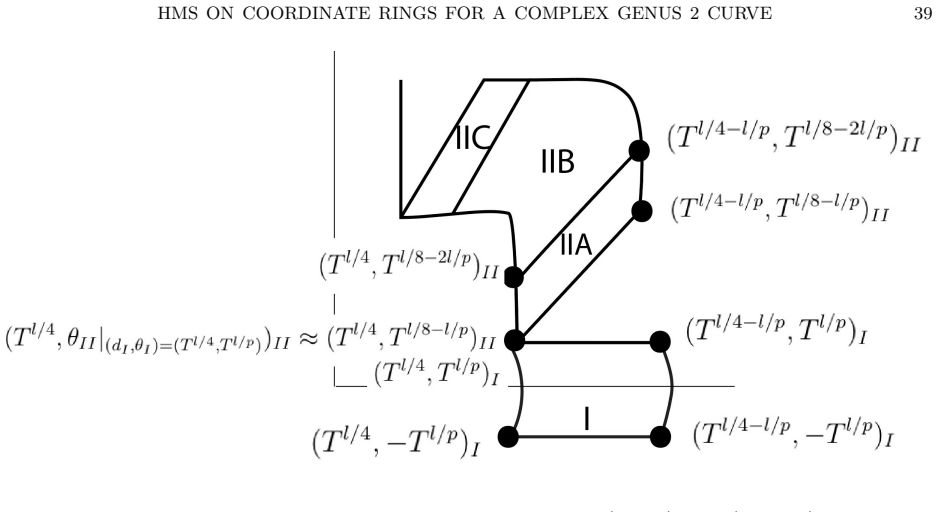
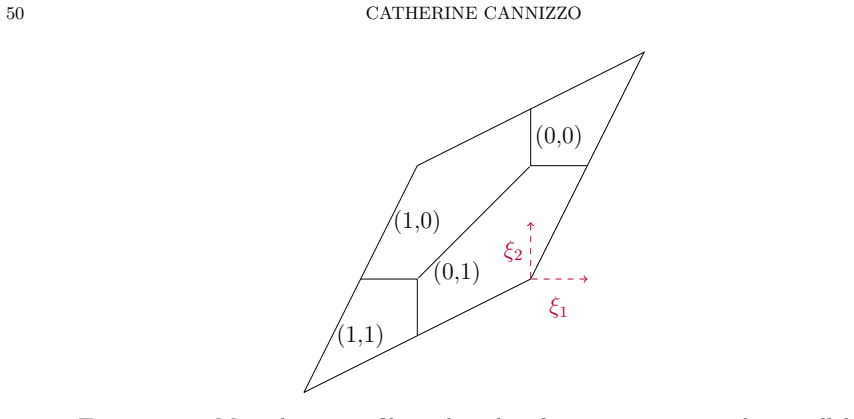
The central object is the family of linear Lagrangians $\ell_k$ in the SYZ dual abelian variety $V^\vee=T_B\times T_F$, defined in action-angle coordinates by $\theta\equiv-k\lambda\xi\pmod{\mathbb{Z}^2}$ with $\lambda=\begin{pmatrix}2&1\\1&2\end{pmatrix}^{-1}$; these are Lagrangian graphs whose intersections with $\ell_j$ and $\ell_i$ number $(j-i)^2$, matching the dimension of $H^0(V,L^{j-i})$. The same Lagrangians, parallel transported over U-shaped curves in the base of the superpotential $v_0=xyz$, generate the Fukaya-Seidel-type category on $(Y,v_0)$. The symplectic fibration itself is built from a Kähler potential patched from the toric potentials of $\mathbb{C}^3$ charts and of the singular fiber $\mathbb{CP}^2(3)/\Gamma_B$, with the symplectic form chosen so that $v_0$ is a symplectic fibration. The computational engine is a Leibniz rule reducing the differential on all Lagrangians to the differential for the moment-map fiber Lagrangian $t_x$, followed by a cobordism argument that identifies the desired count with $J_0$-holomorphic discs; that disc count equals the $\theta$ function defining the line bundle, while disc-with-sphere configurations are included through an open mirror theorem for infinite-type toric Calabi-Yau manifolds.
What would settle it
Compute the morphism space between $L_k$ and its upward pushoff in the localized category of Definition 4.6 by both the directed bigon count and by roofs; if the two answers differ for some regular almost complex structure, Lemma 4.8 fails and the right vertical embedding has no well-defined target.
Extended reading notes
Core claim
On its own terms, the discovery is Theorem 1.2: choose $L\to V$ to be the ample line bundle whose factor of automorphy is $s(\gamma,x)=x^{\lambda(\gamma)}\tau^{\kappa(\gamma)}$, with $\lambda=\begin{pmatrix}2&1\\1&2\end{pmatrix}^{-1}$; then $H=s^{-1}(0)$ is a complex genus 2 curve. The paper proves that the diagram with $D^b_{\mathrm{LCoh}}(V)\to D^b_{\mathrm{LCoh}}(H)$ on the complex side and $H^0\mathrm{Fuk}(V^\vee)\to H^0\mathrm{FS}(Y,v_0)$ on the symplectic side commutes, with fully faithful vertical embeddings. The objects on the symplectic side are explicit: $L^k$ maps to the linear Lagrangian $\ell_k$ in $V^\vee$, and $L^k|_H$ maps to the fibered Lagrangian obtained by parallel transporting $\ell_k$ around a U-shaped curve in the base of $v_0$. The core numerical fact is that the $\mu_2$ product in the torus, which counts holomorphic triangles, matches the product of $\theta$ functions computing the multiplication of sections; since $L|_H$ is the canonical bundle of $\Sigma_2$, the ring structure on $\bigoplus_{i\ge0}H^0(\Sigma_2,L^i)$ is determined by those triangle counts. The proof of the right vertical arrow uses a computation of the differential as the $\theta$ function, with disc counts contributing in the leading order and sphere-bubble corrections handled separately.
Load-bearing premise
The load-bearing premise is that the unpublished categorical-localization technology for defining morphisms in a Fukaya-Seidel category works for this non-exact symplectic fibration with compact torus fibers and sphere bubbles; if it does not, the category $H^0\mathrm{FS}(Y,v_0)$ used in the main theorem is not defined.
Editorial extensions
If this is right
- If the embeddings of Theorem 1.2 hold, the canonical ring $\bigoplus_{i\ge0}H^0(\Sigma_2,L^i)$ is isomorphic to the cohomological endomorphism ring of the mirror Lagrangians, so the projective embeddings of $\Sigma_2$ are determined by Lagrangian intersection data.
- The product in that ring is computable, in principle, by counting holomorphic triangles in $(Y,v_0)$; the paper writes the $\mu_2$ coefficient as a sum of weights $\tau^{-(l/l'l'')\kappa(\cdots)}$ over lattice elements $\gamma_A$.
- For the abelian surface $V$, the embedding $D^b_{\mathrm{LCoh}}(V)\hookrightarrow H^0\mathrm{Fuk}(V^\vee)$ gives a direct verification in this example that multiplication of sections of a line bundle matches the triangle count in the mirror torus.
- Because the line bundles and their shifts generate the subcategories considered, an $A_\infty$ enhancement would extend these cohomological embeddings to the whole derived category $D^b\mathrm{Coh}(H)$, a step the paper identifies as the natural next one.
Reading between the lines
- Editorial inference: the same pattern -- linear Lagrangians mirroring powers of an ample line bundle, with products counted by triangles -- should extend to any smooth curve in an abelian variety; the honeycomb tropicalization of the corresponding theta function would determine the mirror quotient and the triangle weights.
- Editorial inference: the equality between theta-function multiplication and the $\mu_2$ count gives a testable numerical prediction: for low powers $L$, $L^2$, $L^3$ on $V$, the coefficients of the product of theta functions should reproduce the weighted triangle sums term by term as $\tau\to0$.
- Editorial inference: if the unpublished localization results used for Definition 4.6 are replaced by an explicit construction, the cohomological Fukaya-Seidel category of $(Y,v_0)$ may admit a description as a wrapped-type Fukaya category on the smooth part of the fibration, which would make the right vertical embedding computable by standard wrapped-Floer methods.
Signed reviews
Editorial analysis
A structured set of objections, weighed in public.
Referee Report
Summary. The paper proposes a cohomological mirror symmetry statement for a complex genus 2 curve realized as a theta divisor H in an abelian surface V. It constructs the SYZ mirror as a Landau-Ginzburg model (Y,v0), where Y is a Gamma_B-quotient of an infinite-type toric variety and v0 = xyz, equipped with a non-exact symplectic fibration structure. Theorem 1.2 asserts two fully faithful embeddings: D^b_LCoh(V) into H^0Fuk(V^vee) (left vertical arrow) and D^b_LCoh(H) into H^0FS(Y,v0) (right vertical arrow). The left arrow is established by explicit computation of morphisms between linear Lagrangians and a triangle count whose weights match theta-function multiplication in Lemma 2.20. The right arrow rests on a definition of a DFS-type Fukaya-Seidel category via categorical localization (Definition 4.6), a monodromy computation (Lemma 4.20), and a computation of the differential as proportional to the theta function after incorporating disc and sphere counts. The main structural gap is that the target category for the right arrow is not constructed self-containedly: its localized morphism and quasi-invariance lemmas are postponed to unpublished work.
Significance. If the category foundations can be supplied, the paper would be a significant contribution: a concrete, computable HMS statement for a general-type curve with the curve on the complex side, and one of the first Fukaya-Seidel categories for a non-exact, non-monotone symplectic fibration with compact fibers. The explicit triangle count in Lemma 2.5 and its matching with theta multiplication in Lemma 2.20 are strong internal evidence for the left arrow; the monodromy computation is detailed; and the differential computation is ambitious and, conditional on the standard tools, internally consistent. The paper also gives a clean description of how the mirror is forced by the tropicalization of the defining theta function. The manuscript is not self-contained in a load-bearing way; however, the gaps are of the missing-proof or unpublished-reference type rather than obvious contradictions, so the result is credible as a research announcement and worthy of a major revision.
major comments (3)
- [Section 4.1, Definition 4.6; Lemmas 4.8, 4.9, 4.54] The category H^0FS(Y,v0) in Theorem 1.2 is the target of the main embedding, but its definition is not self-contained: Definition 4.6 defines morphisms by categorical localization, and Lemmas 4.8 and 4.9, which identify the localized morphisms and compositions with directed ones, are assigned to unpublished work of Abouzaid-Seidel and Abouzaid-Auroux; Lemma 4.54 (quasi-invariance on regular choices) is tagged "References for proof." Because Remark 4.11 explicitly notes that the fibration is not exact (compact torus fibers) and Remark 4.13 notes it is not monotone, the standard localization and quasi-invariance arguments do not automatically apply, and no replacement argument is supplied. This is load-bearing: without these lemmas the right vertical arrow is not defined.
- [Section 4.6, Lemma 4.54] Quasi-invariance of H^0FS on regular choices is needed for the computation in Section 5 to be an invariant of the category: the paper computes the differential at J0 with an admissible perturbation and uses a cobordism from a generic J, but the cobordism and the independence of the count from the perturbation must be established within the non-exact setting. The proof reference to unpublished work is not enough for a foundational lemma of this kind, since the category used in the main theorem is defined only after this invariance is known.
- [Section 5.3, Theorem 5.8] The sphere-bubble contributions to the differential are imported from [KL19] for the infinite-type toric cover ~Y, while the target Y is the quotient by Gamma_B with compact fibers. The paper does not prove that the relevant counts, homology classes, and weights descend to the quotient, or that the open Gromov-Witten invariants used in Corollary 5.3 are Gamma_B-invariant. Without such a descent statement, the proportionality of the differential to the theta function is not established on Y itself.
minor comments (3)
- [Highlights] There is a typo in the Highlights: "sympectic side" should be "symplectic side."
- [Theorem 1.2 and Section 2] The paper uses H^0Fuk(V^vee) and H^0FS(Y,v0) for cohomological categories, but the Maslov grading conventions for the linear Lagrangians are not spelled out; since the grading determines which part of Floer cohomology is taken, a sentence specifying the grading would help the reader.
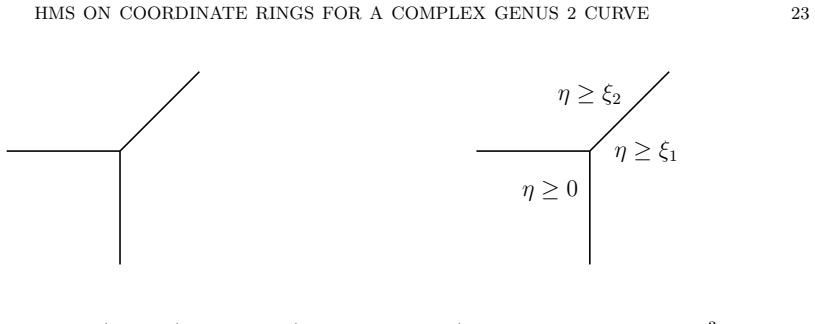
- [Definition 3.28] The bump functions alpha3,...,alpha6 are constrained only by inequalities in the text; their precise domains, boundary conditions, and derivative bounds should be collected in one place, since Appendix A is invoked repeatedly and the reader cannot easily check the claimed smallness of derivative contributions.
Circularity Check
The mirror is built from Trop(s) and then 'recovers' the same theta function s as the computed differential; the recovery reduces to unpacking the construction, though the categorical embedding retains independent content.
-
self definitional
[Section 3.3, Eq. (3.10); Section 5.2, Theorem 5.4]
"∆˜Y := {(ξ1, ξ2, η) ∈ R^3 | η ≥ Trop(s)(ξ)} ... Trop(s)(ξ) := max_γ κ(γ) + ⟨ξ, λ(γ)⟩ ... Theorem 5.4. ... Then the disc count equals the defining theta function s(x) = Σ_{n∈Z^2} x_1^{-n1} x_2^{-n2} τ^{1/2 n^t ((2,1),(1,2)) n} up to a coordinate change."
The mirror (Y, v0) is built in Section 3.3 from the tropicalization of the same theta function s that Section 5.2 presents as a computed output: ∆_Y = {η ≥ Trop(s)} with Trop(s) = max_γ κ(γ)+⟨ξ,λ(γ)⟩. The proof of Theorem 5.4 obtains disc areas from the facet data of this same polytope, ν(F_{m1,m2})=(−m1,−m2,1)^t and α(F_{m1,m2})=m1^2+m1m2+m2^2, then compares the [CO06] series with the theta series and finds identical exponents and coefficients. The 'recovery' of s as the differential is therefore not an independent symplectic prediction; it is the input tropical function repackaged through the construction of (Y, v0), up to the standard local-system coordinate change. The embedding statements retain independent content, but this derivation of s is by construction.
full rationale
The main circular step is the theta-function input-output loop: the mirror's SYZ polytope is defined by η ≥ Trop(s)(ξ), and Theorem 5.4 then announces that the disc count equals s(x) 'up to a coordinate change.' Because the facet equations used in the count are read off from the same tropical function, the differential computation reduces to unpacking the definition of (Y, v0) rather than to an independent verification of the canonical ring of Σ2. This is partial circularity: the fully faithful embedding of D^b_LCoh(H) into H^0FS(Y, v0) is a category-theoretic claim that does not automatically follow from the construction of the polytope, and the left-arrow computation for abelian varieties is an independent flat-torus triangle count matched with theta multiplication. I did not count the reliance on unpublished Abouzaid-Seidel localization lemmas (Lemmas 4.8, 4.9, 4.54) as circularity: those are external cited tools, not self-citations, and the concern about whether they apply in this non-exact, compact-fiber setting is a correctness or rigor issue rather than a circularity. No other load-bearing step was found to reduce to its own inputs. Score 6 reflects one central 'prediction' that is forced by the construction while the overall embedding program retains independent content.
Assumptions & free parameters
free parameters (4)
- Kahler potential exponents (a,b,c) and rotation exponents (alpha,beta) =
(a,b,c) = (1,1,2), (alpha,beta) = (-2,1).
- Symplectic area normalization of the three axial P1s =
Area = 1 for each axis (Claim 3.21).
- Bump functions alpha3, alpha4, alpha5, alpha6 =
Ranges: 2/3 <= alpha3 <= 1, -1/2 <= alpha4 <= 1/2, 0 <= alpha5 <= 1, 0 <= alpha6 <= 1, monotone with specified…
- Family parameters tau and T =
tau in R_+ << 1, T << 1, with |v0| <= T^l.
assumptions (7)
- domain assumption Generalized SYZ mirror construction of Abouzaid-Auroux-Katzarkov: the blow-up Bl_{H x 0}(V x C) admits a Lagrangian torus fibration, with Fuk(X) ~ Fuk(H) and D^bCoh(X) = <D^bCoh(V x C), D^bCoh(H)>.
- ad hoc to paper The localized Fukaya-Seidel category of the non-exact, non-Lefschetz symplectic fibration (Y,v0) is well-defined, and morphisms and compositions in it agree with those in the directed category.
- standard math Seidel's Fukaya category framework for Lefschetz fibrations [Sei08] (moduli spaces, regularity, strip-like ends) adapts to this non-Lefschetz setting.
- domain assumption The open mirror theorem for toric Calabi-Yau manifolds of infinite type [KL19, Theorem 3.10], together with [Cha11] and Givental's mirror theorem, computes the disc plus sphere contributions as exp(g_I(q)).
- domain assumption Quasi-invariance of the Fukaya category under change of regular almost complex structure holds for this fibration.
- domain assumption For the U-shaped linear Lagrangians, there is no disc bubbling, no strip-breaking, and no Maslov-zero disc in a fiber; the only possible degenerations are sphere bubbles, whose moduli have negative dimension for regular J (Example 4.34, Corollary 4.53).
- standard math Standard background: action-angle coordinates and quasi-Hamiltonian moment maps; Delzant's theorem; classification of line bundles on abelian varieties (Appell-Humbert); h0(V,L^l) = l^2; Riemann-Roch; the theta divisor of the Jacobian of a genus 2 curve is a genus 2 curve with L|_H = K_H.
invented entities (2)
-
DFS-type Fukaya-Seidel category of linear Lagrangians in (Y,v0)
-
The quotient toric variety (Y,v0) with the chosen Gamma_B-complex structure (Definition 3.14)
independent evidence
Cite this review
Pith. "Pith review of Categorical mirror symmetry on cohomology for a complex genus 2 curve." pith.science (2026). https://pith.science/paper/47FBIMCE
@misc{pith2026190804227,
  author       = {Pith},
  title        = {Pith review of: Categorical mirror symmetry on cohomology for a complex genus 2 curve},
  year         = {2026},
  howpublished = {\url{https://pith.science/paper/47FBIMCE}},
  note         = {Machine review of arXiv:1908.04227}
}
abstract
Motivated by observations in physics, mirror symmetry is the concept that certain manifolds come in pairs $X$ and $Y$ such that the complex geometry on $X$ mirrors the symplectic geometry on $Y$. It allows one to deduce symplectic information about $Y$ from known complex properties of $X$. Strominger-Yau-Zaslow arXiv:hep-th/9606040 described how such pairs arise geometrically as torus fibrations with the same base and related fibers, known as SYZ mirror symmetry. Kontsevich arXiv:alg-geom/9411018 conjectured that a complex invariant on $X$ (the bounded derived category of coherent sheaves) should be equivalent to a symplectic invariant of $Y$ (the Fukaya category, see references in article abstract). This is known as homological mirror symmetry. In this project, we first use the construction of "generalized SYZ mirrors" for hypersurfaces in toric varieties following Abouzaid-Auroux-Katzarkov arXiv:1205.0053v4, in order to obtain $X$ and $Y$ as manifolds. The complex manifold is the genus 2 curve $\Sigma_2$ (so of general type $c_1<0$) as a hypersurface in its Jacobian torus. Its generalized SYZ mirror is a Landau-Ginzburg model $(Y,v_0)$ equipped with a holomorphic function $v_0:Y \to \mathbb{C}$ which we put the structure of a symplectic fibration on. We then describe an embedding of a full subcategory of $D^bCoh(\Sigma_2)$ into a cohomological Fukaya-Seidel category of $Y$ as a symplectic fibration. While our fibration is one of the first nonexact, non-Lefschetz fibrations to be equipped with a Fukaya category, the main geometric idea in defining it is the same as in Seidel's construction for Fukaya categories of Lefschetz fibrations and in Abouzaid-Seidel.
Figures

Figures from the paper (22 more)







Reference graph
Works this paper leans on
-
[1]
Lagrangian fibrations on blowups of toric varieties and mirror symmetry for hypersurfaces
Mohammed Abouzaid, Denis Auroux, and Ludmil Katzarkov. Lagrangian fibrations on blowups of toric varieties and mirror symmetry for hypersurfaces. Publ. Math. Inst. Hautes \'Etudes Sci. , 123:199--282, 2016
work page 2016
-
[2]
Morse homology, tropical geometry, and homological mirror symmetry for toric varieties
Mohammed Abouzaid. Morse homology, tropical geometry, and homological mirror symmetry for toric varieties. Selecta Math. (N.S.) , 15(2):189--270, 2009. ://doi.org/10.1007/s00029-009-0492-2
-
[3]
Mirror symmetry for weighted projective planes and their noncommutative deformations
Denis Auroux, Ludmil Katzarkov, and Dmitri Orlov. Mirror symmetry for weighted projective planes and their noncommutative deformations. Ann. of Math. (2) , 167(3):867--943, 2008. doi:10.4007/annals.2008.167.867
-
[4]
Summer graduate school, D erived C ategories
Nicolas Addington, Alexander Polishchuk, and Ed Segal. Summer graduate school, D erived C ategories. https://www.msri.org/summer_schools/821
-
[5]
L efschetz fibration methods in wrapped F loer cohomology
Mohammed Abouzaid and Paul Seidel. L efschetz fibration methods in wrapped F loer cohomology. in preparation
-
[6]
Homological mirror symmetry for the 4-torus
Mohammed Abouzaid and Ivan Smith. Homological mirror symmetry for the 4-torus. Duke Math. J. , 152(3):373--440, 2010
work page 2010
-
[7]
Khovanov homology from F loer cohomology
Mohammed Abouzaid and Ivan Smith. Khovanov homology from F loer cohomology. J. Amer. Math. Soc. , 32(1):1--79, 2019. doi:10.1090/jams/902
doi:10.1090/jams/902 2019
-
[8]
Mirror symmetry and T -duality in the complement of an anticanonical divisor
Denis Auroux. Mirror symmetry and T -duality in the complement of an anticanonical divisor. J. G\"okova Geom. Topol. GGT , 1:51--91, 2007
work page 2007
Show all 68 references
-
[9]
A beginner's introduction to F ukaya categories
Denis Auroux. A beginner's introduction to F ukaya categories. In Contact and symplectic topology , volume 26 of Bolyai Soc. Math. Stud. , pages 85--136. J\' a nos Bolyai Math. Soc., Budapest, 2014. ://doi.org/10.1007/978-3-319-02036-5_3
2014 doi
-
[10]
Complex abelian varieties , volume 302 of Grundlehren der Mathematischen Wissenschaften [Fundamental Principles of Mathematical Sciences]
Christina Birkenhake and Herbert Lange. Complex abelian varieties , volume 302 of Grundlehren der Mathematischen Wissenschaften [Fundamental Principles of Mathematical Sciences] . Springer-Verlag, Berlin, second edition, 2004
2004
-
[11]
Homological mirror symmetry for the genus 2 curve in an abelian variety and its generalized S trominger- Y au- Z aslow mirror
Catherine Cannizzo. Homological mirror symmetry for the genus 2 curve in an abelian variety and its generalized S trominger- Y au- Z aslow mirror . PhD thesis, U niversity of C alifornia, Berkeley, 2019. https://arxiv.org/abs/1908.04227
2019 arXiv
-
[12]
A mirror theorem for toric stacks
Tom Coates, Alessio Corti, Hiroshi Iritani, and Hsian-Hua Tseng. A mirror theorem for toric stacks. Compos. Math. , 151(10):1878--1912, 2015. ://doi.org/10.1112/S0010437X15007356
1912 doi
-
[13]
Gross fibrations, SYZ mirror symmetry, and open G romov- W itten invariants for toric C alabi- Y au orbifolds
Kwokwai Chan, Cheol-Hyun Cho, Siu-Cheong Lau, and Hsian-Hua Tseng. Gross fibrations, SYZ mirror symmetry, and open G romov- W itten invariants for toric C alabi- Y au orbifolds. J. Differential Geom. , 103(2):207--288, 2016. ://projecteuclid.org/euclid.jdg/1463404118
2016
-
[14]
Symplectic T oric M anifolds
Ana Cannas da Silva. Symplectic T oric M anifolds. https://people.math.ethz.ch/ acannas/Papers/toric.pdf
-
[15]
http://www.polyfolds.org/index.php?title=Polyfold_constructions_for_Fukaya_categories
Polyfold constructions for F ukaya categories. http://www.polyfolds.org/index.php?title=Polyfold_constructions_for_Fukaya_categories
-
[16]
A formula equating open and closed G romov- W itten invariants and its applications to mirror symmetry
Kwokwai Chan. A formula equating open and closed G romov- W itten invariants and its applications to mirror symmetry. Pacific J. Math. , 254(2):275--293, 2011. ://doi.org/10.2140/pjm.2011.254.275
2011 doi
-
[17]
Cox and Sheldon Katz
David A. Cox and Sheldon Katz. Mirror symmetry and algebraic geometry , volume 68 of Mathematical Surveys and Monographs . American Mathematical Society, Providence, RI, 1999. ://doi.org/10.1090/surv/068
1999 doi
-
[18]
S YZ mirror symmetry for toric C alabi- Y au manifolds
Kwokwai Chan, Siu-Cheong Lau, and Naichung Conan Leung. S YZ mirror symmetry for toric C alabi- Y au manifolds. J. Differential Geom. , 90(2):177--250, 2012. ://projecteuclid.org/euclid.jdg/1335230845
2012
-
[19]
Cox, John B
David A. Cox, John B. Little, and Henry K. Schenck. Toric varieties , volume 124 of Graduate Studies in Mathematics . American Mathematical Society, Providence, RI, 2011. doi:10.1090/gsm/124
2011 doi
-
[20]
Floer cohomology and disc instantons of L agrangian torus fibers in F ano toric manifolds
Cheol-Hyun Cho and Yong-Geun Oh. Floer cohomology and disc instantons of L agrangian torus fibers in F ano toric manifolds. Asian J. Math. , 10(4):773--814, 2006
2006
-
[21]
Symplectic homology and the E ilenberg- S teenrod axioms
Kai Cieliebak and Alexandru Oancea. Symplectic homology and the E ilenberg- S teenrod axioms. Algebr. Geom. Topol. , 18(4):1953--2130, 2018. doi:10.2140/agt.2018.18.1953. Appendix written jointly with Peter Albers
1953 doi
-
[22]
Stacks for everybody
Barbara Fantechi. Stacks for everybody. In European C ongress of M athematics, V ol. I ( B arcelona, 2000) , volume 201 of Progr. Math. , pages 349--359. Birkh\" a user, Basel, 2001
2000
-
[23]
The coherent-constructible correspondence and homological mirror symmetry for toric varieties
Bohan Fang, Chiu-Chu Melissa Liu, David Treumann, and Eric Zaslow. The coherent-constructible correspondence and homological mirror symmetry for toric varieties. In Geometry and analysis. N o. 2 , volume 18 of Adv. Lect. Math. (ALM) , pages 3--37. Int. Press, Somerville, MA, 2011
2011
-
[24]
Lagrangian intersection F loer theory: anomaly and obstruction
Kenji Fukaya, Yong-Geun Oh, Hiroshi Ohta, and Kaoru Ono. Lagrangian intersection F loer theory: anomaly and obstruction. P art I , volume 46 of AMS/IP Studies in Advanced Mathematics . American Mathematical Society, Providence, RI; International Press, Somerville, MA, 2009
2009
-
[25]
Lagrangian intersection F loer theory: anomaly and obstruction
Kenji Fukaya, Yong-Geun Oh, Hiroshi Ohta, and Kaoru Ono. Lagrangian intersection F loer theory: anomaly and obstruction. P art II , volume 46 of AMS/IP Studies in Advanced Mathematics . American Mathematical Society, Providence, RI; International Press, Somerville, MA, 2009
2009
-
[26]
Kuranishi Structures and Virtual Fundamental Chains
Kenji Fukaya, Yong-Geun Oh, Hiroshi Ohta, and Kaoru Ono. Kuranishi Structures and Virtual Fundamental Chains . Springer Monographs in Mathematics. Springer Singapore, 2020. doi:10.1007/978-981-15-5562-6
2020 doi
-
[27]
Gromov convergence of pseudoholomorphic disks
Urs Frauenfelder. Gromov convergence of pseudoholomorphic disks. J. Fixed Point Theory Appl. , 3(2):215--271, 2008. doi:10.1007/s11784-008-0078-1
2008 doi
-
[28]
M ath 465, S pring 2010: T opology of manifolds
J Francis. M ath 465, S pring 2010: T opology of manifolds. http://math.northwestern.edu/ jnkf/classes/mflds/, 2010
2010
-
[29]
Mirror symmetry of abelian varieties and multi-theta functions
Kenji Fukaya. Mirror symmetry of abelian varieties and multi-theta functions. J. Algebraic Geom. , 11(3):393--512, 2002
2002
-
[30]
Mat 667 advanced topics in topology: Global symplectic geometry via pseudo-holomorphic curves
Kenji Fukaya. Mat 667 advanced topics in topology: Global symplectic geometry via pseudo-holomorphic curves. http://scgp.stonybrook.edu/video_portal/video.php?id=4438, 2020. https://onedrive.live.com/view.aspx?resid=2232CE7612EBBB59 onenote:https://d.docs.live.net/2232ce7612eb...
2020
-
[31]
Introduction to toric varieties , volume 131 of Annals of Mathematics Studies
William Fulton. Introduction to toric varieties , volume 131 of Annals of Mathematics Studies . Princeton University Press, Princeton, NJ, 1993. ://doi.org/10.1515/9781400882526. The William H. Roever Lectures in Geometry
1993 doi
-
[32]
A polyfold proof of the arnold conjecture, 2018, 1810.06180 http://arxiv.org/abs/1810.06180
Benjamin Filippenko and Katrin Wehrheim. A polyfold proof of the arnold conjecture, 2018, 1810.06180 http://arxiv.org/abs/1810.06180
2018 arXiv
-
[33]
Math 257b: Topics in symplectic geometry -- aspects of F ukaya categories
Sheel Ganatra. Math 257b: Topics in symplectic geometry -- aspects of F ukaya categories. https://drive.google.com/file/d/1-anqMQbQCxgu01AKCK3rUqmOF95vkhvK/view, 2016
2016
-
[34]
A mirror theorem for toric complete intersections
Alexander Givental. A mirror theorem for toric complete intersections. In Topological field theory, primitive forms and related topics ( K yoto, 1996) , volume 160 of Progr. Math. , pages 141--175. Birkh\" a user Boston, Boston, MA, 1998
1996
-
[35]
Topological mirror symmetry
Mark Gross. Topological mirror symmetry. Invent. Math. , 144(1):75--137, 2001. doi:10.1007/s002220000119
2001 doi
-
[36]
Mirror symmetry and the S trominger- Y au- Z aslow conjecture
Mark Gross. Mirror symmetry and the S trominger- Y au- Z aslow conjecture. In Current developments in mathematics 2012 , pages 133--191. Int. Press, Somerville, MA, 2013
2012
-
[37]
Lagrangian torus fibration for symplectic toric degenerations
Roberta Guadagni. Lagrangian torus fibration for symplectic toric degenerations . PhD thesis, University of T exas at A ustin, 2017. https://repositories.lib.utexas.edu/handle/2152/63642
2017
-
[38]
Kaehler structures on toric varieties
Victor Guillemin. Kaehler structures on toric varieties. J. Differential Geom. , 40(2):285--309, 1994. ://projecteuclid.org/euclid.jdg/1214455538
1994
-
[39]
Mirror symmetry , volume 1 of Clay Mathematics Monographs
Kentaro Hori, Sheldon Katz, Albrecht Klemm, Rahul Pandharipande, Richard Thomas, Cumrun Vafa, Ravi Vakil, and Eric Zaslow. Mirror symmetry , volume 1 of Clay Mathematics Monographs . American Mathematical Society, Providence, RI; Clay Mathematics Institute, Cambridge, MA, 2003...
2003
-
[40]
Complex geometry
Daniel Huybrechts. Complex geometry . Universitext. Springer-Verlag, Berlin, 2005. An introduction
2005
-
[41]
Polyfold and Fredholm Theory
Helmut Hofer , Krzysztof Wysocki , and Eduard Zehnder . Polyfold and Fredholm Theory . arXiv e-prints , page arXiv:1707.08941, Jul 2017, 1707.08941 http://arxiv.org/abs/1707.08941
2017 arXiv
-
[42]
Local C alabi- Y au manifolds of type A via SYZ mirror symmetry
Atsushi Kanazawa and Siu-Cheong Lau. Local C alabi- Y au manifolds of type A via SYZ mirror symmetry. J. Geom. Phys. , 139:103--138, 2019. ://doi.org/10.1016/j.geomphys.2018.12.015
2019 doi
-
[43]
urich, 1994) , pages 120--139. Birkh\
Maxim Kontsevich. Homological algebra of mirror symmetry. In Proceedings of the I nternational C ongress of M athematicians, V ol.\ 1, 2 ( Z \"urich, 1994) , pages 120--139. Birkh\"auser, Basel, 1995
1994
-
[44]
Lazzarini
L. Lazzarini. Existence of a somewhere injective pseudo-holomorphic disc. Geom. Funct. Anal. , 10(4):829--862, 2000. ://doi.org/10.1007/PL00001640
2000 doi
-
[45]
Relative frames on J -holomorphic curves
Laurent Lazzarini. Relative frames on J -holomorphic curves. J. Fixed Point Theory Appl. , 9(2):213--256, 2011. ://doi.org/10.1007/s11784-010-0004-1
2011 doi
-
[46]
Chiu-Chu Melissa Liu. Moduli of J -holomorphic curves with L agrangian boundary conditions and open G romov- W itten invariants for an S^1 -equivariant pair, 2002, math/0210257 http://arxiv.org/abs/math/0210257
2002 arXiv
-
[47]
Lectures on the h -cobordism theorem
John Milnor. Lectures on the h -cobordism theorem . Notes by L. Siebenmann and J. Sondow. Princeton University Press, Princeton, N.J., 1965
1965
-
[48]
J -holomorphic curves and symplectic topology , volume 52 of American Mathematical Society Colloquium Publications
Dusa McDuff and Dietmar Salamon. J -holomorphic curves and symplectic topology , volume 52 of American Mathematical Society Colloquium Publications . American Mathematical Society, Providence, RI, second edition, 2012
2012
-
[49]
Introduction to Symplectic Topology
Dusa McDuff and Dietmar Salamon. Introduction to Symplectic Topology . Oxford Graduate Texts in Mathematics. Oxford University Press, Oxford, third edition, 2017. ://doi.org/10.1093/oso/9780198794899.001.0001
2017
-
[50]
Virtual Fundamental Cycles in Symplectic Topology
Dusa McDuff, Mohammad Tehrani, Kenji Fukaya, and Dominic Joyce. Virtual Fundamental Cycles in Symplectic Topology . American Mathematical Society, 2019
2019
-
[51]
Floer cohomology of L agrangian intersections and pseudo-holomorphic disks
Yong-Geun Oh. Floer cohomology of L agrangian intersections and pseudo-holomorphic disks. I . Comm. Pure Appl. Math. , 46(7):949--993, 1993. ://doi.org/10.1002/cpa.3160460702
1993 doi
-
[52]
M 392c: L agrangian F loer homology, hw 1
James Pascaleff. M 392c: L agrangian F loer homology, hw 1. https://faculty.math.illinois.edu/ jpascale/courses/2014/m392c/notes/homework1.pdf , 2014
2014
-
[53]
Abelian varieties, theta functions and the F ourier transform , volume 153 of Cambridge Tracts in Mathematics
Alexander Polishchuk. Abelian varieties, theta functions and the F ourier transform , volume 153 of Cambridge Tracts in Mathematics . Cambridge University Press, Cambridge, 2003. doi:10.1017/CBO9780511546532
2003 doi
-
[54]
Categorical mirror symmetry: The Elliptic curve
Alexander Polishchuk and Eric Zaslow. Categorical mirror symmetry: The Elliptic curve . Adv. Theor. Math. Phys. , 2:443--470, 1998
1998
-
[55]
Fukaya categories and P icard- L efschetz theory
Paul Seidel. Fukaya categories and P icard- L efschetz theory . Zurich Lectures in Advanced Mathematics. European Mathematical Society (EMS), Z\"urich, 2008
2008
-
[56]
Homological mirror symmetry for the genus two curve
Paul Seidel. Homological mirror symmetry for the genus two curve. J. Algebraic Geom. , 20(4):727--769, 2011
2011
-
[57]
Some speculations on pairs-of-pants decompositions and F ukaya categories
Paul Seidel. Some speculations on pairs-of-pants decompositions and F ukaya categories. In Surveys in differential geometry. V ol. XVII , volume 17 of Surv. Differ. Geom. , pages 411--425. Int. Press, Boston, MA, 2012. doi:10.4310/SDG.2012.v17.n1.a9
2012 doi
-
[58]
Homological mirror symmetry for the quartic surface
Paul Seidel. Homological mirror symmetry for the quartic surface. Mem. Amer. Math. Soc. , 236(1116):vi+129, 2015. doi:10.1090/memo/1116
2015 doi
-
[59]
Homological mirror symmetry for C alabi- Y au hypersurfaces in projective space
Nick Sheridan. Homological mirror symmetry for C alabi- Y au hypersurfaces in projective space. Invent. Math. , 199(1):1--186, 2015. doi:10.1007/s00222-014-0507-2
2015 doi
-
[60]
On the F ukaya category of a F ano hypersurface in projective space
Nick Sheridan. On the F ukaya category of a F ano hypersurface in projective space. Publ. Math. Inst. Hautes \' E tudes Sci. , 124:165--317, 2016. doi:10.1007/s10240-016-0082-8
2016 doi
-
[61]
Four dimensions from two in symplectic topology
Margaret Symington. Four dimensions from two in symplectic topology. In Topology and geometry of manifolds ( A thens, GA , 2001) , volume 71 of Proc. Sympos. Pure Math. , pages 153--208. Amer. Math. Soc., Providence, RI, 2003. doi:10.1090/pspum/071/2024634
2001 doi
-
[62]
Mirror symmetry is T -duality
Andrew Strominger, Shing-Tung Yau, and Eric Zaslow. Mirror symmetry is T -duality. Nuclear Phys. B , 479(1-2):243--259, 1996
1996
-
[63]
Homological mirror symmetry for toric del P ezzo surfaces
Kazushi Ueda. Homological mirror symmetry for toric del P ezzo surfaces. Comm. Math. Phys. , 264(1):71--85, 2006. doi:10.1007/s00220-005-1509-0
2006 doi
-
[64]
Berkeley math 278: Analysis of pseudoholomorphic curves
Katrin Wehrheim. Berkeley math 278: Analysis of pseudoholomorphic curves. https://piazza.com/berkeley/fall2013/berkeleymath278/resources, 2013
2013
-
[65]
Regularization of moduli spaces of pseudoholomorphic curves
Katrin Wehrheim. Regularization of moduli spaces of pseudoholomorphic curves. https://math.berkeley.edu/ katrin/teach/regularization/lectures.shtml, 2014
2014
-
[66]
Lectures on Symplectic Field Theory
Chris Wendl . Lectures on Symplectic Field Theory . arXiv e-prints , page arXiv:1612.01009, Dec 2016, 1612.01009 http://arxiv.org/abs/1612.01009
2016 arXiv
-
[67]
A _ -structures from M orse trees with pseudoholomorphic disks
Katrin Wehrheim and Jiayong Li. A _ -structures from M orse trees with pseudoholomorphic disks. https://math.berkeley.edu/ katrin/papers/disktrees.pdf
-
[68]
write newline
" write newline "" before.all 'output.state := FUNCTION fin.entry add.period write newline FUNCTION new.block output.state before.all = 'skip after.block 'output.state := if FUNCTION new.sentence output.state after.block = 'skip output.state before.all = 'skip after.sentence '...
Reviewed August 14, 2026 · model on record in the stance chip above.
Discussion (0). Continue with ORCID to comment.