REVIEW 5 minor 27 references
Simple $k$-Planar Graphs are Simple $(k+1)$-Quasiplanar
T0 review · 0 major / 5 minor · reviewed 2026-08-14 · deepseek-v4-flash
Pith's one-line read Every simple k-planar graph is a simple (k+1)-quasiplanar graph for all k≥2.
desk verdict The theorem is real and the proof mostly holds, but the headline inclusion was already announced in the cited WG 2017 and MFCS 2017 papers, so the contribution here is the full proof and the unified technique, not the statement itself. read the letter →
The pith
A machine-rendered reading of the paper's core claim, the machinery that carries it, and where it could break.
The reading
What carries the argument
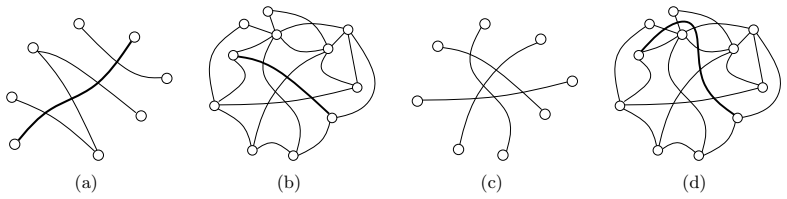
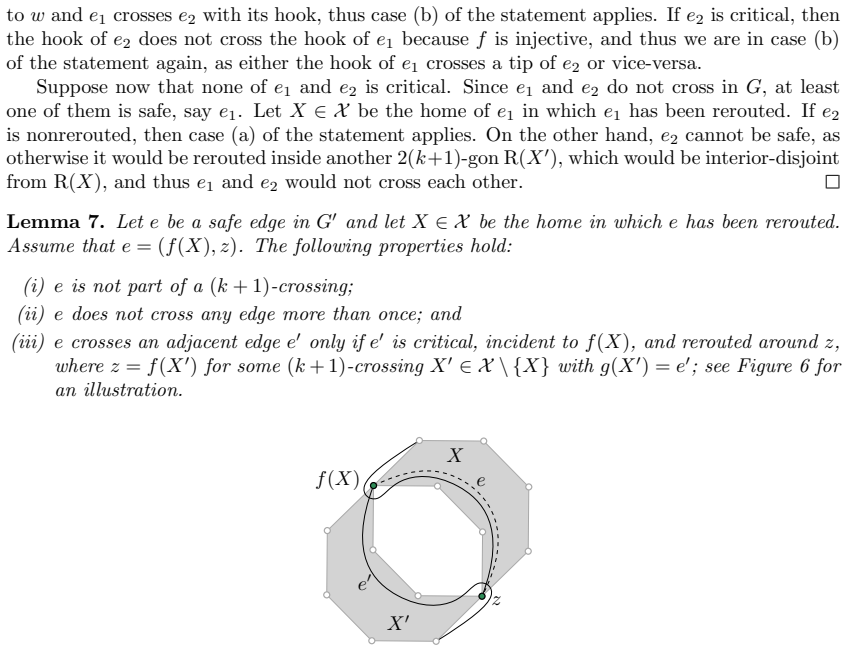
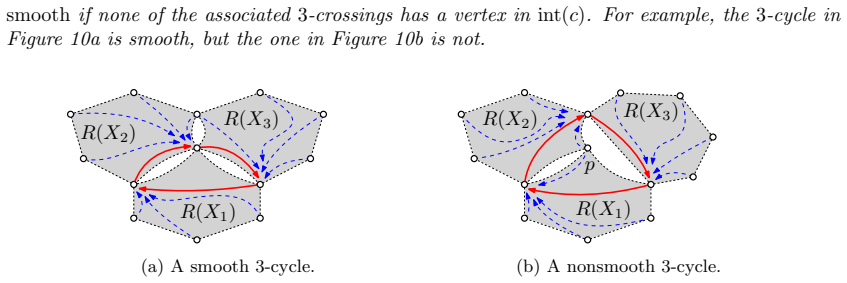
The engine of the proof is an edge-rerouting operation on an 'untangled' (k+1)-crossing, a set of k+1 pairwise crossing edges whose 2k+2 endpoints all lie on a single face of the arrangement those edges form. For each such crossing X the paper selects a vertex f(X) on the crossing and an edge g(X) in the crossing, then redraws g(X) through a disk around the crossing and along a crossing-free boundary edge, dissolving the crossing. The choices of f and g must be injective and compatible. For k=2 this is handled by a plane conflict digraph whose 2-cycles and 3-cycles encode the twin and whirl configurations that can survive a naive rerouting; the paper shows how to modify f so that all short nonghost cycles are smooth, then uses a bipartite matching condition to choose g so that every remaining cycle is broken. For k≥3, injectivity alone prevents new (k+1)-crossings, and a final redrawing step repairs multiple or adjacent crossings.
What would settle it
Search all small 2-planar simple topological graphs and all injective choices of f; if some maximal nonsmooth cycle c has fewer distinct vertices inside R(c) (minus the at most three cycle vertices) than the number of 3-crossings whose regions lie inside R(c), then the matching condition fails and the reassignment step of the k=2 proof cannot be executed. Finding such a configuration would locate exactly where the argument collapses; an exhaustive search that finds none would support the paper's one-sentence claim.
Extended reading notes
Core claim
The central claim is Theorem 1: for every integer k≥2, every simple k-planar topological graph is isomorphic to a simple (k+1)-quasiplanar topological graph. Concretely, from any drawing in which each edge is crossed at most k times, the paper builds another drawing of the same abstract graph in which no k+1 edges are pairwise crossing. The new drawing may allow an edge to be crossed more than k times, but it remains a simple topological graph: adjacent edges do not cross and no two edges cross more than once. The authors note the result cannot extend to k=1, because 2-quasiplanar graphs are exactly planar graphs, while 1-planar graphs need not be planar.
Load-bearing premise
The proof assumes that after reassigning one 3-crossing to a vertex inside a chosen maximal nonsmooth cycle, the remaining 3-crossings inside that cycle can still be matched to distinct interior vertices even after excluding up to three vertices of the cycle, an assertion it states without displaying the full matching-condition check.
Editorial extensions
If this is right
- For every k≥2, the class of simple k-planar graphs is contained in the class of simple (k+1)-quasiplanar graphs, so the two hierarchies are separated by exactly one step.
- For k=2 and k=3, the containment extends to all k-planar graphs, not only simple ones, because every k-planar graph in that range admits a simple k-planar drawing.
- Known upper bounds on the edge count of (k+1)-quasiplanar simple graphs automatically become upper bounds on the edge count of k-planar simple graphs, since every such graph has a (k+1)-quasiplanar drawing.
- The result is tight in the sense that k=1 is impossible: 2-quasiplanar graphs are planar, and 1-planar graphs are not all planar.
Reading between the lines
- The construction selects edges via injective matchings, so it is plausibly implementable as an algorithm that rewrites a k-planar drawing into a (k+1)-quasiplanar one; the paper does not state a running time, and measuring the number of rerouted edges on small examples would be a natural next step.
- The k=2 bottleneck is the existence of enough distinct interior vertices after deleting up to three cycle vertices; this suggests that any counterexample to the theorem would first surface as a violation of the bipartite matching condition in a small conflict graph.
- The conflict-digraph technique for breaking twin and whirl configurations is not tied to the specific parameters k=2 and 3, and may transfer to other beyond-planar containment questions where forbidden configurations form short cycles.
Signed reviews
Editorial analysis
A structured set of objections, weighed in public.
Referee Report
Summary. The paper proves Theorem 1: for every k ≥ 2, every simple topological graph in which each edge is crossed at most k times admits an isomorphic simple topological drawing with no k+1 pairwise crossing edges. The proof is constructive. It first eliminates tangled (k+1)-crossings, then selects an injective function f assigning to each (k+1)-crossing a rerouting vertex, and a function g selecting the edge to be rerouted. A global rerouting is then applied, followed by home reroutings. For k = 2, a conflict digraph is used to rule out the only two possible remaining 3-crossing configurations (twins and whirls). For k ≥ 3, quasiplanarity follows from a separate counting argument, and a final redrawing step removes violations of simplicity. The main inclusion is stated as Theorem 1 and the proof is self-contained apart from classical facts such as Hall's theorem, Euler's formula, the Jordan curve theorem, and the nonplanarity of K3,3.
Significance. If correct, this is a notable structural result: it establishes the first nontrivial inclusion between the k-planar and the k-quasiplanar hierarchies for simple topological graphs, and it does so with an explicit redrawing that preserves the abstract graph. The proof introduces reusable techniques, notably the untangling procedure for (k+1)-crossings and the global rerouting framework based on matching arguments and a conflict digraph. The argument has no free parameters and builds on standard tools. The authors are also explicit about limitations: the result does not extend to k = 1, and the question for non-simple k-planar graphs remains open. I checked the densest step highlighted in the review, the Hall reassignment in Lemma 19, and the concern does not land as a correctness issue: the slack in Lemma 4 is sufficient for the required matching once the bound is stated with the necessary exclusions.
minor comments (5)
- [§6.2, Lemma 19] The Hall step is compressed: after setting f′(X1) = v, the proof should explicitly exclude not only the at most three vertices of the cycle c but also the newly occupied vertex v from the candidate set for the remaining 3-crossings. Lemma 4 gives |N(A′)| ≥ |A′| + 5 for every subset A′ of those crossings, so after excluding these at most four forbidden vertices Hall's condition still holds with at least one unit of slack. Please spell out this argument in the text.
- [§6.1, Lemmas 15 and 18] The sentence 'a short cycle has a directed edge between any two of its vertices' is not literally true for directed 3-cycles. In the two places where this assertion is used, the required reverse edge follows from the fact that the edge of the other cycle lies outside the cycle, so the statement should be replaced by the precise local argument to avoid confusion.
- [§2, Property 1] The first sentence of Property 1 contains a duplicated phrase: 'k-planar simple topological graph topological graph'.
- [§6.2, definition of F(f,c,X1,v)] The expression 'f′(X) ∈ V ∈ int c' is a typo and should read 'f′(X) ∈ V ∩ int(c)'.
- [§6.2, Lemma 19] The derivation of claim (B) from claim (A) is abbreviated; a short explanation of why a new non-smooth cycle containing v1 would have to be bad would improve readability.
Circularity Check
No significant circularity: the proof is self-contained and does not derive (k+1)-quasiplanarity from its own assumptions.
full rationale
Theorem 1 is proved by an explicit, self-contained construction rather than by importing the conclusion. Lemma 1 removes tangled (k+1)-crossings while preserving k-planarity; Lemmas 4 and 5 select an injective function f via Hall's theorem; Lemmas 6-12 analyze crossings in the rerouted graph; Lemma 19 iteratively modifies f using the decreasing measure Vns; Lemma 23 selects g to break the short cycles in the conflict digraph; and Lemmas 11, 24, 25, and 27 eliminate all (k+1)-crossings and restore simplicity. None of these steps assumes the target containment or invokes (k+1)-quasiplanarity as an input. The self-citations to the preliminary versions [6] and [19] appear only in the footnote and are not load-bearing: the k=2 case is reproved through Lemmas 19-25 rather than imported from [19], and [6] is not used as a proof ingredient. The densest point, the Hall-condition reduction in Lemma 19, is compressed but is an appeal to Lemma 4, not to the desired result; any gap there would be a correctness concern, not circularity. There are no fitted parameters renamed as predictions and no definition stated in terms of the target property. The minor self-citations therefore do not affect the independence of the derivation.
Assumptions & free parameters
assumptions (6)
- standard math Hall's marriage theorem
- standard math Euler's bound for simple bipartite planar graphs with n at least 3: m at most 2n minus 4
- standard math K3,3 is nonplanar
- standard math Jordan curve theorem and standard facts about faces and cyclic edge orders in plane drawings
- standard math A projective transformation can make any face of a plane drawing the outer face
- domain assumption Connectedness can be assumed without loss of generality
Cite this review
Pith. "Pith review of Simple $k$-Planar Graphs are Simple $(k+1)$-Quasiplanar." pith.science (2026). https://pith.science/paper/47LL27JA
@misc{pith2026190900223,
  author       = {Pith},
  title        = {Pith review of: Simple $k$-Planar Graphs are Simple $(k+1)$-Quasiplanar},
  year         = {2026},
  howpublished = {\url{https://pith.science/paper/47LL27JA}},
  note         = {Machine review of arXiv:1909.00223}
}
abstract
A simple topological graph is $k$-quasiplanar ($k\geq 2$) if it contains no $k$ pairwise crossing edges, and $k$-planar if no edge is crossed more than $k$ times. In this paper, we explore the relationship between $k$-planarity and $k$-quasiplanarity to show that, for $k \geq 2$, every $k$-planar simple topological graph can be transformed into a $(k+1)$-quasiplanar simple topological graph.
Figures


Figures from the paper (12 more)






Reference graph
Works this paper leans on
- [1]
- [2]
-
[3]
E. Ackerman, J. Fox, J. Pach, and A. Suk. On grids in topological graphs. Comput. Geom., 47(7):710–723, 2014
work page 2014
-
[4]
E. Ackerman and G. Tardos. On the maximum number of edges in quasi-planar graphs. J. Comb. Theory, Ser. A , 114(3):563–571, 2007
work page 2007
-
[5]
P. K. Agarwal, B. Aronov, J. Pach, R. Pollack, and M. Sharir. Quasi-planar graphs have a linear number of edges. Combinatorica, 17(1):1–9, 1997
work page 1997
-
[6]
P. Angelini, M. A. Bekos, F. J. Brandenburg, G. Da Lozzo, G. Di Battista, W. Didimo, G. Liotta, F. Montecchiani, and I. Rutter. On the relationship between k-planar and k- quasi-planar graphs. In Graph-Theoretic Concepts in Computer Science , volume 10520 of LNCS, pages 59–74. Springer, 2017
work page 2017
-
[7]
S. W. Bae, J.-F. Baffier, J. Chun, P. Eades, K. Eickmeyer, L. Grilli, S.-H. Hong, M. Korman, F. Montecchiani, I. Rutter, and C. D. T´ oth. Gap-planar graphs. Theoretical Computer Science, 2018
work page 2018
-
[8]
M. A. Bekos, M. Kaufmann, and C. N. Raftopoulou. On the density of non-simple 3-planar graphs. In Graph Drawing and Network Visualization, volume 9801 of LNCS, pages 344–356. Springer, 2016
work page 2016
Show all 27 references
-
[9]
M. A. Bekos, M. Kaufmann, and C. N. Raftopoulou. On optimal 2- and 3-planar graphs. In Symposium on Computational Geometry , volume 77 of LIPIcs, pages 16:1–16:16. Schloss Dagstuhl - Leibniz-Zentrum fuer Informatik, 2017
2017
-
[10]
Binucci, M
C. Binucci, M. Chimani, W. Didimo, M. Gronemann, K. Klein, J. Kratochv´ ıl, F. Montec- chiani, and I. G. Tollis. Algorithms and characterizations for 2-layer fan-planarity: From caterpillar to stegosaurus. J. Graph Algorithms Appl. , 21(1):81–102, 2017
2017
-
[11]
Binucci, E
C. Binucci, E. Di Giacomo, W. Didimo, F. Montecchiani, M. Patrignani, A. Symvonis, and I. G. Tollis. Fan-planarity: Properties and complexity. Theor. Comput. Sci. , 589:76–86, 2015
2015
-
[12]
F. J. Brandenburg, W. Didimo, W. S. Evans, P. Kindermann, G. Liotta, and F. Montecchi- ani. Recognizing and drawing IC-planar graphs. Theor. Comput. Sci. , 636:1–16, 2016
2016
-
[13]
Capoyleas and J
V. Capoyleas and J. Pach. A Tur´ an-type theorem on chords of a convex polygon. J. Comb. Theory, Ser. B , 56(1):9–15, 1992. 30
1992
-
[14]
Cheong, S
O. Cheong, S. Har-Peled, H. Kim, and H. Kim. On the number of edges of fan-crossing free graphs. Algorithmica, 73(4):673–695, 2015
2015
-
[15]
Didimo, G
W. Didimo, G. Liotta, and F. Montecchiani. A survey on graph drawing beyond planarity. ACM Comput. Surv. , 52(1):4:1–4:37, 2019
2019
-
[16]
Eades and G
P. Eades and G. Liotta. Right angle crossing graphs and 1-planarity. Discrete Appl. Math., 161(7-8):961–969, 2013
2013
-
[17]
Fox and J
J. Fox and J. Pach. Coloring Kk-free intersection graphs of geometric objects in the plane. In Symposium on Computational Geometry , pages 346–354. ACM, 2008
2008
-
[18]
J. Fox, J. Pach, and A. Suk. The number of edges in k-quasi-planar graphs. SIAM J. Discrete Math., 27(1):550–561, 2013
2013
-
[19]
Hoffmann and C
M. Hoffmann and C. D. T´ oth. Two-planar graphs are quasiplanar. In MFCS, volume 83 of LIPIcs, pages 47:1–47:14. Schloss Dagstuhl - Leibniz-Zentrum fuer Informatik, 2017
2017
-
[20]
Kaufmann and T
M. Kaufmann and T. Ueckerdt. The density of fan-planar graphs. CoRR, abs/1403.6184, 2014
2014 arXiv
-
[21]
J. Pach, R. Pinchasi, M. Sharir, and G. T´ oth. Topological graphs with no large grids.Graphs and Combinatorics, 21(3):355–364, 2005
2005
-
[22]
J. Pach, R. Radoiˇ ci´ c, G. Tardos, and G. T´ oth. Improving the crossing lemma by finding more crossings in sparse graphs. Discrete Comput. Geom., 36(4):527–552, 2006
2006
-
[23]
J. Pach, R. Radoiˇ ci´ c, and G. T´ oth. Relaxing planarity for topological graphs. InJapanese Conf. Discrete Comput. Geom. , volume 2866 of LNCS, pages 221–232. Springer, 2003
2003
-
[24]
J. Pach, F. Shahrokhi, and M. Szegedy. Applications of the crossing number. Algorithmica, 16(1):111–117, 1996
1996
-
[25]
Pach and G
J. Pach and G. T´ oth. Graphs drawn with few crossings per edge.Combinatorica, 17(3):427– 439, 1997
1997
-
[26]
Suk and B
A. Suk and B. Walczak. New bounds on the maximum number of edges in k-quasi-planar graphs. Comput. Geom., 50:24–33, 2015
2015
-
[27]
P. Valtr. On geometric graphs with no k pairwise parallel edges. Discrete Comput. Geom., 19(3):461–469, 1998. 31
1998
Reviewed August 14, 2026 · model on record in the stance chip above.
Discussion (0). Continue with ORCID to comment.