Uncountably many non-rotationally symmetric type II ancient Yamabe flows on the sphere
Pith reviewed 2026-06-26 10:25 UTC · model grok-4.3
The pith
For every n at least 3, uncountably many families of non-rotationally symmetric type II ancient Yamabe flows exist on the n-sphere.
A machine-rendered reading of the paper's core claim, the machinery that carries it, and where it could break.
Core claim
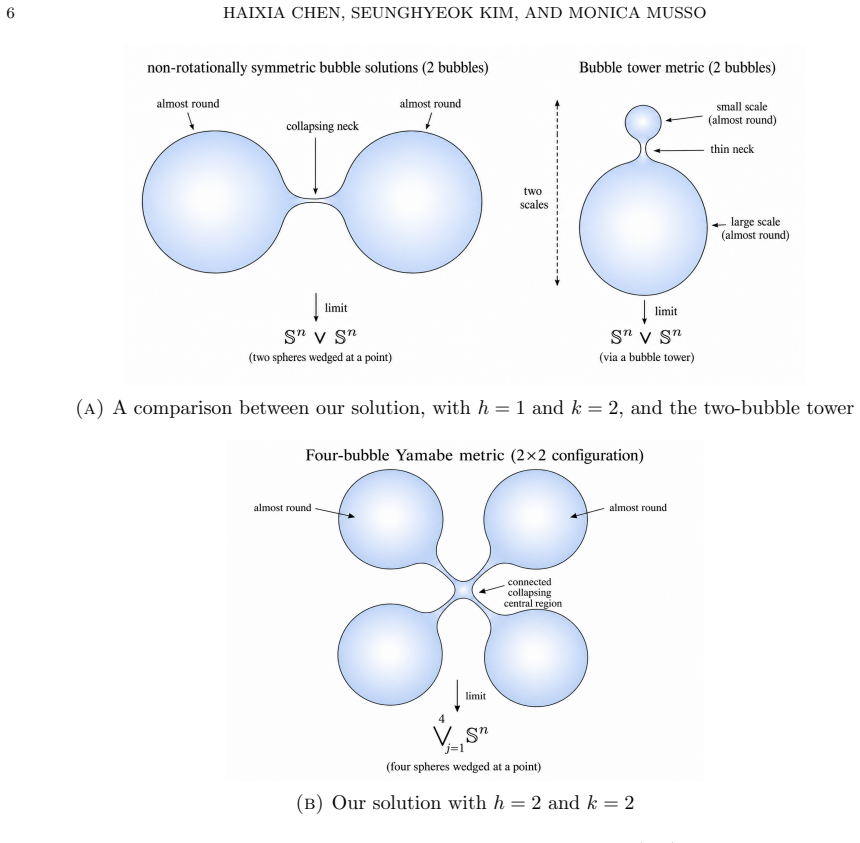
For every n ≥ 3, we construct uncountably many families of type II ancient solutions to the Yamabe flow on the unit round n-sphere S^n. These families are pairwise distinct up to conformal equivalence, and no member is conformally equivalent to a rotationally symmetric solution. At every negative time, the Ricci curvature tensor of each solution is indefinite at some point. Moreover, the associated backward limit space is a wedge sum of finitely many isometric copies of S^n.
What carries the argument
Non-radial inner-outer gluing scheme that exploits Kelvin invariance to switch between Euclidean and spherical formulations while applying weighted Hölder estimates to control non-radial modes directly.
If this is right
- The collection of ancient Yamabe flows on S^n has a much richer structure than suggested by rotationally symmetric compact ancient Ricci flows on S^2.
- The collection is also richer than the positive entire solutions to the elliptic Yamabe equation on R^n, which are only the standard bubbles.
- Each solution has indefinite Ricci curvature at some point at every negative time.
- The backward limit space of each solution is a wedge sum of finitely many isometric copies of S^n.
Where Pith is reading between the lines
- The construction indicates that type II ancient solutions may form a larger portion of the solution set than previously expected in dimensions three and higher.
- Similar non-radial gluing methods could be applied to produce non-symmetric ancient solutions for other conformally invariant parabolic equations on the sphere.
- The set of conformal equivalence classes of ancient Yamabe flows on S^n for n ≥ 3 is uncountable.
- One could investigate whether every ancient Yamabe flow on the sphere arises from some form of inner-outer gluing or whether additional families exist outside this scheme.
Load-bearing premise
The weighted Hölder estimates suffice to control the non-radial modes directly in the non-radial inner-outer gluing scheme after switching between Euclidean and spherical formulations via Kelvin invariance.
What would settle it
A direct computation or conformal transformation showing that one constructed solution is rotationally symmetric or has definite Ricci curvature everywhere at some negative time would falsify the claims of non-equivalence and indefinite curvature.
Figures
read the original abstract
For every $n \ge 3$, we construct uncountably many families of type II ancient solutions to the Yamabe flow on the unit round $n$-sphere $\Ss^n$. These families are pairwise distinct up to conformal equivalence, and no member is conformally equivalent to a rotationally symmetric solution. At every negative time, the Ricci curvature tensor of each solution is indefinite at some point. Moreover, the associated backward limit space is a wedge sum of finitely many isometric copies of $\Ss^n$. These examples show that the collection of ancient Yamabe flows on $\Ss^n$ has a much richer structure than suggested by two natural comparison problems: the compact ancient Ricci flows on $\Ss^2$, all of which are known to be rotationally symmetric, and the elliptic Yamabe equation on $\R^n$, whose positive entire solutions are only the standard bubbles. The construction uses a non-radial inner--outer gluing scheme. After stereographic projection, we reformulate the flow as a conformally invariant parabolic problem on $\R^n$. By exploiting Kelvin invariance and switching between the Euclidean and spherical formulations as needed, we control the non-radial modes directly without reducing the problem to one space dimension. Weighted H\"older estimates provide the pointwise control needed to establish the Type II behavior, the Ricci-sign property, conformal inequivalence, and the description of the backward limits in a straightforward manner.
Editorial analysis
A structured set of objections, weighed in public.
Referee Report
Summary. The manuscript claims to construct, for every n ≥ 3, uncountably many families of type II ancient Yamabe flows on the round sphere S^n. These families are pairwise distinct up to conformal equivalence, none is rotationally symmetric, each has indefinite Ricci curvature at some point for every negative time, and each has a backward limit that is a wedge sum of finitely many isometric copies of S^n. The construction proceeds via a non-radial inner-outer gluing scheme after stereographic projection to R^n, using Kelvin invariance to switch between Euclidean and spherical formulations and weighted Hölder estimates to obtain the required pointwise control on non-radial modes.
Significance. If the estimates close, the result would establish a substantially richer moduli space of ancient Yamabe flows on S^n than is suggested by the known rotational symmetry of compact ancient Ricci flows on S^2 or the classification of positive entire solutions to the elliptic Yamabe equation on R^n. The construction supplies the first explicit non-radial type II examples and demonstrates that the flow can produce indefinite curvature and non-trivial wedge-sum limits without reducing to one dimension.
major comments (2)
- [non-radial inner-outer gluing scheme (construction outline)] The central non-radial claim rests on the assertion that weighted Hölder estimates continue to control spherical harmonics of degree ≥2 after the Kelvin switch between Euclidean and spherical formulations. The manuscript does not supply the explicit transformation law for the weights under Kelvin inversion or the resulting spectral-gap verification at the gluing interface; without this, the pointwise bounds needed for type II behavior and conformal inequivalence are not yet secured.
- [backward-limit analysis] The description of the backward limit as a wedge sum of finitely many S^n copies is stated to follow directly from the gluing, yet the argument that the non-radial perturbations remain small enough in the ancient-time regime to produce exactly this topology (rather than a different limit) is not accompanied by a quantitative decay estimate that accounts for the Kelvin-transformed non-radial modes.
minor comments (1)
- [preliminaries] Notation for the weighted Hölder spaces and the precise form of the weights (e.g., |x|^α) should be introduced once at the beginning of the estimates section rather than re-defined inline.
Simulated Author's Rebuttal
We thank the referee for the careful reading and constructive suggestions. The comments correctly identify places where additional explicit calculations would improve the clarity of the non-radial estimates. We address each point below and will revise the manuscript to incorporate the requested details.
read point-by-point responses
-
Referee: The central non-radial claim rests on the assertion that weighted Hölder estimates continue to control spherical harmonics of degree ≥2 after the Kelvin switch between Euclidean and spherical formulations. The manuscript does not supply the explicit transformation law for the weights under Kelvin inversion or the resulting spectral-gap verification at the gluing interface; without this, the pointwise bounds needed for type II behavior and conformal inequivalence are not yet secured.
Authors: We agree that the explicit transformation law for the weights under Kelvin inversion and the spectral-gap verification for spherical harmonics of degree ≥2 at the gluing interface are not written out in the current text. These steps follow from standard conformal covariance of the Yamabe operator and the weighted spaces already introduced, but were left implicit. In the revised manuscript we will add the precise transformation formulas for the weights and the resulting spectral-gap estimate, thereby securing the pointwise bounds for the non-radial modes. revision: yes
-
Referee: The description of the backward limit as a wedge sum of finitely many S^n copies is stated to follow directly from the gluing, yet the argument that the non-radial perturbations remain small enough in the ancient-time regime to produce exactly this topology (rather than a different limit) is not accompanied by a quantitative decay estimate that accounts for the Kelvin-transformed non-radial modes.
Authors: We acknowledge that a quantitative decay estimate for the Kelvin-transformed non-radial modes in the ancient-time regime is needed to rigorously confirm that the backward limit is precisely the claimed wedge sum rather than a different topology. The weighted Hölder estimates already control these modes, but the decay rates must be tracked explicitly through the ancient-time limit. We will insert the required quantitative estimates in the revision. revision: yes
Circularity Check
No circularity; construction is self-contained via gluing
full rationale
The paper's derivation is a direct existence construction of ancient solutions via non-radial inner-outer gluing after stereographic projection, with Kelvin invariance used to switch formulations and control modes, followed by application of weighted Hölder estimates to verify type II behavior and other properties. No step reduces a claimed result to its own inputs by definition, renames a fitted quantity as a prediction, or relies on a self-citation chain for a uniqueness theorem or ansatz. The central claims follow from the gluing procedure and estimates without tautological equivalence to the setup, making the derivation independent and self-contained.
Axiom & Free-Parameter Ledger
axioms (2)
- standard math Standard local existence, uniqueness, and regularity theory for parabolic geometric flows
- domain assumption Kelvin inversion preserves the Yamabe flow equation after stereographic projection
Reference graph
Works this paper leans on
-
[1]
Angenent, Shrinking doughnuts, in Nonlinear diffusion equations and their equilibrium states, 3 (Gregynog, 1989), 21–38, Birkh¨ auser Boston, Boston, MA, 1992
S. Angenent, Shrinking doughnuts, in Nonlinear diffusion equations and their equilibrium states, 3 (Gregynog, 1989), 21–38, Birkh¨ auser Boston, Boston, MA, 1992
1989
-
[2]
Angenent, P
S. Angenent, P. Daskalopoulos, and N. Sesum, Uniqueness of two-convex closed ancient solutions to the mean curvature flow, Ann. of Math.192(2020), 353–436
2020
-
[3]
Bakas, S
I. Bakas, S. Kong, and L. Ni, Ancient solutions of Ricci flow on spheres and generalized Hopf fibrations, J. Reine Angew. Math.663(2012), 209–248. 62 HAIXIA CHEN, SEUNGHYEOK KIM, AND MONICA MUSSO
2012
-
[4]
Y. Bi, T. Hao, S. He, Y. Shi, and J. Zhu, A proof for the Riemannian positive mass theorem up to dimension 19, preprint, arXiv:2603.02769
-
[5]
Brendle, Convergence of the Yamabe flow for arbitrary initial energy, J
S. Brendle, Convergence of the Yamabe flow for arbitrary initial energy, J. Differential Geom.69(2005), 217–278
2005
-
[6]
Math.170(2007), 541–576
, Convergence of the Yamabe flow in dimension 6 and higher, Invent. Math.170(2007), 541–576
2007
-
[7]
Brendle, P
S. Brendle, P. Daskalopoulos, K. Naff, and N. Sesum, Uniqueness of compact ancient solutions to the higher- dimensional Ricci flow, J. Reine Angew. Math.795(2023), 85–138
2023
-
[8]
Brendle, P
S. Brendle, P. Daskalopoulos, and N. Sesum, Uniqueness of compact ancient solutions to three-dimensional Ricci flow, Invent. Math.226(2021), 579–651
2021
-
[9]
Brendle and N
S. Brendle and N. Kapouleas, Gluing Eguchi–Hanson metrics and a question of Page, Comm. Pure Appl. Math.70(2017), 1366–1401
2017
-
[10]
S. Brendle and Y. Wang, A dimension descent scheme for the positive mass theorem in arbitrary dimension, preprint, arXiv:2604.08473
-
[11]
Chow, The Yamabe flow on locally conformally flat manifolds with positive Ricci curvature, Comm
B. Chow, The Yamabe flow on locally conformally flat manifolds with positive Ricci curvature, Comm. Pure Appl. Math.45(1992), 1003–1014
1992
-
[12]
Collot, Nonradial type II blow up for the energy-supercritical semilinear heat equation, Anal
C. Collot, Nonradial type II blow up for the energy-supercritical semilinear heat equation, Anal. PDE10 (2017), 127–252
2017
-
[13]
Cort´ azar, M
C. Cort´ azar, M. del Pino, and M. Musso, Green’s function and infinite-time bubbling in the critical nonlinear heat equation, J. Eur. Math. Soc.22(2020), 283–344
2020
-
[14]
Daskalopoulos, M
P. Daskalopoulos, M. del Pino, J. King, and N. Sesum, New type I ancient compact solutions of the Yamabe flow, Math. Res. Lett.24(2017), 1667–1691
2017
-
[15]
Daskalopoulos, M
P. Daskalopoulos, M. del Pino, and N. Sesum, Type II ancient compact solutions to the Yamabe flow, J. Reine Angew. Math.738(2018), 1–71
2018
-
[16]
Daskalopoulos, R
P. Daskalopoulos, R. Hamilton, and N. Sesum, Classification of compact ancient solutions to the curve short- ening flow, J. Differential Geom.84(2010), 455–464
2010
-
[17]
Differential Geom.91 (2012), 171–214
, Classification of ancient compact solutions to the Ricci flow on surfaces, J. Differential Geom.91 (2012), 171–214
2012
-
[18]
D´ avila, M
J. D´ avila, M. del Pino, C. Pesce, and J. Wei, Blow-up for the 3-dimensional axially symmetric harmonic map flow intoS 2, Discrete Contin. Dyn. Syst.39(2019), 6913–6943
2019
-
[19]
D´ avila, M
J. D´ avila, M. del Pino, and J. Wei, Singularity formation for the two-dimensional harmonic map flow intoS2, Invent. Math.219(2020), 345–466
2020
-
[20]
del Pino, M
M. del Pino, M. Musso, F. Pacard, and A. Pistoia, Large energy entire solutions for the Yamabe equation, J. Differential Equations251(2011), 2568–2597
2011
-
[21]
del Pino, M
M. del Pino, M. Musso, and J. Wei, Infinite-time blow-up for the 3-dimensional energy-criticial heat equation, Anal. PDE13(2020), 215–274
2020
-
[22]
, Geometry driven type II higher dimensional blow-up for the critical heat equation, J. Funct. Anal. 280(2021), Paper No. 108788, 49 pp
2021
-
[23]
M. del Pino, M. Musso, J. Wei, Q. Zhang, and Y. Zhou, Type II finite time blow-up for the three dimensional energy critical heat equation, preprint, arXiv:2002.05765
arXiv 2002
-
[24]
del Pino, M
M. del Pino, M. Musso, J. Wei, and Y. Zheng, Sign-changing blowing-up solutions for the critical nonlinear heat equation, Ann. Sc. Norm. Super. Pisa Cl. Sci.21(2020), 569–641
2020
-
[25]
del Pino, M
M. del Pino, M. Musso, J. Wei, and Y. Zhou, Type II finite time blow-up for the energy critical heat equation inR 4, Discrete Contin. Dyn. Syst.40(2020), 3327–3355
2020
-
[26]
Hamilton, Lectures on geometric flows, unpublished manuscript (1989)
R. Hamilton, Lectures on geometric flows, unpublished manuscript (1989)
1989
-
[27]
Haslhofer and O
R. Haslhofer and O. Hershkovits, Ancient solutions of the mean curvature flow, Comm. Anal. Geom.24(2016), 593–604
2016
-
[28]
Kim and F
K. Kim and F. Merle, On classification of global dynamics for energy-critical equivariant harmonic map heat flows and radial nonlinear heat equation, Comm. Pure Appl. Math.78(2025), 1783–1842
2025
-
[29]
, Rigidity results in multi-bubble dynamics for non-radial energy-critical heat equation, preprint, arXiv:2601.12517
-
[30]
Kim and M
S. Kim and M. Musso, Infinite-time blowing-up solutions to small perturbations of the Yamabe flow, Adv. Math.443(2024), Paper No. 109611, 77 pp
2024
-
[31]
J. R. King, Exact polynomial solutions to some nonlinear diffusion equations, Phys. D64(1993), 39–65
1993
-
[32]
Y. Li and L. Sun, Planar doubling nodal solutions to the Yamabe equation with maximal rank, preprint, arXiv:2604.02978
-
[33]
Medina and M
M. Medina and M. Musso, Doubling nodal solutions to the Yamabe equation inR n with maximal rank, J. Math. Pures Appl.152(2021), 145–188. NON-ROTATIONALLY SYMMETRIC TYPE II ANCIENT YAMABE FLOWS 63
2021
-
[34]
Medina, M
M. Medina, M. Musso, and J. Wei, Desingularization of Clifford torus and nonradial solutions to the Yamabe problem with maximal rank, J. Funct. Anal.276(2019), 2470–2523
2019
-
[35]
Musso and J
M. Musso and J. Wei, Nondegeneracy of nodal solutions to the critical Yamabe problem, Comm. Math. Phys. 340(2015), 1049–1107
2015
-
[36]
G. Perelman, The entropy formula for the Ricci flow and its geometric applications, preprint, arXiv:math/0211159
-
[37]
Rosenau, Fast and superfast diffusion processes, Phys
P. Rosenau, Fast and superfast diffusion processes, Phys. Rev. Lett.74(1995), 1056–1059
1995
-
[38]
Schwetlick and M
H. Schwetlick and M. Struwe, Convergence of the Yamabe flow for large energies, J. Reine Angew. Math.562 (2003), 59–100
2003
-
[39]
L. Sun, J. Wei, and W. Yang, On Brezis’ first open problem: A complete solution, preprint, arXiv:2503.06904
-
[40]
J. Wei, Q. Zhang, and Y. Zhou, On Fila-King conjecture in dimension four, J. Differential Equations398 (2024), 38–140
2024
-
[41]
White, The nature of singularities in mean curvature flow of mean convex sets, J
B. White, The nature of singularities in mean curvature flow of mean convex sets, J. Amer. Math. Soc.16 (2003), 123–138
2003
-
[42]
Ye, Global existence and convergence of Yamabe flow, J
R. Ye, Global existence and convergence of Yamabe flow, J. Differential Geom.39(1994), 35–50. (Haixia Chen)Department of Mathematics and Research Institute for Natural Sciences, College of Natural Sciences, Hanyang University, 222 W angsimni-ro Seongdong-gu, Seoul 04763, Republic of Korea Email address:hxchen0402@gmail.com (Seunghyeok Kim)Department of Ma...
1994
discussion (0)
Sign in with ORCID, Apple, or X to comment. Anyone can read and Pith papers without signing in.