REVIEW 2 major objections 4 minor 11 references
Marginal Reputation
T0 review · 2 major / 4 minor · reviewed 2026-08-12 · deepseek-v4-flash
Pith's one-line read A patient long-run player can secure her Stackelberg payoff even when short-run opponents observe only her action marginal, provided the Stackelberg strategy is confound-defeating and not behaviorally confounded.
desk verdict A genuinely new core result on reputation with partial identification, but the advertised salience extension is unproved and should be treated as a conjecture. read the letter →
The pith
A machine-rendered reading of the paper's core claim, the machinery that carries it, and where it could break.
The reading
What carries the argument
The load-bearing object is the confound-defeating property: $s_1^*$ is confound-defeating if, for any short-run strategy pair $(\alpha_0,\alpha_2)$ that is a 0-confirmed best response to $s_1^*$, the joint distribution $\gamma(\alpha_0,s_1^*)$ over private signals and actions is the unique maximizer of the optimal transport problem with the marginals fixed. This property, characterized by strict cyclical monotonicity of the support, is what lets the paper replace the weak bound from 0-confirmed best responses with the full commitment payoff $V(s_1^*)$. The second pillar is the non-behavioral-confounding assumption, which ensures that the public signal separates $s_1^*$ from every other commitment type and lets posterior beliefs concentrate on $\omega_{s_1^*}$; the proof of this concentration step uses a merging argument and a bound on the expected number of periods before short-run players learn the Stackelberg marginal.
What would settle it
In the deterrence game of Section 2 with two commitment types—the pure Stackelberg strategy $(A,F)$ and a type that plays $A$ with probability $p$ after every signal—Theorem 2 predicts $\liminf_{\delta\to 1} U_1(\delta)\ge \beta p+(1-\beta)(1-p)$, where $\beta$ is the salience of $(A,F)$. Computing equilibrium payoffs of the repeated game for $\delta$ close to 1, with parameters satisfying $x+y<1$ and a prior that makes $\beta\in(0,1)$, and checking whether any equilibrium falls below that bound would settle the claim.
Extended reading notes
Core claim
The paper's main theorem states that if a commitment type $\omega_{s_1^*}\in\Omega$, $s_1^*$ is confound-defeating, and $s_1^*$ is not behaviorally confounded, then $\liminf_{\delta\to 1} U_1(\delta)\ge V(s_1^*)$. Hence a patient long-run player can secure her Stackelberg payoff $v_1^*$ whenever the Stackelberg strategy satisfies these conditions. The reason is that short-run players eventually learn the marginal signal distribution induced by $s_1^*$ and, because the strategy is confound-defeating, they also learn that rational play near that marginal must be close to $s_1^*$; because the strategy is not behaviorally confounded, posterior beliefs concentrate on the commitment type $\omega_{s_1^*}$. Confound-defeatingness is equivalent to $s_1^*$ being the unique solution of an optimal transport problem with fixed marginals over the private signal and the action, which in turn is equivalent to strict cyclical monotonicity of the support of the induced joint distribution. In strictly supermodular one-dimensional games this is equivalent to $s_1^*$ being monotone, and the converse bound shows that a rational long-run player who is almost surely known cannot earn more than the upper commitment payoff from cyclically monotone strategies. When $s_1^*$ is behaviorally confounded but salient under the prior, the lower bound becomes $\beta V(s_1^*)+(1-\beta)V_0(s_1^*)$, where $\beta$ is the salience of the Stackelberg type.
Load-bearing premise
The payoff bound depends on the Stackelberg strategy not being behaviorally confounded—no other commitment type can produce the same observed signal distribution under any short-run-player best response—and when that fails, the paper recovers the bound only under a strong prior-salience condition whose proof relies on an asserted modification of the belief-concentration lemma.
Editorial extensions
If this is right
- In one-dimensional strictly supermodular games, any monotone, non-behaviorally confounded Stackelberg strategy secures its commitment payoff, and when short-run players have unique best responses the equilibrium payoff is uniquely pinned down as patience and prior rationality both approach 1.
- The Fudenberg–Levine lower bound is vacuous in these games because both deterring and not deterring are 0-confirmed best responses to the Stackelberg strategy; confound-defeatingness is exactly what upgrades the bound from $V_0(s_1^*)$ to $V(s_1^*)$.
- In repeated signaling with state-independent sender preferences over receiver actions and strictly submodular signaling costs, a patient sender secures the commitment payoff from any monotone signaling strategy even though receivers never observe past states.
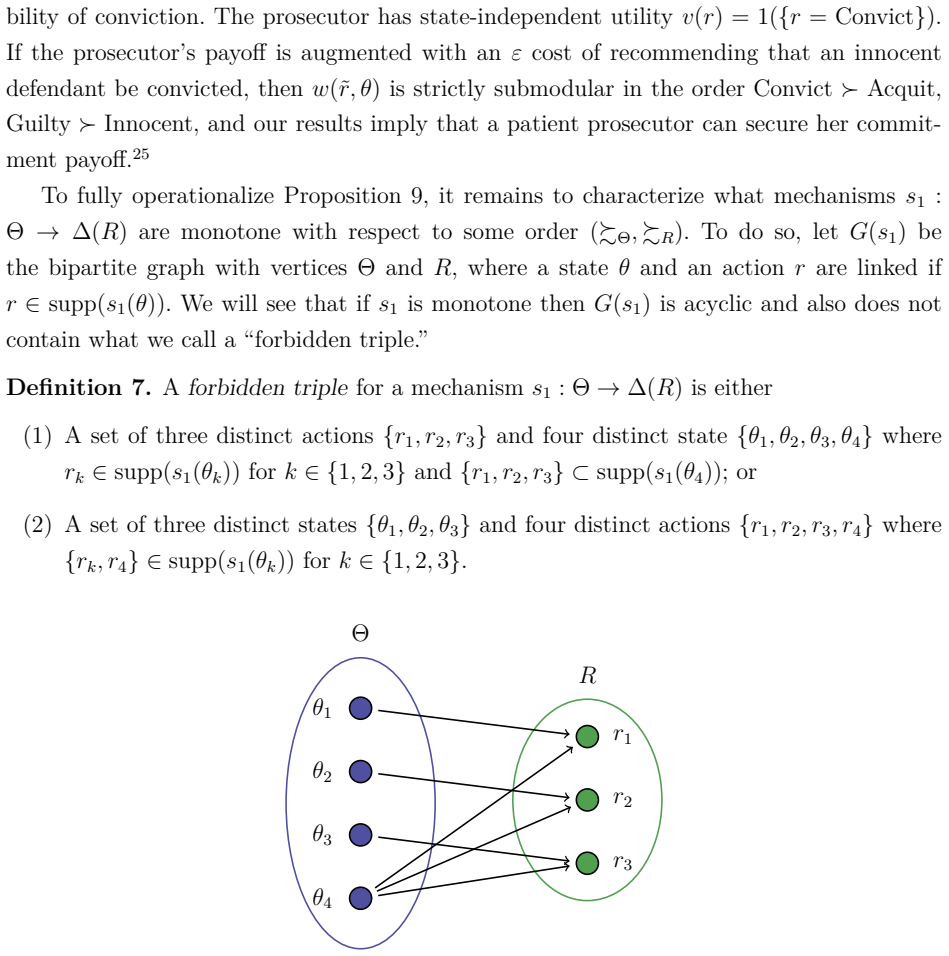
- Adding a small strictly submodular lying cost to repeated cheap talk provides a reputational foundation for every communication mechanism that is monotone with respect to some order on states and receiver actions, a class characterized by acyclicity plus absence of forbidden triples in the mechanism's bipartite graph.
- If the Stackelberg type is behaviorally confounded, the assured payoff is $\beta V(s_1^*)+(1-\beta)V_0(s_1^*)$, so raising the prior weight on the Stackelberg type raises the lower bound continuously rather than in a discrete jump.
Reading between the lines
- A likely extension left undeveloped: the optimal-transport test for confound-defeatingness can serve as a general criterion for when undetectable deviations are harmless in other repeated-game environments, including long-run mediators and games with multiple long-run players.
- Because the salience bound is linear in $\beta$, the model predicts that equilibrium payoff guarantees respond smoothly to prior odds on the Stackelberg type, an implication that could be tested experimentally by varying the prior across treatments.
- The forbidden-triple/acyclicity characterization of monotone mechanisms is a purely combinatorial criterion that could be reused to identify which information structures are robust to small communication costs outside the reputation setting, which the paper does not develop.
Editorial analysis
A structured set of objections, weighed in public.
Referee Report
Summary. The paper studies repeated games with a long-run player who privately observes i.i.d. signals and takes actions, while short-run players observe only the history of her actions. Because only the marginal distribution of actions is observed, the long-run player's strategy is not identified, so standard reputation bounds are vacuous. The paper introduces the notion of a confound-defeating strategy—one that is uniquely optimal among all strategies inducing the same action marginal against any 0-confirmed best response—and proves (Theorem 1) that if the Stackelberg strategy is confound-defeating and not behaviorally confounded, a patient long-run player secures her Stackelberg payoff. Confound-defeatingness is characterized as strict cyclical monotonicity of the support of the induced signal–action distribution (Corollary 1, Proposition 4), which in one-dimensional supermodular games reduces to monotonicity (Proposition 6). Applications to deterrence, delegation, signaling, and cheap talk with lying costs are developed. The paper also claims an extension to behaviorally confounded types via a prior-salience condition (Theorem 2).
Significance. If the proofs are correct, this is a substantial contribution to the reputation literature: it gives a tight condition under which a long-run player can secure her commitment payoff even when her strategy is only partially identified, and it provides a clean optimal-transport characterization that is easy to verify in applications. The paper is self-contained, uses standard tools, and the proof of Theorem 1 is detailed and appears correct. The applications to deterrence and communication are timely and well-developed. The main weakness is that the advertised extension to indistinguishable commitment types (Theorem 2) rests on an unproved lemma, so the full advertised scope is not yet established.
major comments (2)
- [Appendix A.8 (proof of Lemma 9)] The proof of Lemma 9 begins by asserting that "Lemma 2 and an appropriate modification of Lemma 3 (with Ω_η(s*_1) in place of {ω_s*_1}) imply that..." but no such modified Lemma 3 is stated or proved anywhere in the manuscript. This is not a cosmetic change: Lemma 3's proof relies on the non-behavioral-confounding assumption to force posterior concentration on the singleton {ω_R, ω_s*_1}; the modified version would have to concentrate on Ω_η(s*_1), a set that grows with η and contains types whose behavior is genuinely different from s*_1. The compactness and Kochen–Stone uniformity argument in Appendix A.3 may fail when the target set is a neighborhood rather than a singleton. Because Theorem 2 is the only result that covers behaviorally confounded types, and the abstract explicitly advertises this extension, the proof gap is load-bearing. Please provide a complete statement and proof of the modified Lemma 3, or clearly delineate which claims of Theorem 2 are conditional on this unproved step.
- [Appendix A.8 (definition of β_{ς,η})] In the proof of Lemma 9, the quantity β_{ς,η} is first defined using μ0(ω_s*_1|Ω_0(s*_1)\{ω_R})(s*_1), while the subsequent inequality and closing arguments use μ0(ω_s*_1|Ω_η(s*_1)\{ω_R}). The relationship between Ω_0(s*_1) (the exact limit set) and Ω_η(s*_1) (the η-neighborhood) is not clarified, and the double limit lim_{ς→0} lim_{η→0} that should yield the β of Definition 9 is not exhibited. The proof therefore does not establish the stated lower bound in Lemma 9 even conditionally on the modified Lemma 3; the limiting argument needs to be spelled out carefully.
minor comments (4)
- [Throughout] There are several typographical errors and inconsistent notations (for example, the stray "(s*_1)" inside the conditional probability in the definition of β_{ς,η} in A.8, and occasional alternation between "confound-defeating" and "confounding-defeating"). A careful proofreading pass is recommended.
- [Section 8, Definition of Ω_η(s*_1)] The definition of Ω_η(s*_1) includes the rational type ω_R, but the proof of Lemma 9 repeatedly uses the expression μ_t(Ω_η(s*_1)\{ω_R}|h_t). For readability, it would help to explicitly separate the rational type from the commitment types in the notation.
- [Appendix A.8, proof of Lemma 10] The assertion that the best-response set at a convex combination of strategies is the same as at s'_1 "by the sure-thing principle" is correct but terse; a one-sentence explanation referencing linearity of payoffs in the strategy would improve clarity.
- [Proposition 10] In the proof of Proposition 10, the statement that for any k ≥ 2 and any r ∈ supp(s1(θ_k)) we have r_{k−1} ≾_R r ≾_R r_k is asserted without proof; the cycle argument that justifies this claim should be made explicit.
Circularity Check
No circularity: all load-bearing results are proved from stated assumptions or external theorems; Theorem 2 has an unproved lemma but no circular reduction.
full rationale
The paper's central derivation is self-contained against external benchmarks. Theorem 1's sufficient conditions are defined independently of the payoff bound V(s1*): confound-defeatingness is characterized as unique optimality in an optimal transport problem (Definition 2, Proposition 3), and non-behavioral confounding is a signal-distinguishability condition across commitment types (Definition 3). Neither definition references V(s1*) or the Stackelberg payoff, so the conclusion is not built into the assumptions. The proof chain is a genuine derivation: Lemma 1 uses confound-defeatingness to force rational play near s1* once the marginal is learned; Lemma 2 invokes Gossner's standard entropy bound; Lemma 3 uses the martingale convergence theorem plus non-behavioral confounding to concentrate posterior beliefs on {omega_R, omega_s1*}; Lemma 4 converts those beliefs into near-best responses to s1*. The payoff lower bound emerges from these steps rather than being assumed. The cyclical-monotonicity results (Propositions 4 and 6) rely on external optimal transport theorems of Rochet and Santambrogio, and on Lin-Liu's co-monotonicity lemma, not on the authors' own prior results. Self-citations such as Acemoglu-Wolitzky (2024) and Clark-Fudenberg-Wolitzky (2021) appear only in the literature discussion and are not load-bearing. The only notable gap is in the proof of Theorem 2: Appendix A.8 invokes 'an appropriate modification of Lemma 3 (with Omega_eta(s1*) in place of {omega_s1*})' without stating or proving that modification. This is a completeness or correctness gap, not circularity, because the required modification is an independent posterior-concentration claim; it is not equivalent to the payoff bound being derived, and no fitted parameter is renamed as a prediction. No step in the paper reduces, by definition or by self-citation, to its own inputs.
Assumptions & free parameters
assumptions (8)
- domain assumption Assumption 1(1): private signal y0 has full support for every player 0 action.
- domain assumption Assumption 1(2): the support of public signal y1 is independent of player 2's action.
- domain assumption Assumption 1(3): public signal y1 statistically identifies the long-run player's action.
- domain assumption Commitment types are countable and the prior μ0 has full support on the type space Ω.
- standard math The Fudenberg-Levine / Gossner lower bound (Theorem 0) holds in this environment.
- standard math Optimal transport results: strict cyclical monotonicity characterizes unique optima; co-monotone couplings are unique maximizers for supermodular costs.
- standard math Martingale convergence theorem, Pinsker's inequality, relative entropy chain rule, Arzela-Ascoli, and Kochen-Stone theorem.
- domain assumption The Stackelberg strategy is not behaviorally confounded (Definition 3), or otherwise has sufficient salience under the prior.
Cite this review
Pith. "Pith review of Marginal Reputation." pith.science (2026). https://pith.science/paper/4BIHGQUH
@misc{pith2026241115317,
  author       = {Pith},
  title        = {Pith review of: Marginal Reputation},
  year         = {2026},
  howpublished = {\url{https://pith.science/paper/4BIHGQUH}},
  note         = {Machine review of arXiv:2411.15317}
}
read the original abstract
We study reputation formation where a long-run player repeatedly observes private signals and takes actions. Short-run players observe the long-run player's past actions but not her past signals. The long-run player can thus develop a reputation for playing a distribution over actions, but not necessarily for playing a particular mapping from signals to actions. Nonetheless, we show that the long-run player can secure her Stackelberg payoff if distinct commitment types are statistically distinguishable and the Stackelberg strategy is confound-defeating. This property holds if and only if the Stackelberg strategy is the unique solution to an optimal transport problem. If the long-run player's payoff is supermodular in one-dimensional signals and actions, she secures the Stackelberg payoff if and only if the Stackelberg strategy is monotone. Applications include deterrence, delegation, signaling, and persuasion. Our results extend to the case where distinct commitment types may be indistinguishable but the Stackelberg type is salient under the prior.
Figures

Reference graph
Works this paper leans on
-
[1]
Mistrust, Misperception, and Mis- understanding:ImperfectInformationandConflictDynamics
Acemoglu, Daron, and Alexander Wolitzky.2024. “Mistrust, Misperception, and Mis- understanding:ImperfectInformationandConflictDynamics.” Handbook of the Economics of Conflict. Arieli, Itai, Yakov Babichenko, Rann Smorodinsky, and Takuro Yamashita.2023. “Optimal Persuasion via Bi-Pooling.”Theoretical Economics18 (1): 15–36. Arthan, Rob, and Paulo Oliva.202...
work page 2024
-
[3]
Quota Mechanisms: Finite-Sample Optimality and Robustness
Chap. 51 1947–1987, Elsevier. Ball, Ian, and Deniz Kattwinkel.2024. “Quota Mechanisms: Finite-Sample Optimality and Robustness.”Working Paper. Battigalli, Pierpaolo, and Joel Watson.1997. “On “reputation” refinements with het- erogeneous beliefs.”Econometrica 369–374. Best, James, and Daniel Quigley
work page 1947
-
[5]
Information acquisition and reputation dynamics
“Information acquisition and reputation dynamics.”The Review of Economic Studies78 (4): 1400–1425. Liu, Qingmin, and Andrzej Skrzypacz.2014. “Limited Records and Reputation Bub- bles.”Journal of Economic Theory151 2–29. Mailath, George J., and Larry Samuelson.2006. Repeated Games and Reputations: Long-Run Relationships. Oxford University Press. Margaria, ...
work page 2014
-
[10]
Detecting Profitable Deviations
“Detecting Profitable Deviations.” Journal of Mathematical Economics 111 102946. Rayo, Luis, and Ilya Segal.2010. “Optimal Information Disclosure.”Journal of Political Economy 118 (5): 949–987. Renault, Jérôme, Eilon Solan, and Nicolas Vieille.2013. “Dynamic Sender–Receiver Games.”Journal of Economic Theory148 (2): 502–534. Rochet, Jean-Charles.1987. “A N...
work page 2010
-
[55]
Cambridge University Press. Morris, Stephen.2001. “Political correctness.”Journal of Political Economy109 (2): 231–
work page 2001
- [265]
-
[1966]
Merging, Reputation, and Repeated Games with Incomplete Infor- mation
Arms and Influence. Chap. 1 74, The Henry L. Stimson Lectures Series, Yale University Press. Sorin, Sylvain.1999. “Merging, Reputation, and Repeated Games with Incomplete Infor- mation.”Games and Economic Behavior29 274–308. Spence, Michael.1973. “Job Market Signaling.”The Quarterly Journal of Economics87 (3): 355–374. Takahashi, Satoru.2010. “Community e...
work page 1999
-
[1982]
Optimal coordination mechanisms in generalized principal– agent problems
“Optimal coordination mechanisms in generalized principal– agent problems.”Journal of mathematical economics10 (1): 67–81. Pei, Harry.2020. “Reputation Effects Under Interdependent Values.”Econometrica88 (5): 1671–1700. 46 Pei, Harry.2023. “Repeated Communication with Private Lying Costs.”Journal of Eco- nomic Theory210 105668. Pei, Harry.2024. “Reputatio...
work page 2020
Show all 11 references
-
[2011]
Bayesian Persuasion
“Bayesian Persuasion.”American Economic Review101 (6): 2590–2615. Kartik, Navin.2009. “Strategic communication with lying costs.”The Review of Economic Studies 76 (4): 1359–1395. Kleiner, Andreas, Benny Moldovanu, and Philipp Strack.2021. “Extreme Points and Majorization: Econ...
2009
-
[2018]
Dynamic Communication with Biased Senders
“Dynamic Communication with Biased Senders.”Games and Economic Behavior110 330–339. Mathevet, Laurent, David Pearce, and Ennio Stacchetti.2024. “Reputation and Information Design.”Working Paper. Matsushima, Hitoshi, Koichi Miyazaki, and Nobuyuki Yagi.2010. “Role of Linking Mec...
2024
-
[2024]
Persuasion for the Long Run
“Persuasion for the Long Run.”Journal of Political Economy132 (5): 1305–1337. Chakraborty,Archishman,andRickHarbaugh. 2007.“Comparativecheaptalk.” Jour- nal of Economic Theory132 (1): 70–94. Chen, Ying, Navin Kartik, and Joel Sobel.2008. “Selecting cheap-talk equilibria.” Econ...
2007
Reviewed August 12, 2026 · model on record in the stance chip above.
Discussion (0). Continue with ORCID to comment.