REVIEW 4 major objections 6 minor 18 references
Embedding and Approximation Theorems for Echo State Networks
T0 review · 4 major / 6 minor · reviewed 2026-08-14 · deepseek-v4-flash
Pith's one-line read An echo state network trained on a scalar time series can reconstruct the full dynamics of the observed system, up to topological equivalence.
desk verdict A serious theoretical contribution with two load-bearing proof gaps that are likely fixable; deserves peer review but not citation as a theorem yet. read the letter →
The pith
A machine-rendered reading of the paper's core claim, the machinery that carries it, and where it could break.
The reading
What carries the argument
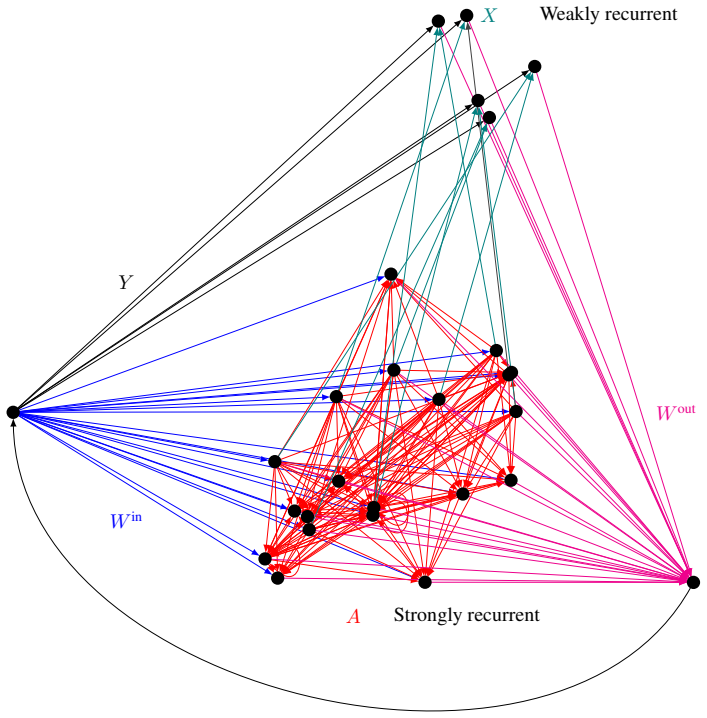
The load-bearing object is the Echo State Family $F=\{f_k^{r_0}\}$, defined by $f_{k+1}^{r_0}(x)=\phi(A f_k^{r_0}(\phi^{-1}(x))+W_{\mathrm{in}}\omega(x))$, and its limit $f=\lim_{k\to\infty} f_k^{r_0}$, the Echo State Map. The argument first proves $f$ exists as the unique $C^1$ fixed point of the composition operator $\Psi(f)=\phi(Af\circ\phi^{-1}+W_{\mathrm{in}}\omega)$; if $f$ embeds $M$ into reservoir space, then the target dynamics on the embedded copy are $f\circ\phi\circ f^{-1}$. The Random Universal Approximation Theorem then supplies a linear readout approximating this conjugate dynamics in the $C^1$ norm, and the Invariant Manifold Theorem guarantees that a sufficiently close approximation has a normally hyperbolic attracting submanifold carrying the same dynamics.
What would settle it
Choose $\sigma\in C^1(\mathbb{R},(-1,1))$ with $0<\sigma'<1$ but with $\sigma'$ not Lipschitz, for example by adding a small square-root cusp to a sigmoid, and pick $f,g$ whose values straddle the cusp. Computing $\Psi(f)-\Psi(g)$ in the $C^1$ norm shows that the contraction factor can be pushed close to or beyond $\|A\|_2\max(1,\|D\varphi^{-1}\|_\infty)$, exactly the step the proof justifies by saying the activation is contracting in $C^1$; the existence and $C^1$ regularity of the Echo State Map would then not follow from the stated hypotheses.
Extended reading notes
Core claim
The central claim is the ESN Approximation Theorem: let $M$ be a compact $m$-manifold, $n>2m$, and suppose the Echo State Map $f$ is a $C^1$ embedding and $\phi\in\mathrm{Diff}^1(M)$ is structurally stable. Then, with probability $\alpha$ (for any prescribed $\alpha\in(0,1)$), there exist $d>n$, an extended reservoir matrix, and a linear readout $W_{\mathrm{out}}$ such that the autonomous ESN $\psi$ has a normally hyperbolic attracting submanifold on which $\psi$ is topologically conjugate to $\phi$. The companion Weak ESN Embedding Theorem shows that the embedding hypothesis is satisfied with positive probability for generic observation functions and random reservoir and input matrices with full-support distributions. Together these statements assert that the trained autonomous ESN is not merely a good predictor of future observations but a genuine copy of the underlying dynamical system in the sense of topological conjugacy.
Load-bearing premise
The proof of the Echo State Mapping Theorem treats the activation map as a contraction in the $C^1$ norm, but the stated hypotheses on $\sigma$ only control its first derivative pointwise; for the estimate to hold, $\sigma'$ must also be Lipschitz, so that the derivative part of the $C^1$ error is bounded by a uniform constant less than 1.
Editorial extensions
If this is right
- A single scalar time series from a structurally stable system can determine the system's dynamics up to topological equivalence, not just its short-term predictions.
- Geometric and topological invariants of the observed system---fixed-point eigenvalues, Lyapunov exponents, and homology---can legitimately be computed from the autonomous reservoir attractor.
- The readout is linear and only the reservoir matrices need be random, so no backpropagation through the recurrent layer is needed to obtain the topological copy.
- Because embeddings form an open set and normally hyperbolic invariant manifolds persist under small $C^1$ perturbations, a sufficiently long finite training history and approximate readout can come arbitrarily close to the ideal conjugacy.
Reading between the lines
- Beyond the paper: the authors leave the density half of Takens' theorem unproved for the Echo State Map; if that density argument can be adapted, the 'positive probability' in the Weak ESN Embedding Theorem would become an almost-sure statement, matching the heuristic that random reservoirs are topologically faithful.
- Beyond the paper: the specially structured weakly recurrent reservoir used in the proof appears stronger than needed, since the paper's own numerics use an unstructured random reservoir; the structure may be a proof device rather than a practical requirement.
- Beyond the paper: extending the approximation theorem from compact manifolds to compact invariant sets with fractional box-counting dimension would bring it directly to fractal chaotic attractors, which the authors note are not manifolds.
- Beyond the paper: if the Echo State Map acts as a nonlinear noise-reducing filter, as the authors suggest, then its embedding may be more robust to noise than delay embeddings; this is testable by comparing topological reconstructions at increasing noise levels.
Signed reviews
Editorial analysis
A structured set of objections, weighed in public.
Referee Report
Summary. This paper studies Echo State Networks driven by scalar observations of an invertible dynamical system (φ,ω) on a compact manifold M. It defines the Echo State Family as the k-step maps from M to the reservoir cube and claims (Theorem 2.2.2) that these converge in the C1 topology to a unique C1 Echo State Map f solving f=ϕ(Af∘φ^{-1}+W_inω). It then claims a weak probabilistic embedding theorem for f (Theorem 2.3.7), a Random Universal Approximation Theorem for single-layer networks with random hidden weights (Theorem 2.4.5), and the ESN Approximation Theorem (Theorem 2.4.13), stating that a sufficiently large ESN whose Echo State Map is an embedding has an autonomous phase with a normally hyperbolic attracting submanifold on which the dynamics are topologically conjugate to φ. The final sections present numerical experiments on the Lorenz system comparing eigenvalues, Lyapunov exponents, and persistent homology.
Significance. The ambition of the paper is high and the programme is natural: connecting ESNs to Takens-style delay embeddings and proving a conjugacy theorem for the autonomous phase would be a valuable contribution to reservoir computing theory. The Random Universal Approximation Theorem is a useful formalization of the extreme-learning-machine idea, and the numerical experiments are a genuine, if heuristic, illustration of the claims. I also credit the authors for clearly labelling the embedding conjecture as a conjecture and for stating limitations of the training procedure in Section 4. However, two load-bearing steps in the proofs are not justified as written—the C1 contraction estimate in Theorem 2.2.2 and the persistence-to-conjugacy step in Theorem 2.4.13—and the construction of the reference dynamics in Lemma 2.4.10 is not rigorous. These gaps currently prevent the main theoretical results from being accepted.
major comments (4)
- [§2.2, Theorem 2.2.2 (also used in Lemma 2.3.5 and Theorem 2.4.13)] The proof asserts 'because φ is contracting in C1' to pass from ‖ϕ(u)-ϕ(v)‖_{C1} to ‖u-v‖_{C1}. This is not a consequence of σ∈C1(R,(-1,1)) with 0<σ'<1. For scalar composition, D(σ∘u)=σ'(u)Du, so the derivative difference contains the term (σ'(u)-σ'(v))Dv, which is not controlled by ‖u-v‖_{C1} without a Lipschitz bound on σ' and a uniform bound on Dv. The spectral condition ‖A‖2<min(1,1/‖Dφ^{-1}‖∞) does not fix this. Because the existence, uniqueness, and C1 regularity of the Echo State Map are the foundation for the later embedding and approximation theorems, this gap is load-bearing. The proof needs either additional hypotheses (e.g., Lipschitz σ', with a norm for which the composition operator is a genuine contraction) or a different argument for C1 regularity of the C0 fixed point.
- [§2.4, Theorem 2.4.13] Immediately after citing Theorem 2.4.11, the proof states that there exists ε such that any u∈Diff1(K) with ‖u−η|K‖C1<ε is topologically conjugate to η. The stated Invariant Manifold Theorem only guarantees existence of a nearby invariant submanifold U; it says nothing about conjugacy on K (or on an open neighbourhood Ω). The subsequent line 'ψ|Ω is conjugate to η|Ω' therefore does not follow. The hypothesis that φ is structurally stable is never used in the proof, although it is precisely the kind of assumption that could justify a conjugacy conclusion after transferring the perturbed dynamics back to M. As written, the headline claim of topological conjugacy in Theorem 2.4.13 is not established. The proof should either invoke the full normal-hyperbolicity persistence theorem, which includes conjugacy of the restricted dynamics on the invariant submanifold, or supply the missing transfer argument via structural stability.
- [§2.4, Lemma 2.4.10] The construction of η as η=∑ α_k η_x, where each η_x is a local diffeomorphism in a cubic chart, is not justified. A convex combination of local diffeomorphisms need not be a diffeomorphism, and the normal contraction property of the individual η_x is not automatically preserved by the partition-of-unity sum. Since Lemma 2.4.10 supplies the reference dynamics η to which ψ is compared, this step needs a rigorous construction, for example via a tubular neighbourhood of f(M) with a product extension of fφf^{-1} and a linear contraction on the normal fibres.
- [§2.4, Theorem 2.4.13, Eq. (8)-(9)] The Random Universal Approximation Theorem is stated for C1 targets on the unit cube I_n, but it is applied to ω∘φ∘y^{-1} defined on the compact submanifold y(M)⊂R^{n+1}. The proof does not give the required extension/scaling argument. In addition, the first n summands in Eq. (8) use the fixed rows of (A,W_in), which are not drawn from the i.i.d. sequences (x_j),(y_j); to apply RUA T one must set the corresponding output weights to zero and use only the weakly recurrent rows.
minor comments (6)
- [§2.2, proof of Theorem 2.2.2] The displayed inequality '≤ ‖Af∘φ^{-1}+Winω − Af∘φ^{-1}−Winω‖' contains an obvious typo; the second occurrence of Af should be Ag.
- [§2.3, Lemma 2.3.5] 'C1 embeddings form an open subset of C1(M,R)' should read C1(M,R^n).
- [§2.3, Lemma 2.3.5] In the derivative estimate, '‖W_n^in ω_n‖∞' should be '‖W_n^in Dω_n‖∞', and the bound for rearrangement requires arρ<1/‖Dφ^{-1}‖∞, not merely arρ<1.
- [§2.4, Theorem 2.4.13] The phrase 'with probability α' should be 'with probability at least α' to match RUA T, and the existence statement for d, W_out, A~, W~_in should be read as holding on a probability-α event.
- [§2.4.2, Definition 2.4.6] The estimate ‖Dφ^kv‖≤cλ^k‖v‖ for v∈E^s is stated for k∈N; the definition of normal hyperbolicity normally requires the estimate for all k≥0 (or the sign convention should be specified).
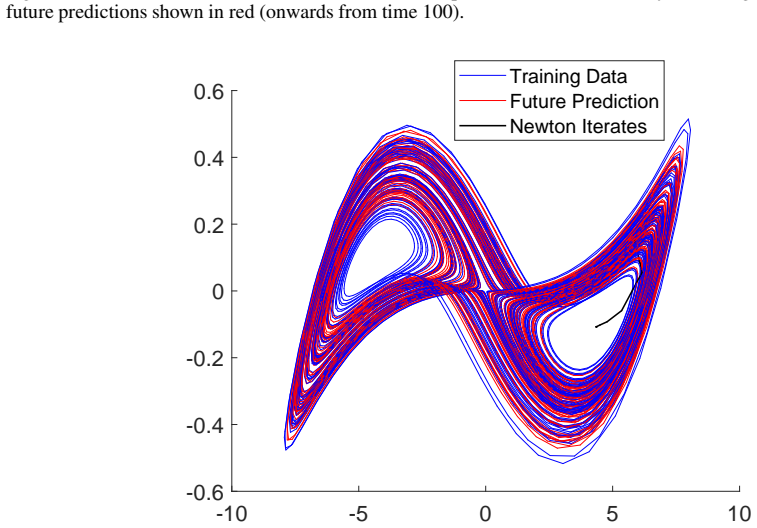
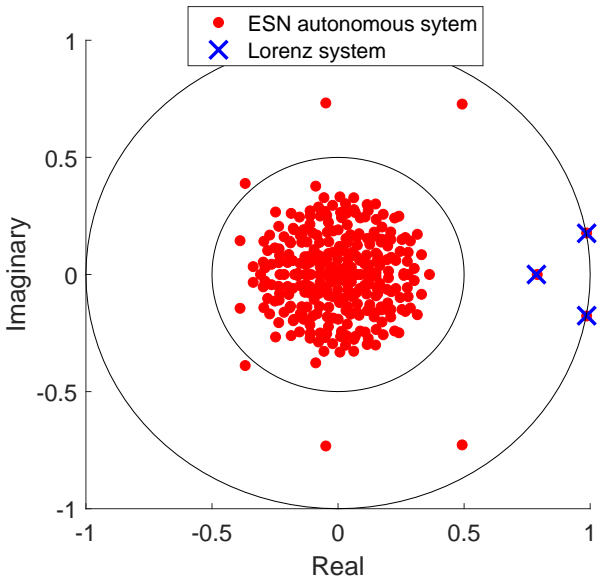
- [§3, Numerical experiments] The numerical experiments do not satisfy the hypotheses of Theorem 2.4.13 (spectral radius 1 instead of ‖A‖2<1, and a full Erdős-Rényi reservoir instead of the block-triangular structure); the authors acknowledge this, but the section should emphasise more clearly that it is an illustration rather than a validation of the theorem's assumptions.
Circularity Check
No circularity: the ESN theorems are existence/approximation results built on external benchmarks; the identified conjugacy gap is a proof issue, not a circular reduction.
full rationale
The derivation chain is self-contained against external theorems (Banach contraction, Whitney, Takens/Huke, Hornik et al., Hirsch–Pugh–Shub). The Echo State Map is defined as the unique fixed point of a contraction operator, not as a fitted quantity later renamed as a prediction. In the ESN Approximation Theorem, W_out is constructed via the Random Universal Approximation Theorem to approximate a target derived from φ, f, and ω; this is a standard existence/approximation argument rather than a fitted input called prediction. The paper explicitly concedes in Section 4 that the W_out actually obtained by ridge regression is not guaranteed to be the constructed one, confirming that the theorem is not a tautology. There are no load-bearing self-citations. The only notable defect is a non-circular proof gap: in Theorem 2.4.13 the proof jumps from persistence of a normally hyperbolic submanifold to topological conjugacy without invoking the structural stability hypothesis; this is a correctness concern, not an instance of a conclusion being equivalent to its inputs by construction.
Assumptions & free parameters
free parameters (5)
- Reservoir size n =
300
- Spectral radius rho =
1
- Erdos-Renyi mean degree =
6
- Output strength p =
0.1
- Ridge regularisation lambda =
1e-6
assumptions (8)
- standard math Banach fixed point theorem and completeness of C^1(M,R^n)
- standard math Whitney weak embedding theorem
- standard math Takens' delay embedding theorem (Huke formulation)
- standard math Hornik et al. universal approximation theorem for C^1 functions
- standard math Invariant manifold theorem (Hirsch, Pugh, Shub)
- ad hoc to paper Activation composition operator is a contraction in C1 norm
- domain assumption The target function omega o phi o y^{-1} extends to a C1 function on the hypercube
- domain assumption The Echo State Map f is a C1 embedding
Cite this review
Pith. "Pith review of Embedding and Approximation Theorems for Echo State Networks." pith.science (2026). https://pith.science/paper/4C7P5Z7I
@misc{pith2026190805202,
  author       = {Pith},
  title        = {Pith review of: Embedding and Approximation Theorems for Echo State Networks},
  year         = {2026},
  howpublished = {\url{https://pith.science/paper/4C7P5Z7I}},
  note         = {Machine review of arXiv:1908.05202}
}
read the original abstract
Echo State Networks (ESNs) are a class of single layer recurrent neural networks that have enjoyed recent attention. In this paper we prove that a suitable ESN, trained on a series of measurements of an invertible dynamical system, induces a C1 map from the dynamical system's phase space to the ESN's reservoir space. We call this the Echo State Map. We then prove that the Echo State Map is generically an embedding with positive probability. Under additional mild assumptions, we further conjecture that the Echo State Map is almost surely an embedding. For sufficiently large, and specially structured, but still randomly generated ESNs, we prove that there exists a linear readout layer that allows the ESN to predict the next observation of a dynamical system arbitrarily well. Consequently, if the dynamical system under observation is structurally stable then the trained ESN will exhibit dynamics that are topologically conjugate to the future behaviour of the observed dynamical system. Our theoretical results connect the theory of ESNs to the delay-embedding literature for dynamical systems, and are supported by numerical evidence from simulations of the traditional Lorenz equations. The simulations confirm that, from a one dimensional observation function, an ESN can accurately infer a range of geometric and topological features of the dynamics such as the eigenvalues of equilibrium points, Lyapunov exponents and homology groups.
Figures


Figures from the paper (6 more)




Reference graph
Works this paper leans on
-
[1]
Banach, S. (1922), ‘Sur les opérations dans les ensembles ab straits et leur application aux équations intégrales’, Fun- damenta Mathematicae 22, 133–181. Chattopadhyay, A., Hassanzadeh, P ., Palem, K. & Subramania n, D. (2019), ‘Data-driven prediction of a multi-scale lorenz 96 chaotic system using a hierarchy of deep learning m ethods: Reservoir computi...
arXiv 1922
-
[3]
Y eo, K. (2019), ‘Data-driven reconstruction of nonlinear dynamics from sparse observation’, Journal of Computational Physics 395, 671 –
work page 2019
-
[16]
Pathak, J., Lu, Z., Hunt, B. R., Girvan, M. & Ott, E. (2017), ‘U sing machine learning to replicate chaotic attractors and calculate lyapunov exponents from data’, Chaos
work page 2017
-
[27]
Plöger, P . G., Arghir, A., Günther, T. & Hosseiny, R. (2004), Echo state networks for mobile robot modeling and control, in D. Polani, B. Browning, A. Bonarini & K. Y oshida, eds, ‘RoboC up 2003: Robot Soccer World Cup VII’, Springer Berlin Heidelberg, Berlin, Heidelberg, pp. 157–1
work page 2004
- [59]
-
[68]
Sauer, T., Y orke, J. A. & Casdagli, M. (1991), ‘Embedology’, Journal of Statistical Physics 65(3), 579–616. Schrauwen, B., V erstraeten, D. & V an Campenhout, J. (2007), An overview of reservoir computing: theory, appli- cations and implementations, in ‘Proceedings of the 15th European Symposium on Artificial Ne ural Networks. p. 471-482 2007’, pp. 471–48...
work page 1991
-
[75]
Approximation Bounds for Random Neural Networks and Reservoir Systems
Glorot, X., Bordes, A. & Bengio, Y . (2011), Deep sparse recti fier neural networks, in G. Gordon, D. Dunson & M. Dudík, eds, ‘Proceedings of the Fourteenth Internationa l Conference on Artificial Intelligence and Statistics’, V ol. 15 ofProceedings of Machine Learning Research , PMLR, Fort Lauderdale, FL, USA, pp. 315–323. Gonon, L., Grigoryeva, L. & Orteg...
work page Pith review arXiv 2011
-
[123]
Tausz, A., V ejdemo-Johansson, M. & Adams, H. (2014), JavaPl ex: A research software package for persistent (co)homology, in H. Hong & C. Y ap, eds, ‘Proceedings of ICMS 2014’, Lecture Not es in Computer Science 8592, pp. 129–136. Tong, M. H., Bickett, A. D., Christiansen, E. M. & Cottrell, G . W . (2007), ‘Learning grammatical structure with echo state n...
work page 2014
Show all 18 references
-
[305]
& Meiss, J
Garland, J., Bradley, E. & Meiss, J. D. (2016), ‘Exploring th e topology of dynamical reconstructions’, Physica D: Nonlinear Phenomena 334, 49 –
2016
-
[366]
B., Nakane, R., Kanazawa, N., Takeda, S., Numata, H., Nakano, D
Tanaka, G., Y amane, T., Héroux, J. B., Nakane, R., Kanazawa, N., Takeda, S., Numata, H., Nakano, D. & Hirose, A. (2019), ‘Recent advances in physical reservoir computing: A review’, Neural Networks 115, 100 –
2019
-
[423]
Sprott, J
Echo State Networks and Liquid State Machines . Sprott, J. C. (2003), Chaos and time-series analysis , Oxford University Press. Takens, F. (1981), ‘Detecting strange attractors in turbul ence’, Lecture Notes in Mathematics, Berlin Springer V erlag 898,
2003
-
[432]
Tralie, C., Saul, N
Echo State Networks and Liquid State Machines . Tralie, C., Saul, N. & Bar-On, R. (2018), ‘Ripser.py: A lean p ersistent homology library for python’, The Journal of Open Source Software 3(29),
2018
-
[501]
echo state
Neural Networks. Huke, J. P . (2006), ‘Embedding nonlinear dynamical systems : A guide to Takens’ theorem’. Ilies, I., Jaeger, H., Kosuchinas, O., Rincon, M., Sakenas, V . & V askevicius, N. (2007), ‘Stepping forward through echoes of the past: forecasting with echo state netw...
2006
-
[508]
& Ortega, J.-P
Grigoryeva, L. & Ortega, J.-P . (2019), ‘Differentiable res ervoir computing’, Journal of Machine Learning Research 20(179), 1–62. URL: http://jmlr .org/papers/v20/19-150.html Gürel, T. & Egert, S. R. U. (2010), ‘Functional identificatio n of biological neural networks using re...
2019 arXiv
-
[560]
& Siew, C.-K
Huang, G.-B., Zhu, Q.-Y . & Siew, C.-K. (2006), ‘Extreme learning machine: Theory and applications’, Neurocomput- ing 70(1), 489 –
2006
-
[689]
Y ong Song, Yibin Li, Qun Wang & Caihong Li (2010), Multi-step s prediction of chaotic time series based on echo state network, in ‘2010 IEEE Fifth International Conference on Bio-Inspired Computing: Theories and Applications (BIC-TA)’, pp. 669–672. Yperman, J. & Becker, T. (2...
2010 arXiv
-
[925]
R., Pathak, J., Hunt, B
23 Vlachas, P . R., Pathak, J., Hunt, B. R., Sapsis, T. P ., Girvan , M., Ott, E. & Koumoutsakos, P . (2019), ‘Forecasting of spatio-temporal chaotic dynamics with recurrent neural ne tworks: a comparative study of reservoir computing and backpropagation algorithms’, arXiv:191...
2019 arXiv
-
[7317]
Løkse, S., Bianchi, F. M. & Jenssen, R. (2017), ‘Training ech o state networks with regularization through dimension- ality reduction’, Cognitive Computation 9(3), 364–378. Lorenz, E. N. (1963), ‘Deterministic nonperiodic flow’, Journal of the Atmospheric Sciences 20(2), 130–14...
2017
Reviewed August 14, 2026 · model on record in the stance chip above.
Discussion (0). Continue with ORCID to comment.