REVIEW 5 major objections 5 minor 2 cited by
Korn's inequality from the viewpoint of calculus of variations
T0 review · 5 major / 5 minor · reviewed 2026-08-04 · deepseek-v4-flash
Pith's one-line read The paper proves a dimension-free upper bound of √3(p∗−1) for the best constant in Korn's inequality, matching the conjectured sharp value up to a universal factor.
desk verdict The dimension-free Korn bound with factor √3 is a real new result and the proof outline is sound; the gaps are repairable, but the manuscript needs a few fixes before it can be trusted as written. read the letter →
The pith
A machine-rendered reading of the paper's core claim, the machinery that carries it, and where it could break.
The reading
What carries the argument
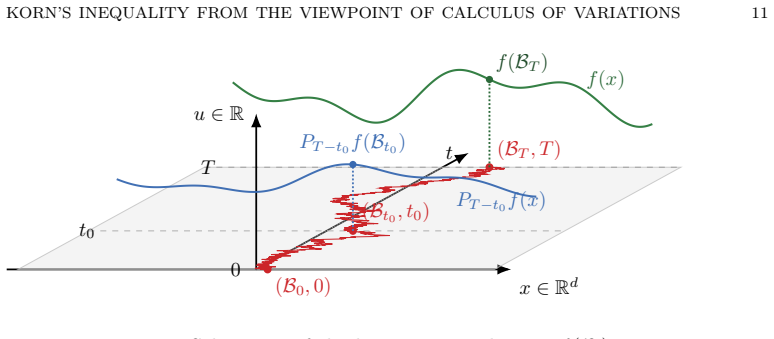
The space-time Brownian heat martingale M_t^T = P_{T−t} f(B_t) and its matrix-valued stochastic-integral analogue Z_t^T, built by integrating the heat kernel's spatial derivatives against the coordinates of the Brownian motion. For symmetric matrix inputs, the quadratic-variation comparison d⟨Z^T⟩ ≤ 3 d⟨M^T⟩ follows from the spectral identity on R^d⊗Sym(d): the antisymmetrisation operator I−σ satisfies |(I−σ)a|² ≤ 3|a|², with sharp constant 3. Plugging this comparison into the differential-subordination theorem and letting T→∞ transfers the martingale inequality into the dimension-free bound for the Riesz transform and hence for Korn's inequality.
What would settle it
For a fixed p∈(1,∞) and d≥2, take a matrix-valued Schwartz function f and compare R⊗R(f) with the conditional expectation E[Z^T_T | Y^T_T = (x,0)] as T→∞; if the L^p difference fails to go to zero for some f, Proposition 4.1 and thus Theorem 1.1 collapse. Alternatively, test the inequality itself: any sequence u_n with ||A(u_n)||_{L^p} > √3(p∗−1)||E(u_n)||_{L^p} would falsify the theorem, while one with ratio strictly larger than p∗−1 would falsify the sharp-constant conjecture.
Extended reading notes
Core claim
The central claim is that the Korn constant satisfies C(p,d) ≤ √3(p∗−1) and C(p,d) ≥ p∗−1 (trace-free version in d≥3 included); for generalised-radial fields the constant is exactly p∗−1, sharp in dimension two for p≥2. The proof begins with the identity A(u) = (R⊗R)E(u) − ((R⊗R)E(u))^t, reducing Korn's inequality to an L^p bound for the matrix-valued second-order Riesz transform. That operator is represented by a space-time Brownian martingale, against which the classical differential-subordination inequality yields p∗−1; a tensor lemma then shows that antisymmetrisation on symmetric-matrix inputs inflates the quadratic variation by at most 3, giving the √3. The lower bound p∗−1 is obtained
Load-bearing premise
The upper-bound proof assumes, without proof, that the conditional expectations of the matrix-valued space-time Brownian martingale converge in L^p to the matrix Riesz operator R⊗R as the heat horizon tends to infinity; if that convergence fails, the dimension-free bound does not follow.
Editorial extensions
If this is right
- The Korn constant is bounded by √3(p∗−1) in every dimension, so coercivity estimates in elasticity and hydrodynamics no longer worsen as the dimension grows.
- The constant is always at least p∗−1, and the gap to the upper bound is a universal factor √3; for generalised-radial fields the constant is exactly p∗−1, with sharpness on radial examples in two dimensions for p≥2.
- The trace-free Korn inequality in d≥3 and the full-gradient variant satisfy the same dimension-free estimates, with the full-gradient constant bounded by √(3(p−1)²+1) for p≥2.
- Korn's inequality holds in every Orlicz space in which it is possible (Φ satisfying the Δ₂ and ∇₂ conditions), with a dimension-free constant depending only on the Orlicz indices; the same holds in weighted L^p(w) for Muckenhoupt weights, dimension-free in the weight characteristic.
- The sharp-constant conjecture is reduced to a single quasiconvexity question; if the extremal function is quasiconvex at 0, the Korn constant is p∗−1 and the Morrey-type gap between rank-one convexity and quasiconvexity is resolved for this family.
Reading between the lines
- The martingale-representation route is likely to transfer to other elliptic homogeneous constant-coefficient operators whose symbol maps matrices into a fixed subspace; any such operator should admit a dimension-free L^p bound whenever a quadratic-variation lemma of the same type holds.
- A concrete numerical experiment could test the sharp-constant conjecture: compute extremal ratios ||A(u)||_p/||E(u)||_p for large p in dimensions 3 and 4; if the supremum stays strictly below √3(p∗−1), the √3 is an artifact of the proof and the conjecture p∗−1 becomes more credible.
- If the quasiconvexity statement fails, the construction would provide a new example of a rank-one convex but non-quasiconvex integrand, feeding directly into the open problem on the gap between the two notions in dimensions above two.
- The dimension-free weighted estimate with heat weights suggests an analogous sharp weighted bound with the usual Muckenhoupt characteristic [w]_{A_p}, which would be the Korn analogue of the sharp weighted bound for classical singular integrals.
Editorial analysis
A structured set of objections, weighed in public.
Referee Report
Summary. The paper studies optimal constants in Korn's inequality and their relation to Morrey's problem. The main claim (Theorem 1.1) is that for u∈Ẇ^{1,p}(R^d,R^d) one has ∥A(u)∥_{L^p}≤√3(p*−1)∥E(u)∥_{L^p}, hence C(p,d)≤√3(p*−1), together with C(p,d)≥p*−1; analogous statements are claimed for the full-gradient and trace-free versions, for Orlicz spaces, and for Muckenhoupt-weighted spaces. The upper bound is obtained by representing the matrix operator R⊗R through heat-extension martingales, applying Burkholder's differential-subordination theorem, and then using a linear-algebra lemma (Lemma 4.1) to improve from p*−1 to √3(p*−1). Lower bounds are obtained in dimension 2 by explicit radial witnesses and in general by a reduction to rank-one convexity importing results from the author's preprint [23]. The paper also draws a conceptual connection between the sharp constant and quasiconvexity of a Burkholder-type integrand.
Significance. If established, the main theorem would be the first dimension-free upper bound for the Korn constant with the optimal linear growth in p*−1, and it would give strong support to the natural conjecture that the sharp constant is p*−1. The approach via heat martingales is attractive and the explicit 2D witnesses in Proposition 4.4 and the linear-algebra lemma are convincing and useful. However, the manuscript as submitted is not ready: the key Burkholder step has an initial-value gap, the L^p convergence in Proposition 4.1 is asserted rather than proved, the trace-free bound rests on an unproved lemma, and the lower-bound half of Theorem 1.1 is essentially imported from another preprint of the author. These issues are local and probably repairable, but they are load-bearing for the central claims.
major comments (5)
- [§4.1, Proposition 4.1] The application of Theorem 3.2 is not justified. Definition 2 and Theorem 3.2 require X_0=Y_0=0. For M_t^T=P_{T-t}f(B_t) with Brownian motion started from the Lebesgue measure, M_0^T=P_T f(B_0) is generically non-zero, while Z_0^T=0. Thus the pair (Z^T,M^T) is not differentially subordinate in the sense of the paper, and the displayed inequality ∥Z_T^T∥_{L^p}≤(p*−1)∥M_T^T∥_{L^p} does not follow from the stated theorem. A repair is possible — one can either state and prove the continuous-time Burkholder theorem with the initial condition |X_0|≤(p*−1)|Y_0|, or compare Z^T with M^T−M_0^T and control the extra term as T→∞ — but the manuscript supplies neither. The same defect is inherited by the weighted proof in §6.2.
- [§4.1, Proposition 4.1] The assertion 'As one easily checks, even in the matricial case we have convergence in L^p' is load-bearing. The operator (R⊗R)_T must be shown to converge to R⊗R in the strong operator topology on L^p(R^d,M_d(R)); for matrix-valued functions on an infinite measure space this is not completely routine, and the final bound is obtained by letting T→∞. A proof, at least for f∈C_c^∞ followed by a density argument, should be supplied.
- [§4.3, Lemma 4.2] The trace-free upper bound C_0(p,d)≤√3(p*−1) for d≥3 relies entirely on Lemma 4.2, but Lemma 4.2 is stated without proof; the text only says the proof is 'very similar' to that of Lemma 4.1. Since Lemma 4.2 is the only new ingredient for the trace-free case, its proof must be included. In addition, the p∈(1,2) case of Theorem 4.3 is only sketched ('using the convexity of t^{2/p}') with no displayed argument; this should be expanded.
- [§5, Theorem 5.1] The lower bounds C(p,d)≥p*−1 and C_0(p,d)≥p*−1 are quoted as a direct corollary of [23, Theorem 2.2] together with Lemma 5.2. Thus the paper does not contain a proof of half of Theorem 1.1; [23] is an unpublished preprint of the author. Please either include a self-contained derivation or state explicitly the imported theorem, its hypotheses, and its status. As written, a central part of the main theorem is not verifiable from the manuscript.
- [Abstract vs. body] The abstract claims that in dimension 2 the paper obtains a bound sharp up to a factor of 1.158. No statement or proof of such a bound appears in the body; Theorem 1.1 gives the factor √3≈1.732. Please either add the advertised 2D theorem with a proof or reference, or correct the abstract to match the results actually proved.
minor comments (5)
- [§4.4, Eq. (25)–(28)] The description of X_k as '(p(k−1)+1, 1/k) Gamma-distributed' is ambiguous between scale and rate parametrizations. Write the density or specify 'rate k' explicitly.
- [Theorem 1.2] The statement uses p and q as Φ's indices but defines them only later in Section 6.1. State p=i_Φ and q=s_Φ in the theorem statement.
- [§6.1] The notation ∇2(∞) and Δ2(∞) is used in Proposition 6.1 without definition; please define it or refer explicitly to the earlier Δ2/∇2 terminology.
- [§2, Proposition 2.2] The notation in the calculation of N mixes ζ⊗ζ^t, (ζ⊗ζ^t)^†, and ζ⊗ζ^† in a way that is hard to follow. A short explanation of the convention would improve readability.
- [§4.2, Proposition 4.3] The scaling argument is sketched rather tersely. In particular, the use of f_d(rx_1,…,r x_d) and the need for f_d to be (or be approximated by) compactly supported functions should be made explicit, since f_d need not belong to L^p(R^d).
Circularity Check
Upper bound is independent, but the general lower bound is imported from the author's own companion preprint [23].
-
self citation load bearing
[Section 5, Theorem 5.1 and its proof; used for the lower bound in Theorem 1.1, eq. (6)]
"Theorem 5.1. For p∈(1,∞) and d∈N\{0,1}, C_rc(p,d)=p∗−1. ... This theorem is a direct corollary of [23, Theorem 2.2] together with the following elementary lemma: Lemma 5.2 ... Proof of Theorem 5.1. This result is a corollary of [23, Theorem 2.2]. Indeed, [23, Proposition 3.7] implies C_rc(p,d)≤C(Sym(d))(p∗−1), which together with the above lemma proves the upper bound, and [23, Theorem 2.2] proves the lower bound."
The paper's claimed lower bound C(p,d), C0(p,d) ≥ p∗−1 in Theorem 1.1 is not proved in this paper for general p: it is delegated to Theorem 5.1, whose proof is a citation to the author's own companion preprint [23] ('[23, Theorem 2.2] proves the lower bound'). Since [23] is an unpublished preprint by the same author and is not otherwise verified in the text, the lower-bound half of the central result rests entirely on a self-citation chain rather than on a derivation exhibited here. The upper bound remains independent, so this is partial, not total, circularity.
full rationale
The central upper bound ∥A(u)∥ ≤ √3(p∗−1)∥E(u)∥ is derived from external tools: Burkholder's differential subordination theorem (Thm 3.2 from [65]), heat-semigroup martingales (following Bañuelos–Baudoin), and a self-contained linear algebra lemma (Lemma 4.1). That part does not reduce to its inputs by construction, so it is not circular. The lower bound C(p,d) ≥ p∗−1, however, is not established in this paper for all p,d: Section 4.2 gives an elementary proof only for p≥2 via radial examples and dimension lifting, while the general lower bound is delegated to Theorem 5.1, whose proof is a citation to the author's own companion preprint [23] ('[23, Theorem 2.2] proves the lower bound'). Because [23] is a same-author unpublished preprint and is not verified in the text, the lower-bound half of Theorem 1.1 is load-bearing self-citation. This is partial circularity (an unverified self-citation dependency), but the main upper-bound contribution has independent content, so the score is 4 rather than higher. Technical gaps in Proposition 4.1 (uncentered M_0 and the asserted Lp convergence 'as one easily checks') are correctness concerns, not circularity, and do not affect this score.
Assumptions & free parameters
assumptions (5)
- standard math Burkholder's continuous-time differential subordination inequality: if X is p-differentially subordinate to Y, then ||X||_{Lp} ≤ (p*−1)||Y||_{Lp} (Theorem 3.2).
- standard math Heat-space-time martingale representation of R_iR_j: R_iR_j f = lim_{T→∞} E[Z_T | Y_T=(·,0)] with L^p convergence for f in suitable spaces.
- standard math A_p = A_p^{Heat}: the heat-weight class equals the classical Muckenhoupt class A_p (Prop 6.3).
- standard math Weighted Burkholder estimate of Domelevo–Petermichl–Škreb for martingale weights (Theorem 6.4).
- domain assumption C^rc(p,d)=p*−1 and the associated rank-one-convex envelope formulas from [23, Theorem 2.2 and Proposition 3.7].
Cite this review
Pith. "Pith review of Korn's inequality from the viewpoint of calculus of variations." pith.science (2026). https://pith.science/paper/4CRC2QRZ
@misc{pith2026260322431,
  author       = {Pith},
  title        = {Pith review of: Korn's inequality from the viewpoint of calculus of variations},
  year         = {2026},
  howpublished = {\url{https://pith.science/paper/4CRC2QRZ}},
  note         = {Machine review of arXiv:2603.22431}
}
abstract
We study the best possible constants in Korn-type inequalities and their connection with Morrey's problem in the calculus of variations. We adapt techniques from the analysis of the Beurling-Ahlfors transform to Korn's inequality. In dimension $2$, we obtain a bound that is sharp up to a factor of $1.158$. In general, we show that the constant in Korn's inequality admits a dimension-free bound, and we obtain an estimate that is sharp up to a factor of $\sqrt 3$. We also establish several improvements to estimates in various other function spaces. Using a weighted version of Burkholder's differential subordination theorem, recently introduced in [J. Reine Angew. Math. 824 (2025), pp. 137-166], we also prove a dimension-free weighted version of the inequality for Muckenhoupt weights.
Figures


Forward citations
Cited by 2 Pith papers
-
A solution to Morrey's problem in $\mathbb{R}^{2\times m}$
For every p>1 there are p-homogeneous rank-one convex integrands on R^{2xm}, and on large square matrix spaces, that are nowhere quasiconvex; for m large enough and in R^{4x2} when p≠2.
-
A short note on Meyers' theorem
The known Meyers interval is widened to ((26K−16)/(13K−3), (26K−16)/(13K−13)), conditional on a strong Riesz-transform norm bound from a cited preprint.
Reference graph
Works this paper leans on
-
[23]
Martingales, laminates and minimal Korn inequalities
G. Cassese, “Martingales, laminates and minimal Korn inequalities”, Preprint, arXiv: 2512.02784, Dec. 2025
arXiv 2025
-
[1]
Regularity Results for Stationary Electro-Rheological Fluids
E. Acerbi and G. Mingione, “Regularity Results for Stationary Electro-Rheological Fluids”,Arch. Ration. Mech. Anal., vol. 164, no. 3, pp. 213–259, 2002
2002
-
[2]
On Saint Venant’s compat- ibility conditions and Poincaré’s lemma
C. Amrouche, P. G. Ciarlet, L. Gratie, and S. Kesavan, “On Saint Venant’s compat- ibility conditions and Poincaré’s lemma”,C. R. Acad. Sci. Paris, Ser. I, vol. 342, no. 11, pp. 887–891, 2006
2006
-
[3]
The local Burkholder functional, quasiconvexity and Geometric Function Theory
K. Astala, D. Faraco, A. Guerra, A. Koski, and J. Kristensen, “The local Burkholder functional, quasiconvexity and Geometric Function Theory”, arXiv:2309.03495, 2023
arXiv 2023
-
[4]
Lower semicontinuity, Stoilow factorization and principal maps
K. Astala, D. Faraco, A. Guerra, A. Koski, and J. Kristensen, “Lower semicontinuity, Stoilow factorization and principal maps”,Commun. Pure Appl. Anal., vol. 23, no. 10, pp. 1608–1645, 2024
2024
-
[5]
A hunt for sharpLp-estimates and rank-one convex variational integrals
K. Astala, T. Iwaniec, I. Prause, and E. Saksman, “A hunt for sharpLp-estimates and rank-one convex variational integrals”,Filomat, vol. 29, no. 2, pp. 245–261, 2015
2015
-
[6]
Optimal Range of Haar Martingale Transforms and Its Applications
S. Astashkin, J. Huang, M. Pliev, F. Sukochev, and D. Zanin, “Optimal Range of Haar Martingale Transforms and Its Applications”,Int. Math. Res. Not., vol. 2023, no. 24, pp. 20827–20854, Dec. 2023
2023
-
[7]
Some conjectures about integral means of ∂fand ¯∂f
A. Baernstein and S. Montgomery-Smith, “Some conjectures about integral means of ∂fand ¯∂f”, inComplex Analysis and Differential Equations, ser. Acta Universitatis Upsaliensis C. C. Kiselman, Ed., vol. 64, 1999, pp. 92–109
1999
Show all 77 references
-
[8]
Sets of gradients with no rank-one connections
J. M. Ball, “Sets of gradients with no rank-one connections”,J. Math. Pures Appl., vol. 69, no. 3, pp. 241–259, 1990
1990
-
[9]
The foundational inequalities of D. L. Burkholder and some of their ramifications
R. Bañuelos, “The foundational inequalities of D. L. Burkholder and some of their ramifications”,Ill. J. Math., vol. 54, no. 3, pp. 789–868, 2010
2010
-
[10]
Martingale transforms and their projection operators on manifolds
R. Bañuelos and F. Baudoin, “Martingale transforms and their projection operators on manifolds”,Potential Anal., vol. 38, no. 4, pp. 1071–1089, 2013
2013
-
[11]
Lp bounds for the Beurling–Ahlfors transform
R. Bañuelos and P. Janakiraman, “Lp bounds for the Beurling–Ahlfors transform”, Trans. Amer. Math. Soc., vol. 360, no. 7, pp. 3603–3612, 2008
2008
-
[12]
Martingales and sharp bounds for Fourier multipli- ers
R. Bañuelos and A. Osękowski, “Martingales and sharp bounds for Fourier multipli- ers”,Ann. Fenn. Math., vol. 37, no. 1, pp. 251–263, 2012
2012
-
[13]
SharpinequalitiesfortheBeurling–Ahlforstransform on radial functions
R.BañuelosandA.Osękowski,“SharpinequalitiesfortheBeurling–Ahlforstransform on radial functions”,Duke Math. J., vol. 162, no. 2, pp. 417–434, 2013. 30 REFERENCES
2013
-
[14]
Bañuelos and A
R. Bañuelos and A. Osękowski,Weighted square function estimates, 2017. arXiv: 1711.08754 [math.PR]
2017 arXiv
-
[15]
Sharp inequalities for martingales with applications to the Beurling-Ahlfors and Riesz transforms
R. Bañuelos and G. Wang, “Sharp inequalities for martingales with applications to the Beurling-Ahlfors and Riesz transforms”,Duke Math. J., vol. 80, no. 3, pp. 575– 600, 1995
1995
-
[16]
Subordination by conformal mar- tingales inL p and zeros of Laguerre polynomials
A. Borichev, P. Janakiraman, and A. Volberg, “Subordination by conformal mar- tingales inL p and zeros of Laguerre polynomials”,Duke Math. J., vol. 162, no. 5, pp. 889–924, 2013
2013
-
[17]
Boros and A
N. Boros and A. Volberg,Sharp Lower bound estimates for vector-valued and matrix- valued multipliers inLp, 2011. eprint:1110.5405
2011 arXiv
-
[18]
Boucheron, G
S. Boucheron, G. Lugosi, and P. Massart,Concentration Inequalities: A Nonasymp- totic Theory of Independence. Oxford University Press, Feb. 2013
2013
-
[19]
Trace-Free Korn Inequalities in Orlicz Spaces
D. Breit, A. Cianchi, and L. Diening, “Trace-Free Korn Inequalities in Orlicz Spaces”, SIAM J. Math. Anal., vol. 49, no. 4, pp. 2496–2526, 2017
2017
-
[20]
Sharp Conditions for Korn Inequalities in Orlicz Spaces
D. Breit and L. Diening, “Sharp Conditions for Korn Inequalities in Orlicz Spaces”, J. Math. Fluid Mech., vol. 14, no. 3, pp. 565–573, 2012
2012
-
[21]
Sharp inequalities for martingales and stochastic integrals
D. L. Burkholder, “Sharp inequalities for martingales and stochastic integrals”, in Colloque Paul Lévy sur les processus stochastiques, ser. Astérisque 157–158, Société mathématique de France, 1988, pp. 75–94
1988
-
[22]
Spaces betweenL 1 andL ∞ and the theorem of Marcinkiewicz
A. Calderón, “Spaces betweenL 1 andL ∞ and the theorem of Marcinkiewicz”,Stud. Math., vol. 26, no. 3, pp. 301–304, 1966
1966
-
[24]
A Riemannian version of Korn’s inequality
W. Chen and J. Jost, “A Riemannian version of Korn’s inequality”,Calc. Var. Partial Differential Equations, vol. 14, no. 4, pp. 517–530, 2002
2002
-
[25]
Dacorogna,Direct methods in the Calculus of Variations(Applied Mathematical Sciences, 78)
B. Dacorogna,Direct methods in the Calculus of Variations(Applied Mathematical Sciences, 78). Springer, 2008
2008
-
[26]
Dellacherie and P.-A
C. Dellacherie and P.-A. Meyer,Probabilities and Potential B: Theory of Martingales (North-Holland Mathematics Studies, 72). North-Holland Publishing Co., 1982
1982
-
[27]
Korn and Poincaré–Korn inequalities: a different perspective
G. Di Fratta and F. Solombrino, “Korn and Poincaré–Korn inequalities: a different perspective”,Proc. Amer. Math. Soc., vol. 153, no. 1, pp. 143–159, 2025
2025
-
[28]
Continuous sparse domination and di- mensionless weighted estimates for the Bakry–Riesz vector
K. Domelevo, S. Petermichl, and K. A. Škreb, “Continuous sparse domination and di- mensionless weighted estimates for the Bakry–Riesz vector”,J. Reine Angew. Math., vol. 2025, no. 824, pp. 137–166, 2025
2025
-
[29]
A complex from linear elasticity
M. Eastwood, “A complex from linear elasticity”, inProceedings of the 19th Winter School "Geometry and Physics", Circolo Matematico di Palermo, 2000, pp. 23–29
2000
-
[30]
L. C. Evans,An Introduction to Stochastic Differential Equations. American Mathe- matical Society, 2013
2013
-
[31]
Tartar’s conjecture and localization of the quasi- convex hull inR2×2
D. Faraco and L. Székelyhidi Jr., “Tartar’s conjecture and localization of the quasi- convex hull inR2×2”,Acta Math., vol. 200, no. 2, pp. 279–305, 2008
2008
-
[32]
The theory of weights and the Dirichlet problem for elliptic equations
R. A. Fefferman, C. E. Kenig, and J. Pipher, “The theory of weights and the Dirichlet problem for elliptic equations”,Ann. Math., vol. 134, no. 1, pp. 65–124, 1991
1991
-
[33]
From Microstructure-Independent Formulas for Composite Materi- als to Rank-One Convex, Non-quasiconvex Functions
Y. Grabovsky, “From Microstructure-Independent Formulas for Composite Materi- als to Rank-One Convex, Non-quasiconvex Functions”,Arch. Ration. Mech. Anal., vol. 227, no. 2, pp. 607–636, 2017
2017
-
[34]
Extremal rank-one convex integrands and a conjecture of Šverák
A. Guerra, “Extremal rank-one convex integrands and a conjecture of Šverák”,Calc. Var. Partial Differential Equations, vol. 58, pp. 1–19, 6 Nov. 2019
2019
-
[35]
Automatic Quasiconvexity of Homogeneous Isotropic Rank-One Convex Integrands
A. Guerra and J. Kristensen, “Automatic Quasiconvexity of Homogeneous Isotropic Rank-One Convex Integrands”,Arch. Ration. Mech. Anal., vol. 245, no. 1, pp. 479– 500, 2022. REFERENCES 31
2022
-
[36]
Two-by-two upper triangular matrices and Morrey’s conjecture
T. L. J. Harris, B. Kirchheim, and C.-C. Lin, “Two-by-two upper triangular matrices and Morrey’s conjecture”,Calc. Var. Partial Differential Equations, vol. 57, pp. 1–12, 3 Apr. 2018
2018
-
[37]
Korn’s inequalities and their applications in continuum mechanics
C. O. Horgan, “Korn’s inequalities and their applications in continuum mechanics”, SIAM Rev., vol. 37, no. 4, pp. 491–511, 1995
1995
-
[38]
Hytönen, J
T. Hytönen, J. van Neerven, M. Veraar, and L. Weis,Analysis in Banach Spaces. Volume I: Martingales and Littlewood-Paley Theory(Ergebnisse der Mathematik und ihrer Grenzgebiete. 3. Folge / A Series of Modern Surveys in Mathematics, 63). Springer, 2016
2016
-
[39]
On the norm of the Beurling–Ahlfors operator in several dimensions
T. P. Hytönen, “On the norm of the Beurling–Ahlfors operator in several dimensions”, Canad. Math. Bull., vol. 54, no. 1, pp. 113–125, 2011
2011
-
[40]
The sharp weighted bound for general Calderón–Zygmund opera- tors
T. P. Hytönen, “The sharp weighted bound for general Calderón–Zygmund opera- tors”,Ann. Math., vol. 175, no. 3, pp. 1473–1506, 2012
2012
-
[41]
Inequality for Burkholder’s martingale transform
P. Ivanisvili, “Inequality for Burkholder’s martingale transform”,Anal. PDE, vol. 8, no. 4, pp. 765–806, 2015
2015
-
[42]
Extremal inequalities in Sobolev spaces and quasiconformal mappings
T. Iwaniec, “Extremal inequalities in Sobolev spaces and quasiconformal mappings”, Z. Anal. Anwend., vol. 1, no. 6, pp. 1–16, 1982
1982
-
[43]
OnL p-integrability in PDE’s and quasiregular mappings for large expo- nents
T. Iwaniec, “OnL p-integrability in PDE’s and quasiregular mappings for large expo- nents”,Ann. Acad. Sci. Fenn. Math., vol. 7, no. 2, pp. 301–322, 1982
1982
-
[44]
Nonlinear Cauchy-Riemann operators inRn
T. Iwaniec, “Nonlinear Cauchy-Riemann operators inRn”,Trans. Amer. Math. Soc., vol. 354, no. 5, pp. 1961–1995, 2002
1961
-
[45]
Riesz transforms and related singular integrals
T. Iwaniec and G. Martin, “Riesz transforms and related singular integrals”,J. Reine Angew. Math., vol. 473, pp. 25–58, 1996
1996
-
[46]
Korn’s inequality and John domains
R. Jiang and A. Kauranen, “Korn’s inequality and John domains”,Calc. Var. Partial Differ. Equ., vol. 56, no. 4, 2017
2017
-
[47]
Karatzas and S
I. Karatzas and S. E. Shreve,Brownian Motion and Stochastic Calculus(Graduate Texts in Mathematics, 113), 2nd ed. Springer, 1991
1991
-
[48]
On the interpolation constant for Orlicz spaces
A. Y. Karlovich and L. Maligranda, “On the interpolation constant for Orlicz spaces”, Proc. Amer. Math. Soc., vol. 129, no. 9, pp. 2727–2739, 2001
2001
-
[49]
Weighted Sobolev spaces and capacity
T. Kilpeläinen, “Weighted Sobolev spaces and capacity”,Ann. Acad. Sci. Fenn. Math., vol. 19, no. 1, pp. 95–113, 1994
1994
-
[50]
Characterizations of Young measures generated by gradients
D. Kinderlehrer and P. Pedregal, “Characterizations of Young measures generated by gradients”,Arch. Ration. Mech. Anal., vol. 115, no. 4, pp. 329–365, 1991
1991
-
[51]
Onrank-oneconvexfunctionsthatarehomogeneous of degree one
B.KirchheimandJ.Kristensen,“Onrank-oneconvexfunctionsthatarehomogeneous of degree one”,Arch. Ration. Mech. Anal., vol. 221, no. 1, pp. 527–558, 2016
2016
-
[52]
Solution générale du problème d’équilibre dans la théorie de l’élasticité
A. Korn, “Solution générale du problème d’équilibre dans la théorie de l’élasticité”, Ann. Fac. Sci. Toulouse Math., vol. 10, pp. 141–269, 1908
1908
-
[53]
Ueber einige Ungleichungen, welche in der Theorie der elastischen und elektrischen Schwingungen eine Rolle spielen
A. Korn, “Ueber einige Ungleichungen, welche in der Theorie der elastischen und elektrischen Schwingungen eine Rolle spielen”,Bull. Int. Acad. Sci. Cracovie, vol. 9, pp. 705–724, 1909
1909
-
[54]
On the non-locality of quasiconvexity
J. Kristensen, “On the non-locality of quasiconvexity”,Ann. Inst. H. Poincaré C Anal. Non Linéaire, vol. 16, no. 1, pp. 1–13, 1999
1999
-
[55]
Justification of the Dirichlet principle for the first boundary value problem of the nonlinear theory of elasticity
A. L. Krylov, “Justification of the Dirichlet principle for the first boundary value problem of the nonlinear theory of elasticity”,Proc. USSR Acad. Sci., vol. 146, no. 1, pp. 54–57, 1962
1962
-
[56]
Algebras of differentiable functions
K. de Leeuw and H. Mirkil, “Algebras of differentiable functions”,Bull. Amer. Math. Soc., vol. 68, no. 4, pp. 411–415, 1962
1962
-
[57]
Remarks on the integrability of the derivatives of quasiconformal map- pings
O. Lehto, “Remarks on the integrability of the derivatives of quasiconformal map- pings”,Ann. Acad. Sci. Fenn. Ser. A I, no. 371, pp. 1–8, 1966
1966
-
[58]
On the optimal constants in Korn’s and geometric rigid- ity estimates, in bounded and unbounded domains, under Neumann boundary con- ditions
M. Lewicka and S. Müller, “On the optimal constants in Korn’s and geometric rigid- ity estimates, in bounded and unbounded domains, under Neumann boundary con- ditions”,Indiana Univ. Math. J., vol. 65, no. 2, pp. 377–397, 2016. 32 REFERENCES
2016
-
[59]
Weighted Littlewood–Paley inequalities for heat flows in RCD spaces
H. Li, “Weighted Littlewood–Paley inequalities for heat flows in RCD spaces”,J. Math. Anal. Appl., vol. 479, no. 2, pp. 1618–1640, 2019
2019
-
[60]
Lindenstrauss and L
J. Lindenstrauss and L. Tzafriri,Classical Banach Spaces I and II: Sequence Spaces and Function Spaces(Classics in Mathematics). Springer Berlin Heidelberg, 1996
1996
-
[61]
Variational models for microstructure and phase transitions
S. Müller, “Variational models for microstructure and phase transitions”, inCalculus of Variations and Geometric Evolution Problems, ser. Lecture Notes in Mathematics, S. Hildebrandt and M. Struwe, Eds., vol. 1713, Springer Berlin, Heidelberg, 1999, pp. 85–210
1999
-
[62]
Rank-one Convexity Implies Quasiconvexity on Diagonal Matrices
S. Müller, “Rank-one Convexity Implies Quasiconvexity on Diagonal Matrices”,Int. Math. Res. Not., vol. 1999, no. 20, pp. 1087–1095, 1999
1999
-
[63]
A non-inequality for differential operators in theL1 norm
D. Ornstein, “A non-inequality for differential operators in theL1 norm”,Arch. Ra- tion. Mech. Anal., vol. 11, no. 1, pp. 40–49, 1962
1962
-
[64]
Inequalities for dominated martingales
A. Osękowski, “Inequalities for dominated martingales”,Bernoulli, vol. 13, no. 1, pp. 54–79, 2007
2007
-
[65]
Osękowski,Sharp Martingale and Semimartingale inequalities(IMPAN Monogr
A. Osękowski,Sharp Martingale and Semimartingale inequalities(IMPAN Monogr. Mat. (N. S.), 72). Springer, 2012
2012
-
[66]
On Korn’s inequality
L. E. Payne and H. F. Weinberger, “On Korn’s inequality”,Arch. Ration. Mech. Anal., vol. 8, no. 1, pp. 89–98, 1961
1961
-
[67]
Laminates and microstructure
P. Pedregal, “Laminates and microstructure”,European J. Appl. Math., vol. 4, no. 2, pp. 121–149, 1993
1993
-
[68]
Heating of the Ahlfors-Beurling operator: weakly quasiregular maps on the plane are quasiregular
S. Petermichl and A. Volberg, “Heating of the Ahlfors-Beurling operator: weakly quasiregular maps on the plane are quasiregular”,Duke Math. J., vol. 112, no. 2, pp. 281–305, 2002
2002
-
[69]
Revuz and M
D. Revuz and M. Yor,Continuous Martingales and Brownian Motion(Grundlehren der mathematischen Wissenschaften), 3rd ed. Berlin, Heidelberg: Springer, 1999, vol. 293
1999
-
[70]
Rindler,Calculus of Variations(Universitext)
F. Rindler,Calculus of Variations(Universitext). Springer, 2018
2018
-
[71]
Implications of rank one convexity
J. Sivaloganathan, “Implications of rank one convexity”,Ann. Inst. Henri Poincaré C, vol. 5, no. 2, pp. 99–118, 1988
1988
-
[72]
On Korn’s first inequality in a Hardy–Sobolev space
D. E. Spector and S. J. Spector, “On Korn’s first inequality in a Hardy–Sobolev space”,J. Elasticity, vol. 154, no. 1–4, pp. 187–198, 2023
2023
-
[73]
D. W. Stroock,Probability Theory, An Analytic View, 3rd ed. Cambridge University Press, 2024
2024
-
[74]
TheL p-norms of the Beurling-Ahlfors transform on radial functions
M. Strzelecki, “TheL p-norms of the Beurling-Ahlfors transform on radial functions”, Ann. Acad. Sci. Fenn. Math., vol. 42, no. 1, pp. 73–93, 2017
2017
-
[75]
Rank-one convexity does not imply quasiconvexity
V. Šverák, “Rank-one convexity does not imply quasiconvexity”,Proc. R. Soc. Edinb., Sect. A, Math., vol. 120, no. 1–2, pp. 185–189, 1992
1992
-
[76]
Burkholder’s function via Monge–Ampère equation
V. Vasyunin and A. Volberg, “Burkholder’s function via Monge–Ampère equation”, Ill. J. Math., vol. 54, no. 4, pp. 1393–1428, 2010
2010
-
[77]
Vasyunin and A
V. Vasyunin and A. Volberg,The Bellman Function Technique in Harmonic Analysis (Cambridge Studies in Advanced Mathematics, 186). Cambridge University Press, 2020. University of Oxford, Mathematical Institute, Radcliffe Obser v atory Quarter, OX2 6GG, Oxford, United Kingdom Ema...
2020
Reviewed August 4, 2026 · model on record in the stance chip above.
Discussion (0). Continue with ORCID to comment.