REVIEW 3 major objections 3 minor 52 references
Groups of finite type: classification and structural properties
T0 review · 3 major / 3 minor · reviewed 2026-08-05 · deepseek-v4-flash
Pith's one-line read For a broad family of profinite groups acting on rooted trees, just-infiniteness, topological finite generation, and strong completeness are equivalent, provided a torsion condition holds.
desk verdict A serious, mostly careful paper whose headline equivalence theorem is explicitly conditional on an unproved torsion conjecture; the computational and classification work is solid and useful, but the central result is not yet unconditional. read the letter →
The pith
A machine-rendered reading of the paper's core claim, the machinery that carries it, and where it could break.
The reading
What carries the argument
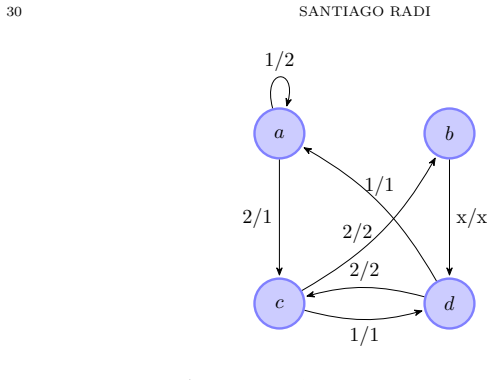
The load-bearing object is StG(D−1), the subgroup of a depth-D group of finite type fixing all vertices at level D−1. Its abelianization StG(D−1)/StG(D−1)′ is the switchboard: finiteness of this quotient is both the branch-group criterion for just-infiniteness and the target of the strong-completeness implication, while the torsion hypothesis on this same quotient is what makes strong completeness feed back into finiteness. For the classification half, the central mechanism is the directed graph ΓPQ whose vertices are classes of tree automorphisms, modulo Q, that conjugate pattern P onto Q; a cycle in ΓPQ yields a tree automorphism conjugating the two groups, and for fractal groups the cycle
What would settle it
Run the improved enumeration algorithm on the binary tree to depth 5 and, for each level-transitive minimal pattern subgroup P, compute StG(D−1)ab and check topological finite generation and strong completeness. Finding a group whose abelianization is non-torsion but which is strongly complete without being just-infinite would break the torsion hypothesis; finding any group with finite StG(D−1)ab that is not topologically finitely generated, or not strongly complete, would falsify Theorem 1 directly.
Extended reading notes
Core claim
The central claim is Theorem 1: if G is a level-transitive group of finite type of depth D and StG(D−1)/StG(D−1)′ is torsion, then just-infiniteness, topological finite generation, and strong completeness are equivalent. The proof runs through six equivalent conditions in Theorem 5.15. Just-infiniteness is equivalent to finiteness of StG(D−1)ab via a branch-group criterion; finiteness of this abelianization feeds into the Bondarenko–Samoilovych finite-generation criterion; topological finite generation gives strong completeness by the Nikolov–Segal theorem; and the torsion hypothesis supplies the reverse implication, strong completeness implies finiteness of the abelianization. The paper als
Load-bearing premise
The whole cycle depends on the unproved conjecture that for any group of finite type of depth D, the quotient StG(D−1)/StG(D−1)′ is torsion; if a level-transitive group of finite type had a non-torsion abelianization there, the implication from strong completeness to just-infiniteness would no longer be established.
Editorial extensions
If this is right
- For iterated wreath products WP acting on a d-regular tree, the three properties become equivalent to P=P′; in particular Aut(T) is neither just-infinite, nor topologically finitely generated, nor strongly complete.
- The closure of the Hanoi towers group on three pegs is just-infinite, giving the first example of a regular branch group that is not just-infinite while its closure is.
- The closures of IMG(z²+i) and the third Grigorchuk group are isomorphic, yet their profinite completions are not, so the abstract groups IMG(z²+i) and the third Grigorchuk group are not isomorphic.
- Explicit classification bounds follow: 5 isomorphism classes in the binary tree depth 2, between 16 and 23 at depth 3, exactly 8 among the 32 topologically finitely generated groups at depth 4; on the ternary tree, 15–40 classes at depth 2 and exactly 12 among the 216 topologically finitely generated pro-3 groups at depth 3.
- Theorem 7 gives a sufficient condition for a finite Mealy automaton group to have a prescribed group of finite type as its closure, making Hausdorff dimension computations available for automata groups.
Reading between the lines
- If Conjecture 2 holds, the trichotomy becomes a single absolute dichotomy for every level-transitive group of finite type: either all three properties hold or none do; the paper's 'vast family' would then be the whole class.
- The torsion condition can be probed computationally: Proposition 5.17 reduces it to checking that generators of the minimal pattern can be extended to elements of finite order modulo StG(D−1)′; automating this check on the newly enumerated depth-3 ternary patterns would test the conjecture on groups already in hand.
- The isomorphism graph ΓPQ suggests that classification by patterns must pass through conjugacy data, not just abstract isomorphism: non-isomorphic minimal patterns can yield isomorphic groups, and isomorphic minimal patterns can yield non-isomorphic groups.
- The automata-group results hint that a finite-type closure does not determine the abstract group: one can have a group containing the Grigorchuk group as an infinite-index subgroup with the same closure, which may be useful for constructing branch groups with prescribed closures but different rigidity or congruence properties.
Editorial analysis
A structured set of objections, weighed in public.
Referee Report
Summary. The paper studies profinite groups of finite type (finitely constrained groups) acting on regular rooted trees. Its main structural result, Theorem 1, states that for a level-transitive group of finite type of depth D satisfying the condition that StG(D−1)/StG(D−1)′ is torsion, the properties of being just-infinite, topologically finitely generated, and strongly complete are equivalent. This theorem is explicitly conditional on Conjecture 2, which asserts the torsion condition for all groups of finite type and is left unproved. The paper also gives an improved algorithm for computing minimal pattern subgroups, a sufficient condition under which the closure of an automaton group is a group of finite type, and an isomorphism algorithm based on a directed graph ΓPQ, with associated classification counts for binary and ternary trees at small depths. Corollaries include just-infiniteness of the closure of the Hanoi towers group and isomorphism between the closures of IMG(z²+i) and the third Grigorchuk group.
Significance. If the conditional equivalence in Theorem 1 could be made unconditional, it would unify three central properties of profinite groups in the substantial class of groups of finite type. The algorithmic and classification material is also potentially valuable: explicit automata representing many topologically finitely generated groups of finite type, and a graph-theoretic criterion for conjugacy. The paper is honest about the main unproved hypothesis, which is a genuine strength, and several intermediate results—such as the topological finite-generation criterion in Theorem 5.6 and the automaton-closure criterion in Theorem 6.1—are useful in their own right. However, the headline theorem is not unconditional, and the classification counts rely on GAP computations whose scripts and output are not supplied, so the exhaustive claims cannot currently be independently audited.
major comments (3)
- [§5.3, Theorem 1 and Conjecture 2] Theorem 1 is conditional on the unproved torsion hypothesis StG(D−1)/StG(D−1)′ is torsion. The paper states at the end of the introduction that a proof cannot yet be claimed. This is load-bearing: the only argument that strong completeness implies just-infiniteness, namely implication (3)⇒(6) in Theorem 5.15, explicitly uses torsion of the abelianization. If Conjecture 2 fails for some group of finite type with, for example, a Z_p factor in StG(D−1)ab, then Corollary 2.15 would allow a topologically finitely generated, strongly complete group that is not just-infinite, breaking the equivalence. The theorem should be explicitly framed as a conditional result about groups satisfying Conjecture 2, and the family satisfying that hypothesis should be quantified, rather than described as 'vast' without evidence.
- [§5.3, Theorem 5.15, implication (3)⇒(6)] The proof of (3)⇒(6) contains a gap. It produces uncountably many finite-index subgroups of StG(D−1) containing StG(D−1)′. These are normal in StG(D−1) because StG(D−1)ab is abelian, but they are not claimed to be normal in G. The contradiction, however, counts normal subgroups of G containing StG(n), using the correspondence theorem. Strong completeness applies to all finite-index subgroups, not only normal ones, but the proof as written treats the constructed subgroups as if they were normal in G. The argument can likely be repaired by replacing 'normal' with arbitrary finite-index subgroups and counting finite-index open subgroups containing StG(n), but as written implication (3)⇒(6) is not established.
- [§8, Corollary 6 and Table 1] The classification counts—for example, 4544 minimal patterns for (d,D)=(2,4), 588 for (3,2), 216 topologically finitely generated groups for (3,3), and the exact isomorphism class counts 8 and 12—are based on GAP computations with no released code, scripts, or detailed output. The paper reports timings but not the computational artifacts. Since these exhaustive claims are not verifiable from the text alone, the manuscript should provide the scripts and generated data as supplementary material, or at least a machine-readable certificate of the search results. This is necessary for the classification part of the paper to be auditable.
minor comments (3)
- [§5.3, Theorem 5.15, item (7)] Item (7) says 'π_n(StG(n0−1)) ≤ π_n(G)′ for all n ≥ D', but the proof and Proposition 5.8 use π_n(StG(n−1)). The n0 appears to be a typo for n; the proof uses the correct statement.
- [§5.5, Corollary 5.21] The notation H is used both for the abstract Hanoi towers group and for its closure. In Corollary 5.21 'The group H is just-infinite and strongly complete' must refer to the closure, since the abstract Hanoi towers group is neither profinite nor just-infinite. Please distinguish the two objects notationally.
- [§8.3] The list of automata in Section 10 is extremely useful, but for the two groups 'that do not coincide with the closure of an automata group with at most 5 states', no information is given about how that negative conclusion was obtained. A short explanation or reference to the GAP search would help.
Circularity Check
No significant circularity: the main theorem is a genuine conditional equivalence derived from independent external results, with the only caveat being an openly disclosed unproved torsion hypothesis.
full rationale
The paper's central Theorem 1 is explicitly conditional on Conjecture 2, the statement that StG(D−1)/StG(D−1)′ is torsion, and the paper honestly says 'a proof cannot be claimed yet.' This is a load-bearing unproved premise, but it is not circular: the torsion condition is not defined in terms of just-infiniteness, topological finite generation, or strong completeness, and the proof of (3)⇒(6) in Theorem 5.15 is a real argument using the torsion hypothesis to produce uncountably many finite-index subgroups in an infinite torsion abelian profinite group, then contrasting this with the countably many open subgroups forced by strong completeness. If the conjecture fails, the theorem's scope shrinks, but the derivation does not reduce to its own input. The other implications are imported from independent external sources: Bondarenko–Samoilovych gives (5)⇒(2) and (2)⇒(7); Nikolov–Segal gives (2)⇒(3); Grigorchuk's criterion gives (1)⇔(6). The paper's own contributions—Theorem 5.6, the graph criterion in Theorem 7.6, and the algorithmic classification—are proved from first principles or exact finite computations, not by fitting parameters to the target statements. Self-citations such as [41] and [42] appear as background or application facts, not as definitions of the quantities being proved; in particular, the isomorphism of closures of IMG(z2+i) and the third Grigorchuk group is established by the independent cycle argument in Corollary 8.1, and the non-CSP result from [42] is only used as an input for a further consequence. No equation is shown to equal another by construction, and no fitted quantity is renamed as a prediction. Therefore the paper is not circular; the appropriate verdict is no significant circularity.
Assumptions & free parameters
assumptions (6)
- standard math Every topologically finitely generated profinite group is strongly complete (Nikolov-Segal, using the classification of finite simple groups).
- standard math Grigorchuk's criterion: a profinite branch group is just-infinite if and only if all branching-factor abelianizations are finite.
- standard math Groups of finite type are exactly the closures of regular branch groups (Sunic).
- standard math Bondarenko-Samoilovych criteria for topological finite generation of groups of finite type.
- standard math Rigidity criteria for weakly branch groups acting on rooted trees, imported from Bartholdi-Nekrashevych and Farina-Asategui.
- ad hoc to paper The unproved torsion condition StG(D-1)/StG(D-1)' is torsion (Conjecture 2).
Cite this review
Pith. "Pith review of Groups of finite type: classification and structural properties." pith.science (2026). https://pith.science/paper/4DMTXHGM
@misc{pith2026250903927,
  author       = {Pith},
  title        = {Pith review of: Groups of finite type: classification and structural properties},
  year         = {2026},
  howpublished = {\url{https://pith.science/paper/4DMTXHGM}},
  note         = {Machine review of arXiv:2509.03927}
}
read the original abstract
Groups of finite type (also called finitely constrained groups), introduced by Grigorchuk, are known to be the closure of regular branch groups. This article explores many of their properties. Firstly, we prove that being finitely generated, just-infinite and strongly complete are equivalent in a vast family of groups of finite type. As a consequence, we prove that the closure of the Hanoi towers group on 3 pegs is just-infinite although the group itself is not. Secondly, we improve the algorithm given by Bondarenko and Samoilovych in [9], to compute all the groups of finite type of a given depth and acting on a given tree. We use this to find the groups of finite type acting on the ternary tree with depth 2 and 3. Thirdly, we give a sufficient condition for a group generated by a finite automaton of Mealy type to have as closure a group of finite type. This allows us to identify groups of finite type as the closure of explicit groups generated by a finite automaton. Lastly, we give an algorithm to prove whether two groups of finite type are isomorphic. With this result, we classify groups of finite type up to isomorphism in the binary tree for depths 2, 3 and 4 and in the ternary tree for depths 2 and 3.
Figures


Figures from the paper (9 more)



Reference graph
Works this paper leans on
-
[1]
A. G. Abercrombie, Subgroups and subrings of profinite rings, Mathematical Proceedings of the Cambridge Philosophical Society , 116 (2), 209–222, 2004
work page 2004
-
[2]
M. Ab´ ert, Group laws and free subgroups in topological groups, The Bulletin of the London Mathematical Society, 37 (4), 525–534, 2005
work page 2005
-
[3]
M. Ab´ ert and B. Vir´ ag, Dimension and randomness in groups acting on rooted trees,Journal of the American Mathematical Society , 18 (1), 157–192, 2005
work page 2005
-
[4]
Y. Barnea and A. Shalev, Hausdorff dimension, pro- p groups, and Kac-Moody algebras, Trans- actions of the American Mathematical Society , 349 (12), 5073–5091, 1997
work page 1997
-
[5]
L. Bartholdi, Branch rings, thinned rings, tree enveloping rings—Erratum, Israel Journal of Mathematics, 193 (1), 507–508, 2013
work page 2013
-
[6]
L. Bartholdi and V. Nekrashevych, Thurston equivalence of topological polynomials, Acta Mathematica, 197 (1), 1–51, 2006
work page 2006
-
[7]
L. Bartholdi, O. Siegenthaler and P. Zalesskii, The congruence subgroup problem for branch groups, Israel Journal of Mathematics , 187, 419–450, 2012
work page 2012
-
[8]
I. V. Bondarenko, Finite generation of iterated wreath products, Archiv der Mathematik , 95 (4), 301–308, 2010
work page 2010
Show all 52 references
-
[9]
I. V. Bondarenko and I. O. Samoilovych, On finite generation of self-similar groups of finite type, International Journal of Algebra and Computation , 23 (1), 69–79, 2013
2013
-
[10]
Capdeboscq, D
I. Capdeboscq, D. Gorenstein, R. Lyons and R. Solomon, The classification of the finite simple groups, American Mathematical Society, Providence, 40, xiii–570, 2023
2023
-
[11]
de la Harpe, Topics in geometric group theory, University of Chicago Press, Chicago, IL , vi–310, 2000
P. de la Harpe, Topics in geometric group theory, University of Chicago Press, Chicago, IL , vi–310, 2000
2000
-
[12]
Di Domenico, G
E. Di Domenico, G. A. Fern´ andez-Alcober and N. Gavioli, GGS-groups over primary trees: branch structures, Monatshefte f¨ ur Mathematik, 200 (4), 781–797, 2023
2023
-
[13]
Fari˜ na-Asategui, Cyclicity, hypercyclicity and randomness in self-similar groups, Monat- shefte f¨ ur Mathematik, 207 (2), 275–292, 2025
J. Fari˜ na-Asategui, Cyclicity, hypercyclicity and randomness in self-similar groups, Monat- shefte f¨ ur Mathematik, 207 (2), 275–292, 2025
2025
-
[14]
Fari˜ na-Asategui, Restricted Hausdorff spectra ofq-adic automorphisms, Advances in Math- ematics, 472, 2025
J. Fari˜ na-Asategui, Restricted Hausdorff spectra ofq-adic automorphisms, Advances in Math- ematics, 472, 2025
2025
-
[15]
Jorge Fari˜ na-Asategui, An algorithm to compute the Hausdorff dimension of regular branch groups, arXiv preprint: 2502.09113, 2025
J. Jorge Fari˜ na-Asategui, An algorithm to compute the Hausdorff dimension of regular branch groups, arXiv preprint: 2502.09113, 2025
2025
-
[16]
Fari˜ na-Asategui, Weakly branch actions: first-order theory, rigidity and Boston conjecture, arXiv preprint: 2507.22507, 2025
J. Fari˜ na-Asategui, Weakly branch actions: first-order theory, rigidity and Boston conjecture, arXiv preprint: 2507.22507, 2025
2025 arXiv
-
[17]
Fari˜ na-Asategui and S
J. Fari˜ na-Asategui and S. Radi, On the fixed-point proportion of self-similar groups, arXiv preprint: 2503.00185, 2025
2025 arXiv
-
[18]
Fari˜ na-Asategui and S
J. Fari˜ na-Asategui and S. Radi, Random subgroups of branch groups, arXiv preprint: 2508.20082, 2025
2025 arXiv
-
[19]
G. A. Fern´ andez-Alcober, A. Garrido and J. Uria-Albizuri, On the congruence subgroup property for GGS-groups, Proceedings of the American Mathematical Society , 145 (8), 3311– 3322, 2017. GROUPS OF FINITE TYPE: CLASSIFICATION AND STRUCTURAL PROPERTIES 57
2017
-
[20]
Garrido and Z
A. Garrido and Z. ˇSuni´ c, Branch groups with infinite rigid kernel, arXiv preprint: 2310.06581, 2023
2023 arXiv
-
[21]
Grigorchuk, Solved and unsolved problems around one group, Birkh¨ auser, Basel, 248, 117–218, 2005
R. Grigorchuk, Solved and unsolved problems around one group, Birkh¨ auser, Basel, 248, 117–218, 2005
2005
-
[22]
Grigorchuk, V
R. Grigorchuk, V. Nekrashevych and Z. ˇSuni´ c, Hanoi Towers groups,Oberwolfach Rep., 19, 11-14, 2006
2006
-
[23]
Grigorchuk, D
R. Grigorchuk, D. Savchuk and Z. ˇSuni´ c, The spectral problem, substitutions and iterated monodromy, Amer. Math. Soc., Providence, RI , 42, 225–248, 2007
2007
-
[24]
Grigorchuk, Just infinite branch groups, Birkh¨ auser Boston, Boston, MA 184, 121–179, 2000
R. Grigorchuk, Just infinite branch groups, Birkh¨ auser Boston, Boston, MA 184, 121–179, 2000
2000
-
[25]
Grigorchuk, V
R. Grigorchuk, V. Nekrashevich and V. I. Sushchanskii, Automata, dynamical systems, and groups,Trudy Matematicheskogo Instituta Imeni V. A. Steklova , 231, 134–214, 2000
2000
-
[26]
R. I. Grigorchuk and J. S. Wilson, The uniqueness of the actions of certain branch groups on rooted trees, Geometriae Dedicata, 100, 103–116, 2003
2003
-
[27]
Grigorcuk, On Burnside’s problem on periodic groups, Funktsional
R. Grigorcuk, On Burnside’s problem on periodic groups, Funktsional. Anal. i Prilozhen , 14 (1), 53–54, 1980
1980
-
[28]
Gupta and S
N. Gupta and S. Sidki, Said, On the Burnside problem for periodic groups, Mathematische Zeitschrift, 182 (3), 385–388, 1983
1983
-
[29]
Hall, A note on SI -groups, The Journal of the London Mathematical Society , 39, 338–344, 1964
P. Hall, A note on SI -groups, The Journal of the London Mathematical Society , 39, 338–344, 1964
1964
-
[30]
T. W. Hungerford, Algebra, Springer-Verlag, New York-Berlin, 73, xxiii–502, 1980
1980
-
[31]
Lind and B
D. Lind and B. Marcus, An introduction to symbolic dynamics and coding, Cambridge Uni- versity Press, Cambridge , xix–550, 2021
2021
-
[32]
Magnus, A
W. Magnus, A. Karrass D. Solitar, Combinatorial group theory, Dover Publications, Inc., Mineola, NY, xii–444, 2004
2004
-
[33]
J. L. Mennicke, Finite factor groups of the unimodular group, Annals of Mathematics. Second Series, 81, 31–17, 1965
1965
-
[34]
Nekrashevych, Self-similar groups, American Mathematical Society, Providence, RI 117, xii–231, 2005
V. Nekrashevych, Self-similar groups, American Mathematical Society, Providence, RI 117, xii–231, 2005
2005
-
[35]
Nekrashevych, Groups and topological dynamics, American Mathematical Society, Prov- idence, RI, 223, xii–693, 2022
V. Nekrashevych, Groups and topological dynamics, American Mathematical Society, Prov- idence, RI, 223, xii–693, 2022
2022
-
[36]
Nikolov and D
N. Nikolov and D. Segal, On finitely generated profinite groups. I. Strong completeness and uniform bounds, Annals of Mathematics. Second Series , 165 (1), 171–238, 2007
2007
-
[37]
Penland, Nearly Maximal Hausdorff Dimension in Finitely Constrained Groups, arXiv prerint: 1710.05261, 2017
A. Penland, Nearly Maximal Hausdorff Dimension in Finitely Constrained Groups, arXiv prerint: 1710.05261, 2017
2017 arXiv
-
[38]
Penland and Z
A. Penland and Z. ˇSuni´ c, Finitely constrained groups of maximal Hausdorff dimension,Jour- nal of the Australian Mathematical Society , 100 (1), 108–123, 2016
2016
-
[39]
J. M. Petschick, On conjugacy of GGS-groups, Journal of Group Theory , 22 (3), 347–358, 2019
2019
-
[40]
Pletch, Strong completeness in profinite groups, Pacific Journal of Mathematics , 97 (1), 203–208, 1981
A. Pletch, Strong completeness in profinite groups, Pacific Journal of Mathematics , 97 (1), 203–208, 1981
1981
-
[41]
Radi, A family of level-transitive groups with positive fixed-point proportion and positive Hausdorff dimension, arXiv preprint: 2501.00515, 2025
S. Radi, A family of level-transitive groups with positive fixed-point proportion and positive Hausdorff dimension, arXiv preprint: 2501.00515, 2025
2025 arXiv
-
[42]
Radi, A just-infinite iterated monodromy group without the congruence subgroup property, arXiv preprint: 2505.19649, 2025
S. Radi, A just-infinite iterated monodromy group without the congruence subgroup property, arXiv preprint: 2505.19649, 2025
2025 arXiv
-
[43]
Ribes and P
L. Ribes and P. Zalesskii, Profinite groups, Springer-Verlag, Berlin 40, xvi–464, 2010
2010
-
[44]
Serre, Galois cohomology, Springer-Verlag, Berlin, x–210, 1997
J. Serre, Galois cohomology, Springer-Verlag, Berlin, x–210, 1997
1997
-
[45]
Siegenthaler, Hausdorff dimension of some groups acting on the binary tree, Journal of Group Theory, 11 (4), 555–567, 2008
O. Siegenthaler, Hausdorff dimension of some groups acting on the binary tree, Journal of Group Theory, 11 (4), 555–567, 2008
2008
-
[46]
Skipper, On a Generalization of the Hanoi Towers Group, ProQuest LLC, Ann Arbor, MI, 1–58, 2018
R. Skipper, On a Generalization of the Hanoi Towers Group, ProQuest LLC, Ann Arbor, MI, 1–58, 2018
2018
-
[47]
ˇSuni´ c, Hausdorff dimension in a family of self-similar groups, Geometriae Dedicata, 124, 213–236, 2007
Z. ˇSuni´ c, Hausdorff dimension in a family of self-similar groups, Geometriae Dedicata, 124, 213–236, 2007
2007
-
[48]
ˇSuni´ c, Pattern closure of groups of tree automorphisms,Bulletin of Mathematical Sciences, 1 (1), 115–127, 2011
Z. ˇSuni´ c, Pattern closure of groups of tree automorphisms,Bulletin of Mathematical Sciences, 1 (1), 115–127, 2011
2011
-
[49]
Uria-Albizuri, On the concept of fractality for groups of automorphisms of a regular rooted tree, arXiv preprint: 1604.05950, 2016
J. Uria-Albizuri, On the concept of fractality for groups of automorphisms of a regular rooted tree, arXiv preprint: 1604.05950, 2016. 58 SANTIAGO RADI
2016 arXiv
-
[50]
J. S. Wilson, Groups with every proper quotient finite, Proceedings of the Cambridge Philo- sophical Society, 69, 373–391, 1971
1971
-
[51]
J. S. Wilson, On just infinite abstract and profinite groups, Birkh¨ auser Boston, Boston, MA, 184, 181–203, 2000
2000
-
[52]
Email address : santiradi@tamu.edu
The GAP Group, GAP – Groups, Algorithms, and Programming, Version 4.13.1 (2024), https://www.gap-system.org Department of Mathematics, Texas A&M University, 77843 College Station, U.S.A. Email address : santiradi@tamu.edu
2024
Reviewed August 5, 2026 · model on record in the stance chip above.
Discussion (0). Sign in to comment.