A Conversational Agentic Interface to Physics-Based Household Digital Twins for Residential Energy Decision Support
Pith reviewed 2026-07-01 03:36 UTC · model grok-4.3
The pith
A two-tier LLM agent translates everyday questions into accurate physics simulations of household energy systems.
A machine-rendered reading of the paper's core claim, the machinery that carries it, and where it could break.
Core claim
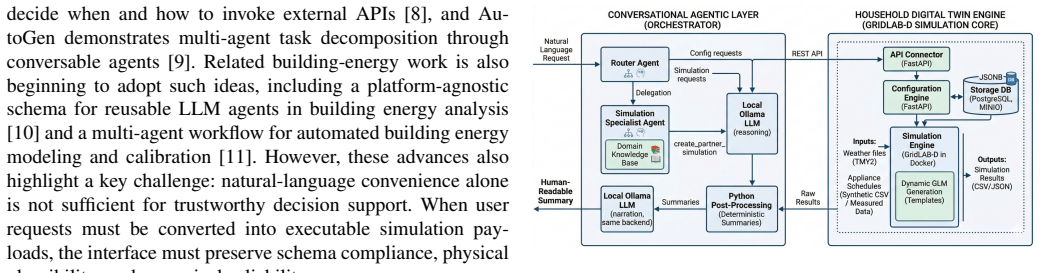
The central claim is that a Household Digital Twin built on GridLAB-D and exposed via REST microservices, when combined with a two-tier LLM agentic layer that performs intent routing, knowledge-base lookup, deterministic post-processing, and tool-governed execution, converts natural-language requests into schema-compliant simulation payloads and returns usable results at 100% schema conformance, 96.1% field-level F1, 90.4% value accuracy, and 95.6% end-to-end success on a 45-prompt test set spanning multiple households, seasons, and override cases.
What carries the argument
The two-tier LLM agentic layer that converts user requests into structured, schema-compliant simulation payloads for the Household Digital Twin while enforcing deterministic post-processing and tool-governed policies.
If this is right
- Homeowners and tenants gain the ability to evaluate dwelling-level retrofit choices without paying for professional audits.
- Consultants and municipal planners can assess building- and district-level interventions using household-specific physics models.
- Retailers and aggregators obtain estimates of residential flexibility and can coordinate distributed energy resources through natural language.
- The combination of LLM routing with deterministic post-processing keeps reliability high even though the front end accepts free-form input.
Where Pith is reading between the lines
- The same two-tier pattern could be applied to other physics simulators if equivalent digital twins and schema definitions are created for those domains.
- Deployment in live settings would need additional handling for continuous data streams from smart meters that were not present in the static test prompts.
- Voice or mobile-app front ends could be layered on top without changing the core agentic translation logic, further lowering the barrier for non-technical users.
Load-bearing premise
The 45 curated prompts with increasing complexity stand in for the full variety of real requests that households, consultants, and retailers would actually make, including novel or ambiguous inputs.
What would settle it
Collecting 100 new prompts directly from homeowners and municipal planners, running them through the live system, and finding the end-to-end simulation success rate falls below 80 percent.
Figures
read the original abstract
Multiple actors around residential energy systems require accessible decision-support tools: homeowners and tenants for dwelling-level retrofit choices, consultants and municipal planners for building and district-level intervention assessment, and retailers and aggregators for estimating residential flexibility and coordinating distributed energy resources. However, existing pathways remain limited, since professional audits are costly and static, rule-of-thumb estimates lack household specificity, and high-fidelity simulation tools require specialized expertise. This paper presents a conversational agentic framework that makes physics-based household energy simulation accessible through natural language interaction. The proposed system integrates a Household Digital Twin (HDT), built on GridLAB-D and exposed through a REST-based microservices architecture, with a two-tier large language model (LLM) agentic layer that translates user requests into structured, schema-compliant simulation payloads. To improve reliability, the architecture combines intent routing, a domain-specific knowledge base, deterministic post-processing of simulation outputs, and tool-governed execution policies. The system is evaluated on a curated dataset of 45 prompts with increasing complexity, covering multiple households, seasons, and override scenarios. Results show 100% schema conformance, 96.1% field-level F1, 90.4% value accuracy, and a 95.6% end-to-end simulation success rate. The findings indicate that conversational agentic interfaces can substantially lower the usability barrier of physics-based household digital twins while preserving the reliability required for residential energy decision support.
Editorial analysis
A structured set of objections, weighed in public.
Referee Report
Summary. The paper presents a conversational agentic framework integrating a Household Digital Twin (HDT) built on GridLAB-D with a two-tier LLM agentic layer, using intent routing, a domain-specific knowledge base, deterministic post-processing, and tool-governed policies to translate natural language requests into schema-compliant simulation payloads for residential energy decision support. It evaluates the system on a curated dataset of 45 prompts with increasing complexity across households, seasons, and override scenarios, reporting 100% schema conformance, 96.1% field-level F1, 90.4% value accuracy, and 95.6% end-to-end simulation success rate.
Significance. If the reliability mechanisms prove robust, the work could substantially lower the expertise barrier for physics-based household energy modeling, enabling accessible decision support for homeowners, consultants, planners, and aggregators.
major comments (3)
- [Evaluation] Evaluation section: The headline metrics (100% schema conformance, 96.1% F1, 90.4% value accuracy, 95.6% end-to-end success) are obtained solely on a hand-curated set of 45 prompts. No criteria for prompt selection, inter-annotator agreement, or statistical significance testing are provided, leaving open whether the results establish the claimed reliability for residential decision support.
- [Evaluation] Evaluation section: No out-of-distribution test set, ablation on the two-tier agentic components, or failure-mode analysis is reported. This leaves untested whether intent routing, the knowledge base, and deterministic post-processing maintain performance on novel phrasing, seasonal edge cases, or override combinations absent from the 45-prompt collection.
- [Results] Results: The central claim that the architecture 'preserves the reliability required for residential energy decision support' is load-bearing on the evaluation; without evidence that the test prompts match real-user distributions or that the system generalizes, the metrics do not yet substantiate the claim.
minor comments (1)
- The abstract states the prompts cover 'multiple households, seasons, and override scenarios' but provides no breakdown by category or examples of the prompts used.
Simulated Author's Rebuttal
We thank the referee for the constructive comments on our manuscript. We address each major comment below, indicating where revisions will be made.
read point-by-point responses
-
Referee: [Evaluation] Evaluation section: The headline metrics (100% schema conformance, 96.1% F1, 90.4% value accuracy, 95.6% end-to-end success) are obtained solely on a hand-curated set of 45 prompts. No criteria for prompt selection, inter-annotator agreement, or statistical significance testing are provided, leaving open whether the results establish the claimed reliability for residential decision support.
Authors: We agree that the evaluation would be strengthened by explicit documentation of prompt curation. In the revised manuscript we will add a subsection detailing the selection criteria, including systematic coverage of increasing complexity, multiple households, seasons, and override scenarios. Inter-annotator agreement is not applicable because the prompts were authored by the team to probe specific system behaviors; we will note this as a limitation. We will also report the metrics with the sample size and include binomial confidence intervals to address statistical considerations. revision: yes
-
Referee: [Evaluation] Evaluation section: No out-of-distribution test set, ablation on the two-tier agentic components, or failure-mode analysis is reported. This leaves untested whether intent routing, the knowledge base, and deterministic post-processing maintain performance on novel phrasing, seasonal edge cases, or override combinations absent from the 45-prompt collection.
Authors: We concur that these analyses would improve the evaluation. We will add a failure-mode analysis that examines the four unsuccessful cases (4.4 %) to identify patterns. Where feasible from existing execution logs we will include an ablation on the contribution of the two-tier routing and post-processing steps. Out-of-distribution testing on entirely novel user phrasing is a limitation of the current study; we will state this explicitly and list it as future work. revision: partial
-
Referee: [Results] Results: The central claim that the architecture 'preserves the reliability required for residential energy decision support' is load-bearing on the evaluation; without evidence that the test prompts match real-user distributions or that the system generalizes, the metrics do not yet substantiate the claim.
Authors: The claim is tied to performance on the evaluated prompt set, which was constructed to span relevant residential scenarios. We accept that stronger evidence of real-user distribution matching would be needed for an unqualified generalization statement. In revision we will temper the language in the abstract, results, and conclusion to indicate that the architecture achieves high reliability on the tested distributions and thereby lowers the barrier to physics-based modeling, while noting the need for future validation against actual user queries. revision: yes
Circularity Check
No circularity; paper reports direct empirical metrics from implemented system
full rationale
The manuscript presents an implemented architecture (HDT on GridLAB-D + two-tier LLM agentic layer with intent routing, KB, post-processing, and policies) and measures its performance directly on a fixed curated test set of 45 prompts. Reported figures (100% schema conformance, 96.1% field-level F1, 90.4% value accuracy, 95.6% end-to-end success) are obtained by running the system on those prompts; no equations, parameter fitting, predictions derived from the same data, or self-citation chains are used to generate the claims. The evaluation is therefore a straightforward measurement rather than a derivation that reduces to its own inputs. No load-bearing self-citations, ansatzes, or renamings appear in the derivation chain because no derivation chain exists.
Axiom & Free-Parameter Ledger
Reference graph
Works this paper leans on
-
[1]
Energy consumption in households,
Eurostat, “Energy consumption in households,” 2026, accessed: 2026-04-12. [Online]. Available: https://ec.europa.eu/eurostat/statistics- explained/index.php?title=Energy consumption in households
2026
-
[2]
Review of existing energy retrofit decision tools for homeowners,
M. Seddiki, A. Bennadji, R. Laing, D. Gray, and J. M. Alabid, “Review of existing energy retrofit decision tools for homeowners,”Sustainability, vol. 13, no. 18, p. 10189, 2021
2021
-
[3]
A review of building digital twins to improve energy efficiency in the building operational stage,
A. S. Cespedes-Cubides and M. Jradi, “A review of building digital twins to improve energy efficiency in the building operational stage,” Energy Informatics, vol. 7, no. 1, p. 11, 2024
2024
-
[4]
Towards democratization of digital twins: Design principles for trans- formation into a human-building interface,
K. S. Lee, J.-J. Lee, C. Aucremanne, I. Shah, and A. Ghahramani, “Towards democratization of digital twins: Design principles for trans- formation into a human-building interface,”Building and Environment, vol. 244, p. 110771, 2023
2023
-
[5]
A natural language interface for an energy system model,
J. H ¨ulsmann, L. J. Sieben, M. Mesgar, and F. Steinke, “A natural language interface for an energy system model,” in2021 IEEE PES Innovative Smart Grid Technologies Europe (ISGT Europe), 2021, pp. 1–5
2021
-
[6]
Eplus-llm: A large language model-based computing platform for automated building energy model- ing,
G. Jiang, Z. Ma, L. Zhang, and J. Chen, “Eplus-llm: A large language model-based computing platform for automated building energy model- ing,”Applied Energy, vol. 367, p. 123431, 2024
2024
-
[7]
React: Synergizing reasoning and acting in language models,
S. Yao, J. Zhao, D. Yu, N. Du, I. Shafran, K. Narasimhan, and Y . Cao, “React: Synergizing reasoning and acting in language models,” inThe Eleventh International Conference on Learning Representations (ICLR), 2023. [Online]. Available: https://openreview.net/forum?id= WE vluYUL-X
2023
-
[8]
Toolformer: Language models can teach themselves to use tools,
T. Schick, J. Dwivedi-Yu, R. Dess `ı, R. Raileanu, M. Lomeli, L. Zettle- moyer, N. Cancedda, and T. Scialom, “Toolformer: Language models can teach themselves to use tools,” inAdvances in Neural Information Processing Systems, vol. 36, 2023
2023
-
[9]
Autogen: Enabling next-gen llm applications via multi-agent conversation,
Q. Wu, G. Bansal, J. Zhang, Y . Wu, B. Li, E. Zhu, L. Jiang, X. Zhang, S. Zhang, J. Liu, A. H. Awadallah, R. W. White, D. Burger, and C. Wang, “Autogen: Enabling next-gen llm applications via multi-agent conversation,” inProceedings of the First Conference on Language Modeling (COLM), 2024
2024
-
[10]
Large language model-based agent schema and library for automated building energy analysis and modeling,
L. Zhang, X. Fu, Y . Li, and J. Chen, “Large language model-based agent schema and library for automated building energy analysis and modeling,”Automation in Construction, vol. 176, p. 106244, 2025
2025
-
[11]
Automated building energy modeling for energy retrofits using a large language model-based multi- agent framework,
J. Lu, Z. Zheng, M. Langtry, M. Jackson, Y . Zhao, C. Feng, R. Zhang, C. Zhang, J. Zhang, and R. Choudhary, “Automated building energy modeling for energy retrofits using a large language model-based multi- agent framework,”iScience, vol. 28, no. 11, p. 113867, 2025
2025
-
[12]
Gridlab-d: An agent-based simulation framework for smart grids,
D. P. Chassin, J. C. Fuller, and N. Djilali, “Gridlab-d: An agent-based simulation framework for smart grids,”Journal of Applied Mathematics, vol. 2014, pp. 1–12, 2014
2014
-
[13]
Gridlab-d technical support document: Residential end-use module version 1.0,
Z. T. Taylor, K. Gowri, and S. Katipamula, “Gridlab-d technical support document: Residential end-use module version 1.0,” Pacific Northwest National Laboratory, Tech. Rep. PNNL-17694, 2008
2008
discussion (0)
Sign in with ORCID, Apple, or X to comment. Anyone can read and Pith papers without signing in.