Optimization of Predictive Maintenance Schedules under Uncertainty: A Scenario-Based Theoretical Framework
Pith reviewed 2026-06-29 05:34 UTC · model grok-4.3
The pith
A scenario-based framework shows integrated maintenance policies outperform single-trigger rules by combining calendar, usage and RUL data.
A machine-rendered reading of the paper's core claim, the machinery that carries it, and where it could break.
Core claim
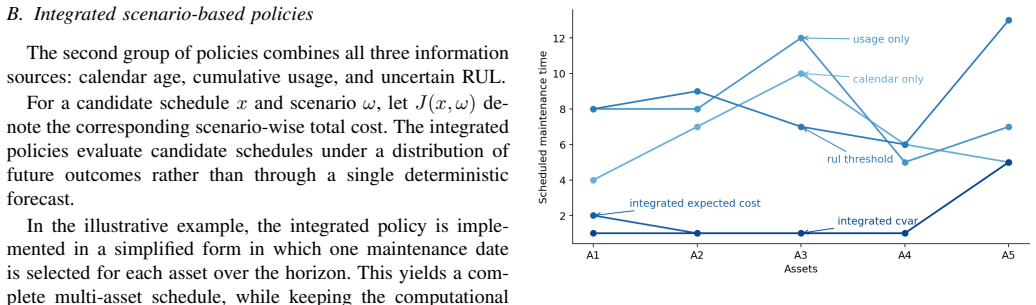
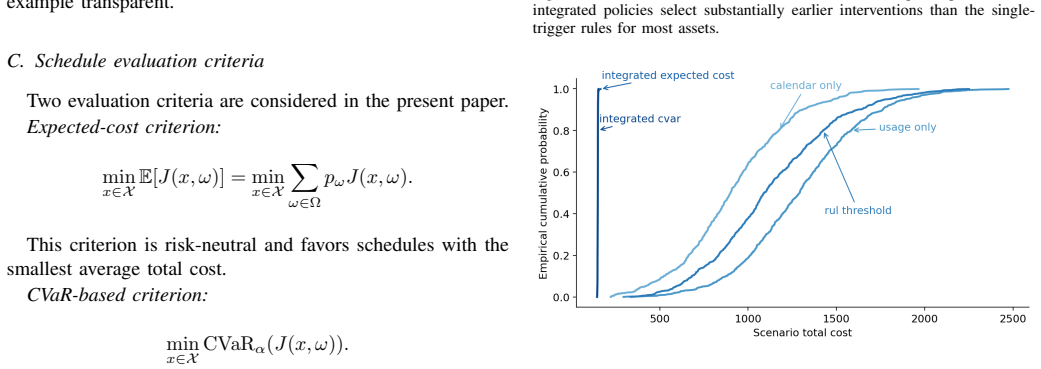
The central claim is that a scenario-based optimization framework, which generates simulated future operating scenarios and scores entire candidate maintenance schedules using expected-cost and tail-risk criteria, supplies a common decision structure for calendar-based, usage-based, and condition-monitoring information. In the synthetic test case this integrated approach yields markedly better cost performance than simpler single-trigger policies, while the further step from risk-neutral to risk-aware objectives produces only modest additional improvement under the chosen calibration.
What carries the argument
The scenario-based decision framework that simulates future scenarios and evaluates complete maintenance schedules by expected-cost and tail-risk criteria.
If this is right
- Complete schedule evaluation under multiple scenarios captures interactions among calendar, usage and condition data that isolated triggers miss.
- Risk-aware criteria produce policies whose cost performance differs only modestly from risk-neutral ones in the tested calibration.
- The framework supplies a single optimization language for comparing decisions drawn from three heterogeneous information sources.
- Finite planning horizons make explicit the trade-off between immediate maintenance actions and their consequences across future scenarios.
Where Pith is reading between the lines
- If the framework scales, asset fleets could replace fixed triggers with libraries of historical failure scenarios that are re-optimized as new RUL estimates arrive.
- The modest difference between risk-neutral and risk-aware results suggests that expected-cost optimization alone may be sufficient unless tail events carry unusually high penalties.
- Testing the method on streaming sensor data from operating equipment would show whether the synthetic gains persist when uncertainty sources are correlated in practice.
Load-bearing premise
The small synthetic computational example is assumed to be representative enough to support claims about outperformance of integrated policies over single-trigger rules in real settings with heterogeneous uncertainty sources.
What would settle it
A dataset from actual industrial assets in which the lowest-cost single-trigger policy achieves costs within ten percent of the scenario-optimized integrated policy would falsify the claim of substantial outperformance.
Figures
read the original abstract
This paper proposes a scenario-based framework for predictive maintenance scheduling under uncertainty in a finite planning horizon. The considered setting involves multiple assets for which maintenance decisions are informed by three heterogeneous sources of information: calendar-based overhaul intervals, usage-based limits driven by uncertain future operating cycles, and condition-monitoring outputs represented through remaining useful life (RUL) estimates with uncertainty. While these elements have been studied extensively in the maintenance literature, they are often treated separately or only partially integrated. In contrast, the proposed formulation evaluates complete maintenance schedules under simulated future scenarios and compares them using expected-cost and tail-risk criteria. The contribution is primarily conceptual and methodological: we define a unified finite-horizon decision framework that combines calendar-, usage-, and prognostics-based information within a common scheduling problem. A small synthetic computational example is used as a proof of concept. The results show that integrated scenario-based policies can substantially outperform simpler single-trigger rules, while the difference between risk-neutral and risk-aware integrated policies remains modest under the present calibration.
Editorial analysis
A structured set of objections, weighed in public.
Referee Report
Summary. The paper proposes a scenario-based framework for predictive maintenance scheduling under uncertainty over a finite planning horizon. It integrates three heterogeneous information sources—calendar-based overhaul intervals, usage-based limits from uncertain operating cycles, and condition-monitoring outputs via uncertain RUL estimates—into a unified decision model. Complete maintenance schedules are evaluated under simulated future scenarios using expected-cost and tail-risk criteria. The contribution is framed as primarily conceptual and methodological, with a small synthetic computational example serving as a proof of concept. Results indicate that integrated scenario-based policies substantially outperform simpler single-trigger rules, while differences between risk-neutral and risk-aware integrated policies are modest under the given calibration.
Significance. If the framework and example hold, the work provides a methodological contribution by unifying calendar-, usage-, and prognostics-based triggers within a common scenario-based optimization setting, which is often treated separately in the maintenance literature. The explicit scoping of the computational study as a 'small synthetic ... proof of concept' supports internal consistency of the outperformance claim within that instance. The approach could serve as a foundation for more integrated maintenance policies, though the manuscript does not claim quantitative transfer to real heterogeneous fleets.
minor comments (2)
- [Abstract] The abstract refers to 'the present calibration' when describing the modest difference between risk-neutral and risk-aware policies; adding a brief statement of the key parameter values or scenario count used would improve clarity without altering the proof-of-concept scope.
- [Abstract] The manuscript would benefit from an explicit statement of the finite planning horizon length and the number of assets in the synthetic example, as these details are referenced but not quantified in the provided description.
Simulated Author's Rebuttal
We thank the referee for the positive summary, significance assessment, and recommendation of minor revision. No major comments appear in the report.
Circularity Check
No significant circularity; framework is self-contained
full rationale
The manuscript is explicitly scoped as a conceptual/methodological contribution that defines a unified finite-horizon scheduling framework and demonstrates behavior inside one small synthetic proof-of-concept instance. No equations, fitted parameters, or self-citations are shown that reduce any claimed result to its own inputs by construction. The outperformance statement is limited to the chosen baselines inside the example and does not rely on external uniqueness theorems or prior self-work to force the outcome. This is the normal case of an honest non-finding for a framework paper.
Axiom & Free-Parameter Ledger
Reference graph
Works this paper leans on
-
[1]
An overview of time-based and condition-based maintenance in industrial application,
R. Ahmad and S. Kamaruddin, “An overview of time-based and condition-based maintenance in industrial application,”Computers & Industrial Engineering, vol. 63, no. 1, pp. 135–149, 2012
2012
-
[2]
A review on maintenance optimization,
B. de Jonge and P. A. Scarf, “A review on maintenance optimization,” European Journal of Operational Research, vol. 285, no. 3, pp. 805–824, 2020
2020
-
[3]
Decision making in predictive maintenance: Literature review and research agenda for industry 4.0,
A. Bousdekis, K. Lepenioti, D. Apostolou, and G. Mentzas, “Decision making in predictive maintenance: Literature review and research agenda for industry 4.0,”IF AC-PapersOnLine, vol. 52, no. 13, pp. 607–612, 2019
2019
-
[4]
A review of condition-based mainte- nance: Its prognostic and operational aspects,
Y . Li, S. Peng, Y . Li, and W. Jiang, “A review of condition-based mainte- nance: Its prognostic and operational aspects,”Frontiers of Engineering Management, vol. 7, no. 3, pp. 323–334, 2020
2020
-
[5]
Maintenance scheduling based on remaining useful life predictions for wind farms managed using power purchase agreements,
X. Lei and P. A. Sandborn, “Maintenance scheduling based on remaining useful life predictions for wind farms managed using power purchase agreements,”Renewable Energy, vol. 116, pp. 188–198, 2018
2018
-
[6]
Condition- based maintenance policies for systems with multiple dependent compo- nents: A review,
M. C. A. O. Keizer, S. D. P. Flapper, and R. H. Teunter, “Condition- based maintenance policies for systems with multiple dependent compo- nents: A review,”European Journal of Operational Research, vol. 261, no. 2, pp. 405–420, 2017
2017
-
[7]
Multicomponent maintenance opti- mization: A stochastic programming approach,
Z. Zhu, Y . Xiang, and B. Zeng, “Multicomponent maintenance opti- mization: A stochastic programming approach,”INFORMS Journal on Computing, vol. 33, no. 3, pp. 898–914, 2021
2021
-
[8]
Condition-based multi-component main- tenance decision support under degradation uncertainties,
A. M. A. Islam and J. Vatn, “Condition-based multi-component main- tenance decision support under degradation uncertainties,”International Journal of System Assurance Engineering and Management, vol. 14, no. 4, pp. 961–979, 2023
2023
-
[9]
Dynamic predictive and preventive maintenance planning with failure risk and opportunistic grouping considerations: A case study in the automotive industry,
B. Einabadi, M. Mahmoodjanloo, A. Baboli, and E. Rother, “Dynamic predictive and preventive maintenance planning with failure risk and opportunistic grouping considerations: A case study in the automotive industry,”Journal of Manufacturing Systems, vol. 69, pp. 292–310, 2023
2023
-
[10]
Optimizing a condition-based maintenance policy by taking the preferences of a risk-averse decision maker into account,
T. I. Pedersen and J. Vatn, “Optimizing a condition-based maintenance policy by taking the preferences of a risk-averse decision maker into account,”Reliability Engineering & System Safety, vol. 228, p. 108775, 2022
2022
-
[11]
J. R. Birge and F. Louveaux,Introduction to Stochastic Programming, 2nd ed. Springer, 2011
2011
-
[12]
Optimization of conditional value- at-risk,
R. T. Rockafellar and S. Uryasev, “Optimization of conditional value- at-risk,”Journal of Risk, vol. 2, no. 3, pp. 21–41, 2000
2000
-
[13]
A predictive maintenance framework based on real-time credibility evalua- tion of remaining useful life prediction results,
G. Shi, X. Zhang, J. Zeng, H. Liao, J. Gan, J. Wang, and Z. Wang, “A predictive maintenance framework based on real-time credibility evalua- tion of remaining useful life prediction results,”Reliability Engineering & System Safety, vol. 264, p. 111342, 2025
2025
-
[14]
Condition- based and age-based maintenance in a multi-component system with het- erogeneous components incorporating imperfect preventive maintenance actions,
L. Bautista, I. T. Castro, M. D. Nardo, and T. Murino, “Condition- based and age-based maintenance in a multi-component system with het- erogeneous components incorporating imperfect preventive maintenance actions,”Computers & Industrial Engineering, vol. 206, p. 111188, 2025
2025
discussion (0)
Sign in with ORCID, Apple, or X to comment. Anyone can read and Pith papers without signing in.