REVIEW 3 major objections 4 minor 30 references
On the forts and related parameters of the hypercube graph
T0 review · 3 major / 4 minor · reviewed 2026-08-06 · deepseek-v4-flash
Pith's one-line read The paper proves that every minimum fort of the hypercube graph Q_d is an open neighborhood of a vertex, except in dimension 4, where exactly one additional class of minimum forts appears.
desk verdict New and likely correct characterization of minimum hypercube forts, with a genuine Q4 surprise, but Proposition 3.7 has a load-bearing gap that needs referee attention. read the letter →
The pith
A machine-rendered reading of the paper's core claim, the machinery that carries it, and where it could break.
The reading
What carries the argument
The load-bearing mechanism is the hypercube's common-neighbor geometry. Proposition 3.2—two vertices whose open neighborhoods intersect share exactly two common neighbors—makes every open neighborhood $N(v)$ a fort and controls how many fort violations a new vertex can repair. Starting from a candidate pair, the proof counts the $2d$ violations contributed by $N(u) \cup N(v)$, then shows each added vertex resolves at most two of them; this counting forces a minimum fort either to be all of $N(v)$ or, in dimension 4 only, to be the exceptional Figure 2 set. The second machinery is the fort-cover linear program: Theorem 2.1 identifies zero forcing sets with fort transversals, so the characterization directly yields $Z^*(Q_d)$.
What would settle it
Enumerate all d-element subsets of V(Q_d) for d=5 (and if feasible d=6) and test the fort condition directly. Theorem 3.8 predicts that the only forts of size d are the 32 (respectively 64) open neighborhoods; any other d-element fort, especially one containing two vertices at distance 4, would disprove the characterization.
Extended reading notes
Core claim
In the paper's own terms, the discovery is Theorem 3.8: for $d \ge 2$ and $d \ne 4$, a subset $F$ of $V(Q_d)$ is a minimum fort if and only if $F = N(v)$ for some $v \in V(Q_d)$. Proposition 3.9 handles the remaining case $d=4$, where the minimum forts are exactly the open neighborhoods together with the automorphic images of the set in Figure 2. Corollary 3.10 then fixes the size of every minimum fort at $d$. The proof is a sequence of exclusions inside the hypercube: minimum forts contain no adjacent vertices, no vertices from both bipartition parts, no vertices at distance at least 6, and (for $d \ge 5$) no vertices at distance 4; what remains is a set whose vertices are pairwise at distance 2, i.e., the neighborhood of one vertex.
Load-bearing premise
The proof depends on the counting assumption that after choosing two vertices at distance 4, every further vertex added to the growing set repairs at most two of the remaining violations of the fort condition, and that for dimension at least 6 the necessary repairs force another pair of vertices at distance at least 6; if a cheaper repair existed, a minimum fort not equal to an open neighborhood could exist.
Editorial extensions
If this is right
- For every $d \ge 2$ with $d \ne 4$, the minimum forts of $Q_d$ coincide with the open neighborhoods, and Corollary 3.10 fixes their size at $d$.
- The fractional zero forcing number is $Z^*(Q_d)=2^d/d$ (Corollary 3.11), reproducing the known value through a complete structural description.
- The fort number obeys $2^d/2^{\lfloor \log_2(d-1)\rfloor+1} \le ft(Q_d) \le 2^d/d$, and when $d=2^k$ the bounds coincide: $ft(Q_{2^k})$, $Z^*(Q_{2^k})$, $\gamma(Q_{2^k})$, $\gamma_t(Q_{2^k})$, and $\rho_o(Q_{2^k})$ all equal $2^{2^k-k}$ (Corollary 3.14).
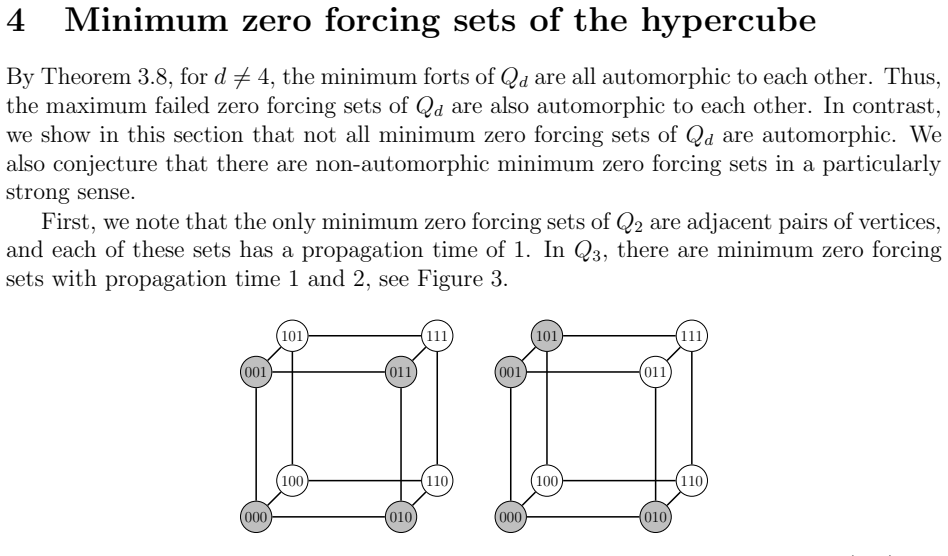
- Minimum zero forcing sets of $Q_d$ for $d \ge 4$ include examples with propagation times 1, 2, 3, and 4, which are therefore pairwise non-automorphic (Corollaries 4.2 and 4.3).
- The Cartesian-product constructions of Theorems 5.1 and 5.3 enumerate all 14 minimal forts of $Q_3$ and produce 60 of the 348 minimal forts of $Q_4$, so a full census for higher dimensions remains open.
Reading between the lines
- The same repair-counting strategy might transfer to other distance-regular bipartite graphs whose open neighborhoods have constant intersection sizes; the common-neighbor count is the only graph-specific input, so testing analogues such as folded hypercubes or grid graphs would show how far the mechanism generalizes.
- The fort-number bounds leave a gap for dimensions that are not powers of two; one could try to construct disjoint neighborhoods meeting the lower bound more often, or search for a matching upper bound via a different dual of the fort-cover program.
- Because the characterization makes all minimum forts explicit, the fort-cover inequalities for $Q_d$ become explicitly indexable; a natural follow-up, which the paper leaves open, is whether separating over hypercube forts can be done in polynomial time for zero-forcing integer programs.
- The conjecture that $Q_d$ has minimum zero forcing sets realizing every propagation time from 1 to $2^{d-2}$ is checkable by search for $Q_5$ and $Q_6$; if correct, the non-automorphism phenomenon is much stronger than the four propagation times constructed here.
Editorial analysis
A structured set of objections, weighed in public.
Referee Report
Summary. The paper studies forts in hypercube graphs and claims a complete classification of minimum forts: for every d ≠ 4 the minimum forts of Q_d are exactly the open neighborhoods of vertices, while for Q_4 they are the open neighborhoods together with the automorphic images of the set shown in Figure 2. From this characterization the paper derives that every minimum fort has cardinality d, that the fractional zero forcing number of Q_d is 2^d/d, and that for dimensions that are powers of two the fort number coincides with the domination number, total domination number, and open packing number. The paper also constructs non-automorphic minimum zero forcing sets of Q_d with propagation times 1 through 4 and gives general constructions for minimal forts of Cartesian products of graphs, with partial enumerations of minimal forts of Q_3 and Q_4.
Significance. The characterization, if correct, is a clean and structurally interesting result: in almost all hypercubes the minimum forts are exactly the open neighborhoods, with Q_4 as a single exceptional case. The paper is honest about the fact that Z*(Q_d) was already known, and it uses the fort characterization to give a new route to that value and to connect the fort number with domination-type parameters for power-of-two dimensions. The Cartesian product constructions in Section 5 are useful and are checked against explicit computational enumerations for Q_3 and Q_4. The main weakness is not the plausibility of the central theorem but the rigor of the proof: Proposition 3.7 needs an equality-case analysis before it can exclude size-d forts containing distance-4 pairs, and one lower-bound step in Corollary 3.11 is written incorrectly. I found no circular reasoning or misuse of the prior results cited in the paper.
major comments (3)
- [Section 3, Proposition 3.7] The proof of the strict bound |F| > d for d ≥ 5 is incomplete. After the two vertices p1 and p2 are added, there are 2d - 8 residual violations, so the lower bound |F| ≥ d follows; to obtain strictness for d ≥ 6 one must rule out the equality case in which exactly d - 4 further vertices are added, each resolving exactly two residuals. The text only analyzes the particular vertex w that is the common neighbor of two residual vertices in N(u), observes that d(w,v) = 6, and invokes Proposition 3.6. It does not classify the possible pairings of residual vertices, nor does it analyze the new violations created by the added repair vertices. For example, for d = 6 one must also rule out pairing the two residual vertices in N(v), which gives a vertex at distance 6 from u, and one must rule out mixed pairings. Without this equality-case analysis, a size-d fort containing a distance-4 pair is not excluded, and Theorem 3.8 would not be established. In the d = 5 paragraph, the statement that at least four vertices must be added is asserted without proof; the desired strict inequality would already follow from the fact that the two remaining residuals cannot be resolved by a single added vertex.
- [Corollary 3.11] The proof of the lower bound Z*(Q_d) ≥ 2^d/d is not valid as written. From the fact that every minimum fort has size d it does not follow that 'no weighting of less than 1/d on a vertex will suffice': weights need not be uniform, and a vertex could receive more than 1/d while another receives less. The conclusion is true, but it requires an averaging argument: summing the constraints sum_{v in N(x)} w(v) ≥ 1 over all 2^d neighborhoods N(x) counts each vertex exactly d times and yields d * sum_v w(v) ≥ 2^d. The text should replace the quoted sentence with this or an equivalent derivation.
- [Theorem 3.8, proof] The final step 'all vertices in F are a distance of 2 apart from each other, which means F is the neighborhood of a single vertex' is asserted without proof. This is true for a fort of size d in Q_d, but the proof needs the extra facts that a set of d pairwise-distance-2 vertices in Q_d must be a full neighborhood of some vertex, and that no proper subset of a neighborhood is itself a fort. As written, the characterization relies on an unstated lemma.
minor comments (4)
- [Page 5, after Proposition 3.2] The text says 'Note that Corollary 3.2 states...' but the referenced result is Proposition 3.2, not a corollary.
- [Section 6, conclusion] The conclusion states that 'Theorem 5.2 establishes that F x F' is a minimal fort of G box G''; this is inaccurate because Theorem 5.2 constructs a fort, not generally the Cartesian product and not minimality, while minimality is the content of Theorems 5.1 and 5.3.
- [Theorem 5.1, proof, Case 2] The equality N_{\hat G}((u,u')) cap \hat S = {(u,v')} is claimed for each u in V(G), but for u outside F this need not hold if u has neighbors in F. The subsequent argument only needs the displayed equality for u in F, so the statement should be restricted accordingly.
- [Proposition 3.9] The sentence 'All sets F of this form are automorphic to the set in Figure 2' is too terse; a brief argument that the automorphism group of Q_4 is transitive on such configurations would make the proof self-contained.
Circularity Check
No circularity: the minimum-fort characterization of Q_d is derived from definitions and independent propositions, not from its conclusion.
full rationale
The central claim (Theorem 3.8) is not assumed anywhere. Neighborhoods are shown to be forts in Proposition 3.3 by direct counting of common neighbors, and the lower-bound machinery (Propositions 3.4-3.7) is built from bipartiteness, degree, and common-neighbor facts. No parameter is fitted, and no prediction is defined in terms of the target result. The self-citations [7], [8], and [13] are used for background, for the general fort-cover model, for the known inequality ft(G) <= Z*(G) <= Z(G), and for a product-of-forts lemma; none of these inputs contains Theorem 3.8 or Corollary 3.10, and the fractional zero forcing number of Q_d is disclosed as already known in [13, Proposition 3.15] but is re-derived from the paper's own characterization in Corollary 3.11. The use of Proposition 3.6 inside Proposition 3.7 is not circular because Proposition 3.6 is proved earlier from the fact that neighborhoods are forts. The proof of Proposition 3.7 contains an unquantified equality-case argument for d >= 5, so that part may be a rigor gap, but a gap in an independent proof is a correctness issue, not circularity: no equation in the paper reduces to its own input by construction.
Assumptions & free parameters
assumptions (6)
- domain assumption Vertices of Q_d are binary d-vectors with adjacency by Hamming distance 1, the Boolean lattice representation.
- standard math In Q_d, two vertices at distance k have k! distinct shortest paths (Proposition 3.1, cited to [19]).
- standard math Z(Q_d) = 2^(d-1) and pt(Q_d) = 1 (cited to [3] and [22]).
- standard math Open packing number of Q_d satisfies rho_o(Q_d) >= 2^(d - floor(log2(d-1)) - 1) (cited to [6, Theorem 3.2]).
- standard math For k in N, rho_o(Q_{2^k}) = gamma(Q_{2^k}) = gamma_t(Q_{2^k}) = 2^(2k - k) (cited to [6]).
- standard math If F is a fort of G and F' is a fort of G', then F x F' is a fort of G square G' (cited to [13, Proposition 4.1]).
Cite this review
Pith. "Pith review of On the forts and related parameters of the hypercube graph." pith.science (2026). https://pith.science/paper/4EN6MQE7
@misc{pith2026250710826,
  author       = {Pith},
  title        = {Pith review of: On the forts and related parameters of the hypercube graph},
  year         = {2026},
  howpublished = {\url{https://pith.science/paper/4EN6MQE7}},
  note         = {Machine review of arXiv:2507.10826}
}
read the original abstract
In 2018, forts were defined as non-empty subsets of vertices in a graph where no vertex outside the set has exactly one neighbor in the set. Forts have since been used to characterize zero forcing sets, model zero forcing as an integer program, and provide lower bounds on the zero forcing number. In this article, we give a complete characterization of minimum forts in the hypercube graph, showing that they are automorphic to one of two sets. In contrast, non-automorphic minimum zero forcing sets are identified with distinct propagation times. We also derive the fractional zero forcing number and bounds on the fort number of the hypercube. When the hypercube's dimension is a power of two, the fort number and fractional zero forcing number are equal to the domination number, total domination number, and open packing number. Lastly, we present general constructions for minimal forts in the Cartesian product of graphs, reflecting some minimal forts of the hypercube.
Figures


Figures from the paper (5 more)


Reference graph
Works this paper leans on
-
[1]
A. Aazami , Hardness results and approximation algorithms for some problems on graphs, University of Waterloo, 2008
work page 2008
-
[2]
F. Afzali, A.H. Ghodrati, and H.R. Maimani , Failed zero forcing numbers of Kneser graphs, Johnson graphs, and hypercubes, J. Appl. Math. Comput. , 70:2665– 2675, 2024
work page 2024
-
[3]
AIM Minimum Rank – Special Graphs Work Group , Zero forcing sets and the minimum rank of graphs, Linear Algebra Appl., 428:1628–1648, 2008
work page 2008
-
[4]
J. Azarija, M.A. Henning, and S. Klav ˇzar, (Total) Domination in Prisms, Electron. J. Combin. , 24(1):19, 2017
work page 2017
-
[5]
R. Bertolo, P.R.J. ¨Osterg˚ard, and W.D. Weakley An Updated Table of Binary/ternary Mixed Covering Codes, J. Combin. Des. , 12:157-176, 2004. 17
work page 2004
-
[6]
B. Breˇsar, S. Klavˇzar, D.F. Rall Packings in bipartite prisms and hypercubes, Discrete Math., 347:113875, 2024
work page 2024
-
[7]
B. Brimkov, C.C. F ast, and I.V. Hicks, Computational approaches for zero forcing and related problems, European J. Oper. Res., 273(3):889–903, 2019
work page 2019
-
[8]
B. Brimkov, D. Mikesell, and I.V. Hicks , Improved computational approaches and heuristics for zero forcing, INFORMS J. Comput. , 33(4):1384-1399, 2021
work page 2021
Show all 30 references
-
[9]
Brimkov, J
B. Brimkov, J. Carlson, I.V. Hicks, R. Patel, and L. Smith, Power domination throttling, Theoret. Comput. Sci. , 795:142–153, 2019
2019
-
[10]
Brueni and L.S
D.J. Brueni and L.S. Heath , The PMU placement problem, SIAM J. Discrete Math., 19(3):744–761, 2005
2005
-
[11]
Burgarth and V
D. Burgarth and V. Giovannetti, Full control by locally induced relaxation, Phys. Rev. Lett., 99:100501, 2007
2007
-
[12]
Butler and M
S. Butler and M. Young, Throttling zero forcing propagation time speed on graphs, Australas J. Combin. , 57:65–71, 2013
2013
-
[13]
Cameron, L
T.R. Cameron, L. Hogben, F.H.J. Kenter, S.A. Mojallal, and H. Schuerger, Forts, (fractional) zero forcing, and Cartesian products of graphs, arXiv:2310.17904 [math.CO] , 2023
2023
-
[14]
Carlson and J
J. Carlson and J. Kritschgau , Various characterizations of throttling numbers, Discrete Appl. Math. , 294:85–97, 2021
2021
-
[15]
Chilakamarri, N
K. Chilakamarri, N. Dean, C.X. Kang, and E. Yi , Iteration index of a zero forcing set in a graph, Bull. Inst. Combin. Appl. , 64:57–72, 2012
2012
-
[16]
Erd˝os and R.K
P. Erd˝os and R.K. Guy, Crossing Number Problems, Amer. Math. Monthly, 80:52– 58, 1973
1973
-
[17]
F ast and I.V
C.C. F ast and I.V. Hicks, Effects of vertex degrees on the zero-forcing number and propogation time of a graph, Discrete Appl. Math. , 250:215–226, 2018
2018
-
[18]
Fetci, B
K. Fetci, B. Jacob, and D. Saavedra, The failed zero forcing number of a graph, Involve, 8(1):99–117, 2015
2015
-
[19]
Foldes, A characterization of hypercubes, Discrete Math., 17(2):155–159, 1977
S. Foldes, A characterization of hypercubes, Discrete Math., 17(2):155–159, 1977
1977
-
[20]
Gomez, K
L. Gomez, K. Rubi, J. Terrazas, and D.A. Narayan , All graphs with a failed zero forcing number of two, Symmetry, 13(11):2221, 2021
2021
-
[21]
Gomez, K
L. Gomez, K. Rubi, J. Terrazas, and D.A. Narayn , Failed zero forcing number of trees and circulant graphs, Theory and Applications of Graphs , 11(1):5, 2025
2025
-
[22]
Hogben, M
L. Hogben, M. Huynh, N. Kingsley, S. Meyer, S. W alker, and M. Young , Propagation time for zero forcing on a graph, Discrete Appl. Math., 160(13):1994–2005, 2012. 18
1994
-
[23]
Hogben, J.C.-H
L. Hogben, J.C.-H. Lin, and B. Shader , Inverse Problems and Zero Forcing for graphs, Mathematical Surveys and Monographs 270, American Mathematical Society, Providence, RI, 2022
2022
-
[24]
Jenssen, W
M. Jenssen, W. Perkins, and A. Potukuchi , Independent sets of a given size and structure in the hypercube, Combin. Probab. Comput. 31(4):702-720, 2022
2022
-
[25]
Kaudan, R
C. Kaudan, R. Taylor, D.A. Narayan , An inverse approach for finding graphs with a failed zero forcing number of k, Mathematics 11(19):4068, 2023
2023
-
[26]
Mirafzal , On the distance-transitivity of the folded hypercube, Commun
S.M. Mirafzal , On the distance-transitivity of the folded hypercube, Commun. Comb. Optim. 10(1):207–217, 2025
2025
-
[27]
Severini, Nondiscriminatory propagation on trees, J
S. Severini, Nondiscriminatory propagation on trees, J. Phys. A, 41(48):482002, 2008
2008
-
[28]
Shitov, On the complexity of failed zero forcing, Theoret
Y. Shitov, On the complexity of failed zero forcing, Theoret. Comput. Sci. , 660:102– 104, 2017
2017
-
[29]
Swanson and E
N. Swanson and E. Ufferman, A lower bound on the failed zero-forcing number of a graph, Involve, 16(3):493–504, 2023
2023
-
[30]
West, Introduction to Graph Theory, 2nd ed
D. West, Introduction to Graph Theory, 2nd ed. , Prentice Hall, Upper Saddle River, NJ, 2001. 19
2001
Reviewed August 6, 2026 · model on record in the stance chip above.
Discussion (0). Sign in to comment.