REVIEW 4 major objections 3 minor 37 references
Decay of a Quantum Knot
T0 review · 4 major / 3 minor · reviewed 2026-08-14 · deepseek-v4-flash
Pith's one-line read Under a 1-G magnetic field, a quantum knot in a spinor Bose–Einstein condensate decays into a long-lived polar-core spin vortex.
desk verdict First experimental study of quantum knot dynamics beyond creation, with a credible but not directly measured decay into a polar-core spin vortex. read the letter →
The pith
A machine-rendered reading of the paper's core claim, the machinery that carries it, and where it could break.
The reading
What carries the argument
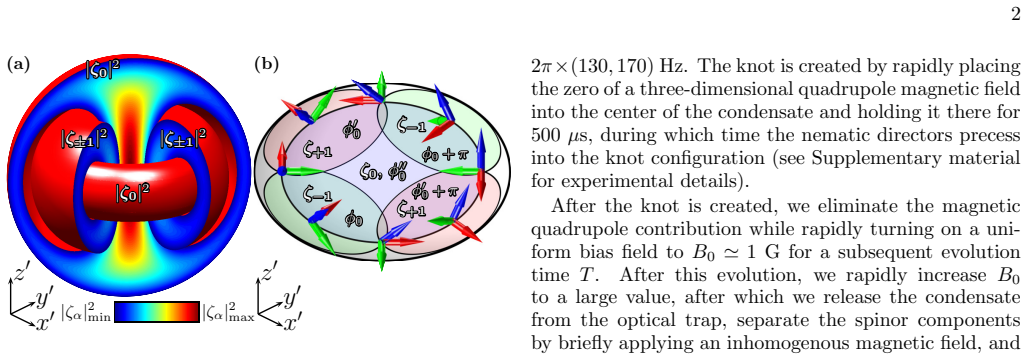
The argument is carried by the Cartesian triad representation of the spin-1 order parameter, in which each spinor is written with two real vectors $\mathbf{m}$ and $\mathbf{n}$ whose cross product gives the spin vector $\mathbf{s}=\mathbf{m}\times\mathbf{n}$. This representation turns the polar-core spin vortex into a concrete winding pattern: $\mathbf{s}$ and $\mathbf{m}$ execute quadrupolar $2\pi$ rotations about a non-winding $\mathbf{n}$ along any loop around the core, identifying the defect as a singly quantized singular $SO(3)$ vortex. The experimental identification combines Stern–Gerlach spinor separation after time-of-flight expansion, rotation of the quantization basis, and extraction of the nematic director from the magnetic quadrupole moment tensor, with numerical simulations reproducing the observed densities and phases.
What would settle it
Measure the three-dimensional spinor texture at evolution times beyond 500 ms using tomographic or slice-selective imaging; the central claim fails if the on-axis spin density is not depleted and the $\zeta_0$ component does not occupy the core in all rotated measurement bases.
Extended reading notes
Core claim
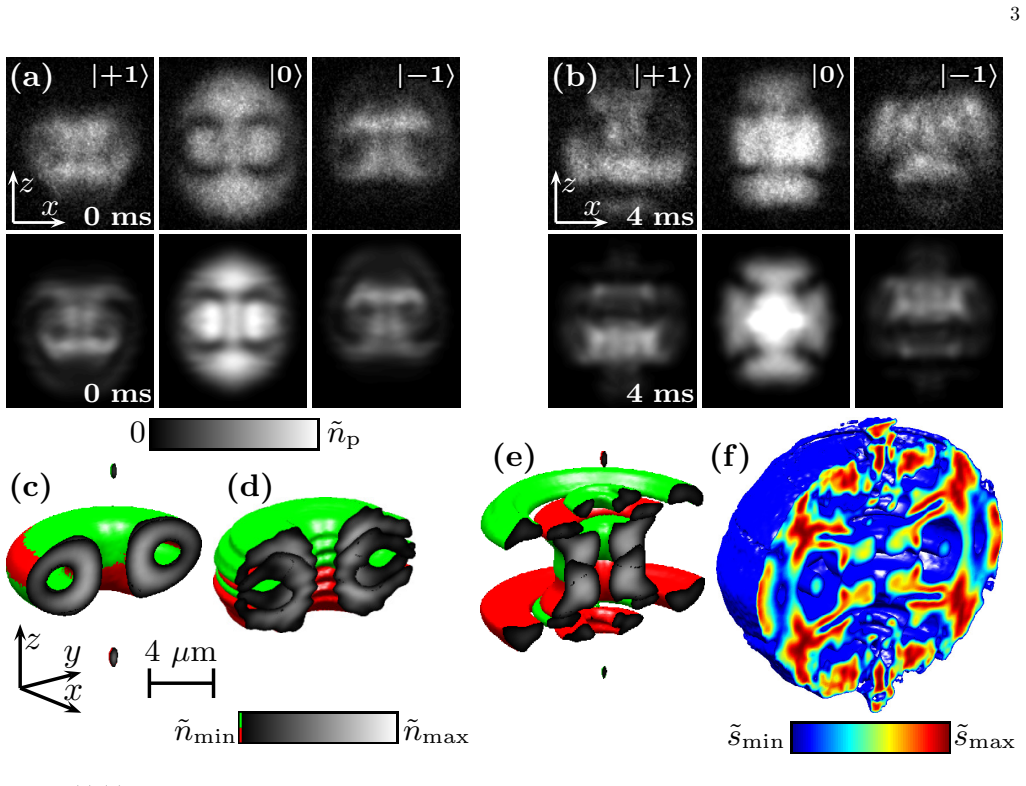
Under a uniform magnetic field of about 1 G, the knot's polar-phase order parameter is unstable and evolves toward ferromagnetic domains; within a few milliseconds the $\zeta_{\pm 1}$ components separate and the Hopf texture is lost. After an intermediate period of scrambled spinor order, a well-defined polar-core spin vortex emerges at the condensate center and persists to evolution times of several seconds. In the Cartesian triad representation of the $SO(3)$ order parameter, the spin vector $\mathbf{s}$ and the nematic vector $\mathbf{m}$ each wind by $2\pi$ around the non-winding vector $\mathbf{n}$ on any loop enclosing the core, while the $\zeta_0$ component occupies the core and the spin density is depleted along the symmetry axis. The experimental column densities, rotated-basis measurements, and Gross–Pitaevskii simulations agree, placing the object in the class of singly quantized singular $SO(3)$ vortices. Because the same structure was predicted for monopole decay, the paper proposes that the polar-core spin vortex may be a universal late-time product of topological-defect dynamics in these condensates.
Load-bearing premise
The identification of the long-lived object as a singular polar-core spin vortex assumes that the three-dimensional spinor phase reconstructed from two-dimensional line-of-sight-integrated images is faithful, since a hidden core structure could masquerade as a polar core.
Editorial extensions
If this is right
- The quantum knot is not a stable excitation under a uniform magnetic field: its polar-phase order decays to ferromagnetic domains within milliseconds.
- The emergent polar-core spin vortex is long-lived, with an observed lifetime comparable to the condensate itself in a 1-G bias field.
- The same final vortex appears in simulations of monopole decay, suggesting that distinct topological defects may share a common late-time product.
- The observed transition changes the defect's topological classification from the third homotopy group to the first, enabled by the finite system size.
- Simple spinor mixtures without a defect do not produce the vortex, indicating that a nontrivial initial structure is needed to seed the dynamics.
Reading between the lines
- If the polar-core spin vortex is a universal late-time attractor, then the Hopf charge of the knot is not a conserved quantity through the dissipative decay; tracking the linking number over time would reveal which, if any, topological invariant survives.
- Varying the quadratic Zeeman shift or the sign of the spin-dependent interaction across species could map the stability region of the emergent vortex and test whether the 1-G field is essential.
- Tomographic or slice-selective imaging of the core beyond 500 ms could distinguish a true singular core from a nonsingular polar region hidden by column-density averaging.
- The absence of vortex formation from simple mixtures implies that a nontrivial initial texture acts as a seed; systematically varying initial textures would map the basin of attraction for the final vortex state.
Signed reviews
Editorial analysis
A structured set of objections, weighed in public.
Referee Report
Summary. The manuscript reports an experimental study of the time evolution of a topologically charged quantum knot in a spin-1 87Rb Bose-Einstein condensate in a uniform magnetic field. The knot is created using the method of Ref. [21]; the authors follow its decay through the polar-to-ferromagnetic transition, observe scrambling of the spinor components on intermediate timescales, and report the emergence at evolution times of about 500 ms and beyond of a long-lived polar-core spin vortex. Based on Gross-Pitaevskii simulations and a rotated-basis measurement, they identify this vortex as a singly quantized singular SO(3) vortex and note a resemblance to the long-time state predicted for an isolated monopole, suggesting a possible universal decay endpoint for topological defects in this system.
Significance. If the identification holds, this is the first experimental observation of a quantum knot decaying into a singular SO(3) spin vortex, establishing a concrete decay pathway and a candidate universal final state for distinct topological defects in spinor BECs. The paper's strengths are the time-resolved experimental images of all three spinor components, the comparison with first-principles mean-field simulations using independently known parameters and no evident fitting, and the additional rotated-basis measurement that supports the polar-core structure. These strengths make the central observation credible. However, the topological classification of the long-time object rests on simulation rather than on direct measurement of the 3D spinor winding, and the stability/lifetime claim is not quantitatively supported; these points need to be addressed before the headline claims are fully supported.
major comments (4)
- [Results, Fig. 3(d),(g)-(j)] The experimental data do not directly establish the 2π winding of s and m around the core that defines a singular SO(3) vortex. The column densities of the three m_F components and the single π/2-rotated-basis image are consistent with a polar core with d∥z surrounded by mixed polar/ferromagnetic regions, but line-of-sight integration means that several topologically distinct 3D spinor textures, including textures without 2π spin winding, can project to similar 2D densities. Since the statement 'Thus, the observed spin vortex belongs to the family of singly quantized singular SO(3) vortices' is the basis of the headline decay-pathway claim, it should be weakened to a consistency statement or supported by a direct measurement of the spinor phase winding around the core.
- [Results, early-time comparison (Fig. 2)] The manuscript acknowledges unexplained differences between experiment and Gross-Pitaevskii simulation at T = 4 ms, attributed to eddy currents or uncontrolled magnetic fields, but the long-time identification as an SO(3) vortex relies on the simulated spin texture in Fig. 3(g)-(i). The authors should either quantify how well the simulation matches the experimental column densities at long times, beyond the qualitative agreement in Fig. 3(a)-(c) and (e), or demonstrate that the simulated winding is robust to the type of perturbation invoked for the early-time discrepancy; otherwise the simulation-inferred topological classification remains vulnerable.
- [Abstract and Discussion] The abstract's claim that the polar-core spin vortex 'is stable with an observed lifetime comparable to that of the condensate itself' is not supported by any quantitative measurement. No lifetime fit, no decay rate, and no measurement of the condensate lifetime under identical conditions are reported; the text itself refers to the vortex as 'apparently stable.' Please either provide the supporting lifetime data or rephrase the claim to describe the observed persistence time, for example 'remains visible for evolution times up to several seconds.'
- [Results, final paragraph before Discussion] The assertion that a nontrivial spinor structure is required for vortex emergence, based on 'our experimental and numerical studies on simple mixtures' in which no spin vortex appeared, is not documented in the manuscript. If this control supports the causal claim that the knot decays into the spin vortex, the control runs or a citation should be provided; otherwise the statement should be removed or explicitly labeled as preliminary. This matters because the central claim is a temporal connection between the knot and the emergent vortex.
minor comments (3)
- [Results, near Fig. 1(b)] There is a typo in the text: 'tends towards the the ferromagnetic phase' should read 'tends towards the ferromagnetic phase.'
- [Fig. 3 caption] The rotated-basis comparison in Fig. 3(d) and (j) uses different evolution times (1.0 s in experiment, 0.5 s in simulation); the text should explicitly acknowledge this timing mismatch and justify why the comparison is meaningful.
- [Methods] The sentence 'The knot is created by rapidly placing the zero of a three-dimensional quadrupole magnetic field into the center of the condensate' would benefit from a quantitative specification of the ramp time or a pointer to the supplementary material, since the creation protocol is important for reproducibility.
Circularity Check
No circularity: the decay pathway and long-time spin texture are obtained from experimental observation and independent GPE simulations, not from the definitions or fitted inputs.
full rationale
The paper is an experimental study of the time evolution of a quantum knot. Its central claims are observations: the knot decays, the polar phase converts to ferromagnetic, and a long-lived polar-core spin vortex emerges. The polar-core vortex identification is supported by numerical GPE simulations (Supplemental) whose inputs are independently measured parameters (N = 2.5e5, trap frequencies 2pi x (130, 170) Hz, B0 ~ 1 G) and by comparison with experimental column densities and a pi/2-rotated basis image. No parameter is fitted to the long-time defect structure, and the definition of the polar-core spin vortex is not the input of the simulation. The initial knot follows the procedure of Ref. [21], which is a legitimate external benchmark (previous experimental creation protocol); using it as an initial condition does not force the observed decay. The reference to monopole evolution [32] is a self-citation (Mottonen) but only appears as an analogy suggesting possible universality; it is not load-bearing for the existence or stability of the observed vortex. The paper even notes an early-time discrepancy between experiment and simulation due to uncontrolled magnetic fields, which weakens quantitative agreement but does not amount to circular reasoning. Therefore the claimed derivation chain is self-contained and no prediction reduces by construction to its inputs.
Assumptions & free parameters
assumptions (3)
- domain assumption The mean-field Gross-Pitaevskii equation accurately describes the zero-temperature dynamics of the spin-1 BEC.
- domain assumption The spinor configuration created by the procedure of Ref. [21] is a quantum knot with Hopf charge Q=1.
- domain assumption The emergent long-time structure is correctly classified as a singular SO(3) vortex based on the observed spinor textures.
Cite this review
Pith. "Pith review of Decay of a Quantum Knot." pith.science (2026). https://pith.science/paper/4FBGWQGA
@misc{pith2026190801285,
  author       = {Pith},
  title        = {Pith review of: Decay of a Quantum Knot},
  year         = {2026},
  howpublished = {\url{https://pith.science/paper/4FBGWQGA}},
  note         = {Machine review of arXiv:1908.01285}
}
read the original abstract
We experimentally study the dynamics of quantum knots in a uniform magnetic field in spin-1 Bose-Einstein condensates. The knot is created in the polar magnetic phase, which rapidly undergoes a transition towards the ferromagnetic phase in the presence of the knot. The magnetic order becomes scrambled as the system evolves, and the knot disappears. Strikingly, over long evolution times, the knot decays into a polar-core spin vortex, which is a member of a class of singular SO(3) vortices. The polar-core spin vortex is stable with an observed lifetime comparable to that of the condensate itself. The structure is similar to that predicted to appear in the evolution of an isolated monopole defect, suggesting a possible universality in the observed topological transition.
Figures

Reference graph
Works this paper leans on
-
[21]
Y. Kawaguchi, M. Nitta, and M. Ueda, Phys. Rev. Lett. 100, 180403 (2008)
work page 2008
-
[1]
The dynamics of the mean-field order parameter are determined by solving the Gross–Pitaevskii equation (see Supplemental material for numerical methods). A transformation into a Cartesian basis, ζx = (−ζ+1 + ζ−1)/ √ 2,ζy =−i(ζ+1 +ζ−1)/ √ 2, and ζz =ζ0 [27], gives rise to two real-valued vectors, m and n. The compo- nents of these vectors are defined through...
work page Pith review arXiv 1908
-
[2]
N. D. Mermin, Rev. Mod. Phys. 51, 591 (1979)
1979
-
[3]
Nakahara, Geometry, Topology and Physics, 2nd ed
M. Nakahara, Geometry, Topology and Physics, 2nd ed. (Taylor & Francis Group, Boca Raton, FL, 2003)
work page 2003
- [4]
-
[5]
M. R. Matthews, B. P. Anderson, P. C. Haljan, D. S. Hall, C. E. Wieman, and E. A. Cornell, Phys. Rev. Lett. 83, 2498 (1999)
1999
-
[6]
A. E. Leanhardt, A. G¨ orlitz, A. P. Chikkatur, D. Kielpin- ski, Y. Shin, D. E. Pritchard, and W. Ketterle, Phys. Rev. Lett. 89, 190403 (2002)
work page 2002
-
[7]
A. E. Leanhardt, Y. Shin, D. Kielpinski, D. E. Pritchard, and W. Ketterle, Phys. Rev. Lett. 90, 140403 (2003)
work page 2003
Show all 37 references
-
[8]
L. E. Sadler, J. M. Higbie, S. R. Leslie, M. Vengalat- tore, and D. M. Stamper-Kurn, Nature (London) 443, 312 (2006)
2006
-
[9]
Donadello, S
S. Donadello, S. Serafini, M. Tylutki, L. P. Pitaevskii, F. Dalfovo, G. Lamporesi, and G. Ferrari, Phys. Rev. Lett. 113, 065302 (2014)
2014
-
[10]
S. W. Seo, S. Kang, W. J. Kwon, and Y.-i. Shin, Phys. Rev. Lett. 115, 015301 (2015)
2015
-
[11]
Ruostekoski and J
J. Ruostekoski and J. R. Anglin, Phys. Rev. Lett. 86, 3934 (2001)
2001
-
[12]
Al Khawaja and H
U. Al Khawaja and H. Stoof, Nature (London) 411, 918 (2001)
2001
-
[13]
C. M. Savage and J. Ruostekoski, Phys. Rev. Lett. 91, 010403 (2003)
2003
-
[14]
J.-Y. Choi, W. J. Kwon, and Y.-I. Shin, Phys. Rev. Lett. 108, 035301 (2012)
2012
-
[15]
W. Lee, A. H. Gheorghe, K. Tiurev, T. Ollikainen, M. M¨ ott¨ onen, and D. S. Hall, Sci. Adv. 4, eaao3820 (2018)
2018
-
[16]
Pietil¨ a and M
V. Pietil¨ a and M. M¨ ott¨ onen, Phys. Rev. Lett. 103, 030401 (2009)
2009
-
[17]
M. W. Ray, E. Ruokokoski, S. Kandel, M. M¨ ott¨ onen, and D. S. Hall, Nature (London) 505, 657 (2014)
2014
-
[18]
M. W. Ray, E. Ruokokoski, K. Tiurev, M. M¨ ott¨ onen, and D. S. Hall, Science 348, 544 (2015)
2015
-
[19]
Sugawa, F
S. Sugawa, F. Salces-Carcoba, A. R. Perry, Y. Yue, and I. B. Spielman, Science 360, 1429 (2018)
2018
-
[20]
Ollikainen, K
T. Ollikainen, K. Tiurev, A. Blinova, W. Lee, D. S. Hall, and M. M¨ ott¨ onen, Phys. Rev. X7, 021023 (2017)
2017
-
[22]
D. S. Hall, M. W. Ray, K. Tiurev, E. Ruokokoski, A. H. Gheorghe, and M. M¨ ott¨ onen, Nat. Phys.12, 478 (2016)
2016
-
[23]
Hopf, Math
H. Hopf, Math. Ann. 104, 637 (1931)
1931
-
[24]
Ollikainen, S
T. Ollikainen, S. Masuda, M. M¨ ott¨ onen, and M. Naka- hara, Phys. Rev. A 95, 013615 (2017)
2017
-
[25]
Y.-K. Liu, Y. Liu, and S.-J. Yang, Phys. Rev. A 99, 063626 (2019)
2019
-
[26]
Saito, Y
H. Saito, Y. Kawaguchi, and M. Ueda, Phys. Rev. Lett. 96, 065302 (2006)
2006
-
[27]
Controlled Creation of a Singular Spinor Vortex by Bypassing the Dirac Belt Trick,
L. S. Weiss, M. O. Borgh, A. Blinova, T. Ollikainen, M. Mttnen, J. Ruostekoski, and D. S. Hall, “Controlled Creation of a Singular Spinor Vortex by Bypassing the Dirac Belt Trick,” (unpublished)
-
[28]
Kawaguchi and M
Y. Kawaguchi and M. Ueda, Phys. Rep. 520, 253 (2012)
2012
-
[29]
E. J. Mueller, Phys. Rev. A 69, 033606 (2004)
2004
-
[30]
Lovegrove, M
J. Lovegrove, M. O. Borgh, and J. Ruostekoski, Phys. Rev. Lett. 112, 075301 (2014)
2014
-
[31]
Lovegrove, M
J. Lovegrove, M. O. Borgh, and J. Ruostekoski, Phys. Rev. A 93, 033633 (2016)
2016
-
[32]
A. P. Finne, V. B. Eltsov, R. Hnninen, N. B. Kopnin, J. Kopu, M. Krusius, M. Tsubota, and G. E. Volovik, Rep. Prog. Phys. 69, 3157 (2006)
2006
-
[33]
Tiurev, P
K. Tiurev, P. Kuopanportti, A. M. Gunyh´ o, M. Ueda, and M. M¨ ott¨ onen, Phys. Rev. A94, 053616 (2016)
2016
-
[34]
Ueda, Fundamentals and New Frontiers of Bose– Einstein Condensation (World Scientific, Singapore, 2010)
M. Ueda, Fundamentals and New Frontiers of Bose– Einstein Condensation (World Scientific, Singapore, 2010)
2010
-
[35]
Lovegrove, M
J. Lovegrove, M. O. Borgh, and J. Ruostekoski, Phys. Rev. A 86, 013613 (2012)
2012
-
[36]
M. O. Borgh and J. Ruostekoski, Phys. Rev. Lett. 109, 015302 (2012)
2012
-
[37]
M. O. Borgh and J. Ruostekoski, Phys. Rev. A87, 033617 (2013)
2013
Reviewed August 14, 2026 · model on record in the stance chip above.
Discussion (0). Continue with ORCID to comment.