REVIEW 4 major objections 6 minor 20 references
Tunable Birefringence in Silica Mediated Magnetic Fluid
T0 review · 4 major / 6 minor · reviewed 2026-08-14 · deepseek-v4-flash
Pith's one-line read Silica nanoparticles bind to the lauric acid coat on magnetite and can tune the fluid's magnetic birefringence up or down depending on dilution.
desk verdict A plausible new observation of silica-dependent birefringence tuning, but the direct-interaction mechanism is overinterpreted from uncontrolled DLS/TGA. read the letter →
The pith
A machine-rendered reading of the paper's core claim, the machinery that carries it, and where it could break.
The reading
What carries the argument
The load-bearing mechanism is the direct interaction between silica nanoparticles and the secondary (physi-adsorbed) lauric acid layer on the magnetite surface. The paper's evidence chain is: a single DLS peak shifting from 58 to 68 nm (a ~10 nm increase, close to the 12 nm silica size, with ~2 nm attributed to surfactant compression); a TGA shift of the phys-adsorbed layer decomposition from 247±5°C to 262±5°C while the chemi-adsorbed layer stays at 347°C; and the resulting redistribution of surfactant reflected in reduced mass-loss percentages. This interaction is then invoked to explain why the magnetic-field-induced structures—and therefore birefringence—respond oppositely in the two base fluids: in the dilute FN30, silica widens the size distribution ($\sigma_D$ 0.49 to 0.54), producing long thick scattered chains with large interchain spacing that suppress $\Delta n$; in F30, silica increases chain length and density up to a critical concentration, boosting $\Delta n$.
What would settle it
Measure the hydrodynamic size distribution with silica at several concentrations: if a separate ~12 nm silica peak ever appears alongside the ~58–68 nm magnetite peak in a non-interacting control (for example, silica added to lauric-acid-free magnetite), the single-peak argument fails. Likewise, if TGA of a physical mixture of silica and magnetite without incubation shows the same 262°C shift, or zeta-potential and FTIR of dried FA0.27 powder show no spectral shifts of carboxylate or silanol bands upon mixing, the claimed molecular binding is not established.
Extended reading notes
Core claim
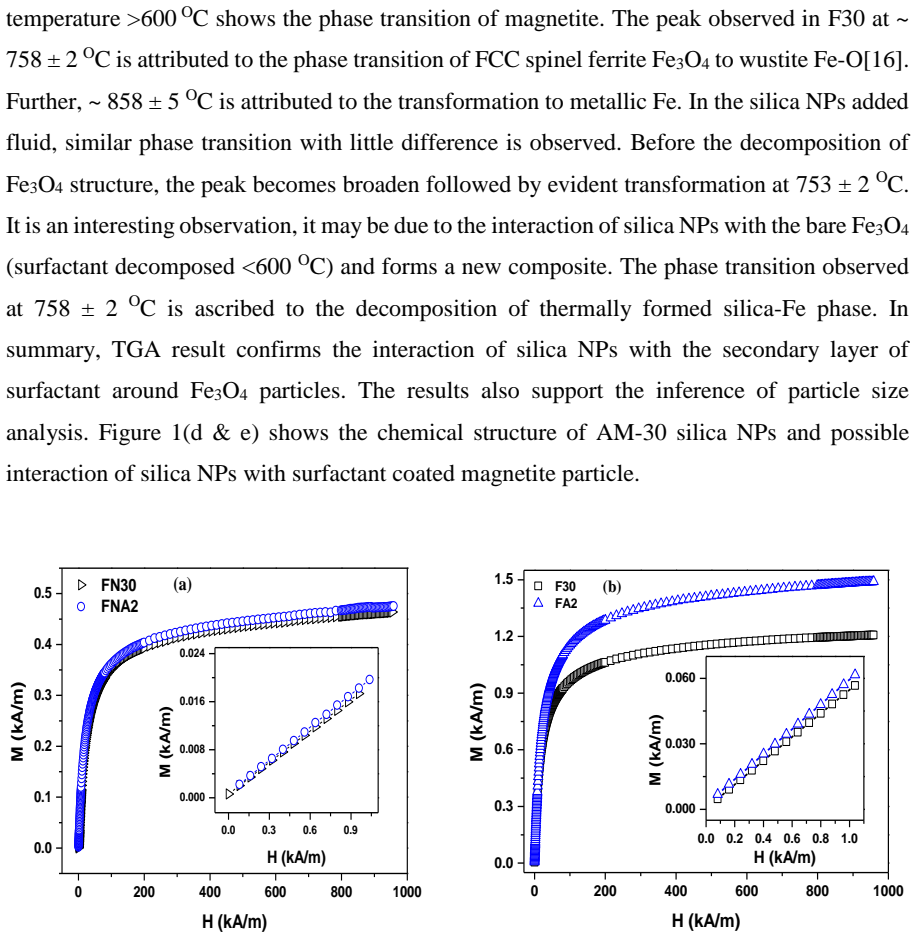
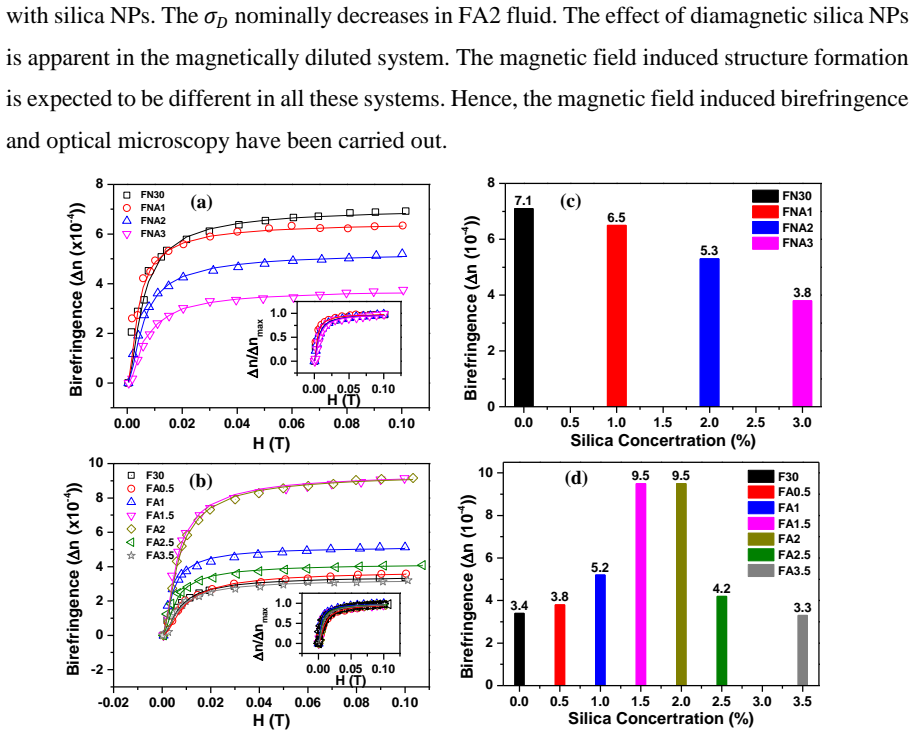
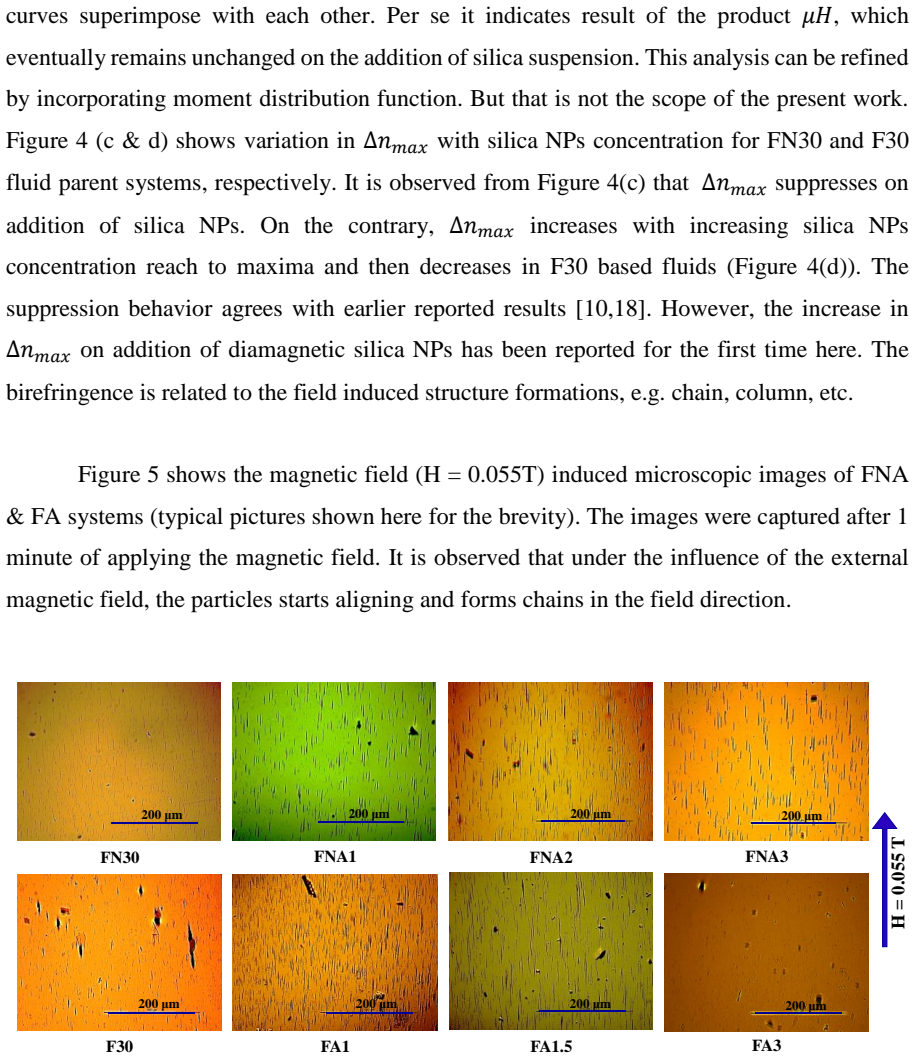
The central claim is that silica nanoparticles (~12 nm AM-30) bind to the outer lauric-acid layer of magnetite nanoparticles, and this binding changes how the particles assemble under a magnetic field, thereby tuning birefringence. Support comes from three measurements: particle sizing shows a single hydrodynamic peak at ~58 nm for FN30 that moves to ~68 nm with silica (rather than two independent peaks at ~12 and ~58 nm); TGA shows the decomposition of the phys-adsorbed lauric acid layer shifting from about 247°C to 262°C with reduced mass loss attributed to redistribution of surfactant on silica; and magnetization data show initial susceptibility and saturation magnetization rise slightly when silica is added, while the log-normal size-distribution parameter $\sigma_D$ rises in the dilute system and falls slightly in the concentrated one. The optical consequence is a field-dependent birefringence that saturates with a Langevin-type form, whose maximum $\Delta n_{\max}$ decreases monotonically with silica in FN30-based fluids but increases up to a critical concentration in F30-based fluids (maximal around FA1.5), then decreases. Microscopy at 0.055 T shows correspondingly long, thick, scattered chains in FN30-based fluids and short, thin, dense chains in F30-based fluids.
Load-bearing premise
The claim of direct molecular interaction rests on interpreting a single DLS peak and a TGA peak shift as evidence that silica binds to the lauric acid layer; if those changes instead come from two coexisting populations or unrelated thermal effects, the mechanism tying silica to the birefringence tuning loses its support.
Editorial extensions
If this is right
- Birefringence of a lauric-acid magnetic fluid can be tuned in either direction by varying silica concentration and base magnetization, so composition, not just field, sets the optical response.
- The enhancement regime (F30-based fluids) provides a route to increase $\Delta n$ without raising the magnetic volume fraction, which matters for low-absorption optical devices.
- The direct silica–surfactant interaction adds a design handle: the chemistry of the outer surfactant layer determines whether nonmagnetic nanoparticles suppress or enhance field-induced structure formation.
- The normalized birefringence curves collapse onto a common Langevin-type form, so the tuning changes the saturation level $\Delta n_{\max}$ rather than the field scale of the response.
- Chain statistics (length, width, density) correlate with $\Delta n$, making optical birefringence a non-invasive probe of field-induced microstructure.
Reading between the lines
- If the surfactant-layer binding picture is right, other nonmagnetic nanoparticles with surface chemistry that binds to the outer surfactant layer should reproduce the enhancement in concentrated ferrofluids, while particles that only disperse freely should not; this is testable with latex, alumina, or titania nanoparticles of similar size.
- The same mechanism may predict magnetic-field-dependent rheology in the same samples: bound silica effectively enlarges and stiffens the magnetic particles, which should raise low-field viscosity and alter chain-coalescence rates in a time-resolved way.
- The 247→262°C TGA shift and 58→68 nm DLS shift are consistent with a thin bound layer; a direct test would be FTIR or zeta-potential titration of the silica–surfactant composite, which the paper does not report.
- A quantitative theory connecting $\Delta n_{\max}$ to the ratio of silica to magnetite volume fraction is not given; the reported maximum near FA1.5 suggests an optimum that could be modelled by the modified Halsey–Toor chain-coalescence energy.
Signed reviews
Editorial analysis
A structured set of objections, weighed in public.
Referee Report
Summary. The paper reports the synthesis and characterization of lauric-acid-stabilized magnetite magnetic fluids with added colloidal silica (AM-30), at two base magnetizations (FN30 and F30). It claims that silica nanoparticles directly interact with the secondary lauric acid layer on magnetite, based on a single-peak shift in DLS (58 to 68 nm) and a TGA decomposition-peak shift (247 to 262 °C). The central optical claim is that the magnetic-field-induced birefringence Δn decreases monotonically with silica in the more dilute FN30 fluid, while in the more concentrated F30 fluid Δn first increases up to a critical silica concentration and then decreases. Magnetization measurements and optical microscopy of field-induced chains are used to support the correlation between structure and birefringence. The paper concludes that both suppression and enhancement are tunable via silica concentration and base magnetization, and claims this is the first report of direct silica–magnetite interaction.
Significance. If the central claims hold, the paper would demonstrate a simple route to bidirectionally tune the magneto-optical response of magnetic fluids by adding a nonmagnetic nanoparticle suspension, which is of practical interest for magnetic-fluid-based optical devices. The manuscript contains genuinely quantitative elements: the birefringence setup is described in sufficient detail to be reproducible, the Langmuir–Langevin fits are explicit, and the microscopy analysis provides numerical chain-length and width statistics. However, the mechanistic claim of direct molecular interaction between silica and the lauric acid layer is the load-bearing pillar of the paper, and it currently rests on indirect DLS and TGA evidence with alternative explanations that are not excluded by the reported experiments.
major comments (4)
- [§3.1, Figure 1(c)] The DLS evidence is not sufficient to establish direct interaction between silica nanoparticles and lauric-acid-coated magnetite. The argument that a single peak at 68 nm proves association because free 12 nm silica would appear as a separate peak is weakened by the known unreliability of number-weighted distributions in bimodal mixtures of very different sizes, and by the authors' own admission that surfactant-decorated dimer/trimers could form during the extensive dilution. No control DLS measurement of AM-30 in the same surfactant/ammonia buffer is reported, and no physical-mixture control is given. Without such controls, the single-peak observation is compatible with independent coexisting populations or with dilution-induced aggregates, and cannot carry the interaction claim.
- [§3.2, Figure 2] The TGA interpretation is underdetermined. The shift of the physi-adsorbed-layer decomposition peak from 247 °C to 262 °C and the reduction in mass loss are assigned to silica interacting with the lauric acid layer, but no TGA of silica-only, no physical-mixture control, and no explicit normalization of the mass-loss data are reported. The shift could arise from altered thermal contact, different surfactant/silica mass ratios, or adsorption of free lauric acid onto the large silica surface. Since this interaction is the explicitly stated basis for both the suppression in FN30 and the enhancement in F30 (Section 4), the mechanism requires dedicated control experiments before the causal attribution is justified.
- [§2 and §5 (crystallite size and Table 1)] There is an internal inconsistency in the reported crystallite size: Section 2 states (8.2 ± 0.2) nm, while the Conclusion states 8.4 nm. In addition, the Conclusion claims a 'nominal increase' in the mean magnetic size for the F30-based fluid in the presence of silica, but Table 1 shows Dm decreasing from 11.8 nm (F30) to 11.2 nm (FA2), i.e., a decrease, not an increase. These discrepancies need to be corrected, as they affect the consistency of the reported trends.
- [§4, Figure 4] The birefringence data are presented without error bars, and the central trends (suppression in FN30, enhancement up to a critical concentration in F30) are trends of the fitted parameter Δn_max. The paper does not report the fit quality, residuals, or confidence intervals for Δn_max. Given that the enhancement in F30 spans a relatively narrow range (about 7.1 to 9.5 × 10⁻⁴ in Figure 4(d)), error bars or fit uncertainties are needed to establish that the non-monotonic behavior is experimentally significant rather than within scatter.
minor comments (6)
- [Figure 4 labels] The axis labels read 'Silica Concertration (%)' and should be corrected to 'Silica Concentration (%).'
- [§3.4] The equation for Δn is formatted with extraneous symbols (e.g., '𝑐ℎ(ℎ1 − ℎ2)') and appears to be missing a closing parenthesis; please check the typesetting and define all symbols explicitly.
- [Conclusion] The phrase 'The tunability of these properties are dedicated to the interaction' should be 'The tunability of these properties is attributed to the interaction.'
- [References] Reference [18] duplicates reference [11]; please merge or cite uniquely.
- [Figure 5] The microscopy images would benefit from uniform scale bars and a statement of the image-analysis threshold used in ImageJ, since the chain statistics in Table 2 depend on that choice.
- [Abstract and text] The symbol MS is written without proper subscript formatting in the abstract; please use M_S consistently throughout.
Circularity Check
No circular derivation; the self-citations are background, and the central birefringence and interaction claims rest on independent measurements.
full rationale
The derivation chain is not circular. The birefringence is measured directly via the transmission formula in Sec. 3.4 and then fitted to a Langevin expression with Δn_max as a saturation parameter; the reported suppression/enhancement is a trend of measured/fitted maximum values, not a quantity forced by the fitting input. The DLS size shift (58 to 68 nm, Fig. 1c) and the TGA peak shift (247 to 262 °C, Fig. 2) are independent empirical observations used to infer a silica–lauric-acid interaction. They may be underdetermined as evidence, but underdetermination is an evidence-strength issue, not circularity. The self-citations [13,14] in the Introduction are background statements about the authors' prior work on HNTs and silica and are not used to justify the central claim. No uniqueness theorem is imported, no known result is renamed, and no fitted parameter is presented as a prediction. Thus no conclusion reduces to its own inputs by construction. Score 2 reflects the presence of two minor, non-load-bearing self-citations rather than any circular dependency.
Assumptions & free parameters
free parameters (2)
- Δn_max (saturation birefringence) per sample =
not tabulated; extracted from Langevin fits shown in Fig. 4
- Effective susceptibility χ_eff in dipole model =
not specified
assumptions (6)
- domain assumption Magnetic-field-induced birefringence follows the ideal Langevin superparamagnetic model
- domain assumption Chantrell's model gives the magnetic size distribution from M-H data
- ad hoc to paper The single DLS peak in the silica-added sample indicates molecular interaction between silica and lauric-acid-coated magnetite
- ad hoc to paper The TGA decomposition peak shift (247°C to 262°C) is caused by interaction of silica with the secondary lauric acid layer
- domain assumption Bulk magnetite domain magnetization (485 kA/m) applies to the nanoparticles when computing φ_m
- domain assumption The microscopy images are representative of the bulk field-induced structure
Cite this review
Pith. "Pith review of Tunable Birefringence in Silica Mediated Magnetic Fluid." pith.science (2026). https://pith.science/paper/4GGEB2XT
@misc{pith2026190808366,
  author       = {Pith},
  title        = {Pith review of: Tunable Birefringence in Silica Mediated Magnetic Fluid},
  year         = {2026},
  howpublished = {\url{https://pith.science/paper/4GGEB2XT}},
  note         = {Machine review of arXiv:1908.08366}
}
read the original abstract
The present study reports magnetic and optical properties of silica mediated lauric acid stabilized magnetic fluids. The tunable birefringence ({\Delta}n) and other properties are investigated as a function of (i) concentrations of silica suspension, and (ii) saturation magnetization (MS) 0.5099 kA/m (FN30) and 1.2855 kA/m (F30) of magnetite magnetic fluid (MF). The study reveals that {\Delta}n suppresses on addition of silica in FN30, whereas enhances (up to critical concentrations of silica) in F30. The magnetic field induced chain observed in the FN30 based fluids are long, thick and scattered, while short, thin and dense chains emerges in F30 based fluid. The magnetic field induced assembly and the magnetic parameters correlates with the results of {\Delta}n. The particle size analysis indicates increment of particle size on addition of silica nanoparticles. The thermogravimetry analysis confirms the direct interaction of silica nanoparticles and the lauric acid coated magnetite particles. This is the first report of direct interaction of silica - magnetite magnetic fluids, and its subsequent effect on tunable birefringence and other properties.
Figures
Reference graph
Works this paper leans on
-
[1]
Rosensweig R E 2013 Ferrohydrodynamics (Courier Corporation)
work page 2013
-
[2]
Zhao Y, Lv R, Zhang Y and Wang Q 2012 Novel optical devices based on the transmission properties of magnetic fluid and their characteristics Opt. Lasers Eng. 50 1177–84 15
work page 2012
-
[3]
Candiani A, Margulis W, Sterner C, Konstantaki M and Pissadakis S 2011 Phase- shifted Bragg microstructured optical fiber gratings utilizing infiltrated ferrofluids Opt. Lett. 36 2548
work page 2011
-
[4]
Yuan W, Yin C, Xiao P, Wang X, Sun J, Huang S, Chen X and Cao Z 2011 Microsecond-scale switching time of magnetic fluids due to the optical trapping effect in waveguide structure Microfluid. Nanofluidics 11 781–5
work page 2011
-
[5]
Ji H, Pu S, Wang X and Yu G 2012 Magnetic field sensing based on V-shaped groove filled with magnetic fluids. Appl. Opt. 51 1010–20
work page 2012
-
[6]
2011 Ferrodispersion: a promising candidate for an optical capacitor Appl
Patel R and Mehta R V. 2011 Ferrodispersion: a promising candidate for an optical capacitor Appl. Opt. 50 G17
work page 2011
-
[7]
Pu S, Yao L, Guan F and Liu M 2009 Threshold-tunable optical limiters based on nonlinear refraction in ferrosols Opt. Commun. 282 908–13
work page 2009
-
[8]
Bell R C, Karli J O, Vavreck A N, Zimmerman D T, Ngatu G T and Wereley N M 2008 Magnetorheology of submicron diameter iron microwires dispersed in silicone oil Smart Mater. Struct. 17
work page 2008
Show all 20 references
-
[9]
Lin J F, Sheu J J and Lee M Z 2014 Measurement of birefringence and dichroism in magnetic fluid doped with silica microsphere IEEE Trans. Magn. 50
2014
-
[10]
Di Z, Chen X, Chen J, Xia Y and Pu S 2007 Suppressing the field-induced agglomeration in the magnetic fluid by doping the nonmagnetic particles Appl. Phys. Lett. 90 1–4
2007
-
[11]
Di Z, Chen X, Pu S, Hu X and Xia Y 2006 Magnetic-field-induced birefringence and particle agglomeration in magnetic fluids Appl. Phys. Lett. 89 4–6
2006
-
[12]
Islam M F, Lin K H, Lacoste D, Lubensky T C and Yodh A G 2003 Field-induced structures in miscible ferrofluid suspensions with and without latex spheres Phys. Rev. E 67 021402
2003
-
[13]
and Mehta R V
Desai R, Upadhyay R V. and Mehta R V. 2014 Augmentation of chain formation in a magnetic fluid by the addition of halloysite nanotubes J. Phys. D. Appl. Phys. 47
2014
-
[14]
2015 Anomalous increase in the magnetorheological properties of magnetic fluid induced by silica nanoparticles Mater
Desai R and Upadhyay R V. 2015 Anomalous increase in the magnetorheological properties of magnetic fluid induced by silica nanoparticles Mater. Res. Express 1 46116
2015
-
[15]
Upadhyay R V, Aswal V K and Desai R 2012 Micro-structural characterisation of water-based magnetic fluid Int. J. Nanoparticles 5 243
2012
-
[16]
Sau D, Banerjee A, Kumar M and Kumar R 2015 Experimental investigation for conversion of hematite to magnetite with high ash Jhama Coal J. Metall. Mater. Sci. 57 16 83–91
2015
-
[17]
Chantrell R W, Popplewell J and Charles S W 1978 Measurements of particle size distribution parameters in ferrofluids IEEE Trans. Magn. 14 975–7
1978
-
[18]
Di Z, Chen X, Pu S, Hu X and Xia Y 2006 Magnetic-field-induced birefringence and particle agglomeration in magnetic fluids Appl. Phys. Lett. 89 1–4
2006
-
[19]
Martin J E, Hill K M and Tigges C P 1999 Magnetic-field-induced optical transmittance in colloidal suspensions. Phys. Rev. E. Stat. Phys. Plasmas. Fluids. Relat. Interdiscip. Topics 59 5676–92
1999
-
[20]
Ginder J M 1998 Behavior of magnetorheological fluids MRS Bull. 23 26–9
1998
Reviewed August 14, 2026 · model on record in the stance chip above.
Discussion (0). Continue with ORCID to comment.