REVIEW 1 major objections 4 minor 15 references
Exponential polynomials with Fatou and non-escaping sets of finite Lebesgue measure
T0 review · 1 major / 4 minor · reviewed 2026-08-14 · deepseek-v4-flash
Pith's one-line read For a class of exponential polynomials, the Fatou set and the non-escaping set have finite Lebesgue measure.
desk verdict Genuinely new measure finiteness results for exponential polynomials, but Section 4's tiling side-length bound appears inverted and the proof as written doesn't close. read the letter →
The pith
A machine-rendered reading of the paper's core claim, the machinery that carries it, and where it could break.
The reading
What carries the argument
The load-bearing objects are the phase-difference polynomials $P_{j,k}(z)=(b_j-b_k)z^d+(P_j-P_k)(z)$ and the exceptional sets $E_l=\bigcup_{j\ne k}P_{j,k}^{-1}(U_l)$, where $U_l=\{w:|\Re w|<l|w|^{\nu/d}\}$ with $\nu=d-\tfrac52$. These sets have finite Lebesgue measure; outside them one summand dominates, so $f$ behaves like a single exponential and satisfies the lower bound $|f(z)|\ge\exp(|z|^\alpha)$ for $\alpha<\nu$. Condition (3) enters exactly to keep this lower bound valid in the case of opposite leading arguments, where without it the function can be bounded on an infinite-area set. Injectivity on small disks centered outside $E_2$, obtained from derivative estimates and the standard distortion lemma, allows the construction of nested preimages inside a square tiling.
What would settle it
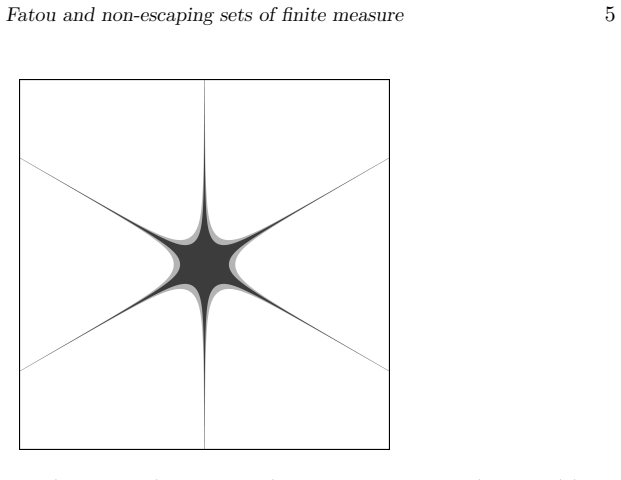
For any function satisfying the hypotheses except condition (3), inspect the set where $|f(z)|\(\le 1\)$. The paper shows that for $h(z)=\exp(iz)\sinh(z^3)$, the infinite-measure set $B=\{re^{i\theta}: |\theta-\pi/2|\le 1/(r^2\log r)\}$ is mapped into a small disk around zero, so it lies in the attracting basin. If a function satisfying condition (3) also had an infinite-measure region where $|f|$ stays bounded, the theorem would fail; checking this bound along the curves $\arg z\approx \pm\pi/(2d)$ is a direct numerical test.
Extended reading notes
Core claim
The central claim is Theorem 1.3: under the hypotheses above, and with an additional condition (3) when $\arg b_{j+1}=\arg b_j+\pi$ or $\arg b_N=\arg b_1+\pi$, the Lebesgue measure of $\mathbb{C}\setminus(A(f)\cap J(f))$ is finite. The proof works by showing that $|f(z)|\ge \exp(|z|^\alpha)$ for some $\alpha>0$ on the complement of a finite-area exceptional set, then using a square-mesh construction to build a nested family of sets inside $A(f)\cap J(f)$ whose leftover density decays faster than any exponential. Theorem 1.1 is the special case with strictly separated arguments, and the theorem also covers the functions $Q_1(z)e^{P(z)}+Q_2(z)e^{-P(z)}$ studied earlier. The example $h(z)=\exp(iz)\sinh(z^3)$ is shown to violate the conclusion without condition (3): its attracting basin of zero has infinite measure.
Load-bearing premise
The proof's global lower bound $|f(z)|\ge \exp(|z|^\alpha)$ outside a finite-area set rests on condition (3) when two leading exponents point in opposite directions; if that condition fails, the function can be bounded on an infinite-area set and the conclusion is false.
Editorial extensions
If this is right
- For every function in the stated class, the Fatou set has finite Lebesgue measure, so almost every point lies in the Julia set and in the fast escaping set.
- The non-escaping set has finite Lebesgue measure, meaning almost every starting point escapes to infinity under iteration.
- Theorem 1.1 covers sums of exponentials with strictly separated arguments, without any additional phase-matching condition.
- The theorem subsumes the earlier finite-measure result for $f=Q_1 e^{P}+Q_2 e^{-P}$ with $\deg P\ge 3$.
- The proof gives a quantitative annulus estimate: the part of a large annulus not already in $A(f)\cap J(f)$ has measure at most $\exp(-c r^\alpha)$, which forces the total exceptional set to be finite.
Reading between the lines
- The proof's exponent $\nu=(d-5)/2$ is positive only for $d\ge 3$, which suggests that extending the theorem to $d=2$ would require a genuinely new mechanism rather than a minor modification.
- Condition (3) has a geometric reading: opposite exponentials must share a common polynomial $g$ in their phases, making their leading level sets parallel; the paper does not explore this geometric interpretation.
- A natural next step would be to ask whether the same hypotheses give lower bounds on the Hausdorff or packing dimension of the Julia set, since finite-area complements plus fast escape often force substantial fractal structure.
- The same square-mesh density construction may adapt to entire perturbations with slowly growing prefactors, provided the domination and injectivity estimates survive.
Signed reviews
Editorial analysis
A structured set of objections, weighed in public.
Referee Report
Summary. The paper studies exponential polynomials of the form f(z) = sum_{j=1}^N Q_j(z) exp(b_j z^d + P_j(z)) with d >= 3, deg(P_j) < d, and distinct nonzero b_j. The main results, Theorems 1.1 and 1.3, give conditions on the arguments of the b_j — and, in the 'opposite arguments' case, an additional polynomial condition (3) — under which C \ (A(f) ∩ J(f)) has finite Lebesgue measure. Since F(f) ⊂ C \ J(f) and C \ I(f) ⊂ C \ A(f), this implies that the Fatou set and the non-escaping set have finite Lebesgue measure. The proof has three parts: Section 2 establishes that |f| and |f'| grow at least like exp(|z|^alpha) for some alpha > 0 outside an exceptional set E_1 of finite Lebesgue measure; Section 3 proves injectivity of f on small disks of radius comparable to |z|^{-(d-1)} near the complement of a slightly larger exceptional set; Section 4 uses a McMullen-type tiling and density argument to show that the iterated preimages of tiles capture almost all of C outside a finite-measure set. Example 1.2 shows that condition (3) is sharp: without it, exp(iz) sinh(z^3) has a superattracting fixed point whose basin has infinite measure.
Significance. If the proof is completed, the paper gives a substantial and fairly general sufficient condition for finiteness of the Fatou set and the complement of the escaping set for exponential polynomials, going beyond the special functions treated by Schubert, Hemke, and Zhang-Yang and complementing the positive-measure results of Sixsmith and Bergweiler-Chyzhykov. The paper is self-contained: all auxiliary lemmas, including the key growth estimate (Lemma 2.4), the injectivity criteria (Lemmas 3.2-3.5), and the final density argument, are proved in the text. The sharpness example is instructive and correctly handled in Section 5. The main caveat is a load-bearing inconsistency in the tiling construction in Section 4, which I describe below; I view it as correctable, but it must be fixed before the proof is valid.
major comments (1)
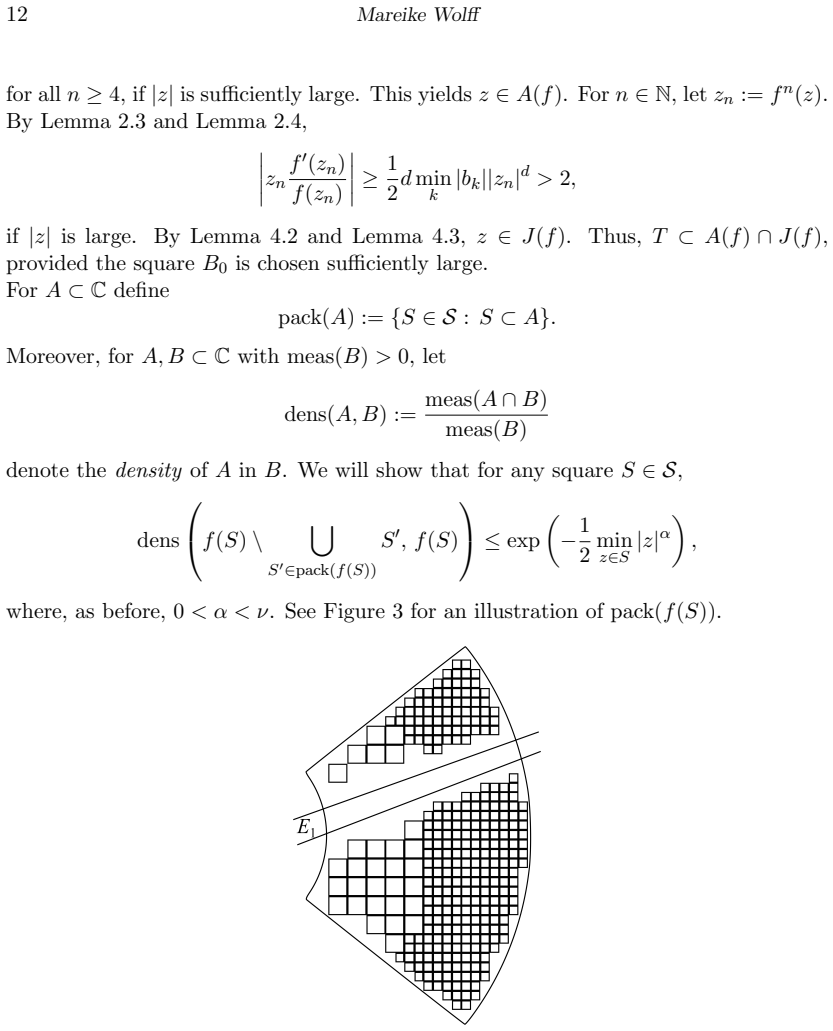
- The displayed side-length condition for the squares in the tiling is internally inconsistent with the rest of the proof. Read literally, the inequalities give a side length s of order |z|^{d-1} for a square at distance |z| from the origin. However, Lemma 3.3 only guarantees injectivity on disks of radius 2 sigma |z|^{-(d-1)}, and the proof later asserts that a square S with centre z0 satisfies S subset D(z0, (sigma/2)|z0|^{-(d-1)}). These statements cannot hold simultaneously for large |z|. The construction described immediately afterward — start with fixed-size squares and subdivide until the upper bound is met — also fails for the literal reading, because the lower bound grows with |z|. The intended condition must have the reciprocal exponent: the min and max should appear in the denominator, i.e. s should be comparable to |z|^{-(d-1)}. This correction is load-bearing: the density estimate (6), the bound on the perimeter of f(S), the inclusion used for the Koebe distortion argument, and the annulus sum all rely on tiles having diameter comparable to |z|^{-(d-1)}. I regard this as a fixable typographical/sign error rather than a fatal flaw, but it must be corrected and the surrounding constants (for example the factor 4 sigma sqrt(2) in the perimeter estimate) adjusted accordingly.
minor comments (4)
- The displayed formula for f'(z) is missing a closing parenthesis at the end; it reads '... exp(bjzd +Pj(z).' and should close the exponential argument as exp(b_j z^d + P_j(z)).
- The symbol S is used both for the collection of squares and for a generic square in the collection; using a script letter for the collection would reduce ambiguity.
- In the bound for meas(f(S) \ bigcup_{S' in pack(f(S))} S'), the term meas(f(S) cap B0) is not explicitly included; it is harmless because B0 is bounded and max_{z in S} |f'(z)| is large for the squares that matter, but it should be mentioned for completeness.
- Reference [4] contains a typo in the author name: 'Bergweilwer' should be 'Bergweiler'.
Circularity Check
No significant circularity: the main theorem is proved from its stated assumptions by an independent chain of lemmas, with no fitted input renamed as a prediction and no load-bearing self-citation.
full rationale
The derivation chain is self-contained and non-circular. Theorem 1.3 states explicit hypotheses on the exponents b_j and, in the opposite-argument case, condition (3) on the polynomials P_k, P_l. Lemma 2.4 then proves the lower bound |f(z)| >= exp(|z|^alpha) and |f'(z)| >= exp(|z|^alpha) from those hypotheses; the bound is derived, not assumed, and alpha is an arbitrary number in (0, nu), not a fitted parameter. Injectivity (Lemma 3.3) is proved from the behaviour of f''/f' via Becker's criterion, and the Section 4 measure estimate uses the Koebe distortion theorem and a McMullen-style square tiling with density estimates; none of these steps re-imports the conclusion. The citations to Sixsmith, Zheng, Bergweiler, Koebe/Becker, and McMullen are external results that do not involve the author and do not assert the theorem's conclusion. The abstract's phrase that conditions are 'designed such that' the lower bound holds is a description of the proof strategy, not a definitional equivalence. The skeptic's observation about the side-length exponent in Section 4 is an internal consistency/correctness concern, not a circularity: even if the displayed inequality has a typo, no parameter is fitted from the target measure and no claim is assumed to prove itself. Therefore no circular step was identified, and the appropriate circularity score is 0.
Assumptions & free parameters
assumptions (5)
- standard math Koebe distortion theorem (including derivative distortion bounds)
- standard math Becker's univalence criterion
- domain assumption Sixsmith's lemma (Lemma 4.2): if z0 in I(f) and |z_n f'(z_n)/f(z_n)| >= lambda > 1 eventually, then either z0 is in a multiply connected Fatou component or z0 in J(f)
- domain assumption Zheng's theorem (Lemma 4.3): Fatou set of exponential polynomial has no multiply connected components
- domain assumption Bergweiler's iteration inequality (Lemma 4.1): E_alpha^k(x) >= E_beta^{k-2}(x) for beta > alpha > 0, k >= 4, x large
Cite this review
Pith. "Pith review of Exponential polynomials with Fatou and non-escaping sets of finite Lebesgue measure." pith.science (2026). https://pith.science/paper/4HGJ2GUE
@misc{pith2026190803037,
  author       = {Pith},
  title        = {Pith review of: Exponential polynomials with Fatou and non-escaping sets of finite Lebesgue measure},
  year         = {2026},
  howpublished = {\url{https://pith.science/paper/4HGJ2GUE}},
  note         = {Machine review of arXiv:1908.03037}
}
abstract
We give conditions ensuring that the Fatou set and the complement of the fast escaping set of an exponential polynomial $f$ have finite Lebesgue measure. Essentially, these conditions are designed such that $|f(z)|\ge\exp(|z|^\alpha)$ for some $\alpha>0$ and all $z$ outside a set of finite Lebesgue measure.
Figures

Reference graph
Works this paper leans on
-
[1]
M. Aspenberg and W. Bergweiler , Entire functions with Julia sets of positive measure, Math. Ann. 352 (2012), 27-54
work page 2012
-
[2]
Bergweiler, Iteration of meromorphic functions, Bull
W. Bergweiler, Iteration of meromorphic functions, Bull. Amer. Math. Soc. (N. S.) 29 (1993), 151-188
work page 1993
-
[3]
Bergweiler , Lebesgue measure of Julia sets and escaping sets of certain entire functions, Fund
W. Bergweiler , Lebesgue measure of Julia sets and escaping sets of certain entire functions, Fund. Math. 242 (2018), 281-301
work page 2018
-
[4]
W. Bergweilwer and I. Chyzhykov , Lebesgue measure of escaping sets of entire functions of completely regular growth, J. Lond. Math. Soc. 94 (2016), 639- 661
work page 2016
-
[5]
W. Bergweiler and A. Hinkkanen , On semiconjugation of entire functions, Math. Proc. Cambridge Philos. Soc. 126 (1999), 565-574
work page 1999
-
[6]
Bock , On the dynamics of entire functions on the Julia set, Results Math
H. Bock , On the dynamics of entire functions on the Julia set, Results Math. 30 (1996), 16-20
work page 1996
-
[7]
A. E. Eremenko , On the iteration of entire functions, in: Dynamical systems and ergodic theory (Warsaw 1986) , 339-345, Banach Center Publ. 23, PWN, Warsaw, 1989
work page 1986
-
[8]
Hemke , Recurrence of entire transcendental functions with simple post- singular sets, Fund
J.-M. Hemke , Recurrence of entire transcendental functions with simple post- singular sets, Fund. Math. 187 (2005), 255-289
work page 2005
Show all 15 references
-
[9]
McMullen , Area and Hausdorff dimension of Julia sets of entire functions, Trans
C. McMullen , Area and Hausdorff dimension of Julia sets of entire functions, Trans. Amer. Math. Soc. 300 (1987), 329-342 18 Mareike Wolff
1987
-
[10]
Pommerenke , Boundary Behaviour of Conformal Maps , Grundlehren der mathematischen Wissenschaften 299, Springer, Berlin, 1992
C. Pommerenke , Boundary Behaviour of Conformal Maps , Grundlehren der mathematischen Wissenschaften 299, Springer, Berlin, 1992
1992
-
[11]
Pommerenke , Univalent functions , Studia Mathematica/Mathematische Lehrb¨ ucher XXV, Vandenhoeck & Ruprecht, G¨ ottingen, 1975
C. Pommerenke , Univalent functions , Studia Mathematica/Mathematische Lehrb¨ ucher XXV, Vandenhoeck & Ruprecht, G¨ ottingen, 1975
1975
-
[12]
Schubert, Area of Fatou sets of trigonometric functions, Proc
H. Schubert, Area of Fatou sets of trigonometric functions, Proc. Amer. Math. Soc. 136 (2008), 1251-1259
2008
-
[13]
D. J. Sixsmith , Julia and Escaping Set Spiders’ Webs of Positive Area,Int. Math. Res. Not. 2015 (2015), 9751-9774
2015
-
[14]
Zhang and F
S. Zhang and F. Yang , Area of the complement of the fast escaping set of a family of entire functions, Kodai Math. J. 41 (2018), 531-553
2018
-
[15]
Zheng , On multiply-connected Fatou components in iteration of meromor- phic functions, J
J.-H. Zheng , On multiply-connected Fatou components in iteration of meromor- phic functions, J. Math. Anal. Appl. 313 (2006), 24-37
2006
Reviewed August 14, 2026 · model on record in the stance chip above.
Discussion (0). Continue with ORCID to comment.