REVIEW 4 major objections 4 minor 25 references
A Truthful Mechanism Design for Distributed Optimisation Algorithms in Networks with Self-interested Agents
T0 review · 4 major / 4 minor · reviewed 2026-08-15 · deepseek-v4-flash
Pith's one-line read Under conservative agents, a distributed VCG mechanism with a gradient filter makes truthful reporting a near-dominant strategy and recovers asymptotic efficiency, even when agents report different fake cost functions across sequences.
desk verdict The DeVCG-G idea is worth taking seriously, but Lemma 4's proof has a sign error and the main TISD theorem is currently unsupported. read the letter →
The pith
A machine-rendered reading of the paper's core claim, the machinery that carries it, and where it could break.
The reading
What carries the argument
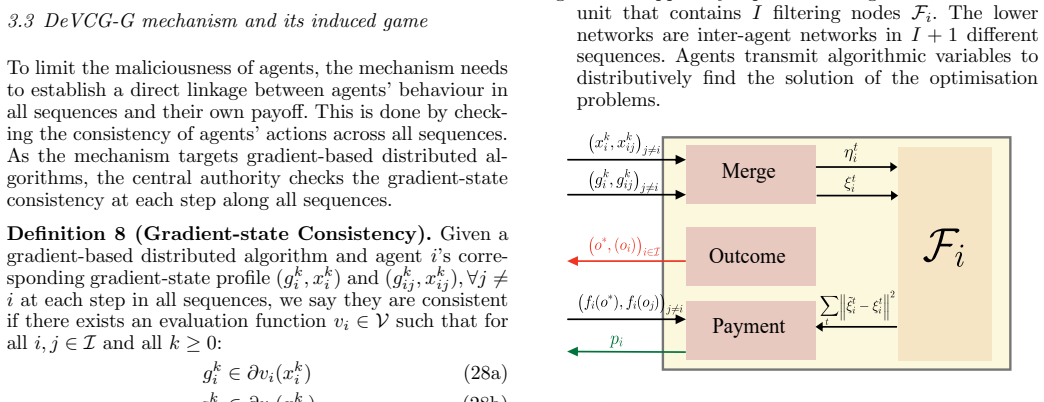
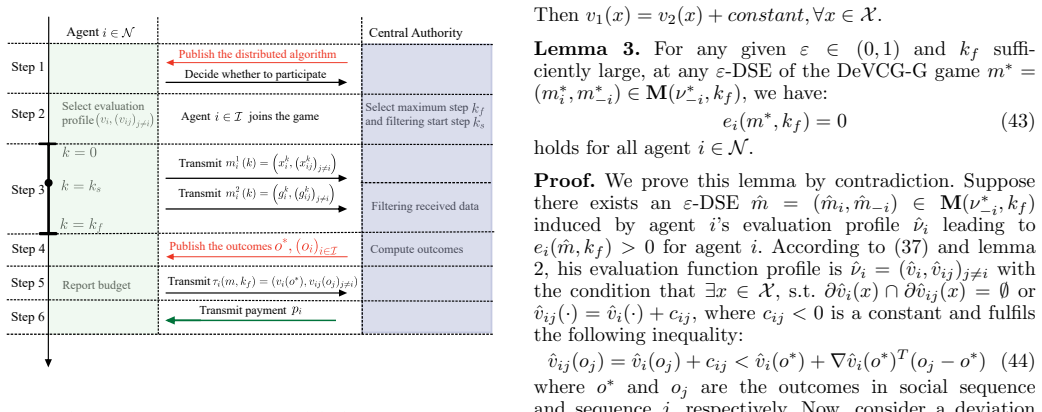
The load-bearing object is the DeVCG-G mechanism: a distributed VCG payment rule wrapped around a gradient-state consistency filter. The mechanism runs $I+1$ parallel sequences of the chosen distributed algorithm—a social sequence using all agents' reported evaluation functions $v_i$, and for each agent $i$ a sequence without $i$ using the others' reports $v_{ji}$—and selects the social outcome and each sequence outcome as component-wise medians of the agents' final states, so no single agent's trajectory decides the result. Payments have the VCG form $p_i = \sum_{j\ne i} v_j(o^*) - \sum_{j\ne i} v_{ji}(o_i) + \pi_i$, where the extra term $\pi_i$ is zero unless agent $i$'s data fail the filter. The filter, a causal projection from Angeli et al. (2023), checks whether the gradient-state pairs $(g_i^k,x_i^k)$ and $(g_{ij}^k,x_{ij}^k)$ reported in all sequences and all steps are consistent with the subdifferential (the set of slopes a convex function admits at a point) of one unknown convex function; if not, it minimally adjusts the gradients and charges $k_f$ times the squared adjustment. This makes deliberate inconsistency expensive, which is what forces $e_i=0$ at equilibrium and bounds the malicious constants $c_{ij}$.
What would settle it
Run the EV charging example with two agents where one uses a TISD profile satisfying Assumption 3 and takes $c_{ij}$ at the upper bound of (54), then check the $\varepsilon$-DSE inequality (40) for small $\varepsilon$ and increasing $k_f$; if some deviation ever beats truthful reporting by more than $\varepsilon$, Lemma 4's characterization is false. A complementary test is to relax the assumption and let an agent choose a profile with $\partial v_i(x)\cap\partial v_{ij}(x)=\emptyset$ at some $x$; observing a profitable manipulation there would show exactly where the theorem's guarantee stops.
Extended reading notes
Core claim
The central claim is Theorem 3: under Assumptions 1–3 (strongly convex Lipschitz costs, selfish-and-malicious preferences, and conservative adversarial behaviour), for agents using time-invariant sequence-dependent (TISD) manipulation strategies, the DeVCG-G mechanism is $\varepsilon$-incentive compatible for any $\varepsilon\in(0,1)$ once the horizon $k_f$ is large enough, and the mechanism sequence is asymptotically efficient. The route is Lemma 3 (any $\varepsilon$-dominant strategy equilibrium has filter error $e_i=0$), Lemma 4 (at such equilibria agent $i$'s reported functions in the other sequences equal his own function up to constants $c_{ij}\le 0$ in a bounded interval, and reporting the true $f_i$ with all $c_{ij}=0$ is Pareto-optimal among equilibria), and Lemma 5 (joining the game is always within $\varepsilon$ of staying out). The paper also proves Theorem 1, that the simpler DeVCG mechanism without the gradient filter is $\varepsilon$-IC and asymptotically efficient against time-invariant sequence-independent strategies, and Theorem 2, that DeVCG-G inherits this when agents use only such strategies. Lemma 1 shows the filter is needed for sequence-dependent strategies: without it, agents can force a pure Nash equilibrium in which only one agent participates and all others report huge negative values, making the unfiltered mechanism inefficient.
Load-bearing premise
The load-bearing premise is Assumption 3: agents are conservative and will not adopt any evaluation-function profile that could activate the gradient filter, even though the paper does not show that avoiding the filter is always the payoff-maximizing choice.
Editorial extensions
If this is right
- A central authority can add truthful incentives to any existing gradient-based distributed optimization algorithm that can output at least one subgradient at a point, without changing the inter-agent negotiation dynamics.
- Under time-invariant sequence-independent manipulation, the simpler DeVCG mechanism already gives $\varepsilon$-incentive compatibility and asymptotic efficiency; the filter is not needed for that case.
- Under time-invariant sequence-dependent manipulation, the gradient filter restores $\varepsilon$-IC and asymptotic efficiency for conservative agents, whereas the unfiltered DeVCG mechanism admits bad equilibria with a single participating agent and huge negative reported values.
- At equilibrium, an agent's maliciousness is bounded: in any other sequence his evaluation function may differ from his own only by constants $c_{ij}$ within the interval (54), and choosing all $c_{ij}=0$ is Pareto-optimal among equilibria.
- Agents are incentivized to participate: under Assumption 3, the payoff from joining the game is within $\varepsilon$ of the payoff from quitting and paying nothing.
Reading between the lines
- If the filter penalty were made superlinear in the projection error $e_i$, the conservative-adversary assumption could likely be weakened, since Lemma 3 only needs $\pi_i>\varepsilon$ whenever $e_i>0$; the paper fixes the penalty at $k_f e_i+1$.
- The mechanism's promise for time-varying manipulations is untested; the same filter could be used in a dynamic mechanism that re-evaluates consistency each round, but the paper stops at time-invariant strategies.
- In the EV charging example the filter is active only for the last few steps ($k_s=296$ of $k_f=300$), which suggests a practical trade-off: a later filter start cuts computation and memory but leaves most of the trajectory unchecked, so the incentive strength may degrade if agents can detect $k_s$.
- Outside Assumption 3, the mechanism still acts as a deterrent rather than a guarantee: an agent who deliberately triggers the filter pays $k_f e_i+1$, so whether manipulation is profitable depends on the relative magnitudes of the outcome shift and the horizon $k_f$.
Signed reviews
Editorial analysis
A structured set of objections, weighed in public.
Referee Report
Summary. The paper proposes two mechanisms for distributed convex optimization with self-interested, potentially malicious agents. The DeVCG mechanism is a distributed implementation of the VCG scheme in which a central authority chooses outcomes as medians of finite-horizon algorithm outputs and computes payments from the agents' budget proposals. The DeVCG-G mechanism augments this with a gradient filter and a penalty term to deter sequence-dependent manipulations. The main theoretical claims are Theorem 1 (DeVCG is epsilon-incentive compatible and asymptotically efficient under time-invariant sequence-independent strategies), Theorem 2 (the same conclusion for DeVCG-G under TISI strategies), and Theorem 3 (DeVCG-G is epsilon-incentive compatible and asymptotically efficient under time-invariant sequence-dependent strategies, under Assumptions 1-3). An EV charging example is used for illustration.
Significance. The topic is important: enabling distributed optimization algorithms to resist agents who strategically misreport their local cost functions would be a valuable and general contribution. The proposed mechanisms are cleanly described, and the claimed compatibility with any subgradient-based distributed algorithm is a useful design feature. However, the central TISD result is not established as written. The proof of Lemma 4 contains a sign error in the epsilon-DSE inequality that removes the stated contradiction, and Theorem 3 also relies on an exogenous behavioural assumption that restricts the adversary model. Because the main advertised contribution is the TISD guarantee, the significance of the paper is conditional on a substantial revision of the proofs.
major comments (4)
- [Section 4.2, Lemma 4, Eq. (57)] The proof of Lemma 4 uses Definition 9 in the wrong direction. For the deviation m-hat-* induced by (f_i, f_i + c_ij), inequality (40) gives ui(o*(m*,kf), pi(m*,kf)) + epsilon >= ui(o*(m-hat-*,kf), pi(m-hat-*,kf)), hence ui(m*) - ui(m-hat-*) >= -epsilon, not >= epsilon as written in Eq. (57). With the correct inequality, Eq. (58) has the sign of epsilon reversed, and the limiting contradiction with Eq. (59) disappears: a truthful deviation may improve agent i's payoff by at most epsilon, which is exactly what epsilon-DSE permits. Since Lemma 4 is the only step that forces v*_i = f_i at an epsilon-DSE, Theorem 3 is not supported by the proof as written.
- [Section 4.2, Assumption 3] Assumption 3 (Conservative Adversarial Behaviour) is an exogenous restriction on the adversary model, not a consequence of the mechanism's incentives. It is introduced after Lemma 3 precisely because the gradient filter only certifies consistency at the realised finite sample of state-gradient pairs, whereas Lemma 2 requires subdifferential overlap on the whole open set X. The paper does not show that a payoff-maximising agent who could benefit by triggering the filter would refrain from doing so; it simply assumes that agents avoid such strategies. Thus Theorem 3 guarantees good behaviour only for agents who are already assumed not to use the harmful strategies the mechanism is supposed to deter.
- [Section 4.2, Lemma 4 and Theorem 3] The argument gives only a necessary condition on any assumed epsilon-DSE. Lemma 3 and Lemma 4 show that if an epsilon-DSE exists, its evaluation functions are, up to constants, the true ones; they do not prove that the truthful message profile m* of Definition 3 satisfies inequality (40) against every unilateral deviation, in particular against deviations with e_i > 0. Lemma 3 shows that a profile with e_i > 0 cannot itself be an epsilon-DSE, but profitability of a deviation is decided by (40), not by whether the deviating profile is an equilibrium. The paper therefore also omits an existence and dominance argument needed for the conclusion that Galma_k is epsilon-IC.
- [Section 3.1, Theorem 1] Theorem 1 is asserted to follow 'directly from Definitions 2-5' but no proof is supplied. The claim is not immediate: the mechanism replaces exact VCG outcomes and counterfactual outcomes by medians of outputs of a finite-horizon distributed algorithm, and the message space contains arbitrary strategies, so one must bound the approximation error and verify the epsilon-DSE inequalities for all unilateral deviations. Because Theorem 2 is derived from Theorem 1, the TISI results also rest on this unproved statement.
minor comments (4)
- [Section 2.2, Eq. (5)] The definition of V in Eq. (5) includes the symbol 'empty set' as a possible evaluation function, but it is not stated how the properties in Assumption 1 apply to that symbol; please clarify that 'empty set' is a non-participation marker rather than a function.
- [Section 3.2, Lemma 1] The phrase 'vij(x) is negative and sufficiently large' should read 'sufficiently negative'; as written it is ambiguous because a large negative number is small in value.
- [Section 4.2, Lemma 3] The proof of Lemma 3 states that 'the social outcome and sequence i's outcome remain unchanged' after the deviation, but it only argues that the social outcome is unchanged; please spell out why o_i is unchanged, or remove the claim if it is not needed for the payment comparison.
- [Section 5] There are several typographical errors, including 'truethful' in Section 5 and 'Malicous' in the heading of Assumption 2; these should be corrected in a revision.
Circularity Check
No significant circularity: DeVCG-G is a conditional mechanism built on standard VCG plus an externally published gradient filter; Assumption 3 is an explicit restriction, not a fitted prediction.
full rationale
Walking the derivation chain, the DeVCG payment (18) is a distributed implementation of the classical VCG transfer (9), so Theorem 1 inherits truthfulness from an external benchmark rather than from the paper's own conclusions. For DeVCG-G, the gradient filter is cited from Angeli et al. (2023) and used as a component; it is prior published work with stated assumptions and is not invoked to prove its own target result. Lemma 3 derives ei=0 from the epsilon-DSE inequality and the penalty pi>1, not from an assumption that agents are honest. Assumption 3 is explicitly labelled an assumption and restricts the admissible adversary strategies; this weakens the theorem but does not make the proof circular, because it does not assert the conclusion v*_i=f_i. The example in Section 5 is a simulation, not a fitted prediction. The only serious issue found is a mathematical one, not circularity: Eq. (57) in Lemma 4 reverses the sign of the epsilon-DSE inequality (Definition 9 gives lower bound -epsilon, not +epsilon), so the claimed contradiction in (59) fails and Theorem 3 is not established by the text as written. An internal proof error is a correctness risk, not a self-referential derivation, and it does not by itself make the claim circular. Accordingly, no circular step is identified.
Assumptions & free parameters
assumptions (4)
- domain assumption Cost functions f_i are Lipschitz continuous and µ-strongly convex, and the constraint set X is the interior of a convex compact set.
- domain assumption All agents are self-interested and malicious, aiming to increase their own utility and decrease others' utility.
- ad hoc to paper All agents avoid taking strategies that could activate the gradient filter (Conservative Adversarial Behaviour).
- standard math The distributed optimization algorithm converges to a tolerance ε within a finite number of steps k_f, and the tolerance is guaranteed by the central authority.
Cite this review
Pith. "Pith review of A Truthful Mechanism Design for Distributed Optimisation Algorithms in Networks with Self-interested Agents." pith.science (2026). https://pith.science/paper/4HTGCJT4
@misc{pith2026250720250,
  author       = {Pith},
  title        = {Pith review of: A Truthful Mechanism Design for Distributed Optimisation Algorithms in Networks with Self-interested Agents},
  year         = {2026},
  howpublished = {\url{https://pith.science/paper/4HTGCJT4}},
  note         = {Machine review of arXiv:2507.20250}
}
read the original abstract
Enhancing resilience in multi-agent systems in the face of selfish agents is an important problem that requires further characterisation. This work develops a truthful mechanism that avoids self-interested and strategic agents maliciously manipulating the algorithm. We prove theoretically that the proposed mechanism incentivises self-interested agents to participate and follow the provided algorithm faithfully. Additionally, the mechanism is compatible with any distributed optimisation algorithm that can calculate at least one subgradient at a given point. Finally, we present an illustrative example that shows the effectiveness of the mechanism.
Figures


Figures from the paper (5 more)


Reference graph
Works this paper leans on
-
[1]
, " * write output.state after.block = add.period write newline
ENTRY address author booktitle chapter doi edition editor eid howpublished institution journal key month note number organization pages publisher school series title type url volume year label extra.label sort.label short.list INTEGERS output.state before.all mid.sentence after.sentence after.block FUNCTION init.state.consts #0 'before.all := #1 'mid.sent...
-
[2]
write newline
" write newline "" before.all 'output.state := FUNCTION n.dashify 't := "" t empty not t #1 #1 substring "-" = t #1 #2 substring "--" = not "--" * t #2 global.max substring 't := t #1 #1 substring "-" = "-" * t #2 global.max substring 't := while if t #1 #1 substring * t #2 global.max substring 't := if while FUNCTION word.in bbl.in capitalize " " * FUNCT...
-
[3]
Angeli, D., Manfredi, S., and Zhong, T. (2023). A causal filter of gradient information for enhanced robustness and resilience in distributed convex optimization. Systems & Control Letters, 181, 105645
work page 2023
-
[4]
Bergemann, D. and V \"a lim \"a ki, J. (2010). The dynamic pivot mechanism. Econometrica, 78(2), 771--789
work page 2010
-
[5]
Day , A.K., Akg \"u n, O.E., Gil, S., Yemini, M., and Nedi \'c , A. (2024). Fast distributed optimization over directed graphs under malicious attacks using trust. arXiv preprint arXiv:2407.06541
arXiv 2024
-
[6]
Farhadi, F., Golestani, S.J., and Teneketzis, D. (2018). A surrogate optimization-based mechanism for resource allocation and routing in networks with strategic agents. IEEE Transactions on Automatic Control, 64(2), 464--479
work page 2018
-
[7]
Fu, F. and Kozat, U.C. (2012). Stochastic game for wireless network virtualization. IEEE/ACM Transactions on Networking, 21(1), 84--97
work page 2012
-
[8]
Garcia, A. and Hong, M. (2015). Efficient rate allocation in wireless networks under incomplete information. IEEE Transactions on Automatic Control, 61(5), 1397--1402
work page 2015
Show all 25 references
-
[9]
Gonz \'a lez-Sanz, A., Hallin, M., and Sen, B. (2023). Monotone measure-preserving maps in hilbert spaces: Existence, uniqueness, and stability. arXiv preprint arXiv:2305.11751
2023 arXiv
-
[10]
and Walrand, J
Jain, R. and Walrand, J. (2010). An efficient nash-implementation mechanism for network resource allocation. Automatica, 46(8), 1276--1283
2010
-
[11]
and Tsitsiklis, J.N
Johari, R. and Tsitsiklis, J.N. (2009). Efficiency of scalar-parameterized mechanisms. Operations Research, 57(4), 823--839
2009
-
[12]
and Teneketzis, D
Kakhbod, A. and Teneketzis, D. (2012). Power allocation and spectrum sharing in multi-user, multi-channel systems with strategic users. IEEE Transactions on Automatic Control, 57(9), 2338--2342. doi:10.1109/TAC.2012.2183192
2012
-
[13]
and Shneidman, J
Parkes, D.C. and Shneidman, J. (2004). Distributed implementations of vickrey-clarke-groves mechanisms
2004
-
[14]
Petcu, A., Faltings, B., and Parkes, D.C. (2006). Mdpop: Faithful distributed implementation of efficient social choice problems. In Proceedings of the fifth international joint conference on Autonomous agents and multiagent systems, 1397--1404
2006
-
[15]
Rockafellar, R. (1970). On the maximal monotonicity of subdifferential mappings. Pacific Journal of Mathematics, 33(1), 209--216
1970
-
[16]
Samadi, P., Mohsenian-Rad, H., Schober, R., and Wong, V.W. (2012). Advanced demand side management for the future smart grid using mechanism design. IEEE Transactions on Smart Grid, 3(3), 1170--1180
2012
-
[17]
and Anastasopoulos, A
Sinha, A. and Anastasopoulos, A. (2014). A general mechanism design methodology for social utility maximization with linear constraints. ACM SIGMETRICS Performance Evaluation Review, 42(3), 12--15
2014
-
[18]
and Vaidya, N.H
Su, L. and Vaidya, N.H. (2020). Byzantine-resilient multiagent optimization. IEEE Transactions on Automatic Control, 66(5), 2227--2233
2020
-
[19]
and Gharesifard, B
Sundaram, S. and Gharesifard, B. (2018). Distributed optimization under adversarial nodes. IEEE Transactions on Automatic Control, 64(3), 1063--1076
2018
-
[20]
Tanaka, T., Farokhi, F., and Langbort, C. (2015). Faithful implementations of distributed algorithms and control laws. IEEE Transactions on Control of Network Systems, 4(2), 191--201
2015
-
[21]
and Huang, J
Zhang, M. and Huang, J. (2019). Efficient network sharing with asymmetric constraint information. IEEE Journal on Selected Areas in Communications, 37(8), 1898--1910
2019
-
[22]
Zhang, S., Liu, Z.W., Wen, G., and Wang, Y.W. (2023). Accelerated distributed optimization algorithm with malicious nodes. IEEE Transactions on Network Science and Engineering, 11(2), 2238--2248
2023
-
[23]
Zheng, Z., Song, L., and Han, Z. (2017). Bridge the gap between admm and stackelberg game: Incentive mechanism design for big data networks. IEEE Signal Processing Letters, 24(2), 191--195
2017
-
[24]
and Angeli, D
Zhong, T. and Angeli, D. (2025). Distributed cutting plane method via sample point consensus. IEEE Transactions on Automatic Control
2025
-
[25]
Zou, S., Ma, Z., Liu, X., and Hiskens, I. (2016). An efficient game for coordinating electric vehicle charging. IEEE Transactions on Automatic Control, 62(5), 2374--2389
2016
Reviewed August 15, 2026 · model on record in the stance chip above.
Discussion (0). Continue with ORCID to comment.