REVIEW 3 major objections 4 minor 16 references
Minimal triangulations of circle bundles, circular permutations and binary Chern cocycle
T0 review · 3 major / 4 minor · reviewed 2026-08-14 · deepseek-v4-flash
Pith's one-line read A circle bundle over a triangulated base is triangulable exactly when its Chern class admits a 0/1-valued simplicial cocycle.
desk verdict A new cohomological criterion for triangulability of circle bundles—clean and plausible, but two load-bearing lemmas are asserted rather than proved. read the letter →
The pith
A machine-rendered reading of the paper's core claim, the machinery that carries it, and where it could break.
The reading
What carries the argument
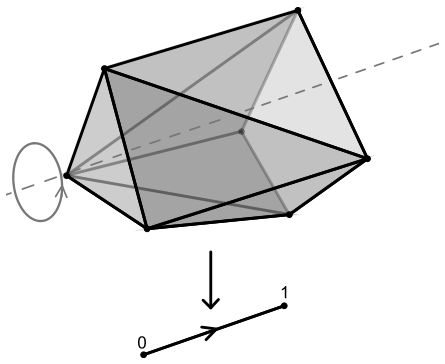
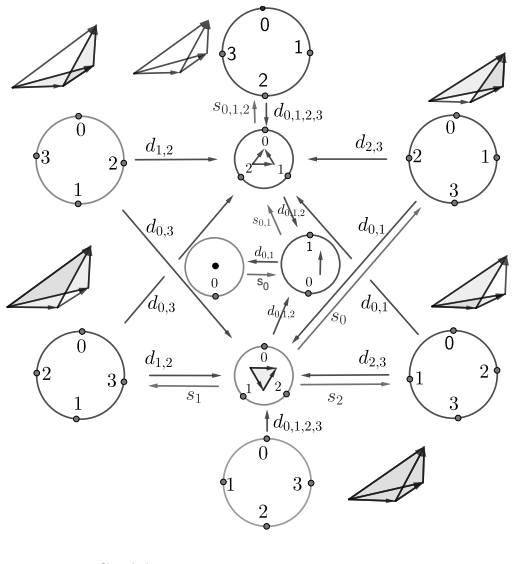
The load-bearing objects are circular permutations and their associated minimal elementary bundles, together with the universal binary Chern cocycle. A circular permutation of $[k]$ is an oriented necklace with one bead of each color, and it determines a minimal semi-simplicial circle bundle over the $k$-simplex; minimal bundles over a base are exactly local systems of such permutations, i.e. simplicial maps $B \to \mathrm{SSSC}$, where $\mathrm{SSSC}$ is the simplicial set of all circular permutations. The universal binary Chern cocycle is the parity formula $c_{01}(0,1,2)=0$, $c_{01}(2,1,0)=1$ on $\mathrm{SSSC}$, giving a $0/1$-valued integer 2-cocycle. The argument then hangs on Proposition 7, which identifies the simplicial cocycle condition on the boundary of a 3-simplex with the classical transitivity axiom for cyclic orders: once triples are cyclically ordered compatibly, the orders extend uniquely over higher skeleta by the unique-extension property of $\mathrm{SSSC}$. A spindle-contraction trick reduces an arbitrary triangulated bundle to a minimal one by deleting all but one bead from each fiber circle, preserving strong concordance and hence the isomorphism class.
What would settle it
Enumerate the 16 binary 2-cochains on the boundary of the ordered 3-simplex and check Proposition 7 directly: for every cochain with $c(f)=0$, verify that the induced cyclic orders on the four faces extend to a cyclic order on $\{0,1,2,3\}$; for every cochain with $c(f)\neq 0$, verify that extension fails. A single counterexample in either direction would break the only-if direction of Theorem 1.
Extended reading notes
Core claim
The central claim is Theorem 1: for a finite semi-simplicial set $B$, an oriented circle bundle $p$ over $|B|$ admits a semi-simplicial triangulation over $B$ if and only if $c_1(p)\in H^2(|B|;\mathbb{Z})$ can be represented by a binary simplicial cocycle, i.e. a 2-cocycle taking only the values $0$ and $1$ on 2-simplices. For ordinary classical simplicial triangulations the same condition is necessary but not sufficient. The 'if' direction is built from a spindle-contraction trick reducing any triangulated bundle to a minimal one while preserving the bundle class, combined with a universal local formula $c_{01}$ assigning to a circular permutation of three elements the parity $0$ or $1$; the 'only if' direction uses a binary cocycle to define cyclic orders on every triple of vertices of each base simplex, and then uses the classical transitivity axiom for cyclic orders (verified by an explicit case check over the hexagram of the 3-skeleton, Proposition 7) to extend them to a global system of circular permutations, i.e. a minimal triangulation. The paper also proves Theorem 2: over an oriented closed surface triangulated with $N$ 2-simplices, every circle bundle with Chern number $c$ satisfying $|c| \le N/2$ can be semi-simplicially triangulated, and at the extreme $|c| = N/2$ the triangulation cannot be classical simplicial.
Load-bearing premise
The only-if direction depends on an unproved case check: that a pattern of zeroes and ones on the four faces of a tetrahedron produces a consistent cyclic ordering of the four vertices exactly when the pattern is a cocycle, and the paper's proof of this is an experimental enumeration, not a formal proof.
Editorial extensions
If this is right
- A circle bundle over a finite semi-simplicial base is triangulable exactly when its Chern class has a $0/1$-valued simplicial representative, so triangulability becomes a local arithmetic condition on the base rather than a search for a triangulation.
- Over an oriented closed surface with $N$ 2-simplices, every circle bundle with Chern number $c$ satisfying $|c| \le N/2$ admits a semi-simplicial triangulation over that surface triangulation.
- The extreme values $|c| = N/2$ require genuinely semi-simplicial triangulations; classical simplicial triangulations cannot realize them.
- Minimally triangulated circle bundles coincide with local systems of circular permutations of base-vertex orders, so the construction is purely local: one assigns a circular permutation to each 2-simplex and the face maps fit automatically.
- The simplicial set of circular permutations is a $K(\mathbb{Z},2)$, giving a combinatorial universal object for minimal circle bundles with a universal binary Chern cocycle.
Reading between the lines
- This is an editorial inference: if Theorem 1 is accepted, deciding triangulability of a circle bundle over a fixed finite base reduces to a finite enumeration—one can check all binary cochains for the cocycle condition and compare cohomology classes.
- The author leaves open a rigorous proof of Proposition 7; an automated enumeration of the 16 cases would be a direct check and would close the only-if direction without relying on the experimental verification.
- The same binary-cocycle mechanism suggests a combinatorial analogue of prequantization: an integral symplectic form represented by a $0/1$ cocycle should correspond to a minimally triangulated prequantum circle bundle with an explicit piecewise-linear connection, giving local formulas for its curvature.
- The author notes that crossed simplicial groups and generalized orders are the natural context; if pursued, the classification might extend to higher sphere bundles by replacing circular permutations with cyclic structures on higher-dimensional spheres.
Signed reviews
Editorial analysis
A structured set of objections, weighed in public.
Referee Report
Summary. The paper studies which circle bundles over a given semi-simplicial base admit a semi-simplicial triangulation over that base. Its main result, Theorem 1, states that a circle bundle p can be semi-simplicially triangulated over a finite semi-simplicial set BBB if and only if the integer Chern class c1(p) ∈ H^2(|BBB|; Z) can be represented by a binary simplicial cocycle with values 0 and 1 on 2-simplices. The proof strategy is to encode minimal triangulations as local systems of circular permutations, represented by simplicial maps to a classifying object SSSC, then to connect the simplicial cocycle condition to Huntington's transitivity axiom for cyclic orders. The paper also gives a surface version, Theorem 2, bounding the possible Chern numbers of triangulable bundles over a fixed triangulated oriented closed surface.
Significance. If the main theorem is established, it would be a clean and striking characterization: triangulability of a circle bundle over a fixed semi-simplicial base becomes a purely cohomological 0/1 condition. The manuscript introduces a natural combinatorial object, SSSC, the simplicial set of circular permutations, and proposes a useful spindle-contraction reduction from arbitrary triangulations to minimal ones. The universal binary Chern cocycle c01 is a concrete local formula that could be of independent interest. However, the paper explicitly labels its central bridge as an 'experimental fact,' and the two key propositions that make the converse direction of Theorem 1 work are not proved. The manuscript is therefore best viewed as a promising research announcement whose central claim is not yet established as written.
major comments (3)
- [Section 6.2, Proposition 7] Proposition 7 is the load-bearing step that lets a binary 2-cochain on ∂⟨3⟩ satisfying the cocycle condition (equation (8)) be extended to a transitive Huntington cyclic order on [3]. Its proof is explicitly called 'experimental' and 'a pseudoscientific check of cases during meditation over the hexagram,' and it rests entirely on Table 1, which is not machine-checked and is not accompanied by a derivation from Huntington's axioms. A single incorrect or omitted row in the 16-case table would invalidate the extension argument. This proposition is used in Proposition 8 and in the 'if' direction of Theorem 1, so the converse direction of Theorem 1 is not rigorously established.
- [Section 6.1, Proposition 6] Proposition 6 asserts the unique extension property for maps ∂⟨k⟩ → SSSC for k = 0, 1 and k ≥ 4, with a gap in dimension 3. No proof is given; the surrounding text says 'we can see that SSSC ≈ K(Z, 2)' and that π2 follows 'by inspection of the hexagram on Figure 5.' This proposition is required in the proof of Proposition 8 to extend a local system of circular permutations from the 3-skeleton to the whole base, so the gap is load-bearing for Theorem 1. A rigorous proof or a precise reference for the Kan properties of SSSC is needed.
- [Section 7, proof of Proposition 8] The proof of Proposition 8, which is the core of the 'if' direction of Theorem 1, reduces the construction of a minimal bundle from a binary cocycle to 'general Huntington theory and Proposition 7' and 'the Kan property of cyclic orders from Proposition 6.' Since both Proposition 7 and Proposition 6 are unproved in the manuscript, Proposition 8 is not independently established. The proof as written does not supply a complete argument that a binary 2-cocycle uniquely defines a local system of circular permutations over the entire base.
minor comments (4)
- [Section 6.2, Table 1] The layout of Table 1 is difficult to read: the row and column labels are not clearly separated, and the correspondence between the 16 binary cochains and the listed circular permutations is not immediately evident. A clearer enumeration with explicit labels for the faces of ∂⟨3⟩ would help the reader verify the statement.
- [Section 3.6] The text says 'We don't prove this fact in this paper' regarding the universality of the minimal bundle over SSSC. If this fact is used later, it should either be proved or clearly marked as an assumption; if it is not used, the sentence could be removed for clarity.
- [Section 5] The definition of the universal binary Chern cocycle c01 states that it is the rational local formula from [MS17] shifted by the universal 2-coboundary 1/2, but the verification that this cochain is indeed a cocycle on SSSC is not carried out in the paper. A direct check or a more detailed reference would strengthen the exposition.
- [Section 8, Lemma 9] The proof of Lemma 9 uses a 1-cochain 11 taking value 1 on every 1-simplex. The notation is understandable but a brief explanation of why the resulting 2-cochain evaluates to 1 on every 2-simplex would help readability.
Circularity Check
Load-bearing pieces of Theorem 1 are imported from the authors' [MS17] and an explicitly experimental 16-case check; the central statement is not a tautology but its converse direction is not independently proved here.
-
self citation load bearing
[Section 3.6 (definition of SSSC and minimal bundles; used in Proposition 8)]
"Actually, a minimal elementary s.c. bundle eeec(ϑ) is the stalk of the simplicial map SSS ⟳−→SSSC over the base simplex ⟨k⟩ ϑ−→SSSC. Therefore ⟳ is the universal minimal s.c. bundle over SSSC. We don’t prove this fact in this paper."
The identification of minimally triangulated circle bundles with local systems of circular permutations is the premise of Proposition 8 and of both directions of Theorem 1. The paper explicitly declines to prove it here and inherits it from the author's [MS17]; Section 5 likewise takes the binary Chern cocycle as 'the rational local formula from [MS17]'. Since [MS17] is the same author's prior work and is not machine-checked or reproduced in this paper, the theorem's classification rests on a load-bearing self-citation rather than on a derivation contained in the text. This is not a fitted-parameter reduction, but it is exactly the 'uniqueness/representation imported from authors' pattern that the rubric treats as partial circularity.
full rationale
No prediction in the paper is obtained by fitting a parameter and then re-predicting the fitted data, and the main equivalence is not definitional: a binary 2-cocycle is not simply a renamed triangulable bundle, and the passage through Huntington cyclic orders and the extension over 3-simplices is genuine mathematical work. However, two load-bearing supports are not independently established in this paper. First, the representation of minimal s.c. bundles by simplicial maps to SSSC is explicitly stated to be unproved here ('We don’t prove this fact in this paper') and comes from [MS17]; Proposition 8 and the converse direction of Theorem 1 use it as input. Second, Proposition 7—the only bridge from the cocycle condition (8) to transitivity, hence to extension over each 3-simplex—has a proof the author labels 'experimental' and 'a pseudoscientific check of cases' resting on Table 1; a wrong or missing row would invalidate Proposition 8's inverse direction. These are correctness/rigor gaps and self-citation dependencies, not reductions by construction, and the paper contains independent content (spindle concordance, Theorem 2's explicit surface construction, the hexagram analysis), so the score is 4 rather than 6 or higher. The experimental status of Proposition 7 is flagged here as a limitation explicitly stated in the manuscript (Section 6.2); it does not by itself make the derivation circular.
Assumptions & free parameters
free parameters (1)
- universal coboundary shift 1/2 (binary normalization) =
1/2
assumptions (7)
- standard math Weil-Kostant correspondence: H^1(B;S^1) approximately H^2(B;Z) identifies circle bundles with Chern classes
- standard math Oriented PL S1 bundles can be made into U(1) principal bundles by a flat Euclidean fiber metric, uniquely up to gauge
- domain assumption Necklace description: stalks of an s.c. circle bundle over ordered k-simplex correspond to necklaces colored by [k]; minimal stalks are circular permutations
- domain assumption Any s.c. bundle is strongly concordant to a minimal s.c. bundle (Proposition 4)
- ad hoc to paper SSSC has unique extension over ∂⟨k⟩ for k=0,1 and k≥4 (Proposition 6)
- ad hoc to paper Binary cochain on ∂⟨3⟩ is a cocycle iff the associated cyclic orders are transitive (Proposition 7)
- ad hoc to paper π2(SSSC)=Z follows from homology of the 2-sphere by inspecting the hexagram (Figure 5)
invented entities (1)
-
SSSC, the simplicial set of circular permutations
Cite this review
Pith. "Pith review of Minimal triangulations of circle bundles, circular permutations and binary Chern cocycle." pith.science (2026). https://pith.science/paper/4IL2TU6A
@misc{pith2026190804029,
  author       = {Pith},
  title        = {Pith review of: Minimal triangulations of circle bundles, circular permutations and binary Chern cocycle},
  year         = {2026},
  howpublished = {\url{https://pith.science/paper/4IL2TU6A}},
  note         = {Machine review of arXiv:1908.04029}
}
read the original abstract
We investigate a PL topology question: which circle bundles can be triangulated over a given triangulation of the base? The question got a simple answer emphasizing the role of minimal triangulations encoded by local systems of circular permutations of vertices of the base simplices. The answer is based on an experimental fact: classical Huntington transitivity axiom for cyclic orders can be expressed as the universal binary Chern cocycle.
Figures

Reference graph
Works this paper leans on
-
[3]
Sheaves, Cosheaves and Applications
Justin Curry . Sheaves, Cosheaves and Applications . arXiv e-prints , arXiv:1303.3255, Mar 2013
arXiv 2013
-
[1]
Loop spaces, characteristic classes and geometric quantization
Jean-Luc Brylinski . Loop spaces, characteristic classes and geometric quantization. Reprint of the 1993 edition. Basel: Birkh\"auser, reprint of the 1993 edition edition, 2008
work page 1993
-
[2]
Shiing-shen Chern. Circle bundles. In Jacob Palis and Manfredo do Carmo, editors, Geometry and Topology , volume 597 of Lecture Notes in Mathematics , pages 114--131. Springer Berlin Heidelberg, 1977
work page 1977
-
[4]
Crossed simplicial groups and structured surfaces
Tobias Dyckerhoff and Mikhail Kapranov . Crossed simplicial groups and structured surfaces . arXiv e-prints , arXiv:1403.5799, Mar 2014
work page Pith review arXiv 2014
-
[5]
Crossed simplicial groups and their associated homology
Zbigniew Fiedorowicz and Jean-Louis Loday . Crossed simplicial groups and their associated homology. Trans. Am. Math. Soc. , 326(1):57--87, 1991
work page 1991
-
[6]
B. L. Feigin and B. L. Tsygan . Additive \(K\)-theory. \(K\)-theory, arithmetic and geometry, Semin., Moscow Univ. 1984-86, Lect. Notes Math. 1289, 67-209 (1987). , 1987
work page 1987
-
[7]
E. V. Huntington . A set of independent postulates for cyclic order. Nat. Acad. Proc. 2, 630-631 (1916). , 1916
work page 1916
-
[8]
Edward V. Huntington . Inter-relations among the four principal types of order. Trans. Am. Math. Soc. , 38:1--9, 1935
work page 1935
Show all 16 references
-
[9]
Dmitry N. Kozlov . Combinatorial algebraic topology. Eur. Math. Soc. Newsl. , 68:13--16, 2008
2008
-
[10]
Krasauskas
R. Krasauskas . Skew-simplicial groups. Lith. Math. J. , 27(1):47--54, 1987
1987
-
[11]
N. Mn\"ev . Which circle bundles can be triangulated over ^3 ? arXiv e-prints , arXiv:1807.06842, Jul 2018
2018 arXiv
-
[12]
K. V. Madahar and K. S. Sarkaria. A minimal triangulation of the H opf map and its application. Geom. Dedicata , 82(1-3):105--114, 2000
2000
-
[13]
Mn \"e v and G
N. Mn \"e v and G. Sharygin . On local combinatorial formulas for Chern classes of a triangulated circle bundle. J. Math. Sci., New York , 224(2):304--327, 2017
2017
-
[14]
Cyclically ordered sets
Vitezslav Novak . Cyclically ordered sets. Czech. Math. J. , 32:460--473, 1982
1982
-
[15]
C. P. Rourke and B. J. Sanderson. -sets. I . H omotopy theory. Quart. J. Math. Oxford Ser. (2) , 22:321--338, 1971
1971
-
[16]
Spaces of PL Manifolds and Categories of Simple Maps (AM-186)
Friedhelm Waldhausen, Bj rn Jahren, and John Rognes. Spaces of PL Manifolds and Categories of Simple Maps (AM-186) . Princeton University Press, 2013
2013
Reviewed August 14, 2026 · model on record in the stance chip above.
Discussion (0). Continue with ORCID to comment.