Quantifying the inside-out formation of disk galaxies at 1.5 le z le 3.0
Pith reviewed 2026-06-26 01:34 UTC · model grok-4.3
The pith
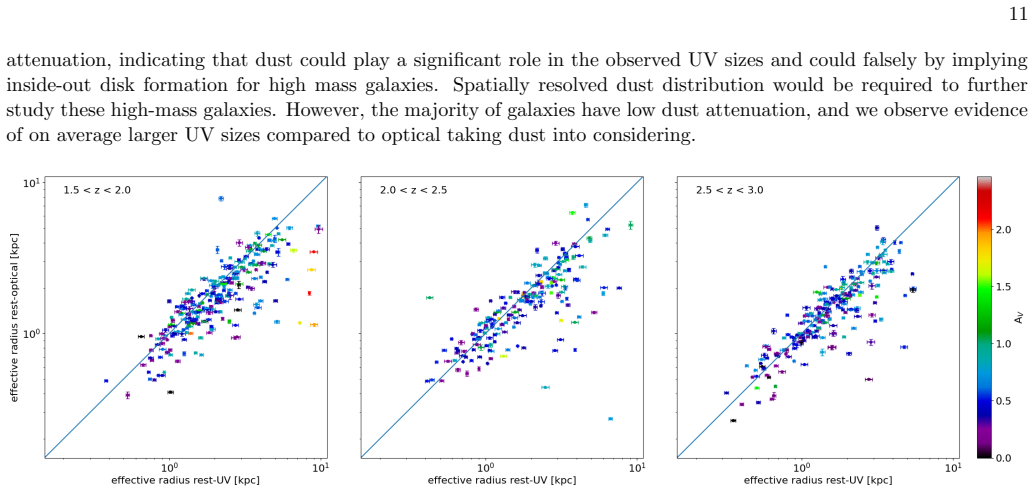
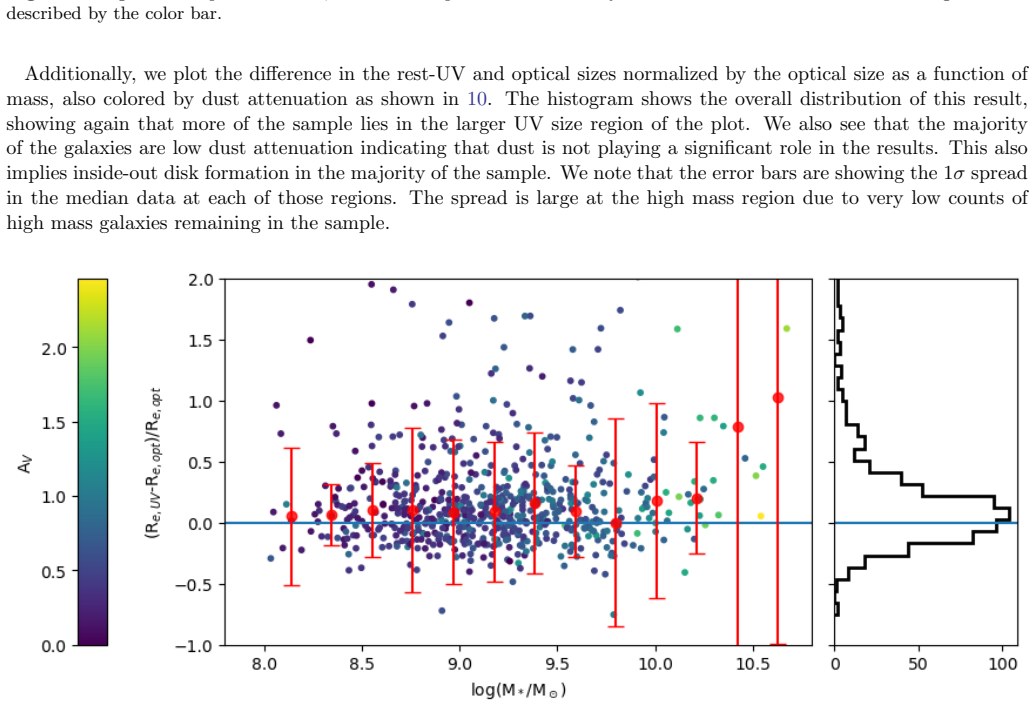
Galaxies at redshifts 1.5 to 3 show larger UV-emitting regions than optical sizes, indicating inside-out disk formation.
A machine-rendered reading of the paper's core claim, the machinery that carries it, and where it could break.
Core claim
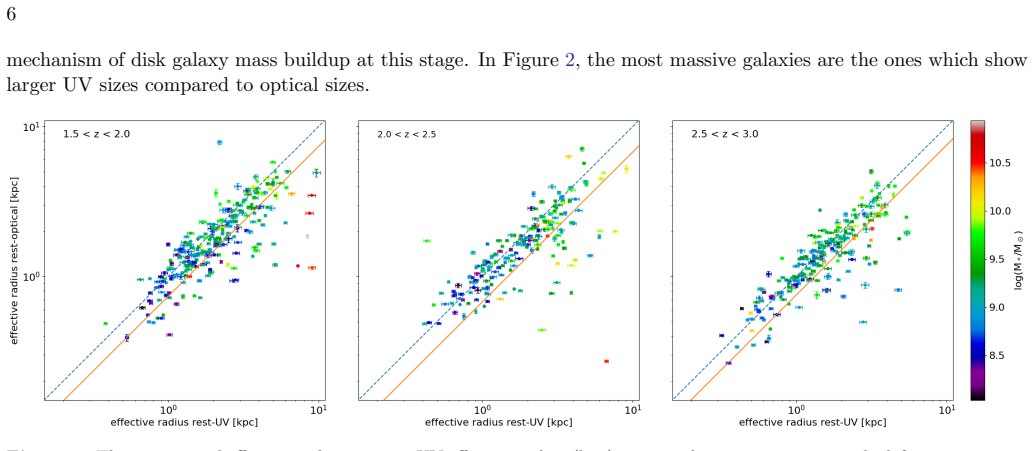
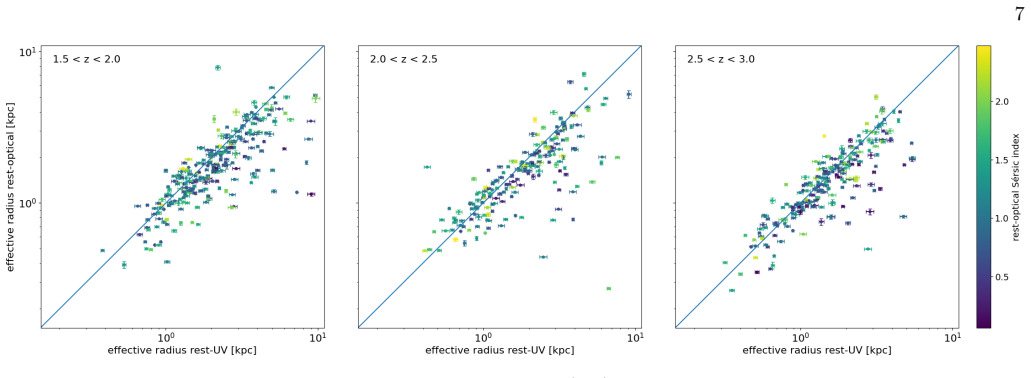
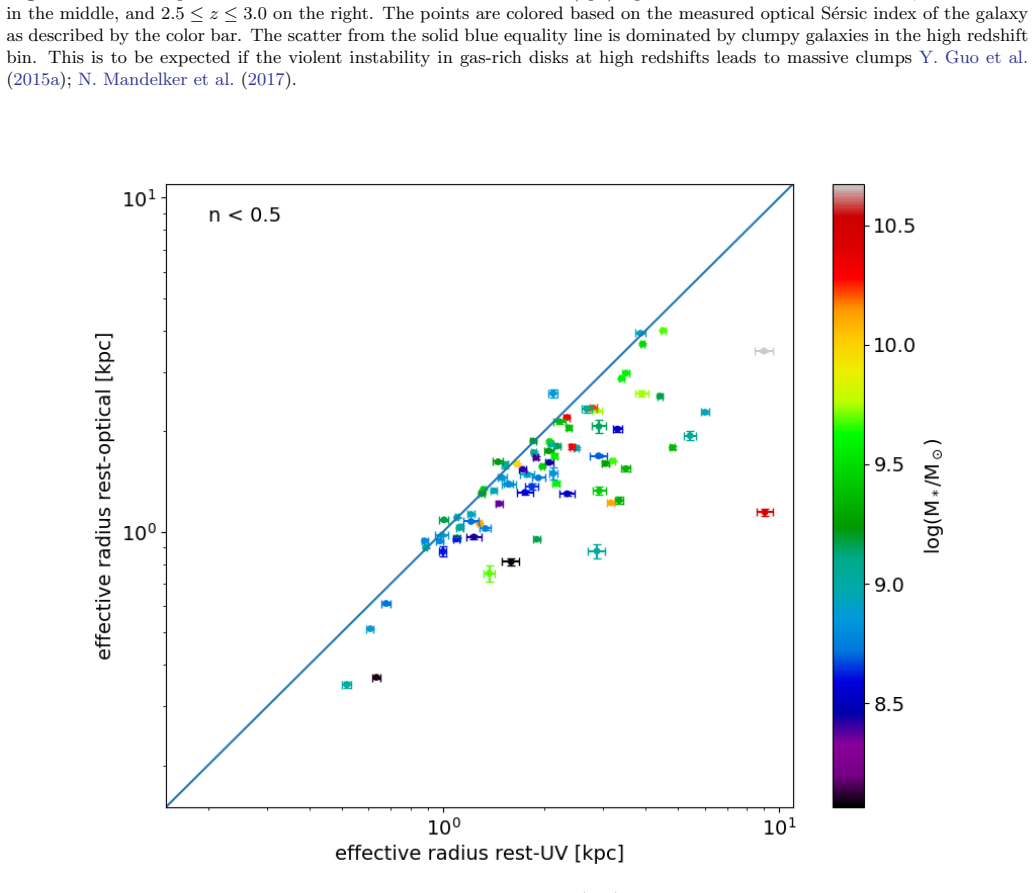
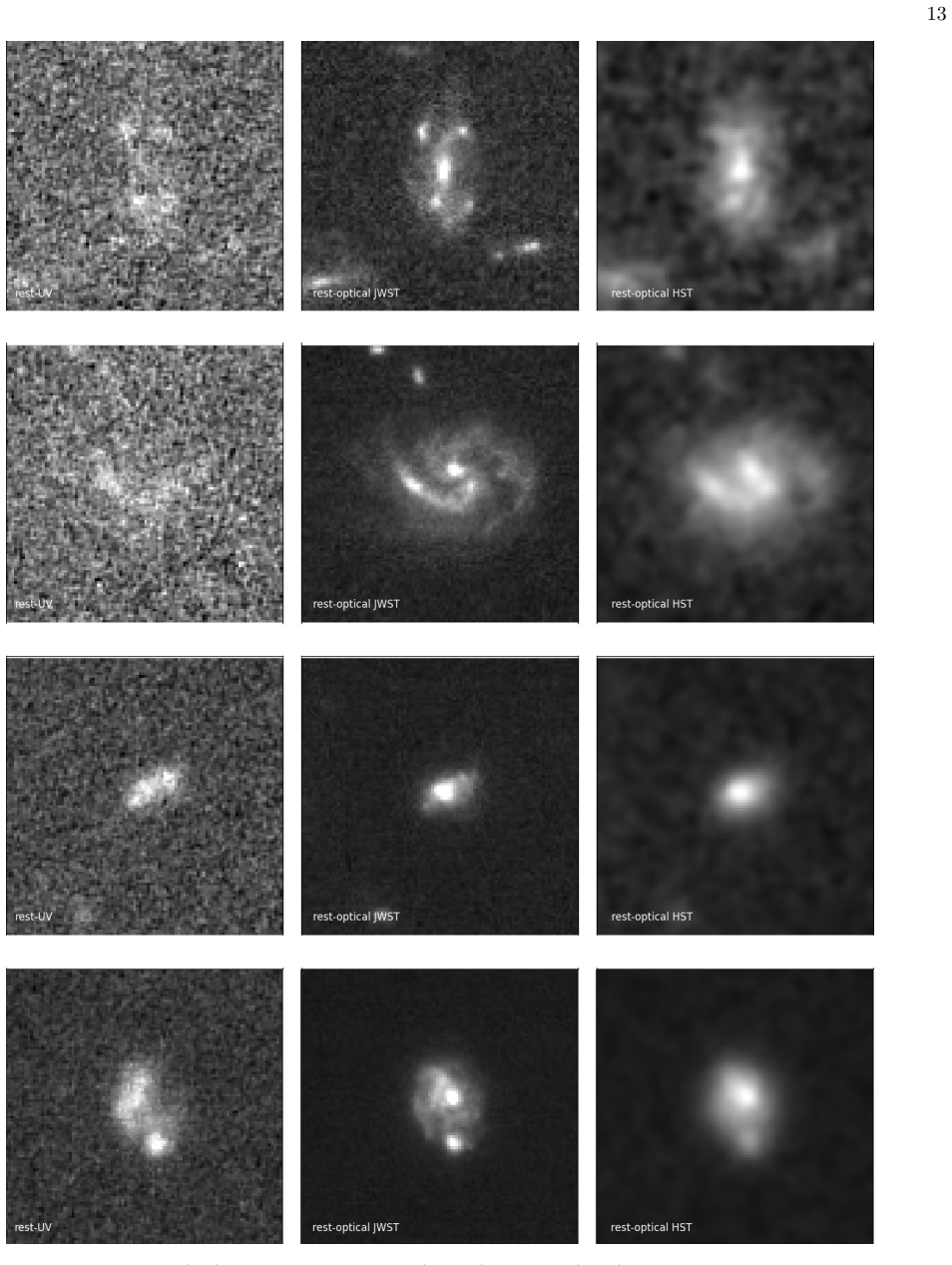
Galaxies at 1.5 ≤ z ≤ 3.0 exhibit larger rest-UV half-light radii than rest-optical radii on average. This offset persists after dust corrections and is especially clear in clumpy (n < 0.5) morphologies, supporting inside-out disk formation in which younger stars form at larger radii than the older central population.
What carries the argument
Direct comparison of rest-frame UV and rest-frame optical half-light radii measured at comparable spatial resolution from JWST and HST imaging.
If this is right
- Star formation begins centrally and propagates outward over time in these disks.
- Clumpy UV morphologies trace distributed star-forming regions rather than centralized bursts.
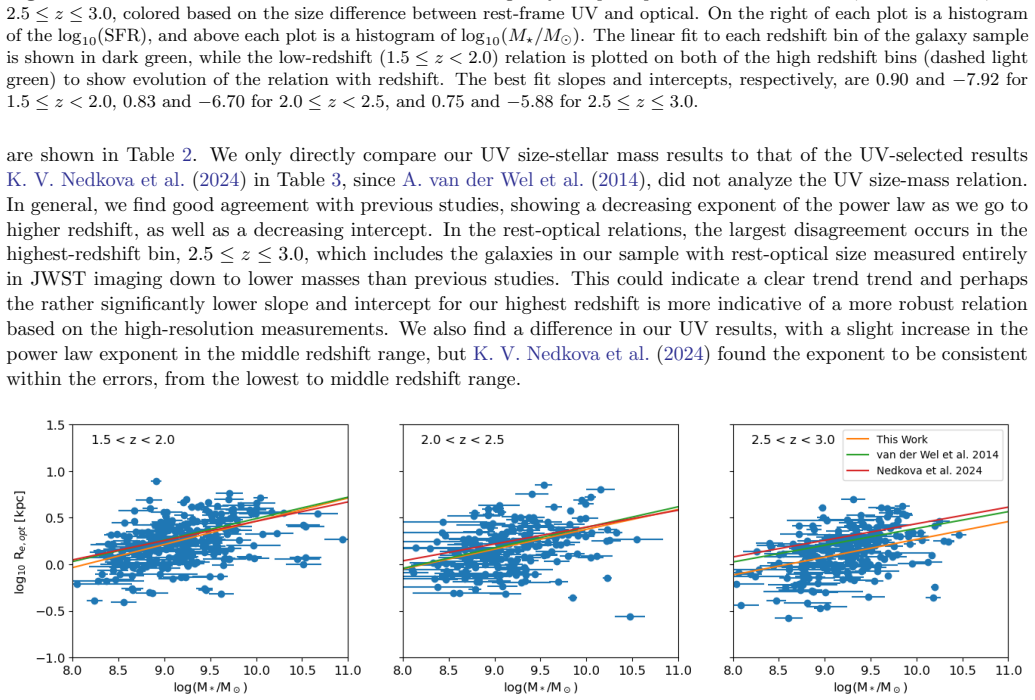
- The optical size-mass power-law slope is shallower when measured at JWST resolution than in prior lower-resolution studies.
- Structural parameters correlate with star-formation rate and dust content in patterns consistent with inside-out assembly.
Where Pith is reading between the lines
- If the size offset holds at lower redshifts, the inside-out mode may continue to the present epoch.
- Refining dust corrections with spatially resolved SED fitting could isolate true age gradients more cleanly.
- The result suggests feedback processes allow star formation to migrate outward without destroying the disk structure.
Load-bearing premise
The dust attenuation corrections fully remove any residual effects that could produce apparently larger UV sizes without a true radial age gradient in the stellar populations.
What would settle it
Re-measurement of the same sample with independent dust maps or deeper multi-band data that eliminates the UV-optical size difference after correction would falsify the inside-out claim.
Figures
read the original abstract
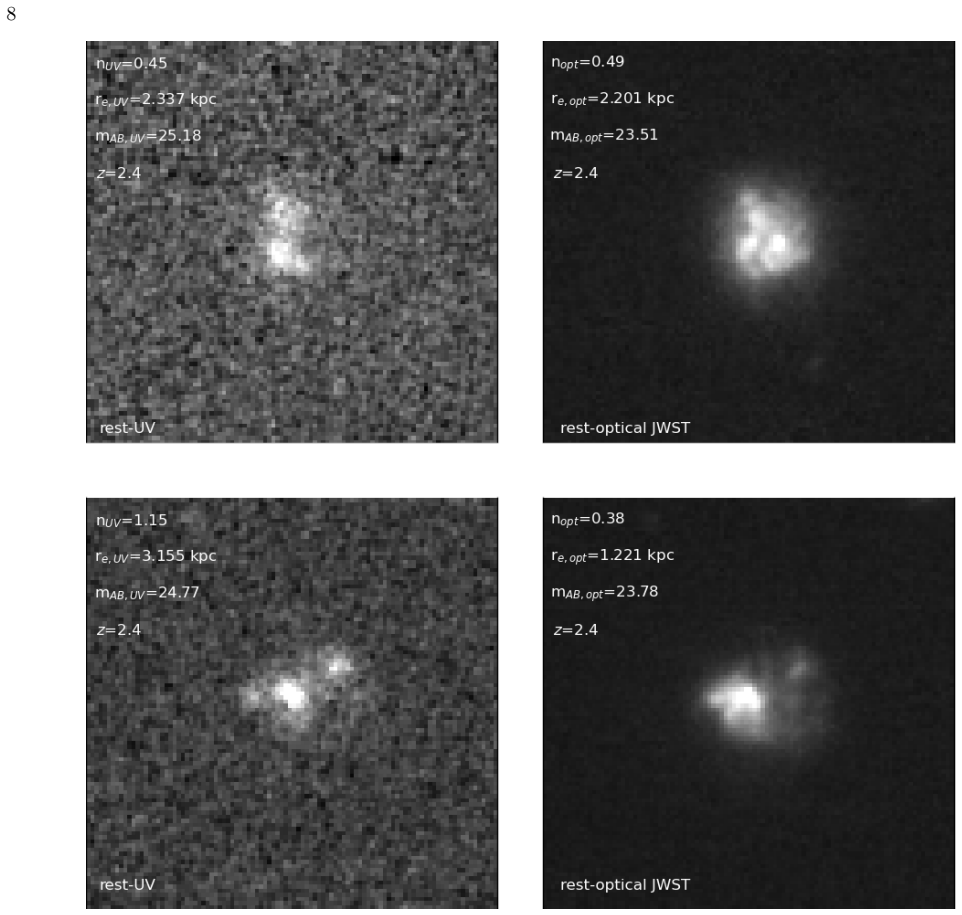
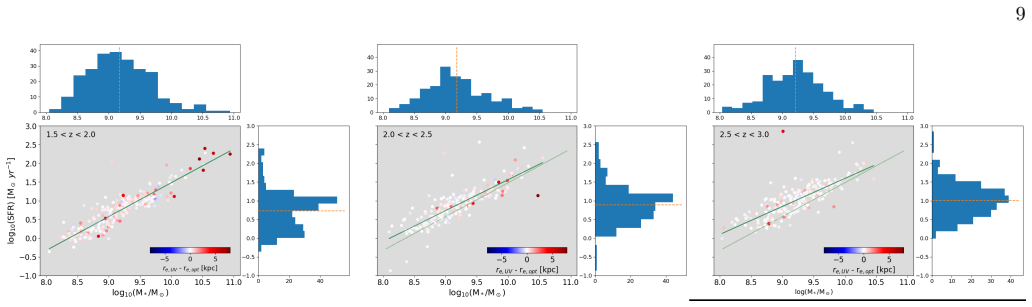
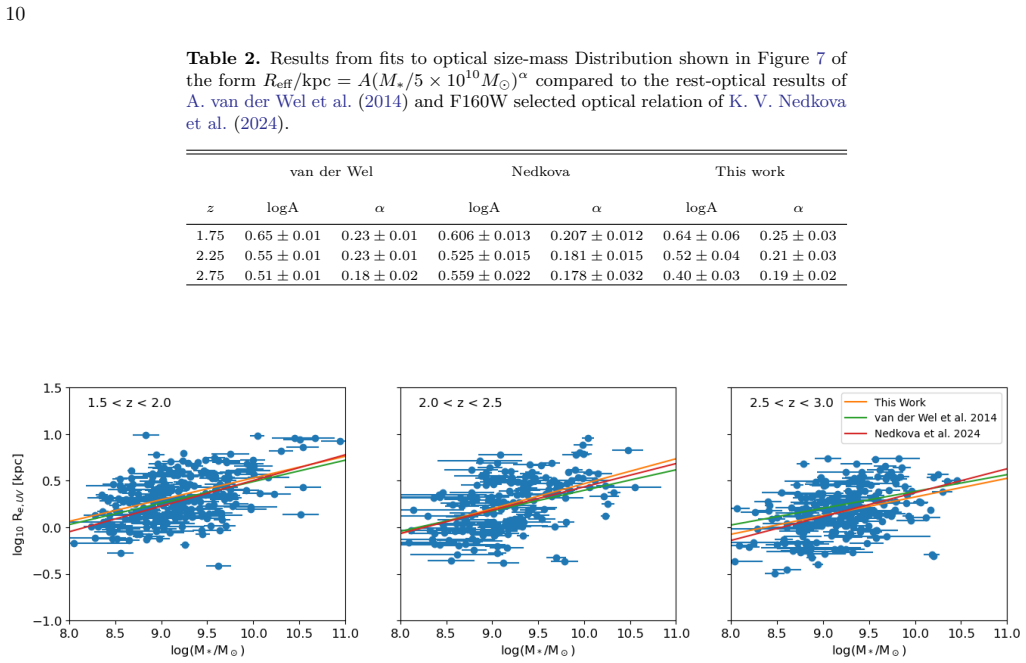
We examine the properties of galaxies at $1.5\le z\le3.0$ in the Extended Groth Strip (EGS) field to explore inside-out disk growth. We take advantage of the high-resolution James Webb Space Telescope (JWST) imaging and imaging from the Hubble Space Telescope (HST) to measure rest-frame optical and rest-frame UV half-light radii of the galaxies at comparable spatial resolution. We also examine the relation between structural properties and star formation rates, mass, and dust attenuation. While previous studies have inferred inside-out disk formation via the comparison of rest-optical and rest-UV radii using HST images, this study advances this knowledge by using the unprecedented resolution of JWST. We find evidence of inside-out disk formation from, on average, larger UV sizes than optical for galaxies across all redshifts. While previous studies suggested that this could be accounted for due to dust, we find that measurements with the improved resolution of the JWST support this size difference, after accounting for dust attenuation. We also observe that majority of galaxies with clumpy morphologies ($n < 0.5$) exhibit larger UV sizes than rest-optical because the star formation is distributed in multiple star forming clumps or mergers. We observe correlations in both the optical and UV for the size-mass relation, which are consistent with previous results but we find lower values for the slope of the power-law relation of the rest-optical fit, based on robust measurements from JWST images compared to the low resolution HST images used in previous studies.
Editorial analysis
A structured set of objections, weighed in public.
Referee Report
Summary. The manuscript examines galaxies at 1.5 ≤ z ≤ 3.0 in the EGS field using JWST and HST imaging to measure rest-frame UV and optical half-light radii. It claims evidence for inside-out disk formation from systematically larger UV sizes than optical sizes across the redshift range, even after dust attenuation correction, with additional findings on size-mass relations (lower optical slopes than prior HST work), correlations with SFR/mass/dust, and larger UV sizes in clumpy (n < 0.5) systems.
Significance. If the dust correction is robust, the higher-resolution JWST data would strengthen observational support for inside-out growth at cosmic noon by reducing resolution biases present in earlier HST studies and providing direct size comparisons at matched spatial scales.
major comments (2)
- [Abstract] Abstract: the central claim that the observed <r_UV> > <r_opt> difference traces inside-out formation 'after accounting for dust attenuation' lacks any description of the attenuation law, dust geometry (e.g., screen vs. two-component vs. pixel-by-pixel), or correction procedure. This is load-bearing because an underestimated central optical depth at rest-UV wavelengths could leave an artificially extended UV half-light radius even if the intrinsic stellar distribution shows no radial age gradient.
- [Abstract] Abstract: the statement of 'lower values for the slope of the power-law relation of the rest-optical fit' is presented without numerical slope values, uncertainties, sample size, or direct comparison to the HST-based literature slopes being superseded, preventing assessment of whether the JWST result meaningfully revises the size-mass relation.
minor comments (1)
- The abstract refers to 'majority of galaxies with clumpy morphologies (n < 0.5)' without stating how the Sérsic index n is derived or the precise selection criteria for the sample.
Simulated Author's Rebuttal
We thank the referee for their constructive comments, which help clarify the presentation of our results. We address each major comment below and will revise the abstract accordingly.
read point-by-point responses
-
Referee: [Abstract] Abstract: the central claim that the observed <r_UV> > <r_opt> difference traces inside-out formation 'after accounting for dust attenuation' lacks any description of the attenuation law, dust geometry (e.g., screen vs. two-component vs. pixel-by-pixel), or correction procedure. This is load-bearing because an underestimated central optical depth at rest-UV wavelengths could leave an artificially extended UV half-light radius even if the intrinsic stellar distribution shows no radial age gradient.
Authors: We agree that the abstract should briefly specify the dust correction approach to support the central claim. The full manuscript details the attenuation correction using a Calzetti law applied to integrated photometry with a two-component dust geometry (birth-cloud and diffuse ISM components) derived from SED fitting; no pixel-by-pixel correction was performed. We will revise the abstract to include a concise statement of the attenuation law and geometry used, while retaining the length constraints. revision: yes
-
Referee: [Abstract] Abstract: the statement of 'lower values for the slope of the power-law relation of the rest-optical fit' is presented without numerical slope values, uncertainties, sample size, or direct comparison to the HST-based literature slopes being superseded, preventing assessment of whether the JWST result meaningfully revises the size-mass relation.
Authors: We acknowledge that the abstract omits the quantitative details. The manuscript reports the rest-optical size-mass slope as 0.18 ± 0.03 (N=XXX galaxies) compared to literature values of ~0.25 from HST studies (e.g., van der Wel et al.). We will update the abstract to include the numerical slope, uncertainty, sample size, and explicit comparison to prior HST results. revision: yes
Circularity Check
No significant circularity in direct observational size comparisons
full rationale
The paper reports empirical measurements of rest-UV and rest-optical half-light radii from JWST and HST imaging at 1.5 ≤ z ≤ 3.0, finding on average larger UV sizes after dust correction, plus size-mass correlations. No equations, derivations, or model fits are described that reduce by construction to their own inputs. There are no self-definitional steps, fitted parameters renamed as predictions, or load-bearing self-citations that close a loop. The analysis consists of direct image-based measurements and observational comparisons, which are self-contained against external data and do not invoke uniqueness theorems or ansatzes from prior author work. This is a standard observational study whose central claim rests on the measurements themselves rather than any circular reduction.
Axiom & Free-Parameter Ledger
axioms (2)
- standard math Assumptions about the cosmology used to convert angular sizes to physical sizes at given redshifts
- domain assumption Validity of half-light radius as a measure of galaxy size
Reference graph
Works this paper leans on
-
[1]
Publications of the Astronomical Society of the Pacific , author =
Common-. Publications of the Astronomical Society of the Pacific , author =. 2011 , note =. doi:10.1086/662219 , abstract =
-
[2]
The Astropy Project: Building an inclusive, open-science project and status of the v2.0 core package
The Astropy Project: Building an Open-science Project and Status of the v2.0 Core Package. , keywords =. doi:10.3847/1538-3881/aabc4f , archivePrefix =. 1801.02634 , primaryClass =
work page internal anchor Pith review Pith/arXiv arXiv doi:10.3847/1538-3881/aabc4f
-
[3]
Astropy: A Community Python Package for Astronomy
Astropy: A community Python package for astronomy. , keywords =. 2013. doi:10.1051/0004-6361/201322068 , archivePrefix =. 1307.6212 , primaryClass =
work page internal anchor Pith review Pith/arXiv arXiv doi:10.1051/0004-6361/201322068 2013
-
[4]
CEERS Epoch 1 NIRCam Imaging: Reduction Methods and Simulations Enabling Early JWST Science Results. , keywords =. doi:10.3847/2041-8213/acbb08 , archivePrefix =. 2211.02495 , primaryClass =
-
[5]
GALAPAGOS: from pixels to parameters. , keywords =. doi:10.1111/j.1365-2966.2012.20619.x , archivePrefix =. 1203.1831 , primaryClass =
-
[6]
The CANDELS/SHARDS Multiwavelength Catalog in GOODS-N: Photometry, Photometric Redshifts, Stellar Masses, Emission-line Fluxes, and Star Formation Rates. , keywords =. doi:10.3847/1538-4365/ab23f2 , archivePrefix =. 1908.00569 , primaryClass =
-
[7]
DYNAMO II: Coupled Stellar and Ionized Gas Kinematics in Two Low Redshift Clumpy Disks
DYNAMO - II. Coupled stellar and ionized-gas kinematics in two low-redshift clumpy discs. , keywords =. doi:10.1093/mnras/stu1029 , archivePrefix =. 1405.6753 , primaryClass =
work page internal anchor Pith review Pith/arXiv arXiv doi:10.1093/mnras/stu1029
-
[8]
What Turns Galaxies Off? The Different Morphologies of Star-forming and Quiescent Galaxies since z -0.5ex 2 from CANDELS. , keywords =. doi:10.1088/0004-637X/753/2/167 , archivePrefix =. 1110.3786 , primaryClass =
work page internal anchor Pith review Pith/arXiv arXiv doi:10.1088/0004-637x/753/2/167
-
[9]
JWST Reveals Bulge-dominated Star-forming Galaxies at Cosmic Noon. , keywords =. doi:10.3847/2041-8213/ad7e27 , archivePrefix =. 2409.08328 , primaryClass =
-
[10]
SExtractor: Software for source extraction. , keywords =. doi:10.1051/aas:1996164 , adsurl =
-
[11]
Rapid Formation of Exponential Disks and Bulges at High Redshift from the Dynamical Evolution of Clump-Cluster and Chain Galaxies. , keywords =. doi:10.1086/522077 , archivePrefix =. 0708.0306 , primaryClass =
work page internal anchor Pith review Pith/arXiv arXiv doi:10.1086/522077
-
[12]
The thick disks of spiral galaxies as relics from gas-rich, turbulent, clumpy disks at high redshift
The Thick Disks of Spiral Galaxies as Relics from Gas-rich, Turbulent, Clumpy Disks at High Redshift. , keywords =. doi:10.1088/0004-637X/707/1/L1 , archivePrefix =. 0910.3677 , primaryClass =
work page internal anchor Pith review Pith/arXiv arXiv doi:10.1088/0004-637x/707/1/l1
-
[13]
Bradley, Larry and Sipőcz, Brigitta M. and Robitaille, T. P. and Tollerud, E. J. and Vinícius, Zé and Deil, Christoph and Barbary, Kyle and Wilson, Tom J. and Busko, Ivo and Donath, Axel and Günther, Hans Moritz and Cara, Mihai and Lim, P. L. and Meßlinger, Sebastian and Conseil, Simon and Droettboom, Michael and Bostroem, K. Azalee and Bray, E. M. and Br...
-
[14]
Astronomy & Astrophysics , author =
Convolution kernels for multi-wavelength imaging , volume =. Astronomy & Astrophysics , author =. 2016 , note =. doi:10.1051/0004-6361/201629080 , abstract =
-
[15]
Observations and modeling of a clumpy galaxy at z = 1.6. Spectroscopic clues to the origin and evolution of chain galaxies. , keywords =. doi:10.1051/0004-6361:20079250 , archivePrefix =. 0803.3831 , primaryClass =
work page internal anchor Pith review Pith/arXiv arXiv doi:10.1051/0004-6361:20079250
-
[16]
Modeling CO emission from hydrodynamic simulations of nearby spirals, starbursting mergers, and high-redshift galaxies. , keywords =. doi:10.1051/0004-6361/201425078 , archivePrefix =. 1409.8157 , primaryClass =
work page internal anchor Pith review Pith/arXiv arXiv doi:10.1051/0004-6361/201425078
-
[17]
The long lives of giant clumps and the birth of outflows in gas-rich galaxies at high redshift
The Long Lives of Giant Clumps and the Birth of Outflows in Gas-rich Galaxies at High Redshift. , keywords =. doi:10.1088/0004-637X/780/1/57 , archivePrefix =. 1307.7136 , primaryClass =
work page internal anchor Pith review Pith/arXiv arXiv doi:10.1088/0004-637x/780/1/57
-
[18]
2024, astropy/photutils: 2.0.2, 2.0.2, Zenodo, doi: 10.5281/zenodo.13989456
Larry Bradley and Brigitta Sip. astropy/photutils: 2.0.2 , month = oct, year = 2024, publisher =. doi:10.5281/zenodo.13989456 , url =
-
[19]
The Mass Assembly Histories of Galaxies of Various Morphologies in the GOODS Fields
The Mass Assembly Histories of Galaxies of Various Morphologies in the GOODS Fields. , keywords =. doi:10.1086/429549 , archivePrefix =. astro-ph/0502204 , primaryClass =
work page internal anchor Pith review Pith/arXiv arXiv doi:10.1086/429549
-
[20]
Prograde rotation of protoplanets by accretion of pebbles in a gaseous environment , ISSN=
High-redshift clumpy discs and bulges in cosmological simulations. , keywords =. doi:10.1111/j.1365-2966.2010.16433.x , archivePrefix =. 0907.3271 , primaryClass =
-
[21]
Radiative feedback and the low efficiency of galaxy formation in low-mass haloes at high redshift
Radiative feedback and the low efficiency of galaxy formation in low-mass haloes at high redshift. , keywords =. doi:10.1093/mnras/stu956 , archivePrefix =. 1307.0943 , primaryClass =
work page internal anchor Pith review Pith/arXiv arXiv doi:10.1093/mnras/stu956
-
[22]
The Evolution of Galaxy Structure over Cosmic Time
The Evolution of Galaxy Structure Over Cosmic Time. , keywords =. doi:10.1146/annurev-astro-081913-040037 , archivePrefix =. 1403.2783 , primaryClass =
work page internal anchor Pith review Pith/arXiv arXiv doi:10.1146/annurev-astro-081913-040037
-
[23]
Ultra Diffuse Galaxies are a Subset of Cluster Dwarf Elliptical/Spheroidal Galaxies
Ultra-diffuse Galaxies Are a Subset of Cluster Dwarf Elliptical/Spheroidal Galaxies. Research Notes of the American Astronomical Society , keywords =. doi:10.3847/2515-5172/aab7f6 , archivePrefix =. 1803.06927 , primaryClass =
work page internal anchor Pith review Pith/arXiv arXiv doi:10.3847/2515-5172/aab7f6
-
[24]
Multiwavelength Study of Massive Galaxies at z -0.5ex 2. I. Star Formation and Galaxy Growth. , keywords =. doi:10.1086/521818 , archivePrefix =. 0705.2831 , primaryClass =
work page internal anchor Pith review Pith/arXiv arXiv doi:10.1086/521818
-
[25]
A Critical Assessment of Photometric Redshift Methods: A CANDELS Investigation
A Critical Assessment of Photometric Redshift Methods: A CANDELS Investigation. , keywords =. doi:10.1088/0004-637X/775/2/93 , archivePrefix =. 1308.5353 , primaryClass =
work page internal anchor Pith review Pith/arXiv arXiv doi:10.1088/0004-637x/775/2/93
-
[26]
The evolution of the specific star formation rate of massive galaxies to z ~ 1.8 in the E-CDFS
The Evolution of the Specific Star Formation Rate of Massive Galaxies to z -0.5ex 1.8 in the Extended Chandra Deep Field South. , keywords =. doi:10.1088/0004-637X/690/1/937 , archivePrefix =. 0809.1426 , primaryClass =
work page internal anchor Pith review Pith/arXiv arXiv doi:10.1088/0004-637x/690/1/937
-
[27]
Formation of Massive Galaxies at High Redshift: Cold Streams, Clumpy Disks and Compact Spheroids
Formation of Massive Galaxies at High Redshift: Cold Streams, Clumpy Disks, and Compact Spheroids. , keywords =. doi:10.1088/0004-637X/703/1/785 , archivePrefix =. 0901.2458 , primaryClass =
work page internal anchor Pith review Pith/arXiv arXiv doi:10.1088/0004-637x/703/1/785
-
[28]
Wet Disc Contraction to Galactic Blue Nuggets and Quenching to Red Nuggets
Wet disc contraction to galactic blue nuggets and quenching to red nuggets. , keywords =. doi:10.1093/mnras/stt2331 , archivePrefix =. 1310.1074 , primaryClass =
work page internal anchor Pith review Pith/arXiv arXiv doi:10.1093/mnras/stt2331
-
[29]
Near-infrared and optical broadband surface photometry of 86 face-on disk dominated galaxies. II. A two-dimensional method to determine bulge and disk parameters. , keywords =. doi:10.48550/arXiv.astro-ph/9601002 , archivePrefix =. astro-ph/9601002 , primaryClass =
work page internal anchor Pith review Pith/arXiv arXiv doi:10.48550/arxiv.astro-ph/9601002
-
[30]
The structural properties of classical bulges and discs from z 2. , keywords =. doi:10.1093/mnras/stz2421 , archivePrefix =. 1902.04089 , primaryClass =
-
[31]
Prograde rotation of protoplanets by accretion of pebbles in a gaseous environment , ISSN=
On the evolution of the velocity-mass-size relations of disc-dominated galaxies over the past 10 billion years. , keywords =. doi:10.1111/j.1365-2966.2010.17555.x , archivePrefix =. 1006.3558 , primaryClass =
-
[32]
Resolved Galaxies in the Hubble Ultra Deep Field: Star Formation in Disks at High Redshift
Resolved Galaxies in the Hubble Ultra Deep Field: Star Formation in Disks at High Redshift. , keywords =. doi:10.1086/511667 , archivePrefix =. astro-ph/0701121 , primaryClass =
work page internal anchor Pith review Pith/arXiv arXiv doi:10.1086/511667
-
[33]
Bulge Formation by the Coalescence of Giant Clumps in Primordial Disk Galaxies
Bulge Formation by the Coalescence of Giant Clumps in Primordial Disk Galaxies. , keywords =. doi:10.1086/592190 , archivePrefix =. 0808.0716 , primaryClass =
work page internal anchor Pith review Pith/arXiv arXiv doi:10.1086/592190
-
[34]
The Cosmic Evolution Early Release Science (CEERS) Survey
-
[35]
CEERS Key Paper. I. An Early Look into the First 500 Myr of Galaxy Formation with JWST. , keywords =. doi:10.3847/2041-8213/acade4 , archivePrefix =. 2211.05792 , primaryClass =
-
[36]
The Cosmic Evolution Early Release Science Survey (CEERS). , keywords =. doi:10.3847/2041-8213/adbbd3 , archivePrefix =. 2501.04085 , primaryClass =
-
[37]
Connecting Clump Sizes in Turbulent Disk Galaxies to Instability Theory
Connecting Clump Sizes in Turbulent Disk Galaxies to Instability Theory. , keywords =. doi:10.3847/2041-8213/aa6478 , archivePrefix =. 1703.00458 , primaryClass =
work page internal anchor Pith review Pith/arXiv arXiv doi:10.3847/2041-8213/aa6478 2041
-
[38]
Star-Forming Galaxies at Cosmic Noon. , keywords =. doi:10.1146/annurev-astro-032620-021910 , archivePrefix =. 2010.10171 , primaryClass =
-
[39]
Structure and Star Formation in Galaxies out to z = 3: Evidence for Surface Density Dependent Evolution and Upsizing. , keywords =. doi:10.1086/592431 , archivePrefix =. 0808.2642 , primaryClass =
work page internal anchor Pith review Pith/arXiv arXiv doi:10.1086/592431
-
[40]
From Rings to Bulges: Evidence for Rapid Secular Galaxy Evolution at z -0.5ex 2 from Integral Field Spectroscopy in the SINS Survey. , keywords =. doi:10.1086/591840 , archivePrefix =. 0807.1184 , primaryClass =
work page internal anchor Pith review Pith/arXiv arXiv doi:10.1086/591840
-
[41]
The SINS survey of z~2 galaxy kinematics: properties of the giant star forming clumps
The Sins Survey of z -0.5ex 2 Galaxy Kinematics: Properties of the Giant Star-forming Clumps. , keywords =. doi:10.1088/0004-637X/733/2/101 , archivePrefix =. 1011.5360 , primaryClass =
work page internal anchor Pith review Pith/arXiv arXiv doi:10.1088/0004-637x/733/2/101
-
[42]
CANDELS: The Cosmic Assembly Near-infrared Deep Extragalactic Legacy Survey
CANDELS: The Cosmic Assembly Near-infrared Deep Extragalactic Legacy Survey. , keywords =. doi:10.1088/0067-0049/197/2/35 , archivePrefix =. 1105.3753 , primaryClass =
work page internal anchor Pith review Pith/arXiv arXiv doi:10.1088/0067-0049/197/2/35
-
[43]
Color and Stellar Population Gradients in Passively Evolving Galaxies at z -0.5ex 2 from HST/WFC3 Deep Imaging in the Hubble Ultra Deep Field. , keywords =. doi:10.1088/0004-637X/735/1/18 , archivePrefix =. 1101.0843 , primaryClass =
work page internal anchor Pith review Pith/arXiv arXiv doi:10.1088/0004-637x/735/1/18
-
[44]
Multi-Wavelength View of Kiloparsec-Scale Clumps in Star-Forming Galaxies at z~2
Multi-wavelength View of Kiloparsec-scale Clumps in Star-forming Galaxies at z -0.5ex 2. , keywords =. doi:10.1088/0004-637X/757/2/120 , archivePrefix =. 1110.3800 , primaryClass =
work page internal anchor Pith review Pith/arXiv arXiv doi:10.1088/0004-637x/757/2/120
-
[45]
CANDELS Multi-wavelength Catalogs: Source Detection and Photometry in the GOODS-South Field
CANDELS Multi-wavelength Catalogs: Source Detection and Photometry in the GOODS-South Field. , keywords =. doi:10.1088/0067-0049/207/2/24 , archivePrefix =. 1308.4405 , primaryClass =
work page internal anchor Pith review Pith/arXiv arXiv doi:10.1088/0067-0049/207/2/24
-
[46]
Clumpy Galaxies in CANDELS. I. The Definition of UV Clumps and the Fraction of Clumpy Galaxies at 0.5 < z < 3. , keywords =. doi:10.1088/0004-637X/800/1/39 , archivePrefix =. 1410.7398 , primaryClass =
work page internal anchor Pith review Pith/arXiv arXiv doi:10.1088/0004-637x/800/1/39
-
[47]
Clumpy Galaxies in CANDELS. II. Physical Properties of UV-bright Clumps at 0.5 z < 3. , keywords =. doi:10.3847/1538-4357/aaa018 , archivePrefix =. 1712.01858 , primaryClass =
work page internal anchor Pith review Pith/arXiv arXiv doi:10.3847/1538-4357/aaa018
-
[48]
GEMS: Galaxy fitting catalogues and testing parametric galaxy fitting codes
GEMS: Galaxy Fitting Catalogs and Testing Parametric Galaxy Fitting Codes: GALFIT and GIM2D. , keywords =. doi:10.1086/518836 , archivePrefix =. 0704.2601 , primaryClass =
work page internal anchor Pith review Pith/arXiv arXiv doi:10.1086/518836
-
[49]
Kpc-scale Properties of Emission-line Galaxies
Kiloparsec-scale Properties of Emission-line Galaxies. , keywords =. doi:10.1088/0004-637X/797/2/108 , archivePrefix =. 1409.4791 , primaryClass =
work page internal anchor Pith review Pith/arXiv arXiv doi:10.1088/0004-637x/797/2/108
-
[50]
Starburst galaxies in the COSMOS field: clumpy star-formation at redshift 0 < z < 0.5
Starburst galaxies in the COSMOS field: clumpy star-formation at redshift 0 < z < 0.5. , keywords =. doi:10.1051/0004-6361/201527066 , archivePrefix =. 1604.01698 , primaryClass =
work page internal anchor Pith review Pith/arXiv arXiv doi:10.1051/0004-6361/201527066
-
[51]
Sub-Galactic Clumps at High Redshift: A Fragmentation Origin?
Subgalactic Clumps at High Redshift: A Fragmentation Origin?. , keywords =. doi:10.1086/422179 , archivePrefix =. astro-ph/0406135 , primaryClass =
work page internal anchor Pith review Pith/arXiv arXiv doi:10.1086/422179
-
[52]
Gas Physics, Disk Fragmentation, and Bulge Formation in Young Galaxies
Gas physics, disk fragmentation, and bulge formation in young galaxies. , keywords =. doi:10.1051/0004-6361:20034282 , archivePrefix =. astro-ph/0312139 , primaryClass =
work page internal anchor Pith review Pith/arXiv arXiv doi:10.1051/0004-6361:20034282
-
[53]
Properties of thick discs formed in clumpy galaxies
Properties of thick discs formed in clumpy galaxies. , keywords =. doi:10.1093/mnras/stu544 , archivePrefix =. 1402.5986 , primaryClass =
work page internal anchor Pith review Pith/arXiv arXiv doi:10.1093/mnras/stu544
-
[54]
Non-linear violent disc instability with high Toomre's Q in high-redshift clumpy disc galaxies
Non-linear violent disc instability with high Toomre's Q in high-redshift clumpy disc galaxies. , keywords =. doi:10.1093/mnras/stv2793 , archivePrefix =. 1510.07695 , primaryClass =
work page internal anchor Pith review Pith/arXiv arXiv doi:10.1093/mnras/stv2793
-
[55]
Size Stellar Mass Relation and Morphology of Quiescent Galaxies at z 3 in Public JWST Fields. , keywords =. doi:10.3847/1538-4357/ad2512 , archivePrefix =. 2307.06994 , primaryClass =
-
[56]
The star formation history of mass-selected galaxies in the COSMOS field
The Star Formation History of Mass-selected Galaxies in the COSMOS Field. , keywords =. doi:10.1088/0004-637X/730/2/61 , archivePrefix =. 1011.6370 , primaryClass =
work page internal anchor Pith review Pith/arXiv arXiv doi:10.1088/0004-637x/730/2/61
-
[57]
Optimized Photometric Redshifts for the Cosmic Assembly Near-infrared Deep Extragalactic Legacy Survey (CANDELS). , keywords =. doi:10.3847/1538-4357/ac9f12 , archivePrefix =. 2210.01140 , primaryClass =
-
[58]
CANDELS: The Cosmic Assembly Near-infrared Deep Extragalactic Legacy Survey The Hubble Space Telescope Observations, Imaging Data Products, and Mosaics. , keywords =. doi:10.1088/0067-0049/197/2/36 , archivePrefix =. 1105.3754 , primaryClass =
work page internal anchor Pith review Pith/arXiv arXiv doi:10.1088/0067-0049/197/2/36
-
[59]
SKYSURF-3: Testing Crowded Object Catalogs in the Hubble eXtreme Deep Field Mosaics to Study Sample Incompleteness from an Extragalactic Background Light Perspective. , keywords =. doi:10.3847/2041-8213/ac9cca , archivePrefix =. 2208.07218 , primaryClass =
-
[60]
An ultra-deep near-infrared spectrum of a compact quiescent galaxy at z=2.2
An Ultra-Deep Near-Infrared Spectrum of a Compact Quiescent Galaxy at z = 2.2. , keywords =. doi:10.1088/0004-637X/700/1/221 , archivePrefix =. 0905.1692 , primaryClass =
work page internal anchor Pith review Pith/arXiv arXiv doi:10.1088/0004-637x/700/1/221
-
[61]
FAST: Fitting and Assessment of Synthetic Templates
-
[62]
TFIT: A Photometry Package Using Prior Information for Mixed-Resolution Data Sets. , keywords =. doi:10.1086/523898 , adsurl =
-
[63]
The population of giant clumps in simulated high-z galaxies: in situ and ex situ migration and survival. , keywords =. doi:10.1093/mnras/stu1340 , archivePrefix =. 1311.0013 , primaryClass =
work page internal anchor Pith review Pith/arXiv arXiv doi:10.1093/mnras/stu1340
-
[64]
Giant Clumps in Simulated High-z Galaxies: Properties, Evolution and Dependence on Feedback
Giant clumps in simulated high- z Galaxies: properties, evolution and dependence on feedback. , keywords =. doi:10.1093/mnras/stw2358 , archivePrefix =. 1512.08791 , primaryClass =
work page internal anchor Pith review Pith/arXiv arXiv doi:10.1093/mnras/stw2358
-
[65]
The impact of dust on the sizes of galaxies in the Epoch of Reionization. , keywords =. doi:10.1093/mnras/stac380 , archivePrefix =. 2110.12075 , primaryClass =
-
[66]
2024 , eprint=
UVCANDELS: Catalogs of photometric redshifts and galaxy physical properties , author=. 2024 , eprint=
2024
-
[67]
IROCKS: Spatially resolved kinematics of z~1 star forming galaxies
IROCKS: Spatially Resolved Kinematics of z 1 Star-forming Galaxies. , keywords =. doi:10.3847/0004-637X/831/1/78 , archivePrefix =. 1608.01676 , primaryClass =
work page internal anchor Pith review Pith/arXiv arXiv doi:10.3847/0004-637x/831/1/78
-
[68]
Monthly Notices of the Royal Astronomical Society , author =
A deep probe of the galaxy stellar mass functions at z 1-3 with the GOODS NICMOS Survey. , keywords =. doi:10.1111/j.1365-2966.2011.18357.x , archivePrefix =. 1101.2867 , primaryClass =
-
[69]
The Evolution of Mass-size Relation for Lyman Break Galaxies From z=1 to z=7
The Evolution of Mass-Size Relation for Lyman Break Galaxies from z = 1 to z = 7. , keywords =. doi:10.1088/2041-8205/756/1/L12 , archivePrefix =. 1207.6634 , primaryClass =
work page internal anchor Pith review Pith/arXiv arXiv doi:10.1088/2041-8205/756/1/l12 2041
-
[70]
COSMOS-DASH: The Evolution of the Galaxy Size-Mass Relation since z 3 from New Wide-field WFC3 Imaging Combined with CANDELS/3D-HST. , keywords =. doi:10.3847/1538-4357/ab290a , archivePrefix =. 1808.04379 , primaryClass =
-
[71]
Extending the evolution of the stellar mass-size relation at z 2 to low stellar mass galaxies from HFF and CANDELS. , keywords =. doi:10.1093/mnras/stab1744 , archivePrefix =. 2106.07663 , primaryClass =
-
[72]
UVCANDELS: The Role of Dust on the Stellar Mass Size Relation of Disk Galaxies at 0.5 z 3.0. , keywords =. doi:10.3847/1538-4357/ad4ede , archivePrefix =. 2405.10908 , primaryClass =
-
[73]
Spatially Resolved H Maps and Sizes of 57 Strongly Star-forming Galaxies at z -0.5ex 1 from 3D-HST: Evidence for Rapid Inside-out Assembly of Disk Galaxies. , keywords =. doi:10.1088/2041-8205/747/2/L28 , archivePrefix =. 1202.1822 , primaryClass =
work page internal anchor Pith review Pith/arXiv arXiv doi:10.1088/2041-8205/747/2/l28 2041
-
[74]
The Radial Distribution of Star Formation in Galaxies at z~1 from the 3D-HST Survey
The Radial Distribution of Star Formation in Galaxies at z -0.5ex 1 from the 3D-HST Survey. , keywords =. doi:10.1088/2041-8205/763/1/L16 , archivePrefix =. 1301.0320 , primaryClass =
work page internal anchor Pith review Pith/arXiv arXiv doi:10.1088/2041-8205/763/1/l16 2041
-
[75]
Spatially-resolved dust maps from Balmer decrements in galaxies at z~1.4
Spatially Resolved Dust Maps from Balmer Decrements in Galaxies at z -0.5ex 1.4. , keywords =. doi:10.3847/2041-8205/817/1/L9 , archivePrefix =. 1511.04443 , primaryClass =
work page internal anchor Pith review Pith/arXiv arXiv doi:10.3847/2041-8205/817/1/l9 2041
-
[77]
The Astrophysical Journal , author =. 2016 , note =. doi:10.3847/0004-637X/828/1/27 , abstract =
-
[78]
Millimeter mapping at z~1: dust-obscured bulge building and disk growth
Millimeter Mapping at z 1: Dust-obscured Bulge Building and Disk Growth. , keywords =. doi:10.3847/1538-4357/aaf38a , archivePrefix =. 1801.02647 , primaryClass =
work page internal anchor Pith review Pith/arXiv arXiv doi:10.3847/1538-4357/aaf38a
-
[79]
Early Evolution of Disk Galaxies : Formation of Bulges in Clumpy Young Galactic Disks
Early Evolution of Disk Galaxies: Formation of Bulges in Clumpy Young Galactic Disks. , keywords =. doi:10.1086/306932 , archivePrefix =. astro-ph/9806355 , primaryClass =
work page internal anchor Pith review Pith/arXiv arXiv doi:10.1086/306932
-
[80]
Secondary standard stars for absolute spectrophotometry. , keywords =. doi:10.1086/160817 , adsurl =
-
[81]
The Assembly of Diversity in the Morphologies and Stellar Populations of High-Redshift Galaxies
The Assembly of Diversity in the Morphologies and Stellar Populations of High-Redshift Galaxies. , keywords =. doi:10.1086/429120 , archivePrefix =. astro-ph/0501088 , primaryClass =
work page internal anchor Pith review Pith/arXiv arXiv doi:10.1086/429120
discussion (0)
Sign in with ORCID, Apple, or X to comment. Anyone can read and Pith papers without signing in.