REVIEW 3 major objections 5 minor 1 cited by
Broadband Tunable Deep-UV Emission from AI-Optimized Nonlinear Metasurface Architectures
T0 review · 3 major / 5 minor · reviewed 2026-08-07 · deepseek-v4-flash
Pith's one-line read A hybrid CNN-LSTM network predicts multilayer-metasurface reflection spectra to over 98.3% accuracy, enabling fast searches for deep-UV third-harmonic designs.
desk verdict A plausible ML surrogate for reflection spectra is buried under an unphysical THG calculation; the DUV emission claims do not hold. read the letter →
The pith
A machine-rendered reading of the paper's core claim, the machinery that carries it, and where it could break.
The reading
What carries the argument
The load-bearing object is the trained surrogate network plus the analytic chain that turns its output into THG. NanoPhotoNet-NL is a hybrid CNN-LSTM: the CNN acts as a spatial feature extractor on the $50\times181$ refractive-index image, and the LSTM models spectral dependencies across the 1000 wavelength points. The THG estimate is then carried by three formulas: absorbed spectral power $P_{\rm abs}(\omega) = -\frac{1}{2}\omega\int\varepsilon''|E|^2\,dV$, the nonlinear polarization integral $P_{\rm THG}(3\omega)=3\varepsilon_0\int \chi^{(3)}(E\cdot E)E\,dV$, and a closed-form expression for $P_{\rm THG}(3\omega)$ in terms of interaction length, refractive indices, beam waist, and absorbed power. A symmetry reduction from the 3D unit cell to a 2D image is what keeps the dataset size manageable.
What would settle it
Measure the third-harmonic output of the optimized five-layer SiO2/ZnO/a-Si pillar array at a known pump power and compare with the value Equation 6 predicts, while recomputing Equation 5 in proper SI units with field profiles from full-wave simulation rather than from the network's reflection output. If the measured power differs by more than an order of magnitude from the nW-scale prediction, the conversion chain fails.
Extended reading notes
Core claim
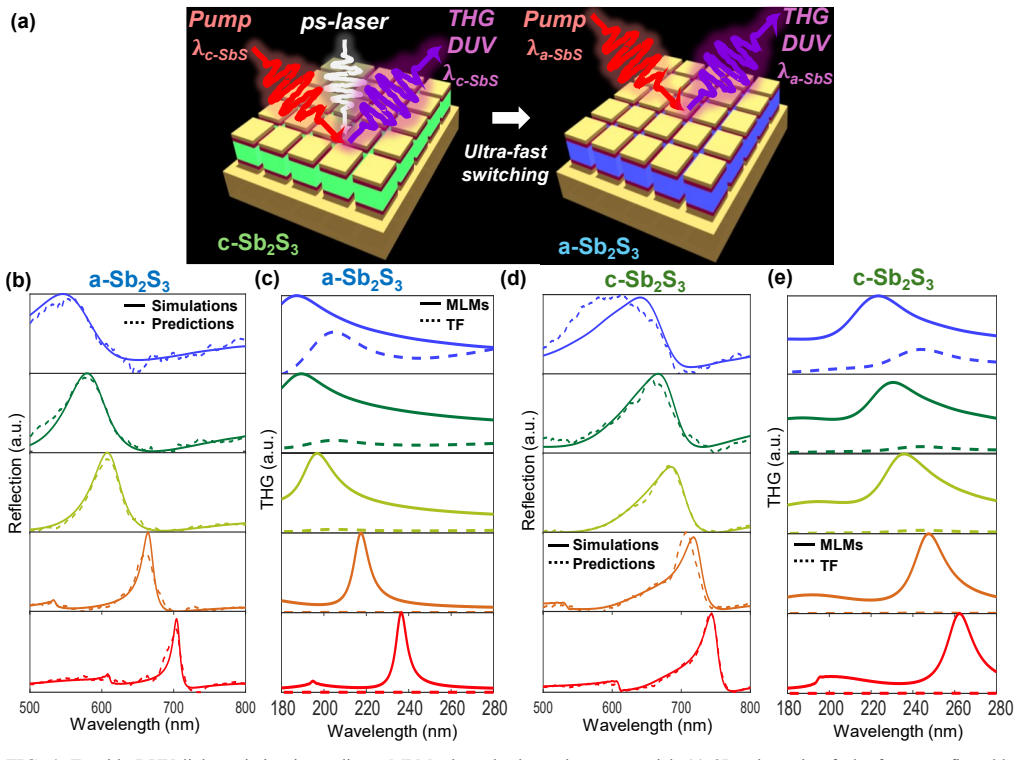
On the paper's own terms, the discovery is that the nonlinear response of a multilayer metasurface can be optimized through a learned image-to-spectrum map instead of repeated full-wave simulations. Each meta-atom is encoded as a $50\times181$ grayscale refractive-index image; convolutional layers extract spatial shape features, an LSTM processes the spectral sequence, and the network returns a 1000-point reflection spectrum. Trained on 10,836 FDTD simulations, the model predicts unseen designs to better than 98.3% accuracy and is fast enough to sweep the lattice period from 230 nm to 380 nm while holding the width-to-period ratio at 0.5. The paper reports that the resulting five-layer SiO2/ZnO/a-Si stack reaches quality factors above 50 and produces calculated third-harmonic output across 200–260 nm, with up to 500-fold enhancement over an unstructured thin film, and that Sb2S3-based stacks give roughly 1 nW and 400 nW of calculated THG at 1 mW pump in the amorphous and crystalline states, with 20 nm of spectral tuning. These THG values come from Equations 4–6, which convert absorbed linear power into harmonic power using the material's $\chi^{(3)}$; they are not measured results.
Load-bearing premise
The absolute THG powers and the resulting 200–260 nm and 20 nm tuning claims rest on Equations 5 and 6, which convert absorbed linear power into third-harmonic output; Equation 6 is stated without derivation or citation, Equation 5 as written does not have power units, and the paper never explains how the network's reflection prediction yields the internal electric-field intensity used in these integrals.
Editorial extensions
If this is right
- Full-wave FDTD optimization of multilayer metasurfaces can be replaced by a surrogate search, with expensive simulations reserved for final verification.
- A single trained model covers many materials and a broad span of period, width, and layer-count parameters, so new spectral targets require retraining on only a small dataset.
- The period-sweep strategy yields a family of cavities whose computed THG spans 200–260 nm, offering a route to compact DUV sources at selected wavelengths.
- Phase-change Sb2S3 cores add a reconfiguration mechanism, so one cavity can shift its DUV output by 20 nm rather than needing a new design.
Reading between the lines
- The same image-to-spectrum surrogate strategy should transfer to other multilayer response targets, such as transmission, absorption, phase, or second-harmonic generation, since the learned map is not specific to THG; this is my editorial extension.
- If the calculated nW-level powers survive direct measurement, a single metasurface could become a practical DUV seed source for bioimaging and lithography, a consequence the paper states only as motivation.
- A natural extension the paper leaves untested is training the network to also output internal field-intensity distributions; that would make the THG chain more direct than deriving it from reflection predictions through Equations 4–6.
Signed reviews
Editorial analysis
A structured set of objections, weighed in public.
Referee Report
Summary. The manuscript presents NanoPhotoNet-NL, a hybrid CNN-LSTM surrogate model trained on FDTD reflection spectra to accelerate the design of multilayer metasurfaces (MLMs). The authors claim four-orders-of-magnitude speedup, >98.3% prediction accuracy, and optimized MLMs with Q-factors above 50 that produce broadband third-harmonic generation (THG) in the deep ultraviolet (200–260 nm), including tunable emission via the phase-change material Sb2S3. The THG powers and enhancements are computed from Eqs. (4)–(6), which convert absorbed linear power into third-harmonic output.
Significance. If the THG results were valid, an AI-optimized, tunable DUV source would be a valuable contribution to nonlinear nanophotonics. The reflection surrogate itself appears to be trained and evaluated without circularity: the network is trained on FDTD labels and compared against held-out FDTD simulations, and the reported accuracy is a legitimate machine-learning result. However, the paper's central claim—the generation of 1.02 nW / 400 nW DUV THG from the optimized MLMs—rests on Eqs. (5) and (6), which are not derived, not cited, and dimensionally inconsistent as printed. The neural network also predicts only reflection spectra, so it cannot supply the internal electric fields required by the volume integrals in Eqs. (4)–(5). These issues are load-bearing: without a corrected and validated nonlinear model, the headline DUV emission results are unsupported.
major comments (3)
- [Section 2, Eqs. (5)–(6)] The THG power formulas are dimensionally inconsistent and are stated without derivation or citation. Equation (5), P_THG(3ω) = 3ε0 ∫ χ^(3) (E·E)E dV, has the units of an electric dipole moment (C·m), not power (W); a time derivative or radiation term is missing. Equation (6) combines l [m], χ^(3)^2 [m^4/V^4], ε0^2 [C^2/(V^2·m^2)], c^2 [m^2/s^2], λ^2 [m^2], ω0^4 [s^-4] or [m^4] if ω0 is the beam waist, and [∫ P_abs(ω)/ω]^3 [J^3]; the product does not reduce to watts. Because the absolute powers (1.02 nW, 400 nW), the enhancement factors (500×, 790×), and the 200–260 nm DUV emission range all depend on these equations, the central quantitative claims are not supported by the formulas as printed.
- [Section 2, Eqs. (4)–(6) and Fig. 3] The neural network is trained exclusively on 1000-point reflection spectra, so it has no learned representation of the internal electric-field distribution E(r,ω). Equations (4) and (5) require volume integrals of |E|^2 and E^3 inside the multilayer stack, but the manuscript never explains how the predicted R(λ) is converted into E(r,ω), nor does it state whether the THG calculation uses FDTD-obtained fields for the selected designs. Without a defined route from the network output to the fields in these integrals, the 'AI-optimized' THG results cannot be reproduced or independently verified.
- [Section 3.1 and 3.2] The THG power calibration is not established. The text states that the TF Sb2S3 THG output was 'calibrated against literature' (Ref. 40), but no numerical values are given for the interaction length l, the third-order susceptibility χ^(3), the refractive indices n_ω and n_3ω, or the beam waist ω0, and Eq. (6) is not a standard formula for THG power from absorbed fundamental power. The absence of both a derivation and a reproducible calibration makes the reported absolute powers and the 20 nm tuning range uncheckable.
minor comments (5)
- [Abstract] The abstract contains a typo: 'CNLs' should read 'CNNs' in the phrase 'synergizes convolutional neural networks (CNLs) and Long Short-Term Memory (LSTM) models.'
- [Section 2, Eq. (4)] Equation (4) is written with a minus sign; for a passive material with ε'' > 0, the absorbed power should be positive, so the sign convention needs an explicit explanation or a corrected sign.
- [Section 2, Eq. (6)] The symbol ω0 is called 'beam waist' in the text but is conventionally used for angular frequency; this ambiguity must be resolved because the units of ω0^4 differ by orders of magnitude between the two interpretations.
- [Section 3.1] The claim that a-Si supports 'interband plasmon transitions in the DUV, which enhances THG through surface plasmon-induced field confinement' is unsupported; amorphous silicon is not a plasmonic material in this context, and no such transition is quantified.
- [Table 2] Table 2 compares accuracy values of different networks trained on different datasets, which is not a meaningful benchmark; the table formatting also makes the references unclear (e.g., 'DNN 41 86' should be 'DNN [41] 86').
Circularity Check
No significant circularity: the surrogate's accuracy is judged against held-out FDTD simulations, and the THG numbers come from an unvalidated formula rather than being equivalent to the network's labels.
full rationale
NanoPhotoNet-NL is trained on FDTD-computed reflection spectra, and the claimed >98.3% accuracy is measured on a held-out 15% test split of the same simulation dataset; this is standard surrogate-model validation and is not circular. The DUV THG output is not a direct network prediction: Sec. 2 states that the DUV THG response was 'calculated using Equation 5' and that total THG power is 'calculated using equation 6'. Equations 5 and 6 are not derived in the paper and are dimensionally inconsistent as written, but a dimensional or unvalidated formula is a correctness/support gap, not an input-output equivalence. The paper's self-citations (refs. 28-31) provide motivation and prior benchmarks; for instance, ref. 30 is cited for the a-Si DUV interband-plasmon enhancement mechanism, but the numerical THG enhancement is computed from the same Equations 5 and 6 for both MLM and thin-film structures, so the 500-fold and 790-fold ratios do not reduce to that self-cited result. External benchmarks (refs. 39 and 40) are used for calibration and comparison. I therefore find no circular step; the load-bearing weakness is the unvalidated THG conversion chain, which is a correctness concern outside circularity.
Assumptions & free parameters
free parameters (2)
- Neural network architecture hyperparameters (CNN channels, LSTM units, FCNN size, learning rate) =
32/64/128, 32, 2000, 1e-3
- Data split and normalization =
70/15/15, min-max to [0,1]
assumptions (4)
- domain assumption FDTD with a 10 nm mesh accurately models the reflection spectra of the multilayer metasurfaces.
- ad hoc to paper The total THG power can be computed from Eq. 6 using the spectral absorbed power.
- ad hoc to paper The trained reflection surrogate provides enough information to determine the internal field intensity or absorbed power for the THG integrals.
- domain assumption Material parameters (chi^(3) of a-Si and Sb2S3, refractive indices) from cited literature are accurate at the operating wavelengths.
Cite this review
Pith. "Pith review of Broadband Tunable Deep-UV Emission from AI-Optimized Nonlinear Metasurface Architectures." pith.science (2026). https://pith.science/paper/4JGQ2KYL
@misc{pith2026250610442,
  author       = {Pith},
  title        = {Pith review of: Broadband Tunable Deep-UV Emission from AI-Optimized Nonlinear Metasurface Architectures},
  year         = {2026},
  howpublished = {\url{https://pith.science/paper/4JGQ2KYL}},
  note         = {Machine review of arXiv:2506.10442}
}
read the original abstract
Metasurfaces represent a pivotal advancement in nonlinear optics, leveraging high-Q resonant cavities to enhance harmonic generation. Multi-layer metasurfaces (MLMs) further amplify this potential by intensifying light-matter interactions within individual meta-atoms at the nanoscale. However, maximizing nonlinear efficiency demands extreme field confinement through optimized designs of large geometric and material parameters, which exceed traditional simulation's computational ability. To overcome this, we introduce NanoPhotoNet-NL, an AI-driven design tool employing a hybrid deep neural network (DNN) that synergizes convolutional neural networks (CNNs) and Long Short-Term Memory (LSTM) models. This framework accelerates nonlinear MLM design speed by four orders of magnitude while maintaining over 98.3% prediction accuracy relative to physical simulators. The optimized MLMs achieve quality factors exceeding 50, enabling broadband third-harmonic generation (THG) in the deep ultraviolet (DUV) from wavelengths 200 nm to 260 nm via parametric sweeps. Furthermore, NanoPhotoNet-NL facilitates dynamically tunable DUV nanolight sources with 20 nm spectral coverage in the UVC band using low-loss nonlinear phase change materials. This work marks a transformative leap in nonlinear metasurface engineering, unlocking high-performance, reconfigurable platforms for nonlinear and quantum optical nanodevices.
Figures


Figures from the paper (2 more)

Forward citations
Cited by 1 Pith paper
-
Illuminating the Future: Nanophotonics for Future Green Technologies, Precision Healthcare, and Optical Computing
A broad survey of nanophotonics applications claiming transformative potential in green energy, healthcare, and computing, with no new experimental results.
Reference graph
Works this paper leans on
-
[1]
A.; Wang, Z.; Liu, H.; Dong, Z.; Wang, Q.; Ye, M.; Wang, X
(1) Abdelraouf, O. A.; Wang, Z.; Liu, H.; Dong, Z.; Wang, Q.; Ye, M.; Wang, X. R.; Wang, Q. J.; Liu, H. Recent advances in tunable metasurfaces: materials, design, and applications. ACS nano 2022, 16 (9), 13339-13369. (2) Abdelraouf, O. A.; Wu, M.; Liu, H. Hybrid Metasurfaces Enabling Focused Tunable Amplified Photoluminescence Through Dual Bound States i...
work page 2022
-
[3]
(30) Abdelraouf, O. A.; Anthur, A. P.; Wang, X. R.; Wang, Q. J.; Liu, H. Modal phase -matched bound states in the continuum for enhancing third harmonic generation of deep ultraviolet emission. ACS nano 2024, 18 (5), 4388-4397. (31) Abdelraouf, O. A.; Mousa, A.; Ragab, M. NanoPhotoNet: AI -Enhanced Design Tool for Reconfigurable and High -Performance Mult...
work page 2024
-
[4]
(25) Huang, L.; Xu, L.; Woolley, M.; Miroshnichenko, A. E. Trends in quantum nanophotonics. Advanced quantum technologies 2020, 3 (4), 1900126. (26) Xavier, J.; Yu, D.; Jones, C.; Zossimova, E.; Vollmer, F. Quantum nanophotonic and nanoplasmonic sensing: towards quantum optical bioscience laboratories on chip. Nanophotonics 2021, 10 (5), 1387-
work page 2020
-
[174]
(15) Abdelraouf, O. A.; Shaker, A.; Allam, N. K. All dielectric and plasmonic cross -grating metasurface for efficient perovskite solar cells. In Metamaterials Xi, 2018; SPIE: Vol. 10671, pp 104-112. (16) Abdelraouf, O. A.; Shaker, A.; Allam, N. K. Using all dielectric and plasmonic cross grating metasurface for enhancing efficiency of CZTS solar cells. I...
arXiv 2018
-
[1435]
(27) Minovich, A. E.; Miroshnichenko, A. E.; Bykov, A. Y.; Murzina, T. V.; Neshev, D. N.; Kivshar, Y. S. Functional and nonlinear optical metasurfaces. Laser & Photonics Reviews 2015, 9 (2), 195-213. (28) Abdelraouf, O. A.; Anthur, A. P.; Dong, Z.; Liu, H.; Wang, Q.; Krivitsky, L.; Renshaw Wang, X.; Wang, Q. J.; Liu, H. Multistate tuning of third harmonic...
work page 2015
-
[2025]
(23) Smirnova, D.; Kivshar, Y. S. Multipolar nonlinear nanophotonics. Optica 2016, 3 (11), 1241-1255. (24) Abdelraouf, O. A. Electrically Reconfigurable NbOCl $ _2 $ Metasurface for Quantum Technologies. arXiv preprint arXiv:2505.03341
work page Pith review arXiv 2016
Reviewed August 7, 2026 · model on record in the stance chip above.
Discussion (0). Continue with ORCID to comment.