REVIEW 4 major objections 4 minor 37 references
The Legendrian Whitney trick
T0 review · 4 major / 4 minor · reviewed 2026-08-14 · deepseek-v4-flash
Pith's one-line read The paper establishes a Legendrian Whitney trick: standard contact disks can be slid off standard Legendrian spheres by compactly supported contact isotopies, and this yields the existence h-principle for codimension-two isocontact…
desk verdict The Legendrian Whitney trick is a plausible and genuinely new idea, but the paper's second half leans on unproven assertions—Lemma 6, Proposition 11, and Lemma 10—so the h-principle application is not yet established as written. read the letter →
The pith
A machine-rendered reading of the paper's core claim, the machinery that carries it, and where it could break.
The reading
What carries the argument
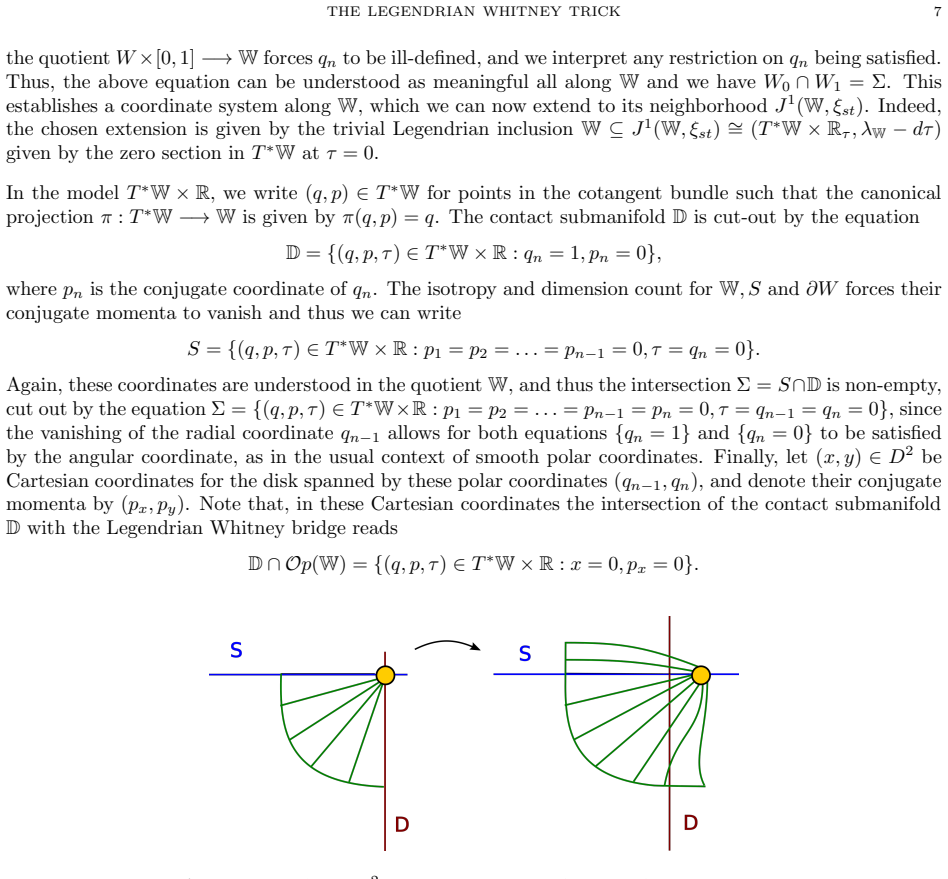
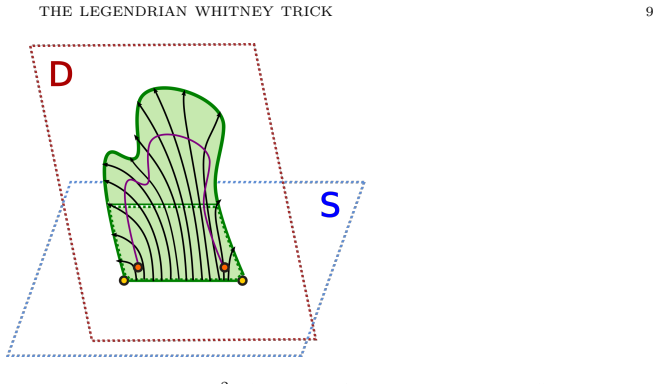
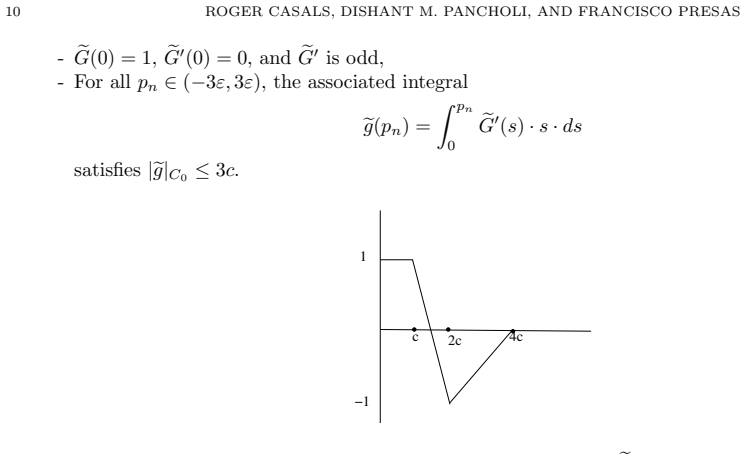
The load-bearing object is the Legendrian Whitney bridge: a Legendrian embedding $\psi:W\times[0,1]\to(M,\xi)$ (or a quotient version $\overline{W}$) whose lower and upper ends are isotropic embeddings into the Legendrian sphere $S$ and the contact submanifold $D$, whose boundary over $\partial W$ is exactly the intersection $\Sigma=S\cap D$, and whose interior avoids both submanifolds. It plays the role of the Whitney disk: the sphere is slid along it by a compactly supported contact vector field, equivalently a contact Hamiltonian, so that the intersection is pushed off the disk and no new intersection is created. The bridge is first built as a smooth embedding, using the smooth embedding theorem and transversality, and then converted into a Legendrian embedding through the h-principle for Legendrian immersions; the local computation is carried out in the 1-jet model $J^1(W,\xi_{\mathrm{st}})$, where the contact disk is cut out by $\{x=0,p_x=0\}$, the sphere is the zero section, and the sliding flow is cut off carefully in the conjugate momentum $p_n$ to keep the support compact.
What would settle it
Find a standard embedding of $S^n$ into $S^1\times B^{2n}$ ($n\ge 2$) whose projection to $B^{2n}$ cannot be made, by adding finitely many kinks, to have only paired self-intersections of opposite sign, or whose Whitney-disk sliding cannot be lifted to an embedding in $S^1\times B^{2n}$ without creating a new self-intersection; such an example would falsify Proposition 11 and remove the load-bearing step of Theorem 8.
Extended reading notes
Core claim
For $n\ge 2$, let $\varphi:(D^{2n-1},\xi_{\mathrm{st}})\to(B,\xi)$ be a proper isocontact embedding of the standard contact disk and $\lambda:S^n\to(B,\xi)$ a Legendrian embedding, both smoothly standard—that is, smoothly isotopic to the linear inclusions described in the introduction. Theorem 1 asserts that there is a compactly supported family of isocontact embeddings starting at $\varphi$ whose final image is disjoint from $\lambda$. The proof constructs the intersection $\Sigma=S^n\cap D^{2n-1}$, fills it with an $(n-1)$-dimensional manifold $W$ whose boundary is $\Sigma$, and builds a Legendrian Whitney bridge $F:\overline{W}\to B$; a cut-off contact Hamiltonian flow slides $S^n$ along the bridge until it clears $D^{2n-1}$. Theorem 2 draws the h-principle consequence: every formal isocontact embedding $(f_0,F_s^0):(N,\xi_N)\to(M,\xi_M)$ with $\dim M=\dim N+2\ge 5$ is deformable, through formal isocontact embeddings, to a genuine isocontact embedding $(f_1,df_1)$. Here 'formal' means the embedding is augmented by a fiberwise linear map covering it and restricting to the differential on the contact distribution; such data is the algebraic shadow that a genuine isocontact embedding would carry. In the paper's own terms, this resolves the existence problem for codimension-two contact embeddings with prescribed contact structure.
Load-bearing premise
The proof's Proposition 11 assumes that a standard $n$-sphere in $S^1\times B^{2n}$ can be arranged, after adding finitely many small loops (kinks), so that its projected immersion into $B^{2n}$ has all self-intersection points paired with opposite sign, and that the Whitney-disk sliding can be lifted to an isotopy of the embedding in $S^1\times B^{2n}$; this connectivity of the embedding space is asserted without proof, and Theorem 8's h-principle argument depends on it through Lemma 10.
Editorial extensions
If this is right
- In contact manifolds of dimension at least five, a standard contact disk and a standard Legendrian sphere admit no contact intersection obstruction beyond the smooth one: smooth cancellations become contact cancellations.
- The existence h-principle for codimension-two isocontact embeddings holds: any formal isocontact embedding is formally homotopic to a genuine one, so the only obstructions to realizing a contact submanifold are algebraic-topological.
- Together with the h-principle for higher-codimension smooth submanifolds, the result completes the existence h-principle for isocontact submanifolds in every codimension.
- The dimensional hypothesis $n\ge 2$ is essential: in the 3-dimensional case the conclusion can fail without changing the self-linking number, so the gap between smooth and contact topology persists in low dimensions.
Reading between the lines
- Editorial extension: the bridge construction is local and uses only the Legendrian h-principle, so the same removal argument should transplant from the standard ball to any contact manifold in which both the contact disk and the Legendrian sphere pass through a common Darboux chart.
- Editorial extension: a parametric version of the Legendrian Whitney trick—sliding a whole family of contact disks off one Legendrian sphere simultaneously—would give a direct route to relative and classification h-principles; the paper only uses a light one-parameter version inside Lemma 10.
- Editorial extension: if the Whitney-bridge sliding survives in non-simply connected ambient manifolds, the overtwisted-disk insertion in Theorem 8 could be bypassed or weakened, since the paper invokes it only to obtain a genuine isocontact embedding and then removes its intersection with the Legendrian page.
Signed reviews
Editorial analysis
A structured set of objections, weighed in public.
Referee Report
Summary. The manuscript proves a 'Legendrian Whitney trick' (Theorem 1): in a standard contact ball of dimension 2n+1, n≥2, a properly embedded standard contact disk and a standard Legendrian n-sphere that are smoothly standard can be made disjoint by a compactly supported contact isotopy. It then uses this theorem to prove an existence h-principle (Theorem 2) for codimension-two isocontact embeddings with a prescribed contact structure, passing through a local version (Theorem 8) and an overtwisted-disk insertion argument. The main new ingredients are a Legendrian Whitney bridge (Proposition 3), a modified bridge (Lemma 6), and a connectedness statement for embeddings of S^n into S^1×B^{2n} (Proposition 11). The paper is clearly organized and the overall strategy is plausible, but several load-bearing steps are only sketched or asserted without proof.
Significance. If the results are correct, they would establish an important new flexibility phenomenon in high-dimensional contact topology: the removal of intersections between Legendrian and contact submanifolds whenever a smooth cancellation exists, and the existence of codimension-two isocontact embeddings in every formal class in dimension at least five. This would complement the rigidity results of Casals–Murphy–Presas and answer a natural existence question. The manuscript is well written and the strategy—combining standard h-principles, contact Hamiltonians, the smooth Whitney trick, and Haefliger's connectivity theorem—is attractive. However, the proofs of Proposition 11, Lemma 6, and parts of Proposition 3 are incomplete, and these are load-bearing for the main theorems. The paper is therefore not yet ready for publication in its present form.
major comments (4)
- [Section 3.2, Proposition 11] The proof of Proposition 11 is not self-contained and leaves central topological steps unproved. Specifically: (i) the claim that after genericity and 'possibly adding a finite number of kinks' the projection π∘e has all self-intersection points paired (zero algebraic self-intersection) is asserted without a construction or a justification that kinks can change the pairing to zero; (ii) the existence of a lift ~d of the Whitney disk d to S^1×B^{2n} with the stated intersection properties is not established, because lifting requires a consistent choice of the S^1-coordinate over a 2-cell whose boundary arcs lie on two different sheets, and the vertical (S^1) component must be interpolated without reintroducing self-intersections; (iii) the assertion that the Whitney-move isotopy of the immersed projection lifts to an isotopy of the embedding e is likewise unsupported. Since Lemma 10 invokes Proposition 11 to deform the family φ_t while fixing endpoints, and Theorem 8 depends on Lemma 10, the proof of Theorem 2 collapses unless Proposition 11 is proved in full detail.
- [Section 2.3.2, Lemma 6] The proof of Lemma 6 does not establish the crucial inequalities in part (e). It states that items (a)–(d) are 'proven similarly as Proposition 3' and that the strict inequalities ∂_{q_{n-1}}x > 0 and ∂_{q_n}x > 0 'can be ensured' because the initial e satisfies non-strict inequalities globally; no construction of the extension e with strict positivity is given. These inequalities are used in Lemma 7 (and hence in the displacement argument in §2.3.3) to conclude that p_x ≠ 0 when x = 0 and p_n ≠ 0. Without a proof of Lemma 6(e), the proof of Theorem 1 is incomplete at this point.
- [Section 2.2, Proposition 3, conditions (a)–(c)] The proof of Proposition 3 asserts that the formal isotropic embedding (φ,G) can be chosen to satisfy conditions (a)–(c). Condition (c) is justified by the deformation retraction of W×[0,1] to (W×[0,ε])∪(C_Σ×[0,1]), and condition (b) is merely stated; the proof does not show how the Lagrangian subbundle G_t(TW⊕{0}) is extended over the rest of W×[0,1] while preserving conditions (a) and (b). Since Proposition 3 constructs the Legendrian Whitney bridge used in Theorem 1, this is a load-bearing gap.
- [Section 3.2, Lemma 10] The proof of Lemma 10 is a single sentence that invokes Proposition 11. Even if Proposition 11 were true, the conclusion of Lemma 10 requires a deformation of the entire family φ_t (not just of S_π) with both endpoint conditions φ_{0,s}=φ_0 and φ_{1,s}=φ_1 fixed for all s, and with the deformation relative to the boundary of the disk. Merely deforming S_π to a small sphere and precomposing does not automatically preserve these relative endpoint conditions. A relative/parametric version of the connectedness statement is needed, but none is stated or proved. The proof of Theorem 8 therefore remains incomplete even modulo Proposition 11.
minor comments (4)
- [Section 2.3.2, Lemma 6] The proof refers to item '(g)', but the statement of Lemma 6 lists items (a)–(f); additionally, item (f) is printed tautologically as 'e(W×{0})⊂e(W×{0})'. Please correct the reference and clarify the intended statement of item (f).
- [Section 3.2, Lemma 10 proof] The sentence 'Proposition 11, proven below, shows that the space of smoothly embedded n-spheres in B^{2n+1}∼=D^{2n-1} is connected' is confusing: the space in question should be the space of embeddings into S^1×B^{2n}, not into B^{2n+1} or D^{2n-1}. Please rephrase the relevant diffeomorphism statements.
- [Bibliography] Entry [34] contains a stray line 'C. R. Acad. Sci. Paris 232, (1951). 142–144.' that appears to belong to a separate reference; please remove or format it properly.
- [Proposition 11] The term 'standard embedding' is used in the statement of Proposition 11 without a definition; please define it (e.g., as the embedding that is isotopic to the standard inclusion into a slice {p}×B^{2n}).
Circularity Check
No significant circularity: the Legendrian Whitney trick and the isocontact h-principle are derived from standard h-principles and Whitney-type arguments, with self-citations to independent published results only.
full rationale
Walking the derivation chain: Theorem 1 is proved internally via Proposition 3 (construction of the Legendrian Whitney bridge), Lemma 6 (extension of the collar), and a direct contact-Hamiltonian computation in Section 2.3; no equation in that proof is defined in terms of the conclusion, and no parameter is fitted to the target intersection. Theorem 2 is then obtained from Theorem 8 by a standard h-principle reduction: insert an overtwisted disk, apply the external h-principles [3,11,12,21], move the embedding away with Lemma 9, use Theorem 1 to avoid the Legendrian sphere, and finish with Lemma 10 and Proposition 11. The only author-overlapping citation that is load-bearing is [7] (Casals–Murphy–Presas), used to assert that changing the monodromy in the adapted open book (T*S^n, lambda_st; tau^{-1}_{S^n}) yields an overtwisted contact structure. That is a published, externally checkable theorem, not an input equivalent to the present conclusion, so it is real evidence rather than circularity. The genuine weakness is a proof gap, not circularity: Proposition 11 asserts without proof that after adding finitely many kinks the projection of a standard sphere has all self-intersection points paired, and that the Whitney disk sliding can be lifted to an isotopy of the embedding in S^1 x B^{2n}; this is load-bearing for Lemma 10 and hence for Theorem 8, but it is an omitted justification, not a reduction of a conclusion to its own input. No fitted quantity is relabelled as a prediction, no known result is merely renamed, and no uniqueness theorem is imported from the authors' prior work to force a choice. Therefore the circularity score is 0.
Assumptions & free parameters
free parameters (1)
- Smallness constants ε, c, δ and cut-off functions =
Arbitrarily small positive reals; no fixed values
assumptions (5)
- standard math Standard theorems used as black boxes: Whitney embedding theorem, smooth Whitney trick, Thom transversality, Gromov's h-principle for Legendrian immersions, Borman-Eliashberg-Murphy h-principle for overtwisted contact manifolds [3], Gray's stability, Moser's stability, Haefliger's theorem on…
- standard math The space of standard embeddings of S^n into B^{2n+1} is connected for n≥2 (Haefliger [22]).
- domain assumption The monodromy change τ_{S^n} to τ^{-1}_{S^n} in the adapted open book produces an overtwisted contact structure (proven in [7]).
- ad hoc to paper After genericity and possibly adding a finite number of kinks, the projected smooth map π∘e : S^n -> B^{2n} can be assumed to be a generic immersion with all self-intersection points paired.
- ad hoc to paper The formal isotropic embedding (φ,G) of W×[0,1] can be chosen satisfying conditions (a)-(c) in Section 2.2, particularly that G_t(TW⊕{0}) is a Lagrangian subspace of V_t.
Cite this review
Pith. "Pith review of The Legendrian Whitney trick." pith.science (2026). https://pith.science/paper/4JR42CBC
@misc{pith2026190804828,
  author       = {Pith},
  title        = {Pith review of: The Legendrian Whitney trick},
  year         = {2026},
  howpublished = {\url{https://pith.science/paper/4JR42CBC}},
  note         = {Machine review of arXiv:1908.04828}
}
read the original abstract
In this article, we prove a Legendrian Whitney trick which allows for the removal of intersections between codimension-two contact submanifolds and Legendrian submanifolds, assuming such a smooth cancellation is possible. This technique is applied to show the existence h-principle for codimension-two contact embeddings with a prescribed contact structure.
Figures

Figures from the paper (1 more)
Reference graph
Works this paper leans on
-
[32]
Iso-contact embeddings of manifolds in co-dimension $2$
D. Pancholi, S. Pandit, Iso–contact embeddings of manifolds in co–dimension 2. arXiv:1808.04059
- [27]
-
[1]
V. I. Arnold, S. M. Gusein-Zade, A. N. Varchenko. Singularities of Differentiable Maps. Volume I. Birkh¨ auser, Boston, Basel, Sttutgart. 1985
work page 1985
- [2]
- [3]
-
[4]
Non-simplicity of isocontact embeddings in all higher dimensions
R. Casals, J.B. Etnyre, Non-simplicity of isocontact embeddings in all higher dimensions, arXiv:1811.05455
-
[5]
R. Casals, J.L. P´ erez, A. del Pino, F. Presas, Existence h-principle for Engel structures, Invent. Math. Volume 210, Issue 2, (2017) 417-451
work page 2017
- [6]
Show all 37 references
-
[7]
Casals, E
R. Casals, E. Murphy, F. Presas, Geometric criteria for overtwistedness , J. Amer. Math. Soc. 32 (2019), no. 2, 563–604
2019
-
[8]
Casson, ”Three lectures on new infinite constructions in 4-dimensional manifolds” , A la Recherche de la Topologie Perdue , Progress in Mathematics , 62 , Birkh¨ auser (1986) pp
A. Casson, ”Three lectures on new infinite constructions in 4-dimensional manifolds” , A la Recherche de la Topologie Perdue , Progress in Mathematics , 62 , Birkh¨ auser (1986) pp. 201-244
1986
-
[9]
Chekanov
Y. Chekanov. Differential algebra of Legendrian links. Invent. Math. 150 (2002), no. 3, 441–483
2002
-
[10]
Colin, Livres ouverts en g´ eom´ etrie de contact, Ast´ erisque, S´ eminaire Bourbaki 59` eme ann´ ee, 2006-2007, 969, 91-118
V. Colin, Livres ouverts en g´ eom´ etrie de contact, Ast´ erisque, S´ eminaire Bourbaki 59` eme ann´ ee, 2006-2007, 969, 91-118
2006
-
[11]
Eliashberg, Classification of overtwisted contact structures on 3-manifolds, Invent
Ya. Eliashberg, Classification of overtwisted contact structures on 3-manifolds, Invent. Math. 98 (1989), 623–637
1989
-
[12]
Eliashberg, N
Y. Eliashberg, N. Mishachev, Introduction to the h–Principle. Grad. Studies in Math. 48. AMS, Providence 2002
2002
-
[13]
Eliahsberg, N
Y. Eliahsberg, N. Mishachev, Wrinkling of smooth mappings and its applications, Inven. Math. 130 (1997), 345-369
1997
-
[14]
J. Etnyre. Legendrian and transversal knots. Handbook of knot theory, 105–185, Elsevier B. V., Amsterdam, 2005
2005
-
[15]
Etnyre, R
J. Etnyre, R. Furukawa, Braided embeddings of contact 3-manifolds in the standard contact 5-sphere. J. Topol. 10 (2017), no. 2, 412—446
2017
-
[16]
Etnyre, Y
J. Etnyre, Y. Lekili, Embedding all contact 3–manifolds in a fixed contact 5–manifold, to appear in Journal of the LMS
-
[17]
Freedman, ”The topology of four-dimensional manifolds”, J
M. Freedman, ”The topology of four-dimensional manifolds”, J. Diff. Geom. , 17 (1982) pp. 357-453
1982
-
[18]
Fuchs, S
D. Fuchs, S. Tabachnikov. Invariants of Legendrian and transverse knots in the standard contact space. Topology 36 (1997), no. 5, 1025–1053
1997
-
[19]
H. Geiges. An Introduction to Contact Topology. Cambr. Studies in Adv. Math. 109. Cambr. Univ. Press 2008
2008
-
[20]
Goodwillie, T. G. A multiple disjunction lemma for smooth concordance embeddings. Mem. Amer. Math. Soc. 86 (1990), no. 431
1990
-
[21]
Gromov, Partial differential relations
M. Gromov, Partial differential relations. Ergebnisse der Mathematik und ihrer Grenzgebiete (3) [Results in Mathematics and Related Areas (3)], Vol. 9, Springer-Verlag, Berlin
-
[22]
Haefliger, Andr´ e,Differentiable imbeddings. Bull. Amer. Math. Soc. 67 1961 109–112
1961
-
[23]
Haefliger, Andr´ e,Knotted (4k− 1)–spheres in 6k-space. Ann. of Math. (2) 75 1962 452–466
1962
-
[24]
A. Hatcher. Algebraic topology. Cambridge University Press, Cambridge, 2002
2002
-
[25]
Hatcher, Topological moduli spaces of knots, available at A
A. Hatcher, Topological moduli spaces of knots, available at A. Hatcher’s website (see also arXiv:math/9909095)
-
[26]
Honda, On the classification of tight contact structures
K. Honda, On the classification of tight contact structures. I. Geom. Topol. 4:309-368, 200
-
[28]
R. Kirby. The Whitney trick , Celebratio Mathematica
-
[29]
Lazarev Maximal contact and symplectic structures , arXiv:1810.11728
O. Lazarev Maximal contact and symplectic structures , arXiv:1810.11728
-
[30]
An analogue of the Whitney trick
Mabillard, Isaac; Wagner, Uli; Eliminating Tverberg points, I. An analogue of the Whitney trick . Computational geom- etry (SoCG’14), 171–180, ACM, New York, 2014
2014
-
[31]
Milnor, Lectures on the h-cobordism Theorem, Princeton University Press (1965), Princeton
J. Milnor, Lectures on the h-cobordism Theorem, Princeton University Press (1965), Princeton
1965
-
[33]
Shapiro, Obstructions to the Imbedding of a Complex in a Euclidean Space.: I
A. Shapiro, Obstructions to the Imbedding of a Complex in a Euclidean Space.: I. The First Obstruction, Annals of Mathematics Second Series, Vol. 66, No. 2 (Sep., 1957), pp. 256-269
1957
-
[34]
Smale, On the structure of manifolds, Amer
S. Smale, On the structure of manifolds, Amer. J. Math.84 (1962), 387-399. C. R. Acad. Sci. Paris 232, (1951). 142–144
1962
-
[35]
Vogel, Non-loose unknots, overtwisted discs, and the contact mapping class group of S3, Geom
T. Vogel, Non-loose unknots, overtwisted discs, and the contact mapping class group of S3, Geom. Funct. Anal. 28 (2018), no. 1, 228–288
2018
-
[36]
Whitney, Differentiable manifolds
H. Whitney, Differentiable manifolds. Ann. of Math. (2) 37 (1936), no. 3, 645-680
1936
-
[37]
Whitney, The self-intersections of a smooth n-manifold in 2n-space, Ann
H. Whitney, The self-intersections of a smooth n-manifold in 2n-space, Ann. Math. (2) 45 (April 1944), pp. 220-246. 16 ROGER CASALS, DISHANT M. PANCHOLI, AND FRANCISCO PRESAS University of California Davis, Dept. of Mathematics, Shields Avenue, Davis, CA 95616, USA E-mail addr...
1944
Reviewed August 14, 2026 · model on record in the stance chip above.
Discussion (0). Continue with ORCID to comment.