3DLS: A 3D Logic-Stacked Architecture for Disaggregated LLM Serving
Pith reviewed 2026-07-03 04:27 UTC · model grok-4.3
The pith
3D-stacked chiplets isolate KV-cache transfers vertically to cut contention in PD-disaggregated LLM serving.
A machine-rendered reading of the paper's core claim, the machinery that carries it, and where it could break.
Core claim
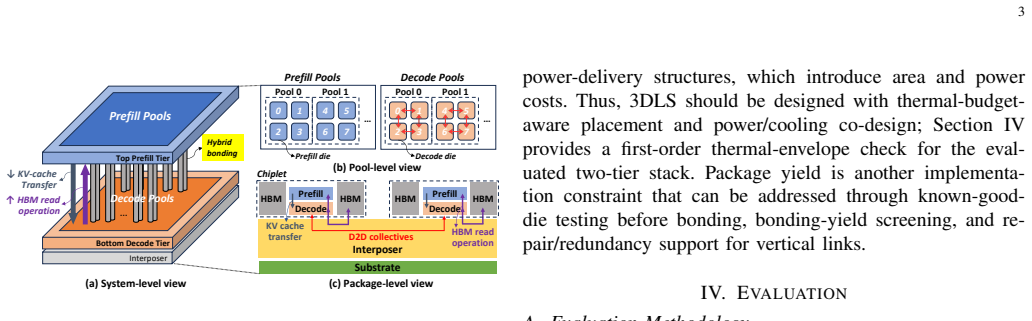
3DLS is a logic-on-logic 3D-stacked chiplet architecture that separates traffic classes by routing KV-cache transfers through vertical interconnects while preserving decode-side TP collectives on the lateral D2D fabric.
What carries the argument
logic-on-logic 3D-stacked chiplet that routes KV-cache transfers vertically to isolate them from lateral D2D TP collectives
If this is right
- Mixed-traffic contention on the decode critical path is removed, shortening token generation intervals.
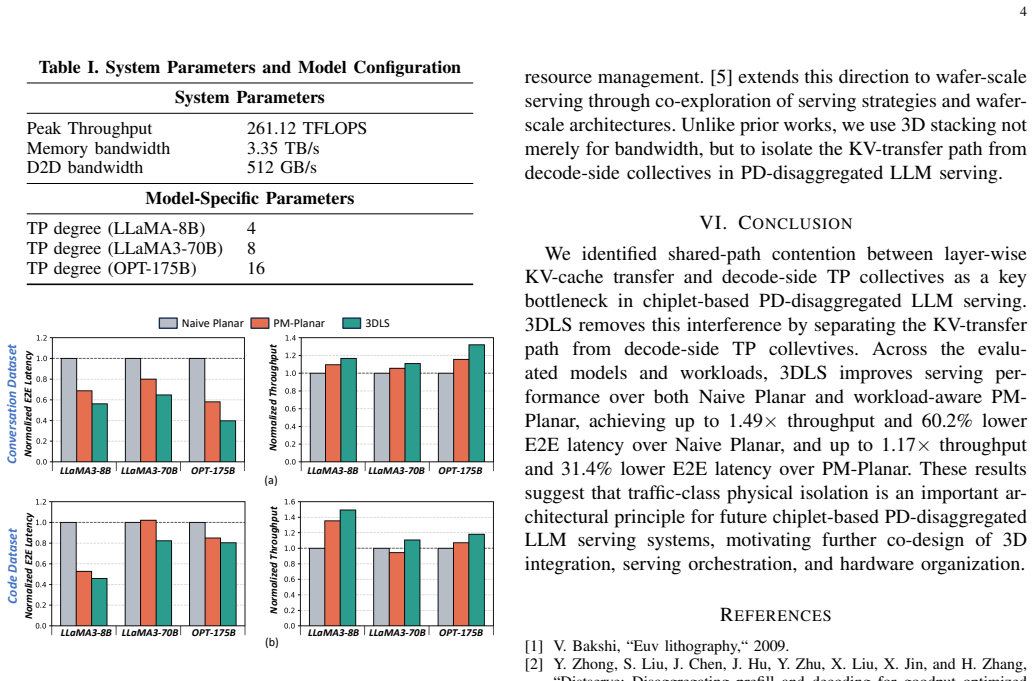
- Throughput improves by up to 1.49 times and end-to-end latency falls by up to 60.2 percent relative to an unprioritized planar baseline.
- Even against a workload-aware priority-managed planar baseline, throughput rises by up to 1.17 times and latency drops by 31.4 percent.
- Physical isolation of traffic classes becomes a first-order requirement for future chiplet-based PD-disaggregated serving systems.
Where Pith is reading between the lines
- The same vertical-lateral separation principle could apply to other multi-phase AI workloads that move large intermediate state across chip boundaries.
- If 3D stacking costs fall, designers may prefer hardware traffic isolation over increasingly complex software schedulers for latency-sensitive serving.
- Interconnect topologies in future multi-chip modules may need to be co-designed around the distinct latency requirements of KV-cache movement versus collective communication.
Load-bearing premise
Implementing vertical routing for KV-cache transfers in a logic-on-logic 3D-stacked chiplet is practical and does not introduce prohibitive manufacturing, thermal, or power challenges that would offset the reported latency benefits.
What would settle it
Fabrication and measurement of a 3DLS prototype whose thermal or power overheads exceed the 31-to-60 percent latency gains reported in simulation would falsify the claim that the architecture is practically beneficial.
Figures


read the original abstract
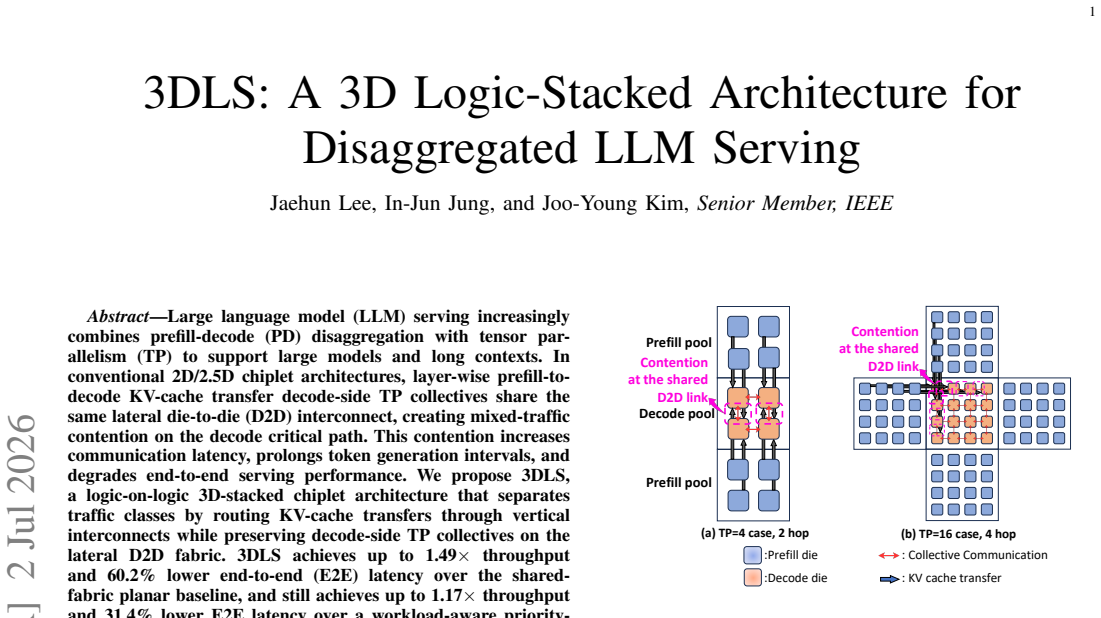
Large language model (LLM) serving increasingly combines prefill-decode (PD) disaggregation with tensor parallelism (TP) to support large models and long contexts. In conventional 2D/2.5D chiplet architectures, layer-wise prefill-to-decode KV-cache transfer decode-side TP collectives share the same lateral die-to-die (D2D) interconnect, creating mixed-traffic contention on the decode critical path. This contention increases communication latency, prolongs token generation intervals, and degrades end-to-end serving performance. We propose 3DLS, a logic-on-logic 3D-stacked chiplet architecture that separates traffic classes by routing KV-cache transfers through vertical interconnects while preserving decode-side TP collectives on the lateral D2D fabric. 3DLS achieves up to 1.49$\times$ throughput and 60.2\% lower end-to-end (E2E) latency over the shared-fabric planar baseline, and still achieves up to 1.17$\times$ throughput and 31.4\% lower E2E latency over a workload-aware priority-managed planar baseline. These results highlight that physical isolation is an important design principle for future chiplet-based PD-disaggregated LLM serving systems.
Editorial analysis
A structured set of objections, weighed in public.
Referee Report
Summary. The paper proposes 3DLS, a logic-on-logic 3D-stacked chiplet architecture for PD-disaggregated LLM serving with tensor parallelism. It argues that conventional 2D/2.5D planar chiplets suffer from mixed-traffic contention on lateral D2D interconnects when KV-cache transfers and decode-side TP collectives share the fabric. 3DLS routes KV-cache transfers vertically while keeping TP collectives lateral, claiming up to 1.49× throughput and 60.2% lower E2E latency versus a shared-fabric planar baseline, and 1.17× throughput / 31.4% lower E2E latency versus a workload-aware priority-managed planar baseline.
Significance. If the modeled gains hold under realistic 3D-stacking constraints, the work would establish physical traffic isolation as a useful design principle for future chiplet-based LLM serving systems. The simulation results provide a concrete quantitative case for separating traffic classes by interconnect dimension rather than solely by scheduling.
major comments (2)
- [evaluation / architecture sections] The headline performance claims (abstract and evaluation sections) rest on the premise that vertical KV-cache routing via 3D interconnects can be realized without thermal, power-delivery, or yield penalties large enough to offset the reported latency reductions. No TSV density estimates, thermal modeling, or power budgeting for the vertical fabric appear in the architecture description or evaluation sections, leaving the central feasibility assumption unvalidated.
- [results / baseline comparison] The comparison to the priority-managed planar baseline (abstract) shows smaller but still positive gains (1.17× / 31.4%). It is unclear from the workload assumptions and simulation setup whether these gains would persist once realistic vertical-interconnect overheads are included, which directly affects the strength of the claim that physical isolation is superior to software prioritization.
minor comments (2)
- [abstract] The abstract uses LaTeX formatting (1.49$\times$) that should be rendered consistently in the final manuscript.
- [architecture section] Notation for traffic classes (KV-cache vs. TP collectives) and interconnect types (vertical vs. lateral D2D) could be introduced with a small diagram or table early in the architecture section to improve readability.
Simulated Author's Rebuttal
We thank the referee for the constructive comments on our paper. We address each major comment below and outline the revisions we plan to make.
read point-by-point responses
-
Referee: [evaluation / architecture sections] The headline performance claims (abstract and evaluation sections) rest on the premise that vertical KV-cache routing via 3D interconnects can be realized without thermal, power-delivery, or yield penalties large enough to offset the reported latency reductions. No TSV density estimates, thermal modeling, or power budgeting for the vertical fabric appear in the architecture description or evaluation sections, leaving the central feasibility assumption unvalidated.
Authors: We agree that the manuscript does not include detailed thermal modeling, power budgeting, or TSV density estimates for the vertical interconnects. Our work focuses on demonstrating the performance advantages of physical traffic isolation through simulation, assuming the 3D stacking technology can support the required vertical bandwidth with reasonable overheads, as supported by prior 3D integration literature. To strengthen the paper, we will revise the architecture section to explicitly state these assumptions and add a discussion on potential thermal and power implications, citing relevant 3D-stacking studies. This will clarify the scope without changing the core results. revision: yes
-
Referee: [results / baseline comparison] The comparison to the priority-managed planar baseline (abstract) shows smaller but still positive gains (1.17× / 31.4%). It is unclear from the workload assumptions and simulation setup whether these gains would persist once realistic vertical-interconnect overheads are included, which directly affects the strength of the claim that physical isolation is superior to software prioritization.
Authors: The reported gains versus the priority-managed baseline are obtained under the modeled conditions where vertical interconnects incur no additional latency beyond the separation benefit. We acknowledge that realistic overheads from TSVs or 3D routing could diminish these gains. In the revised version, we will add a paragraph in the results section discussing the sensitivity to vertical interconnect overheads and note that the 1.17× improvement represents an upper bound under ideal 3D assumptions. This will better qualify the comparison to software-based prioritization. revision: yes
Circularity Check
No significant circularity: architectural proposal with simulation results
full rationale
The paper proposes a 3D-stacked chiplet architecture for LLM serving and reports simulation-based performance numbers (throughput and latency) against baselines. No equations, fitted parameters, predictions derived from inputs, or self-citation chains appear in the provided text or abstract. The central claims rest on modeled outcomes of the proposed separation of traffic classes via vertical interconnects, which are externally falsifiable via simulation or hardware and do not reduce to self-definition or renaming. This is the normal case of a self-contained systems paper.
Axiom & Free-Parameter Ledger
Reference graph
Works this paper leans on
- [1]
-
[2]
Distserve: Disaggregating prefill and decoding for goodput optimized large language model serving,
Y . Zhong, S. Liu, J. Chen, J. Hu, Y . Zhu, X. Liu, X. Jin, and H. Zhang, “Distserve: Disaggregating prefill and decoding for goodput optimized large language model serving,” in18th USENIX Symposium on Operating Systems Design and Implementation (OSDI 24), 2024, pp. 193–210
work page 2024
-
[3]
P/d-serve: Serving disaggregated large language model at scale,
Y . Jin, T. Wang, H. Lin, M. Song, P. Li, Y . Ma, Y . Shan, Z. Yuan, C. Li, Y . Sun et al., “P/d-serve: Serving disaggregated large language model at scale,”arXiv preprint arXiv:2408.08147, 2024
-
[4]
Megatron-LM: Training Multi-Billion Parameter Language Models Using Model Parallelism
M. Shoeybi, M. Patwary, R. Puri, P. LeGresley, J. Casper, and B. Catan- zaro, “Megatron-lm: Training multi-billion parameter language models using model parallelism,”arXiv preprint arXiv:1909.08053, 2019
work page internal anchor Pith review Pith/arXiv arXiv 1909
-
[5]
Wsc-llm: Efficient llm service and architecture co-exploration for wafer-scale chips,
Z. Xu, D. Kong, J. Liu, J. Li, J. Hou, X. Dai, C. Li, S. Wei, Y . Hu, and S. Yin, “Wsc-llm: Efficient llm service and architecture co-exploration for wafer-scale chips,” inProceedings of the 52nd Annual International Symposium on Computer Architecture, 2025, pp. 1–17
work page 2025
-
[6]
Pd constraint-aware physical/logical topology co-design for network on wafer,
Q. Yang, T. Wei, S. Guan, C. Li, H. Shang, J. Deng, H. Wang, C. Li, L. Wang, Y . Zhanget al., “Pd constraint-aware physical/logical topology co-design for network on wafer,” inProceedings of the 52nd Annual International Symposium on Computer Architecture, 2025, pp. 49–64
work page 2025
-
[7]
Splitwise: Efficient generative llm inference using phase splitting,
P. Patel, E. Choukse, C. Zhang, A. Shah, I. Goiri, S. Maleki, and R. Bianchini, “Splitwise: Efficient generative llm inference using phase splitting,” in2024 ACM/IEEE 51st Annual International Symposium on Computer Architecture (ISCA). IEEE, 2024, pp. 118–132
work page 2024
-
[8]
OPT: Open Pre-trained Transformer Language Models
S. Zhang, S. Roller, N. Goyal, M. Artetxe, M. Chen, S. Chen, C. Dewan, M. Diab, X. Li, X. V . Linet al., “Opt: Open pre-trained transformer language models,”arXiv preprint arXiv:2205.01068, 2022
work page internal anchor Pith review Pith/arXiv arXiv 2022
-
[9]
Microsoft, “Azure Public Dataset,” [Online]. Available: https://github.com/Azure/AzurePublicDataset, accessed: 2025-03-10
work page 2025
-
[10]
D. D. Sharma, “Ucie 3.0 specification: Driving innovation for efficient, scalable, and reliable chiplet integration,”White paper published by UCIe Consortium, 2025
work page 2025
-
[11]
Dojo: The microarchitecture of tesla’s exa-scale computer,
E. Talpes, D. Williams, and D. D. Sarma, “Dojo: The microarchitecture of tesla’s exa-scale computer,” in2022 IEEE Hot Chips 34 Symposium (HCS). IEEE, 2022, pp. 1–28
work page 2022
-
[12]
Y . Pan, Z. Xia, P.-K. Hsu, L. Hu, H. Kim, J. Sharda, M. Zhou, N. S. Kim, S. Yu, T. Rosinget al., “Stratum: System-hardware co-design with tiered monolithic 3d-stackable dram for efficient moe serving,” inProceedings of the 58th IEEE/ACM International Symposium on Microarchitecture, 2025, pp. 1–17
work page 2025
-
[13]
A. Grattafiori, A. Dubey, A. Jauhri, A. Pandey, A. Kadian, A. Al-Dahle, A. Letman, A. Mathur, A. Schelten, A. Vaughanet al., “The llama 3 herd of models,”arXiv preprint arXiv:2407.21783, 2024
work page internal anchor Pith review Pith/arXiv arXiv 2024
discussion (0)
Sign in with ORCID, Apple, or X to comment. Anyone can read and Pith papers without signing in.