REVIEW 2 major objections 4 minor 4 references
Random walk model from the point of view of algorithmic trading
T0 review · 2 major / 4 minor · reviewed 2026-08-14 · deepseek-v4-flash
Pith's one-line read In a random-walk market, no limit price beats trading immediately.
desk verdict The core no-optimal-level result is correct and is essentially optional stopping, but the paper's auxiliary variance and fill-probability formulas have parity errors that need fixing before they can be used as stated. read the letter →
The pith
A machine-rendered reading of the paper's core claim, the machinery that carries it, and where it could break.
The reading
What carries the argument
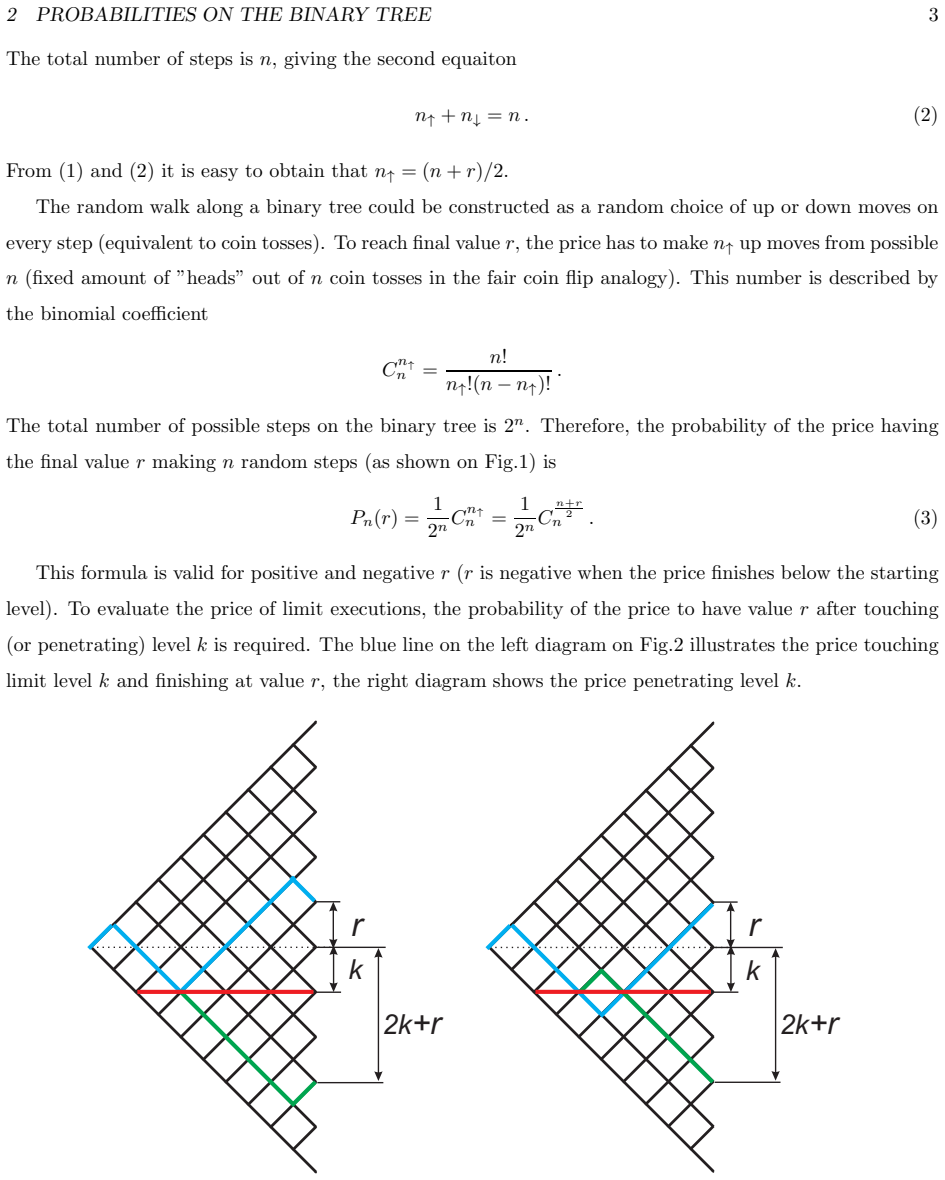
The load-bearing tool is the reflection principle on the binomial tree, borrowed from classical random-walk theory. For a walk starting at zero, the number of paths that touch level $k$ and end at $r$ equals the number of unrestricted paths ending at $2k+r$, because reflecting the part of the path after the first touch maps one set bijectively onto the other. This converts the probabilities of limit-order fills into binomial coefficients, and the symmetry $C_n^{(n+r)/2}=C_n^{(n-r)/2}$ makes the expected-cost differences between adjacent limit levels vanish. The same path-counting machinery, taken to the normal approximation for large $n$, produces the variance formula and the error-function expression for fill probability.
What would settle it
Compute the expected cost $\Delta_k$ of the same static passive slice in a binomial tree with upward probability $p \neq 1/2$, or in a simulated market with serially correlated price moves; if $\Delta_k$ is nonzero or varies with $k$, the central claim is false. Empirically, group real child orders by limit distance $k$ and compare their average all-in execution cost with that of immediate aggressive orders; any systematic $k$-dependent difference after controlling for volatility and spread would contradict the paper's zero-cost identity.
Extended reading notes
Core claim
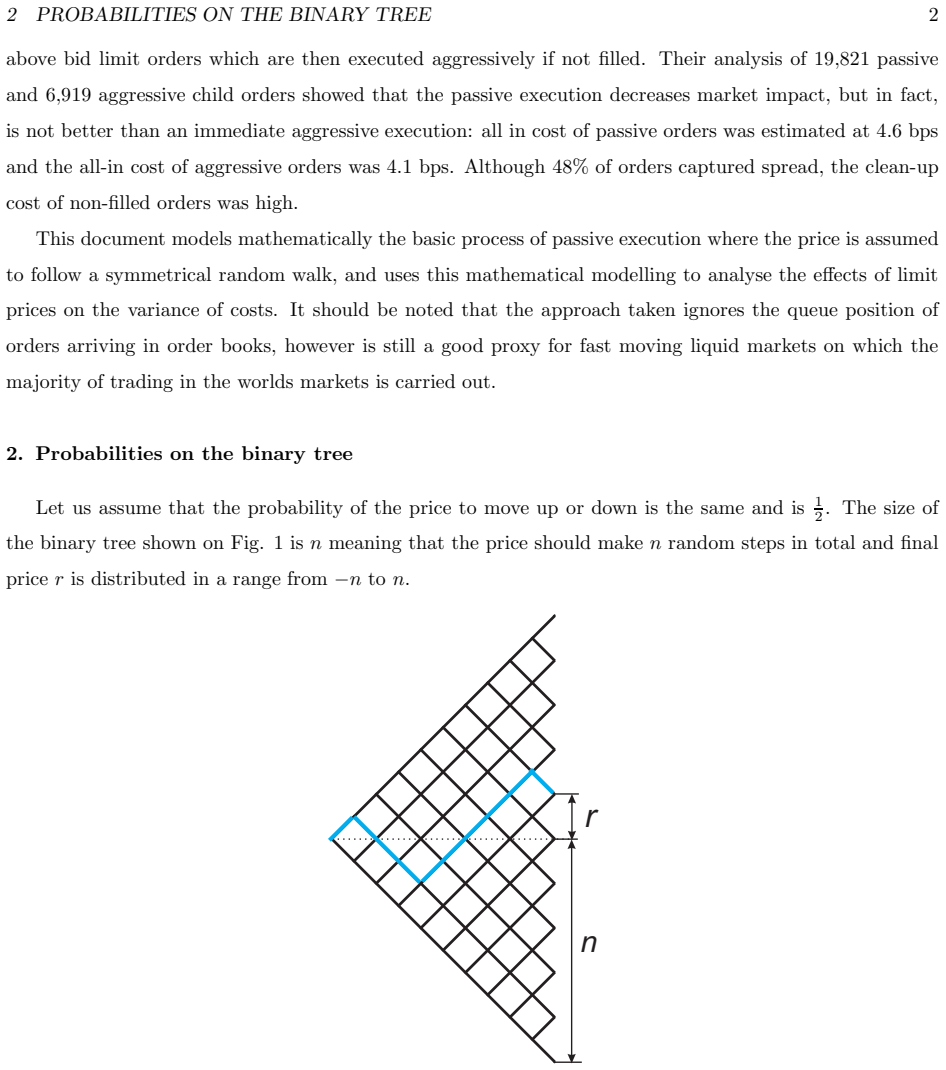
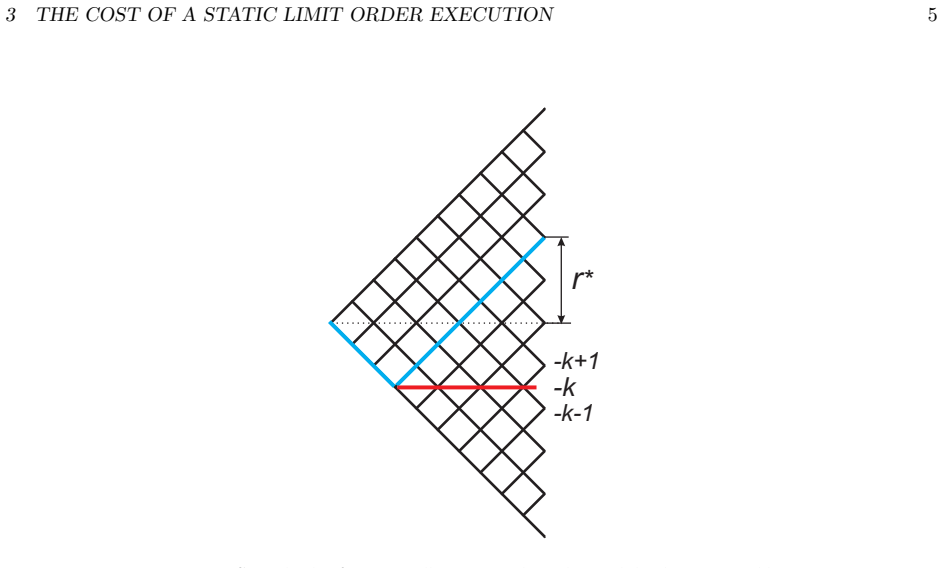
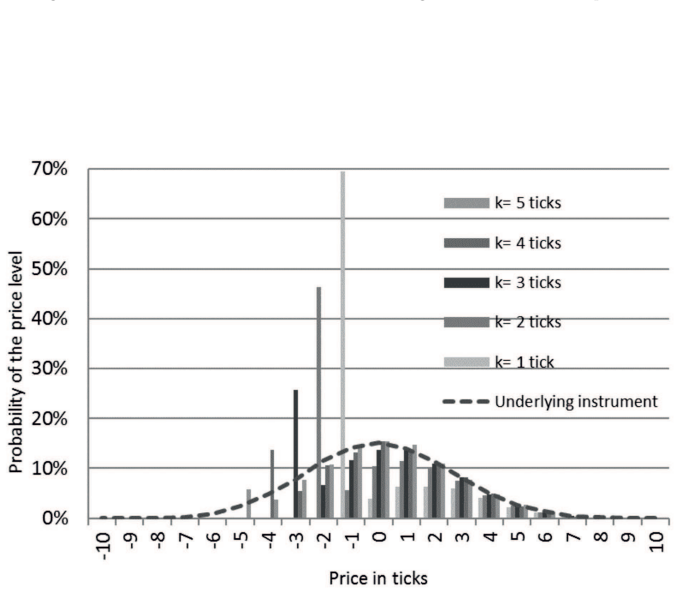
The central discovery is a cost identity for the static passive slice. Model the mid-price as an $n$-step symmetric random walk starting at zero, place a buy limit $k$ ticks below the opposite side, and if the limit is not touched by the end of the slice buy aggressively at the terminal price $r$. Let $\Delta_k$ be the expected cost measured from the starting price. Using the reflection principle to count paths that touch the limit, the paper shows $\Delta_{k+1} - \Delta_k = 0$, and since $\Delta_0 = 0$ for an immediate aggressive order, it follows that $\Delta_k = 0$ for every $k$. Thus the expected execution cost is independent of the limit level and equals the cost of aggressive execution at the start. The same calculation yields the variance of execution results, $\sigma_X^2 \approx 4k\sqrt{n}/\sqrt{2\pi} - k^2$ capped at $n$, and the passive-fill probability $P(k,T) = 1 - \mathrm{erf}(k/(\sigma(T)\sqrt{2}))$.
Load-bearing premise
The result assumes the price follows a symmetric random walk with no drift and equal up/down probabilities, and that queue position can be ignored; if the real process has drift, serial correlation, or queue effects, the equality of costs across limit levels no longer holds.
Editorial extensions
If this is right
- In a driftless random-walk market, moving a passive slice further from the touch does not change its expected cost; all limit levels are equivalent to an immediate aggressive print at the start.
- Passive execution adds risk without expected reward: the variance of outcomes grows roughly linearly with limit distance $k$ and with the price volatility, so a one-tick touch order already has standard deviation proportional to $T^{1/4}$.
- The probability that a limit order at distance $k$ fills within horizon $T$ is $1-\mathrm{erf}(k/(\sigma(T)\sqrt{2}))$; at one price-volatility unit away this is about 32%, rising to about 48% when the horizon is doubled.
- As the horizon goes to infinity the fill probability goes to 1, the random-walk recurrence property; but for any finite slice the unfilled tail is a real cost.
- Execution algorithms that want a better average price need a second layer that decides when to aggress, using order-book imbalance or trade-acceleration signals, rather than relying on the limit distance alone.
Reading between the lines
- The zero-cost equality is knife-edge: with a nonzero drift the binomial probabilities become asymmetric and the expected cost should acquire a drift term that varies with $k$, likely making deeper passive levels either attractive or unattractive depending on the sign of the drift.
- Because the average is flat while variance rises with $k$, the passive slice is a mean-preserving spread around the initial market price; any risk-averse objective, such as minimizing expected shortfall or using a concave utility, strictly prefers immediate aggressive execution.
- The formula $P(k,T)=1-\mathrm{erf}(k/(\sigma(T)\sqrt{2}))$ can serve as a no-queue benchmark for fill rates; actual fill probabilities above it would signal queue priority or order-flow effects, while below it would signal queue disadvantage or adverse selection.
- A direct continuous-time analogue should hold for driftless Brownian motion with the same stop-and-liquidate strategy, and a Monte Carlo check across $k$ values would confirm whether the discrete-tree identity survives in the diffusion limit.
Signed reviews
Editorial analysis
A structured set of objections, weighed in public.
Referee Report
Summary. The paper analyzes a static passive execution slice under the assumption that the mid-price follows a symmetric binomial random walk. It claims that the expected execution cost of a passive limit order placed k ticks away from the aggressive price is exactly zero for every k, so that passive execution has the same average cost as immediate aggressive execution; it then derives approximate formulas for the variance of execution outcomes and for the probability of a passive fill. The paper explicitly frames the random walk as a zero-order model for liquid fast-moving markets and acknowledges that queue position, drift, and serial correlation are outside its scope.
Significance. The central indifference result—that under a fair martingale price any static passive slice has the same expected execution price as an immediate aggressive execution—is correct and is proven here by a reflection-principle argument that can also be verified by the optional stopping theorem. The derivation is self-contained and parameter-free, and the paper connects the result to the empirical all-in-cost observations of the Piccolo algorithm. The variance and fill-probability sections, however, contain parity-dependent errors in their exact formulas, and these need correction before the paper's quantitative claims can be accepted. With those fixes the paper would be a useful pedagogical and practical benchmark for zero-order execution-cost modeling.
major comments (2)
- [§4, Eqs. (15)–(17)] Equation (17) is not exact. After the substitution r' = r + 2k in the second term of Eq. (15), the contribution from the interval r = -k+1, ..., k is sum (r^2 + kr) C, not sum r^2 C; the kr term does not vanish because the interval is asymmetric, containing r = k but not r = -k. The missing contribution is exactly k^2 P_n(k), which is nonzero whenever n and k have the same parity. For example, for n = 2, k = 2, Eq. (17) gives 1, while the actual variance is 2; for n = 3, k = 1, Eq. (17) gives 13/8, while the actual variance is 2. This error affects the exact-variance comparison in Section 5 and Figure 6.
- [§6, Eqs. (22)–(23)] Equation (23) is correct only when n and k have different parity. From Eq. (22), the exact expression is P(k) = 2 * sum_{r=k+1}^{n} P_n(r) + P_n(k); the extra P_n(k) term vanishes exactly when r = k is not attainable, i.e., when n + k is odd. The statement that selecting n slightly larger to change its parity removes the difference is an approximation that changes the model's time horizon, not an exact derivation. The continuous approximation (24) is still valid asymptotically for large n and fixed k, but the exact formula and the surrounding claim that the difference is insignificant should be corrected.
minor comments (4)
- [§2, Eq. (3)] The notation C_{n+r/2}^n and C_{n+r/2}^{n} is nonstandard and can be confused with the alternative order of arguments; please use explicit binomial-coefficient notation such as binom(n, (n+r)/2).
- [§3, Eq. (9)] The two components of the total cost in Eq. (9) are printed with visually identical symbols, which makes the equation ambiguous; please use distinct notation, e.g., an overline and an underline, consistently throughout.
- [§5, approximation preceding Eq. (18)] The phrase 'in the limit k → 0' is imprecise: the approximation is for fixed k with n large and k much smaller than sqrt(n), not for k tending to zero while n is held fixed.
- [General] There are several typographical errors, including 'equaiton' in Section 2, 'If the the order' in Section 4, and 'tradi ng' in the header; these should be corrected in a final revision.
Circularity Check
No significant circularity: the zero-cost theorem is derived from the symmetric random walk assumption without fitted parameters or a self-citation chain.
full rationale
The derivation chain is self-contained and non-circular. The central claim—that all static passive limit levels have the same expected execution cost as an immediate aggressive execution (Eq. (11))—is proved by induction on k using only the symmetric binomial random walk probabilities (3), the reflection-principle probabilities (4)–(6), and the accounting definitions (7)–(9). No parameter is fitted to data, and no load-bearing input is obtained from a self-citation: the reflection principle is attributed to Feller (1959), and the Piccolo empirical result is used only as an ex-post explanatory check, not as an assumption. The result is in fact a form of the optional-stopping theorem for the bounded stopping time τ∧n, so it follows from the martingale property of the symmetric walk rather than from the conclusion being assumed. The auxiliary variance and fill-probability formulas have their own mathematical approximations and possible parity or boundary subtleties, but those are correctness concerns, not circularity. The stated limitations (zero-order approximation, queue ignored) are explicit scope conditions, not circular inputs. Therefore no circular step is present.
Assumptions & free parameters
assumptions (5)
- domain assumption Price follows a symmetric random walk on a binary tree with n steps; up and down moves have equal probability 1/2.
- standard math Reflection principle for binomial paths: the number of paths from 0 to r that touch level k equals the number of paths from 0 to 2k+r.
- standard math Binomial coefficient symmetry C_{(n+r)/2}^n = C_{(n-r)/2}^n.
- domain assumption The execution strategy is a static slice: a limit order at price -k; if not filled by the end of the window, the remainder is filled aggressively at the final price; no queue effects.
- domain assumption For large n, sums of binomial probabilities are approximated by integrals over a normal distribution N(0, sqrt(n)).
Cite this review
Pith. "Pith review of Random walk model from the point of view of algorithmic trading." pith.science (2026). https://pith.science/paper/4KCZOZC3
@misc{pith2026190804333,
  author       = {Pith},
  title        = {Pith review of: Random walk model from the point of view of algorithmic trading},
  year         = {2026},
  howpublished = {\url{https://pith.science/paper/4KCZOZC3}},
  note         = {Machine review of arXiv:1908.04333}
}
read the original abstract
Despite the fact that an intraday market price distribution is not normal, the random walk model of price behaviour is as important for the understanding of basic principles of the market as the pendulum model is a starting point of many fundamental theories in physics. This model is a good zero order approximation for liquid fast moving markets where the queue position is less important than the price action. In this paper we present an exact solution for the cost of the static passive slice execution. It is shown, that if a price has a random walk behaviour, there is no optimal limit level for an order execution: all levels have the same execution cost as an immediate aggressive execution at the beginning of the slice. Additionally the estimations for the risk of a limit order as well as the probability of a limit order execution as functions of the slice time and standard deviation of the price are derived.
Figures
Figures from the paper (3 more)


Reference graph
Works this paper leans on
-
[1]
author B. Johnson , title Algorithmic Trading & DMA: An Introduction to Direct Access Trading Strategies , publisher 4 Myeloma Press , address London, UK , pages pp.118--132 , year 2010
work page 2010
-
[2]
author V. Markov , title On the design of sell-side limit and market order tactics , journal Journal of Trading volume 7 number 3 ( year 2012 ), pages 29--39
work page 2012
-
[3]
author D. Jeria , author T. Schouwenaars , author G. Sofianos , title The all-in cost of passive limit orders , journal Street smart , issue Issue 38 , publisher Goldman Sachs , ( year 2009 )
work page 2009
-
[4]
author W. Feller , title Introduction to probability theory and its applications , publisher John Wiley & Sons Inc , edition Second Edition , address NY , pages p. 70 , year 1959
work page 1959
Reviewed August 14, 2026 · model on record in the stance chip above.
Discussion (0). Continue with ORCID to comment.