REVIEW 3 major objections 8 minor 6 references
Visualization of Abel's Impossibility Theorem
T0 review · 3 major / 8 minor · reviewed 2026-08-14 · deepseek-v4-flash
Pith's one-line read The paper reports an interactive visualization that makes the impossibility of solving the general quintic by radicals visible through commutator loops.
desk verdict A well-intentioned undergraduate visualization of Arnold's proof; useful for teaching, but the paper's claims outrun what the animation and the proof sketch actually establish. read the letter →
The pith
A machine-rendered reading of the paper's core claim, the machinery that carries it, and where it could break.
The reading
What carries the argument
The load-bearing mechanism is the commutator of closed coefficient loops, applied once for each level of nested radicals. A radical sends a closed coefficient loop to a cyclic permutation of its branches, and a commutator $[\beta,\gamma]=\beta\gamma\beta^{-1}\gamma^{-1}$ makes those cyclic permutations cancel, returning the radical to its starting branch while the roots themselves are permuted by the commutator of the two root cycles. Iterating this at successive nesting levels gives exactly the solvability condition of the monodromy group: a finite expression of analytic functions and radicals has a group of possible root-label changes whose commutator series reaches the identity. The visualization turns that abstract group ladder into moving points on screen, with $S_5$ as the stage on which the ladder never reaches the bottom.
What would settle it
Run the program with a concrete candidate expression carrying more nested radicals than the displayed levels and look for one closed coefficient path along which the roots permute non-trivially while the candidate's output returns exactly to its starting position. More directly, give one finite expression in analytic functions, field operations, and radicals whose monodromy group is not solvable, since the proof of Claim 3.7 silently assumes none exists.
Extended reading notes
Core claim
The central claim is that the obstruction to solving the quintic by radicals can be exhibited as a loop-winding phenomenon. Starting with five distinct roots, the program uses the elementary symmetric relations between roots and coefficients to convert root motions into coefficient motions, then tracks the value of any candidate formula built from analytic functions, field operations, and nested radicals. For a carefully chosen commutator of coefficient loops, the roots undergo a non-trivial permutation while every analytic subexpression and every radical branch closes up, so the candidate formula returns to its starting value and fails to track the roots. The group-theoretic reason is that the monodromy group of a radical expression is solvable—after enough iterated commutators all branch choices close—whereas the symmetric group $S_5$ is not solvable, so no finite nesting depth can eliminate the obstruction. The same argument applies to every degree at least five.
Load-bearing premise
The argument stands on the unproved premise that every finite expression in analytic functions and nested radicals has a monodromy group whose repeated commutators eventually collapse to the identity, so that a sufficiently iterated coefficient loop closes all radical branches; without that premise, the visual loop cannot force the claimed contradiction.
Editorial extensions
If this is right
- No increase in the number or depth of nested radicals can rescue a formula for degree five.
- The same commutator-loop construction rules out radical formulas for every degree $\geq 5$, since $S_n$ contains a copy of $S_5$ and is therefore not solvable.
- For degrees two, three, and four, the visualization makes visible why one level of radicals, nested radicals, and three nested levels respectively are needed.
- A user can test any proposed formula: if its animated value follows the roots through the commutator loop, the formula is tracking a root; if it closes up while the roots permute, the formula fails.
Reading between the lines
- Beyond the paper, the same loop-winding picture suggests a practical certificate: for any proposed finite expression in analytic functions and radicals, one could algorithmically search coefficient loops for a commutator that closes the expression while permuting roots, turning non-existence into a checkable animation.
- The commutator-depth reading also predicts a natural grading on radical formulas by nesting level, with solvability of the monodromy group as the invariant; this could connect to circuit-depth lower bounds or complexity-theoretic versions of Galois theory.
- The visualization could be extended to one-parameter families of higher-degree polynomials or to algebraic functions defined by equations, testing whether their monodromy groups are solvable and making the same argument operate outside the narrow polynomial setting.
Signed reviews
Editorial analysis
A structured set of objections, weighed in public.
Referee Report
Summary. This paper describes a JavaScript/p5.js animation intended to visualize Arnold's topological proof of the Abel-Ruffini theorem. After sketching Riemann-surface and monodromy background in Section 2, the authors present a sequence of claims: analytic functions alone cannot solve the quadratic (Section 3.1); a commutator argument forces nested radicals for the cubic and higher degrees (Sections 3.2-3.3); the derived series of S4 accounts for the three levels of nesting in the quartic (Sections 3.4-3.5); and no finite expression built from analytic functions, field operations, and nested radicals can solve the general quintic, because closed coefficient paths can return the expression to its starting values while non-trivially permuting the roots (Claim 3.7 in Section 3.7). Section 4 documents the software implementation (Point, Path, Motion classes, Vieta's formulas, Complex.js). The mathematical content is the classical Arnold argument as presented in Alekseev's problem book [2]/[3]; the paper's contribution is the visualization and its expository framing rather than new mathematics.
Significance. The underlying theorem is classical and true, and the paper's pedagogical plan -- building from S2 to S5 via commutators and the derived series -- is a sound way to present Arnold's proof. The visualization artifact is a genuine strength: the GitHub repository [5] makes the animation reproducible, and the quadrant layout (roots, coefficients from Vieta, expression values, radical branches) gives a concrete picture of the path argument. If the proof texts are corrected and the load-bearing steps are located in the literature, this could be a useful teaching supplement for courses using Alekseev's problem book. As it stands, however, the paper's own proofs are sketches: Theorem 3.4 is stated for degree 2 but proved for five roots, and Claim 3.7 asserts rather than proves the decisive soluble-monodromy fact for nested radicals. The contribution is expository rather than research-level, which is appropriate for math.HO, but the exposition must be accurate at precisely the points where it claims to prove the theorem.
major comments (3)
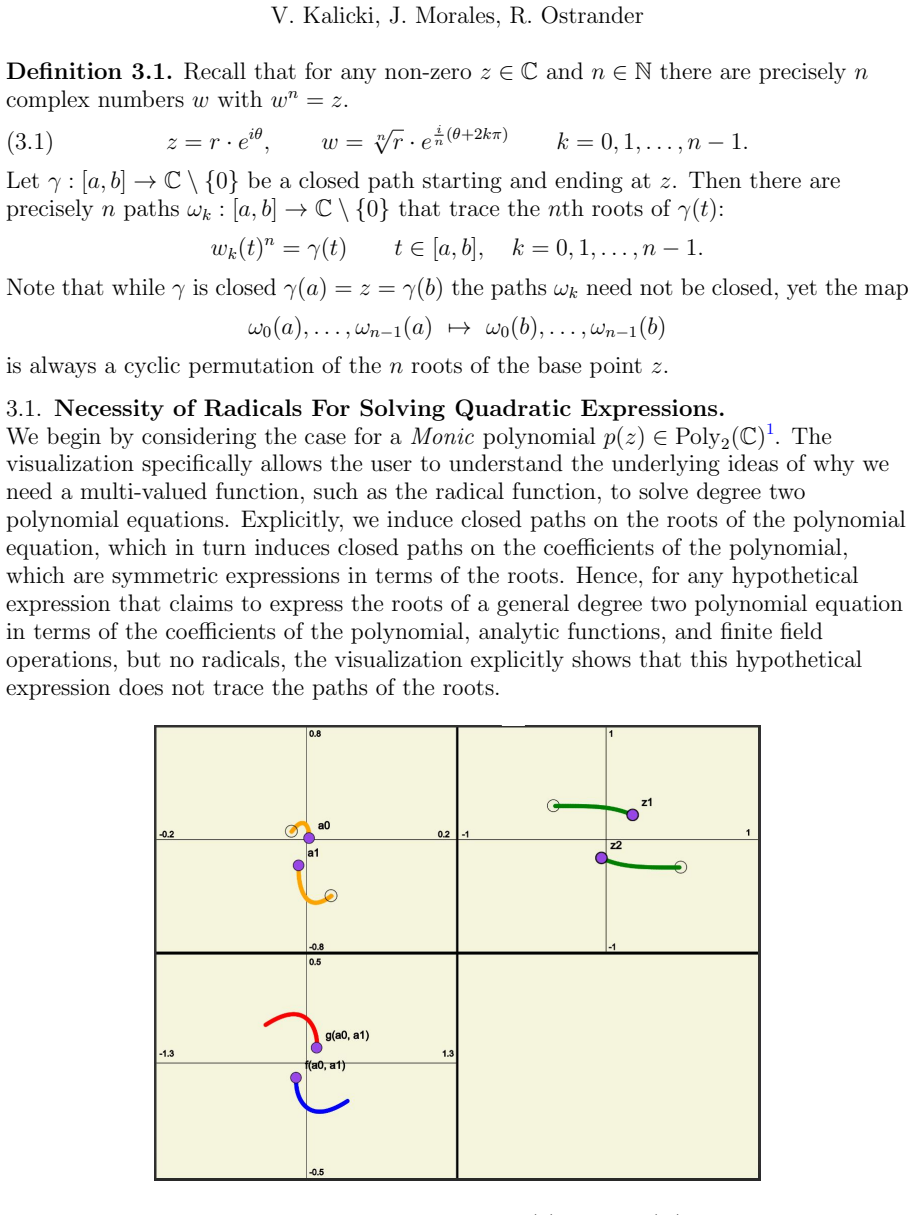
- [§3.2, Theorem 3.4 and Eq. (3.2)] Theorem 3.4 is stated for a monic polynomial in Poly2(C), but the statement is false in that degree: with k=1, n1=2, f1(a0,a1)=a1^2-4a0, and g(w)=(-a1+w)/2, Eq. (3.2) is exactly the quadratic formula, an analytic g applied to a single radical of an analytic f1. The proof is also internally inconsistent with the statement: it fixes five roots z1,...,z5 and loops β̂=(123), γ̂=(345), which cannot arise for a degree-2 polynomial. The proof is evidently the degree-5 argument; the theorem should be restated for Poly5(C) (or degree at least 5), and the text should not claim that quadratic roots are inexpressible in the form (3.2), since the quadratic formula refutes that.
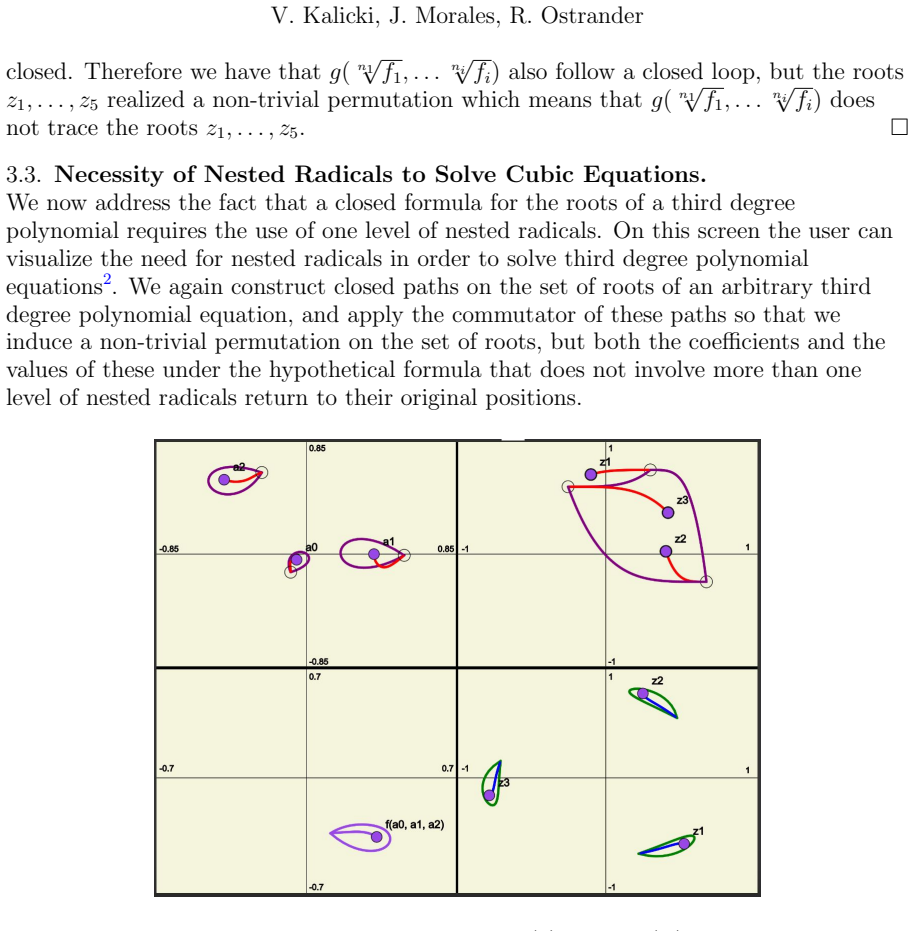
- [§3.7, Claim 3.7 (and §3.3, Claim 3.3)] The proof's decisive sentence -- 'Since S5 is not soluble, then we know that there exists continuous paths such that their commutator induces a non-trivial permutation of the roots, while both the coefficients of p(z) and fi, for 1≤i≤k, follow a closed loop' -- presupposes the soluble-monodromy lemma for nested radicals: for every finite expression built from analytic functions, field operations, and N levels of nested radicals, there exist closed coefficient paths whose (N+1)-fold iterated commutator restores every intermediate radical branch and hence the whole expression. The manuscript proves this only for a single radical: Claim 3.3 handles one level, and even there the justification ('both β and γ define a cyclic permutation of the 5 radicals which commute') is compressed, since arbitrary distinct 5-cycles need not commute; the real reason is that the monodromy of w = z^{1/5} is an abelian group of multiplications by roots of unity. Neither Theorem 3.4 ('by previous case') nor Claim 3.7 ('we know') supplies the induction over nesting depth. Without that induction, non-solubility of S5 is not by itself a contradiction to the existence of a radical formula, because one must also know that the formula's own monodromy cannot be non-soluble. This is the standard Arnold step; the paper should either prove the induction (each added radical level contributes an abelian cyclic factor to the monodromy, so the derived length is bounded by the nesting depth) or cite the specific problem in Alekseev [2]/[3] where it is proved. As written, the step is a restatement of the desired contradiction rather than a derivation of it.
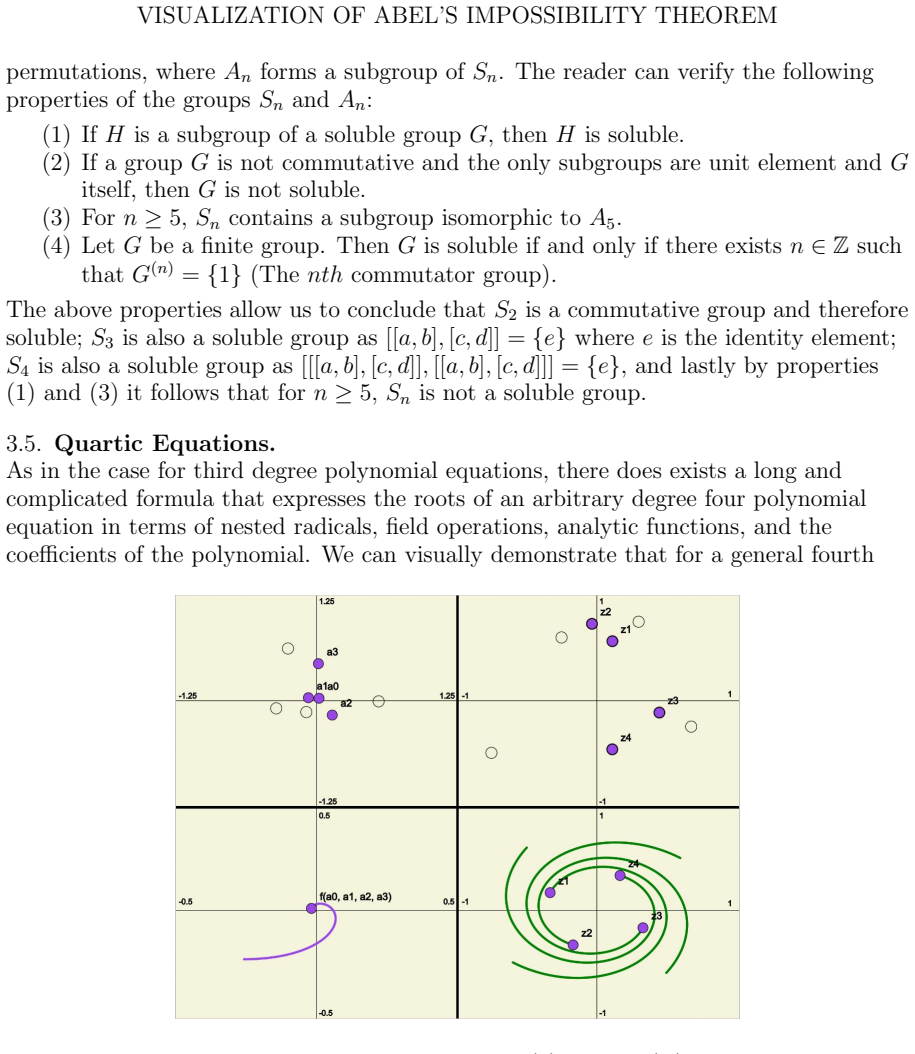
- [Abstract and §3.7] The abstract claims that 'given any expression that uses analytic functions and radicals one can always construct closed paths' with the stated behavior, and §3.7 says the visualization 'demonstrates the impossibility' of a quintic formula. A finite animation runs specific loops for specific root configurations; it cannot, by itself, establish a universal statement over all expressions. The paper should explicitly separate (i) what the program illustrates (a concrete instance of the path argument) from (ii) what is proved in the text and (iii) what is imported from the literature. This distinction matters because Claims 3.2, 3.5, and 3.7 are each labeled 'Proof.', while §2 itself admits that the Galois-theoretic arguments behind Arnold's proof are omitted; the §3.7 proof then relies on exactly that omitted content.
minor comments (8)
- [§1] 'Gorup theory' should read 'group theory', and the theorem should be referred to consistently as the Abel-Ruffini theorem rather than 'Abel's Impossibility Theorem'.
- [Abstract, §2, §3.1] 'it's' should be 'its' in the abstract, in §2, and in §3.1.
- [References] References [2] and [3] are the same book (Alekseev, Abel's Theorem in Problems and Solutions); they should be consolidated into one entry, and the text should cite specific problem or section numbers for the monodromy-of-radicals step.
- [§2] The displayed notation 'zt↦→z2πint' is garbled, and the sentence about t = m/n should be rewritten with proper formatting so that the argument of the exponential is unambiguous.
- [§3.1] The superscript footnote marker in 'Poly2(C)1' is a leftover LaTeX reference; the footnote about the screen shot should be attached to the figure itself.
- [§3.5] The counts '12 non-trivial permutations of commutators ... 4 non-trivial ... trivial' are an informal description of the derived series S4 > A4 > V4 > {e}; since the count '4' includes the identity, the text should state the group-theoretic statement explicitly.
- [§4, item (4)] It is unclear how the program 'calculates' the solutions from the coefficients without solving the quintic; clarify that the animation prescribes the root paths and computes coefficients via Vieta, then plots the branches of the displayed expression rather than numerically solving the polynomial.
- [References and §4] Only the GitHub repository [5] is given for the artifact; a live URL for the running animation and a note on the tested browsers/versions would improve reproducibility and allow a reader to verify the central visual claim.
Circularity Check
Claim 3.7's contradiction is reached by asserting the very soluble-monodromy lemma that the proof needs; the central step is a restatement rather than a derivation.
-
other
[§3.7, Claim 3.7, proof of impossibility of the quintic in radicals]
"Since S5 is not soluble, then we know that there exists continuous paths such that their commutator induces a non-trivial permutation of the roots, while both the coefficients of p(z) and fi, for 1≤i≤k, follow a closed loop, a contradiction."
For an arbitrary expression with N nested radicals, the existence of paths whose iterated commutator closes every intermediate radical branch while permuting the roots is exactly the soluble-monodromy lemma for radical expressions. The paper proved only the one-radical, two-loop case in Claim 3.3 and never supplies the induction over N levels. Without that lemma, non-solubility of S5 does not by itself force a contradiction, because one must also prove that any radical formula's own monodromy cannot be non-soluble. The sentence 'we know' thus imports the missing load-bearing fact as if it were already available, making the central contradiction a restatement of the needed lemma rather than a derivation.
full rationale
No fitted parameters are called predictions, no self-citation chain is load-bearing, and no known result is renamed as a new derivation. The paper's external citations to Alekseev's presentation of Arnold's proof [2,3] provide independent support for the underlying theorem, and the visualization itself does not fabricate data. The only circularity-like step is the unproved soluble-monodromy assertion inside Claim 3.7: the proof assumes, rather than establishes, that iterated commutators of coefficient loops close all branches of an arbitrary finite tower of nested radicals. This step is load-bearing because it is the bridge from non-solubility of S5 to a contradiction for arbitrary radical formulas. The score of 3 reflects one central question-begging step in an expository visualization, not a fully circular derivation or a fabricated result.
Assumptions & free parameters
assumptions (3)
- domain assumption Any finite expression built from analytic functions, field operations, and nested radicals has a soluble monodromy group.
- standard math For n≥5, S5 is not soluble.
- domain assumption Arnold's theorem: the monodromy of x^5+ax+1=0 is the full symmetric group S5.
Cite this review
Pith. "Pith review of Visualization of Abel's Impossibility Theorem." pith.science (2026). https://pith.science/paper/4KOY7WEH
@misc{pith2026190800972,
  author       = {Pith},
  title        = {Pith review of: Visualization of Abel's Impossibility Theorem},
  year         = {2026},
  howpublished = {\url{https://pith.science/paper/4KOY7WEH}},
  note         = {Machine review of arXiv:1908.00972}
}
read the original abstract
In this paper we construct a visualization of the Abel's Impossibility Theorem also known as the Abel-Ruffini Theorem. Using the canvas object in JavaScript along with the p5.js library, and given any expression that uses analytic functions and radicals one can always construct closed paths such that the expression evaluated at the coefficients of a general polynomial returns to it's initial position, while the roots of the polynomial undergo a non-trivial permutation. Hence, such expression does not reconstruct the roots from the coefficients. Using the visualization we begin by considering the necessity of radicals to solve second degree polynomial equations and build towards degree five polynomial equations. In eventuality our program shows that there is no formula for an arbitrary fifth degree polynomial equation that uses analytic functions, finite field operations, and radicals that reconstructs the roots of the polynomial from it's coefficients. This theorem was partially completed by Paolo Ruffini in 1799 and completed by Niels Abel in 1824.
Figures
Figures from the paper (1 more)

Reference graph
Works this paper leans on
-
[2]
V. B. Alekseev. Abel’s theorem in problems and solutions . Kluwer Academic Publishers, Dordrecht,
-
[3]
Springer Science & Business Media, 2004
Valerij Borisoviˇ c Alekseev.Abel’s Theorem in Problems and Solutions: Based on the lectures of Professor VI Arnold . Springer Science & Business Media, 2004
work page 2004
-
[5]
ryanostrander/abel-s-theorem, Apr 2019
Ryan Ostrander, Juan Morales, and Veronica Kalicki. ryanostrander/abel-s-theorem, Apr 2019. https://github.com/ryanOstrander/Abel-s-Theorem. 11
work page 2019
-
[1]
Mathematical computing laboratory at uic. https://mcl.math.uic.edu/
-
[4]
Infusion. infusion/complex.js, Apr 2019. https://github.com/infusion/Complex.js/
work page 2019
-
[2004]
Based on the lectures of Professor V. I. Arnold, With a preface and an appendix by Arnold and an appendix by A. Khovanskii
Reviewed August 14, 2026 · model on record in the stance chip above.
Discussion (0). Continue with ORCID to comment.