REVIEW 3 major objections 5 minor 2 cited by
HMCF: A Human-in-the-loop Multi-Robot Collaboration Framework Based on Large Language Models
T0 review · 3 major / 5 minor · reviewed 2026-08-16 · deepseek-v4-flash
Pith's one-line read This paper claims that adding a human-in-the-loop and per-robot task verification to LLM-based multi-robot coordination outperforms RL and LLM baselines, reaching 92.4% success in five simulated household scenes.
desk verdict The framework is a sensible engineering integration, but the headline 4.76% SR win is really the oracle human: HMCF without human feedback (0.882) ties HMAS-2 (0.880), so the architecture alone doesn't separate from the best baseline. read the letter →
The pith
A machine-rendered reading of the paper's core claim, the machinery that carries it, and where it could break.
The reading
What carries the argument
The central mechanism is HMCF's four-step workflow: input aggregation, task delegation and verification, task execution, and task reallocation. An assistant LLM agent assigns subtasks to robot agents; each robot's own LLM agent verifies whether it can execute the task before accepting, and on disagreement or exception the assistant LLM reallocates tasks, with a human supervisor able to intervene with one-word or natural-language commands. Retrieval-augmented generation lets new robots be added by uploading their manuals, and summarized chat history is used to bound context length and reduce hallucination.
What would settle it
Run the same five BEHAVIOR-1K scenes with HMCF but make the human supervisor answer correctly only, say, 70% of the time (or randomly); if the success rate falls to the 0.882 level of the no-human variant, then the claimed 4.76% improvement comes from the human rather than the framework. Alternatively, run HMCF on all 1,000 BEHAVIOR-1K tasks and check whether the 0.92 average holds outside the five selected scenes.
Extended reading notes
Core claim
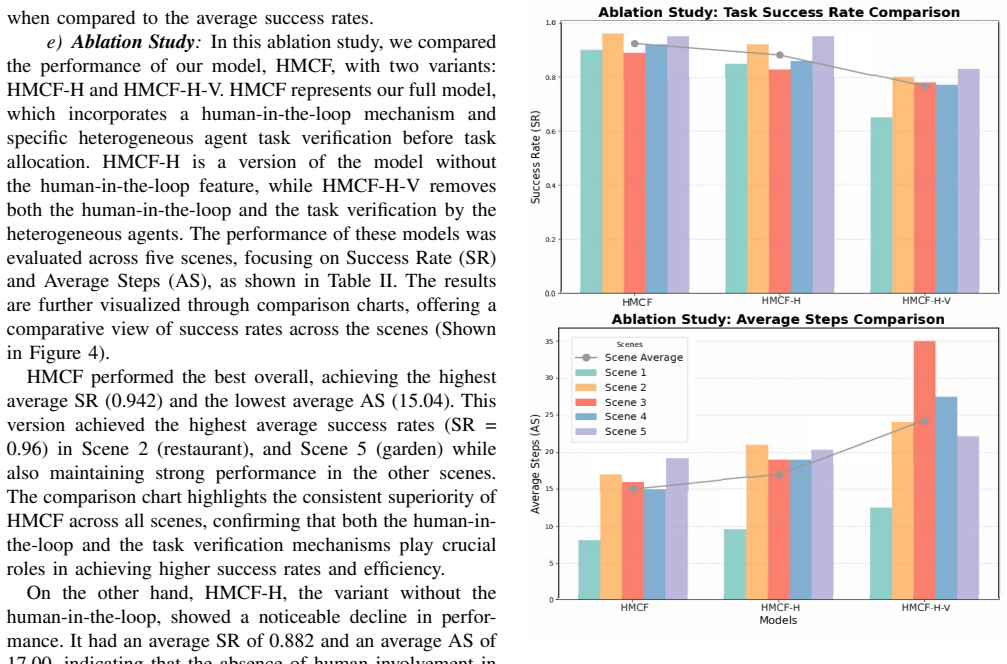
On its own terms, the paper's central claim is that adding human-in-the-loop arbitration and per-robot LLM task verification to an LLM-based multi-robot coordination system produces better task allocation and execution than centralized or decentralized LLM planners and reinforcement-learning baselines. In the five chosen BEHAVIOR-1K scenes, HMCF reports the highest average success rate (0.924) and the lowest average steps (15.04), with the abstract summarizing the edge as a 4.76% improvement. The ablation attributes that edge to both components: the human contributes roughly four percentage points of success rate, and the verification step contributes the rest, since removing both drops success to 0.766. The paper also claims the framework transfers zero-shot to real wheeled and legged robots with only uploaded manuals and natural-language commands, demonstrated in a small apple-finding lab task.
Load-bearing premise
The simulation assumes the human supervisor always gives the correct one-word answer when agents disagree, so the framework's reported advantage is only as strong as that oracle-like human.
Editorial extensions
If this is right
- If HMCF generalizes as claimed, LLM-based coordination can replace task-specific RL training for new multi-robot tasks, since new tasks and new robots are handled by reasoning over capability profiles and uploaded manuals rather than retraining policies.
- The 4.76% success-rate gain implies that even minimal human oversight, a single yes/no answer at a disagreement, can meaningfully improve reliability in simulated multi-robot collaboration.
- Removing per-robot task verification drops success from 92.4% to 76.6%, so decentralized verification is doing substantial work beyond the LLM's planning power.
- The real-world apple-finding deployment suggests the same framework can be applied to physical heterogeneous robots with no task-specific engineering and minimal human intervention.
Reading between the lines
- An implication the authors leave implicit: the ablation numbers suggest that the reported edge over the best LLM baseline is attributable to the human supervisor, since HMCF without the human (88.2%) almost exactly ties HMAS-2 (88.0%).
- A natural stress test would replace the always-correct supervisor with a fallible one or with probabilistic answers; if success rate tracks human accuracy, the framework's contribution is arbitration rather than planning.
- The authors identify communication latency and scalability as limitations, so an obvious extension is a hierarchical allocator or local LLM agents to reduce reliance on cloud-hosted models in poor connectivity.
- The design pattern, LLM agents propose and verify, humans arbitrate disagreements, and chat history is summarized to bound context, could transfer to other embodied multi-agent settings such as warehouse logistics or disaster response, but the paper only demonstrates household-style tasks.
Signed reviews
Editorial analysis
A structured set of objections, weighed in public.
Referee Report
Summary. The manuscript proposes HMCF, a human-in-the-loop multi-robot task-allocation framework in which a central LLM assistant assigns sub-tasks to heterogeneous robots, each robot carries an LLM agent that verifies feasibility and translates commands, and a human supervisor can intervene through a chat interface. The method is evaluated in five selected BEHAVIOR-1K scenes against three RL baselines and two LLM baselines using success rate (SR) and average steps (AS), and compared with two ablated variants that remove human oversight and task verification, and a real-world demonstration with one legged and two wheeled robots. The central claim is that HMCF achieves state-of-the-art performance with a 4.76% improvement in task success rate over the best baseline.
Significance. If the central comparative claim were established with appropriate statistics, HMCF would be a useful contribution to LLM-based multi-robot coordination, particularly for heterogeneous robot teams and human oversight. The paper's strengths are its concrete system integration (RAG-based robot configuration, chat interface, task verification and reallocation), the real-world deployment with three robot types, and the ablation that separately removes the human and the verification components. However, the headline result is currently supported only by point estimates with an oracle-like human supervisor; the load-bearing comparison between the no-human variant and the strongest baseline is not statistically distinguished.
major comments (3)
- [§IV-A-d, Tables I–II] The central comparative claim that HMCF 'consistently demonstrated the best overall performance' is not statistically supported. The paper reports only point estimates over five scenes and ten runs per task, with no error bars, confidence intervals, or significance tests; the reported SR gap to HMAS-2 is 0.04, and HMCF-H (SR 0.882) is essentially tied with HMAS-2 (SR 0.880). Please report per-scene variances, the number of independent trials, and paired significance tests (e.g., bootstrap or Wilcoxon) for SR and AS, and justify the selection of only five BEHAVIOR-1K scenes for the generalization claim.
- [§IV-A-b, Table II, §V] The human supervisor in simulation is an oracle: an expert familiar with BEHAVIOR-1K who always provides the correct one-bit yes/no answer. The ablation shows that removing the human (HMCF-H) yields SR 0.882, almost identical to HMAS-2's 0.880, so the abstract's 4.76% improvement is attributable to the oracle human rather than to the LLM allocation and verification architecture. To support the stated contribution, the authors should add a fallible-human model (e.g., with error rates and intervention costs) and an equal-intervention control in which baselines receive the same one-bit oracle feedback.
- [§IV-A-d, Table I, Table II, §V] The reported numbers are internally inconsistent. The results text states the highest average SR is 0.924, the ablation text states HMCF achieves 0.942, both tables list HMCF's SR as 0.92, and the Discussion reports 92.4% and attributes a 4.76% improvement to the human mechanism. A single consistent set of numbers tied to the raw data must be provided.
minor comments (5)
- [Table I] The column header 'AR' should be 'AS'.
- [§IV-A-a and §IV-A-e] The scene/room labels are inconsistent: S2 is defined as 'store' in Section IV-A-a, but the ablation study calls it 'restaurant', and S3 is used for 'restaurant' in one place and 'store' in another; please align the labels.
- [§IV-A-b] Please clarify whether the human supervisor's one-bit response is included in the average steps for all models or only for HMCF; the current wording says it is counted, but the cross-model comparison is unclear.
- [Figure 2] The numbered regions referenced in the caption are hard to discern in the figure; either use a higher-resolution image or describe each region explicitly in the text.
- [§III-C] The paper would benefit from reporting reproducibility details for the LLM calls, such as temperature, prompt templates, and token usage, in addition to the model name GPT-4o-2024-08-06.
Circularity Check
No significant circularity: HMCF's empirical evaluation is self-contained against external baselines and involves no fitted parameter presented as a prediction.
full rationale
This paper makes no formal derivation whose conclusion is equivalent to its inputs. HMCF is an LLM-based multi-robot framework evaluated empirically on BEHAVIOR-1K against external baselines (RL-VMC, RL-Prim, RL-Prim.H, DMRS-2D, HMAS-2). No parameter is fitted to the reported success-rate data, and no equation is substituted into itself to produce the headline result. The human-in-the-loop component is an explicit design feature, and the ablation comparing HMCF with HMCF-H measures its empirical contribution rather than defining the result; the assumption that the human supervisor's yes/no answers are always correct is an experimental limitation or validity concern, not a circularity. Self-citations appear in the related-work and reference list, but none is load-bearing for the central claim; no uniqueness theorem or prior result is invoked to force the framework's design. Because the central comparison is benchmarked against systems whose numbers are not derived from HMCF's own assumptions, the paper's claimed advantage is independently falsifiable and does not reduce to its inputs by construction.
Assumptions & free parameters
assumptions (4)
- domain assumption GPT-4o and the OpenAI Assistant API provide reliable task reasoning, verification, and multimodal understanding for all agents.
- ad hoc to paper Human supervisor feedback in simulation is always correct and is fairly counted as a system component.
- domain assumption The BEHAVIOR-1K benchmark remains a valid evaluation of multi-robot heterogeneous collaboration after modification.
- domain assumption Stable, continuous communication between robots and cloud-hosted LLM agents is available.
Cite this review
Pith. "Pith review of HMCF: A Human-in-the-loop Multi-Robot Collaboration Framework Based on Large Language Models." pith.science (2026). https://pith.science/paper/4LNB5DMU
@misc{pith2026250500820,
  author       = {Pith},
  title        = {Pith review of: HMCF: A Human-in-the-loop Multi-Robot Collaboration Framework Based on Large Language Models},
  year         = {2026},
  howpublished = {\url{https://pith.science/paper/4LNB5DMU}},
  note         = {Machine review of arXiv:2505.00820}
}
read the original abstract
Rapid advancements in artificial intelligence (AI) have enabled robots to performcomplex tasks autonomously with increasing precision. However, multi-robot systems (MRSs) face challenges in generalization, heterogeneity, and safety, especially when scaling to large-scale deployments like disaster response. Traditional approaches often lack generalization, requiring extensive engineering for new tasks and scenarios, and struggle with managing diverse robots. To overcome these limitations, we propose a Human-in-the-loop Multi-Robot Collaboration Framework (HMCF) powered by large language models (LLMs). LLMs enhance adaptability by reasoning over diverse tasks and robot capabilities, while human oversight ensures safety and reliability, intervening only when necessary. Our framework seamlessly integrates human oversight, LLM agents, and heterogeneous robots to optimize task allocation and execution. Each robot is equipped with an LLM agent capable of understanding its capabilities, converting tasks into executable instructions, and reducing hallucinations through task verification and human supervision. Simulation results show that our framework outperforms state-of-the-art task planning methods, achieving higher task success rates with an improvement of 4.76%. Real-world tests demonstrate its robust zero-shot generalization feature and ability to handle diverse tasks and environments with minimal human intervention.
Figures


Figures from the paper (3 more)


Forward citations
Cited by 2 Pith papers
-
Reinforced Language Models for Sequential Decision Making
A 3B LLM post-trained with MS-GRPO, which gives every step the episode's total reward and samples high-advantage episodes, beats a 72B baseline on Frozen Lake but is inconsistent on Snake.
-
A quantum semantic framework for natural language processing
The paper reports CHSH inequality violations from LLM interpretations of ambiguous sentences and uses them to claim that linguistic meaning is non-classical and observer-dependent.
Reference graph
Works this paper leans on
-
[1]
D. Mitchell, J. Blanche, S. Harper, T. Lim, R. Gupta, O. Zaki, W. Tang, V . Robu, S. Watson, and D. Flynn, “A review: Challenges and opportunities for artificial intelligence and robotics in the offshore wind sector,” Energy and AI , vol. 8, p. 100146, 2022
work page 2022
-
[2]
Multi-robot task allocation in disaster response: Addressing dynamic tasks with deadlines and robots with range and payload constraints,
P. Ghassemi and S. Chowdhury, “Multi-robot task allocation in disaster response: Addressing dynamic tasks with deadlines and robots with range and payload constraints,” Robotics and Autonomous Systems , vol. 147, p. 103905, 2022
2022
-
[3]
Proof of location verifica- tion towards trustworthy collaborative multi-vendor robotic systems,
E. W. Wu, M. Jurt, B. Holden, and Y . Jin, “Proof of location verifica- tion towards trustworthy collaborative multi-vendor robotic systems,” in 2024 IEEE International Conference on Industrial Technology (ICIT). IEEE, 2024, pp. 1–8
work page 2024
-
[4]
Agentverse: Facilitating multi-agent collaboration and exploring emergent behaviors in agents,
W. Chen, Y . Su, J. Zuo, C. Yang, C. Yuan, C. Qian, C.-M. Chan, Y . Qin, Y . Lu, R. Xie et al. , “Agentverse: Facilitating multi-agent collaboration and exploring emergent behaviors in agents,” arXiv preprint arXiv:2308.10848, vol. 2, no. 4, p. 6, 2023
arXiv 2023
-
[5]
Scalable multi-robot collaboration with large language models: Centralized or decentralized systems?
Y . Chen, J. Arkin, Y . Zhang, N. Roy, and C. Fan, “Scalable multi-robot collaboration with large language models: Centralized or decentralized systems?” in 2024 IEEE International Conference on Robotics and Automation (ICRA). IEEE, 2024, pp. 4311–4317
work page 2024
-
[6]
Roco: Dialectic multi-robot col- laboration with large language models,
Z. Mandi, S. Jain, and S. Song, “Roco: Dialectic multi-robot col- laboration with large language models,” in 2024 IEEE International Conference on Robotics and Automation (ICRA) . IEEE, 2024, pp. 286–299
2024
-
[7]
Cognitive mirage: A review of hallucinations in large language models,
H. Ye, T. Liu, A. Zhang, W. Hua, and W. Jia, “Cognitive mirage: A review of hallucinations in large language models,” arXiv preprint arXiv:2309.06794, 2023
arXiv 2023
-
[8]
A survey on integration of large language models with intelligent robots,
Y . Kim, D. Kim, J. Choi, J. Park, N. Oh, and D. Park, “A survey on integration of large language models with intelligent robots,” Intelligent Service Robotics , vol. 17, no. 5, pp. 1091–1107, 2024
work page 2024
Show all 33 references
-
[9]
A survey of collaborative reinforcement learning: interactive methods and design patterns,
Z. Li, L. Shi, A. I. Cristea, and Y . Zhou, “A survey of collaborative reinforcement learning: interactive methods and design patterns,” in Proceedings of the 2021 ACM Designing Interactive Systems Confer- ence, 2021, pp. 1579–1590
2021
-
[10]
Towards citizen-centric multiagent systems based on large language models,
Z. Li, V . Yazdanpanah, S. Sarkadi, Y . He, E. Shafipour, and S. Stein, “Towards citizen-centric multiagent systems based on large language models,” in Proceedings of the 2024 International Conference on Information Technology for Social Good , 2024, pp. 26–31
2024
-
[11]
A survey on large language model based autonomous agents,
L. Wang, C. Ma, X. Feng, Z. Zhang, H. Yang, J. Zhang, Z. Chen, J. Tang, X. Chen, Y . Lin et al. , “A survey on large language model based autonomous agents,” Frontiers of Computer Science , vol. 18, no. 6, pp. 1–26, 2024
2024
-
[12]
Large language model based multi-agents: A survey of progress and challenges,
T. Guo, X. Chen, Y . Wang, R. Chang, S. Pei, N. V . Chawla, O. Wiest, and X. Zhang, “Large language model based multi-agents: A survey of progress and challenges,” arXiv preprint arXiv:2402.01680 , 2024
2024 arXiv
-
[13]
On emergent communication in competitive multi-agent teams,
P. P. Liang, J. Chen, R. Salakhutdinov, L.-P. Morency, and S. Kottur, “On emergent communication in competitive multi-agent teams,” arXiv preprint arXiv:2003.01848 , 2020
2003 arXiv
-
[14]
Behavior- 1k: A benchmark for embodied AI with 1,000 everyday activities and realistic simulation,
C. Li, R. Zhang, J. Wong, C. Gokmen, S. Srivastava, R. Mart ´ın- Mart´ın, C. Wang, G. Levine, M. Lingelbach, J. Sun et al., “Behavior- 1k: A benchmark for embodied AI with 1,000 everyday activities and realistic simulation,” in Conference on Robot Learning. PMLR, 2023, pp. 80–93
2023
-
[15]
Effective human-ai teams via learned natural language rules and onboarding,
H. Mozannar, J. Lee, D. Wei, P. Sattigeri, S. Das, and D. Sontag, “Effective human-ai teams via learned natural language rules and onboarding,” Advances in Neural Information Processing Systems , vol. 36, 2024
2024
-
[16]
Broader and deeper: A multi-features with latent relations bert knowledge tracing model,
Z. Li, M. Jacobsen, L. Shi, Y . Zhou, and J. Wang, “Broader and deeper: A multi-features with latent relations bert knowledge tracing model,” in European Conference on Technology Enhanced Learning. Springer, 2023, pp. 183–197
2023
-
[17]
Rt-2: Vision- language-action models transfer web knowledge to robotic control,
A. Brohan, N. Brown, J. Carbajal, Y . Chebotar, X. Chen, K. Choro- manski, T. Ding, D. Driess, A. Dubey, C. Finn et al., “Rt-2: Vision- language-action models transfer web knowledge to robotic control,” arXiv preprint arXiv:2307.15818 , 2023
2023 arXiv
-
[18]
Deep reinforcement learning approaches for technology en- hanced learning,
Z. Li, “Deep reinforcement learning approaches for technology en- hanced learning,” Ph.D. dissertation, Durham University, 2023
2023
-
[19]
The language barrier: Dissecting safety challenges of llms in multilingual contexts,
L. Shen, W. Tan, S. Chen, Y . Chen, J. Zhang, H. Xu, B. Zheng, P. Koehn, and D. Khashabi, “The language barrier: Dissecting safety challenges of llms in multilingual contexts,” arXiv preprint arXiv:2401.13136, 2024
2024 arXiv
-
[20]
Sim-gail: A gen- erative adversarial imitation learning approach of student modelling for intelligent tutoring systems,
Z. Li, L. Shi, J. Wang, A. I. Cristea, and Y . Zhou, “Sim-gail: A gen- erative adversarial imitation learning approach of student modelling for intelligent tutoring systems,” Neural Computing and Applications , vol. 35, no. 34, pp. 24 369–24 388, 2023
2023
-
[21]
Towards student behaviour simulation: a decision transformer based approach,
Z. Li, L. Shi, Y . Zhou, and J. Wang, “Towards student behaviour simulation: a decision transformer based approach,” in International Conference on Intelligent Tutoring Systems. Springer, 2023, pp. 553– 562
2023
-
[22]
Planbench: An extensible benchmark for evaluating large language models on planning and reasoning about change,
K. Valmeekam, M. Marquez, A. Olmo, S. Sreedharan, and S. Kamb- hampati, “Planbench: An extensible benchmark for evaluating large language models on planning and reasoning about change,” Advances in Neural Information Processing Systems , vol. 36, 2024
2024
-
[23]
A design trajectory map of human-ai collaborative rein- forcement learning systems: Survey and taxonomy,
Z. Li, “A design trajectory map of human-ai collaborative rein- forcement learning systems: Survey and taxonomy,” arXiv preprint arXiv:2405.10214, 2024
2024 arXiv
-
[24]
Smart-llm: Smart multi-agent robot task planning using large language models,
S. S. Kannan, V . L. Venkatesh, and B.-C. Min, “Smart-llm: Smart multi-agent robot task planning using large language models,” arXiv preprint arXiv:2309.10062, 2023
2023 arXiv
-
[25]
Integrating lstm and bert for long-sequence data analysis in intelligent tutoring systems,
Z. Li, J. Yang, J. Wang, L. Shi, and S. Stein, “Integrating lstm and bert for long-sequence data analysis in intelligent tutoring systems,” arXiv preprint arXiv:2405.05136 , 2024
2024 arXiv
-
[26]
Lbkt: a lstm bert-based knowledge tracing model for long-sequence data,
Z. Li, J. Yang, J. Wang, L. Shi, J. Feng, and S. Stein, “Lbkt: a lstm bert-based knowledge tracing model for long-sequence data,” in International Conference on Intelligent Tutoring Systems . Springer, 2024, pp. 174–184
2024
-
[27]
Building cooperative embodied agents modularly with large language models,
H. Zhang, W. Du, J. Shan, Q. Zhou, Y . Du, J. B. Tenenbaum, T. Shu, and C. Gan, “Building cooperative embodied agents modularly with large language models,” arXiv preprint:2307.02485, 2023
2023 arXiv
-
[28]
Knowledge injection to counter large language model (llm) hallucination,
A. Martino, M. Iannelli, and C. Truong, “Knowledge injection to counter large language model (llm) hallucination,” in European Se- mantic Web Conference. Springer, 2023, pp. 182–185
2023
-
[29]
Mixed initiative systems for human- swarm interaction: Opportunities and challenges,
A. Hussein and H. Abbass, “Mixed initiative systems for human- swarm interaction: Opportunities and challenges,” in 2018 2nd Annual Systems Modelling Conference (SMC) . IEEE, 2018, pp. 1–8
2018
-
[30]
A survey of human-in-the-loop for machine learning,
X. Wu, L. Xiao, Y . Sun, J. Zhang, T. Ma, and L. He, “A survey of human-in-the-loop for machine learning,” Future Generation Com- puter Systems, vol. 135, pp. 364–381, 2022
2022
-
[31]
Retrieval- augmented generation for knowledge-intensive nlp tasks,
P. Lewis, E. Perez, A. Piktus, F. Petroni, V . Karpukhin, N. Goyal, H. K ¨uttler, M. Lewis, W.-t. Yih, T. Rockt ¨aschel et al. , “Retrieval- augmented generation for knowledge-intensive nlp tasks,” Advances in Neural Information Processing Systems , vol. 33, pp. 9459–9474, 2020
2020
-
[32]
Soft actor-critic: Off- policy maximum entropy deep reinforcement learning with a stochastic actor,
T. Haarnoja, A. Zhou, P. Abbeel, and S. Levine, “Soft actor-critic: Off- policy maximum entropy deep reinforcement learning with a stochastic actor,” in International conference on machine learning . PMLR, 2018, pp. 1861–70
2018
-
[33]
Proximal policy optimization algorithms,
J. Schulman, F. Wolski, P. Dhariwal, A. Radford, and O. Klimov, “Proximal policy optimization algorithms,” arXiv preprint arXiv:1707.06347, 2017
2017 arXiv
Reviewed August 16, 2026 · model on record in the stance chip above.
Discussion (0). Continue with ORCID to comment.