REVIEW 3 major objections 4 minor 23 references
On Translation Lengths of Anosov Maps on Curve Graph of Torus
T0 review · 3 major / 4 minor · reviewed 2026-08-14 · deepseek-v4-flash
Pith's one-line read Every Anosov map of the torus has a bi-infinite geodesic axis in the Farey graph, making its stable translation length a computable positive integer.
desk verdict The integer-translation-length theorem for Anosov maps on the Farey graph is plausible and likely true, but the paper's main construction rests on a genuine proof gap in Proposition 13 that must be filled before the theorem is fully secured. read the letter →
The pith
A machine-rendered reading of the paper's core claim, the machinery that carries it, and where it could break.
The reading
Extended reading notes
Core claim
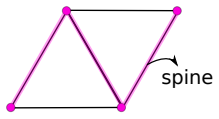
Theorem 18: For any Anosov map f, there exists a bi-infinite geodesic P in the Farey graph F on which f acts by translation. Consequently the stable translation length of an Anosov map on the curve graph of the torus is always a positive integer, and it can be computed exactly by the ladder-and-efficient-geodesic algorithm of Section 5.
Load-bearing premise
The proof of the axis theorem rests on Proposition 13, which states that in a periodic ladder one can find an efficient geodesic in a prime subladder whose bi-infinite concatenation is again an efficient geodesic. The proof is a case analysis of 'reluctant moves' at the ends of the subladder (Section 3.3, proof of Proposition 13, including Lemma 14); if the concatenation is not efficient at the period boundary, the invariant bi-infinite geodesic in the Farey graph would not be constructed. This is a load-bearing combinatorial step, distinct from the geometric claim itself.
Signed reviews
Editorial analysis
A structured set of objections, weighed in public.
Referee Report
Summary. The paper studies the stable translation length of Anosov (hyperbolic) elements of PSL(2,Z) acting on the Farey graph of the torus. The main result (Theorem 18) asserts that every Anosov map has a bi-infinite geodesic axis in the Farey graph, so its stable translation length is a positive integer; the proof is constructive and the authors give an algorithm for computing it from the continued-fraction expansion of a fixed point. The framework is a combinatorial object called a ladder, together with 'efficient' geodesics satisfying a local move rule. Three applications are then developed: identifying a minimal word among products of two Dehn twists, bounding the ratio of Teichmuller to curve-graph translation lengths, and showing the length spectrum is evenly spread.
Significance. If the central theorem is established, this is a clean sporadic-case strengthening of Bowditch's rationality result: on the Farey graph the stable translation length is not merely rational but an integer. The constructive ladder-and-efficient-geodesic method is a useful feature, and the two worked examples give concrete integer lengths. The paper is self-contained against standard facts on cutting sequences and continued fractions, and the main construction has no fitted parameters. However, the central combinatorial concatenation lemma (Proposition 13) is not yet proved rigorously, and since Theorem 18 depends directly on it, the paper currently does not fully secure the advertised result.
major comments (3)
- [§3.3, Proposition 13 and Lemma 14] Proposition 13 is load-bearing for Theorem 18, but its proof is incomplete. The proof asserts, without derivation, that the only possible obstruction to efficiency of the bi-infinite concatenation is a 'reluctant move' at the semi-final-to-final transition; that there are exactly two maximal efficient geodesics in a prime subladder with endpoints on the same side; and that if both candidates are problematic then the first and last coefficients of L' are 1. Figure 9 is used in place of a complete case analysis for the last assertion. Lemma 14, which is supposed to resolve the remaining case, only treats the situation in which the two geodesics do not intersect; it concludes that both are p...p and all coefficients are 1. It does not analyze intersections that occur after different earlier choices, and it does not establish the final claim in the proof of Proposition 13 that an all-1 ladder contradicts the presence of reluctant moves, since the proof does not rule out the possibility that an efficient path in an all-1 finite ladder contains a final t-move. A complete proof of this lemma is required before Theorem 18 can be accepted.
- [§4, Theorem 17] The proof of Theorem 17 asserts that L' is a finite concatenation of copies of the prime subladder L''. This is needed to apply the 'more generally' clause of Proposition 13 in Theorem 18. The common-divisor argument states that minimality of the prime subladder forces the common divisor d to be odd, and then infers from the even length of a prime subladder that p and f(p) lie on different sides of L. Neither the minimality assertion nor the side-switching inference is proved. Please replace this passage with a formal argument, or prove directly that the f-translate of a rung in the periodic part is separated from the rung by an integral number of prime subladders.
- [§5, algorithm after Proposition 21] The correctness of the computation algorithm is not established. After Proposition 21, the paper asserts that if the subladder ~L has even length then p is a pivot point and ~L is a finite concatenation of a prime subladder, and that if it has odd length then calibration (Algorithm 2) converts it into an even-length subladder whose efficient geodesic computes the translation length. No proof is supplied that the calibrated ladder is of the required form or that the length of its efficient geodesic equals l_C(f) rather than a multiple of it. Since the advertised contribution includes an algorithm that computes the exact translation length, this missing justification should be supplied.
minor comments (4)
- [Abstract and Introduction] The abstract says f acts 'transitively' on the invariant geodesic; the precise statement, as in Theorem 18, is that f acts by translation. Please correct this wording.
- [Example 1] The displayed matrix in the text is (277 60; 337 73), but the figure caption and the stated fixed points (77±sqrt(26149))/337 correspond to the matrix (227 60; 337 73). Please correct this inconsistency.
- [§3.3, Proposition 11] The proof of Proposition 11 uses the undefined term 'locus' and dismisses endpoint cases as 'obvious'. Please define the term and expand the exceptional cases, since the local-to-global geodesic argument is not fully formal.
- [§2, Lemma 3] Lemma 3 is cited with the one-line proof 'Refer to [Ser15]'. Since the lemma is used in the proof of Theorem 17, a precise reference to the statement in [Ser15] or a short self-contained explanation would be helpful.
Assumptions & free parameters
assumptions (5)
- standard math Lagrange's theorem: a continued fraction is periodic if and only if it represents a quadratic irrational (cited as [Ste92]).
- standard math Cutting-sequence exponents equal the coefficients of the positive continued fraction (Proposition 1, taken from [Ser15]).
- standard math Two oriented geodesics with the same endpoint eventually have the same cutting sequence (Lemma 3, taken from [Ser15]).
- standard math Every geodesic path between vertices x,y of the Farey graph has each internal vertex incident to an edge separating x,y (Fact 7, taken from [Minsky 1996]).
- standard math The number H(t) of conjugacy classes in SL(2,Z) with trace t satisfies H(t) > |t|^{1-theta} for every theta>0 (Lemma 30, taken from [CCC80]).
Cite this review
Pith. "Pith review of On Translation Lengths of Anosov Maps on Curve Graph of Torus." pith.science (2026). https://pith.science/paper/4LTRO6KK
@misc{pith2026190800472,
  author       = {Pith},
  title        = {Pith review of: On Translation Lengths of Anosov Maps on Curve Graph of Torus},
  year         = {2026},
  howpublished = {\url{https://pith.science/paper/4LTRO6KK}},
  note         = {Machine review of arXiv:1908.00472}
}
read the original abstract
We show that an Anosov map has a geodesic axis on the curve graph of a torus. The direct corollary of our result is the stable translation length of an Anosov map on the curve graph is always a positive integer. As the proof is constructive, we also provide an algorithm to calculate the exact translation length for any given Anosov map. The application of our result is threefold: (a) to determine which word realizes the minimal translation length on the curve graph within a specific class of words, (b) to establish the effective bound on the ratio of translation lengths of an Anosov map on the curve graph to that on Teichm\"uller space, and (c) to estimate the overall growth of the number of Anosov maps which have a sufficient number of Anosov maps with the same translation length.
Figures


Figures from the paper (11 more)




Reference graph
Works this paper leans on
-
[1]
T. Aougab and S. J. Taylor. Pseudo- A nosovs optimizing the ratio of T eichm \" u ller to curve graph translation length. In the tradition of Ahlfors-Bers, VII, Contemporary Mathematics , 696:17--28, 2017
work page 2017
-
[2]
An extremal problem for quasiconformal mappings and a theorem by T hurston
Lipman Bers. An extremal problem for quasiconformal mappings and a theorem by T hurston. Acta Mathematica , 141(1):73--98, 1978
work page 1978
-
[3]
A. F. Beardon, M. Hockman, and I. Short. Geodesic continued fractions. Michigan Mathematical Journal , 61(1):133--150, 2012
work page 2012
-
[4]
Bowditch
Brian H. Bowditch. Tight geodesics in the curve complex. Inventiones mathematicae , 171(2):281--300, 2008
2008
-
[5]
Hyungryul Baik, Ahmad Rafiqi, and Chenxi Wu. Is a typical bi- P erron algebraic unit a pseudo- A nosov dilatation? Ergodic Theory and Dynamical Systems , pages 1--6, 2017
work page 2017
-
[6]
Minimal asymptotic translation lengths of T orelli groups and pure braid groups on the curve graph
Hyungryul Baik and Hyunshik Shin. Minimal asymptotic translation lengths of T orelli groups and pure braid groups on the curve graph. Math. Res. Not. IMRN. , 2018. Electronically published on Dec 4, 2018. (To appear in print)
work page 2018
-
[7]
Polynomial-time algorithms for the curve graph
Mark C Bell and Richard CH Webb. Polynomial-time algorithms for the curve graph. arXiv preprint arXiv:1609.09392 , 2016
work page Pith review arXiv 2016
- [8]
Show all 23 references
-
[9]
Leininger, and Dan Margalit
Benson Farb, Christopher J. Leininger, and Dan Margalit. The lower central series and pseudo- A nosov dilatations. Amer. J. Math. , 130(3):799--827, 2008
2008
-
[10]
Gadre, E
V. Gadre, E. Hironaka, R. P. Kent, IV , and C. J. Leininger. Lipschitz constants to curve complexes. Math. Res. Lett. , 20(4):647--656, 2013
2013
-
[11]
Minimal pseudo- A nosov translation lengths on the complex of curves
Vaibhav Gadre and Chia-Yen Tsai. Minimal pseudo- A nosov translation lengths on the complex of curves. Geom. Topol. , 15(3):1297--1312, 2011
2011
-
[12]
Willam J. Harvey. Boundary structure of the modular group. Riemann surfaces and related topics: Proceedings of the 1978 Stony Brook Conference (State Univ. New York, Stony Brook, N.Y., 1978) , pages 245--251, 1981
1978
-
[13]
Topology of numbers
Allen Hatcher. Topology of numbers. Unpublished manuscript, in preparation , 2017
2017
-
[14]
Kin and H
E. Kin and H. Shin. Small asymptotic translation lengths of pseudo- A nosov maps on the curve complex. Groups Geom. Dyn. , 2017. Electronically published on May 7, 2019. (To appear in print)
2017
-
[15]
A geometric approach to the complex of curves on a surface
Yair N Minsky. A geometric approach to the complex of curves on a surface. In Topology and Teichm \"u ller spaces , pages 149--158. World Scientific, 1996
1996
-
[16]
Geometry of the complex of curves I : Hyperbolicity
Howard A Masur and Yair N Minsky. Geometry of the complex of curves I : Hyperbolicity. Inventiones mathematicae , 138(1):103--149, 1999
1999
-
[17]
Continued fractions and hyperbolic geometry, 2015
Caroline Series. Continued fractions and hyperbolic geometry, 2015
2015
-
[18]
Shackleton
Kenneth J. Shackleton. Tightness and computing distances in the curve complex. Geometriae Dedicata , 160(1):243--259, Oct 2012
2012
-
[19]
Pseudo- A nosov mapping classes not arising from P enner’s construction
Hyunshik Shin and Bal \'a zs Strenner. Pseudo- A nosov mapping classes not arising from P enner’s construction. Geometry & Topology , 19(6):3645--3656, 2016
2016
-
[20]
A proof of L agrange's theorem on periodic continued fractions
John Steinig. A proof of L agrange's theorem on periodic continued fractions. Archiv der Mathematik , 59(1):21--23, 1992
1992
-
[21]
Thurston
William P. Thurston. On the geometry and dynamics of diffeomorphisms of surfaces. Bulletin of the american mathematical society , 19(2):417--431, 1988
1988
-
[22]
Valdivia
Aaron D. Valdivia. Asymptotic translation length in the curve complex. New York J. Math. , 20:989--999, 2014
2014
-
[23]
Combinatorics of tight geodesics and stable lengths
Richard Webb. Combinatorics of tight geodesics and stable lengths. Transactions of the American Mathematical Society , 367(10):7323--7342, 2015
2015
Reviewed August 14, 2026 · model on record in the stance chip above.
Discussion (0). Continue with ORCID to comment.