REVIEW 4 major objections 6 minor 1 cited by
Spherical latent space models for social network analysis
T0 review · 4 major / 6 minor · reviewed 2026-08-05 · deepseek-v4-flash
Pith's one-line read This paper argues that placing a social network's hidden 'social space' on a unit sphere, so that tie probability rises with cosine similarity between latent positions, improves link prediction and community detection over the standard Eucl
desk verdict A clean spherical latent space model with sound math, but the empirical superiority claims are contradicted by the paper's own WAIC table and an undocumented predictive protocol. read the letter →
The pith
A machine-rendered reading of the paper's core claim, the machinery that carries it, and where it could break.
The reading
What carries the argument
The load-bearing object is the spherical latent space model S^{d-1}: each actor i carries a unit vector z_i on the (d−1)-sphere, and the linear predictor is η_ij = α + β z_i^T z_j. This inner-product link is the mechanism that converts angular similarity into tie probability; because z_i^T z_j = cos γ_ij, it gives a bounded, rotation-invariant geometry with every position having only d−1 free parameters. The companion machinery is the Bayesian sampler: uniform priors on the sphere, von Mises–Fisher proposals for single-position Metropolis updates, and geodesic Hamiltonian Monte Carlo for manifold-aware exploration.
What would settle it
Run a pre-registered ten-fold cross-validation on the Florentine families and monks networks, using identical priors and identical hyperparameter-selection rules for all models, and report the S2-versus-R3 difference in AUC and F1; the paper's Table 4 does not state the data split, so this check would settle whether S2's reported 0.994 AUC is a real out-of-sample gain or a tuning artifact.
Extended reading notes
Core claim
The central claim is that switching the latent space of a social network model from Euclidean space to the unit sphere changes the model's bias in a beneficial way. The authors specify η_ij = α + β⟨z_i, z_j⟩ with ∥z_i∥ = ∥z_j∥ = 1, so a tie is more probable when two actors' latent directions align; because ⟨z_i, z_j⟩ = cos(γ_ij), this is equivalent to a decreasing function of geodesic distance, but the cosine form avoids arccos instabilities. The sphere fixes origin and scale, leaving only global rotations as a non-identifiability, and it bounds all distances, which the authors argue prevents the extreme tie probabilities and norm drift that can plague Euclidean latent distance models. In th
Load-bearing premise
The paper's empirical case for the spherical model rests on the unstated evaluation protocol behind Table 4 and on prior hyperparameters tuned to optimize predictive criteria, so if the reported AUC and F1 for S2 are not from a genuinely out-of-sample split with fairly tuned hyperparameters, the predictive advantage would be an artifact—and the paper's own WAIC table, which favors Euclidean R3, already shows that the advantage is not one of in-sample fit.
Editorial extensions
If this is right
- Spherical latent positions eliminate unbounded-distance degeneracy, so optimization and MCMC avoid the norm drift that can destabilize Euclidean latent-space fits.
- On the Florentine families network, the S2 model reports the best out-of-sample AUC (0.994), accuracy (0.952), and F1 (0.857) among R1, R2, R3, S1, and S2, suggesting the geometry itself improves link prediction on dense, alliance-driven networks.
- Spherical embeddings produce tighter posterior configurations (S2 average posterior variance 0.154 vs 3.157 for R3), giving sharper, more compact latent-space visualizations.
- Community detection on the spherical latent spaces achieves higher modularity (S1: 0.391) than on Euclidean spaces (best Euclidean R2: 0.351), so the geometry helps expose block structure.
- The same spherical construction extends to mixed-effect covariates, weighted inner products, finite mixtures, Dirichlet-process clustering, multilayer networks, and dynamic networks, all spelled out in the paper's Section 3.2.
Reading between the lines
- A natural but untested consequence is that the spherical model's advantage is strongest on networks with cyclic or periodic tie patterns—dominance hierarchies, citation cycles, seasonal interaction patterns—where circular geometry matches the topology; the paper motivates this but does not analyze such data.
- The paper's predictive table and its in-sample WAIC table point in opposite directions (WAIC favors R3; AUC/F1 favor S2), so a careful reader should read the abstract's 'improved model fit' as shorthand for out-of-sample prediction and visualization, not within-sample likelihood.
- If the spherical advantage holds, the obvious next experiment is a head-to-head against hyperbolic latent spaces, since both geometries bound distances and hyperbolic space is tailored to hierarchical trees; the paper's closing discussion invites this but does not run it.
- Because the inner-product link is symmetric, the model cannot yet represent directed relations; a testable extension is to replace the inner product with an asymmetric kernel or weighted bilinear form and ask whether the spherical constraint still beats Euclidean baselines.
Editorial analysis
A structured set of objections, weighed in public.
Referee Report
Summary. The paper proposes a spherical latent space model for undirected binary social networks, where nodes are embedded on S^{d-1} and tie probabilities depend on the inner product of latent positions. Bayesian inference is carried out with Metropolis–Hastings, Hamiltonian Monte Carlo, and geodesic/spherical HMC, with an application to the Florentine families network and a monks network in the supplement. The authors claim that the spherical geometry yields improved model fit, predictive performance, and interpretability relative to standard Euclidean latent distance models.
Significance. If the empirical claims were substantiated, this would be a useful contribution: the spherical constraint removes translation and scale indeterminacies, gives a compact bounded latent space, and connects latent space modeling to directional statistics. The likelihood and gradient derivations are standard and appear correct, and the authors include reproducible code. However, the central evidence in the manuscript is not currently convincing: the paper's own model comparison table does not support the 'improved model fit' claim, the predictive evaluation protocol is undocumented, and the model comparison confounds geometry with the choice of link function.
major comments (4)
- [Section 5, Table 2] The abstract and Section 5 claim 'improved model fit' for the spherical model, but Table 2 shows S2 WAIC = 199.367, which is worse than R2 (170.072) and R3 (161.099), and S1 WAIC = 384.106 is the worst overall. The statement that 'spherical models achieve log-likelihood values close to their Euclidean counterparts' does not address the WAIC ranking, and S2 has fewer effective parameters than R3 (n(d-1)+2 vs. nd+1), so the WAIC gap is not explained by complexity. This directly contradicts a central claim of the paper.
- [Section 5, Table 2] Table 2 contains internally inconsistent log-likelihood values. For S2, the ML log-likelihood is -31.852, but the MAP log-likelihood is -16.570 and the posterior-mean log-likelihood is -13.469, both exceeding the maximum of the log-likelihood. For R1, the mean log-likelihood (-43.105) also exceeds the ML log-likelihood (-47.632). Since the MLE maximizes the log-likelihood by definition, these numbers indicate an error in the optimization, MCMC post-processing, or table construction. The numerical comparisons involving S2 are therefore unreliable and must be corrected before the empirical claims can be evaluated.
- [Section 5, Table 4] The out-of-sample predictive evaluation behind Table 4 is not described. The text states that AUC, accuracy, and F1 were assessed 'out-of-sample' and that hyperparameters were 'selected via sensitivity analysis to optimize information and predictive criteria (supplementary material)', but it does not state the train/test split, the number of folds, the edge-sampling scheme, or whether the same folds were used for all models. If the predictive criteria used for tuning are the same as those reported in Table 4, the S2 advantage may be a tuning artifact. The full protocol must be reported, or the strong claim that 'S2 outperforms all others' should be withdrawn.
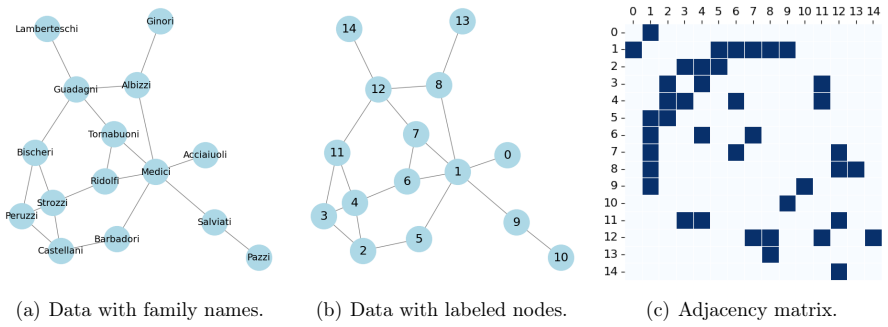
- [Section 3, model specification] The comparison confounds geometry with link function. The spherical model uses the symmetric inner-product link η_{ij} = α + β⟨z_i, z_j⟩, while the Euclidean baselines use the distance link η_{ij} = α - ||z_i - z_j||. Any observed difference in fit or prediction could be due to the change of link function rather than the spherical geometry. To support the claim that spherical geometry itself is beneficial, the paper should include a Euclidean inner-product/projection baseline (for example, the projection model of Hoff et al. 2002) or otherwise isolate the geometric effect.
minor comments (6)
- [Section 5, Table 4] The column headers of Table 4 read 'R1 R2 R2 S1 S2'; the third column should presumably be 'R3'.
- [Section 3.1] Typo: 'see Section 3.1 dor details' should be 'for details'.
- [Section 4.2] The text 'andacorrelatedGaussianprior' is missing spaces; it should read 'and a correlated Gaussian prior'.
- [Section 4.2.1, Algorithm 4] Line 14 of Algorithm 4 uses 'p(m)' which is undefined; it should likely be 'p^{(b)}' or 'p*'.
- [Section 5, Figure 5] The caption says 'Latent space representations for R1 and S1 models', but the figure contains panels for R1, S1, R2, and S2. The caption should list all four panels.
- [Section 5] The sensitivity analysis mentioned in the text is only described as 'supplementary material'; the main text should at least summarize the ranges of hyperparameters considered and the criterion used.
Circularity Check
No significant circularity: the spherical model is a self-contained empirical proposal; the predictive evaluation protocol is under-specified but not shown to be circular.
full rationale
The paper's core contribution is an empirical model specification: latent positions constrained to a sphere, with a well-defined likelihood, prior, and MCMC inference. There is no derivation that reduces a predicted quantity to an input by construction. The spherical linear predictor eta = alpha + beta <z_i, z_j> is defined independently of the Euclidean distance baseline; the comparison is an empirical model fit, not a mathematical consequence. The abstract's claim of 'improved model fit' is undermined by the paper's own Table 2, where WAIC favors the Euclidean R3 model (161.099) over the spherical S2 model (199.367), and Table 4's 'out-of-sample' predictive protocol is not described (no split, folds, or edge-sampling details). These are significant evidential and reproducibility concerns, but they do not constitute circularity: the predictive metrics are not shown to be identical to the hyperparameter selection criterion, and no equation or fitted parameter is renamed as a prediction. Self-citations (e.g., Sosa & Betancourt 2022 for centrality measures) are used for definitions and reviews, not as load-bearing justifications for the central claim. Therefore no circular step can be established from the manuscript text.
Assumptions & free parameters
free parameters (5)
- alpha (intercept) =
estimated, not reported
- beta (similarity scaling) =
estimated, not reported
- Latent positions Z =
n(d-1) values per model
- Euclidean hyperparameters sigma_z and sigma_alpha =
5.0, 5.0
- Spherical hyperparameters rho, mu_alpha, sigma_alpha, mu_beta, sigma_beta =
-0.5, 0.0, 1.0, 10.0, 5.0
assumptions (5)
- domain assumption Dyads are conditionally independent given latent positions and parameters.
- standard math Jointly exchangeable random effects can be represented as h(z_i, z_j) with i.i.d. latent variables z_i.
- domain assumption The spherical geometry with a symmetric inner-product link is adequate for the networks under study.
- domain assumption Excluding the isolated Florentine family does not change the model comparison.
- ad hoc to paper Hyperparameters selected via sensitivity analysis are valid for model comparison.
Cite this review
Pith. "Pith review of Spherical latent space models for social network analysis." pith.science (2026). https://pith.science/paper/4LVWFKVC
@misc{pith2026250816556,
  author       = {Pith},
  title        = {Pith review of: Spherical latent space models for social network analysis},
  year         = {2026},
  howpublished = {\url{https://pith.science/paper/4LVWFKVC}},
  note         = {Machine review of arXiv:2508.16556}
}
read the original abstract
This article introduces a spherical latent space model for social network analysis, embedding actors on a hypersphere rather than in Euclidean space as in standard latent space models. The spherical geometry facilitates the representation of transitive relationships and community structure, naturally captures cyclical patterns, and ensures bounded distances, thereby mitigating degeneracy issues common in traditional approaches. Bayesian inference is performed via Markov chain Monte Carlo methods to estimate both latent positions and other model parameters. The approach is demonstrated using two benchmark social network datasets, yielding improved model fit and interpretability relative to conventional latent space models.
Figures


Figures from the paper (5 more)


Forward citations
Cited by 1 Pith paper
-
Latent space models for networks with nodal multiplicative effects
Nodal multiplicative distance scaling improves generative flexibility and structural fit of latent space network models.
Reference graph
Works this paper leans on
-
[1]
Al-Taie, M. Z. and Kadry, S. (2017).Python for graph and network analysis. Springer. Albert, J. et al. (2009).Bayesian computation with R, volume
work page 2017
-
[2]
Springer. Aldous, D. (1985). Exchangeability and related topics. École d’été de probabilités de Saint-Flour, XIII—1983, 1117:1–198. Aliverti, E. and Russo, M. (2022). Stratified stochastic variational inference for high- dimensional network factor model.Journal of Computational and Graphical Statistics, 31(2):502–511. Austin, A., Linkletter, C., and Wu, Z...
arXiv 1985
-
[3]
Cambridge University Press Cambridge, UK:. Raftery, A. E., Niu, X., Hoff, P. D., and Yeung, K. Y. (2012). Fast inference for the latent space network model using a case-control approximate likelihood.Journal of computational and graphical statistics, 21(4):901–919. Rastelli, R. and Friel, N. (2018). Optimal bayesian estimators for latent variable cluster ...
work page 2012
-
[7]
Courier Dover Publications. Sethuraman, J. (1994). A constructive definition of dirichlet priors. Statistica sinica, pages 639–650. Sewell, D. K. and Chen, Y. (2015). Latent space models for dynamic networks.Journal of the American Statistical Association, 110(512):1646–1657. Sewell, D. K. and Chen, Y. (2016). Latent space models for dynamic networks with...
work page 1994
-
[20]
Hoff, P. D. (2009). Multiplicative latent factor models for description and prediction of social networks. Computational and mathematical organization theory, 15(4):261–272. Hoff, P. D. (2011). Hierarchical multilinear models for multiway data.Computational Statistics & Data Analysis, 55(1):530–543. Hoff, P. D. (2015). Multilinear tensor regression for lo...
work page 2009
-
[233]
Gollini, I. and Murphy, T. B. (2016). Joint modeling of multiple network views.Journal of Computational and Graphical Statistics, 25(1):246–265. Golub, G. H. and Van Loan, C. F. (2013).Matrix computations. JHU press. Guhaniyogi, R. and Rodriguez, A. (2020). Joint modeling of longitudinal relational data and exogenous variables.Bayesian Analysis, 15(2):477...
work page 2016
-
[1087]
Padgett, J. F. and Ansell, C. K. (1993). Robust action and the rise of the medici, 1400-
work page 1993
- [1434]
Show all 9 references
-
[2025]
and Calvo, M.-P
Sanz-Serna, J.-M. and Calvo, M.-P. (2018).Numerical hamiltonian problems, volume
2018
Reviewed August 5, 2026 · model on record in the stance chip above.
Discussion (0). Continue with ORCID to comment.