REVIEW 3 major objections 6 minor 1 cited by
Extreme firebrand transport by atmospheric waves in wildfires
T0 review · 3 major / 6 minor · reviewed 2026-08-12 · deepseek-v4-flash
Pith's one-line read Atmospheric traveling waves can extend firebrand spotting distances by an order of magnitude.
desk verdict Plausible new spotting mechanism, solid numerics, but the analytical explanation rests on unchecked approximations and needs a validation pass against the full model. read the letter →
The pith
A machine-rendered reading of the paper's core claim, the machinery that carries it, and where it could break.
The reading
What carries the argument
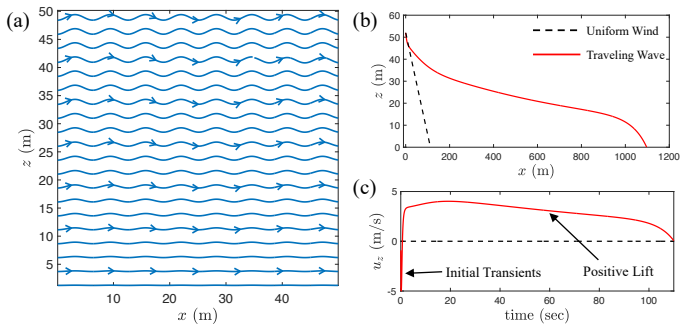
The load-bearing object is the monochromatic traveling wave $\psi(x,z,t)=Uz+aU\sin(\ell z)\cos(kx-\omega t+\phi)$, an exact solution of the two-dimensional inviscid vorticity equation with dispersion relation $\omega=kU$; its vertical velocity is $u_z=akU\sin(\ell z)\sin(kx-\omega t+\phi)$. The analysis also relies on the reduced-order firebrand equations (9)-(10): after initial transients the horizontal firebrand velocity equals the local streamwise wind, and the vertical velocity equals the vertical wind minus a gravitational settling speed $\sqrt{2mg/(\rho_f A_c C_d)}$. The synchronization of the firebrand's horizontal motion with the wave turns the oscillatory vertical wind into a static vertical profile along the trajectory, which is what allows a persistent positive lift and the delayed landing.
What would settle it
Integrate the full equations (1) in the exact traveling wave (6) with $U=10$ m/s, a 0.75 mm firebrand, and initial height 50 m, but keep the variable mass (2). If the landing distance is close to the uniform-wind value near 116 m rather than roughly 1.1 km, the frozen-phase, constant-mass mechanism fails; the same run also tests whether the predicted 130 s residence time is real.
Extended reading notes
Core claim
The paper's central claim is that a firebrand's horizontal velocity can synchronize with a traveling atmospheric wave because the wave's phase speed equals the mean wind speed ($\omega/k=U$). Once synchronized, the wave phase $kx_p(t)-\omega t$ is nearly frozen, so the vertical wind felt by the firebrand becomes a time-independent shape $A\sin(\ell z)$; depending on the random initial horizontal position, the firebrand sits in free fall, a downward-lift region, or an upward-lift region. In the upward-lift region the vertical wind opposes gravity, giving a surf-like motion that delays landing. With mass held fixed, the reduced-order vertical equation (14) solves exactly to give landing time (17), and since the horizontal displacement is approximately $U t_L$, the landing distance can reach roughly $U t_L = 1300$ m for $U=10$ m/s, 0.75-mm firebrands released from 50 m, compared with 116 m in uniform wind. This is the paper's explanation for the empirically observed discrepancy in spotting distances.
Load-bearing premise
The argument assumes that a firebrand's horizontal speed stays locked to the wave's speed for the whole upward ride, and that its mass does not shrink appreciably during that ride, so the same upward wind region keeps lifting it.
Editorial extensions
If this is right
- Landing time in a traveling wave depends on mean wind speed in the positive-lift regime, growing rapidly with $U$, whereas in uniform wind it is independent of $U$.
- The landing-distance distribution acquires a heavy right tail as wind speed increases, so kilometer-scale spot fires become plausible outcomes rather than rare errors.
- The analytical landing-time formula (17) gives a direct parameter-to-distance map that could replace uniform-wind estimates in spotting forecasts.
- Extreme spotting no longer requires extreme wind: in uniform wind a 1-km spot would need about 86 m/s, while the wave achieves it at 10 m/s.
Reading between the lines
- A testable extension: the same phase-locking should apply to other quasi-steady atmospheric waves such as lee waves; tracking embers in a numerical atmosphere with Fourier decomposition of the wind would show whether persistent coherent updrafts produce similar heavy landing tails.
- A natural extension is to redo the landing-time formula without the constant-mass approximation; under the paper's own mass-loss law, after 130 s the ember retains only about 17% of its initial mass, which raises its settling speed and changes the predicted residence time.
- Because the lift regime is selected by $\sin(kx_0+\phi)$, real-world spotting risk depends on the distribution of launch phases inside the fire plume; measuring that distribution in controlled burns would convert the heavy-tail prediction into a quantitative hazard forecast.
Editorial analysis
A structured set of objections, weighed in public.
Referee Report
Summary. The paper studies firebrand (ember) transport in wildfire spotting, focusing on the effect of atmospheric traveling waves on landing distance. The authors first present Monte Carlo evidence that a traveling wave wind field can produce landing distances an order of magnitude larger than a unidirectional wind with the same mean speed. They then propose a theoretical mechanism: after an initial transient, a firebrand's horizontal velocity synchronizes with the wave, freezing the wave phase along the trajectory. In the case of positive vertical lift, the firebrand can experience a surf-like motion that significantly delays landing. The paper derives closed-form expressions for the landing time and landing distance of firebrands in such a traveling wave.
Significance. If the proposed mechanism is correct, the paper offers a plausible physical explanation for kilometer-scale spotting distances that have been observed but not captured by earlier analytical estimates. The numerical Monte Carlo study is straightforward and provides robust evidence of the order-of-magnitude effect in the right tail of the landing-distance distribution, which is the paper's primary empirical claim. The analytical formulas are elegant and may be useful as a reduced-order description, provided the underlying approximations are justified. The central novelty—identification of a phase-locking, positive-lift transport regime—is interesting and clearly communicated. However, the analytical theory relies on two assumptions (constant firebrand mass and exact phase locking) whose validity over the long residence times is not demonstrated, and the theory is not quantitatively validated against the full-order simulations that motivate it.
major comments (3)
- [§4.2, Eq. (14)-(17)] The analytical landing time (17) is derived under the assumption m(t)=m0, stated just before Eq. (14). Over the predicted residence time of 130 s, the mass law (2) gives m(130)/m0 = (1 + 2.86e-4 × 130^2)^-1 ≈ 0.17, so the gravitational settling speed G = sqrt(2 m g/(rho_f A_c C_d)) decreases from about 4.3 m/s to about 1.8 m/s. This is the same order as the lift amplitude A = 4.25 m/s in the example considered here, meaning that the balance A sin(ℓ z) ≈ G that determines the positive-lift branch is strongly time-dependent. Consequently, Eq. (17) is not the solution of the reduced-order equation actually coupled with the mass-loss law, and the paper does not show that the constant-mass approximation is accurate in this regime. The authors should either solve Eq. (14) with m(t) given by (2) (possibly asymptotically) or demonstrate numerically that ignoring mass loss leaves the landing time and distance unchanged for the positive-lift branch; otherwise, the quantitative prediction t_L ≈ 130 s and L ≈ 1300 m is unsupported.
- [§4.2, passage preceding Eq. (14)] The phase-lock condition k x_p − ω t ≈ k x_0 is asserted rather than derived. The actual evolution of the wave phase along a firebrand trajectory, obtained from the reduced equations (9)-(10) and the streamwise velocity (6a), is θ' = k a ℓ U cos(ℓ z_p) cos(θ), where θ = k x_p − ω t + φ. This ODE has a stable fixed point at θ = π/2 when cos(ℓ z_p) > 0, which would indeed produce the positive-lift regime used in the theory. However, the paper does not analyze the rate of convergence to this fixed point, the effect of vertical motion on the sign of cos(ℓ z_p), or the possibility of phase slips over the long residence time. A derivation or, failing that, numerical evidence of phase locking (e.g., a time series of θ along a firebrand trajectory) is needed to justify replacing u_z by A sin(ℓ z_p) in Eq. (14).
- [§3 vs §4.2, closing paragraph] The numerical results in §3 are obtained from the full-order model (1) with the time-dependent mass (2), whereas the theoretical results in §4.2 are obtained from the reduced-order model (9)-(10) with constant mass. The closing paragraph of §4.2 acknowledges that the two models differ, but it does not provide a direct comparison for identical initial conditions. Since the abstract and introduction present the analytical formulas as the main theoretical contribution, the authors should validate Eq. (17) against numerical integrations of the reduced model with variable mass and, if possible, against the full-order model. A scatter plot or table comparing predicted and simulated landing times for a range of U and z0 would clarify the accuracy of the theory and the role of each approximation.
minor comments (6)
- [§2.2, Eq. (4) and §4.2] The symbol ℓ is called the 'spanwise wavenumber,' but ℓ is the vertical wavenumber in the stream function (4). The term 'spanwise' usually refers to the lateral horizontal direction and may confuse readers; 'vertical wavenumber' would be more appropriate.
- [§3, Eq. (7)] The notation LN(μ, σ) is ambiguous because the lognormal distribution is often parameterized by the mean and standard deviation of the underlying normal distribution. The text states that μ and σ are the mean and standard deviation of the lognormal variable itself, which is a valid but nonstandard convention; please define the probability density function or state the parameterization explicitly.
- [§2.2 and §3] The wave phase φ in the traveling wave (4) is never specified in the numerical simulations. Please state the value used (e.g., φ = 0) and indicate whether the statistical results are sensitive to this choice, since the sign of sin(kX0 + φ) determines whether a firebrand enters the positive- or negative-lift regime.
- [§3, Fig. 2(b) and §4.2, Fig. 4] The full-order trajectory in Fig. 2(b) lands at approximately 1100 m, while the analytical prediction for the positive-lift branch with sin(kx0+φ)=0.85 gives L ≈ 1300 m. These are not for identical initial conditions, and the discrepancy is not discussed. A one-to-one comparison for the same (x0, z0, r, φ) would help assess the accuracy of the theoretical formula.
- [§4.1] The statement that 'the time dependence of the firebrand mass does not have a significant impact on its landing time' is justified for uniform wind because the landing time is short (about 11.6 s for the example), during which m(t) changes by only a few percent. The same justification does not apply to the positive-lift regime in §4.2, where the residence time is an order of magnitude longer; this contrast should be made explicit.
- [Abstract and §5] The abstract claims that traveling waves 'can increase the spotting distance by at least an order of magnitude compared to unidirectional wind conditions.' The presented numerical evidence supports this for the right tail of the landing-distance distribution, but not necessarily for the mean landing distance. The wording should specify 'extreme landing distances' or 'the upper tail' to avoid overgeneralizing the claim.
Circularity Check
No significant circularity: the numerical Monte Carlo study and the analytical landing-time formula are independent derivations, and the only same-author citation supports a standard, non-predicted modeling assumption.
full rationale
The paper is not circular. The numerical claim that traveling waves increase spotting distances is obtained by Monte Carlo integration of the full inertial-particle model (1)-(2) with the exact traveling-wave solution (4)-(6); no parameter in that simulation is fitted to the theoretical landing-time formula. The theory in §4.2 starts from the reduced-order equations (9)-(10), attributed to the external Tarifa reference, and solves Eq. (14) analytically under the explicitly stated constant-mass assumption m(t)=m0; Eq. (17) is the exact solution of that stated ODE, not a regression or a re-labeling of simulation outputs. The phase-lock approximation kx_p(t)-omega t ≈ kx_0 follows from the dispersion relation omega=kU together with u_x ≈ U, an approximation quantified by a*ell << 1; it is a derived consequence of the model, not a premise that already contains the claimed prediction. The only same-author citation, [15], is used for the physically checkable standard assumption that buoyancy, pressure gradients, and added mass are negligible; this assumption is an input to the reduced model but is not itself the result being predicted, and no uniqueness theorem is imported from the authors' prior work. The analytic landing-time formula is an exact solution of the reduced equations under the stated approximations, so any failure of the constant-mass or phase-lock assumptions over the long residence time is a correctness risk, not a circular reduction; the paper itself separates full-order numerics from reduced-order theory in the closing paragraph of §4.2. The quantitative agreement with the numerical order-of-magnitude result is therefore a substantive explanation rather than an identity.
Assumptions & free parameters
free parameters (5)
- wave amplitude a and wavenumber k (a*k = 1/2) =
a=1/2, k=1
- vertical wavenumber l = pi/H with H=100 m =
l about 0.0314 m^-1
- wave phase phi =
not stated; effectively 0 in the Monte Carlo
- initial-condition distributions (X0, Z0, R) =
X0~N(0,1), Z0~LN(50,5), R~LN(0.75 mm,0.075 mm)
- mass-loss constant eta =
2.86e-4 s^-2
assumptions (4)
- standard math The vorticity-stream function (4) is an exact solution of the 2D inviscid incompressible Euler equations under the dispersion relation omega=k*U.
- domain assumption The reduced-order equations (9)-(10) are valid after initial transients: horizontal drag equilibrates to v_x=u_x and vertical drag balances gravity.
- ad hoc to paper The firebrand mass is approximately constant, m(t)=m0, and the O(a*ell*U) streamwise velocity perturbation can be neglected so x_p about x0+U*t.
- domain assumption Buoyancy, pressure gradients, and added mass are negligible compared to drag and gravity.
Cite this review
Pith. "Pith review of Extreme firebrand transport by atmospheric waves in wildfires." pith.science (2026). https://pith.science/paper/4MGDJBJ6
@misc{pith2026241113275,
  author       = {Pith},
  title        = {Pith review of: Extreme firebrand transport by atmospheric waves in wildfires},
  year         = {2026},
  howpublished = {\url{https://pith.science/paper/4MGDJBJ6}},
  note         = {Machine review of arXiv:2411.13275}
}
read the original abstract
In wildfires, burning pieces of ember-firebrands-are carried downstream by wind. At the time of landing, these firebrands can start secondary fires far away from the main burning unit. This phenomenon is called spotting and the secondary fires are referred to as spot fires. Here, we first present numerical evidence that atmospheric traveling waves can increase the spotting distance by at least an order of magnitude compared to unidirectional wind conditions. We then present theoretical results explaining this numerical observation. In particular, we show that the firebrand's motion can synchronize with the traveling wave, leading to a surf-like motion for some firebrand particles. This delays the firebrand's landing, making extreme spotting distances possible. This physical phenomena helps explain the discrepancy between previous theoretical estimates of maximum spotting distance and much larger spotting distances observed empirically. We derive new analytical expressions for the landing time and landing distance of the firebrands.
Figures


Figures from the paper (1 more)

Forward citations
Cited by 1 Pith paper
-
Models of Wildland Fire and Ember Spread
A mostly review chapter adds an idealized model showing that surface ember transport can explain why some fires grow linearly in area while others grow quadratically.
Reference graph
Works this paper leans on
- [1]
- [2]
-
[3]
I. Dal-Ri dos Santos and N. Yaghoobian. Effects of urban boundary layer turbu- lence on firebrand transport. Fire Safety Journal, 135:103726, 2023
work page 2023
-
[4]
P. F. Ellis. The aerodynamic and combustion characteristics of eucalypt bark : a firebrand study. PhD thesis, The Australian National University, 2000
work page 2000
-
[5]
G. Haller and T. Sapsis. Where do inertial particles go in fluid flows? Physica D, 237(5):573–583, 2008
work page 2008
-
[6]
M. E. Houssami, E. Mueller, J. C. Thomas, A. Simeoni, A. Filkov, N. Skowronski, M. R. Gallagher, K. Clark, and R. Kremens. Experimental procedures character- ising firebrand generation in wildland fires. Fire Technol, 52:731–751, 2016
work page 2016
-
[7]
I. Kim, S. Elghobashi, and W. A. Sirignano. On the equation for spherical-particle motion: effect of Reynolds and acceleration numbers.Journal of Fluid Mechanics, 367:221–253, 1998
1998
-
[8]
E. Koo, R. R. Linn, P. J. Pagni, and C. B. Edminster. Modelling firebrand transport in wildfires using HIGRAD/FIRETEC. International Journal of Wildland Fire , 21:396–417, 2012
work page 2012
Show all 24 references
-
[9]
E. Koo, P. J. Pagni, D. R. Weise, and J. P. Woycheese. Firebrands and spotting ignition in large-scale fires. International Journal of Wildland Fire , 19(7):818– 843, 2010
2010
-
[10]
Kortas, P
S. Kortas, P. Mindykowski, J. L. Consalvi, H. Mhiri, and B. Porterie. Experimental validation of a numerical model for the transport of firebrands.Fire Safety Journal, 44(8):1095–1102, 2009. 11
2009
-
[11]
Lee and J
S.-L. Lee and J. M. Hellman. Firebrand trajectory study using an empirical velocity-dependent burning law. Combustion and Flame, 15(3):265–274, 1970
1970
-
[12]
R. R. Linn and P. Cunningham. Numerical simulations of grass fires using a coupled atmosphere–fire model: Basic fire behavior and dependence on wind speed. Journal of Geophysical Research: Atmospheres, 110:D13, 2005
2005
-
[13]
Mahato, S
B. Mahato, S. Saxena, and N. Yaghoobian. Aerodynamic force modifications of a spherical particle with varying temperature: a study of an idealized firebrand. Theoretical and Computational Fluid Dynamics, 38(2):251–268, 2024
2024
-
[14]
M. R. Maxey and J. J. Riley. Equation of motion for a small rigid sphere in a nonuniform flow. Phys. Fluids, 26:883–889, 1983
1983
-
[15]
Mendez and M
A. Mendez and M. Farazmand. Quantifying rare events in spotting: How far do wildfires spread? Fire Safety Journal, 132:103630, 2022
2022
-
[16]
Muraszew and J
A. Muraszew and J. B. Fedele. Statistical model for spot fire hazard. Technical report, Aerospace Report No. ATR-77(7588)-1, El Segundo, CA: The Aerospace Corporation, 1976
1976
-
[17]
Nichols, E
J. Nichols, E. Joseph, A. Kaphle, P. Tunby, L. Rodriguez, A. Khandelwal, J. Reale, P. Regier, D. J. Van Horn, and R. Gonz´alez-Pinz´on. Longitudinal propagation of aquatic disturbances following the largest wildfire recorded in New Mexico, USA. Nature Communications, 15(1):7143, 2024
2024
-
[18]
W. G. Page, N. S. Wagenbrenner, B. W. Butler, and D. L. Blunck. An analysis of spotting distances during the 2017 fire season in the Northern Rockies, USA. Canadian Journal of Forest Research, 49(3):317–325, 2019
2017
-
[19]
Rubin, C
J. Rubin, C. K. R. T. Jones, and M. Maxey. Settling and asymptotic motion of aerosol particles in a cellular flow field. J. Nonlinear Sci., 5(4):337–358, 1995
1995
-
[20]
C. S. Tarifa, P. P. del Notario, and F. G. Moreno. On flight paths and life- times of burning particles of wood. Symposium (International) on Combustion , 10(1):1021–1037, 1965
1965
-
[21]
Tohidi, N
A. Tohidi, N. Kaye, and W. Bridges. Statistical description of firebrand size and shape distribution from coniferous trees for use in Metropolis Monte Carlo simulations of firebrand flight distance. Fire Safety Journal, 77:21–35, 2015
2015
-
[22]
Tohidi and N
A. Tohidi and N. B. Kaye. Stochastic modeling of firebrand shower scenarios. Fire Safety Journal, 91:91–102, 2017
2017
-
[23]
Department of Agriculture
U.S. Department of Agriculture. Gallinas-Las Dispensas prescribed fire declared wildfire review, 2022
2022
-
[24]
Wadhwani, C
R. Wadhwani, C. Sullivan, A. Wickramasinghe, M. Kyng, N. Khan, and K. Moin- uddin. A review of firebrand studies on generation and transport. Fire Safety Journal, 134:103674, 2022. 12
2022
Reviewed August 12, 2026 · model on record in the stance chip above.
Discussion (0). Continue with ORCID to comment.