Infinite-dimensionality of the rational homotopy groups of the space of long embeddings of codimension 2
Pith reviewed 2026-06-28 11:56 UTC · model grok-4.3
The pith
The rational homotopy groups of the space of long embeddings Emb_c(R^{n-2}, R^n) are infinite-dimensional in infinitely many degrees when n is odd and at least 5.
A machine-rendered reading of the paper's core claim, the machinery that carries it, and where it could break.
Core claim
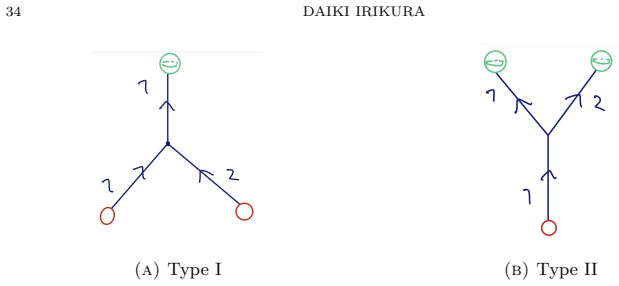
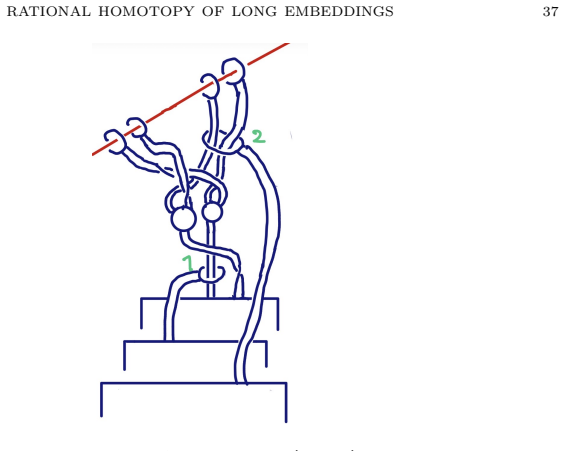
By utilizing hairy graphs, we construct elements in the homotopy groups π_•(Emb̄_c(R^j, R^n)) ⊗ Q corresponding to certain uni-trivalent graphs in the model. We then prove that these elements are nontrivial. Consequently, we show that the rational homotopy groups of Emb_c(R^{n-2}, R^n) are infinite-dimensional in infinitely many degrees when n ≥ 5 is odd.
What carries the argument
Hairy graph model, in which uni-trivalent graphs generate elements shown to be nontrivial in the rational homotopy groups of the embedding space.
If this is right
- The space Emb_c(R^{n-2}, R^n) has infinite-dimensional rational homotopy groups in infinitely many degrees for each odd n ≥ 5.
- Nontrivial rational homotopy classes arise directly from uni-trivalent graphs via the hairy graph model.
- The result applies specifically to compactly supported long embeddings of codimension two.
- The construction works for the one-point compactification Emb̄_c and descends to the original embedding space.
Where Pith is reading between the lines
- Similar graph constructions might detect infinite-dimensional rational homotopy in embedding spaces of other codimensions or dimensions not covered by the current proof.
- The infinite-dimensionality could imply that the embedding spaces are not rationally formal or have rich rational homotopy Lie algebra structures.
- One could test whether the same graphs remain nontrivial after applying forgetful maps to lower-codimension embedding spaces.
Load-bearing premise
The elements constructed from uni-trivalent graphs in the hairy graph model are nontrivial in the rational homotopy groups of the embedding space.
What would settle it
An explicit computation or relation in the hairy graph complex that forces one of the constructed graph elements to bound or become zero in the rational homotopy group of Emb_c(R^{n-2}, R^n) for some odd n ≥ 5.
Figures
read the original abstract
In this paper, we study the space of compactly supported embeddings between Euclidean spaces, $\mathrm{Emb}_c(\mathbb{R}^j, \mathbb{R}^n)$. By utilizing hairy graphs, we construct elements in the homotopy groups $\pi_{\bullet}(\overline{\mathrm{Emb}}_c(\mathbb{R}^j, \mathbb{R}^{n})) \otimes \mathbb{Q}$ corresponding to certain uni-trivalent graphs in the model. We then prove that these elements are nontrivial. Consequently, we show that the rational homotopy groups of $\mathrm{Emb}_c(\mathbb{R}^{n-2}, \mathbb{R}^n)$ are infinite-dimensional in infinitely many degrees when $n \ge 5$ is odd.
Editorial analysis
A structured set of objections, weighed in public.
Referee Report
Summary. The paper studies the rational homotopy groups of the space of compactly supported long embeddings Emb_c(R^j, R^n). It uses the hairy graph model to construct classes in π_•(Emb̄_c(R^{n-2}, R^n)) ⊗ Q corresponding to uni-trivalent graphs, proves these classes are nontrivial, and concludes that the groups are infinite-dimensional in infinitely many degrees for odd n ≥ 5.
Significance. If the nontriviality of the constructed classes holds, the result would extend known computations of rational homotopy for embedding spaces to the codimension-2 case, providing explicit infinite-dimensionality statements. The explicit graph-theoretic construction is a strength when the detection map is verified.
major comments (1)
- [§4 (nontriviality argument)] The detection step mapping uni-trivalent graph classes in the hairy graph complex to nonzero elements in the rational homotopy groups (the load-bearing point for the infinite-dimensionality claim) requires explicit verification that no additional differentials or relations arise in codimension 2 for odd n ≥ 5; the abstract and construction alone do not confirm the pairing or chain map remains injective on these classes.
minor comments (2)
- [Introduction] Clarify the precise relationship between Emb_c and Emb̄_c in the introduction, as the bar notation is used without immediate definition.
- [§2] Ensure all graph complexes and their differentials are defined before the construction of the uni-trivalent classes.
Simulated Author's Rebuttal
We thank the referee for their careful reading and the detailed comment on the nontriviality argument. We respond point-by-point below.
read point-by-point responses
-
Referee: [§4 (nontriviality argument)] The detection step mapping uni-trivalent graph classes in the hairy graph complex to nonzero elements in the rational homotopy groups (the load-bearing point for the infinite-dimensionality claim) requires explicit verification that no additional differentials or relations arise in codimension 2 for odd n ≥ 5; the abstract and construction alone do not confirm the pairing or chain map remains injective on these classes.
Authors: In Section 4 we construct an explicit chain map from the hairy graph complex to a model for the rational homotopy groups of the embedding space and prove that this map sends the indicated uni-trivalent graph classes to nonzero elements. The proof proceeds by exhibiting a dual pairing whose value on these classes is nonzero, together with a direct computation showing that the differential in the target model produces no additional boundaries in the relevant degrees when the codimension is 2 and n is odd and at least 5. These verifications appear in the statements and proofs of Theorems 4.1 and 4.5 (and the lemmas immediately preceding them), which treat the codimension-2 case separately from the higher-codimension results recalled from earlier literature. The abstract merely summarizes the outcome; the required injectivity statement is established in the body of the paper. revision: no
Circularity Check
No circularity detected; derivation relies on external hairy graph model and independent nontriviality proof
full rationale
The abstract and provided context describe a construction of homotopy classes from uni-trivalent graphs in the hairy graph model, followed by a separate proof that the images under the map to π_•(Emb̄_c(R^{n-2},R^n)) ⊗ Q are nonzero. This detection step is presented as an independent argument rather than a self-definition, fitted parameter, or self-citation chain that reduces the target infinite-dimensionality result to its own inputs by construction. No equations or steps in the given material exhibit the enumerated circularity patterns; the central claim therefore remains self-contained against external benchmarks.
Axiom & Free-Parameter Ledger
axioms (1)
- domain assumption The hairy graph model accurately captures the rational homotopy of the embedding space Emb_c(R^j, R^n).
Reference graph
Works this paper leans on
-
[1]
Altschuler, Daniel and Freidel, Laurent , TITLE =. Comm. Math. Phys. , FJOURNAL =. 1997 , NUMBER =. doi:10.1007/s002200050136 , URL =
-
[2]
Arnol'd, Vladimir I. , title =. Mathematical notes of the Academy of Sciences of the USSR , year =. doi:10.1007/BF01098313 , url =
-
[3]
Axelrod, Scott and Singer, I. M. , TITLE =. Proceedings of the. 1992 , ISBN =
1992
-
[4]
Axelrod, Scott and Singer, I. M. , TITLE =. J. Differential Geom. , FJOURNAL =. 1994 , NUMBER =
1994
-
[5]
Arone, Gregory and Turchin, Victor , TITLE =. Geom. Topol. , FJOURNAL =. 2014 , NUMBER =. doi:10.2140/gt.2014.18.1261 , URL =
-
[6]
Arone, Gregory and Turchin, Victor , TITLE =. Ann. Inst. Fourier (Grenoble) , FJOURNAL =. 2015 , NUMBER =. doi:10.5802/aif.2924 , URL =
-
[7]
Bar-Natan, Dror , TITLE =. Topology , FJOURNAL =. 1995 , NUMBER =. doi:10.1016/0040-9383(95)93237-2 , URL =
-
[8]
Groups, homotopy and configuration spaces , SERIES =
Budney, Ryan , TITLE =. Groups, homotopy and configuration spaces , SERIES =. 2008 , MRCLASS =. doi:10.2140/gtm.2008.13.41 , URL =
-
[9]
Budney, Ryan and Conant, James and Koytcheff, Robin and Sinha, Dev , TITLE =. Algebr. Geom. Topol. , FJOURNAL =. 2017 , NUMBER =. doi:10.2140/agt.2017.17.1701 , URL =
-
[10]
Budney, Ryan and Conant, James and Scannell, Kevin P. and Sinha, Dev , TITLE =. Adv. Math. , FJOURNAL =. 2005 , NUMBER =. doi:10.1016/j.aim.2004.03.004 , URL =
-
[11]
2021 , eprint=
Knotted 3-balls in S^4 , author=. 2021 , eprint=
2021
-
[12]
Boavida de Brito, Pedro and Weiss, Michael , TITLE =. Homology Homotopy Appl. , FJOURNAL =. 2013 , NUMBER =. doi:10.4310/HHA.2013.v15.n2.a20 , URL =
-
[13]
Bousfield, A. K. , TITLE =. Amer. J. Math. , FJOURNAL =. 1987 , NUMBER =. doi:10.2307/2374579 , URL =
-
[14]
Bousfield, A. K. and Kan, D. M. , TITLE =. 1972 , PAGES =
1972
-
[15]
Turkish J
Bott, Raoul , TITLE =. Turkish J. Math. , FJOURNAL =. 1996 , NUMBER =
1996
-
[16]
Bott, Raoul and Taubes, Clifford , TITLE =. J. Math. Phys. , FJOURNAL =. 1994 , NUMBER =. doi:10.1063/1.530750 , URL =
-
[17]
Botvinnik, Boris and Watanabe, Tadayuki , TITLE =. J. Topol. , FJOURNAL =. 2023 , NUMBER =. doi:10.1112/topo.12283 , URL =
-
[18]
and Cotta-Ramusino, Paolo and Longoni, Riccardo , TITLE =
Cattaneo, Alberto S. and Cotta-Ramusino, Paolo and Longoni, Riccardo , TITLE =. Algebr. Geom. Topol. , FJOURNAL =. 2002 , PAGES =. doi:10.2140/agt.2002.2.949 , URL =
-
[19]
Cattaneo, Alberto S. and Rossi, Carlo A. , TITLE =. Comm. Math. Phys. , FJOURNAL =. 2005 , NUMBER =. doi:10.1007/s00220-005-1339-0 , URL =
-
[20]
and Shimizu, Tatsuro , TITLE =
Cattaneo, Alberto S. and Shimizu, Tatsuro , TITLE =. Quantum Topol. , FJOURNAL =. 2021 , NUMBER =. doi:10.4171/qt/146 , URL =
-
[21]
Cerf, Jean , TITLE =. Bull. Soc. Math. France , FJOURNAL =. 1961 , PAGES =
1961
-
[22]
Conant, Jim and Costello, Jean and Turchin, Victor and Weed, Patrick , TITLE =. J. Knot Theory Ramifications , FJOURNAL =. 2014 , NUMBER =. doi:10.1142/S0218216514500187 , URL =
-
[23]
Chen, Kuo-tsai , TITLE =. Ann. of Math. (2) , FJOURNAL =. 1973 , PAGES =. doi:10.2307/1970846 , URL =
-
[24]
Chen, Kuo Tsai , TITLE =. Bull. Amer. Math. Soc. , FJOURNAL =. 1977 , NUMBER =. doi:10.1090/S0002-9904-1977-14320-6 , URL =
-
[25]
Chmutov, S. V. and Varchenko, A. N. , TITLE =. Topology , FJOURNAL =. 1997 , NUMBER =. doi:10.1016/0040-9383(95)00071-2 , URL =
-
[26]
and Lada, Thomas J
Cohen, Frederick R. and Lada, Thomas J. and May, J. Peter , TITLE =. 1976 , PAGES =
1976
-
[27]
and Eliashberg, Y
Cieliebak, K. and Eliashberg, Y. and Mishachev, N. , TITLE =. [2024] 2024 , PAGES =
2024
-
[28]
2026 , eprint=
Diffeomorphism groups of solid tori and the rational pseudoisotopy stable range , author=. 2026 , eprint=
2026
-
[29]
The rational homotopy of mapping spaces of E
Benoit Fresse and Victor Turchin and Thomas Willwacher , year=. The rational homotopy of mapping spaces of E. 1703.06123 , archivePrefix=
-
[30]
2020 , eprint=
On the rational homotopy type of embedding spaces of manifolds in R^n , author=. 2020 , eprint=
2020
-
[31]
Garoufalidis, Stavros and Goussarov, Mikhail and Polyak, Michael , TITLE =. Geom. Topol. , FJOURNAL =. 2001 , PAGES =. doi:10.2140/gt.2001.5.75 , URL =
-
[32]
Goussarov, Mikhail , TITLE =. C. R. Acad. Sci. Paris S\'er. I Math. , FJOURNAL =. 1999 , NUMBER =. doi:10.1016/S0764-4442(00)80053-1 , URL =
-
[33]
Goodwillie, Thomas G. and Weiss, Michael , TITLE =. Geom. Topol. , FJOURNAL =. 1999 , PAGES =. doi:10.2140/gt.1999.3.103 , URL =
-
[34]
and Klein, John R
Goodwillie, Thomas G. and Klein, John R. and Weiss, Michael S. , TITLE =. Surveys on surgery theory,. 2001 , ISBN =
2001
-
[35]
Guadagnini, E. and Martellini, M. and Mintchev, M. , TITLE =. Nuclear Phys. B Proc. Suppl. , FJOURNAL =. 1990 , PAGES =. doi:10.1016/0920-5632(91)90129-3 , URL =
-
[36]
Goussarov, Mikhail and Polyak, Michael and Viro, Oleg , TITLE =. Topology , FJOURNAL =. 2000 , NUMBER =. doi:10.1016/S0040-9383(99)00054-3 , URL =
-
[37]
Haefliger, Andr\'e , TITLE =. Ann. of Math. (2) , FJOURNAL =. 1966 , PAGES =. doi:10.2307/1970475 , URL =
-
[38]
Habiro, Kazuo , TITLE =. Geom. Topol. , FJOURNAL =. 2000 , PAGES =. doi:10.2140/gt.2000.4.1 , URL =
-
[39]
2002 , PAGES =
Hatcher, Allen , TITLE =. 2002 , PAGES =
2002
-
[40]
Hirsch, Morris W. , TITLE =. Trans. Amer. Math. Soc. , FJOURNAL =. 1959 , PAGES =. doi:10.2307/1993453 , URL =
-
[41]
Habiro, Kazuo and Kanenobu, Taizo and Shima, Akiko , TITLE =. Low-dimensional topology (. 1999 , ISBN =. doi:10.1090/conm/233/03429 , URL =
-
[42]
Habiro, Kazuo and Shima, Akiko , TITLE =. Topology Appl. , FJOURNAL =. 2001 , NUMBER =. doi:10.1016/S0166-8641(99)00220-5 , URL =
-
[43]
Irikura, Daiki , title =
-
[44]
Symplectic geometry and quantization (
Kohno, Toshitake , TITLE =. Symplectic geometry and quantization (. 1994 , ISBN =. doi:10.1090/conm/179/01937 , URL =
-
[45]
Kontsevich, Maxim , TITLE =. I. 1993 , ISBN =
1993
-
[46]
Kontsevich, Maxim , TITLE =. First. 1994 , ISBN =
1994
-
[47]
Kontsevich, Maxim , TITLE =. Lett. Math. Phys. , FJOURNAL =. 1999 , NUMBER =. doi:10.1023/A:1007555725247 , URL =
-
[48]
Kontsevich, Maxim , TITLE =. Lett. Math. Phys. , FJOURNAL =. 2003 , NUMBER =. doi:10.1023/B:MATH.0000027508.00421.bf , URL =
-
[49]
2000 , eprint=
Perturbative 3-manifold invariants by cut-and-paste topology , author=. 2000 , eprint=
2000
-
[50]
2024 , eprint=
Integral invariants for framed 3-manifolds associated to trivalent graphs possibly with self-loops , author=. 2024 , eprint=
2024
-
[51]
Lambrechts, Pascal and Turchin, Victor and Voli\'c, Ismar , TITLE =. Geom. Topol. , FJOURNAL =. 2010 , NUMBER =. doi:10.2140/gt.2010.14.2151 , URL =
-
[52]
Lambrechts, Pascal and Voli\'c, Ismar , TITLE =. Mem. Amer. Math. Soc. , FJOURNAL =. 2014 , NUMBER =
2014
-
[53]
2004 , eprint=
On the Kontsevich-Kuperberg-Thurston construction of a configuration-space invariant for rational homology 3-spheres , author=. 2004 , eprint=
2004
-
[54]
2004 , eprint=
Splitting formulae for the Kontsevich-Kuperberg-Thurston invariant of rational homology 3-spheres , author=. 2004 , eprint=
2004
-
[55]
Lescop, Christine , TITLE =. Algebr. Geom. Topol. , FJOURNAL =. 2009 , NUMBER =. doi:10.2140/agt.2009.9.979 , URL =
-
[56]
2010 , eprint=
On the cube of the equivariant linking pairing for knots and 3-manifolds of rank one , author=. 2010 , eprint=
2010
-
[57]
[2024] 2024 , PAGES =
Lescop, Christine , TITLE =. [2024] 2024 , PAGES =
2024
-
[58]
Leturcq, David , TITLE =. J. Math. Soc. Japan , FJOURNAL =. 2021 , NUMBER =. doi:10.2969/jmsj/82908290 , URL =
-
[59]
Loday, Jean-Louis and Vallette, Bruno , TITLE =. 2012 , PAGES =. doi:10.1007/978-3-642-30362-3 , URL =
-
[60]
Longoni, Riccardo , TITLE =. Int. J. Geom. Methods Mod. Phys. , FJOURNAL =. 2004 , NUMBER =. doi:10.1142/S0219887804000320 , URL =
-
[61]
Mimura, Mamoru and Toda, Hirosi , TITLE =. 1991 , PAGES =. doi:10.1090/mmono/091 , URL =
-
[62]
Moskovich, Daniel and Ohtsuki, Tomotada , TITLE =. J. Combin. Theory Ser. A , FJOURNAL =. 2007 , NUMBER =. doi:10.1016/j.jcta.2006.10.005 , URL =
-
[63]
Munson, Brian A. and Voli\'c, Ismar , TITLE =. 2015 , PAGES =. doi:10.1017/CBO9781139343329 , URL =
-
[64]
, title =
Nakatsuru, T. , title =. 1998 , month =
1998
-
[65]
Palais, Richard S. , TITLE =. Comment. Math. Helv. , FJOURNAL =. 1960 , PAGES =. doi:10.1007/BF02565942 , URL =
-
[66]
Pelatt, Kristine E. and Sinha, Dev P. , TITLE =. Manifolds and. 2017 , ISBN =. doi:10.1090/conm/682 , URL =
-
[67]
Polyak, Michael and Viro, Oleg , TITLE =. Internat. Math. Res. Notices , FJOURNAL =. 1994 , NUMBER =. doi:10.1155/S1073792894000486 , URL =
-
[68]
Polyak, Michael and Viro, Oleg , TITLE =. J. Knot Theory Ramifications , FJOURNAL =. 2001 , NUMBER =. doi:10.1142/S0218216501001116 , URL =
-
[69]
Sakai, Keiichi , TITLE =. Algebr. Geom. Topol. , FJOURNAL =. 2008 , NUMBER =. doi:10.2140/agt.2008.8.1499 , URL =
-
[70]
Sakai, Keiichi , TITLE =. J. Knot Theory Ramifications , FJOURNAL =. 2010 , NUMBER =. doi:10.1142/S0218216510008583 , URL =
-
[71]
Sakai, Keiichi , TITLE =. Pacific J. Math. , FJOURNAL =. 2011 , NUMBER =. doi:10.2140/pjm.2011.250.407 , URL =
-
[72]
Sakai, Keiichi and Watanabe, Tadayuki , TITLE =. Math. Proc. Cambridge Philos. Soc. , FJOURNAL =. 2012 , NUMBER =. doi:10.1017/S0305004111000429 , URL =
-
[73]
Shimizu, Tatsuro , TITLE =. J. Differential Geom. , FJOURNAL =. 2023 , NUMBER =. doi:10.4310/jdg/1680883580 , URL =
-
[74]
Sinha, Dev P. , TITLE =. Selecta Math. (N.S.) , FJOURNAL =. 2004 , NUMBER =. doi:10.1007/s00029-004-0381-7 , URL =
-
[75]
Sinha, Dev P. , TITLE =. J. Amer. Math. Soc. , FJOURNAL =. 2006 , NUMBER =. doi:10.1090/S0894-0347-05-00510-2 , URL =
-
[76]
Sinha, Dev P. , TITLE =. Amer. J. Math. , FJOURNAL =. 2009 , NUMBER =. doi:10.1353/ajm.0.0061 , URL =
-
[77]
, title =
Sinha, Dev P. , title =. Operads 2009 , series =. 2013 , pages =
2009
-
[78]
Smale, Stephen , TITLE =. Ann. of Math. (2) , FJOURNAL =. 1959 , PAGES =. doi:10.2307/1970186 , URL =
-
[79]
Tourtchine, Victor , TITLE =. Mosc. Math. J. , FJOURNAL =. 2006 , NUMBER =. doi:10.17323/1609-4514-2006-6-1-169-194 , URL =
-
[80]
Tourtchine, V. , TITLE =. J. Knot Theory Ramifications , FJOURNAL =. 2007 , NUMBER =. doi:10.1142/S0218216507005397 , URL =
discussion (0)
Sign in with ORCID, Apple, or X to comment. Anyone can read and Pith papers without signing in.